In the spring of 1915, a young Austro-Czech naval lieutenant Ottokar Prohaska finds himself posted to the minuscule Imperial and Royal Austro-Hungarian Submarine Service in the Adriatic port of Pola. In some trepidation at first, because he has no experience whatever of submarines, his fears are soon set at rest when he discovers that nobody else has either: least of all his superiors.
Aboard primitive, ill-equipped vessels, he contends with exploding lavatories. ,transport of Libyan racing camels.a crew drawn from a dozen different nationalities-and a decaying imperial bureaucracy,more of an enemy than the British, the French, the Italians and sea. After surmounting all this, he becomes - accidentally - Austria Hungary's leading U-boat commander and a holder of its highest military decoration. But by 1918, they have no vessel. no country, no coast.
John Biggins was born in October 1949 in the town of Bromley; then in Kent but now an outer suburb of London and notable only as the birthplace of H.G.Wells and the deathplace of the Emperor Napoleon III. The son of an electrician and part-time Communist Party activist, his childhood was sickly and his schooling intermittent; though he made up for this with a great deal of precocious reading while lying ill in bed. In 1961 he moved with his family to South Wales, his father having in the meantime abandoned the Dictatorship of the Proletariat to become a steelworks engineer, and decided from then on that he would no longer waste time being ill. After attending Chepstow Secondary and Lydney Grammar Schools, then reading history at the University of Wales in Swansea from 1968 to 1971, he went to then-Soviet Bloc Poland and remained there for the next four years studying for a Ph.D. This experience gave him an enduring fascination with institutional dysfunction and the pathology of decaying empires; as did his subsequent four years of unemployment in the now-abolished Ministry of Agriculture, Fisheries and Food where one of his tasks was to write a history of the 1974 Cheese Subsidy in such a way as to show his then-boss in the best possible light: a job which he undertook with such creative relish that he was soon moved to another department.
After being advised politely but firmly to leave the Civil Service in 1980 he turned to journalism to support his wife and two children, then to technical authorship in the burgeoning IT industry of the mid-1980s, then to writing fiction in 1987 largely in order to amuse himself without much expectation that what he wrote would ever published. So it was with some surprise two years later that he found his first novel, A Sailor of Austria, being taken up by the first publisher who had a sight of it. In later years his day-job, by now largely in medical engineering, took him to France, Scandinavia and the Netherlands where he occupied his evenings by reading in the local languages in an effort to try and understand what was going on around him. Later on, two years spent writing and teaching an English course for Polish doctors also allowed him to develop a long-standing interest in medical history and led to his latest series of novels.
Despite advancing years he remains as neurotically active as ever, tirelessly roaming the landscape of whichever country fate has deposited him in with a map in his hand as though other people’s word wasn’t good enough for him and he really expects to discover lost temples or hitherto unknown tribes amid the flat waterlogged fields and motorway junctions of the Rhine-Meuse delta. An inveterate cyclist, he is currently much engaged in reviving the bicycle as a mass means of transport in Great Britain.
Since 2012 he has lived in the extreme south of France, in the Pyrenees near the Spanish border, and is now an Irish citizen.
I too found this one of the most entertaining works of fiction I have read. The book’s subtitle led me to expect something along the lines of “The Good Soldier Švejk”, but while there are comedic aspects, some of which are quite funny, this book doesn’t really have the feel of “Švejk”. Like that book, I could describe this one as an adventure story laced with fair amounts of both farce and satire, but this has a less cynical feel to it. Being set in WW1 there are some darker aspects though. The last quarter of the book is especially effective in the way it describes the collapse of Austria-Hungary during the course of 1918 under the pressures of starvation, the influenza pandemic and a crumbling of military morale, but despite the many tragedies described the author somehow keeps the overall mood upbeat. Prohaska is a great central character and his multi-ethnic crew stick together through thick and thin. I greatly enjoyed the descriptions of the different cultures and languages of Austria-Hungary.
At several points the central character makes reference to a real-life person, Georg von Trapp of “The Sound of Music” fame. I hadn’t known that Trapp was an Austrian U-boat commander during WW1. I’m now tempted to read his memoir.
One of the most perfect books I have ever read--no hyperbole. Brilliant in every way-- it's as if the Patrick O'Brian Master & Commander series was merged with George MacDonald Fraser's Flashman. Craftily plotted--a 101 year old man in a nursing home in Wales confiding to the silver-choppered nun (her teeth were all knocked out in a Soviet gulag) and the 20 something year old handyman his life story as a u-boat captain in WW1 for the dying Habsburg empire.
The action was riveting, but Prohaska is a hero in every sense of the word--not exulting in life lost, and there are scenes of absolute horror and suspense in this book, and I don't think war is taken lightly at all--but it is also a hilarious book, with some of the most comedic scenes I've read (the angry camel that they had to ride back with crammed in their tiny submarine was my favorite). There are sad parts too where I caught myself tearing up.
I don't normally notice pacing I think so much in books, but I've read a few poorly paced books lately (either too long, too short, scenes run on too long, don't transition right) and this was so awesomely done. His descriptions of his characters are also gems: "Herr Goltz was a large, shambling, unmade bed of a man in his late thirties: a breathless, wild-haired creature who seemed always to have lost something or just missed a train. Not only was he incapable of keeping order in the classroom; he was one of those unfortunate individuals whose mere presence seems to provoke riot and hilarity among even normally well-behaved pupils."
I hear there are 3 more of these and sold! Cannot recommend enough to everyone--one of my new favorite books.
As the blurb says: "ironic, hilarious, and poignant." Biggins' A Sailor of Austria is an outstanding example of how historical fiction can be successful. It is the best such effort since George MacDonald Fraser's early Flashman novels. Biggins leaned on Georg von Trapp's memoirs and, perhaps, owed him an acknowledgement, but nevertheless a superior effort.
There is nothing better than good historical fiction and this book is an excellent example of same. The scene is the dying days of the Austro-Hungarian Empire as told through the WWI adventures of a Czech/Polish U-Boat Captain battling the French, British and Italian navies, as well as the Empire's supposed German and Ottoman allies and its insidious bureaucracy (essential reading for fans of Kafka if they really want to understand the Trial, the Penal Colony, etc.). The book also does a fine job of explaining the hazards of the early days of submarine warfare, the amazing amalgamation of the Empire's multiple ethnicities and 11 official languages, the wretchedly poor treatment of the Hungarian serfs, the savage effect of the British blockade on the civilian populations of the Central Powers and the equally devastating effects of the Spanish Influenza which killed more people than all the battlefield casualties of the Great War. The author is a great story-teller and this is a book not to be missed.
Occasionally the Goodreads recommendation algorithm does actually suggest a book that sounds interesting. That was the case with John Biggins’ A Sailor of Austria. I was fortunate to have stumbled across this book because it turned out to be one of the best books I read this year.
The protagonist of this story is Otto Prohaska, a Czech who is an officer in the Austro-Hungarian navy during World War I. This setting is quite unusual for a novel written in English and its strangeness is further compounded by the author’s choice of Prohaska’s nationality. I wonder just how many Czechs were ever sailors? Absurd as this combination is, I think it works brilliantly because it demonstrates the highly diverse composition of the Austro-Hungarian Empire before its decline.
Indeed, I think one of the strengths of this book is its setting. For instance, if the protagonist was British and saw service in the Royal Navy, no matter how good the writing, it would be yet another historical fiction novel to join the armada of books set in the Royal Navy. If the book was set in the Imperial German Navy instead the perspective would be unique, but it would also lack the innate absurdity and potential for drama and story that the Austro-Hungarian Navy provides (and which Biggins uses to great effect). Here I must acknowledge that I am very interested in Central European history which partly explains why I enjoyed this book so much. It wouldn’t surprise me if those who aren’t interested in this setting would find it much more difficult to get involved in the story and enjoy the humor. Even so, I would recommend this book to anyone with even a passing interest in history simply due to the book’s quality.
Getting back on track, the story is narrated by Prohaska himself as an old man. The result is that the story is episodic by nature. These episodes mainly focus on Prohaska’s experiences as the commander of a U-boat, though occasionally they extend to his adventures on land. Prohaska begins his tale in 1914 and his narration continues through to the end of the war and shortly after.
I thought the first two-thirds or so of the book was excellent. The next few chapters after this mark were the weakest part of the book in my opinion. Some of the adventures were dealt with too quickly for the tension to build and for me to gather interest in them. Fortunately, the last few chapters of the book are superb. Here we see the ruin and devastation of Central Europe in 1918, and the mood of the book gains a gravitas which stands in stark contrast to the jovial light-heartedness of the 1914 adventures.
As one might gather from the humorous subtitle, this book is quite funny. In fact, it is the most entertaining book I’ve read since reading the works of George Macdonald Fraser about a year ago. I had more than a few laugh out loud moments which is not a common experience for me.
Regarding the historical accuracy of this book, I cannot comment with any authority because I do not know anything beyond the surface level history of this time period and setting. I will say that the details ring true to me, particularly the technical details of the submarines and submarine warfare. Some of the national stereotypes might be exaggerated for humorous reasons, but I don’t think there was any deliberate tampering with the facts in this book.
I’ll finish this review by reiterating what I said above. Even if you only have a slight interest in history or historical fiction, I think this book is worth a shot.
The full title of this is worthy of note, as it says much of the dry humor: A Sailor of Austria: In Which, Without Really Intending to, Otto Prohaska Becomes Official War Hero No. 27 of the Habsburg Empire Currently Reading
In my research on the medical field in World War I, I kept seeing mentions of this book as one of the best World War I novels out there. It didn't pertain to my research, but my curiosity was piqued, so I had to get it. Biggins created a charming, realistic, and dryly-humored character in Otto Prohaska, an Austrian submarine officer. My husband was in the United States Navy, so I know all too well how ridiculous the modern navy can be; this book shows that some things never change.
Otto's adventures are hilarious bordering on the absurd... yet absolutely believable at the same time. In particular, there were incidents involving food poisoning and a camel that had me laughing out loud. There's also the uniqueness of the perspective. It's a book from the perspective of a "bad guy" in a sense: a Czech-Pole, who works as an ally of the Germans. It's also mostly set along the Adriatic Sea and Mediterranean, going into deep, fascinating (never boring!) detail on the operation of submarines. Biggins is very honest in his portrayal of how people suffered during the war; his descriptions of Austria at the war's conclusion are very wrenching.
I loved the book up to the end. It's clear from the start that Otto survives the war, since he's narrating these events when he is over a hundred years old, so that takes away a lot of tension. I was able to predict the one twist of the ending quite far out, and I was disappointed that it played out the way I expected. I really hoped I could be surprised instead.
Now I am not sure if I will read on in the series, which apparently goes into other incidents before and during the war, but overall I found this a delightful read.
Based on its title, I was expecting this to be a rollicking comedic novel, something like a sea-going version of George MacDonald Fraser’s Flashman series. Instead it is more like Patrick O’Brian’s Aubrey–Maturin books, with the twist that while the protagonist and the action are all depicted seriously, it takes place in the twilight of the Austrian Empire, when incompetence and confusion were the rule. If you saw Terry Gilliam’s movie Brazil, it was something like that, though the government was more befuddled than malevolent.
The protagonist is Otto Prohaska, a career naval officer with fifteen years of service at the outbreak of World War I. Originally a Moravian Czech, he considers himself simply an officer in the Imperial Navy, nationality irrelevant. He speaks seven languages, but German is the language of command in the Austria military, and that is what he speaks to his crew, even the ones who are Czechs.
At the beginning of the war he is offered command of one of the Navy’s coastal submarines, tiny, primitive fifteen-man boats with two torpedoes and limited range. It was constantly breaking down, and constantly being jury-rigged back together, but Prohaska nevertheless managed a number of successful patrols. In one of the book’s comedic moments, the sub is supposed to be lying on the bottom during the day in hopes of catching an invasion force, but is forced to the surface early after they are nearly asphyxiated by flatulence caused by a bad batch of pickled cabbage.
As the war went on technology turned increasingly against the early submarines, with the introduction of depth charges, hydrophones, widespread adoption of radio on merchant and military ships, and the introduction of the convoy system. Getting close enough to attack with their short range, unreliable torpedoes became almost suicidal, and guaranteed hours of punishing depth charge attacks afterwards. Their best hope was to pick off stragglers that could not keep up with the main body of the convoy.
Not all of Prohaska’s adventures take place underwater. There is a fast paced episode when he and the crew escape from their sinking submarine, and then have to evade the Italian military while stealing a boat and making their way back home. There is also an absurd moment where they are sent all the way to North Africa, well outside the sub’s normal range, on a ridiculous mission to deliver money to tribesmen who might be induced to continue supporting the Austrian cause. It leads to one of the book’s bizarre interludes, this one involving an angry, disgusting, sea-sick camel.
The action scenes are tense and not played for laughs. The author’s descriptions of being depth charged convey an appropriate sense of the violence, uncertainty and fear as every explosion might be your last, and the longer they were kept down the worse their air got. Since it was wartime, people die, both shipmates and friends, and the book does a good job giving a sense of the futility of being sent out again and again based on foolish plans and faulty intelligence, always wondering if this was the patrol you didn’t come home from.
The author’s decision to make the protagonist Austrian was a brilliant choice, because Austria really was in a state of slow dissolution before the war, and had been since Napoleon. It hung on with tradition, ceremony, denial of reality, and harsh repression of nationalism by any of its fourteen ethnic groups other than Germans and Magyars. The military leadership, dreaming of death or glory, pressed the emperor to start wars they knew they were not prepared to fight. The people knew, too, that there was no happy ending coming: if they lost the war the empire would be dismembered, but if they won Austria would become a permanent satellite of Germany. A good description of Austria just before the war is Frederick Morton’s Thunder at Twilight: Vienna 1913/1914.
A considerable amount of research went into this book. The facts that I checked, about early submarine construction, or the seaports along the Adriatic, were all accurate. In the end, the book is about a struggle to survive against the odds, of a competent commander and a well trained crew sent out to fight in an increasingly surreal wartime environment. By the end of the war there were no spare parts, no confidence in the repairs made to the sub, and almost no food. There is a vivid scene where Prohaska is told of another submarine which and been damaged and beached on a friendly coast. It was immediately besieged by Austrian soldiers, who held the crew at gunpoint while ransacking the vessel for food, because they had not received rations in weeks.
The book ends with the final collapse of the empire, and chaotic scenes of the soldiers dissolving into often-hostile national groups, not to mention American, British, and Italian occupation forces, and the murderous conflicts between communists and nationalists. The author has done a fine job recreating the sense of being lost in a new world where nothing makes sense because no one is left in charge, starvation and influenza stalk the land, and it is anyone’s guess what will happen next.
Although the book comes to a clear final ending, its success prompted the author to write three additional books with Otto Prohaska as the protagonist. I enjoyed A Sailor of Austria enough that I put the others on my to-read list.
My paternal great-grandfather was a member of the K.u.k. Kriegsmarine, and had once to swim ashore when his ship sank in the Adriatic Sea, hence I was looking forward to reading A Sailor of Austria; especially so, since the book had been compared to George Macdonald Fraser’s Flashman novels.
Unsurprisingly it doesn’t really come close to the quality of Flashman, but then nothing really does.
I thought the first half of this novel was rather excellent. John Biggins is a fine story-teller who knows how to keep the reader’s attention. Unfortunately the plot derails relatively early by going off in directions which are not particularly interesting.
As long as the author sticks to what he knows or has extensively researched, naval warfare, the living conditions on submarines, the sorry state of the monarchy’s naval fleet, the book is interesting and even educational.
But once our hero steps on land, ironically the author finds himself on far shakier ground. By trying to make sense of early 20th century Austro-Hungarian politics he ends up simplifying things. Of course it would be an almost superhuman task to tell the story of a country with so many different ethnicities, some of which became mortal enemies in the aftermath of the war, in an objective way. Whom are you going to trust? The Hungarians? The Austrians? The Croatians? The Serbs? The Romanians? They all have their own take of this particular time in history, painting themselves as noble heroes or tragic victims, sometimes exaggerating the wickedness of their antagonists to absurd heights.
And yet even taking into account that the author is an outsider, sometimes this lack of objectivity is almost insulting. Mr. Biggins’ depiction of Transylvanian nobility is so ridiculous it could have come out of Stoker’s Dracula. I sensed a certain left-wing sentiment throughout, since most aristocrats here are depicted as either pompous fools or reactionary morons.
I wish this book would have come with extensive footnotes like the Flashman novels or at least an afterword illuminating how many of the characters and events depicted here were real and most of all what sources Mr Biggins used.
Being as it is, this is a witty and at times even laugh-out-loud funny yarn, but also ultimately rather shallow and not a particularly accurate history lesson.
Naval historical fiction doesn't get too much better than this. It's got the intense, minute, period research of O'Brian, and shades of the humor and humanity of the Flashman series. (Not to mention "Little Big Man"). Definitely unique. I wish the author had included footnotes for his sources- there are some absolutely fascinating events and situations in this book I'd love to follow up on.
Also, I'd like to note that I was never a big fan of this historical milieu (the Austro-Hungarian Empire in WWI), but Biggins certainly made it live and breath. I'm looking forward to polishing off the rest of the series, especially the prequel.
'Tis the seasons for musing about the first World War, I suppose, and it's whys and wherefores. This books starts out like a less witty, less political Flashman, and simply, it seems, can't sustain the levity for the life of it. It tried, I think. It really did. The Submarine Corps of the Austro-Hungarian Empire are as rich a mine of absurdity and farce as anywhere, but for a book as meticulously historical as this one, spinning WW1 into a laugh from the perspective of an ordinary soldier is just more than it can apparently allow itself.
The first half or so has the least amount of plot i've ever encountered in a novel this well written in my life. As far as I can tell, the details of the setting are spot on, but there is - despite it being, you know, WW1 - absolutely no conflict. No incompetent superior to overcome, no mysterious women to woo, no challenge to whip the crew of misfits into shape, etc. Well, now and then they blow up an Italian ship or nearly drown or something, but it's all par the course.
Now and then a bit of spectacularly repressed emotional bleakness comes to the surface - all very by the by, all still in this wry, larky-historical-adventure tone. A man makes a note to mourn his mother's death and forgets. An illiterate grandfather is turned away at the door in bourgeoisie embarassment. But still, everyone is seemingly exactly where they want to be, doing exactly what they want to be doing, occasionally musing about it in very civilized, honorable ways.
That doesn't really change, per se, except gradually their entire world collapses around them, everything they ever knew disappears, a lot of people die and it all ends very bitterly...and there's still never a villain.
Really this book and the others in the series belong on Goodreads. It not only illuminates the ill-understood operations on the Adriatic Naval front in WWI, it does so from the Austria-Hungarian side’s viewpoint. Who knew there was a vicious submarine war in the Adriatic which the Austrians generally won? Or that Georg von Trapp was one of the officers fighting there?
Our hero, Otto Prohaska, an Austrian naval officer, shows us the inner workings, or lack thereof, of the Austrians-Hungarian Empire, the faithfulness of its multinational military to its Emperor despite his frailties, and exposes the general “schlamperi” of its officialdom.
Although on its surface a military novel of WWI, it is really a well researched, sardonic, humorous look at Edwardian Austrian Hungarian society from the standpoint of a loyal Austrian Officer who gives his all for Old Austria no matter her foibles and problems.
The incredible ennui of the Empire’s problems seem overwhelming but our hero presses on, no matter the dams of official indifference and incompetence. Along the way we get a good look at several historic characters such as the Archduke Franz Joseph, the Kaiser, General Conrad Hozendorf, and the Emperor Karl.
But we get a longer look at a society coming apart at the seams as it struggles weakly to hold back the tide of history. Fantastish!!
One of the rare books where I wish I could give more than five stars.
A funny, sad and exciting account of the last days of the Austro-Hungarian Empire as seen through the eyes of a former submarine commander, well researched and full of adventure.
Also, you learn how to get a camel in and out of a submarine and how to care for it in between.
Happily, there are three more volumes in the series.
What can I say about this terrific book that hasn’t been said by others? Frankly, I had never heard of author John Biggins or the star of his book series - Linienschiffsleutnant Otto Prohaska. I merely stumbled over this book because I needed to catch up on WWI aviation – German/Austrian perspective – for a project I am working on.
For people interested in WWI aviation (or those who like me have to catch up on the topic) this book offers a treasure chest of information - hundreds of little details about the planes flown by Austrian aviators in WWI, comparisons with German and French planes, various guns and bombs, the opinion of the Austrian aristocracy about these weapons, the flying conditions, and the various maneuvers aviators had to perform to keep their planes in the air, [quote – “It was terrifying yet wildly exhilarating.”] including things you’d never think about such as what did WWI aviators eat, where did they sleep, etc., presented in a remarkably entertaining form.
“The Two-Headed Eagle also offers “deep insights” on the inner workings of the Austrian military apparatus, its leaders and servants, and their rituals.
If you were to believe that all of this is boring – I must correct you. Author John Biggins’ acidic humor kept me glued to the book – “Two world wars were for Europe nothing but a vast experiment in negative Darwinism…”
I won’t lie – though this book plays out against the backdrop of a horrible, horrible war, at times I found myself laughing and laughing, especially when Biggins describes the Austrian leadership during the war, Austrian procedures, paperwork, formalities, etc. The book is simply – brilliant.
If you dear review reader happen to be Austrian (like I am), reading this book is a must; I know you’ll thank me for the advice and Linienschiffsleutnant Otto Prohaska for the entertainment.
And so, I close by extending my collegial thanks to John Biggins – Well Done! I feel I got more than I hoped to gain.
Otto Prohaska is made Captain of an Austrian U-Boat during the early days of World War I. This book details many of the adventures Prohaska somehow managed to survive, and captures the convoluted bureaucracy that made up an Empire on the verge of collapse.
1. Basically the love child of Catch-22 and A Farewell to Arms.
2. This is another book that somehow made it onto my to-read list. I must have read a favorable review or something, but I can't tell you where or how.
3. Framing it as a retrospective was an interesting choice, although it definitely undermined the tension of survival. I thought it did do an interesting thing by allowing the passage of time to "answer" some of the unanswerable questions presented during wartime: what was the name of the boat sunk in 1915? Had U13 actually sunk that German-allied sub? But there were additional unanswered questions, which fits well with the chaos and confusion of a war of that scale.
4. The final tragedy was foreshadowed far too heavily, leaving the eventual reveal as a clumsy mess.
5. This was, ultimately, fine? I found parts of it humorous and parts of it horrifying; but somehow the two never felt like they fully melded into a complete story. Instead, it felt a bit episodic and all over the place.
An interesting read, if you're into mostly landlocked Empires and their attempts to establish a naval presence, particularly in the way of U-Boards during World War I.
Lo sto rileggendo. e mi sto divertendo da matta. E' storia, e i personaggi inseriti sono davvero storici, per dire il barone Thierry citato credo forse il padre di un conoscente di mio padre. I nomi dei luoghi, quelli di allora, e meno male che c'è il glossario, perché adesso chi sa più che SantiQuaranta è Sarande, Dubrovnik Ragusa, anche se non so perchè Lagosta è diventata Lagosto. le avventure sono a volte inverosimili ma su uno schema storicamente : se le scatolette andate a male fanno alla fine silurare la nave nemica, come non pensare alla rivolta della corazzata Potemkine per il cibo avariato? e la storia del nome del paese natale che oscilla fra due nomi tedeschi, uno ceco ed uno polacco.. bene ancora oggi si sbaruffano in certi luoghi sui nomi! Finito! la fine ingloriosa... L'eroe cavaliere di Maria Teresa nella Vienna del novembre 1918 si trova confrontato agli ex colleghi ormai diventati pro nuove nazioni o pro socialisti o proAustriatedesca...
A tasty romp, like a semi-dark chocolate. Clever writing with a dollop of wit, about the routines and dire life of an Austrian u-boat captain during WWI. With a touch of whimsy, the author describes the uncomfortable life under the waves, the unusual characters our hero encounters, a camel, some danger and lots of in-between the action observations. It has good pacing, solid passages savory to the five senses and gives a well rounded look at the Habsburg Imperial Navy in the final days of the Empire. At times melancholy, it is a nostalgic look at a grim period of time, in a confused and confounded part of the world. Not for everyone, this would be best enjoyed by fans of the Flashman books or Mark Twain.
Случайно набрел на эту книжку, неожиданно понравилось. Несколько необычный жанр - воспоминания австро-венгерского морского офицера о первой мировой войне, но написано (относительно) современным британским автором. Литературный талант автора тянет на четверку с минусом в лучшем случае, но в общем вполне читабельно. В книге два основных мотива - 1) Морские будни подводника и описания военных приключений. Очень подробно все расписано, множество технических деталей (даже описано, как и где стоял унитаз) - сначала интересно, довольно быстро надоедает. Описания походов в море и процесса атаки (торпедирования). 2) Для меня гораздо более интересная линия - описание самой Австро-Венгрии, общества и армии в начале ХХ века. Многонациональная империя, с кучей разных народностей - при этом, в отличие от той же России, основная национальность не была столь доминирующей в количественном отношении - поэтому в экипаже подводной лодке было 9 национальностей на 20 человек. Подчеркивается, что офицер присоединяясь к армии, "оставляет за порогом" свою национальность и служит империи. Главный герой - честный офицер, искренне преданный присяге. Было очень интересно прочитать про его детство в смешанном польско-чешско-немецком городке, про отношения между солдатами и офицерами, про визит в глухой трансильванский замок с гордыми помещиками-венграми и забитыми крестьянами-румынами. Особенно цепляет описание развала империи, когда подлодка возвращается в порт, а страны уже нет, и непонятно кому рапортовать и кому сдавать дела. И экипаж прощается и расходится каждый в свою страну.
Естественно, единственная книга об австро-венгерской армии , которую я читал до этого - это Швейк. В отличие от Швейка эта книга совершенно не юмористическая, и главный герой - серьезный человек. Поэтому и взгляд на армию и войну совершенно другой - хотя я могу представить, как эта же книжка и ситуации в ней могли бы быть описаны с точки зрения простого матроса вроде Швейка.
Вряд ли я буду читать другие книги в этой, серии, но я рад, что прочитал.
This is a really good WW1 adventure story about a modest but resourceful submarine captain who has to navigate both the sunny waters of the Adriatic and the inefficient administration of the Dual Monarchy command system .
There's tragedy and comedy , improvisation and incompetence , terror and triumph , all taking place in a forgotten corner of the conflict under the flag of a failing empire . If you like your historical fiction rich in detail (Naval history) , insightful and dramatic then this well constructed novel , presented in the classic format of an old sailor's reflections , then this is a must .
Only my second of the four Otto Prohaska novels, and although “Tomorrow the World” was quite good, this was noticeably better. I am a huge fan of historical fiction and have seen the genre handled deftly, and I’ve seen it clumsily done. Why oh why Otto do you have such a loyalty to that lousy crumbling House of inbred Monarchs and their red-taped multi-ethnic estate hiding in the guise of a great Empire? He should have just stayed with his Liserl in Transylvania and said to hell with the rest of the war…but then again, unlike most good historical fiction characters, he is actually reliable. This work is well researched, original (which is nice to see in the genre) and well written. The ending, even though I kind of saw it coming was still emotional and I can surely put Otto in my pantheon of great historical fiction characters behind Harry Flashman but alongside Jack Absolute, Archibald Fox, Fenwick Travers, Richard Sharpe and Horatio Hornblower. I’m excited to read the other two works and am planning on checking out the Surgeon’s Apprentice, also by Biggins. I highly recommend this book and the series.
A fictional memoir of the captain of an Austro-Hungarian Navy submarine during World War I, as he and his crew ply the Adriatic, battling bureaucracy, boredom, leaky hulls, and the occasional enemy ship. It's extraordinarily well-written with great humor and suspense, without ever being farcical, and so detailed in its account of every aspect of life and war above and below the surface that it's hard to believe the author didn't live through it himself (he's too young to have done so). It was hard to put this one down, while at the same time I learned a lot about an unknown (to me) aspect of the Great War and its fighting men.
A beautifully written, quietly humorous tale of an Austro-Hungarian U-boat commander during World War I. I was sorry to finish it. But then I remembered I've got three more of them to read.
The other Great War novel, with a Czech protagonist, that I had read was The Good Soldier Svejk (highly recommend). Otto Proshka on the other hand is as different from the bumbling Svejk as chalk and cheese. With his redoubtable crew made up of 9 out of the 11 nationalities of the Austro-Hunagrian Empire; Proshka is a curious Czech-Pole with an undying love for the Empire. Mostly hilarious, and sometimes reflective..it brings out a different kind of U boat war..
Wait, landlocked Austria had a navy? Why, yes it did, back when it was an Empire. This historical novel details the adventures of World War I submarine captain Otto Prohaska as he witnesses the birth of submarine warfare and the death of that Empire. Like Thomas Berger in the classic Little Big Man, John Biggins has Prohaska turning the sardonic eye of age on that period as he tells his story to an interested caregiver in the present-day nursing home where he's spending his last days. It's amusing and filled with interesting historical detail. For example, Prohaska tells us, the earliest subs ran on the surface on petrol engines, which leaked so badly that sailors had to watch each other for signs of madness caused by inhaling the fumes.
If the book has one weakness, it's a lack of a single strong plot. Instead the book is a series of anecdotes, taking Prohaska to the end of the war and the rapid disintegration of his country. (I don't think this is a spoiler, since we all kind of know there's no Austro-Hungarian Empire any more). Needless to say, the ending is a bit depressing, but the journey's a lot of fun. Recommended.
Picaresque, historical-fiction, memoir about Imperial and Royal Austro-Hungarian Navy submarine captain Ottokar Prohaska’s service at sea and on land from the beginning to the end of WWI. It's the hero's origin story for the series. Great fun, if you’re a fan of: historical, naval, thrillers, with a high degree of technical and historical accuracy.
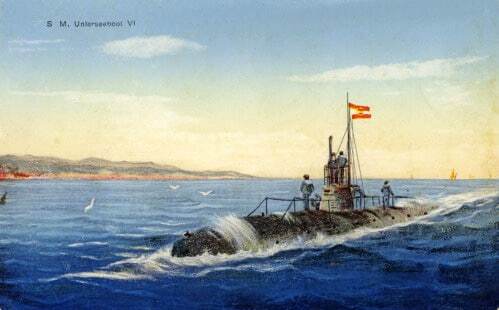
Kaiserliche und königliche Kriegsmarine (k.u.k.) U-Boat of the same class captained by Lieutenant Ottokar Prohaska early in the war.
My audiobook was 13.5 hours long. A dead tree version was 370-pages. My audiobook had a US 2017 copyright. The original British copyright was 1994.
John Biggins is a British writer of historical fiction. He has written seven books in two series. This was the first book in his Prohaska series. This was the first book I’ve read by the author.
Nigel Patterson is a British audiobook narrator and actor. While a tad too British for the mittel-european, Austro-Hungarian characters, he did a fine job of capturing the early 20th century flavor of the story.
I recently finished several books on WWI naval history and technology, and the effect of that war on the Austro-Hungarian and German empires. I was primed for a Tom Clancy-esque, World War I, The Hunt for Red October-like read. Historically and technically, I received everything I expected.
Story-wise, the Prohaska protagonist was a Nominial Hero. He’s a more sedate, and proper incarnation of the Flashman character, whom the author obviously takes inspiration from. Prohaska was a pleasant man, of the Empire’s gentry social class, who lived in a corrupt and decaying society while following a dangerous occupation. He also had the aid of an enormous amount of good luck.
The story is in the format of a memoir written at the end of Prohaska’s 100-year life, encapsulating his adventures during World War I. They include: period submarine actions, clandestine operations , meeting his future wife and getting married, and the abrupt demobilization and loss of livelihood with the dissolution of the Austro-Hungarian Empire.
If I had a problem with the story, it was with the the pacing and the number of Prohaska's adventures. The segue from adventure to adventure could have been smoother. There were also too many adventures. Biggins overloaded what can realistically happen to, or what a single man can realistically take in terms of wartime adventure. Prohaska was also phenomenally lucky, considering the actual mortality rate of WWI submariners.
Prohaka’s narrative of his exploits was amusing in places. It reminded me of The Good Soldier Schweik with it’s lampooning of the Imperial bureaucracy, and the stoicism that is the unofficial philosophy of elite military units, like submariners, could be very funny. Although, the story in its high-degree of historical accuracy may trigger Values Dissonance in some readers. For example, the racist fears of the member regions of the polyglot, Austro-Hungarian Empire were an underlying theme.
Full disclosure, I’ve both extensively read about and been to the Adriatic coast and spent time in several of the regions of the old Austro-Hungarian Empire. Biggins’ description of the geography and in particular that body of water were very apt.
Interestingly for the first book in a series, Prohaska dies at the end of this book. Biggins, reanimates his hero for three additional books. He goes on to write two prequels and a third which was an expansion of a casually mentioned incident in this story. That incident was used to introduce a character moving this story’s plot along.
Note that despite the high-degree of realism in this story, it did not extend to sex, drugs, and rock ‘n roll in ole' Austria-Hungary. The story was very PG. Sex was handled in a fade to black fashion. The k.u.k. sailors drank in excess in port, but never on duty. And, there was a lot of 19th Century mittaleuropa patriotic and folk tunes rendered on accordion and string instruments.
As a book, this was a cross between a period Tom Clancy submarine sea saga and a Flashman novel. As an armchair admiral, I greatly enjoyed picking-out the historical references and the period technology found in the book. The early 20th Century foreign locales featured were also particularly vivid. In addition, the Life at Sea aspect of the book harked back to C. S. Forester. Plotting could have used some work. It’s also possible this book may be a tad too technical or too historically detailed for some folks. However, as a period techno-thriller I quite enjoyed it.
John Biggins is an excellent prose stylist, crisp, funny, and with perfect command of his adjectives, and his book is meticulously researched without being pedantic. That said, the amorality of his characters keeps this novel from reaching Patrick O'Brian's level. It's like a Flashman adventure story, episodic and witty, but in the end, not enough insight into character to be truly great. A shame, because Biggin's style is fantastic, and what kept me going to the end.
I laughed I cried. I was thinking he would be like Flashman, but Otto wasn't one to run from a fight. There were some funny parts, but the second half was a pretty serious read but very interesting. I will definitely be reading more by John Biggins.
This was a great historical book about World War I and centered around the early days of submarines. The dry humor was fun, but not overdone - it is a war story, after all. Apparently, everyone in that place and time were required to have extra long names and I gave up trying to pronounce them as I read. I would recommend this book.
The book started slowly, but ultimately was interesting and enjoyable. Despite that, I didn't feel any great connection to the characters or the times, and probably won't read any further Otto Prohaska stories.



 To the Last Salute by Georg von Trapp.