From the author of the Magellan biography, Over the Edge of the World, a mesmerizing new account of the great explorer.
Christopher Columbus's 1492 voyage across the Atlantic Ocean in search of a trading route to China, and his unexpected landfall in the Americas, is a watershed event in world history. Yet Columbus made three more voyages within the span of only a decade, each designed to demonstrate that he could sail to China within a matter of weeks and convert those he found there to Christianity. These later voyages were even more adventurous, violent, and ambiguous, but they revealed Columbus's uncanny sense of the sea, his mingled brilliance and delusion, and his superb navigational skills. In all these exploits he almost never lost a sailor. By their conclusion, however, Columbus was broken in body and spirit. If the first voyage illustrates the rewards of exploration, the latter voyages illustrate the tragic costs—political, moral, and economic.
In rich detail Laurence Bergreen re-creates each of these adventures as well as the historical background of Columbus's celebrated, controversial career. Written from the participants' vivid perspectives, this breathtakingly dramatic account will be embraced by readers of Bergreen's previous biographies of Marco Polo and Magellan and by fans of Nathaniel Philbrick, Simon Winchester, and Tony Horwitz.
Laurence Bergreen is an award-winning biographer, historian, and chronicler of exploration. His books have been translated into over 20 languages worldwide. In October 2007, Alfred A. Knopf published Marco Polo: From Venice to Xanadu, a groundbreaking biography of the iconic traveler. Warner Brothers is developing a feature film based on this book starring Matt Damon and written by William Monahan, who won an Oscar for “The Departed.”
His previous work, Over the Edge of the World: Magellan’s Terrifying Circumnavigation of the Globe, was published to international acclaim by William Morrow/HarperCollins in October 2003. A New York Times “Notable Book” for 2003, it is also in development as a motion picture and is now in its tenth printing.
In addition, Bergreen is the author of Voyage to Mars: NASA’s Search for Life Beyond Earth, a narrative of NASA’s exploration of Mars, published in November 2000 by Penguin Putnam. Dramatic rights were acquired by TNT.
In 1997, Bantam Doubleday Dell published Louis Armstrong: An Extravagant Life, a comprehensive biography drawing on unpublished manuscripts and exclusive interviews with Armstrong colleagues and friends. It appeared on many “Best Books of 1997” lists, including those of the San Francisco Chronicle, the Philadelphia Inquirer, and Publishers Weekly, and has been published in Germany, Finland, and Great Britain. In 1994, Simon & Schuster published his Capone: The Man and the Era. A Book-of-the-Month Club selection, it has been published in numerous foreign languages, was optioned by Miramax, and was a New York Times “Notable Book.”
His biography, As Thousands Cheer: The Life of Irving Berlin, appeared in 1990. This book won the Ralph J. Gleason Music Book Award and the ASCAP-Deems Taylor award and received front-page reviews in major American and British newspapers and appeared on bestseller lists; it was also a New York Times “Notable Book” for 1990. His previous biography, James Agee: A Life, was also critically acclaimed and was a New York Times “Notable Book” for 1984. His first book was Look Now, Pay Later: The Rise of Network Broadcasting, published by Doubleday in 1980.
He has written for many national publications including Esquire, Newsweek, TV Guide, Details, Prologue, The Chicago Tribune, and Military History Quarterly. He has taught at the New School for Social Research and served as Assistant to the President of the Museum of Television and Radio in New York. In 1995, he served as a judge for the National Book Awards and in 1991 as a judge for the PEN/Albrand Nonfiction Award. A frequent lecturer at major universities and symposiums, he also serves as a Featured Historian for the History Channel.
Mr. Bergreen graduated from Harvard University in 1972. He is a member of PEN American Center, The Explorers Club, the Authors Guild, and the board of the New York Society Library. He lives in New York City and is represented by Suzanne Gluck of the William Morris Agency.
An exciting and rather fun biography on one of the New World’s more controversial players. The reader should not be fooled just by the title alone, as the focus not only pertains to Columbus’ voyages to the Americas, but also quite a bit of details on his life and history of the times. A fascinating intermission sheds light on “The Columbian Exchange”, with Bergreen filling in the similarities between early empire building to modern trade and exploitation. Accounts of betrayal and mutiny are found throughout Bergreen’s rich prose—as ships are left unmanned or marooned on sandbars, and deadly disease abounds among the sailors—all the while they find themselves facing fierce battles with the native inhabitants.
We see the faults, character, and ego of the Great Discoverer, with his overall desire and unrelenting pursuit of China and India showing just a portion of his ignorance as he continues his conquest, not to mention his lust for gold. Bergreen uses Columbus’ personal account and journals from his own son—the bias and self-aggrandizing of which is classic to say the least—as well as those of intimates and enemies. He meticulously explains Columbus’ journals throughout, sometimes with humorous interjection:
He portrayed Hispaniola as an extraordinary opportunity for empire building. "It has many large harbors finer than any I know in Christian lands, and many large rivers. All this is marvelous." In fact, everything there was "marvelous"—the plants, the trees, the fruit—and Hispaniola itself “is a wonder” replete with many “incredibly fine harbors” and “great rivers” containing gold (not really), “many spices” (not true), and “large mines of gold and other metals” (a flagrant exaggeration).
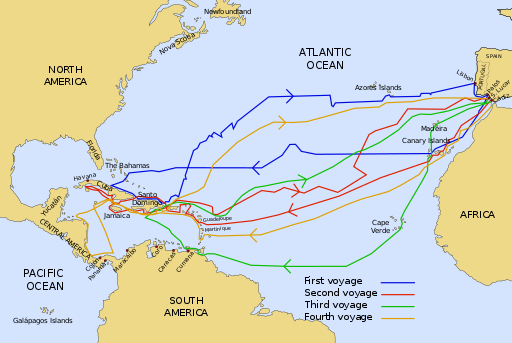
As with his other biographies on renowned explorers, maps of the different voyages are simply portrayed for reference, as well as illustrations pertaining to Columbus and his times. While not an in-depth character study, Bergreen still delivers on an easy to follow account of Columbus’ exploration, conquest, and overall demise.
Laurence Bergreen has provided in this book an exhaustive account of the four voyages made by Christopher Columbus to the New World. He demonstrates the great challenges that Columbus faced, both from the magnitude of the task that he assumed and from the scores of people he managed to alienate along the way. Bergreen also describes the enormous consequences that are still playing out today as a result of the initial contact between the "Old" World and the "New."
As everyone knows, Columbus has become a very divisive figure in the modern age. His defenders laud him as the courageous, forward-thinking and brilliant navigator who discovered the New World and who, in the process, changed forever the course of human history. His detractors, on the other hand, condemn Columbus as the man who inaugurated what they describe as the European assault on the Americas and the people who lived here when the Europeans arrived.
As Bergreen demonstrates, however, these conflicting views of Columbus are hardly new; indeed, they arose almost immediately in the wake of the Voyage of Discovery in 1492, and have persisted ever since. Columbus struggled his entire adult life to combat charges brought against him by those who were jealous of his success, by others who wanted to supplant him, by some who doubted his abilities and by others who had a genuine concern about the effects of Columbus's actions on the people he mistakenly thought to be "Indians."
The challenge of the voyages themselves are almost impossible to imagine. Columbus sailed into unknown and sometimes treacherous waters on tiny ships with motley, undisciplined, and often disloyal crew members. His subsequent attempt to create an empire in the lands he had discovered, proved to be an equally daunting task and while Columbus was certainly a brilliant seaman, he demonstrated considerably less skill at managing the rest of his enterprise. He proved unable to control effectively the men under his command and over the years faced any number of mutinies and insurrections. He vacillated in his dealings with the natives, sometimes showing them great kindness, but at others, kidnapping, enslaving and otherwise brutalizing them. And through it all he had to labor diligently and not always successfully to maintain the support of the Spanish monarchs who had sponsored his explorations.
Columbus was, of course, a man of the Middle Ages, which can make it somewhat more difficult for a person of the twenty-first century to truly understand him and to fairly judge his conduct. He believed that he was inspired by God to undertake the journey to the Indies and to bring Christianity to the people he found along the way. He looked for signs from God to point the way and, on at least one occasion, believed that God had spoken directly to him. He also had vastly different ideas about the distinctions between "civilized" and "uncivilized" peoples than a person of the modern age would hold. He was a very proud man who resented any slight and who believed that his enemies were constantly striving to undermine his reputation and to steal what was rightfully his. He greatly desired fame and riches and to his dying day struggled to secure what he believed to be the just rewards of his voyages on behalf of the Spanish court. A man of great contradictions, he believed to the end that he had reached India, in spite of all the evidence to the contrary.
Columbus's voyages, particularly the fourth when he was shipwrecked and left in miserable straits for over a year, took a terrible physical toll on him. He died a broken man at the age of fifty-four, still attempting to secure the recognition he believed he deserved and even then still hoping to make another voyage to the lands he had discovered. Laurence Bergreen has written a compelling account of Columbus's voyages and his activities in the Americas that should appeal to any reader with an interest in the subject.
I read Laurence Bergreen’s “Over the Edge of the World-Magellan’s Terrifying Circumnavigation of the Globe” years ago. I looked forward to this author’s book on “The Great Discoverer”. Bergreen is a first rate historian and a compelling writer. He seems to have found a niche in delivering early maritime history epics and the early explorers of the New World are rich with drama. I like the Christopher Columbus that Laurence Bergreen has portrayed and feel that it is an accurate presentation of the historical man. Columbus was not necessarily brilliant or visionary but he was somewhat self-deluded. He wanted so badly to find a secret trade route he was disappointed in uncovering a New World. He did not want to “discover” America. He wanted to find old India. When his vision did not work as easily he expected, he had to justify the expense of the voyage with gold and slaves. He kept trying imagining the next Island was Cathy or the next river the Ganges. He wanted to trade silk and spices and instead found tobacco, slaves and small amounts of gold. Not enough to satisfy his visions but just enough to fund another voyage. He was followed by harder men who were less interested in discovery and more driven by conquest. Columbus is frequently derided these days as a religious zealot and exterminator of Indigenous people; a man who was lost and blundered into immortality. His voyages certainly did not lead him to where he intended to go and the man was dedicated to his religion and the sovereigns who backed him. But he was not a killer. Ruthlessness was not something he was comfortable with and he certainly would have balked at the violence that would follow in the wake of DeSoto, Cortez and Pizarro. Indeed, his first little fleet landed in the midst of a war of extermination between Caribs and Tainos. Columbus was a man of the times. He left the Old World during a time of warfare, enslavement, torture, religious violence, political corruption, and disease and landed in a New World dealing with the exact same issues. This book reads like a novel. Bergreen says it best. “Columbus held up a mirror to the Old World, revealing and magnifying its inhumanity and greed, along with its piety, curiosity, and exuberance….For all their accomplishments and liabilities Columbus’s voyages were just the beginning, setting in motion consequences-political, cultural and scientific-that persist to this day. He had found something immense, important and lasting.”
A solid, balanced work of history. When I started this book on Columbus Day 2019, I noticed there was an abundance of articles and YouTube videos trending either to denigrate Columbus (as a genocidal monster, lost buffoon, etc) or to staunchly defend his legacy. I knew about as much as your average person about Columbus but I wanted a book that would offer a comprehensive account of his exploration but without any specific political agenda, and I believe Columbus: The Four Voyages hit the mark. It covers his history, accomplishments, and failures as a human being, explorer, governor, and leader. Columbus was human and a product of his time and he made more than his fair share of atrocious decisions, but he also accomplished something that changed the world as we know it and I think the author does a good job examining both sides.
The author starts by providing excellent context on the era in which Columbus lived, both the geopolitical situation (rivalries between Portugal and Spain, the Reconquista and Inquisition, etc) as well as the realities of day-to-day life (like slavery being common place in Genoa) that really helps to explain much that followed on his journeys. He acknowledges Columbus’ genius for navigation but highlights how he lacked the skills necessary to govern the territories he discovered (something that would contribute to many of the atrocities that would occur on his voyages). He explains the scientific consensus of his day (yes, most people already understood the Earth was round) but they universally misjudged the size, thinking it much smaller than it is, which greatly contributed to Columbus’s enduring belief that he had made it to Asia. Once the evidence against this continued to pile up, Columbus persisted in his belief, in part because his standing in the Old World was now tied to his success in finding a sea route to Asia and fear of losing this legacy became a powerful impetus in his own mind to hold onto and argue for his wrong conclusions.
The author goes into great detail, covering Columbus’ rivalries with his fellow explorers (including the captains of other ships in his group) and how this drove much of his decision making. Titles and riches motivated him greatly and the there was no shortage of other captains/explorers seeking to undercut or denigrate him in the sight of Ferdinand and Isabella of Spain. He explores how Columbus had a strong mystical bent that both motivated and influenced his voyages, including periods of sickness, overwork, sleep deprivation, and delirium when he wrote some his most bizarre entries in his records while on his voyages (like the earth being pair shaped or believing he was close to discovering an entrance to heaven).
In the eyes of many, Columbus wasn’t the first to “discover” America (the Vikings arrived nearly 500 years before, not to mention the millions of native inhabitants) but the author explains how his voyage was different than all who preceded him. Before Columbus the New and Old World remained separate and distinct entities, after Columbus, their destinies would forever be intertwined. The “Columbian Exchange” would include the widespread transfer of plants, animals, technology, disease, culture, and human beings (slaves). In the end, Columbus was human, with both admirable qualities (courage, perseverance, seamanship, spiritual devotion) and repugnant ones (lust for wealth (gold) and titles, inept governance, cut throat attitude with respect to his political rivals, and his handling of relations with the natives that started out well enough but by the end of his life had devolved into the worst case scenario for both their future and his reputation). Overall, a really good, balanced look at his life and voyages.
What follows are some abbreviated notes on the book (I finished this book in November last year but work has been so busy I am just now getting around to typing this up):
Christopher Columbus was born in Genoa, Italy. At age of 14, he went to sea and began working on a ship. At age 23, he was hired as a sailor. He returned to Italy financially independent.
In 1479, he married Filipa Moniz Perestrelo, the daughter of a wealthy Portuguese nobleman. Their son was born in 1480. Felipa passed away at a young age in 1485 around the time Columbus started to envision his trip to the Indies. He had difficulty finding financial backing for his expedition, despite his relations to the Portuguese aristocracy through his wife.
He instead tried his fortunes with their rivals, Ferdinand and Isabella of Spain, who agreed to back his expedition. In 1492 he begins his journey to the Americas with 3 ships and about 100 men, with a stopover in the Canary Islands for provisions and repairs. In October they first see land and eventually go ashore in San Salvador in the Bahamas.
At this juncture he was neither a bringer of laws or a spreader of disease. Both the image of Columbus as divinely inspired saint bringing Christianity and Spanish rule to a primitive people and the image of Columbus as someone who sought to exploit the natives through slavery agreed were at odds with the true picture of a self-serving but skilled navigator trying to communicate with an unknown people.
Upon seeing gold jewelry on the native peoples he asked them to lead him to the source. He was astonished to discover so many islands in the beautiful Caribbean. He mistook Cuba for the Chinese mainland.
In November, the rivalry and competition with the other captains reached a fevered pitch and the Pinta’s captain Pinzon threatens to leave the expedition (whoever returned to Spain first would be first to set the narrative of what happened, capture glory for their discovery, and belittle the contribution of Columbus). By December, Columbus arrives in Hispaniola. On December 25, the Santa Maria sinks. This disaster became “God’s providence” for building a settlement (La Navidad) and dreams of colonization and empire. Building a fort also served Columbus’ own interest. Now Ferdinand and Isabella would be duty-bound finance a second mission to rescue those left behind to man the fort.
January 1493, Columbus and both ships depart for Spain, leaving 39 men in La Navidad. They arrive in Portugal by March 4th, and Spain by March 15th. By leaving his men at La Navidad, he all but assured himself another expedition would be funded by Spain.
By November 22, he returned to La Navidad and found that the men he had left there 11 months ago had been slaughtered (most likely over their fraternization with native women) and the colony was destroyed. He founded a new settlement called Isabela. In 1494, he explored many areas in search of the Asian mainland, including Cuba, Jamaica, and Hispaniola. As the self-appointed Governor of Hispaniola, he faced open conflict with the Taino people as he pressured them to bring gold. His handling of this was indeed brutal (punishments for rebellious sailors or natives could include cutting off ears or noses). This was not as uncommon as youd expect in such a brutal era and he was trying to govern in a harsh environment and people were often at their wits end with starvation and disease so far from home (not really trying to justify the unjustifiable, simply adding the context in which this happened).
Without sufficient gold to justify the cost of his voyages, in 1496 he returned to Spain with 560 enslaved Taino, over 200 of whom would die on the return voyage. Slavery was widely practiced in Portugal and was known to be profitable business venture. However, the Indians were not used to the colder climates and proved poor for most of the traditional uses of slave labor.
In 1498, Columbus again returns to the Americas, this time with more ships. In July he arrived in Trinidad off the South American coast. By August, he had returned to Hispaniola but after accusations against his tyrannical rule and atrocities that occurred under his leadership, he was ousted as governor by Bobadilla, who imprisoned him and returned him to Spain (where he remained in jail for six weeks before being released). While there were certainly atrocities committed, many of them were a result of Columbus’ weakness as a governor, not because of a tyrannical leadership style. For someone obsessed with titles and glory, and after all he had done for the monarchy, he played this “shameful” mistreatment and jail time up to maximum effect (wearing chains when not required by his jailors, etc), and secured backing for a fourth voyage.
He returned for a fourth and final journey in 1502, landing in Martinique in June. He was denied entry to Santa Domingo by the new governor and moved on to explore the coast of the mainland (modern day Honduras, Costa Rica, Nicaragua and Panama). Before he departed, he informed the new governor that he anticipated a hurricane but the new governor refused to listen to his prediction. While Columbus had moved out of harm’s way, the rest of the Spanish treasure fleet sailed into the hurricane. The only ship in that fleet to reach Spain had Columbus's portion of the gold he was owed for his services. His old rival Francisco de Bobadilla also died in the hurricane. Another ironic twist of fate that Columbus likely interpreted as another sign of God’s favor upon his journeys.
He once again tried to establish a garrison, this time on the mainland (again for self-serving purposes) but it was immediately overrun by hostile natives. In June 1503, his ship sinks and he and his crew were marooned on Jamaica. They were not rescued until June 1504. He displayed a great deal of perseverance during his year ashore. He died in 1506 after his return to Spain.
Laurence Bergreen has made a habit of crafting well-told modern historical narratives about some of history’s greatest explorers. Bergreen went world-wide with an exploration of the great world navigator himself, Ferdinand Magellen in "Over the Edge of the World". Then he took readers East to follow Marco Polo on his travels in "Marco Polo: From Venice to Xanadu". And now Bergreen comes closer to home as he travels from Spain to the New World with Christopher Columbus in "Columbus: The Four Voyages".
All of these books synthesize a wealth of contemporary sources and modern references to build out something more than just 'the story' of discovery. Bergreen constructs a view into their exploits through historic and modern lenses that ultimately shines a broad beam of light across the entirety of their adventures.
Moving from Marco Polo to Christopher Columbus is not such a long leap for Bergreen. Columbus carried a well-worn copy of Polo's "Travels" during all his journeys and used it as guidebook in his own search for a route west: from Europe to the Indies and to see the Great Khan in China, then known as Cathay. Marco Polo was a 15th Century Frommer, apparently. Unfortunately, what Columbus had no way of knowing was that "...two oceans and two centuries separated..." Columbus from his target, wrote Bergreen.
Bergreen paints Columbus in a rainbow of personality traits. He was the brave, god-fearing (and preaching), navigational genius that traditional history remembers and teaches us as children. And at the same time he was confused, lost, indecisive and downright delusional. He single-handedly expanded an empire, while at the same time ignited a slave trade across both sides of the Atlantic.
Christopher Columbus is a complicated individual. Bergreen uses a myriad of sources to put flesh on the bone of the great American discoverer, but I still find it difficult to pin him down. Columbus wrote extensively of his four trips in his own journals. His son, Ferdinand, wrote a biography. Neither of which one could consider completely unbiased, of course. The great Bartolome del las Casas who would fight vigorously for the rights of the indigenous people of the Americas wrote about Columbus's voyages. While blasting him for making religious excuses to justify his treatment of the natives, he clearly respected his spirit and accomplishments.
Bergreen wrote that Columbus "was more than a discoverer, he was an intensifier of both his voyages and his inner struggles. This penchant for self-dramatization is part of the reason Columbus's exploits are so memorable; he insisted on making them so."
Columbus was a creation of the time period in which he lived. He saw the world and his explorations through his very medieval perspective. While Slavery wasn't completely accepted within Europe, it certainly existed in Columbus' home of Genoa. Religion was an important part of everyday life. Columbus was even referred to as a "priest of exploration". And there's no better example of the dichotomy of who Columbus was than to understand that, according to his son, he "was so pious that he could be mistaken for a man of the cloth. And a real rarity among sailors was his strict personal policy to never swear." While at the same time he clearly didn't let religion get in the way of some of the awful things the Spaniards did to various Caribbean natives under his watch.
"Somewhere at the confluence of Ptolemy's flawed cartography, the legends of antiquity, Marco Polo's account, and sailor anecdotes lay clues of a great prize waiting to be discovered." Columbus never truly gave up on his search for Marco Polo's Cathay and gold. He adjusted. He modified his trips, as circumstances forced. He kept hunting for gold, and when he couldn't find enough, he focused on colonization, expansion and conversion.
In about 400 pages, Bergreen pulls together all four of Columbus' trip to the new world. He blends Columbus's story into the context of his time. And despite the fact that he died miserable, poor and a broken old man, Bergreen writes, "...he could not, nor could anyone else, have imagined...the long-term implications of this voyage. To him, it was the fulfillment of a divine prophecy. To his Sovereigns and through ministers, it was intended as a land grab and a way to plunder gold. Instead, it became, through forces Columbus inadvertently set in motion and only dimly understood, the most important voyage of its kind ever made."
Really sort of poor. Rife with small mistakes and inconsistencies that are distracting even if you're not looking out for them. There was hardly any analysis or even synthesis of different sources; he really just told me a story, and I couldn't help but think that I'd have gotten more out of it if I'd just read Las Casas and Columbus's letters.
In fairness, I realize after finishing this that the author is a biographer, not a historian (even a popular historian), and if I'm going to read a book by a biographer I shouldn't be expecting quality history. I fail.
This is a very fascinating book. The author takes you on all four of Columbus' voyages and gives a great amount of detail into the traumatic life of the great explorer. That being said, the author does suffer from that predilection, seemingly endemic among modern historians, to judge the past by the present. For instance, the author repeatedly and condescendingly asserts that Columbus "refused" to consider that his new discovery was in fact a new world and not merely the coastline of China, which he thought it was. By doing so the author forgets what a truly groundbreaking discovery Columbus made . . . at least for the western understanding of the world at that time. He, and everyone else in his time, had no clue about the Americas and thought that China did lie on the other side of the Atlantic. We cannot fault them for not immediately realizing what it took decades to figure out.
In light of this, it should also not be surprising that the author engages in the all-too common Columbus-bashing, forgetting that institutions like slavery were well-established in his time and culture and the idea of claiming territory by discovery was the general practice. While certainly these things can be criticized on their merits, Columbus' failure to rise above his time should not be the cause for us to pass too harsh of a judgment upon him. The author lists all of the data necessary to reach this conclusion but fails to do so.
Finally, and least surprising of all, the author incredulously downplays Columbus' spiritual motivations as nothing much more than a cover for greed and gold. But the evidence seems much more complicated than that. Columbus certainly desired gold (as did his sovereigns and pretty much all other Europeans exploring at that time), but his spiritual motivations were nonetheless genuine. As he grew older Columbus even adopted some monastic practices such as wearing a habit and living in a monastery in Spain. Thus, the reflections in his journals and letters upon a higher power are not mere after the fact spiritualizations but they appear to be the heartfelt expressions of a man caught up in events that were larger than he could control and that demanded a society and culture more enlightened than the one to which he belonged. The author's "refusal" to see this detracts from the work.
Despite these weaknesses (and others), the author does reach a reasonable conclusion: that Columbus was a bold explorer, a talented mariner, an effective leader, and, most of all, a relentless dreamer. As the discoverer of a new land, he ushered in an era of world history that has been at once both great and terrible. Flawed as he and his time were, he deserves a respected place in our collective memory.
"Columbus: The Four Voyages" by Laurence Bergreen is an excellent account of Christopher Columbus' four voyages from Spain to the Americas between 1492 and 1504. The book is structured around the four voyages. However, there is also a good amount of biographical information about Columbus and a decent amount of historical information about Europe and the Americas of the time.
Bergreen paints a complex portrait of Columbus: A brilliant, courageous navigator, but a mediocre administrator. A person driven by noble ideas and driven by greed. At times visionary and at times ruthless. Bergreen also devotes space to the Indigenous Peoples’ perspective of these four journeys.
Although Columbus led the first expedition of the European invasion, events quickly overtook him. He lost what little control he had over the various factions (of both Europeans and of Indigenous Peoples) in the "New World." At one point he was arrested and brought back to Spain in chains.
The full realization that the Americas were massive continents between Europe and Asia took hold only after a few decades. Even at the end of his life (he died in 1506 at age 54) Columbus thought he had journeyed to lands off the east coast of Asia.
The invasion of the Western Hemisphere by European nations beginning in 1492 is one of the most significant events in the past 10,000 years of earth history. The "Columbian Exchange" unleashed forces that are still impacting the human race and the earth to this day. This book is an outstanding account of the life and voyages of the person who started it all.
I strongly recommend this book to those interested in world history, exploration, and colonialism.
Rating: 5 out of 5 stars
Notes:
Audiobook: Narrated by: Tim Jerome Length: 18 hours and 11 minutes Unabridged Audiobook Release Date: 2011-09-20 Publisher: Penguin Audio
A detailed and extensive description of the four Columbian voyages, which also provides a good insight in the mysterious man behind Columbus. A perfect introduction to the discovery of the America's
How is it possible, that the man who discovered America, after two years was sent back to home in chains from Hispaniola to Spain? How was it possible that King Ferdinand disdained him, after he discovered rich lands that would enable Spain to dominate the European continent for the century to come? How was it possible that in general, Columbus was scorned, how the New World he ‘discovered’ was named after Amerigo Verspucci and that the settlements he founded, soon erupted in chaos and mutiny?
This book is not only a description of the voyages itself, but also gives great insight in the man behind Columbus. We see his visions, his God-fearing conviction, his thirst for gold and above all his delusions. But also a man who possessed almost supernatural navigational capabilities, managed to survive a beached shipwreck for almost a year and had almost superficial good luck, which helped him to survive a grand total of 4 voyages in all.
Yet, at the end of his live he was not the rich and powerful man he thought he would be, instead dying a poor man in a monastery, whose remains are still not decisively located to this day, cursed to roam the continents he discovered himself.
I'm throwing in the towel on this one at page 76. I wasn't looking for a hagiography of Columbus, but I didn't want a slanderous hatchet job either.
This biography is a prime example of presentism, which is interpreting and judging the past based on present-day knowledge and morals. It's a sneering portrait of a stupid Columbus who didn't realize he wasn't on the doorstep to Asia, or that the earth was six times as large as was commonly believed at the time. (I'd like to see how well the "biographer" would have done in the same circumstances.) We're frequently told how "delusional" and "misguided" Columbus was:
Protected by his delusion, Columbus conveniently concluded that he had reached an island or peninsula on the outskirts of China, a leap made possible only by omitting the Americas and the Pacific Ocean from his skewed geography.
As another reviewer pointed out, the word "omitting" suggests that Columbus knowingly modified or ignored the true geography of the world. Bergreen later makes the same accusation about the mathemetician Toscanelli (pg 70). And we constantly read about how greedily ambitious and vain Columbus was. Bergreen says "circumstances suggest" that Columbus married his wife for her money and connections, even though "scant details" exist (pg 61). (He then assumes she's dead "because she was never spoken of again" (pg 69).)
A good biography should put us in the subject's own time and place and help us understand their thinking and actions as well as possible given reliable evidence, regardless of what we think of the results of their actions. This one does not.
Christopher Columbus - heroic bearer of the light of civilization and Christianity to a world lost in darkness? Christopher Columbus - genocidal egomaniac who raped and plundered a virgin continent and sold its people to slavery and destruction?
Or . . . something in between the two?
Columbus is one of the most celebrated and vilified men of history, and also one of the least understood. Bergreen's new biography separates the man from the myth, showing a Columbus who was neither an enlightened genius nor deluded psychopath, although at times he had attributes of both. Chock full of fascinating details and character sketches of the men Columbus interacted with on both sides of the Atlantic, this work is a worthy addition to the historian's library. Hands down, this is the best Columbus book I have ever read. HIGHLY recommended.
Not much story-telling here as it mostly repeats prose from Columbus' and his contemporaries' journals, strung together with the author's pedantic and repetitive observations about how out of touch Columbus was with 21st century mores and geographical knowledge. Nonetheless, the book serves as a decent overview of the four voyages, even if it is a bit of slog at times.
I never expected to read a book about Columbus. Despite my love of American history, and the name of both my nation’s capital and the name of the city I live in, I have always been content with paying no mind to the man who found the Americas but thought he was someplace else. But that legend from my childhood, it turns out, isn’t quite right.
My interest was piqued by Felipe Fernandez-Armesto’s short book Amerigo, about the man who inexplicably stole continent-naming rights from Columbus, and who’s own strange story doesn’t even come close to that of Columbus.
Both explorers were on missions to find a trading route to the Far East via the Ocean Sea and the west, and neither they, their fellow seafaring adventurers, the royals who sent them, the geographers, or the general public expected a new world to stand in the way.
Laurence Bergreen does a marvelous job of telling the life story of Christopher Columbus through his four voyages to the islands and subcontinent of the Caribbean. Drawing on many sources, Bergreen presents Columbus’s life on land and sea with drama and surprise at every turn. It makes me want Lin-Manuel Miranda to take on another founding historical figure with ties to the warm waters off Central America.
Truth about Columbus is hard to identify, as the earliest writings about him are from a second-hand reproduction of his own words, the unreliable tales from his enemies, and the face-saving efforts of his eldest son. Piecing together all available works on the subject, Columbus evolves as both wise and confused; benevolent and monstrous; criminal and victim—and the centuries since his death have been equally conflicting with his remains and legacy.
Very thorough aside from an absence of anything on his second wife, and no detail on the fate of his firstborn son, Columbus: The Four Voyages passes as a cradle-to-grave biography. And so many times did Columbus dodge an early grave.
An R-rated book, filled with violence and lawlessness, it nonetheless also contains beauty bordering on fantasy. It is easy to place oneself in the new lands, amongst the native peoples and amazing, unfamiliar flora, and in the ships on the tumultuous seas. At several points throughout the book are jaw-dropping revelations, much bigger than the simple myth handed to us in grade school. Columbus didn’t think he discovered India. He yearned to find it, believed it was just out of his grasp, but had no idea what he actually held and then lost.
Five starts, and a book that I might just purchase for my collection, having already read it.
Prior to reading Mr. Bergreen's book, my knowledge of Christopher Columbus was sketchy, and my opinion of him generally negative. I came away from it with a greater understanding and even admiration for Columbus as a navigator and explorer. The book is easy to read, and well worth the effort to understand this exceptional person and his lasting effect on our world.
REVIEW: COLUMBUS – BỐN CHUYẾN HẢI HÀNH (1492 – 1504)
Tác giả: Laurence Bergreen
“Bạn sẽ không bao giờ vượt qua được đại dương trừ khi bạn có đủ can đảm để rời tầm mắt khỏi bờ” - Christopher Columbus (1451-1506) -
“Tôi lên đường tìm Ấn Độ và sẽ tiếp tục cho đến khi nào hoàn thành sứ mệnh đó, với sự giúp đỡ của Chúa.” Bằng niềm tin sắt đá, Columbus đã ra khơi theo hướng Tây Nam từ cảng Palos (Tây Ban Nha) với ba con tàu biển - Nina, Pinta và tàu chỉ huy Santa Maria - để đến với miền đất hứa của mình, cũng là Tân thế giới chưa từng được biết đến trong lịch sử. Chính vào buổi sớm mai ngày 12/10/1492 đó, di sảnq và danh tiếng của Đô đốc đại dương Columbus đã bắt đầu, xuyên suốt sự nghiệp của ông, vinh quang và tủi nhục luôn luôn song hành, và cho tới tận ngày nay, cuộc đua ấy vẫn đang được những thế hệ sau không ngừng tiếp nối.
Christopher Columbus sinh năm 1451 tại thành phố Genoa của Italy, năm 1476 ông đến sống ở Bồ Đào Nha và lưu lạc đến Tây Ban Nha. Qua các nơi, ông đã tham gia rất nhiều cuộc viễn du với những người đi biển cho đến khi có được chuyến hải hành đầu tiên với sự trợ giúp của triều đình Tây Ban Nha. Thời kỳ này, Ấn Độ và Trung Quốc là hai quốc gia giàu có bậc nhất ở phương Đông, nơi bất cứ lái buôn châu Âu nào cũng muốn được đến để trao đổi hàng hóa. Nhưng người ta phải vượt qua rất nhiều lục địa rộng lớn, vượt qua đường đi dài hiểm trở. Một con đường mới, ngắn hơn sẽ là giải pháp tối ưu để khắc phục những điều đó.
Trên tuyến đường biển tương tự với các chuyến du hành của Marco Polo sang đất nước Trung Hoa và tìm kiếm một con đường giàu sang cho bản thân, Columbus đã sa chân vào “một thế giới khác”, nơi không có tấm bản đồ nào dẫn dắt mình. Càng tìm hiểu nhiều, ông càng trở nên kinh ngạc, vì đế chế mà ông đang tìm đã cho thấy nó rộng hơn và đa dạng hơn rất nhiều so với ông hình dung. Columbus ngạc nhiên rằng: “Tôi thấy nhiều cây cối rất khác với cây cối của chúng ta... mỗi cành một kiểu riêng, đây là điều kỳ lạ nhất trên thế giới. Sự đa dạng giữa mọi thứ thật là vô cùng lớn!”. Sự kinh ngạc tột độ và niềm phấn khích tràn ngập trong những ghi chép trong lịch trình đồ sộ của ông.
Tựa như những vần thơ về chuyến phiêu lưu của Odyssey, tôi đắm chìm trong các trang sách và như đang cùng ông phiêu lưu theo những chuyến hải hành. Những ghi chép của ông không chỉ dừng lại nơi cảm xúc choáng ngợp trước vẻ đẹp của thiên nhiên với cát vàng, mây trắng trên những bãi biển vùng Caribbean, đó còn là những thiên sử thi của những con tàu thám hiểm vật lộn trong giông bão giữa biển khơi: “Ông cuộn buồm và gần như đi suốt đêm dưới mấy cột buồm trơ trọi, chỉ giữ lại một mảnh buồm giữa vùng biển động. Đại dương trở nên đáng sợ, và những con sóng chồm lên nhau, dồn ép mấy con tàu”... “những con sóng cuộn cao, bóng tối bao trùm khắp nơi còn đêm đen phủ kín biển cả, chỉ trừ những nơi có ánh chớp lóe lên và tiếng sấm vọng lại”.
Nhưng sau những choáng ngợp và tình cảm dạt dào bộc lộ với cảnh vật và người dân vùng đất mới, lòng tham trong ông và những thủy thủ Tây Ban Nha về vàng, gia vị và nô lệ đã trỗi dậy, hủy hoại họ và hủy hoại cả vùng đất tươi đẹp này. Chỉ có vàng mới đánh thức ông ra khỏi những cơn mơ màng, và khoảnh khắc phát hiện một người đàn ông “đeo một chiếc khuyên vàng ở mũi” có các nét khắc đã khiến ông thay đổi. Từ chuyến hải hành đầu tiên đến chuyến hải hành cuối cùng lần thứ tư, từ pháo đài La Navidad đến thị trấn La Isabela, Columbus đã thiết lập một chế độ khai thác kiệt quệ lượng vàng của hòn đảo. Hệ thống ấy, theo cách nào đó, còn tệ hơn cả chế độ nô lệ, nó đã phá hủy mọi cơ hội để có sự trợ giúp hay hợp tác giữa người Anh-điêng và người Ki-tô giáo trong mọi nỗ lực ngoài việc cống nạp vàng đầy vô nghĩa. Trang sử tăm tối của người Anh điêng cũng đã bắt đầu khi những đoàn tàu của người Ki-tô giáo thâm nhập bãi biển ngày một nhiều, những con tàu mang theo sự tham lam vô độ cùng giấc mơ làm giàu nhanh chóng. Chỉ trong thời kỳ của Columbus, khoảng 50.000 người Anh-điêng bản xứ đã chết bởi nạn đói hành hạ, và khủng khiếp hơn là sự tự hủy diệt. Bị đàn áp với những yêu cầu quá đáng của việc cống nộp vàng, người Anh-điêng đã buông xuôi và tự tử hàng loạt để tránh bị người Ki-tô giáo giết hại hay bắt giữ, để tránh việc chia sẻ đất đai, đồng ruộng, lùm cây, bãi tắm, rừng và phụ nữ của họ với người Ki-tô giáo.
Không còn thứ gì nguyên sơ như cũ, các cuộc thám hiểm của Columbus đã thay đổi Cựu lục địa và Tân thế giới mãi mãi, các tác động của nó vượt qua cả cuộc chinh phục vì đế chế và thương mại. Bên cạnh vấn đề về Ki-tô giáo, nạn nô lệ, vàng hay bất cứ quyền lực nào mà Columbus và Tây Ban Nha có được, sự chuyển giao hai chiều giữa hai lục địa đã mang lại các thay đổi lớn hơn những gì mà họ có thể hình dung. Một khi đã bắt đầu, thời kỳ trao đổi Columbus không bao giờ ngừng lại, và nó tiếp tục với tốc độ luôn tăng lên. “Có lẽ nó sẽ không bao giờ lặp lại theo một cách ngoạn mục như ở Châu Mỹ trong thế kỷ đầu tiên hậu Columbus, cho đến một ngày nào đó diễn ra một sự trao đổi về dạng sống giữa các hành tinh”. Dù tốt hơn hay tệ hơn, thì đây là di sản kéo dài, không ngừng nghỉ, không tránh được, và bao trùm lên tất cả của Columbus.
Một điều rất thú vị, gia sản đáng giá mà Columbus để lại còn là một thư viện khổng lồ gồm 15.000 đầu sách thu hút các học giả từ khắp châu Âu. Thư viện này đã làm nổi bật phương diện ham đọc sách và có học vấn của gia đình Columbus. Tuy Columbus là một nhà hàng hải và được xem như là một người táo bạo, nhưng để chuẩn bị cho những chuyến đi, ông đã nghiên cứu rất chuyên sâu về biển, và trong suốt cuộc đời mình, ông luôn khao khát kiếm tìm và áp dụng những thông tin mới cùng tri thức. Đã hơn 500 năm kể từ chuyến phiêu lưu đầu tiên của Columbus đi tìm kiếm vùng đất mới, tấm gương và những chuyến đi của ông đã trở thành niềm cảm hứng cho nhân loại và cho nhiều thế hệ tiếp theo. Bốn chuyến hải hành của Christopher Columbus đã làm nên một trong những câu chuyện phiêu lưu vĩ đại nhất của lịch sử, như một câu chuyện cổ tích thần tiên đã thành hiện thực. Và đến lượt chúng ta, các bạn hãy cùng tôi giở những trang sách đầu tiên và sẵn sàng phiêu lưu cùng ông nhé!
“Chúng ta rơi vào ho��n cảnh nào cũng không quan trọng, quan trọng là chúng ta sẽ tiến đến đâu.” - Christopher Columbus -
---------
Điểm đánh giá: 9/10
Nhận xét: Với nguồn tài liệu đồ sộ, tác giả đã dệt nên câu chuyện phiêu lưu kỳ thú và chân thực về bốn chuyến hải hành của Chritopher Columbus trên con đường tìm miền đất mới. Cuốn sách là một tài liệu khoa học đầy đủ nhưng đồng thời cũng như một cuốn tiểu thuyết phiêu lưu kỳ diệu. Nhiều bức tranh và ảnh in màu trên giấy bóng couché, các bản đồ của bốn chuyến hải hành được thể hiện một cách chi tiết, có một số lỗi chính tả nhỏ không đáng kể. Tôi tin cuốn sách này sẽ là niềm cảm hứng đầu năm đầy ý nghĩa để khởi đầu cho những chuyến đi và khám phá của mỗi người.
Probably 3.5 stars! It was very interesting. The author used Columbus’ original journals, letters, and documents to tell the story of his four voyages. He did not sugarcoat anything, but did explain things in the context of time and culture.
I love the engraving on a statue in Columbus Circle, NYC: “Christopher Columbus, The Italian Resident in America Scoffed at before, During the Voyage, Menaced, After it, Chained, As generous as oppressed, To the world he gave a world.”
And the author’s ending to the book: “Columbus held up a mirror to the Old World, revealing and magnifying its inhumanity and greed along with its piety, curiosity, and exuberance. Columbus’s voyages revealed many harsh truths about the limits of human understanding… For all the scorn Columbus engendered, his four voyages constitute one of the greatest adventure stories in history… his was the discovery that permanently planted the reality of the New World in the imagination-and political schemes-of the Old.”
I had no idea that Columbus had four voyages after discovering America so I knew I had to read this book when I came across it. It sounded too interesting to pass up.
The pacing of the book was a bit too slow for me but I found the locales and history engaging. I've spent a fair amount of time island-hopping around the Caribbean so I was intrigued to learn the history of some of the places I've been to.
I was appalled by how often Columbus and his merry men took advantage of the local Indian peoples, seeing their mission as ordained of God. Therefore, they believed that they had the right to slice off people's ears, pillage their villages, or rape their women and spread syphilis around the world. This isn't the God I know. It was interesting to contrast these behaviors with other times in the book when Columbus truly did exhibit great spirituality.
Some things that stood out to me in this book were how accurate Columbus became with his maritime navigation (findng a tiny island in thousands of square miles of ocean all the way from Spain), how little fame and fortune Columbus received after discovering the Americas, and how sad it was that Ferdinand didn't acknowledge his accomplishments as he finished the last of these voyages. True, he never discovered the trade routes that Spain commissioned him to find. But, who wouldn't want Jamaica in stead??
A wonderful chronological narrative of a little-known explorer. I say "little-known" because although everyone in the English speaking world knows the rhyme about "In 1492, Columbus sailed the ocean blue" and credits him with discovering the New World, almost nothing else is general knowledge about the extent of his voyages, his personality, his navigational skills, his leadership style, the politics surrounding his life and work, his brother and son, etc., etc. There is much to be told and Bergreen manages to cover it all with a completeness and in a readable style that leaves one with a much more complete portrait of this pivotal figure in world history.
If the story becomes somewhat repetitious it's because, in the initial phases, that's all they did: spy new land, battle or trade with the native inhabitants, seek gold (which is why they were there), re-provision and move on to the next place where they found new land, battled...etc. By the 3rd and 4th voyages however there were many more players in the opening of a new continent and Columbus was relegated to a less than supreme role, a change which he took in stride if not happily.
This is a lovely book and will reward anyone who is interested in finding out about a truly remarkable person in an age of remarkable people.
What Columbus did personally to the natives in the Americas and unleashed on them in the name of Christ in the form of unabated colonialism is criminal. Murder, torture, enslavement, rape, lie after lie, deceptions, taking advantage of their innocence, unfair trade deals (hawks bells and glass beads for gold!!!), and on and on. How can one hold such diametrically opposed ideas of Christ, on the one hand, which should include kindness, love, patience, self-control, humility, etc., to the brutal outrages committed by Columbus, his men, and those who followed in his wake, supposedly under the banner of Christ?
Very uneven account of Columbus and his voyages of discovery. The author lacks any pretense of objectivity and takes every opportunity to belittle Columbus, his failure to discover what he thought he would discover, and his motives. Columbus is a flawed character, to be sure, but the author's constant attacks upon the subject makes this a difficult read.
Bergreen also seems to have difficulty in tracking the story. The voyages themselves are hard to follow in Bergreen's telling, especially given that the main point in each paragraph seems to be to reinforce Columbus's shortcomings.
If you want to learn about the "Admiral of the Ocean Sea," I'd recommend looking elsewhere.
Fascinating historical look at Columbus and his voyages. It was hard for me to get started. This book felt slow at times, but I enjoyed getting a bigger picture of this time in history. The evil done to others is hard to comprehend. There is truly nothing new under the sun.
The period of the 12th moon for the year 1472, the men from the sky came to our islands. They came across the great sea in 3 massive boats. The chief of the sky men was named Christopher Columbus. His biggest boat was named the Santa Maria. The smaller ones were so named the Nina and the Pinta. These boats had large straight branchless trees from which large cloths were draped. These clothes could capture the four winds and propel the sky people across the sea.
Most of the sky men had brown hair and pale skin. On their bodies, the sky men wore light cloths from head to foot. They also wore coverings on the top and bottom of both of their feet. On their heads, many of the sky men wore thick fabric to cover the top of their heads. These head coverings had a circular brim that shielded the sun from their eyes. Some of the men also had hair covering their checks, upper lips and chin, making them look like furry creatures.
We brought the sky men corn, yams, cassava bread and water. Our local chief Guacanagari befriended Chief Columbus and the sky men. They were most fascinated with our yellow metal the sky people call oro. They also were awed by and colorful parrots which are not found in the land of the sky people. Chief Columbus explained to Guacanagari that the sky people come from the greatest land in the world, eastward across the great sea. Their land is called Espana, which has the most intelligent, bold, and beautiful men and women on earth. The land of Espana was ruled by the great and honest King Ferdinand and Queen Isabella. The sky people credited their greatness to the blessings of the greatest god of all, Jesus Christo. They erected a large branchless tree with a horizontal wooden cross bar in honor of their god.
On the eve of the most holy day for the sky men, a great disaster struck. The mighty Santa Maria was wrecked. Chief Columbus was greatly saddened by the loss of the great boat and shed many tears. Our people rushed to help save the stores and valuables from the broken Santa Maria. Chief Guacanagari provided two houses for the displaced sky men. Chief Columbus was greatly appreciative of our help. He gave us the most amazing beads of a material called glass. One can see straight through from one side of the glass bead to the other. When the sun shines on these beads, it makes a most pleasing illumination. They also gave our people heavenly bells which produce a beautiful sound when lightly struck. In return we provided the sky men with food, oro, parrots and jewels we collect from the shellfish, which they call pearls.
Chief Columbus stayed on our islands for less than one moon period before taking the boats Pinta and Nina back across the great sea. He left behind 37 sky men and vowed to return soon.
The trouble with these sky men began soon after Chief Columbus departed. These lazy sky men forcibly took and violated our women whom they found to be most beautiful. They would do no work and were drunk most of the hours of the day. Our great chief of chiefs Caonabo was greatly offended by these sky men. He led our men to burn their village. Many of the sky men drowned to death, and others, our men killed. Chief Guacanagari was worried what the great Chief Columbus would do once he returned to find all his men killed.
On the period of the 11th moon of the year 1493, Chief Columbus returned to our island with 17 ships and 1500 sky people, including some sky women. Chief Guacanagari explained to Chief Columbus the great disrespect and behavior of the sky men after he left. He explained that his great Chief Caonabo ordered the murder of the sky men despite his pleas to show mercy on these wayward men. Chief Columbus was upset at Chief Caonabo, but did not fault Chief Guacanagari for the massacre.
Chief Columbus set up a village for the many sky people. He named the village La Isabela in honor of his great queen. He also named our island Hispanola after his homeland. We had hoped that Chief Columbus would help protect our Tainos people from our enemy the Caribs. The Caribs stole our women, killed and ate our men and babies, and castrated and enslaved our boys. We were soon to find out that the sky men had more cruelty in their hearts than our enemies the Caribs.
Chief Columbus was asking about the oro and where he and the sky men could find more of the yellow metal. We told him of a place on this island callled Cibao where the oro was most plentiful. An evil sky man named Ojeda lead 400 sky men and many of our people to Cibao to collect the oro. He forced our people to leave our crop fields and work day and night to collect oro for the sky men. Our men were dying from overwork. To add to our misery, our people were dying from starvation as our crops died from neglect. Soon, finding oro was getting more and more difficult. Chief Columbus was merciless. He told our people that if they could not bring him oro, they would have to produce large bundles of spun or woven cotton. The demands were impossible to meet.
As the oro became more sparse, Chief Columbus complained that he needed to pay tribute to his great king and queen across the sea. He crafted a plan to send our people across the great sea as slaves. During the period of the second moon of the year 1494, Chief Columbus captured and enslaved 1500 Tainos and Caribs. He calculated to send 500 slaves across the great sea. Frightened at the prospects of the deadly journey, 400 of the captured escaped. During the chaos of the escape many of our women left behind new born babies to die. We learned that of the 500 of our people sent as slaves across the sea, 200 died during the journey. Half of the surviving hostages were gravely ill from the trip. The only positive outcome of this great disaster of this maiden voyage was that the great number of dead and sick dissuaded Chief Columbus from expanding this slave trade.
In the period of the 4th moon of the year 1494, our great Chief Caonabo organized a rebellion of 2000 Tainos warriors to battle the sky men. Despite our superior numbers, our bow and arrows were no match for the magical weapons of the sky men. They had bows that could send pointed arrows many fields in length with deadly accuracy with a press of a button. More frightening, they had poles measuring an arm's length that made a tremendous noise and sent a stone that could kill men with one strike. From across the sea, they had brought terrifying beasts. One such animal was 3 times larger than our deer. With their long legs, huge bodies, long tails, huge extended noses and massive eyes that could run 3 times faster than a man, these beasts were frightening in battle. Many of our men were crushed to death under the feet and bodies of these animals. The sky men also send demon hounds that ran 2 times faster than a man. These hounds had razor sharp teeth which tore our skin and bodies to pieces. Our men were soundly defeated. Three of our chiefs were captured, and the devil sky man Ojeda cut the ears off of one of men as a demonstration of his cruelty. Our people, and even our enemies the Caribs who also were being abused by the sky men, realized that we did not have a means to eliminate the sky men with force. We destroyed our crops, including the all important cassava fields, in order to starve the sky men. We hoped that the lack of food would encourage the sky men to leave our islands. Despite these hardships, Chief Columbus, the evil Ojeda and the sky people showed no signs of departing our islands. Our people became desperate. Over the course of only a few moons in the year 1495, 50,000 Tainos and Caribs committed suicide to depart this earthbound hell that the sky men and Chief Columbus had wrought on our islands. Our people starved themselves to death, threw their bodies over cliffs, and consumed poison to enter the afterlife.
In the period of the 4th moon of the year 1496, Chief Columbus set out to return across the great sea to his homeland. He was taking many of our people as slaves, including our great chief Caonabo. Chief Caonabo ended up dying during the voyage. Before Chief Columbus departed, he elevated his brother Bartholomew as the Chief of the sky people. The sky people closed the village of La Isabela and moved to a new village called Santo Domingo. A lesser chief named Roldan soon took over as Chief of Chiefs of the sky men. Unlike Chief Columbus, Chief Roldan was less interested in oro and cotton. He was a lazy man who lusted after our women. Soon many of the sky men also took to drink and taking our women. Although we did not like this sky man Roldan, we found him to be as a lesser evil than the ever demanding Chief Columbus.
During the period of the 10th moon of the year 1498, Chief Columbus returned to our islands to find his brother Bartholomew replaced with Chief Roldan. He was outraged to find sky men drunk, the work being neglected, and little tribute being collected. Our people and many of the sky men sided with Chief Roldan. Chief Columbus did not have enough loyal men to displace Chief Roldan. Chief Columbus and Chief Roldan came to a peaceful agreement in order to share the leadership of the sky people on our island.
In the period of the 8th moon of the year 1500, another Chief from across the sea named Bobadilla was sent by their Queen Isabella and King Ferdinand to take over ruling the sky people on Hispanola. We learned that the sky peoples' King and Queen were dissatisfied with the reported cruelties of Chief Columbus to his own sky people and our people. They were also unsatisfied with the lack of tributes and oro coming from Hispanola. Chief Bobadilla arrested both Chief Columbus and his brother Bartholomew. They were sent on a boat back to the land across the sea in the period of the 10th moon of the year 1500. We were shocked to see the Great Chief Columbus in chains. The sky people have strange customs.
We assumed this would be the last we would see of Chief Columbus. We were wrong. During the year of 1503, we overheard rumors of Chief Columbus being stranded on the nearby island of Cuba. We heard even stranger rumors of Columbus turning the moon blood red during the period of the second moon of 1504. From our island, we too saw the moon turn black and the blood red. With this ominous sign, we began to believe that the rumor of the return of Chief Columbus was true. In the period of the 8th moon of 1504, Chief Columbus was indeed back on our island. He looked weak and greatly aged. He stayed on our island for less than one moon period back to the land beyond the seas never to return to our islands. We heard that the enfeebled Chief Columbus died in the period of the fourth moon of the year 1506 in the land across the sea.
From the first visit of the sky men in the year of 1492, the Tainos and Caribs numbered 300,000. In only 4 years from their first visit, we had lost 100,000 people due to the curse of the sky people. By 1508,Tainos and Caribs numbered less than 60,000. Little did we know at the time, Chief Columbus and his sky men coming to our island signaled an end of our people's time on earth. The Tainos and Caribs are now only a memory in the earthly world. We now reside only in the afterlife where we are free of the cruelties of the sky people.
Pub. 2011 - This book is a heavily critical, revisionist narrative of Columbus’ four voyages to the New World. The author presents Columbus as distinct in his capacity for arrogance and stupidity, which, when taken within the context of his station, his time, his peers, his religion, temper somewhat. However, Bergreen doesn’t do this. He sits from his armchair as judge, sifting out context to present his own view of history. By only focusing on the four voyages and skimming over what took place before, after, and in between them, the author leans away from nuance and understanding, and into black and white moralistic thinking, and ultimately, misunderstanding. I am no Columbus apologist, but I do believe that all available information should be weighed when assessing the character of such a monumental historical figure. I don’t think Columbus is deserving of praise so much as recognition. He is certainly deserving of condemnation at times, and of sympathy at others. Unfortunately Bergreen seems to be more interested in selling a book with a contemporary popular framework than in shining light into a sequence of historical events, which changed the world forever, yet remains exceptionally controversial, driven more by opinion than fact. I cannot recommend this book to anyone, even in the Columbus-vilifying revisionist crowd, because there are just too many omissions of fact, with an unhealthy amount of subtle disparagement. I have listed below several areas where I think the author gets things wrong.
P 6 - “Columbus conveniently concluded that he had reached an island or a peninsula on the outskirts of China, a leap made possible only by omitting the Americas and the Pacific Ocean from his skewed geography.” Omission requires foreknowledge. It was a more reasonable position to think he had reached the thousands of islands of the East Indies, described by Marco Polo, than that there was a huge continent no one in the eastern hemisphere knew about.
P 7 - “No comparable figure in the age of discovery was so mistaken as to his whereabouts.” Because he was the first. Everyone who came after him had the benefit of his information and discovery.
P8 - “His inability to control the men of this vastly expanded fleet” (2nd voyage) The second voyage was populated by dozens of power-hungry opportunists. I’m not sure anyone could have exercised more, or even better control of his men, especially while continuing to explore other islands, having little knowledge or control over what went on behind his back. Columbus was “in charge,” so in the most basic sense, he is responsible for everything that happened before he was replaced as governor. But framing it as his “inability to control” suggests that this was a situation that could be controlled. As history proved out time and again, no one could control it.
P. 95 - “Symptoms of prolonged isolation from women crept into Columbus’s log. He confessed his fixation with the “island of Matinino,” said by the Indians to be inhabited by “women without men” - a prospect that answered the prayers of many a sailor and even enticed the more circumspect admiral.” He was looking everywhere for confirmation of widely-held mythical beliefs about possible Antipodean people, including cannibals (which were confirmed) and the race of the Amazons. There is nothing to suggest he was looking for this island of women out of sexual lust.
P. 120 - “He omitted references to the menaced posed by the caribs, the difficulty of replicating his feat of navigation, the vagaries of weather, and of course the stupendous misunderstanding of the location of his discoveries. He was selective to the point of being deceptive.” This is in reference to Columbus’ journals which were to be reviewed by the sovereigns. Columbus was trying to sell the idea of a fully funded second voyage. His prosperity, and that of his children, depended upon his success. Had he painted a more accurate picture, it’s possible, from the sovereign’s standpoint, the risks would have outweighed the rewards, and another voyage wouldn’t be allowed. Had he recorded more precise navigations, anyone would have been able to usurp his discovery and upend his livelihood, all of which came to pass anyway. Further, it’s fundamentally unreasonable to hold against Columbus the idea that he thought he had reached Asia. He was the first person in his culture to make contact with these peoples or these lands. Bergreen is relentless on this point, as if he really wishes the reader to view Columbus as a fool. To suggest Columbus’ misunderstanding is a deliberate omission is itself selective to the point of being deceptive.
P. 146 - “With the benefit of hindsight, Columbus realized his hasty choice of site on the first voyage had failed to take into account basic considerations such as the availability of water and food, and proximity to aggressive Caribs.” The location of La Isabela was a hasty decision because the Santa Maria was shipwrecked there. The men were left behind to use the remnants of the ship as a means of building a trading post/living quarters. They were left behind because the other two ships would have been overpopulated, and it was a good opportunity to leave some men to learn the language and customs, and to locate gold mines.
P 176-177 “To avoid a confrontation [in Jamaica], Columbus entered another harbor, only to realize he had sailed straight into an ambush. Or was it? On these islands, the Indians desire to fight, to trade, or just to make noise frequently overlapped, and Columbus resorted to guessing about their real intentions. His own stance was just as ambivalent; within the span of a few days he was capable of regarding the Indians as political allies, trading partners, converts, slaves, or deadly enemies. In the pages of his journal and letters they appeared as wise or primitive, indolent or resourceful, according to his judgment and whims.” Yes, because Indians are just like everybody else in the world, in terms of the diversity of human behavior. These were several cultures, each with different tribes and subsequent bands of Indians, serving different leaders, living across a series of over 700 islands. And on any given island, as was the case on Hispañola, with the contrast between Guacanagarí and Caonabó, there could be different bands with different leadership, goals, cultural norms, priorities, and levels of tolerance. Columbus portrayed the Indians as varied in their attitudes and behavior because they were. This is an important aspect of anthropology that one cannot expect all ethnic peoples to behave the same as their neighbors. It was no different among the millions of European, African, Asian, and Australian peoples. Columbus had consistent learned experience with meeting new and distinct Indian groups. While he surely made mistakes at times (as would anyone meeting a vastly different culture, with a completely different language), I would grant that he was a better assessor of real threats than was the author, writing from the comfort of a climate controlled room, with more than half a millennium of hindsight.
P 180 “he remained befuddled about his global whereabouts and as reliant as ever on spurious sources, especially Sir John Mandeville.” Because there were no other sources. He used what he had access to and tried to make best-guess assumptions. Oftentimes he was wrong - that’s what happens when you’re trying to navigate an unknown world. Ever get lost in the woods? It’s not as straightforward as it may seem to find your bearings and make good choices that to others might later seem obvious.
P 206 “at the time Columbus arrived on the scene, all three tribes - Taino, Carib, and Ciguayo - were trying to preserve peace and prevent mutual destruction with intertribal marriages, a strategy akin to the many liaisons between the royal families of Spain and Portugal. But the Spanish presence brought the Indian alliances to a halt, and pitched the Indian nations into turmoil.” This directly contradicts the testimony of many Tainos who lived in abject fear of the Caribs, and ignores the inescapable element of human behavior. Yes, perhaps alliances were being formed through intermarriage among certain bands, but that doesn’t mean it was widespread. And suggesting the Spanish are solely responsible for some inevitable day when all Indians would learn to live together in peace and harmony not only contradicts the 20,000+ year history of the settlement of the Americas, rife with colonization, competition, and warfare, but also presumes some inhuman form of ultimate and complete benevolence to Indians themselves, that “the Spanish presence” is alone to blame for never materializing. The conduct of the Spanish in any modern sense is wholly terrible, but as Charles C Mann wrote, disease and factionalism among the Indians caused far more loss of life than slavery or warfare. This kind of assessment of Indian history is patronizing and reductionist, presenting the Spanish as the only problem Indian peoples ever had. The arrival of Europeans cannot be overstated in terms of its destructiveness. We had lands that gave birth to cultures as old as Mesopotamia and Egypt, which we are only just now discovering. We saw the largest concentrated loss of human life in history, and with it massive cultural and informational loss, to say nothing of the trauma felt by Indian peoples for centuries. But even with that said, it doesn’t mean that Indians would have necessarily found their way into a world of peaceful cohabitation. The Aztecs weren’t that old of a culture and they were displacing and enslaving thousands. The Tainos themselves were there because they had displaced another earlier group. It’s difficult to read about such devastating tragedy and not want to blame one person or a group of people, but blanket blame doesn’t lead to understanding, and understanding is (hopefully) what prevents such tragedies from reoccurring. History is complicated. If one is only interested in finding heroes and villains, one is not interested in learning.
P 236 “The topography persuaded him that he had arrived at the mainland, and the recognition marked the signal discovery of this or any other of his voyages, his first sighting of the continent whose size and location neither he nor anyone else on his ships fully understood or acknowledged. The mystic in him preferred to assume the Providence had led him closer to the entrance to paradise. P 242 Still unwilling to accept the mounting evidence that he had arrived at a continent, Columbus took refuge in the thought that the coastline delineated an island… P 243 … it led him, in this deceptively calm state of reflection, to the most radical hypothesis that he would ever make - more extreme, even, than his misguided belief that he had sailed to India. He believed that he had discovered the entrance to paradise. P 244 He took solace in his reveries of inhabiting a world where magic is still possible even as he experienced a troubling sense of confronting the unknown. P 248 He had given up on the idea that he was exploring Marco Polo’s ancient India, in search of the Grand Khan, and instead had stumbled across something entirely new and troubling. “I have come to believe that this is a mighty continent that was hitherto unknown.” That was a true discovery, something utterly unexpected. That singular fact did not automatically mean that he now realized that Hispaniola and the other islands of the “Indies” lay far distant from India. It meant that he was more perplexed than ever before. His voyages of confirmation had becomes voyages of doubt. He was equipped to confirm cherished myths, not explode them.” The notion that Eden, or Paradise, was a real place that could be mapped if found, was not controversial at all to a group of people living in the 16th century, whose only lens through which to view the world was through their Catholic faith. To suggest that it is “radical” or “extreme” is as ignorant as it is presumptuous. Many learned people of that time believed that there was in fact a physical location of the earthly paradise, but it was said to exist upon a protuberance of the earth, and that the current of the water was so strong, it was impossible to reach. When Columbus reached the mouth of the Orinoco river, the force of the water was like nothing he’d experienced, he surmised that he had found Paradise, as it matched descriptions of what he had read and studied. We must be mindful that Columbus was an extremely devout Catholic, while the enlightenment and modern science were intellectual frontiers not to be explored for decades and centuries to come. It’s not radical to think you’ve found something you believe to exist, when you’ve found markers of what you think you know about its existence. This is also what began to convince him that he had reached a continent, as any river that had that much force, would have to be quite long. Any reasonably intelligent person of any day, would proceed with radical notions slowly, gathering evidence so as to not be premature in a conclusion. The idea that he had possibly found the entrance to paradise was not radical. The idea that he had found an entire continent that no one knew existed absolutely was. Among Columbus critics there seems to be this insistence that he should have immediately realized he was nowhere near Asia, despite having never been to Asia, nor ever meeting anyone who had been to Asia (Columbus was basing his knowledge of Asia on The Travels of Marco Polo, published nearly 200 years prior to his explorations), and despite no one in Columbus’ known world knowing anything about one, let alone two, undiscovered continents. I fully understand the motive to present Columbus as a real-life, flawed man rather than a mythical hero-genius, especially because the former standpoint is more factual. But I do not understand the contemporary insistence to present Columbus wholly as a buffoon, as if these armchair historians could have performed any more competently had they been a Catholic man of no position, estranged from his country, suffering such a painful illness (likely rheumatoid arthritis) exploring lands and seas unknown to anyone, based upon centuries old writings he believed to be true, which turned out to be hypothetical at best.
P282-284 Bergreen presents the charges against Columbus more as fact than here say, offering no context as to the motives of those who complained or reported charges. Most historians today accept that despite Columbus’ many faults, the charges levied against him were inflated or invented by people seeking to displace him from power. Of course, this is the story of humanity wherever you go, across land and time. People segregate themselves into tribes, and fight with one another for power and control of resources. Alliances are formed as a means to these ends, and the horrors we inflict upon one another are so unspeakable, we often forget them, and history, written or oral, presents the people telling the history in the best light, so the younger generations have something to believe in and aspire to. Europeans were doing this with one another, along with North Africans and western Asian peoples before their discoveries of the western hemisphere, while American Indians were doing the same thing. Post-contact, Europeans and Indians fought against and made alliances with one another as well. For Columbus’ part, he was better than some and worse than others. The moral weight given to his actions are displaced when taken in context, but his discovery of the so-called New World is possibly the most consequential event in human or environmental history. Once the Old World became aware of the New, everything changed for every living thing in the world, forever. I’m not sure this is worth celebrating, so much as it is a candid acknowledgment of an unavoidable moment in history, which happened to occur in 1492, with a man named something like Columbus at the helm.
Columbus: The Four Voyages is a thorough and even-handed look at the life and voyages of Columbus. Laurence Bergreen goes into great detail, and cites many sources to describe the controversial actions of Columbus. He repeatedly credits Columbus with an almost supernatural ability to navigate. He acknowledges his determination and religious fervor. But Bergreen doesn't shy away from acknowledging the personal flaws and mistakes of Columbus. He was greedy for fame and fortune, he was stubborn in holding onto his opinions despite rapidly growing evidence that he was wrong. He trusted his subordinates too much and failed to act decisively when they raped, pillaged, and rebelled. He shaped the facts to his advantage when communicating with the king and queen. Worst of all, he treated the natives as objects that he could use and abuse for his own benefit. The book is not a particularly enjoyable read because it's very repetitive. On each journey, Columbus would go ashore, meet the natives, trade, and take advantage of them. Then he would go to sea and have trouble with the weather or with obstacles in the water. He would drop some men off, but they would mistreat the natives, leading to conflict. This storyline loops around over and over on each voyage, and there were four voyages. I don't think the author is the problem, it's the nature of the events. I'm glad I read it. The book is well-researched, objective and thorough. I just got to a point somewhere in the third voyage when I felt like I had the idea, but there was a lot more to read to get to the end.
I found this to be a very compelling read. Bergreen transcends the grade-school hagiographical mythology of Columbus as well as the contemporary derision (as white, racist, European, yadda yadda yadda) to convey a genuine sense of Columbus the human being. Despite his many flaws -- chief among them his irresolute conviction that he would discover India and China -- Bergreen conveys his strengths of Columbus'd character as well: his exceptional (for that time) maritime knowledge and navigational skills (especially given the limitations of what he had to work with); his ability to persuade others to join him on his quest, venturing into as yet uncharted waters, for God knows how long. One can't help but marvel at the many trials and obstacles he had to overcome (by virtue of his will and yes, at times his genius) in the course of his quest -- disease, starvation, mutinies, shipwrecks. As one who only knew of his initial discoveries, I found each consecutive voyage Columbus took more fascinating than the one before.
Have read a couple of Bergreen's previous works and this one lives up the standard. A very well written narrative of the four voyages. Bergreen doesn't polish over anything in the telling of Columbus' expeditions and exploitation of the Caribbean islands. This should be required reading for high-school and university level history classes. Columbus is presented as an unsympathetic figure who was driven and motivated to make his mark at the expense of whoever was in his way. And as he "found God," spun his actions with that cover. Overall, a very graphic telling of the conquests of the Columbian voyages.
Unexpectedly entertaining. I genuinely thought that I knew everything about the voyages, but learned a few new things. This book also contains differing accounts from the letters and diaries of various people, so we aren't just taking one historical journal as undisputed fact. Also, I have always felt a certain moral superiority over the Spanish and Portuguese "explorers" who seemed to destroy everything they touched in the new world. *Now* I am left wondering if I could have survived in this same situation without exploiting anybody.
Книгата е богато осеяна с думите на самия италиански откривател, Бъргрийн посочва още в началото, че „по време на първото пътуване Колумб подробно записва всички свои мисли и действия, за да се оправдае пред своите суверени, пред Бога и пред самия себе си“, а и за следващите пътешествия има огромно количество архивни материали. Колумб е силно религиозен и е убеден, че пътуването му е предопределено да открие път на запад към Китай, за което има съвсем смътни идеи как точно ще стане – Бъргрийн цитира „неговият план в цялото му величие и наивност.“ До края на живота си той ще се бори „да се убеди, че е изпълнил обета си да стигне до Азия“, а „непоколебимата му самозаблуда относно Китай мотивира всички негови следващи действия в проучването на тези земи“.