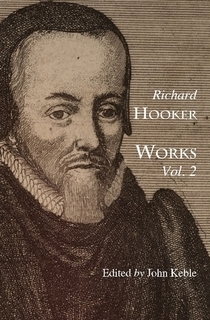
Richard Hooker is the formative Anglican theologian and did much in the late 16th Century to formulate the Anglican ethos. This volume includes Book 5 of "Ecclesiastical Polity". Note: This reprint was made from scans of the 3rd Edition of Keble's edition of Hooker's Works. There are some light shadows and minor text distortion in the gutter. I wanted a relatively inexpensive hardcover set of Keble's edition with wide margins for note-taking. No such edition exists, so I've published this for myself and have made it available here for anyone other interested parties.
Richard Hooker (March 1554 – 3 November 1600) was an Anglican priest and an influential theologian. Hooker's emphases on reason, tolerance and the value of tradition considerably influenced the development of Anglicanism. He was the co-founder (with Thomas Cranmer and Matthew Parker) of Anglican theological thought. Hooker's great Elizabethan guide to Church Government and Discipline is both a masterpiece of English prose and one of the bulwarks of the Established Church in England. Hooker projected eight books for the great work. The first four books of Ecclesiastical Polity appeared in 1593, Book V in 1597. Hooker died in 1600 at the age of forty-six and the remaining three books were completed, though not revised, before his death. The manuscripts fell into careless or unscrupulous hands and were not published until long afterwards (1648 to 1662), and then only in mutilated form. Samuel Pepys makes mention of Hooker's Polity three times in his Diary, first in 1661, "Mr. Chetwind fell commending of 'Hooker's Ecclesiastical Polity,' as the best book, and the only one that made him a Christian, which puts me upon the buying of it, which I will do shortly." In 1667 Pepys bought the new edition that had been printed in 1666, the first to include the life of Hooker by Izaak Walton.
Hooker's a genius. He understands how nations function as well as how the Bible does, and it makes him seminal in his ability to connect piety, national faith and order, and public goods. Reading him would be such a salve for my fellow countrymen.
Importantly, he's far more orthodox and biblically grounded than he's given credit for by those only reading the intro and books i and ii. It's possible he even understates his own reliance on Holy Writ in the beginning in order to slow the discussion down and distinguish. He's a model there as elsewhere.