Set against the backdrop of the 1990s war in former-Yugoslavia, Clair Obscur presents a sustained reflection on memory, guilt, fantasy and desire in late twentieth-century Europe. Its cinematic prose ranges between forensic realism and poetic psychology, like the films of Resnais and Bertolucci its language frequently evokes. Written from a screenplay that won honourable mention at the 2009 Alpe Adria Trieste International Film Festival.
“This lyric, open-ended novel spans several years in the early 1990s and ranges from Prague to Trieste and Bosnia in a meditation on time, loss and recovery” (The Prague Post)
Louis Armand is a writer and visual artist who has lived in Prague since 1994. He has worked as an editor and publisher, and as a subtitles technician at the Karlovy Vary Film Festival, and is an editor of VLAK magazine. He is the author of eight novels, including Breakfast at Midnight in 2012, "a perfect modern noir, presenting Kafka's Prague as a bleak, monochrome singularity of darkness, despair and edgy, dry existentialist hardboil" (Richard Marshall, 3:AM), CAIRO (Equus Press, 2014; short listed for the Guardian's Not-the-Booker Prize), and THE COMBINATIONS (Equus Press, 2016). Described as "Robert Pinget does Canetti (in drag in Yugoslavia)," Armand's third novel Clair Obscur was published by Equus in 2011. His previous novel, Menudo (Antigen), was described as "unrelenting, a flying wedge, an encyclopaedia of the wasteland, an uzi assault pumping desolation lead... inspiring!" (Thor Garcia, author of The News Clown).
Introduction ["It's Not a Religion, It's Just a Technique" (1)]
Half-way through this novel, while contemplating how I would write my review, I decided it might be more helpful to construct a kind of precis of the novel, rather than try to paraphrase it or develop a parallel text or explanation in my own words (or, at least, not the words of the author).
This way, you'll read what the author was expressly trying to achieve (through the eyes of his narrator), as well as get some impression of whether he succeeded on his own terms.
"Call Her M"
There is (or, should I say, "was") a woman, whom the narrator (2) suggests we call "M".
She isn't exactly a protagonist. She doesn't actually do anything in the story (she's presumed to be dead by the time the narration starts), except trigger its commencement. There's nothing to prove that M ever even existed, except perhaps her -
"journal intime, discovered there among the wreckage of that haunted writing desk (the one which, only a moment ago, you seemed to conjure out of nothing for the sake of a metaphor)...
"You begin to read it...until the reading merges with your own voice. The voice inside you. Words and images. Scenes, photographs, tableaux vivants. All the details through which, you're certain now, you'll finally be able to discover the soi-disant heroine's secret identity, the truth behind the initial, the ciphered M, even if, during all this time, it's precisely the incognito which has allured you, which you've desired and with which you've unwittingly begun yet again to 'fall in love'."
"Divining Her Story By Various Subterfuges"
Next, there is an actress whom we also call M (for Meret), who appears in a film for which the narrator has written a screenplay based on the "real" M's journals.
"The story begins, according to a subtitle given at the bottom of the screen, in Trieste, September 1938, in a villa on the Adriatic. From this point alone so much is open to inference. Time, place, circumstance."
"Who are these people? What are they doing here? And where's this scene supposed to be taking us?"
"From the fact that M 'speaks' you deduce an interlocutor, unless it's the camera alone to which her words are addressed, and thus by implication you, yourself, who perhaps have reason to know more about this than you care to admit...In truth, then, the story begins with the material presence of the screen and M's image projected onto it..."
"...You find yourself, by various subterfuges,...beginning to divine her story, to enact it in place of her. A mime. A mesmerism. A malediction."
"Everything Begins with a Journey"
"The figure of M shimmers and warps, hovers, disappears, trailing behind it a slew of names like so many jilted lovers and failed rendezvous: Trieste, Venice, Casablanca, Marseille. 1940. 1942. 1941. Conveying, perhaps, the sense of a journey without end or beginning: an entirely fictional journey, to be sure, becoming itself the allegory of a journey, and thereby even asserting a kind of truth; each scene, each frame of this montage supplanting but tacitly affirming the one that precedes it in mute succession (voiceless, unembellished, das Ding an sich), dissolving and resolving at eighteen frames-per-second. Tough in your rush to pursue her, to apprehend her, you, too, begin to dissolve, to evaporate, to melt into the night of your own spectation."
"Still you cling to her, the way a mind clings to a drug. You search to rediscover her in the hidden essence of this milieu, to isolate by deduction, reason, to interpret her from the mass of extraneous detail...images whose self-evidence either affirms or contradicts what's already been inferred, in whole or in part, from the few acknowledged facts in your possession, even if the facts themselves are at best ambiguous, incomplete, or indeed invented...
"Like them, the incongruity or even incoherence of the images appearing before you now on the screen, and now, and always now, is intended, despite its dubiousness in hindsight, to impart a certain realism, a certain authenticity, in the belief that what's being perceived is something more than mere images but proof of an inner life behind the apparition, the daemon of a psychology trapped in celluloid the way a genie's trapped in a lamp; a belief that matches your own desire to see, to know, to convince yourself there's nothing in the world that's inexplicable..."
"...But you've known from the start, the journey only begins later and always (if only metaphorically) elsewhere. Not an excursion from one place to another, but a placelessness: without destination, itinerary, any scale-of-time, any objective other than itself...It bears all the appearances of an error, an accident, a perturbation. It's not, therefore, an escape in any ordinary sense, from an adversary or from a crime, but rather from circumstance. Or, if you prefer, from a destiny with which you've decided, conveniently, to be at mortal odds, blah-blah, and in light of which everything you've ever said or thought or done or desired means (nothing)? It embarrasses you even to say it."
"Can the journey ever be concluded? Or is each night simply a means of returning to the itinerary of an ongoing recurrence?...The illusion recedes into the shadow of a living image: instances of the unseen, of the invisible, of the unreal. Outside the journey there's only the dream of the journey. An unconscious wavering. A form of sleep. Pale and substanceless visions, abbreviated, fractured, dispersed in the time between repetitions. The time between time."
"Is the journey, then, nothing more than the allegory of starting out, of discovering how to begin?"
"You Do Not Know My History and Will Not Write It"
"We argue about the cult of realism."
"What's being shown would therefore be no less than the innermost mystery of creation, turned into the brilliant light which is evidence of the film itself (itself?), of the inner film which is yet to become manifest, radiating from within, the film-inside-the-film (and not merely, as you previously thought, of an invention, a concoction, des histoires): the true light and not merely an iridescence construed and broken over some hidden situation, its nascent shades convulsing and coalescing in a formless haze..."
"...the difficulty in seeing was that she always sought to see too much, details, pictures, words, and not the underlying order, the fundamental schema."
"The Work of Infatuation"
"And so, already, on the basis of so little, you believe in her. Even if she is nothing but an empty cinematic effect, her presence before you is real. A brief glimpse. A brief impression. Enough for the work of infatuation to take hold, even as the world itself, everything that you've ever learnt to take for granted, everything that has confirmed you in your role of eternal spectator to events, begins to fall apart, to disintegrate (precisely as you feared) into mere images, scattered like debris around a room.
"As though some tempest of hidden emotions had got the better of you, the jealous lover, plunging you into the midst of a sickening melodrama full of shame, self-loathing, accusation: pulling your hair out because, of course, you can't believe this is really happening (to you) and endeavouring frantically (or perhaps not so frantically) to take control of the situation, to reassert a sense of order, to take possession of your senses, etcetera, etcetera.
"After all, it's just a film, even if you've gotten to the point of forcing yourself to watch it for the umpteenth time, as if doing so might cause its protagonist to miraculously come to life and walk out of the screen right into your arms. Mi amore! Mon amour! Meine Liebe!"
"But what if she - I mean the girl - were to materialise before you right now, at this very instant? Would you even begin to recognise her - the part of her which is fictional and that part which isn't? How old would you expect her to be? And would you still find yourself secretly desiring her?"
"...The same scene once full of anticipation, arousal, speechless accord, only now of incomprehension, obligation, boredom."
"A Type of Verisimilitude"
"Or perhaps, even supposing the whole scenario itself is ridiculous, an effect begins to build, to assume a shape, an architecture. A type of verisimilitude, in fact, that isn't located entirely in the mind but has a concrete, physical existence: behind the screen, in the very world you yourself inhabit, seeking and again seeking like some resolutely credulous idiot the place in which you may one day encounter her."
"...Each of those figments, so called, is in reality a true memory of an image perceived or an idea thought at the time of the actual, original instant itself."
"It reminded me of a film, but one entirely imagined, of images and half-images cast psychically upon a blank surface..."
"How easily he'd become nothing more than a phantasm: a ghostly flickering of words, letters, phrases across an incandescent screen, like the phosphorescent afterglow of a ship's wake. Who'll ever read what's written there? Fading as quickly as it first appeared...
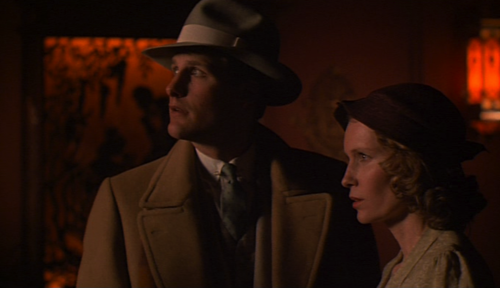
Scene from "The Purple Rose of Cairo"
"It's Not Enough Simply to Believe"
"My task doesn't consist in resurrecting the truth. I only try to seek its meaning. But what could such a lofty notion as truth mean, other than what it was, self-contained, in its own universe? It is that it is. Just as one seeks for the sake of seeking. To be conscious, aware, of being alive. Isn't that enough?
"How else could humanity persist in a thoroughly dreamlike improbability, spun-out between an origin that can't be known and an end that can't be foreseen: the Universe and a grain of sand, God and nothing...
"It's not enough simply to believe. Believe in what? Something? Anything? God in his high mightiness? The rational universe? Unknowable things. And if I say I believe, the contrary may equally be true? Or as true? But what would it matter if this or any other moment didn't exist, or never existed? The question provided no consolation either way. What was the use even thinking about it? What, indeed, if indifference and entropy were the rule to which life itself was the exception?"
"...And what if the sole purpose now is to get rid of meaning? To make darkness the general condition?"
"It's a story without a moral. Like the one we're living. Here and now. The war will never end. It has no end...The question's simply how to survive and to go on surviving."
"We're creatures of accident playing at reason."
"Perception itself is revealed as the object to be perceived."
"Love, Emotion, Feeling"
"You love someone and you want them to love you in the same way. You love the idea that they love you, entirely, narcissistically, that their emotions, their feelings, are the doubles of your own. Like a mirror into the soul. And if you repeat the words often enough - love, emotion, feeling - you might just be able to convince yourself they're not empty cliches. What was ridiculous a moment ago becomes not only permissible but necessary, anything else appears frivolous, doubtful, unthinkable even."
"A desire to be overcome, obliterated and at the same time affirmed, solidified. To become the manifest reality of a hidden force operating in the world...And yet this desire was something that threatened her very being by affirming the power of objects, of the things we disregard as being outside ourselves. Just as the letter M was not a name but rather an object. An object to which she'd attached herself like some form of echo. M was indeed the original object, the majuscule, to which her own name, her own being, secretly referred."
"The dreams are always the same. The scenarios. Only the details vary."
"I'm merely an interval between your body and your desire."
"All I write, all I think, is this kind of nonsense. The old truth game."
"It's all just words, she told herself."
"The Presence of the Camera"
"The camera's presence seems to pose [a threat], of being observed, and being aware of being observed, as though by a third party, a secret agent, followed by the inevitable interrogation routine, its obscure logic and oblique motivations."
"Almost as though you were an actor in a film about someone you can't recognise but whose destiny you nevertheless share in every particular, through countless rehearsals and re-enactments: some kind of fatalism which has become intertwined with your own story and through which you've long ceased to be its author, becoming instead its instrument, not knowing any longer who you're supposed to be...
"The dilemma, of course, strikes you every time as idiotic and absurd, and yet it's impossible to avoid. As if to live at all were nothing but a type of communion with forces outside the body and the scope of the will? A seance, by means of which to communicate not with the dead but with the one who stands in place of you. And the other, the woman sitting beside the piano in that room, always it seems facing away..."
"You mean nothing to me... You're too anxious. Nothing's going to happen..."
"Some Kind of Transaction"
"It isn't dark, but there are shadows."
"Sorting through M's papers and old photographs, whose eternal present is beginning to suffocate me. In a certain sense, in a very real sense, it's become harder and harder to separate myself from her. Or to separate my feelings for Van from my feelings about what's happening, even now, across the border. In making a film about the war in Bosnia, part of him becomes that war. Becomes all wars...
"It's not enough to insist on memory. War, holocaust: we still take for granted our own survival, that history hasn't or our accord come to an end, that time hasn't stopped."
"That Illusory Gap" ("The More I See the Less I Look")
"I don't care anymore if none of this is real. What matters is that it's real enough."
"And then, too, there's the procession of entirely commonplace ideas. Tedious statements of time and place, allusions and intimations of mortality on an industrial scale..."
"The only way out is to write it down..."
"The same story told over and over again in different disguises: it was a question of seeing, of placing oneself there in that endless diorama, like an eye in its visual field, animating it by means of one's presence alone, yet at the same time observing it, as though in secret, a voyeur behind the spectacle of one's own seeming, taken surprise, in that illusory gap between language and the material world, for example, where West had always sought his purpose and his reason for being...
"How easily he's become nothing more than a phantasm: a ghostly flickering of words, letters, phrases across an incandescent screen, like the phosphorescent afterglow of a ship's wake. Who'll ever read what's written there? Fading as quickly as it first appeared..."
"...you're compelled to think of it, of the whole, of a world in which somehow all the details will add up, will be made to add up, all linked together into one great long train of causalities. How portentous it now seems. How mechanical and barren and futile. How utterly arbitrary. Like something battering its way through a labyrinth and leaving a trail of debris and destruction in its wake."
"Is it possible that some kind of transaction has taken place here? A word exchanged. A look. A code. Or the place is simply one more set of arbitrary co-ordinates, X or Y, that could stand for anything or anyone. Their relations, their overlapping accounts. Each one located and organised on a single, continuous place, like so many points on a grid. Life too could be just such a series of coincidences, all happening at the same time or at different times, in the same place or different places, linked together by nothing more than an accident of resemblance. As if one's own life were merely a conjunction of different roles, each of them existing independently of us, circumstantially..."
"Perhaps It Would Be Better if You Didn't Read This"
"The writing's become cramped and overwrought with detail, a monstrum, a hodgepodge: extraneous matter creeps in wherever an idea fails; a grammar of elaboration and deferral, for the sole purpose of keeping the mind, like the page, from going blank."
"Again and again. The depressing monotonous turn of events and an almost childish sense of clinging to anything at all capable of diverting us..."
"I'm still no closer to knowing the truth about M. The further I go, the more uncertain everything becomes. Who she is, who I am. I'm struggling to arrive at a point from which all of this, all the details, the evidence, the written accounts, the medical reports, photographs, travel documents, etcetera, etcetera, can be made to add up and reveal that particular reality which is always more than merely the sum of its appearances. But less, also."
"All this is a fiction, concocted to punish you..."
"While the credits continue, the succession of images become less coherent and distinct."
"It's necessary for them to define themselves gesture by gesture and frame by frame as the film proceeds."
"The journey is endless: an endless night, a train, a compartment, in variations on the one same theme, like a film with neither beginning nor end but constantly in medias res, so to speak, without the slightest regard for overall continuity or preservation of time and place, where even the most conspicuous details are left unexplained despite the fact that their presence intimately concerns you. Actor and spectator. Deceiver and deceived..."
"Art is a seeking, a journey. You know that eventually you'll arrive somewhere, but where exactly? Perhaps the end doesn't matter. Perhaps the real question is: Will the journey be a straight line or a circle? Will it be both?"
HOMAGE:
See message 1 below.
VERSE: [In the words of Louis Armand]
No-One's There
Behind their windows, All the compartments are empty. The doors are locked And won't open. No-one's there. Neither on the platform Nor in the train.
The Isola di San Michele
The ferry edges away From the pier, Someone laughs, Quietly this time, An intimate laughter Soon lost in the fog.
FOOTNOTES:
(1) The Church - "Destination" (see soundtrack in message 2 below)
(2) It's not clear whether the narrator is a male or a female. (Or non-binary.) It's possible that she is Chiara, who might or might not be M's daughter.
Reminded me a lot of the novels of H.D. or Hiroshima Mon Amour and Death in Venice cut-up. Many very dream-like journeys in place and in time. Sarajevo, Venice, Trieste, Paris, Marseilles, Casablanca, Martinique, Veracruz. World War 2, the 'present.'
Some parts that stood out:
"I sit there watching as the girl beside the woman stirs from her sleep, or, not asleep at all, turns, looks directly at me, smiles involuntarily, aware of my interest (don't ask me how), then lowers her eyes, nudges her body slightly further forward on the seat, turns back to the window and crosses her legs. Right leg over left, so that her thighs are left bare above the stockings, right up to the sex which alone is in shadow."
"Unlike M, the girl wasn't smiling. The shape of her mouth, pulled straight across as though inwardly she'd been gritting her teeth, jaw-clenched, her eyes wider than appeared entirely natural. It was as if her whole expression represented a kind of act of desperation. Innocence frayed with culpability."
"Meret was leaning against the wall, laughing, pulling Chiara towards her, into her arms. Suddenly she kissed her. Her mouth was slack and somehow shapeless and tasted of gin, vermouth and cigarettes. Chiara recoiled from the embrace and immediately Meret slid down the wall into a sitting position. Her bare feet jutted from beneath the torn hem of her dress as she laughed, helplessly. ...And then a hissing sound, and a rush of water on the flagstones. Meret lifted the hem of her dress for Chiara to see how she'd pissed herself, looking up in childish astonishment. A pool of urine had gathered between her feet and was slowly spreading, the dull reflection of the lamplight shimmering across it like paracelene."
1. It's written in second person, which frequently caused me to lose that willing suspension of disbelief. The book might say something like the following: You look into the eyes on the screen and feel the deep jealousy of a jilted lover.
Unfortunately, I don't know if I've ever felt like a jilted lover and I suspect I'm not the type who really ever would feel that way. Therefore, the fact that it says "you" (meaning me) makes me think something like, "I don't actually feel jealous. Maybe I should make myself feel it. Is this a normal jealousy, though, or do jilted lovers have a different sort of jealousy. I've never been jilted, but I wonder how that might feel. I wonder if the way _________ boyfriend was counts as jilting. It's similar probably, but not quite a perfect match..." And then I have to force myself back into the story.
2. Clair Obscur is a bit melodramatic and it's full of purple prose. I tend to like my language functional before it's beautiful. I'm from the Strunk and White school of writing, which means I hate all of those flowery, but ultimately needless words. This isn't a book for those of us who think that way.
3. It's more interesting than engaging. I think about what the author is trying to accomplish, and I think that's more interesting than the actual story is.
*I'm not gonna lie, I didn't finish. Sometimes I think that makes reviews a little invalid, so take my opinion however you want to. I'm just telling you my experience of it.
This novel is made up of many intersecting voices (in different tenses), sometimes intersecting in the same paragraph, each relating a different point of view, with each point of view giving us a different perspective on a story that extends through space and time between the Second World War to the war in Bosnia, between France and Italy and Mexico. The language shifts between an almost clinical objectivity (like a film script) to a sensuousness verging on the melodramatic. Unlike 'similar' novels I have read, mostly by male authors, Clair Obscur is anti masculinist. The central narrative - about a daughter searching for her (dead) mother - is predominantly feminine and skeptical toward heterosexuality. It's male characters are almost all unlikable - intentionally so, I assume. But the women in the story aren't weak or sentimental, but they are also not driven by a Hollywood sense of action. Intimate, everyday details make up the substance of the book. Description is a way of returning the the world to a sense of the familiar, from the alienation experienced through depicted human relationships in American films - with the exception of directors like Maya Deren. Reading Clair Obscur actually reminded my of Deren a lot, and maybe French writers like Marguerite Duras or Natalie Sarraute. Its motifs repeat obsessively, while fragments of stories gradually combine to produce a panorama in which most everything finally comes to relate. A book to read slowly.
I just wanted to say that I'm very excited to have won the giveaway that just ending today, I also wanted to thank you for the opportunity. As soon as I receive and read the book we will be sure to edit this and write a proper review. Thanks again!