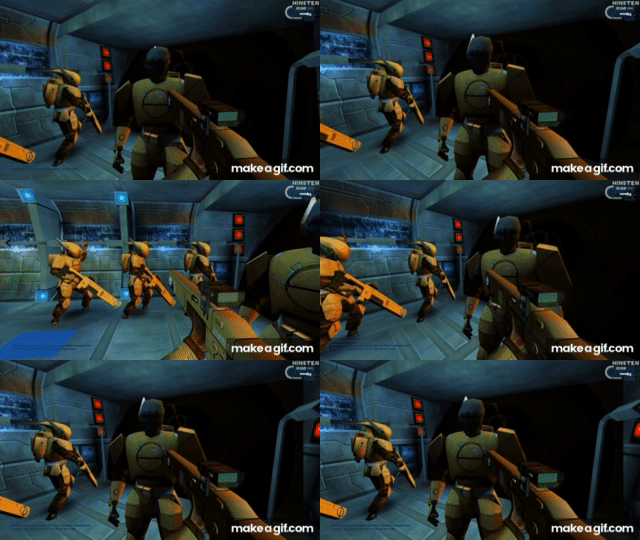
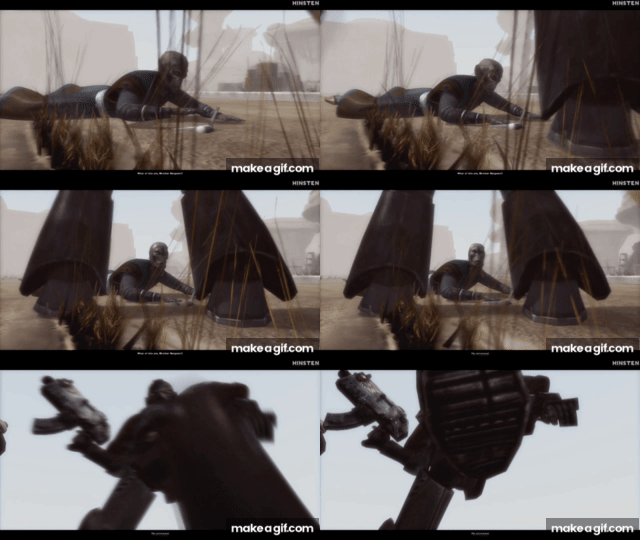
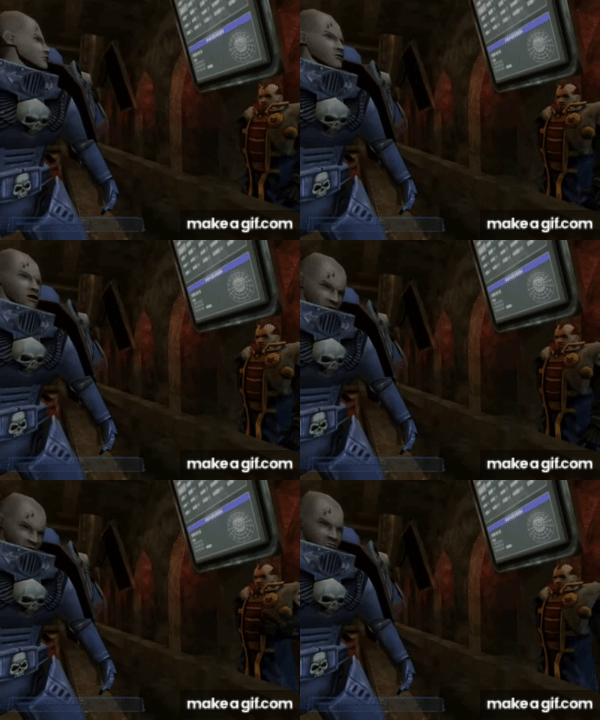
Based on the popular Playstation 2 video game from THQ, this is the action-packed tale of a young Fire Warrior sworn to protect the enigmatic rulers of the benevolent Tau empire who are known as the Ethereals. When one powerful Ethereal crash lands behind Imperial lines, the young Fire Warrior is sent to rescue him. But with the fierce troops of the Imperial Space Marines lying in wait, the success of the mission is far from assured.
My son, No expansion without equilibrium. No conquest without control. Pursue success in serenity And service to the tau'va. With pride. Shas'o T'au Shi'ur
A 100% action-packed read, but being this book the novelization of the fps videogame with the same name it was expected, with a well fleshed main characters and the usual amount of campiness, violence and gore trademark of early W40K novels.
Shas'la (tau's rank for military rookies) T'au Kais (it took me 100+ pages to correctly remember his name), a young and inexperienced Tau Fire Warrior afraid about he would never be worthy in his father, a late well renowned commander of the Tau Empire, dead in battle against Tyranids, is deployed to the rescue of the Ethereal Aun'el Ko'vash from Imperial forces made of guards, stormtroopers, Raptors and Ultramarines Astartes, just to end in allying with them against common menace of Chaos.
Not as good as Simon Spurrier's Lord of the Night Warhammer 40000 novel, but this action-packed tale from the point of view of a Tau, and some other characters, many of them deliciously introduced just to be brutally killed in a few lines, was a nice read and a real breath of fresh air, with main character and storyline gettin' better and better chapter after chapter until to the grim excellent ending.
The admiral remembered the firm alien grip on his shoulder, its accented voice in his ear. He shuddered. “I thought you killed it,” he muttered. “You thought incorrectly.” “It almost murdered me. It slaughtered the bridge personnel, by the throne!” “Indeed. It is a great warrior.” “You’re impressed!”
Based upon the disappointingly average FPS shooter of the same name, Fire Warrior expands upon what little we knew of the Tau Empire through the eyes of one of its grunts; Shas’la Ta’u Kais. Already having a strained psyche from some fairly serious daddy issues, Kais sees the horrors of war for the first time when his cadre is deployed to rescue an abducted Aun’El from an Imperial fortress. As the body count rises Kais begins to question the driving ideology of his people and realises just how unforgiving the universe truly is. Yet with reinforcements from both sides arriving en mass, it becomes clear that someone is pulling strings…
Despite having only written a handful of books for Black Library Spurrier shows distinct skill when writing about the Warhammer universe. His narrative style manages to near perfectly balance out the rapid pacing of the conflict with surprising depth and makes the Tau feel alien without it causing you a headache trying to read it. The book frequently switches between human and xenos viewpoints to contrast the cultures and flesh out events, often using them as a chance to comment upon one another. One brief but memorable moment is when a Tau Kor’El comes to understand that human ships are operated through sheer manpower and numbers rather than AI assistance. He considers how this reflects upon human dominance in the galaxy and realises with each ship that is destroyed the Tau fleet is effectively committing a form of genocide.
Spurrier seems to have understood this mix of contrasting characters and viewpoints was a major strength because he takes every opportunity to show someone else’s perspective. These are not used in the same way authors like Graham McNeill would, to give events greater scope, but are instead utilised to give the book more flavour.
Perhaps the best example of this is Tikoloshe, an insane dreadnought Kais encounters while fleeing a stricken vessel. Half of the fight is shown from the dreadnought’s schizophrenic perspective where the reader glimpses its past. This makes it feel like a genuinely interesting villain despite appearing for only a few pages and helps to add some variety to Kais’ everyman thoughts. The way these shifts in perspective are included however means that very few ever feel like they’re an unnecessary addition to events.
None of this is to say that the central characters are badly written or overlooked. While the book sticks mostly to the video game’s storyline it adapts the characters to make their actions more believable and introduces new scenes to flesh them out. Governor Severus, the main antagonist of the novel, greatly benefits from this and while visibly moustache twirling he’s constantly presented as a skilled manipulator. Effectively bringing about the presence of every faction he needs to carry out his plans and having them play their role exactly when he needs them to. As such what he lacks in terms of a well rounded personality he makes up for being Governor Von Doom. The Ultramarines Captain Ardias is given a similar personality upgrade and has far more believable motivations for his disappearance during the initial battle with the Tau and actions during the second half of the novel.
If there are any flaws to be found in this novel it’s that Spurrier never seems to get into the feel of how old some things should be. While some descriptions to focus upon the age of the environments, particularly the corroded labyrinths of imperial battleships, others visibly lack this quality.
This is a visible problem with Chaos. It is talked about as being a serious threat, a corrupting power in its own right. However, its servants never manage to express how they have been fighting the Imperium for ten thousand years in any believable fashion. They frequently act juvenile rather than simply insane, make too many obvious errors even for fanatics; and lack the descriptions of mutations and equipment which might have helped express their prolonged lives. Even when the novel gets into the thoughts of Tarkh’ax, a powerful daemon locked away by Eldar warlocks for centuries, the way it is described feels like it has only been trapped for a few decades at most. It just seems to lack that storytelling spark authors like Ben Counter have when writing about ancient Chaotic aspects of the Warhammer universe.
At the end of the day if you can forgive one or two minor discrepancies in the canon and the book skimming over aspects of Chaos usually emphasised in other novels, Fire Warrior is a solid read. It’s easily one of the best looks into how alien the Tau really are on a personal and cultural level while having enough explosions to call itself a Black Library story. Though by no means some great groundbreaking work like First Heretic it’s an underrated classic and easily matches the grim dark qualities found in novels like Execution Hour and Storm of Iron. Well worth your money and a must buy for any devoted Tau fan.
Fantastic novel. Why its rating here is so low, I honestly have no idea, although I suspect that Space Marines fanatics have downvoted the rating, like it happened with the Eldar Path novel series. Anyway, this book is absolutely great. It has excellent developement of the main character and in the end of the story you really feal him as a real person - even if he is an alien from the distant future! The descriptions are very good and there is a healthy dose of horror in the novel, so it is not for those who are more squeamish. And the battles - the battles are incredible, over the top action violence, first against human warriors and after that again hideous monsters. The final combat is shockingly good. You can tell that it was created for video game, but nevertheless it is amazing. So, overall, I LOVED this book. Maybe best 40k I have read this year and my favorite after Path of the Warrior and Path of the Outcast novels by Gav Thorpe. I hope for more Tau books and keep my fingers crosses that Kais will reappear in future novels.
So I recently finished this book. I've started several years ago, fifteen years ago when I was playing the game. Didn't you know this is a game? It is. And this is novel adaptation.... so true be told feels like one. Our main character Kais is undoubtly one of the most powerful tau characters to exist. He kills without mercy. So powerful beyond belief. That's one thing that really turn me off in space marines novels and here again... the same stuff. It's action beyond action... althought to be fair Simon although making Kais almost invicible he sure gave him problems and he sure went to trouble, almost killing him several times. In the game he killed a thousand IG, Space Marines & Chaos stuff. Here although he killed a lot we don't feel the same stuff. This was the instance where the book was better than the movie Game.
We've got here Tau trying to expand, you've got humans that kidnap a ethereal and they are trying to get it back. At the same time you've got space marines working as body guards (hmm) and dying as easily as the IG. You've got plots and twists and chaos stuff... Not gonna spoil.. Read the novel or play the game.
One of my main problem was all the Tau words floating around. Sometimes it felt strange and I know it's cool to know some Tau words but we've never going t see them again. The problem was on page 10 he explains a rotaa is but never showing it again until page 300. The same with names and ranks and so on. It was very strange and until the end I really was over my head.
But it's not a bad book. There are better of course out there. But unfortunately if you like to play Tau there aren't that many books with them.
This book encapsulates the problems with adapting books from computer games, especially first person shooters. For no other reason, the story-line is composed of a series of set piece missions that always end in some boss battle - starting with an Imperial Guard tank, through a couple of Space Marines, a f*cking Titan, and ending with a fight against demon lords. (In fact, the ending of the book is even more of a FPS cliche than takes place in the shooter - in the book the protagonist has to kill a succession of four bosses, shooting at a pre-defined weak spot at each level of the fight. The game just features one boss.)
This results in ridiculous scenarios which are awesome in a game but out of place in a 40K novel (which is hard, given the setting.) So, you get a lone tau warrior killing a squad of Space Marines, mostly because he can out-run bolters and then taking down a Titan single-handed. It gets boring quickly because the plot armor is so thick you know nothing will happen to the protagonist, and the book doesn't give many supporting cast to care about.
So why three stars, because Spurrier does one thing really well - he is great at describing Chaos and demons. He has a gift for describing chaos in a florid, unsettling way that brings to mind Lovecraft. (Unfortunately, I can't say the same for the dialogue - a particular low point was a Chaos marine taunting the protagonist with "come out, come out little piggy." Christ.)
This was a very solid Tau novel of a newbie Fire Warrior coming through the crucible of war much stronger than when we first went into it. The grim darkness of the far future demands that combatants be made of harder, darker stuff. Spurrior does an excellent job making Tau culture different than Imperium culture and I really enjoyed reading about Tau battlesuits. That part was amazing!
This far out from publication, I can't imagine my comments will even be noticed, much less influence someone's purchasing/time management decisions. And yet, my opinions on this novel are strong enough that I want to scream them into the void, and that speaks to the strength of the work. Or my own vanity, there's always that. Know that I read the book and wrote this review prior to reading any other opinions, so the ideas expressed here are completely my own.
Spurrier's 400 pager is the novelization of a video game based on the table top miniatures game Warhammer 40,000, itself a futurized take on the fantasy themed table top miniatures game Warhammer. Maybe there's a radio drama in there too. Point is, this endeavor was financed with one goal in mind; merchandising. The odds are laughably stacked against an immersive, thoughtful, even coherent experience emerging from this narrative, yet I believe Spurrier pulls it off so congratulations to him. Based on this, I'm more than open to seeing what he can do with more creative control. Still, the cracks of this novel's origins do show. The natural rhythms of a first-person shooter are more than evident to this semi-experienced gamer, from the in-game tutorial to the step by step objectives piped in from a narrator posing as a mentor/ally, the level designs, the equipment upgrades, and the boss fights. Oh, the boss fights. Gimmicky mechanics that feel perfectly at home in a point & shoot gaming experience designed to marginally challenge a player's dexterity and puzzle solving skills, but appear awkwardly shoehorned into a pure narrative. It disappointingly breaks immersion, but what can you say. You knew this was going to be an issue from the outset, so if it upsets you, don't go looking for someone else to blame. Annoying as this flaw is, it could easily have been this novel's defining characteristic but it's not. Instead of being just another science fantasy advertisement stuffed to the gills with throat ripping action, unrestrained prose, and mind shattering, testosterone fueled escapism, "Fire Warrior (Mass Market Paperback)" is all of these things PLUS a convincing character arc and perhaps a touch of cogent social commentary, if one cares to look.
One of these comments lies in what might appear to be a flaw in Spurrier's word choice, which is the repetition of the word "ugly." A lot of things in the novel are "ugly," when they could be "gruesome" or "misshapen," or any number of more descriptive synonyms you'll be strongly encouraged to use should you trouble yourself to take a creative writing class. Instead we're stuck with plain, stark, uncomplicated and uninteresting "ugly." Why gussy it up with extra syllables and fancy vocabulary when it's just ugly? The overuse itself is also ugly and that's the point; it's always used to describe war and violence in this book, and real war quickly becomes tiresome. Not to historians and enthusiasts, of course. Not to us consumers of narrative. Violence is conflict, and conflict is interesting. Violence taps into something primal in us. It gives us a chance for heroism. But ask anyone who has been in real combat and seen real violence, and they'll tell the truth. War doesn't open the chance to be heroic so much as it does the chance to be arbitrarily dead. Those arbitrary deaths then spread a ripple effect of tragedy and loss, and too often for a cause unworthy of the sacrifice. Speaking of which, the causes in this book are definitely, I believe intentionally, unworthy of the sacrifice (for the most part). I haven't read any other Warhammer 40k books, but I have noted they are all written from the Human empire's perspective save this one. I'm curious to know how they are portrayed in them, but in this one, from the Tau point of view, we are free to see them as overzealous racists and angry, patriotic fanatics who place a bitterly low premium on life in general. It's a bad look, especially in contrast to the restrained and nearly inexhaustibly patient Tau, but then, they don't get off the hook either. The Tau come off as condescending and depressingly naive, and as expressly indicated in the book, are just as opportunistic, violent, and arrogant as the humans when all is said and done. Both cultures are totalitarian collectives running their entire empires on thought control, propaganda, religious fervor, and when all that fails, brutal retribution and stunning intolerance. And yet, despite the horrific flaws in the cultures, there are individuals I can't help but cheer on because they are giving everything they've got trying to be the best version of what they're told they should be. Not only that, but that same thought control, propaganda, and religious fervor winds up being the only thing staving off the greater evil. They're doing the best they can with what they have, even when what they have is a great, heaping mound of bullshit and that feels depressingly relatable.
The one thing I was kind of disappointed in was that the censure, not on a particular brand of tribalism but on the concept of tribalist overreach in general is undermined by a plot twist (anyone who is familiar with Warhammer 40K will see coming from far, far away). Essentially, both sides are relieved of their apparent responsibility for the slaughter and I philosophically disagree. Misguided zeal and blind prejudice isn't a chink in the armor, to be manipulated by Chaos. That stuff IS the Chaos, whether we choose to consciously embrace it or not. I find this an essential lesson to learn, especially now when misguided zeal and blind prejudice seem to be on the rise worldwide. Once again I state, it's not a brand of tribalism I take issue with so much as the concept of tribalism in general.
Whatever, that's out there. This is a cool book and you should probably read it, because it's fun and they shoot a lot of things and solving problems with unrestrained violence, however inadvisable it might be in real life, is refreshingly cathartic when accomplished vicariously through aliens wielding exotic firepower WHICH, now that I mention it, is one of the themes of the book as the protagonist finds himself impotently massacring hordes or enemies as a distraction from his own daddy issues, meaning violence doesn't solve any real problems but now I'm rambling. Good day.
I read this pulpy bit of hyperviolence over one sleepless night. It was unfortunately exciting enough that it did not, in fact, put me to sleep.
Instead of the rest I so desperately needed, I got to experience an angry lil blue guy with daddy issues on a mission to blow holes in things while meeting new, healthier father figures along the way. Has my brain repaired the damage of the day before? Can I see straight? No! But that's not Fire Warrior's fault. It was a good time.
My first venture into the Warhammer novels. Very cool insight into the lore and background of the T'au. Also with a dose of Imperium and Chaos lore as well. Sprinkled with a pinch of daddy issues.
at first i had the game though i liked it i never really understood the bulk of it till i was introduced to the tau in the dawn of war games and the black library site. when i was looking for books about the tau race in this epic war-hammer universe i was delighted to find this. the book is just as good as the game if not more enriching. it truly was worth the price just to have a book that was purely at the point of the tau and most importantly a fire warrior.
the story fallowed a Shas'la (lowest rank of tau military) named Kais with great detail about his bloody duty for the greater good, he went from just being a diversion to the hero that had rescued the Ethereal Aun'el Ko'vash just to be thrown into another bloody fight against the forces of Chaos. this book back washes into the past and social structure that Kais was raised in. however you'd do best to learn a little more about tau lingo sense only tau fans might know like the tau units for time. if your not seasoned in there lingo i'd suggest wiki or the games. for those that are the fans of the tau, imp. guard, Ultramarines Chapter, and the Chaos marines this is the book you'd most likely like if not love. i promise that this review doesn't even put a scratch to the surprises that this book has in store for tau fans. i payed 50$ or so for my copy a long time back when it was harder to get(though your likely to find a cheaper copy now) but it feels like it was worth more than what i had payed for it at the time.
Now now wait just a second! I had heard of the game before having read this, I suspected it was based off of the game, but I actually approached it from the view that it preceded the game. Most would probably spurn this book based off of the poor quality if the game itself, but I found this book to be entertaining and amusing. Shas'la T'au Kais should be preserved and unleashed once again on the enemies of the space communists. If one is looking for a Tau-filled experience with amazingly capable characters, then this book is for you.
A horrible game accompanied by a very very mundane and boring book. This was really just made to make money in my opinion and poularize the new Tau race in Warhammer 40k, personally one would be better off reading fan fiction than reading this.
Halfway through reading this book, I felt a bit odd. It was because of the pacing of the book, which felt clunky and erratic. At one point, while pondering over how the story was progressing, it almost seemed like this was like a video game progression.
Looking up online, lo and behold, Fire warrior, a novel based on the FPS game Warhammer 40000: Fire Warrior. That wouldn't itself be a bad thing. But much is the bane of stories serving to embellish as a companion piece for visual media, they are constrained in how they tell the story.
One of the things 'Agents of Shield' suffer from, having to shoehorn ongoing events from those mediocre movies.
Here, the same issue persists. The narrative lacks any depth, even considering that this is a Warhammer novel. Don't get me wrong, I know very well, when getting into these books, that one can expect is a whole bunch of mindless action, with occasional gems (I recently just finished the first Caiphas Cain novel).
But even by the average 40k novel standard, this was way too surface level, its characters, even our protagonist, only having some shallow window dressing as their motivations, which doesn't really make them all that entertaining.
Pity, considering how there was this throughline, of our protagonist, being unable to fit into the narrative of the greater good, and being subject to their baser emotions. Which would've been a good arc to explore.
But, by the constraints of having to start at point A, ending in point Z, while ticking off all the missions in the game as chapters means that, you're left with a largely unpolished story. One which frustrates you with how OOC some of the characters behave.
My advice, drop the book, just go and watch the game movie on YouTube or something. Wouldn't recommend.
I've not read many video game novelisations but rather than shying away from the ridiculous number of enemy that the main character kills and using the excuse of it being a team or downplaying some other way, this book leans hard into it with Kais feats being ridiculous and everyone from his teammates to his superiors being completely freaked out by him being a Mont'au devil (alien words that all have apostrophes are a common theme).
There are some issues where the meaning isn't clear, "[Space marines] indicated he was on the right path. No mere troopers, he reasoned, would be assigned to guard something important" is confusingly stated.
The clashing of T'au and Space Marine faith is interesting, the exchange that "its chaos. Evil" "Evil is a falsehood, the sio't teaches us that all truth is subjective. Evil is just valour, regarded from a different perspective." And the "How do we fight this" "ceaselessly xeno, ceaselessly".
Wow! This book really surprised me. I went into this novel not expecting much, my only experience with the being from playing the fire warrior game many years ago when it came out.
Shasla T’au Kais is the guts (from berserk) of the tau empire. This story depicts the harsh brutality of conflict and firefighting in the warhammer 40k universe in such a tangible way. I really felt a sense of dread and nervousness as the fire warriors were prepping for a combat drop for their first ever mission.
The protagonist of the story, Kais gets absolutely pummeled throughout the encounters but dishes out way more punishment to every foe he encounters. This is the most “human” tau story and really shows an incredible side to the mentality of the fire caste and how imperfect their strife towards perfection as unified machine really is.
As someone who never heard much about this novelisation I am really surprised how deep and entertaining this story was, a far superior version to the video game.
I hope they bring Kais back in future Tau stories!
Le parti più interessanti sono quelle in cui vengono mostrati gli usi e costumi dei Tau e come questi interagiscano con gli umani, che siano l’etereo all’inizio o il rapporto tra Kais e Ardias. L’autore scrive benissimo e descrive tutto perfettamente senza mai però appesantire la narrazione, che ha un ritmo forsennatissimo.
Proprio questo però è il problema principale: è un libro di warhammer, quindi la maggior parte del tempo deve essere occupato dall’azione, che molto spesso risulta troppo fine a sé stessa e inserita solo come materiale feticistico per i fan standard di quest’universo, che nel 90% dei casi son fasci fissati con la guerra.
I'm normally a 'read once' kind of reader.... but this, I've read 3 times and still love it. Played the game of the same name on PC whilst reading on the 2nd and 3rd times and the book helps the game out more than the game helps the book.
The books adds much more detail to both sides. There's a few weird/random/confusing parts in the game that the book happily explains.
This is my favourite out of shadowsun and farsight only because I've read it 3 times and the others I've yet to come back to
Fire Warrior is a great book and the first Warhammer 40k book I have read. This book in my opinion would be good for your 2nd or 3rd because it has the main space marines (Ultramarines) alongside another group known as the 'Raptors', overall Chaos and its corruption of people and most of all is just a crash course in the T'au including the origins during that siege the Etherials intervened in and most importantly the core concept of the T'au empire of the Greater Good and the T'au'va
This entire review has been hidden because of spoilers.
By far and away one of the best Black Library novels, and not just because it's long enough to justify the price.
An excellent storyline with strong characters and a well balanced perspective of Tau and Space Marine. Spurrier's novel delivers a crescendo of action and epic confrontation. A great read.
I really really loved this and I am baffled as to how this book exists.
It is a videogame adaptation for a truly BAD videogame and as such this book had NO business going as hard as it did.
The book is a TAD bit overwritten but it's worth it to experience an exploration into the horrors of war and a true breakdown of what life would ACTUALLY be like for the protagonist of a videogame.
It's a nice warhammer novel everything what you expect in it. Tau (wel...), Space Marines, Imperial navy, Demons, Treachery, Eldar (even its just a mention), I played its game ten or so years ago, and now I'm reading its novel, how time went so fast i wonder...
Read this a long time ago and just finished re-reading. Remembered nothing, and enjoyed it just as much as before. Kais' struggle against his own shortcomings was superbly depicted. Although a bit cliche at times, great fun the whole way through.
Alright just for being a novel about the Tau, which is its biggest merit, but it grows really repetitive as it continues - maybe something outside of the writer's control since it's a game novelization. The glimpses of Tau society are the best part.
I like the basis of the story. The midsection was very lenghty. It was the second Tau Book I have read and there was Chaos and humans again? Why can it not just be more about the Tau themself and maybe another faction. But maybe I picked bad. the final showdown is good, but videogamy.
This entire review has been hidden because of spoilers.
A really good book exploring the tau'va and it's exposure to the chaos God's, it was quite something to read a tau fire warrior chanting blood for the blood God!!!
Good first half with engaging action and interesting themes. Sadly, massive issues with characterisation start rearing their head around the mid-point and the book never really recovers.