

What do you think?
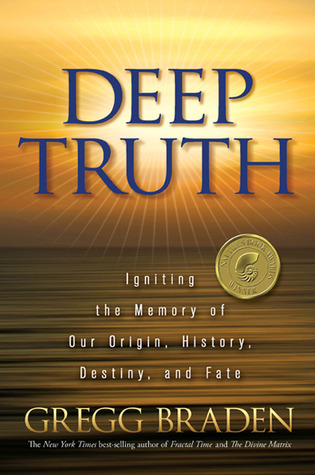
Deep Truth: Igniting the Memory of Our Origin, History, Destiny, and Fate
Deep Truth reveals new discoveries that change the way we think about everything from our personal relationships to civilization itself. When the facts become clear, our choices become obvious.
The Crisis:Best-selling author and visionary scientist Gregg Braden suggests that the hottest topics that divide us as families, cultures, and nations-seemingly disparate issues such as war, terrorism, abortion, genocide, poverty, economic collapse, climate change, and nuclear threats-are actually related. They all stem from a worldview based upon the false assumptions of an incomplete science.
The History:The obsolete beliefs of our modern worldview have brought us to the brink of disaster and the loss of all that we cherish as a civilization. Our reluctance to accept new discoveries about our relationship to the earth, one another, and our ancient past keeps us locked into the thinking that has led to the crises threatening our lives today.
The Facts:The scientific method allows for, and expects, new information to be revealed and assimilated into our existing beliefs. It's the updating of scientific knowledge with the new facts from new discoveries that is the key to keeping science honest, current, and meaningful.
To continue teaching science that is not supported by the new discoveries-ones based upon accepted scientific methods-is not, in fact, scientific. But this is precisely what we see happening in traditional textbooks, classrooms, and mainstream media today.
The Opportunity:Explore for yourself the discoveries that change 150 years of scientific beliefs, yet are still not reflected in mainstream thinking, including:
· Evidence of advanced, near-ice age civilizations
· The origin of, and reasons for, war in our ancient past, and why it may become obsolete in our time
· The false assumptions of human evolution and of the Darwinian theory "Let the strongest live and the weakest die" and how this plays out in corporations, societies, warfare, and civilization today
Deep Truth reveals new discoveries that change the way we think about everything from our personal relationships to civilization itself. When the facts become clear, our choices become obvious.
The Crisis:Best-selling author and visionary scientist Gregg Braden suggests that the hottest topics that divide us as families, cultures, and nations-seemingly disparate issues such as war, terrorism, abortion, genocide, poverty, economic collapse, climate change, and nuclear threats-are actually related. They all stem from a worldview based upon the false assumptions of an incomplete science.
The History:The obsolete beliefs of our modern worldview have brought us to the brink of disaster and the loss of all that we cherish as a civilization. Our reluctance to accept new discoveries about our relationship to the earth, one another, and our ancient past keeps us locked into the thinking that has led to the crises threatening our lives today.
The Facts:The scientific method allows for, and expects, new information to be revealed and assimilated into our existing beliefs. It's the updating of scientific knowledge with the new facts from new discoveries that is the key to keeping science honest, current, and meaningful.
To continue teaching science that is not supported by the new discoveries-ones based upon accepted scientific methods-is not, in fact, scientific. But this is precisely what we see happening in traditional textbooks, classrooms, and mainstream media today.
The Opportunity:Explore for yourself the discoveries that change 150 years of scientific beliefs, yet are still not reflected in mainstream thinking, including:
· Evidence of advanced, near-ice age civilizations
· The origin of, and reasons for, war in our ancient past, and why it may become obsolete in our time
· The false assumptions of human evolution and of the Darwinian theory "Let the strongest live and the weakest die" and how this plays out in corporations, societies, warfare, and civilization today
Deep Truth reveals new discoveries that change the way we think about everything from our personal relationships to civilization itself. When the facts become clear, our choices become obvious.
308 pages, Paperback
First published October 1, 2011
About the author
Gregg Braden
139 books731 followersNew York Times best selling author Gregg Braden is internationally renowned as a pioneer in bridging science and spirituality. Following a successful career as a Computer Geologist for Phillips Petroleum during the 1970s energy crisis, he became a Senior Computer Systems Designer for Martin Marietta Defense Systems during the last year of the Cold War. In 1991 he was appointed the first Technical Operations Manager for Cisco Systems where he led the development of the global support team that assures the reliability of today’s Internet. For more than 22 years, Gregg has searched high mountain villages, remote monasteries, and forgotten texts to uncover their timeless secrets. To date, his work has led to such paradigm-shattering books as The Isaiah Effect, The God Code, The Divine Matrix and his 2008 release, The Spontaneous Healing of Belief: Shattering the Paradigm of False Limits. Gregg’s work is now published in 17 languages and 27 countries and shows us beyond any reasonable doubt that the key to our future lies in the wisdom of our past.
Ratings & Reviews
Friends & Following
Create a free account to discover what your friends think of this book!
Community Reviews
Displaying 1 - 30 of 39 reviews
October 9, 2013
Science and the Spiritual influence on our lives and its historical context are linked in this book. The only problem is that there are some errors in Braden's scientific reasoning, which are glossed over, before he arrives at a theoretical construct, referred to as a"deep truth". For example, recently a panel of scientists determined that they were 95% certain, that since the 1950's man has been responsible for the sharp worsening of climate change (global warming). However, Gregg Braden says man is not responsible for global warming, there is a natural cycle of climate change. Gregg Braden also favors intelligent design in humans, but accepts some evolutionary change in animals: he states that the DNA of primitive man and modern man are too dissimilar, to have a direct evolutionary connection: he does not account for mutation of genes and alterations in the environment, as two possible factors in the DNA differences between primitive and modern man. Gregg Braden asserts that scientists assume that civilization is only about 5,000 years old, yet various tribes have oral histories of more advanced civilizations at least 9 or 10,000 years old: I don't think scientists dispute that there could be much older civilizations than ours, advanced in science and math, that have yet to be unearthed and explored. Maybe he is referring to the Bible's account of civilization, but I am unsure. These are a few of the possible scientific assertions that are questionable. Personally, I can't look at the wonders of the universe, the awe of people's creative inspiration, and not feel that there is a God and spiritual influence in our lives. I just don't think Gregg Braden or any one scientist has the ability to link both science and the spiritual at this time. We all have small pieces to the puzzle, that link the mystery of our being and wonders of our existence. But first, we have to make sure that each piece of science is accurately determined, before we can join these pieces into a semblance of our cosmic puzzle.

May 13, 2012
The epigraph to Chapter 2 is by E. O. Wilson: "Sometimes a concept is baffling not because it is profound but because it is wrong." This book baffled me.
The idea of a "deep truth," as Niels Bohr expressed it, is that "its negation is also a deep truth." Life's apparent contradictions can certainly run deep. But when one writes a fact-based book about subjects including evolution, climate change, war, and when a fetus becomes a human being, one cannot simply make contradictory statements and pass them off as deep truth.
Braden acknowledges that the Earth experiences 100,000-year climate cycles within which are nested shorter-term cycles. He then says they are "all about the Earth's location in space: the tilt, wobble, and angle of our planet relative to the sun and the core of the Milky Way." Especially since he qualifies this with "I am definitely not a climate scientist," he doesn't seem to have the credentials to make the oversimplification that climate is "all about" anything in particular.
One argument in particular left me underwhelmed. Quoting an article in the journal CO2 Science as saying that "changes in atmospheric CO2 content never precede changes in air temperature," he concluded that Antarctic ice core data representing cycles over the last 800,000 years on Earth "shows that the CO2 levels actually lag behind the rise in temperature and cannot be the reason for the warming." I am not a climate scientist either, yet easily I can imagine that just because atmospheric CO2 increase was a lagging indicator of warming in pre-industrial times does not mean it cannot be a leading indicator in the industrial era -- that is, given the relatively recent behavior of burning massive amounts of coal and oil as fuel, CO2 today might play a role in climate change that is different from the role it played in the past. This is just speculation on my part, but my ability to raise such a basic question when the author has already claimed an open-and-shut case suggests a fundamental flaw in his argument. This is characteristic of the entire book: logical arguments are made, but they are so sweeping in scope and so loosely screwed at the ends that they are not persuasive at all.
Other times, imprecision is a major obstacle. In discussing Roe v. Wade, the U.S. Supreme Court decision that ruled it to be unconstitutional for states to outlaw abortion, Braden writes, "the ultimate decision was left to the discretion of local governments. Whether or not abortion is legal would still be based largely upon the values and beliefs of the individual communities." This is imprecise enough as to be inaccurate and misleading. While each U.S. state regulates abortion differently, no U.S. state has the authority to outlaw it entirely. That was the whole point of Roe v. Wade. I am certain the author knows this, but in sentences like this it is not communicated well.
The contradictions seemed to me more messy than deep. He writes: "There can be little doubt on the part of anyone with an honest and open mind that the process of evolution, in and of itself, is very real. It is a fact that we see confirmed in the fossil record of species living in the past." A few pages later, he writes, "If species do, in fact, truly evolve with new DNA, rather than adapt over time, it's reasonable to expect that somewhere in the ongoing search that began in 1859, at least one transitional form would be discovered in the fossil record...there is no physical evidence of transitional species to support this assumption of evolution." Well, were transitional species discovered in the fossil record or not, and does this confirm evolution or not?
The author presents as someone who travels and reads a lot and has all the best intentions to inspire people to live thoughtful, peaceful lives. The text is peppered with interesting questions such as "what would it mean to realize that the wars we fight are over someone else's ideas?" The problem is that these questions don't build on each other and don't go anywhere. Unsupported platitudes such as "in our natural state, we are truly wired for peace" or "when we know the truth of the situation, the choices become clear and the decisions obvious" are ultimately not satisfying.
The idea of a "deep truth," as Niels Bohr expressed it, is that "its negation is also a deep truth." Life's apparent contradictions can certainly run deep. But when one writes a fact-based book about subjects including evolution, climate change, war, and when a fetus becomes a human being, one cannot simply make contradictory statements and pass them off as deep truth.
Braden acknowledges that the Earth experiences 100,000-year climate cycles within which are nested shorter-term cycles. He then says they are "all about the Earth's location in space: the tilt, wobble, and angle of our planet relative to the sun and the core of the Milky Way." Especially since he qualifies this with "I am definitely not a climate scientist," he doesn't seem to have the credentials to make the oversimplification that climate is "all about" anything in particular.
One argument in particular left me underwhelmed. Quoting an article in the journal CO2 Science as saying that "changes in atmospheric CO2 content never precede changes in air temperature," he concluded that Antarctic ice core data representing cycles over the last 800,000 years on Earth "shows that the CO2 levels actually lag behind the rise in temperature and cannot be the reason for the warming." I am not a climate scientist either, yet easily I can imagine that just because atmospheric CO2 increase was a lagging indicator of warming in pre-industrial times does not mean it cannot be a leading indicator in the industrial era -- that is, given the relatively recent behavior of burning massive amounts of coal and oil as fuel, CO2 today might play a role in climate change that is different from the role it played in the past. This is just speculation on my part, but my ability to raise such a basic question when the author has already claimed an open-and-shut case suggests a fundamental flaw in his argument. This is characteristic of the entire book: logical arguments are made, but they are so sweeping in scope and so loosely screwed at the ends that they are not persuasive at all.
Other times, imprecision is a major obstacle. In discussing Roe v. Wade, the U.S. Supreme Court decision that ruled it to be unconstitutional for states to outlaw abortion, Braden writes, "the ultimate decision was left to the discretion of local governments. Whether or not abortion is legal would still be based largely upon the values and beliefs of the individual communities." This is imprecise enough as to be inaccurate and misleading. While each U.S. state regulates abortion differently, no U.S. state has the authority to outlaw it entirely. That was the whole point of Roe v. Wade. I am certain the author knows this, but in sentences like this it is not communicated well.
The contradictions seemed to me more messy than deep. He writes: "There can be little doubt on the part of anyone with an honest and open mind that the process of evolution, in and of itself, is very real. It is a fact that we see confirmed in the fossil record of species living in the past." A few pages later, he writes, "If species do, in fact, truly evolve with new DNA, rather than adapt over time, it's reasonable to expect that somewhere in the ongoing search that began in 1859, at least one transitional form would be discovered in the fossil record...there is no physical evidence of transitional species to support this assumption of evolution." Well, were transitional species discovered in the fossil record or not, and does this confirm evolution or not?
The author presents as someone who travels and reads a lot and has all the best intentions to inspire people to live thoughtful, peaceful lives. The text is peppered with interesting questions such as "what would it mean to realize that the wars we fight are over someone else's ideas?" The problem is that these questions don't build on each other and don't go anywhere. Unsupported platitudes such as "in our natural state, we are truly wired for peace" or "when we know the truth of the situation, the choices become clear and the decisions obvious" are ultimately not satisfying.
October 29, 2012
This is certainly a unique book. It definitely made me think, which is good, but ultimately it provided more questions than answers. And while not very satisfying, that is ok. But I am basically left with a somewhat confused feeling. The best part is the thought-provoking points he raised.
Before getting into the book, I can't help but try to figure out who the heck the author is and where he is coming from. For better or worse, I always try to somewhat peg and categorize the authors of books I read. The best I could come up with is he is a New Age guy or maybe a practitioner of Mayanism (a new term for me, discovered when I looked up Gregg Braden in Wikipedia). It bothers me a little bit that his bio lists all these high powered scientific and engineering-type jobs, yet nowhere does it say what if any degree he has. He did mention being an oceanography major in college. Not that I am so enamored of college degrees, but when someone espouses "scientific" information, I usually want to know their educational background.
So anyway, definitely the most controversial statement he makes is that he apparently believes in "intelligent design". He does make a believable case that it is of course amazing that we came to develop to such a complex machine based on chance mutations, and he plays the "missing link" arguments for all it is worth.
Of course this support for intelligent design was a big red flag to me. An interesting side point here is that I learned a lot about Darwin and especially chilling were the author's examples of Mein Kampf and Mao's Little Red Book apparently using Darwin's "survival of the fittest" ideas as a basis for their author's mass murdering. Certainly an eye-opener, especially when contrasted with Darwin himself who supposedly backpedaled from all this "competition" stuff in his much less well known later book, "The Descent of Man". And another interesting side note is in the chapter entitled "War Doesn't Work Anymore", the author makes a reference to the book "No Contest: The Case Against Competition" by Alfie Kohn (1992) that sounds interesting enough to me that I want to read it. Another interesting reference is the mention of Russian psychologist Peter Kropotkin who wrote the book "Mutual Aid: A Factor of Evolution" in 1902, that described for one thing how ants cooperate so well.
So the bottom line is I am glad I read this book, but at times it seemed sort of muddled and confused and definitely speculative. It was basically all over the map! But that is also its strength, in that it raises questions left and right. My natural suspicion of anything "new agey" really kicked in. So while I admire the author's desire to figure out and fix the world and his overall thoughtfulness and curiosity, I was put off by his wild speculations and somewhat flimsy "proofs" of ideas that he believes. But in the end the book was worth it for the interesting things I learned and its references.
Before getting into the book, I can't help but try to figure out who the heck the author is and where he is coming from. For better or worse, I always try to somewhat peg and categorize the authors of books I read. The best I could come up with is he is a New Age guy or maybe a practitioner of Mayanism (a new term for me, discovered when I looked up Gregg Braden in Wikipedia). It bothers me a little bit that his bio lists all these high powered scientific and engineering-type jobs, yet nowhere does it say what if any degree he has. He did mention being an oceanography major in college. Not that I am so enamored of college degrees, but when someone espouses "scientific" information, I usually want to know their educational background.
So anyway, definitely the most controversial statement he makes is that he apparently believes in "intelligent design". He does make a believable case that it is of course amazing that we came to develop to such a complex machine based on chance mutations, and he plays the "missing link" arguments for all it is worth.
Of course this support for intelligent design was a big red flag to me. An interesting side point here is that I learned a lot about Darwin and especially chilling were the author's examples of Mein Kampf and Mao's Little Red Book apparently using Darwin's "survival of the fittest" ideas as a basis for their author's mass murdering. Certainly an eye-opener, especially when contrasted with Darwin himself who supposedly backpedaled from all this "competition" stuff in his much less well known later book, "The Descent of Man". And another interesting side note is in the chapter entitled "War Doesn't Work Anymore", the author makes a reference to the book "No Contest: The Case Against Competition" by Alfie Kohn (1992) that sounds interesting enough to me that I want to read it. Another interesting reference is the mention of Russian psychologist Peter Kropotkin who wrote the book "Mutual Aid: A Factor of Evolution" in 1902, that described for one thing how ants cooperate so well.
So the bottom line is I am glad I read this book, but at times it seemed sort of muddled and confused and definitely speculative. It was basically all over the map! But that is also its strength, in that it raises questions left and right. My natural suspicion of anything "new agey" really kicked in. So while I admire the author's desire to figure out and fix the world and his overall thoughtfulness and curiosity, I was put off by his wild speculations and somewhat flimsy "proofs" of ideas that he believes. But in the end the book was worth it for the interesting things I learned and its references.
April 15, 2020
Great book. As a scientist who has learned that the truth is not complete without spirituality, I appreciate Gregg’s approach. Scientist need to realize not everything can be explained factually. I’m glad I was recommended this book, I felt I was alone with my beliefs but I realize many people out there make the important link between science and spirituality. I truly enjoyed reading this book.

August 7, 2017
I purchased this book after a lecture by the author. Gregg Braden does a fantastic job of bridging the gap between science and spirit in a way that anyone can understand. The only pre requisite? An open mind. Loved this book and I'll be reading more if Gregg's work. The Divine Matrix is next.

November 4, 2019
тя, книгата е "преплитане" и е в съавторство с някаква лин ненам коя, но само това открих от този автор, а трябва да си отчитам бройка! :P

December 5, 2016
İlgili güncellemelerden birinde kitabın oldukça ilgi çekici bir okuma olanağı sunduğundan bahsetmiştim. Fikrim kitabı bitirdikten sonra da değişmedi, özellikle kitaptaki evrimle ilgili bilimsel araştırmalara dayanarak verilen bilgilerin fazlasıyla ilgimi çektiğini söyleyebilirim çünkü konuya ilişkin doğru olduğunu düşündüklerimiz ve aslında olanları bir arada görme imkanı sunan bir kitaptı. Kitapta ayrıca bahsedilen sürdürülebilir bir yaşam kurabilme fikri, hali hazırda yaşıyor olduğumuz şu günlerde -hele bir de dünyayı gördükçe zaman zaman umudunuzu kaybettiğinizi veya kaybetmek üzere olduğunuzu düşünüyorsanız- kulağa biraz fazla "naif" geliyor gibi olsa da yine de yazarın son sayfalarında vurguladığı "sevgi", "dayanışma" gibi değerlerin geçmişte gerçekleşen olaylardan ders alınmış bir gelecek yaratmak konusunda kolektif olarak harekete geçmek için hiç de yabana atılacak değerler olmadığı göz önüne alındığında "Neden olmasın?" diye düşünmeden edemiyor insan. Belki de önce inanmak, başarılı olabilmenin en önemli anahtarlarından biri gerçekten. Neden olmasın?..

April 2, 2021
Sustento irrefutable de la influencia que tiene y ha tenido la historia y ciencia oficial en la psique colectiva a pesar de sus graves errores y contradicciones

March 20, 2013
I always love books by Gregg Braden...
This is an interesting perspective on some deep issues that we humans are facing right now. I do believe that we are at a crossroads of some kind... and I do believe that information is kept from us that keep us from knowing exactly what those issues are
Our history is not as it is taught to us in school
I may not agree with everything that Gregg Braden says - does anyone ever agree 100% with anyone :) But I do agree with him on most points - and he has me looking at some issues with a different perspective
A good read - and very thought provoking
This is an interesting perspective on some deep issues that we humans are facing right now. I do believe that we are at a crossroads of some kind... and I do believe that information is kept from us that keep us from knowing exactly what those issues are
Our history is not as it is taught to us in school
I may not agree with everything that Gregg Braden says - does anyone ever agree 100% with anyone :) But I do agree with him on most points - and he has me looking at some issues with a different perspective
A good read - and very thought provoking

January 8, 2013
It was interesting. Most of his information did not surprise me. He mentions that climate change is not human induced due to the evidence in geological records. It left me wondering if climate change has increased in intensity and in speed due to humans. It would have been nice if he had been clearer on that point.

April 28, 2018
Beautiful scientific work with a sensitive information. Everybody with deep questions should read this book !!

July 5, 2024
Așa cum spune Einstein, "un nou tip de gândire este esențial, dacă va fi ca omenirea să supraviețuiască și să atingă niveluri superioare." Ca să reușim, trebuie să ne dăm seama cine suntem noi (oamenii) și cum trebuie să ne reconfigurăm traseul pentru a evita extincția pe care tot noi o provocăm.
Câteva revelații:
⚠️ schimbările climatice nu sunt induse de om, există un tipar de cicluri de încălzire și răcire, la intervale de aproximativ 100.000 de ani
⚠️ crizele vremurilor noastre sunt crizele cu care s-au confruntat și strămoșii noștri dinaintea ultimei ere glaciare
⚠️ războiul și competiția violentă contrazic instinctele omenești de cooperare și ajutorare. Oamenii nu sunt condiționați pentru război!
⚠️ studiile asupra ADN-ului dovedesc că nu ne tragem din familiile de neandertalieni
O carte ce nu se declară că fiind științifică, dar bazată pe studii și scrisă într-un limbaj accesibil și ușor de înțeles. O nouă perspectivă asupra lumii în care trăim și totodată un semnal de alarmă. O carte care ar trebui și de cei care ne conduc și consideră planeta tabla lor de șah.
Câteva revelații:
⚠️ schimbările climatice nu sunt induse de om, există un tipar de cicluri de încălzire și răcire, la intervale de aproximativ 100.000 de ani
⚠️ crizele vremurilor noastre sunt crizele cu care s-au confruntat și strămoșii noștri dinaintea ultimei ere glaciare
⚠️ războiul și competiția violentă contrazic instinctele omenești de cooperare și ajutorare. Oamenii nu sunt condiționați pentru război!
⚠️ studiile asupra ADN-ului dovedesc că nu ne tragem din familiile de neandertalieni
O carte ce nu se declară că fiind științifică, dar bazată pe studii și scrisă într-un limbaj accesibil și ușor de înțeles. O nouă perspectivă asupra lumii în care trăim și totodată un semnal de alarmă. O carte care ar trebui și de cei care ne conduc și consideră planeta tabla lor de șah.
This entire review has been hidden because of spoilers.

May 6, 2018
Wow. Although this book asks more questions than provides answers, it has changed the way I think and perceive human origins and the existing world circumstances that we find ourselves in.
- There has been a leap in human development not explainable by Theory of Evolution.
- There have been cycles of warming and cooling as well as species going extinct.
- New discoveries are being made about ancient civilization that started after the last ice age.
- Scientific discoveries suggest humans are placed by intelligent design rather than evolution.
- Humans are wired for basic goodness rather than war and competition.
Fascinating collection of theories that inspires me to think and research deeper. Eye opening and recommended!
- There has been a leap in human development not explainable by Theory of Evolution.
- There have been cycles of warming and cooling as well as species going extinct.
- New discoveries are being made about ancient civilization that started after the last ice age.
- Scientific discoveries suggest humans are placed by intelligent design rather than evolution.
- Humans are wired for basic goodness rather than war and competition.
Fascinating collection of theories that inspires me to think and research deeper. Eye opening and recommended!
April 10, 2024
I found this book, as I was looking into other books. I found some of the information in it, very fascinating. But, when it got into climate change, I kind of skipped over that stuff. Instead, what caught my attention was the history stuff. Especially, the debate beaten stuff on intelligent Design, and the problems modern science with the evidence that support it.
This book isn't for everyone, but for someone who understands there is a lot of riddles, and especially within Anicent history, this is a great book to read.
This book isn't for everyone, but for someone who understands there is a lot of riddles, and especially within Anicent history, this is a great book to read.
May 9, 2025
A great look at the hidden truth
The author points out all the evidence showing the history we’ve known is not the truth. The author goes into detail how information about the planet’s past which shows what is being taught in schools is inaccurate. We get a look at what could be the deeper truth of our world once we stop hiding. Governments and organizations are doing all they can to hide evidence from us which is why I said, ‘could be’. We need to look at why there was no war and suddenly war came to the planet. If there was no war for thousands of years then why do we have it now? Why?
The author points out all the evidence showing the history we’ve known is not the truth. The author goes into detail how information about the planet’s past which shows what is being taught in schools is inaccurate. We get a look at what could be the deeper truth of our world once we stop hiding. Governments and organizations are doing all they can to hide evidence from us which is why I said, ‘could be’. We need to look at why there was no war and suddenly war came to the planet. If there was no war for thousands of years then why do we have it now? Why?

November 20, 2017
Very informative

November 28, 2021
I enjoyed the learning and it has been put on my reread shelf as I imagine I will learn more with every read.

August 6, 2023
Özetini okudum güzel
September 27, 2023
Great book from Gregg
Every books Gregg Braden writes is inspiring and gives a light in the process of being human and being part of humankind
Every books Gregg Braden writes is inspiring and gives a light in the process of being human and being part of humankind
January 28, 2012
New York Times best-selling author Gregg Braden, who is internationally renowned as a pioneer in bridging science, ancient wisdom, and the real world and had successful vocations as an energy crisis computer geologist, Cold War senior computer systems designer, and Cisco Systems technical operations manager, concludes the following:
All these quotes back up my worldview of Intelligent Design and Ultimate Truths. WhooHoo!
This book is well worth reading!
Fact: The false assumptions of long-held beliefs regarding evolution and human origins now make little sense in the presence of new discoveries throughout the sciences.
Deep Truth: The reluctance of mainstream educational systems to reflect new discoveries and explore new theories keeps us stuck in obsolete beliefs that fail to address the greatest crises of human history.
Deep Truth: A growing body of scientific data from multiple disciplines, gathered using new new technology, provides evidence beyond any reasonable doubt that humankind reflects a design put into place at once....
Fact: New evidence does NOT (emphasis mine) support the conventional wisdom of evolution by natural selection as it applies to humans.
Fact: Most of the major divisions of animal life known to exist today appeared on Earth during the time of biology's "big bang": The Cambrian explosion of life into diverse forms....
Fact: The organization of biological information as DNA, coupled with multiple examples of irreducible complexity, adds to the growing body of evidence that random processes cannot explain human existence.
Fact: Modern human first appeared on Earth..., and today we are virtually identical to these earliest members of our species.
Fact: While science may never identify prewcisely what, or perhaps who, is responsible for humankind, the evidence of intelligent design is strongly present.
Fact: For 150 years we've built a civilization based on models of violent competition and the false assumption of so-called social Darwinism, aka "survival of the fittest."
All these quotes back up my worldview of Intelligent Design and Ultimate Truths. WhooHoo!
This book is well worth reading!

August 1, 2014
I enjoy reading Gregg Braden's books . . .don't always agree on all his points, but he does make things interesting. He is a courageous writer and is not afraid to say what he thinks.
Gregg spends a lot of time talking about ancient civilizations and their wisdom. I am not sure he can support the concept that they were as knowledgeble as he suggests. It is true that we are still wondering how the pyramids were built and the many other ancient buildings that exist today, but to suggest that they had greater spiritual, planetary and time knowledge than we have is quite a stretch. I have no problem with him challenging Darwin and his views. I am with him when he strongly asserts that there is an Intelligence behind all that is.
I enjoyed reading "Deep Truth" and feel that most of the book is realistic and reasonable.
Gregg spends a lot of time talking about ancient civilizations and their wisdom. I am not sure he can support the concept that they were as knowledgeble as he suggests. It is true that we are still wondering how the pyramids were built and the many other ancient buildings that exist today, but to suggest that they had greater spiritual, planetary and time knowledge than we have is quite a stretch. I have no problem with him challenging Darwin and his views. I am with him when he strongly asserts that there is an Intelligence behind all that is.
I enjoyed reading "Deep Truth" and feel that most of the book is realistic and reasonable.

February 9, 2015
I think it was worth reading.
It gets one thinking and wondering about the world we live in.
It questions some big concepts that are generally accepted.
It will make many people a little uncomfortable as he makes claims that contradict concepts that people have based their world perspectives on: Evolution versus creationism, Man Made Climate change versus natural climate change, When is a life a life, how old is modern civilization, how will man survive the coming challenges.
It covers so much at a shallow level that it is easy to find fault with concepts one disagrees with.
People will look for ways to poke holes in his arguments, or question his credibility rather than provide evidence that is more credible than what he presents.
Any time an author causes one to feel uncomfortable it is probably a good book to think more deeply about.
It gets one thinking and wondering about the world we live in.
It questions some big concepts that are generally accepted.
It will make many people a little uncomfortable as he makes claims that contradict concepts that people have based their world perspectives on: Evolution versus creationism, Man Made Climate change versus natural climate change, When is a life a life, how old is modern civilization, how will man survive the coming challenges.
It covers so much at a shallow level that it is easy to find fault with concepts one disagrees with.
People will look for ways to poke holes in his arguments, or question his credibility rather than provide evidence that is more credible than what he presents.
Any time an author causes one to feel uncomfortable it is probably a good book to think more deeply about.

October 15, 2011
Gregg Braden, who is arguably the brightest author bridging science and spirituality, offers this look at our current world crises and how we can fix them. In order to move into the future, he advises, we must first know more about our origins. He lays out scientific evidence that suggests mankind is more than 200,000 years old, is part of an overall intelligent design, and is inherently a peaceful species (this assertion I really have trouble with). He says the power and intention of our presence should inform how we work together to create sustainable global change moving into the next world age.
While it's a great collection of ideas, I didn't thoroughly enjoy Deep Truth overall as a book. Braden, however, remains a Class A presenter of ideas.
While it's a great collection of ideas, I didn't thoroughly enjoy Deep Truth overall as a book. Braden, however, remains a Class A presenter of ideas.

December 27, 2013
This book was for me an adventure in watching the dance of science and true spirituality I had only hoped for. Gregg's background in the sciences and technology made him an unlikely bringer of the message yet the paradox was a dramatic launch to his message. Having already researched some of the material myself, I was pleased to see it laid out clearly and well explained with personal narrative and experience. An excellent asset to anyone who is seeking truth.

August 31, 2014
This book is highly questionable because the author states right up front that he hasn't verified his sources and puts together lots of theory without facts. Then he moves through the book talking as if he has thoroughly researched every word. I keep thinking I would put it down, but wanted to see where he went with his ideas. The ending is very hopeful and that alone may be worth reading the book. I did completely skip the chapter that seemed excessively religious.

November 3, 2014
Delves into lots of different subjects - Darwins theory of evolution, how old is civilisation anyway, global warming in the past & future. Lots of crisis' going on in the world at the moment & the author suggests that the way to find solutions to our problems is to look to our past - which is constantly evolving as new discoveries are made (discoveries that take 8-15yrs to make it into school textbooks).

September 6, 2016
Повече научна литература, със скучен начин на изразяване.
• еволюцията сама по себе си не обяснява съществуването ни.
• на Земята сме много по-отдавна, отколкото се признава от конвенционалната история.
• не сме създадени за война, а за мир.
• намираме се в преломен момент от съществуването си.
• еволюцията сама по себе си не обяснява съществуването ни.
• на Земята сме много по-отдавна, отколкото се признава от конвенционалната история.
• не сме създадени за война, а за мир.
• намираме се в преломен момент от съществуването си.
January 5, 2013
The author is endlessly fascinating. This book can give you a perspective you did not get in school and never will get from mainstream media. You can find many interviews and talks by Gregg Braden on YouTube.

September 23, 2013
Labākais grāmatā bija iespēja novērot lasītāju pārliecināšanas tehnikas: lietot lielus vārdus, tad tos izskaidrot pa savam, atkārtot viedokli līdz tas šķietami kļūst par faktu, selektīvi citēt atzītas autoritātes. Vismaz autora mērķis ir atbalstāms, pat ja izvēlētais ceļš izraisa tikai dusmas.

May 1, 2012
interesting facts that all should know......and good questions to ponder
Displaying 1 - 30 of 39 reviews