

What do you think?
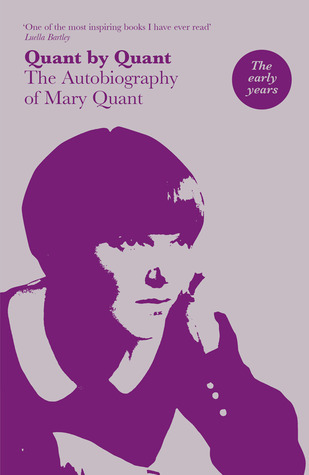
Quant by Quant: The Autobiography of Mary Quant
Originally published in 1966, Quant by Quant is the hugely entertaining story of fashion designer Mary Quant’s early career and life with her husband and business partner, Alexander Plunket Greene. After opening the groundbreaking Bazaar boutique on London’s King’s Road in 1955, Quant soared to international fame with her brand of witty style that fitted perfectly with modern life. Just as her signature styles have become synonymous with the pop culture of the Swinging Sixties, her joyful, evocative autobiography captures the world in which she found inspiration—and which she ultimately helped to define and change.
200 pages, Paperback
First published January 1, 1966
About the author
Mary Quant
12 books5 followersDame Barbara Mary Quant, Mrs Plunket Greene, DBE, FCSD, RDI was a British fashion designer and fashion icon. She became an instrumental figure in the 1960s London-based Mod and youth fashion movements. She was one of the designers who took credit for the miniskirt and hotpants.
Ratings & Reviews
Friends & Following
Create a free account to discover what your friends think of this book!
Community Reviews
Displaying 1 - 30 of 40 reviews

August 30, 2013
This is one of those books that is mostly a list of what the author did and it does not go deep enough to be interesting. To be fair, Quant has had such a fascinating life that she'd need about twelve volumes to do it justice! And there is the odd snippet here and there to add value.
I notice that in common with other successful people, she spends little time on regrets. Her parents refused to send her to a college that would teach her to make clothes. "If I had gone to fashion school at that time, I would have been taken to Paris to see the collections and taught to adapt them for mass production, as that was the way things were done. Luckily I wasn't."
Note the word 'luckily' Many people dwell on an event that ruined their life - I wanted to do X, but my parents wouldn't let me. Maybe it was lucky they didn't?
I notice that in common with other successful people, she spends little time on regrets. Her parents refused to send her to a college that would teach her to make clothes. "If I had gone to fashion school at that time, I would have been taken to Paris to see the collections and taught to adapt them for mass production, as that was the way things were done. Luckily I wasn't."
Note the word 'luckily' Many people dwell on an event that ruined their life - I wanted to do X, but my parents wouldn't let me. Maybe it was lucky they didn't?

November 22, 2013
This is one of my favorite books; especially its "in the moment" quality. As someone who works in music I love it's sense of scene and community and really it's a template of how artistic communities create and some explode like Soho in the 60's or Seattle in the 90's. I haven't owned it in years but if anyone comes across a spare inexpensive edition let me know; essential reference book!

August 21, 2024
Loveeeedddd. Thanks kamma 🫡fashion girls unite

September 18, 2018
This book really captured what must have been the heady, youthful exuberance of 1960s London. As someone who is interested in fashion history, I would really have liked some dates. I had to consult other sources to find out when the events Mary Quant talks about happened. And it isn't clear if her narrative is in chronological order. She talks about the fast-paced, wild fashion shows she put on with 'model girls' running around to jazz music - this book felt like one of those shows, in a good way.

Read
July 27, 2019what a terrifically fun read, Quant really conjures London in the 60s into her USA successes. After seeing her retrospective at the Victoria and Albert museum in summer 2019 this book really clarifies her reasons for becoming the designer for her generation

April 16, 2019
Entertaining, quick read with a few real gems of wisdom sprinkled across the swinging stories (and the descriptions of hard work).
July 31, 2026
Very interesting fashion history, but pretty hard to follow at times due to the lack of chapters and referencing/formatting. Plus, some shocking views towards women that made me feel uncomfortable, but this is very much reflective of the time it was written (60s).

June 10, 2023
Quite a disappointing read from someone who had such an interesting life. It sort of rambled on, with no logical sense of timelines - just random memories strung together. I wish there had been chapters to separate different stages in her life, but it just jumped all over the place.
She constantly name dropped, unaware that the reader might not know who she is talking about. A glossary or even some photos would have helped enormously.
She constantly name dropped, unaware that the reader might not know who she is talking about. A glossary or even some photos would have helped enormously.
June 20, 2020
A stream of consciousness from Mary herself that portrays her personal character and the fashion industry through the 60s, however the layout of the book is confusing as there are no chapters of dates and feels as if everything is being thrown at you all at once.
May 7, 2019
For someone who led such an exciting life it was rather dull. It failed to capture the vibrant London scene of the Sixties. The lack of chapters made it rather monotonous.
May 24, 2019
Exuberant!
In May I visited an exhibit of Quant's work at the Victoria & Albert Museum. The dresses were such a fun, accessible alternative to the also-running Dior ensembles. And, 100%, they represent mod-Britain (the look and mood of 1960s London). The exhibit didn't do near enough to explain who Quant is -- so I picked up this book.
It's an unbroken remembrance of the challenge and fun of starting a clothing line. It speeds through impressions of parties and wild travel and spectacular personalities and the work of design. Lacking in detail, the spirit of speed and irreverence and -- always -- fun spin off the page.
"Good designers . . . know that to have any influence they must keep in step with public needs ... public opinion ... and that intangible 'something in the air'. They must catch the spirit of the day and interpret it in clothes before other designers begin to twitch at the nerve ends."
"Fashion is the product of a thousand and one different things. It is a whole host of elusive ideas, influences, cross-currents and economic factors, captured into a shape and dominated by two things ... impact on others, fun for oneself. It is unpredictable, indefinable. It is successful only when a woman gets a kick out of what she is wearing; when she feels marvelous and loos marvelous."
"I believe that happiness (like misery) is an extreme emotion that cannot be achieved by steering a middle course. It is an incidental that takes us by surprise and the more we pursue it, the less likely we are to achieve a moment of absolute happiness. Such moments always take us by surprise ... often we don't recognize them until they are over."
In May I visited an exhibit of Quant's work at the Victoria & Albert Museum. The dresses were such a fun, accessible alternative to the also-running Dior ensembles. And, 100%, they represent mod-Britain (the look and mood of 1960s London). The exhibit didn't do near enough to explain who Quant is -- so I picked up this book.
It's an unbroken remembrance of the challenge and fun of starting a clothing line. It speeds through impressions of parties and wild travel and spectacular personalities and the work of design. Lacking in detail, the spirit of speed and irreverence and -- always -- fun spin off the page.
"Good designers . . . know that to have any influence they must keep in step with public needs ... public opinion ... and that intangible 'something in the air'. They must catch the spirit of the day and interpret it in clothes before other designers begin to twitch at the nerve ends."
"Fashion is the product of a thousand and one different things. It is a whole host of elusive ideas, influences, cross-currents and economic factors, captured into a shape and dominated by two things ... impact on others, fun for oneself. It is unpredictable, indefinable. It is successful only when a woman gets a kick out of what she is wearing; when she feels marvelous and loos marvelous."
"I believe that happiness (like misery) is an extreme emotion that cannot be achieved by steering a middle course. It is an incidental that takes us by surprise and the more we pursue it, the less likely we are to achieve a moment of absolute happiness. Such moments always take us by surprise ... often we don't recognize them until they are over."
June 6, 2026
Quant by Quant by Mary Quant - OK/Interesting
I was around 5/6 when this book was written so I don't really remember the events discussed, but I do remember Mary Quant, Barbara Hulanicki (Biba), the fashion revolution of the 60s and the 'London Look'. Mary Quant was pivotal in this, I remember her fashions and I still have some of the makeup in my possession.
Because this book was written in 1966, it is of its time. It's written in a breathless pace with no chapters and no obvious stopping points, just paragraph after paragraph of memories of how she got started in fashion and her rise to fame - plus a little of her childhood. In some respects this works and in others it's a little confused - there are no dates for example. She also assumes that all the names she drops are actually folk that are famous enough to be remembered, some are, some I have no idea about.
Regardless, the tales she tells of the chaotic beginning and sheer luck that got her started and the hard work and talent that saw her thrive were great fun. Life then was just so different. I wonder if she was to have started now, would she have been able to succeed in the same way? Would her talent have seen her thrive regardless or would today's strictures have meant it was just too difficult to get off the ground.
I was also amused by the language, attitudes and adventures - young women today would definitely not appreciate being called 'birds' or 'dollys' for example. So much smoking and so many risky, chance encounters. The joys of just rocking up to an airport with a dozen cardboard boxes of clothes instead of luggage.
Definitely of the times.
#review
I was around 5/6 when this book was written so I don't really remember the events discussed, but I do remember Mary Quant, Barbara Hulanicki (Biba), the fashion revolution of the 60s and the 'London Look'. Mary Quant was pivotal in this, I remember her fashions and I still have some of the makeup in my possession.
Because this book was written in 1966, it is of its time. It's written in a breathless pace with no chapters and no obvious stopping points, just paragraph after paragraph of memories of how she got started in fashion and her rise to fame - plus a little of her childhood. In some respects this works and in others it's a little confused - there are no dates for example. She also assumes that all the names she drops are actually folk that are famous enough to be remembered, some are, some I have no idea about.
Regardless, the tales she tells of the chaotic beginning and sheer luck that got her started and the hard work and talent that saw her thrive were great fun. Life then was just so different. I wonder if she was to have started now, would she have been able to succeed in the same way? Would her talent have seen her thrive regardless or would today's strictures have meant it was just too difficult to get off the ground.
I was also amused by the language, attitudes and adventures - young women today would definitely not appreciate being called 'birds' or 'dollys' for example. So much smoking and so many risky, chance encounters. The joys of just rocking up to an airport with a dozen cardboard boxes of clothes instead of luggage.
Definitely of the times.
#review

May 31, 2023
One of the few good feats of this memoir is how vibrant and fresh its voice comes across; as if directly transcribed from a very jolly conversation or soliloquium. One of its greatest defeats, on the other hand, is the slender hand of the editor, if there was any—no one appears in the credits and, after a fruitless search all through the web, I am led to believe there wasn't even one.
Instead of a window to a fascinating life, it feels more like a muffled peephole; it focuses mainly on the surface and, when it gets to a more substantial peak (her retelling of the time she met Schiaparelli at al luncheon is, perhaps, the best part so far), it loses focus and space in trivial thoughts—like musing over how "an intelligent English girl" could not really get raped by an American man because of her "fairly startling sophistication."
Fairly enough, it does survive steadily as a fashion history text, not only because it paints a detailed picture of the dawn of a completely new and radical dynamic in the traditional fashion system—the Youthquake and the big leap of British fashion across the pond—but also for the wise knowledge it offers to young designers when it comes to translating ideas to mass production and on retail marketing, even if the lessons come from a completely different society in history. But again, what is Quant's contribution if not timeless…
Instead of a window to a fascinating life, it feels more like a muffled peephole; it focuses mainly on the surface and, when it gets to a more substantial peak (her retelling of the time she met Schiaparelli at al luncheon is, perhaps, the best part so far), it loses focus and space in trivial thoughts—like musing over how "an intelligent English girl" could not really get raped by an American man because of her "fairly startling sophistication."
Fairly enough, it does survive steadily as a fashion history text, not only because it paints a detailed picture of the dawn of a completely new and radical dynamic in the traditional fashion system—the Youthquake and the big leap of British fashion across the pond—but also for the wise knowledge it offers to young designers when it comes to translating ideas to mass production and on retail marketing, even if the lessons come from a completely different society in history. But again, what is Quant's contribution if not timeless…
April 26, 2024
Very interesting to read how Mary Quant’s rise came about. You can feel the quirky vibe of the time and she tells us of some truly crazy experiences that she had. It made me feel tired just reading about the amount of work she put in, an effect increased by the fact that there are no chapters in this book which makes it all feel a bit breathless. Consequently, I felt that I would have enjoyed it more if there was a bit more structure to the story and a bit more detail to some of the events. It would also have benefited from some photographs of the people, places and clothes she was talking about.

September 3, 2018
The lack of chapter breaks gives this book a breathless quality, like she took one deep breath and started telling her story, and didn’t pause at all until she’d said all she had to say. I suppose that might give the reader a small taste of what it would be like to be there at the beginning helping to create the mod era. This is an enjoyable read for anyone with an affection for that time period. Now I want to look up old advertisements to see her designs as they were really presented in the day. (There are an handful of black and white photos in the book.)

April 10, 2025
I very much enjoyed reading about the life of my favourite designer. Mary's writing made me feel at the center of it all as I learnt about her design techniques, relationships and intimate feelings at the time. I found the book often hard to follow due to there being no chapters,, I understand this is reflective of the chaotic nature of the fashion industry but still. The book was also written in 66 so there is a lot of dated attitudes towards women that completely shocked me. All in all,, I enjoyed the book but found the second half less exciting and hard to keep up with.

January 8, 2020
I started this book months ago after seeing the Mary Quant exhibition at the V&A in August. An interesting story, as with many autobiographies it dragged in places but anyone remotely interested in clothes or fashion would enjoy this book. I particularly liked the last third where she talks about their expansion into the US.

April 28, 2025
“Clothes are not only necessary for warmth and decency but are also an essential factor in the delicate art of putting oneself across…socially, professionally, and commercially. Trend-setting demands confidence as well as perseverance. But, more than anything else, it demands a flair for choosing a look that will catch on despite all initial opposition.”

September 22, 2019
Quite an entertaining read despite a complete lack of chapters and some very old fashioned ideas. Very interesting to look back on the Youthquake era and realise how far further they still had to go.
February 25, 2020
An exhilarating read! Not only will you not want to put it down, you won't be able to because THERE ARE NO CHAPTERS (at least in the first edition I read). I highly recommend it to anyone starting out in their career, and especially the creative arts.

March 5, 2022
Just a crazy personal account of her life. A facinating read. Her life seemed so chaotic and with no agenda, especially in the early days, but her drive for business and passion for fashion really comes across. Mad but great.

December 11, 2023
really fun learning more about Mary quants life! Such an inspirational design and just person in general! Took me a while to get through because there was no chapters and I struggle with that but worth it in the end!

September 18, 2024
This was an ok biography. It felt a little slow at times and frankly a little repetitive. The voice was very fun though and I loved the joy the book seemed to express. I don’t know if I would necessarily recommend this over a different autobiography but it’s pretty solid.

February 4, 2022
If this was fiction you wouldn’t believe half the events described. A fascinating insight into her rise to fame and the hard work it took to get there.


August 27, 2023
Well, you can tell this wasn't written by a ghostwriter - entertaining but very confusing, and the real interest is around 2/3 in as Mary gets to the detail of her design career.
June 17, 2024
Super fun. Love that I was written in the 60s when it was all happening and like that it just feels like she’s chatting to you
June 28, 2024
I have been raving about this book, just so many bonkers stories told in a no nonsense way.

January 14, 2026
Terribly chic and fun. Fashionista fabulousness. Quant recounts her career as well as her ties with the supernatural...
Displaying 1 - 30 of 40 reviews