Jump to ratings and reviews
Rate this book

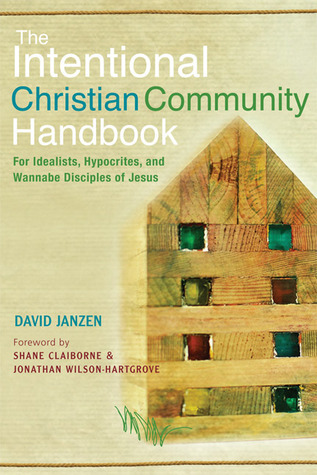
The Intentional Christian Community Handbook: For Idealists, Hypocrites, and Wannabe Disciples of Jesus

Rate this book
“This is a book that we've needed for a long, long time . . . . This is a book for people who long for community and for people who've found it; for young seekers and for old radicals. Like a farmer's almanac or a good cookbook, it's a guide that doesn't tell you what to do, but rather gives you the resources you need to find your way together with friends in the place where you are. We couldn't be more grateful to have a book like this. And we couldn't be happier to share it with you.” —Shane Claiborne and Jonathan Wilson-Hartgrove

In the 21st century, a new generation of Spirit-energized people are searching for a new—yet ancient—way of life together. David Janzen, a friend of the New Monasticism movement with four decades of personal communal experience, has visited scores of communities, both old and new.  The Intentional Christian Community Handbook  shares his wisdom, as well as the experience of intentional Christian communities across North America over the last half century.

338 pages, Paperback

First published January 1, 2012

31 people are currently reading
244 people want to read

About the author

David Janzen

30 books4 followers

Ratings & Reviews

What do you think?
Rate this book

Friends & Following

Create a free account to discover what your friends think of this book!

Community Reviews

5 stars
35 (27%)
4 stars
54 (41%)
3 stars
28 (21%)
2 stars
10 (7%)
1 star
2 (1%)
Displaying 1 - 13 of 13 reviews
Profile Image for Nathan.
341 reviews11 followers
April 11, 2021
This is the book to turn toward if you are considering intentional Christian community. Janzen brings half a century of experience and wisdom in every question about Christian community. Often he offers wisdom to questions in response to questions that you haven't even considered yet.

The book is divided into 6 parts with 3 to 6 shorter chapters in each part, and with each part Janzen moves from those just interested, yearning, and/or discerning a call toward community all the way to how mature communities plant new communities. Throughout Janzen addresses countless questions about community, maybe which a noobie would not even know to ask.

Practical. Insightful. Overflowing with wisdom and good advice. Recommended.
Profile Image for James.
1,506 reviews115 followers
February 11, 2013
Review orginally posted at thoughtsprayersandsongs.com: http://thoughtsprayersandsongs.com/20...

My experience in intentional community is limited. About nine years ago my wife and I did Mission Year in Atlanta. We lived in community with three other couples and invested in our neighborhood there. After a year, we moved with one of the other couples to Miami and continued community living. At the end of that year, they went their way and we went ours. Community living had its headaches and there are things we would do differently, but my wife and I grew from our experience (and still love the couple!). Currently, my wife and I live in a house in a gated community. We do not know our neighbors beyond polite pleasantries. We commute to church. We often feel isolated from those who know and love us best.


The Intentional Christian Community Handbook was written as a guide for those in community, or those who are interested in intentional community living. The subtitle of the book indicated it is “For Idealists, Hypocrites and Wannabe Disciples of Jesus.” I happen to be all three, so I read with interest. David Janzen helped found the New Creation Community in Newton, Kansas in 1971. In 1984 he moved to Evanston, Illinois to be part of Reba Place Fellowship and has been there ever since. He is someone with a wealth of experience living in a ‘thicker’ style community where community members pool possessions and resource and share life together. He is also in conversation with a variety of other intentional communities. In these pages, Janzen offers his wisdom for thos who interested in community, and what practices will sustain communities for the long haul.

This handbook is divided into six sections which address different aspects and stages of community life. In part one, Janzen talks about the longing for community in our individualistic, consumeristic culture. Trends in society have contributed to the break down of families and communities. Those who long for intentional community are bucking those trends.

In part two Janzen helps those interested in community discern ift a particular community context is right for them. He asks probing questions about what the calling of that particular community is, and whether or not you as the individual can find a place in that context. However he also cautions this is not an individual decision. He suggests interning with the community, finding mentors and discerning your personal call with the wider community.

Part three examines considerations which precede community formation. What will community look like? What is the calling and purpose of this community? Where will we put down roots? How will your community commit to racial reconciliation and gender equity? Or will it? This section is fairly practical, and Janzen shares examples of what various communities have done.

Part four talks about the first year of community living. He urges new communities to work-out leadership structures, to thoughtful navigate careers and schedules and advises new communities to connect with other more established communities. he challenges communities to clarify how they share life together (be the church).

In part five he discusses some of the growth edges for young communities. A community rule of life or a covenant may seem unnecessary in the early years of community but as a community matures they clarify identity and purpose. Likewise, there will be growth and change in some community practices. Justice around food and creation care may occupy a more significant place than in earlier years of community life. Communities also faces challenges when people leave, or fail to live up to the community’s ideals. One major challenge for growing communities is the presence of children. It is easier for single people to commit their life and resources to a cause and live in a ‘risky neighborhood.’ As families grow, communities change and often members move to ‘safer’ outlying neighborhoods.

Finally part six addresses issues relevant to the mature community. The communities need avenues for healing hurts, uniting for a common mission, sustaining prophetic vocations, accountability, nurturing new communities, and caring for and challenging the ‘execptionally gifted person.

Janzen has numerous examples from his own community life and from a variety of other intentional communities. I was pleased to see one of my mentors (Leroy Barber) profiled in the book. Because each community is different, this book is by necessity non-comprehensive. However it gives good food for thought and sage advice to all who are on the road to intentional Christian community. People in their twenties and thirties who have read Jonathan Wilson-Hartgrove or Shane Claiborne (who wrote the forward) will find Janzen to be a wise guide as they seek to live in community. Longstanding communities will also find places of challenge and growth. This is a very thoughtful resource!

I do not currently live in intentional community, but part of me still longs for it. Maybe this book will sow the seeds of something new for me and my family. Maybe it will for you too. I give it five stars ★★★★★

Thank you to Paraclete Press for Providing me a copy of this book in exchange for my honest review
Profile Image for Alexis Neal.
460 reviews61 followers
November 15, 2012
An excerpt of a two-part review recently posted on Schaeffer's Ghost:
The Christian church has ceased to be a body and has become instead a disconnected assortment of individuals. We no longer care for one another, meet one another’s needs, or walk alongside one another as the early church once did. “Church” has become somewhere we go once a week instead of something we are on a daily—or even moment-by moment—basis. We are fixated on personal autonomy instead of godly submission to one another, we cling to personal possessions instead of viewing them as gifts from God to be stewarded for His glory and the benefit of others, and we seek to elevate our own careers and reputations instead of prioritizing the health and vitality of Christ’s beloved church in the world.

So says David Janzen, and I confess, I think I agree with him. He raises valid criticisms about the current state of ‘community’ in the church, the materialism that pervades our society, and the emphasis on individualism and independence and self-determinism as unimpeachable human rights to be protected and celebrated (an attitude that has, I think, a unique appeal to Americans, given our historical narrative). He takes issue with the modern idea of watered-down, milquetoast community. And I have to say, he has a point. The trouble is I’m not sure his solutions don’t cause more problems than they purport to solve.
Full review available in two parts here and here.
283 reviews13 followers
October 3, 2019
Book Review: The Intentional Christian Community Handbook:

For Idealists, Hypocrites, and Wannabe Disciples of Jesus
(book by David Janzen; review by Benjamin Vineyard)

Questions:

How can we create an environment where it is more natural for us to follow Jesus?

As a person new to intentional common life, how can my own community grow and nurture one another in the way of Jesus?

What does it mean to be “intentional” as a Christian community? What do we intend to be and do? How will we nurture our intent to do and be this?

Quick Overview:

The Intentional Christian Handbook is an excellent guide for those in community and those discerning such. Each chapter provides excellent questions to process as a community; the questions will help shape common life and underscore the why, what, when, where, who, and how, of being “intentional.”

The Review:

Last fall, my wife and two little boys (four and two) prayerfully discerned joining friends in a common life together in Kansas City, Kansas. The decision felt enormous. We were leaving a comfortable, suburban landscape and transplanting our little boys in a world showing strong signs of poverty and where most neighbors knew Spanish much better than English.

We were drawn to this, knowing that it would be redemptive for us and our boys to live in an environment that was not pursuing (generally speaking) suburban luxuries but sheer simplicity (often by necessity).

We also saw that the neighborhood was undergoing some neat revitalization and felt tugged to explore how to participate. However, the greatest sense of call was exploring how to live a common, intentional life with others in the way of Jesus.

The call to discipleship is a freeing and necessary call. Those interested in intentional community know that. We've tasted it when we've studied the Gospels with friends. Hunger for life in Christ has propelled us to pursue the freedom and necessity of discipleship; a growing desire has been percolating within our souls, rising to see us discover how to create environments and relationships that are built on the Way of Jesus.

We see such a creation as necessary because we've tasted isolation and seen in our own lives that discipleship is hard to sustain. It's easy to slip back into old habits unless there's a voice, a new people who are attempting to live a particular way alongside you.

David Janzen's book, The Intentional Christian Community, was written to help those who see the freedom and necessity of being disciples of Jesus, and who see that in order to walk the way of Jesus, you need to be surrounded by folks who crave the same thing - not just know about such people, but live a life immersed in one another's presence.

As I read the first few chapters of Janzen’s book, I asked myself, “what's the 'problem' the book addresses?”

The problem is that while we want to be sincere disciples and we know community is more than a catch phrase, the kind of community that supports discipleship is very foreign to most of our experiences. We don't know how to do it, create it, or sustain it. We need guidance from those who have been learning through the messiness of intentional common life in common discipleship.

Messiness, it turns out, has become something of a treasured token in community life; messiness gets used as a slogan: “Come on! It's so messy and organic and we just do life like Jesus!”

That's a beautiful way to begin, but we also taste that messiness makes it hard to sustain a life together when you're trying to build stability, discover a common rhythm to life together, and become well-practiced in loving one another. So, while we desire an organic feel in common life, we must work through the mess in order for the community to become fruitful, to nurture things that are truly organic rather than toxic so we can produce life together. (No, we won't get rid of the mess, but hopefully by grace and in time, we in community can learn how not to let mess cause animosity and jealousy.)

Janzen quoted a friend about the desire for organic nature in community on p.50: “…the delightful paradox of building organic community is that 'organic' doesn't happen spontaneously. Organic farming takes years of intentional soil preparation, careful observation of nutrient levels, and patiently disciplined nurture of each particular field.”

Personally, for every organic, go with the flow, nuance of my own group (nuances that I love), I have felt a paradoxical drive to iron out rhythms and intents that would help me, first of all, and us by extension, stay focused on the reasons we were doing what we were doing.

This “ironing out” process is what is at the heart of Janzen's book. I believe it’s also in the soul of a group as they pursue questions like: What does it mean to be “intentional” as a Christian community? Just what do we intend to be and do? How will we nurture the intent to do and be this?

So, it's helpful to pause and ask, “What does it mean to be an intentional Christian community?”

Janzen wrote, “Our working definition of intentional Christian community is a group of people deliberately sharing life in order to follow more closely the teachings and practices of Jesus with his disciples. The more essential dimensions of life that are shared – such as daily prayer and worship, possessions, life decisions, living in proximity, friendships, common work or ministry, meals, care for children and elderly – the more intentional is the community.” (p.12)

If that's “intentional community,” then why am I drawn to it?

“The journey of individuals to community often begins with an ache that has no name, a longing for God, it turns out.” (Janzen, p.26)

This is definitely how my story led me to community life. I have longed for what Janzen wrote on p.94, “We grow in Christ by being in an environment where it is natural to ask one another, 'What are you hearing from the Lord in your quiet times?' 'What have been your desolations and consolations this week?' By asking questions like these and by listening well, we draw water for one another, reviving thirsty souls.”

I know that such an environment doesn't come natural. Janzen spoke to this on p.48, saying, “Sharing life either as a close-knit, extended biological family or as an intentional Christian community requires a relational toolbox of habits, wisdom, rhythms, and values to hammer out challenges and construct durable friendships. …Habits such as learning to listen to one another well, how to initiate confession and forgiveness, how to defer and submit our preferences, doing others' dishes cheerfully, sharing discernment over major life decisions, and sundry other tools for living in unity with others must often be instilled from the ground up.”

The dominant question I felt lingering in the background of Janzen’s book was, “How can communities become intentional and what will they be intentional about?” The obvious answer is that we intend to be disciples of Jesus, but we always face that ideal with the question: “How can we nurture and intend to do that together? How can we keep our focus, not stray to a million side projects, and simply love one another?”

In order to support intentional common life in the way of Jesus as a community, I felt Janzen leading me to see that any community needs to create something akin to the ancient Rule of Life. They need to pray, discern, and listen to the Spirit of God within one another and write out just how they feel called by God to live as disciples within their context. It's one thing to read the Gospels and say, “Let's do this,” and another thing to read the Gospels and say, “This is how we’ve discerned God’s call for us and how we will nurture and do this together.”

The basic idea is that, “A 'rule of life' is an attempt to put down on paper the way that a small group of people agree to live together so that their every effort moves them closer to God.” (The Rule of St. Benedict, © 2012 Paraclete Press, introduction) It's something that would remain fluid and could change based on discernment, prayer, and conversation. Yet, it would also be a solid guide for helping people in community learn the new, foreign rhythms together.

Creating a Rule of Life, then, is a necessary step for communities to take. It helps remind the group why they're doing what they've discerned to do; it also helps a group step into the uncomfortable nuances of close quarters life. A Rule is a statement of intentionality, a step in the group spelling out how the plan to nurture their life together. Janzen simply says, “The community's rule answers the question, How shall we live faithfully in response to the story of what God has given?” (p.198)

Janzen wrote some excellent questions that were intended for potential new-members of an intentional community. I think they’re excellent and worth sharing; they’d make a great starting point for communities to discern writing down the rhythms of their life together. Imagine the freedom and grace of being able to ask and hear questions like this!

Are you developing a spiritual life of regular conversation with God nurtured by common prayer, listening to the Lord, corporate worship, Bible study, and times of contemplation? In what personal spiritual disciplines of you want encouragement and accountability?

Is the practice of confession of sins, forgiveness, and reconciliation in relationships operational in your life? Do you understand Jesus' call to peace and nonviolence, including the love of enemies?

Are you submitting basic life decisions to the spiritual discernment of your small group of people in the Community? Are you willing to stay or be sent according to the Spirit's leading as discerned in the body of Christ at (Name of Community)?

Do you accept Jesus' teachings regarding renunciation of personal possessions, and is this your intention regarding your own belongings? Are you ready to join in the community of goods, to live simply and be content with what you have, be generous and share with others, trust God for future needs, and receive everything with thanksgiving? Do you believe God is calling you to freely share your spiritual gifts and material resources, and do you understand how this works at (Name of Community)?

Do you understand how (Name of Community) works on a practical and organizational level? Do you know how to access shared resources either to give or to receive?

Do you seek to maintain sexual integrity in thought and behavior, whether in singleness or marriage, with support from the community, as taught by Jesus?
Has a bond of trust formed between you and other (Name of Community) members?

Do you sense that you belong to this people, to serve and be served, to give and receive admonition? Is it natural for you to talk about (Name of Community) as “we,” “us,” and “our?”

Are you in a personal mentoring relationship, and are you mentoring others in the way of Jesus?

We are a people in mission. Can you affirm the (Name of Community)'s mission? Are you prepared to offer your gifts and passion, as God gives you grace, to seek the welfare of the people in this neighborhood where God has planted us, with special attention to the poor?

Finally, the substance of making a rule is the opposite of institutionalization; it’s rather a basic form of stating how we intend to love one another by saying, “Here's how we as a community have felt called to handle our struggles and brokenness together.” It will always need work, and it isn’t written to create barriers, but to set people walking toward freedom in the common life, following Jesus.

Additional Suggested Reading:
1.) Being Church by John Alexander.
2.) The Rule of Saint Benedict by Paraclete Press (Forward by Jonathan Wilson-Hartgrove).
Profile Image for Robert Irish.
755 reviews17 followers
December 31, 2018
This well-meaning book aims to help us understand the nature of Christian communities by looking at intentional new monastic communities. It works through many nitty-gritty details of the organization of such groups. It attempts to offer inspirational (or cautionary) stories from various experiences in such communities, but on the whole it falls short. The stories are so specific to their place and time that they do not offer much insight. The details that Janzen works through miss out on the larger questions of the value and meaning of such groupings.
14 reviews
May 8, 2024
A resource to contemplate alternative models of living, inspiring and challenging, honest and helpful
Profile Image for Richard Fitzgerald.
589 reviews9 followers
May 6, 2022
Janzen has written a handbook on developing and sustaining a Christian communal living arrangement. I’m sure it’s a helpful handbook in some situations. I thought it was moderately repetitive. Further, the book struggled to convey the deeper aspects of communal living. As a resource, especially for finding help, it is probably a good but possibly quickly dated book. In the end, I was unconvinced.
Profile Image for Robert D. Cornwall.
Author 35 books126 followers
December 1, 2012
A new interest in intentional Christian community has taken hold in the Christian community. People seeking community want more than a Sunday experience, but instead want to engage others in daily life. Monasticism was developed as a way of providing community, usually for celibate men and women who lived in separate communities. The New Monasticism has a broader vision that includes families as well as singles; adults as well as children.

David Janzen, a long time participant in intentional Christian community provides a detailed handbook that explains the benefits and the concerns of such a life, as well as providing proper guidance for effective and lasting community life.

If you're at all interested in intense community this is a good place to go.
Profile Image for Sagely.
234 reviews24 followers
July 28, 2014
A lovely, practical book for all followers of Jesus in North America (and probably elsewhere as well).

Each of the chapters take up one of the real aspects of discipleship and probe the challenges and joys with hands-on, how-to counsel. The lens of intentional Christian community works, as in Bonhoeffer's Life Together, as a clarifier, a purifier that shows up the real meat of discipleship in a wonderful way.

For those of us not called (at the moment) into intentional community, this book still offers a lot. It might just as well have been titled the The Intentional Church Handbook. (I hope to use this book in a small group setting in out conventional church in the next year.)
27 reviews
April 28, 2015
Didn't really think it took into account people who don't want to live in a forced community. Everyone lives in a community, how involved you are is up to you. Creating a community where you only have the people who think like you is why clubs, organizations, and churches have been created. This just encourages people (especially Christians) to think of themselves as better than "non-intentional" communities. This view may be because this is the type of people I read this with in a "book club" that felt more like a call to be "one of them, one of them, one of them" and not a discussion.
Profile Image for Alex Gordon.
78 reviews4 followers
July 11, 2015
I have been very blessed to have met this man. What a sage. What a kind soul. :) If you are even a little interested in intentional community, this is a must read. This man has been in it since before the 70's I think.
Profile Image for Katherine.
74 reviews
February 11, 2013
an easy to read book on a topic close to my heart! lots of real life examples that make a lot of sense. if christian community is on your agenda I would think this is a must read.
Profile Image for Trace.
1,031 reviews39 followers
May 3, 2013
My bad for not knowing that Intentional Christian community means communal living.... not the sort of Christian community that I am seeking.

Displaying 1 - 13 of 13 reviews

Can't find what you're looking for?

Get help and learn more about the design.