We do not know if Journey to the West is really a great book, and you must read the explanation in the following review.
(That's how all the chapters in Journey end.)
This is the first volume of the widely celebrated and frequently adapted 16th-century novel, most likely written by Wu Cheng'en. It has a lot in common with the storytelling forms and content of the other Four (or Six) Classic Novels of China, including the astonishing length, episodic narrative, and folksy sensibility. But Journey still stands apart.
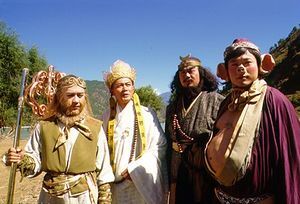
Its cast of characters has an incredible degree of variety and depth. Farmers, monks, monsters, gods, and even Lao Tzu and the Buddha appear, but the reader's heart is first and finally won by Monkey, who dominates the first several chapters. He lives in an Edenic paradise but he cannot bear the realization that he will one day die, so he travels across the world searching for the secrets of immortality and magical powers. He's successful and shortly after earns a seat alongside the gods and sages in heaven. Monkey becomes wise and powerful but also more foolish, capricious, and destructive. He wreaks havoc in heaven and it takes none other than the Buddha himself to curb him and lock him away until he can become useful.
Monkey is a tremendous and beautiful creation -- surely one of the greatest characters in fiction -- who is endlessly endearing, maddening, and shocking. The "monkey mind" concept in Buddhism certainly informed Monkey's creation and meaning in Journey, but the strength of the characterization points to one of the core conundrums of the work as a whole: if Monkey represents the agitated and aimless workings of the unenlightened human spirit, then why do the very gods above fail time and again to contain him? And why do we love and endure him even in his most craven or perverse moments? This reflects a broader conundrum: why is this book about Buddhism -- the religion of nirvana and dharma -- so fun and action-packed? Answering that last question might take one deep into the collision of elite and popular culture as embodied in the great Ming novels.
The following several chapters build towards the introduction of the basic plot and the other main character of the novel, the monk Tang Sanzang. For after locking away Monkey, the Buddha dispatched the Boddhisattva Guanyin on a mission to the Tang imperial capital, Chang'an, to find a monk who could travel to his holy temple in India and retrieve some sacred scrolls. It's a sort of celebratory trial that the Buddha has devised for our as yet undiscovered monk. Along the way to Chang'an, Boddhisattva Guanyin encounters Monkey and the other sinful monsters who will become the monk's companions for the sake of their own redemption. And when she's finally reached Chang'an, the reader is dropped into a very different world from the fantastical regions that Monkey inhabited.
Chang'an is a real place with credibly written medieval people, so the author expertly slows down the pace to allow us to readjust to our new surroundings. This happens through interlinking digressions of characters and storylines -- at one point we are five layers deep into a digression and start to hear about chess strategy. Finally, the Emperor appoints Tang Sanzang for this most important mission and he sets out on the perilous road to India. He is a scrupulous, pious, and honest Buddhist -- lacking only in a bit of courage, but who can blame him when basically the first thing that happens is his aides get dismembered and devoured by monsters.
Much of the rest of the first 25 chapters of Journey follows his trek beyond the Western bounds of the Tang empire. He encounters strange and sinister characters, dramatic landscapes, and of course, his pilgrims Monkey, Pig, and Sandman (I'm going with the simplest of their many names and titles). This is a masterclass in picaresque storytelling on every level, and the dynamic of Tang Sanzang and his pilgrims -- Monkey, especially -- has a similar magic as Don Quixote and Sancho Panza's.
And sure, there's no need to shy away from it: it's obvious that this is exactly the kind of narrative format that works splendidly in a long-running serial adventure show or the main quest/side quest structure of a video game. Whenever Monkey goes out to fight a monster while Tang Sanzang stays behind quivering in fear with the horse and luggage, I was reminded of stuff like the Metal Gear Solid 2 mission when you (Raidan) have to babysit EE because she's afraid of everything. It must be a pain in the ass to be Monkey. But some of the other genres that we encounter in the course of a brisk 25 chapters include: epic, mock epic, fantasy, horror, satire, travel and pilgrimage chronicle, and comedy.
At its highest level, Journey is a Buddhist allegory. You have to dig into all of the footnotes to get a taste of the complex Buddhist cosmology and philosophy (with Taoist and Confucian inflections, of course, and a big helping of esoteric alchemy), and it's completely worthwhile -- essential, even. I'm nowhere closer to understanding its meaning as of yet (redemption? karmic rebirth? relinquishing attachment? it's not easy to fit it all together), but the allegory is rarely overbearing or distracting.
In fact, the moral dimension to some of the incidents is genuinely awe-inspiring. For example, early in their journey, Tang Sanzang and Monkey reach a monastery and meet an elderly monk who covets a sacred, beautiful cassock they're carrying. The old monk appears genuinely agonized that the cassock cannot be his, and that makes his long life worthless to him. He plots to steal it and madness and hilarity ensue. But how ridiculous is the old monk's covetousness, really? It cannot be any more or less pathetic than the many shades of covetousness we all harbor.
And as a Buddhist allegory, Journey is an incredible cross-cultural work -- it melds Tang China and Buddhist India as filtered through centuries of Chinese cultural development. Of course, the book is inspired by the real-life pilgrimage of a Chinese monk to India in the 7th-century. He didn't meet an immortal talking monkey, but he did traverse the Silk Road and all its hazards and he did bring back important scripture and thinking he'd gathered. By the the 12th-century, Buddhism died in its homeland, but it has stayed alive in East and Southeast Asia. Journey is a dramatization of the rescue of a faith.
By the end of the first volume, some of the book's features are close to wearing out their welcome. The story beats and characterization in the episodes begin to feel familiar. They weren't a significant issue before, but now the frequent interruptions for poetry and the compulsive repetition of reports starts to test the reader's patience (when one character has to tell another character what is going on: they tell them. And we read it.). Keeping the book going is a problem for the next 75 chapters to tackle. These first 25 are genius.
A note on translation: Anthony C. Yu wrote the definitive unabridged English edition, and it is lively, witty, and thoroughly researched. There are original and revised editions out there, and this time I read the original edition. I think the original suffices. It just has more typos than you find in your average book, and it uses the older romanization, Wade-Giles, rather than modern pinyin.
Gate! Gate! Paragate! Parasamgate! Bodhi Svaha!