

What do you think?

Strange Attractors
The City is an Engine. Heller Wilson has found the key. From acclaimed writer Charles Soule (27, Strongman, Swamp Thing) comes a mathematical thriller about Chaos, Probability, and the race to stop a citywide disaster. In 1978, Dr. Spencer Brownfield saved New York City from itself, bringing the city back from the verge of collapse and ruin. And for thirty years, his small, unnoticed adjustments to the city's systems have kept the city afloat. Or so he claims to Heller Wilson, a young graduate student that Dr. Brownfield has chosen as his successor. But are Dr. Brownfield's claims about The Butterfly Effect and how his "complexity math" apply to the city's patterns of life real, or are they the ravings of a man broken by the death of his wife and daughter, desperate to find some kind of control over the world around him? Part sci-fi, part philosophical exploration, part thriller, STRANGE ATTRACTORS examines what you can control in your life and what you can't, and how important it is to recognize the difference.
128 pages, Hardcover
First published November 13, 2012
About the author
Charles Soule
1,544 books1,729 followersCharles Soule is a #1 New York Times-bestselling novelist, comics author, screenwriter, musician, and lapsed attorney. He has written some of the most prominent stories of the last decade for Marvel, DC and Lucasfilm in addition to his own work, such as his comics Curse Words, Letter 44 and Undiscovered Country, and his original novels Light of the Jedi, The Endless Vessel, The Oracle Year and Anyone. He lives in New York.
Ratings & Reviews
Friends & Following
Create a free account to discover what your friends think of this book!
Community Reviews
Displaying 1 - 30 of 52 reviews

September 3, 2015
Stay awake in Math class and save New York City!
This one’s all about the Math, kids, but before you dismiss it by saying, “Jeff, I have absolutely no use for all that is fractal and you can take your differential equation and ….”
I’ll say this is actually quite good, Goodreader and what’s with the hostility?
New York City’s in big trouble and according to a “crackpot” ex-Math professor, it will take a series of seemingly random adjustments to avert disaster.
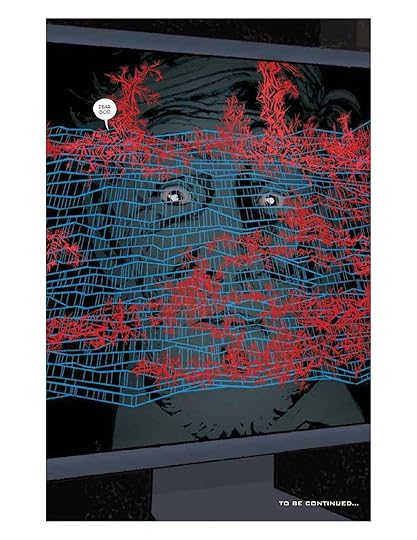
Scary graph, no?
It’s all about patterns, probability and chaos theory, in this heady mix of sci-fi, thriller and philosophy (and yes, Math) as a discredited (and crazy?) professor and grad student race against time to help keep New York City from complete collapse.
Soule is a smart guy who subtly infuses his superhero work with patterns and cause and effect scenarios. Thunderbolts #19, one of his best single issues for Marvel, has the Red Leader contemplating the demise of each member of the Thunderbolts as they all ride in a van somewhere on the Pennsylvania Turnpike. He weighs out the order in which each hero should be killed and the most expedient way of doing it. After getting stuck wedging in this group to the Infinity crossover, Soule got full reign to do something different. Check it out.
Bottom line: The Death of Wolverine aside, I’ve always, at least, liked Soule’s previous writing, but I wasn’t prepared for how much I really enjoyed this collection. Check out this ode to and appreciation for New York City.
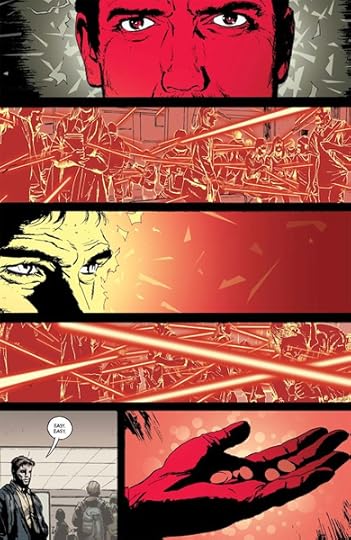
I see patterns. Everywhere.
This one’s all about the Math, kids, but before you dismiss it by saying, “Jeff, I have absolutely no use for all that is fractal and you can take your differential equation and ….”
I’ll say this is actually quite good, Goodreader and what’s with the hostility?
New York City’s in big trouble and according to a “crackpot” ex-Math professor, it will take a series of seemingly random adjustments to avert disaster.
Scary graph, no?
It’s all about patterns, probability and chaos theory, in this heady mix of sci-fi, thriller and philosophy (and yes, Math) as a discredited (and crazy?) professor and grad student race against time to help keep New York City from complete collapse.
Soule is a smart guy who subtly infuses his superhero work with patterns and cause and effect scenarios. Thunderbolts #19, one of his best single issues for Marvel, has the Red Leader contemplating the demise of each member of the Thunderbolts as they all ride in a van somewhere on the Pennsylvania Turnpike. He weighs out the order in which each hero should be killed and the most expedient way of doing it. After getting stuck wedging in this group to the Infinity crossover, Soule got full reign to do something different. Check it out.
Bottom line: The Death of Wolverine aside, I’ve always, at least, liked Soule’s previous writing, but I wasn’t prepared for how much I really enjoyed this collection. Check out this ode to and appreciation for New York City.
I see patterns. Everywhere.

May 8, 2013
Saving the world with mathematical modeling! And flash mobs.

April 27, 2018
Part advanced mathematics, part love letter to New York City. It's a genius concept. A disgraced professor has been using complexity theory to manipulate NYC and keep it healthy since the 1980's. We all know chaos theory and how the theory is that a butterfly flapping its wings in North America could cause a monsoon in Asia. Soule has expanded that to explain how a city that was such a hellhole in the 70's and 80's could return to international prominence and one of the safer cities to live in the U.S. There is something lost in the translation of the art to the page though. The beginning of the book looks like the professor just doing a bunch of random shit. You never see a causal relationship between cause and effect. The second half of the book does a better job in that regard. All in all though a fascinating idea for a book and well worth a read.

July 19, 2014
A man saves New York City with maths.
How awesome does that sound? Don’t bother reading this review - find it and read it now! It’s outstanding, I promise!
Heller Wilson’s writing his PhD thesis and decides to use the theories of disgraced mathematician, Dr Spencer Brownfield, which throws his chances of getting a doctorate out the window. But the more he learns of Brownfield’s ideas, the more he realises how brilliant he is. Using the same principle as the Butterfly Effect (a butterfly flaps its wings on one side of the world, a hurricane appears on the other), the two make small actions in specific areas of NYC at specific times to keep the city from imploding. But a perfect storm is gathering to destroy the city - can Heller rise to the challenge or will the city finally fall?
So many times in comics NYC gets saved by colourful superheroes in tights with powers and, yes, that’s because Avengers Tower is in the heart of Manhattan (for some reason - why paint a target on a densely populated area ripe for multiple casualties, especially as it gets attacked so often?), but when have you ever read a comic where an ordinary academic dude uses maths to save the city from destruction?
It is a bit like a superhero story because of the student being recruited by the aging master to act as guardian to the city, whose identity will never be known to the public, and who uses special mathematical algorithms (“powers”) to keep the city going, save lives, etc. The structure is quite similar, but it’s much more exciting than reading, say, Spider-Man as no characters’ existence is assured and none have any superpowers to protect or help them.
Charles Soule is one of the most remarkable comics writers to emerge in recent years. He’s currently writing Swamp Thing, Superman/Wonder Woman and Red Lanterns for DC, as well as She-Hulk, Inhuman and the forthcoming heavily-hyped mini-series, The Death of Wolverine (he was also writing Thunderbolts but has now left the title). Not content writing that many comics per month, he’s also writing Letter 44 for Oni - the man is a freakin’ machine!!
Not only is his output prodigious, but those comics are actually quite good. However, I would say his best work is in the indie fields - Strongman was great, Letter 44 is terrific, and Strange Attractors from Archaia? It’s my favourite Charles Soule book yet. To take this kind of high concept story with unknown nerdy bookish types as the leads and turn it into this unstoppable thriller takes a special kind of talent. It’s no wonder the Marvel and DC editors read this and thought “we need to hire this guy”.
Greg Scott’s photo-realistic art is stunningly beautiful. The panels are so detailed that even if you’ve never been to NYC, you’ll feel you have once you finish reading. There’s a clear love of the place from both creators as they take the reader on a tour of the world’s most famous city. Special mention has to be made to Robert Saywitz who designed the Complexity Maps that Heller and Spencer create to figure out where the trouble-spots will be ahead of time. They look like modern art sculptures on the page and they differ from when they’re the hand-drawn type in Spencer’s notebooks to the computer-generated type Heller creates. They’re just so awesome!
Strange Attractors was an amazing read. I got so drawn into it that I found myself barrelling through it much too quickly so I had to pace myself. Only read a few pages a day - it’s not often I read a comic this good and I wanted to savour it! - so it took me about a week to get through, though I could’ve gobbled the whole thing down in a single sitting easily.
It’s a fantastic, original story that’ll have you gripped from start to finish and it’s really well-written with one hell of an art team. Strange Attractors is the whole package - don’t miss it!
How awesome does that sound? Don’t bother reading this review - find it and read it now! It’s outstanding, I promise!
Heller Wilson’s writing his PhD thesis and decides to use the theories of disgraced mathematician, Dr Spencer Brownfield, which throws his chances of getting a doctorate out the window. But the more he learns of Brownfield’s ideas, the more he realises how brilliant he is. Using the same principle as the Butterfly Effect (a butterfly flaps its wings on one side of the world, a hurricane appears on the other), the two make small actions in specific areas of NYC at specific times to keep the city from imploding. But a perfect storm is gathering to destroy the city - can Heller rise to the challenge or will the city finally fall?
So many times in comics NYC gets saved by colourful superheroes in tights with powers and, yes, that’s because Avengers Tower is in the heart of Manhattan (for some reason - why paint a target on a densely populated area ripe for multiple casualties, especially as it gets attacked so often?), but when have you ever read a comic where an ordinary academic dude uses maths to save the city from destruction?
It is a bit like a superhero story because of the student being recruited by the aging master to act as guardian to the city, whose identity will never be known to the public, and who uses special mathematical algorithms (“powers”) to keep the city going, save lives, etc. The structure is quite similar, but it’s much more exciting than reading, say, Spider-Man as no characters’ existence is assured and none have any superpowers to protect or help them.
Charles Soule is one of the most remarkable comics writers to emerge in recent years. He’s currently writing Swamp Thing, Superman/Wonder Woman and Red Lanterns for DC, as well as She-Hulk, Inhuman and the forthcoming heavily-hyped mini-series, The Death of Wolverine (he was also writing Thunderbolts but has now left the title). Not content writing that many comics per month, he’s also writing Letter 44 for Oni - the man is a freakin’ machine!!
Not only is his output prodigious, but those comics are actually quite good. However, I would say his best work is in the indie fields - Strongman was great, Letter 44 is terrific, and Strange Attractors from Archaia? It’s my favourite Charles Soule book yet. To take this kind of high concept story with unknown nerdy bookish types as the leads and turn it into this unstoppable thriller takes a special kind of talent. It’s no wonder the Marvel and DC editors read this and thought “we need to hire this guy”.
Greg Scott’s photo-realistic art is stunningly beautiful. The panels are so detailed that even if you’ve never been to NYC, you’ll feel you have once you finish reading. There’s a clear love of the place from both creators as they take the reader on a tour of the world’s most famous city. Special mention has to be made to Robert Saywitz who designed the Complexity Maps that Heller and Spencer create to figure out where the trouble-spots will be ahead of time. They look like modern art sculptures on the page and they differ from when they’re the hand-drawn type in Spencer’s notebooks to the computer-generated type Heller creates. They’re just so awesome!
Strange Attractors was an amazing read. I got so drawn into it that I found myself barrelling through it much too quickly so I had to pace myself. Only read a few pages a day - it’s not often I read a comic this good and I wanted to savour it! - so it took me about a week to get through, though I could’ve gobbled the whole thing down in a single sitting easily.
It’s a fantastic, original story that’ll have you gripped from start to finish and it’s really well-written with one hell of an art team. Strange Attractors is the whole package - don’t miss it!

May 8, 2013
This is certainly an unusual idea. An aging, lonely mathematician (Dr. Spencer Brownfield) has devoted his life to continually saving New York City. What can one man do? Plenty, if he can apply chaos theory properly. According to him, he can use the butterfly effect to do small things that will eventually work huge changes. And the city is due for a major adjustment.
Just on the idea level, this was fascinating to me. Granted, I'm no mathematician, and what I know about chaos theory (complexity theory, it's called here) could fit into a teacup with room left over for the tea. But within the confines of the book, Soule's take made at least some sense to me. I never felt like I was over my head with the scientific basis, though I probably am. And I was interested enough in how the adjustments would work that I read through the end and wanted more.
That said, the characters themselves were flat and unconvincing. I didn't want to keep reading because I was invested in them as people, and they often didn't feel real. Towards the end of the book, a major revelation is made about Brownfield that should change our opinions of him, but it's glossed over and not given nearly enough time to take root before Soule moves on. And the finale ends up seeming a little trite and unrealistic.
That's a shame, because even though I enjoyed this book, it could have been much better. But if the very idea of an underground hero who uses the butterfly effect as his tool appeals to you, as it did to me, you'll enjoy this book.
Just on the idea level, this was fascinating to me. Granted, I'm no mathematician, and what I know about chaos theory (complexity theory, it's called here) could fit into a teacup with room left over for the tea. But within the confines of the book, Soule's take made at least some sense to me. I never felt like I was over my head with the scientific basis, though I probably am. And I was interested enough in how the adjustments would work that I read through the end and wanted more.
That said, the characters themselves were flat and unconvincing. I didn't want to keep reading because I was invested in them as people, and they often didn't feel real. Towards the end of the book, a major revelation is made about Brownfield that should change our opinions of him, but it's glossed over and not given nearly enough time to take root before Soule moves on. And the finale ends up seeming a little trite and unrealistic.
That's a shame, because even though I enjoyed this book, it could have been much better. But if the very idea of an underground hero who uses the butterfly effect as his tool appeals to you, as it did to me, you'll enjoy this book.

May 23, 2013
There is something particularly disheartening about a science fiction story that takes a novel idea and fails to exploit it in service of a compelling story. Strange Attractors certainly has a novel premise – that cities are complex mathematical systems that require constant correction in order to prevent cataclysmic collapse brought about by increased chaos – but author Charles Soule can't seem to make his characters feel like real humans living out a real crisis. The personalities fall flat, but what's worse is Soule's failure to properly evoke a sense of impending doom as his roughly sketched pawns run about, performing seemingly arbitrary acts of urban rebalancing. This is a story that needs some room to breathe, and Strange Attractors simply fails to suggest the scale of catastrophe that is described by the mad mathematical prophet, Dr. Spencer Brownfield. In what should be the climax of a tense speculative thriller, a small group of inspirational-t-shirt-clad volunteers work in unison to attempt a major adjustment to New York's wonky immune system, but it plays like one of those saccharine, corporate flash-mob events, complete with ad hoc inspirational music and A City Coming Together. Barf.

April 19, 2013
When I requested a galley copy of Strange Attractors (thank you, NetGalley and Diamond), I had two motives: I wanted to read a fun story, and I wanted to check out the work of the man who will be picking up writing duties on Swamp Thing and Red Lanterns, two comics I enjoy. I'm very happy on both accounts! The intricate maps on the first few pages sucked me in almost immediately, and I devoured the book in record time. I absolutely love stories with a strong sense of place, and Soule's version of New York is a living, breathing thing. I also enjoy stories with intelligent, academic-minded protagonists, and Strange Attractors definitely delivers. Despite not knowing a thing about higher mathematics (or lower mathematics, if we're being honest-- there's a reason I went into library science instead of physics or accounting), I found the idea of complexity theory fascinating, and Heller and Dr. Brownfield do a great job of selling it. My only complaint is that Strange Attractors is too short, and the ending was a a bit too neat and tidy for such a gloriously messy and complex story. I guess that's not so much a complaint as it is a plea for more stories set in this universe. My understanding is that this is a stand-alone original graphic novel, but there's so much potential here for an awesome ongoing series here that it would be a crime for this to be the end. More Heller the NYC guardian, please! In the meantime, I will make it a point to check out more of Soule's work, and I would recommend you do the same!

October 22, 2016
I went into this with no idea what I was going to read, and found myself completely blown away. The story explores complexity theory as a way to affect events (indirectly), and uses that as a basis for an exploration of the life and mood of a city (in this case New York). And the way it plays out, while in some ways predictable, still managed to catch me off guard, and even bring a smile to my face, as what Dirk Gently would call the 'fundamental interconnectedness of all things' is explored in unexpected ways. The art is nice, very line-heavy, and the complexity maps are fascinating pieces of art interspersed in the story. The use of color to display the sense of order and chaos works well, especially in the climactic finale, which manages to build a powerful level of tension without resorting to much violence.
Maybe I was just in the right frame of mind for this, or maybe it really is this good, but I strongly recommend this graphic novel. It's probably even more powerful if you love New York City, but it may still speak to you if you don't.
Maybe I was just in the right frame of mind for this, or maybe it really is this good, but I strongly recommend this graphic novel. It's probably even more powerful if you love New York City, but it may still speak to you if you don't.

December 6, 2017
Saving New York City with the power of math is a winning concept. And though the actual math is glossed over to the point that it practically becomes magic, that's okay, because the story is really about the magic of people looking out for each other and trying their best to make the world a little bit better every day. I disengaged my critical eye and let myself get swept up in the story.

January 23, 2013
I really enjoyed this graphic novel, even though I’m no mathematician and have never heard of “complexity theory” (though I have heard about chaos theory!)
The world created by the author is one where the greatest city in the world is constantly teetering on the brink of disaster and only an old math professor knows how to fix it – by doing things like putting ice cream cones on the lawn of central park and moving news stands around so that nothing is ever in the same place.
The story was entirely plausible; after all didn’t a stats guy pretty much predict how the last US presidential election went down months before we even knew who was going to get the Republican nomination? The book really made is seem like humanity is not a special snowflake, we’re an equation and if someone is smart enough to crack it they’ve got us figured out as a science. You can then use this science for good or evil, or to save New York City from itself.
The only thing I didn’t like about the book was the artwork. I found it used way too many shadows and dark lines to be enjoyable, but then again I hated the artwork from The Watchmen so it’s probably just me.
*Disclaimer: I received an e-ARC of this graphic novel from netGalley*
The world created by the author is one where the greatest city in the world is constantly teetering on the brink of disaster and only an old math professor knows how to fix it – by doing things like putting ice cream cones on the lawn of central park and moving news stands around so that nothing is ever in the same place.
The story was entirely plausible; after all didn’t a stats guy pretty much predict how the last US presidential election went down months before we even knew who was going to get the Republican nomination? The book really made is seem like humanity is not a special snowflake, we’re an equation and if someone is smart enough to crack it they’ve got us figured out as a science. You can then use this science for good or evil, or to save New York City from itself.
The only thing I didn’t like about the book was the artwork. I found it used way too many shadows and dark lines to be enjoyable, but then again I hated the artwork from The Watchmen so it’s probably just me.
*Disclaimer: I received an e-ARC of this graphic novel from netGalley*

November 1, 2017
A story about maths and cities that starts very strongly and creepily then gradually lets its momentum ebb away. The central problem - is the reclusive maths genius right, and if he is, is he hero or monster? - is what sustains interest. Once we start getting definitive answers to the first part interest starts to flag, and once the second part is swept under the carpet for a "hymn to this great city" style conclusion the series crumbles. Backup strip "Antithesis" mixes things up by showing the human impact of the protagonist's work, but - ironically given the plot - it feels like an injection of fake complexity into a story which has already made up its mind about whether the ends justify the means.
A more serious flaw is Soule's inability to rise to or even illustrate any of his themes well - the uncanny power of maths, the interconnection of human lives, the magic of NYC. Instead we get Sherlock-style overlays of lines to show the maths, 'random acts of kindness' which domino into resolved crises, and corny stuff about "saxophone players at midnight" as the spirit of the city. Strange Attractors is hardly the first paean to New York to disappear up its own algorithm, but that doesn't make it less disappointing.
A more serious flaw is Soule's inability to rise to or even illustrate any of his themes well - the uncanny power of maths, the interconnection of human lives, the magic of NYC. Instead we get Sherlock-style overlays of lines to show the maths, 'random acts of kindness' which domino into resolved crises, and corny stuff about "saxophone players at midnight" as the spirit of the city. Strange Attractors is hardly the first paean to New York to disappear up its own algorithm, but that doesn't make it less disappointing.

April 1, 2014
Knocked a star off because I could guess a couple of the beats before they happened (not that that's necessarily a bad thing, but a few of them were cliché) and because I never really got a sense of the impending doom.
Otherwise, great story, great idea. I often find myself thinking about how one single, insignificant thing can affect our daily lives, so this book really hit my sweet spot.
Also, Charles Soule signed this, "Stay complicated Kelsey," after I told him I would try to contain my disappointment that SA wasn't his Swamp Thing. So there's that.
Otherwise, great story, great idea. I often find myself thinking about how one single, insignificant thing can affect our daily lives, so this book really hit my sweet spot.
Also, Charles Soule signed this, "Stay complicated Kelsey," after I told him I would try to contain my disappointment that SA wasn't his Swamp Thing. So there's that.

March 30, 2014
Heard about it on one of the best of 2013 Talking Comics podcasts http://talkingcomicbooks.com/2014/01/... . Sounded like a cool concept. Apparently the author is a big marvel guy now.
WRAP UP:
Good story. A little short (silent panels!) and expensive. I don't want to give it away. It's heavily into probability, New York City, and some music. I'd recommend a paperback version if one ever came out. It's a cool raised cover though.
March 14, 2013
Would you risk your entire career for the chance to save a city? If the only proof you have that your efforts will have impact is the rantings of an old man, seemingly coherent, and 35 years out of work?
In ‘Strange Attractors’, this is the situation faced by undergraduate Heller Wilson when he bases his thesis on 35 year old theories by Dr Spencer Brown. Reclusive Brown is a self proclaimed custodian of New York City, making minor and major adjustments to keep the big apple from decaying and imploding. Brown tutors and molds Wilson in his forte “Complexity Math” and it’s use in mapping the health of the city as it teeters on the edge of destruction.
Clocking in at 144 pages, the plot was enjoyable and adequate. Though it felt a little rushed at points, the graphic novel was ultimately satisfying. Taking math from Pi, juvenile pranks from Fight Club, and the obvious Butterfly Effect references, Strange Attractors kept me motivated to finish reading, though it took a few pages to initially grab me. The authors could have opted to leave the bow off the wrapped up package plot, it may have helped add weight by allowing this to hint at a continued story line, instead, tied with a nice bow.
Artwork was not a problem here, with vivid colors reserved for certain scenes and muted tones prevailing. Hard crisp lines appearing throughout many pages were stunning, and those that were not were industry par with solid details and clean presentation to compensate.
Review based on an ARC
-- FNORDinc
http://fnordinc.com/2013/03-13/review...
In ‘Strange Attractors’, this is the situation faced by undergraduate Heller Wilson when he bases his thesis on 35 year old theories by Dr Spencer Brown. Reclusive Brown is a self proclaimed custodian of New York City, making minor and major adjustments to keep the big apple from decaying and imploding. Brown tutors and molds Wilson in his forte “Complexity Math” and it’s use in mapping the health of the city as it teeters on the edge of destruction.
Clocking in at 144 pages, the plot was enjoyable and adequate. Though it felt a little rushed at points, the graphic novel was ultimately satisfying. Taking math from Pi, juvenile pranks from Fight Club, and the obvious Butterfly Effect references, Strange Attractors kept me motivated to finish reading, though it took a few pages to initially grab me. The authors could have opted to leave the bow off the wrapped up package plot, it may have helped add weight by allowing this to hint at a continued story line, instead, tied with a nice bow.
Artwork was not a problem here, with vivid colors reserved for certain scenes and muted tones prevailing. Hard crisp lines appearing throughout many pages were stunning, and those that were not were industry par with solid details and clean presentation to compensate.
Review based on an ARC
-- FNORDinc
http://fnordinc.com/2013/03-13/review...
April 12, 2013
Saving New York City one seemingly random act at a time!
Archaia Entertainment has definitely caught my attention! They've produced some of our staff’s favorite graphic novels of the last few years including The Return of the Dapper Men, Tumor, Cursed Pirate Girl and Sharaz-De and they haven’t missed with Charles Soule’s intense science fiction story about mathematics and fate. Is it really possible that minor corrections can keep The Big Apple in balance? The story is only intensified by the illustration, painting, and coloring courtesy of Greg Scott, Robert Saywitz, and Art Lyon respectively.
Archaia Entertainment has definitely caught my attention! They've produced some of our staff’s favorite graphic novels of the last few years including The Return of the Dapper Men, Tumor, Cursed Pirate Girl and Sharaz-De and they haven’t missed with Charles Soule’s intense science fiction story about mathematics and fate. Is it really possible that minor corrections can keep The Big Apple in balance? The story is only intensified by the illustration, painting, and coloring courtesy of Greg Scott, Robert Saywitz, and Art Lyon respectively.

July 29, 2014
Charles Soule has a particular mode to approach storytelling, it starts with an excellent premise, dwells around its constrains, and when you think he'll push deeper the mystery explanation, is when he resurfaces making it all sound simpler, regular, as nothing really dramatic occurred. It was like that with the recent series "Letter 44" (2014), and it was with this "Strange Attractors" (2013). In the end, an interesting read, able to rise big expectations, but for which the author don't expect to reward the reader.

January 1, 2026
Strange Attractors
caught me by surprise in ways I can't explain fully. It's one of those comic miniseries that quietly pulls you in, then leaves something with you long after you put it down. A thought-provoking and thrilling story. NYT bestseller
Charles Soule
leans into some pretty big ideas like chaos, patterns, and how small actions ripple outward while grounding the series in a very lived-in version of New York City. Strange Attractors is a smart and refreshing comic series.
In 1978, Dr. Spencer Brownfield saved New York City from itself, bringing the city back from the verge of collapse and ruin. And for thirty years, his small, unnoticed adjustments to the city's systems have kept the city afloat. Or so he claims to Heller Wilson, a young graduate student that he has chosen as his successor. Is there truth behind Dr. Brownfield's claims about The Butterfly Effect and how his "complexity math" applies to the city's patterns? Or are they simply the ravings of a man broken by loss and desperate to make sense of the world around him?
One of my favorite shows to watch in the early 2000s was Numb3rs . It was your typical FBI crime show, but using math to help solve crimes. It was a unique spin on the classic crime drama. Strange Attractors brings a similar feel, but with the honesty of someone who has lived within the city and understands the everyday life of a New Yorker.
Soule crafts Strange Attractors with a confidence in the concept you can almost feel. It doesn't rush to explain itself or even talk down to the reader, never feeling inaccessible. Using chaos theory and math to subtly influence NYC could have easily felt dry and boring, yet Soule presents the story in a way that feels grounded, like being in on this secret might actually work.
The City of New York feels alive and lived-in. NYC feels like a character itself and not just a backdrop or setting for the story. Written by a resident of the city helps the story feel authentic with a care for the city. The little moments and visual cues reinforce the sense that everything is connected, making the stakes feel even more personal when these ideas are so abstract. It was easy to come away feeling like you'll never look at a busy street or random encounter the same way again.
While the story is what drew me in, it was the visuals that made things feel even more immersive. Greg Scott's illustrations complement the story's tone very well. There is a deliberate feeling, sometimes even restrained that fits the analytical nature of the tale, while still giving the living city plenty of character of its own. Additionally, the backup stories at the end of each chapter is wonderfully illustrated by Soo Lee.
Charles Soule, Greg Scott, and Soo Lee crafted a unique science fiction story with Strange Attractors that has as much off-the-wall thinking as it does emotion and heart. You feel peoples' pain, while also looking towards the future. The comic leaves you with thought-provoking moments as well as thrilling action that blends into a great miniseries.
The collected edition of Strange Attractors is available at local comic shops and bookstores everywhere from BOOM! Studios.
In 1978, Dr. Spencer Brownfield saved New York City from itself, bringing the city back from the verge of collapse and ruin. And for thirty years, his small, unnoticed adjustments to the city's systems have kept the city afloat. Or so he claims to Heller Wilson, a young graduate student that he has chosen as his successor. Is there truth behind Dr. Brownfield's claims about The Butterfly Effect and how his "complexity math" applies to the city's patterns? Or are they simply the ravings of a man broken by loss and desperate to make sense of the world around him?
One of my favorite shows to watch in the early 2000s was Numb3rs . It was your typical FBI crime show, but using math to help solve crimes. It was a unique spin on the classic crime drama. Strange Attractors brings a similar feel, but with the honesty of someone who has lived within the city and understands the everyday life of a New Yorker.
Soule crafts Strange Attractors with a confidence in the concept you can almost feel. It doesn't rush to explain itself or even talk down to the reader, never feeling inaccessible. Using chaos theory and math to subtly influence NYC could have easily felt dry and boring, yet Soule presents the story in a way that feels grounded, like being in on this secret might actually work.
The City of New York feels alive and lived-in. NYC feels like a character itself and not just a backdrop or setting for the story. Written by a resident of the city helps the story feel authentic with a care for the city. The little moments and visual cues reinforce the sense that everything is connected, making the stakes feel even more personal when these ideas are so abstract. It was easy to come away feeling like you'll never look at a busy street or random encounter the same way again.
While the story is what drew me in, it was the visuals that made things feel even more immersive. Greg Scott's illustrations complement the story's tone very well. There is a deliberate feeling, sometimes even restrained that fits the analytical nature of the tale, while still giving the living city plenty of character of its own. Additionally, the backup stories at the end of each chapter is wonderfully illustrated by Soo Lee.
Charles Soule, Greg Scott, and Soo Lee crafted a unique science fiction story with Strange Attractors that has as much off-the-wall thinking as it does emotion and heart. You feel peoples' pain, while also looking towards the future. The comic leaves you with thought-provoking moments as well as thrilling action that blends into a great miniseries.
The collected edition of Strange Attractors is available at local comic shops and bookstores everywhere from BOOM! Studios.

Read
October 26, 2019"You can choose a piece of NYC and make it your emotional or literal home, but you can't understand this place. Not all of it at once. No one can do that.
But what if someone could?"
On the one hand, intriguing premise. On the other, a writer having to explain their own work in the introduction isn't always the best sign, and this writer is the maddeningly variable Charles Soule. Although initially it feels more like a Warren Ellis comic, with a young supplicant coming to a mad old man who might be a genius, and is definitely a liability, and getting snared in his bullshit. True, if it were Ellis the old man would probably be more presentable, and the apprentice would be female, more obviously alternative looking, and definitely hotter than grad student Heller Wilson. But the vague handwaving at a science-y concept, the idea that sufficient grasp of complexity theory could let one man's small actions (getting a particular cafe closed, buying all the diet Coke in a particular shop) affect the flow of a whole city? That feels very budget Jack Hawksmoor. Except that here the guy is called Spencer Brownfield which, yes, that name, I know. Also, Greg Scott's art occasionally goes oddly off-key (there's one scene where Brownfield is relaying terrible news with a massive grin which, for all his unreliability and idiosyncrasies, really didn't feel right), and as for Robert Saywitz' renditions of Brownfield's diagrams, encoding the city's lines of force and its hidden tensions and levers...most of them are very good, really capturing a sense of something I can sometimes almost glimpse myself, but there's one which is a key reveal, which even gets a fold-out...and it just looks like a rather tense doodle, completely blowing the moment and the sense of verisimilitude. Although I realise that's a very specific flavour of realism, given it relies on a reader having a similar flavour of crazy to the characters and the story. I do, though. The moments where the newspapers are laid out in a different order, or your usual spot can't fill your usual breakfast order because a delivery didn't come, here played as terrible harbingers that the city's systems are out of sorts? They are, and it was only seeing them used as such that made me realise oh, wait, so not everyone reads them like that anyway? Weird. What must it be like in their funny little heads? So yes, I stand by all those earlier cavils. And for all that I enjoyed Brownfield and Spencer's minor adjustments to obliquely offset the grit in the city's gears, there was still something a little Hollywood and forced about the strand in which the threat is stepped up a level by a terror plot, not least the way it uses those carefully non-specific terrorists who don't offend any constituency of readers, not least because they don't exist. On top of which, New York is obviously not "the greatest city in the history of the world". But, it is probably the only rival claimant where I smile at the plucky newcomer's presumption, rather than laughing out loud at the obvious absurdity. And as I was getting a little overwhelmed by the joyous urban synchronicity of the resolution, I did realise that the commute on which I read this had gone five minutes quicker than usual.
But what if someone could?"
On the one hand, intriguing premise. On the other, a writer having to explain their own work in the introduction isn't always the best sign, and this writer is the maddeningly variable Charles Soule. Although initially it feels more like a Warren Ellis comic, with a young supplicant coming to a mad old man who might be a genius, and is definitely a liability, and getting snared in his bullshit. True, if it were Ellis the old man would probably be more presentable, and the apprentice would be female, more obviously alternative looking, and definitely hotter than grad student Heller Wilson. But the vague handwaving at a science-y concept, the idea that sufficient grasp of complexity theory could let one man's small actions (getting a particular cafe closed, buying all the diet Coke in a particular shop) affect the flow of a whole city? That feels very budget Jack Hawksmoor. Except that here the guy is called Spencer Brownfield which, yes, that name, I know. Also, Greg Scott's art occasionally goes oddly off-key (there's one scene where Brownfield is relaying terrible news with a massive grin which, for all his unreliability and idiosyncrasies, really didn't feel right), and as for Robert Saywitz' renditions of Brownfield's diagrams, encoding the city's lines of force and its hidden tensions and levers...most of them are very good, really capturing a sense of something I can sometimes almost glimpse myself, but there's one which is a key reveal, which even gets a fold-out...and it just looks like a rather tense doodle, completely blowing the moment and the sense of verisimilitude. Although I realise that's a very specific flavour of realism, given it relies on a reader having a similar flavour of crazy to the characters and the story. I do, though. The moments where the newspapers are laid out in a different order, or your usual spot can't fill your usual breakfast order because a delivery didn't come, here played as terrible harbingers that the city's systems are out of sorts? They are, and it was only seeing them used as such that made me realise oh, wait, so not everyone reads them like that anyway? Weird. What must it be like in their funny little heads? So yes, I stand by all those earlier cavils. And for all that I enjoyed Brownfield and Spencer's minor adjustments to obliquely offset the grit in the city's gears, there was still something a little Hollywood and forced about the strand in which the threat is stepped up a level by a terror plot, not least the way it uses those carefully non-specific terrorists who don't offend any constituency of readers, not least because they don't exist. On top of which, New York is obviously not "the greatest city in the history of the world". But, it is probably the only rival claimant where I smile at the plucky newcomer's presumption, rather than laughing out loud at the obvious absurdity. And as I was getting a little overwhelmed by the joyous urban synchronicity of the resolution, I did realise that the commute on which I read this had gone five minutes quicker than usual.
June 16, 2017
E=NYC Squared
New York City. The City That Never Sleeps. What if the key to understanding how such a complex microcosm works is based on a simple equation? If such a formula existed, could the Capital of the World be saved from itself in times of trouble and tragedy?
According to disgraced professor Spencer Brownfield, the answer is yes! Not only could New York be rescued from imminent threats with a slide rule and a calculator, it’s been done by before by Professor Brownfield. Or so he claims… However, age is catching up with the de facto savior of the Big Apple. To maintain the city in running order, a replacement must be found soon. Will Dr. Brownfield be able to find the right man for the job before the next forecasted disaster strikes? If it strikes at all.
Manhattan Tourism Authority
Charles Soule’s (Letter 44) look at the five boroughs through the realm of mathematics is an excellent read. It does start off very slowly; like putting a puzzle together without a box for reference. Yet as the disjointed segments started to come together as beautiful mosaic of the American melting pot. Building a mystery from the ground up is really Soule’s style. Thankfully, he’s got a great foundation in the metropolis that is New York City.
Helping Soule on visuals is native New Yorker Greg Scott. His flowing sketches capture both the good and bad elements of NYC. Scott is also the creative genius behind the flow charts that Brownfield and his colleagues use. The artist takes painstaking care to make each equation match the personality of the characters who draft them. Together, Soule and Scott are the perfect guides to the Empire City.
There’s so much to this amazing story. To reveal too much would be a disservice to the reader. One must really explore Strange Attractors with as little knowledge of the plot as possible. But if it helps, I will at least reveal the source of the enigma behind this Boom Entertainment work. It can all be traced back to the music scene of Gotham.
Unlocking the Music Box
Soule references New York based bands such as Blondie, the Talking Heads and the Paper Clips extensively throughout this book. The patterns Professor Brownfield notices throughout New York looks almost like sheet music. Now I can’t read music to save my life. But I am sure that at least 1 pattern is this book is actually the musical bridge to Blitzkrieg Bop!
Math, music, and New York. Thrown in a dash of the Magician’s Apprentice with a smattering of Minority Report and you will have deciphered the mystery of Strange Attractors.
New York City. The City That Never Sleeps. What if the key to understanding how such a complex microcosm works is based on a simple equation? If such a formula existed, could the Capital of the World be saved from itself in times of trouble and tragedy?
According to disgraced professor Spencer Brownfield, the answer is yes! Not only could New York be rescued from imminent threats with a slide rule and a calculator, it’s been done by before by Professor Brownfield. Or so he claims… However, age is catching up with the de facto savior of the Big Apple. To maintain the city in running order, a replacement must be found soon. Will Dr. Brownfield be able to find the right man for the job before the next forecasted disaster strikes? If it strikes at all.
Manhattan Tourism Authority
Charles Soule’s (Letter 44) look at the five boroughs through the realm of mathematics is an excellent read. It does start off very slowly; like putting a puzzle together without a box for reference. Yet as the disjointed segments started to come together as beautiful mosaic of the American melting pot. Building a mystery from the ground up is really Soule’s style. Thankfully, he’s got a great foundation in the metropolis that is New York City.
Helping Soule on visuals is native New Yorker Greg Scott. His flowing sketches capture both the good and bad elements of NYC. Scott is also the creative genius behind the flow charts that Brownfield and his colleagues use. The artist takes painstaking care to make each equation match the personality of the characters who draft them. Together, Soule and Scott are the perfect guides to the Empire City.
There’s so much to this amazing story. To reveal too much would be a disservice to the reader. One must really explore Strange Attractors with as little knowledge of the plot as possible. But if it helps, I will at least reveal the source of the enigma behind this Boom Entertainment work. It can all be traced back to the music scene of Gotham.
Unlocking the Music Box
Soule references New York based bands such as Blondie, the Talking Heads and the Paper Clips extensively throughout this book. The patterns Professor Brownfield notices throughout New York looks almost like sheet music. Now I can’t read music to save my life. But I am sure that at least 1 pattern is this book is actually the musical bridge to Blitzkrieg Bop!
Math, music, and New York. Thrown in a dash of the Magician’s Apprentice with a smattering of Minority Report and you will have deciphered the mystery of Strange Attractors.

July 17, 2025
Interesting premise.
Charles Soule always has interesting starting plots and ideas for stories, and he often manages to explore these plots very well, but this was not the case.
Here, the idea itself takes front stage, and character development is weak.
It bothered me most the sudden change in mood the protagonist's girlfriend has at some point.
She was completely against his involvement in the whole thing, but after a nice date, she was even supportive of him assuming control over that.
But the idea of cities working like a system is inspiring.
A modern fantasy.
Charles Soule even explores that in a broader sense in his ongoing series: "Undiscovered Country".
But then, he explores the myths of the whole USA, and we can see those myths have been manipulated into an intricate system that got corrupted, and that is what the characters have to deal with, while dealing with their own personal issues.
It is easy to see how much he evolved as a writer in the six years between Strange Attractors and Undiscovered Country.
Charles Soule always has interesting starting plots and ideas for stories, and he often manages to explore these plots very well, but this was not the case.
Here, the idea itself takes front stage, and character development is weak.
It bothered me most the sudden change in mood the protagonist's girlfriend has at some point.
She was completely against his involvement in the whole thing, but after a nice date, she was even supportive of him assuming control over that.
But the idea of cities working like a system is inspiring.
A modern fantasy.
Charles Soule even explores that in a broader sense in his ongoing series: "Undiscovered Country".
But then, he explores the myths of the whole USA, and we can see those myths have been manipulated into an intricate system that got corrupted, and that is what the characters have to deal with, while dealing with their own personal issues.
It is easy to see how much he evolved as a writer in the six years between Strange Attractors and Undiscovered Country.

November 14, 2022
Strange Attractors follows a grad student whose research brings him in touch with a retired professor with some outlandish ideas. Without giving too much away, he believes that he’s successfully modeled New York City using advanced mathematics. It’s a bit like the Aronofsky film Pi, but with a much sunnier outlook. I enjoyed it quite a bit.
I picked this up earlier this summer from a discount bin and it wasn’t until just now that I realized that it had actually been signed and inscribed by the writer, Charles Soule! I would say it was luck, but as the characters in the book repeat regularly, there’s no such thing.
Follow along with my reading challenge at https://www.instagram.com/tothpicks/
I picked this up earlier this summer from a discount bin and it wasn’t until just now that I realized that it had actually been signed and inscribed by the writer, Charles Soule! I would say it was luck, but as the characters in the book repeat regularly, there’s no such thing.
Follow along with my reading challenge at https://www.instagram.com/tothpicks/

April 28, 2018
A crazy old mathematical genius finds a possible protege to help him map the complexities of New York City and avoid disaster by making minor day-to-day "adjustments" to city life. Could pressing a crosswalk button, throwing a can of paint in Grand Central Station, and passing out free fortune cookies, all at just the right time, really save the city from collapsing in on itself? An incredibly intriguing look at cause and effect, and the vast complexities of how a city holds itself together in times of trouble.

January 20, 2021
Charles Soule is a really smart guy and it really comes through in his work. He does a great job of delivering a complex plot without talking down or over everyone's head. The idea of New York City being a system of itself is interesting and even more so is the idea that it needs a custodian. The characters here were intriguing and even believable. The story comes together really well. The artwork by Greg Scott was delightful. I think the book could have and maybe should have been turned into a longer series. Overall, a book that not everyone will enjoy (very wordy) but very good.

April 1, 2022
I give it 4 stars for the concept and story, 3 stars for the artwork. Designs of the city and maps were very good, but characters and their facial expressions were just bland and even jarring sometimes. Someone would express surprise or horror, yet they'd be drawn as almost smiling. Just sort of bizarre.
The concept is certainly interesting though, and one I've thought about a lot - albeit on a much grander scale.
The concept is certainly interesting though, and one I've thought about a lot - albeit on a much grander scale.

December 4, 2017
What a terrific concept for a story. While I admit to being a bit lost by the 'math' behind the ideas, the overall concept was fascinating. I especially enjoyed the followup chapter at the very end. Perfect.

February 15, 2020
So beautiful!
And such a fascinating story!
I loved the art - especially how it applies to math. Or how math applied to it?
Math is beauty.
Math is art.
Check this one out!
And such a fascinating story!
I loved the art - especially how it applies to math. Or how math applied to it?
Math is beauty.
Math is art.
Check this one out!

October 24, 2021
This is a fascinating theory on the intricacies that define a big city and the possibility that a great force manages it all.

July 29, 2023
3.5. Some fantastic art by Greg Scott and I nice, almost wholesome, outlook on why NYC is so beautiful. The ending feels a bit rushed but overall I enjoyed it

March 20, 2024
Very cool premise, but the execution never felt high stakes enough. The math didn’t math. Characters were flat. No payoff.

February 24, 2025
The idea is solid but in the execution....something is lost.
Displaying 1 - 30 of 52 reviews