

What do you think?

Kore: On Sickness, the Sick, and the Search for the Soul of Medicine
Kolejna, po Katharsis, książka wybitnego lekarza profesora Andrzeja Szczeklika.
Jak zwykle pełna erudycyjnych nawiązań do literatury, filozofii, historii i malarstwa. Profesor pokazuje czytelnikowi największe osiągnięcia medycyny, te historyczne i zupełnie najnowsze. Zastanawia się jednocześnie nad istotą pracy medyka, sednem tej dziedziny nauki oraz szuka w niej… duszy.
„Kore to po grecku dziewczyna. A także – źrenica. Grecy mówili, iż duszę, w postaci maleńkiej dziewczynki, zobaczyć można przez oka źrenicę. Skąd mogli wiedzieć, że źrenica to jedyne okienko z widokiem na mózg, na jego nerwy wzrokowe? A gdzie dziś podziała się dusza? Co mówi nam o niej medycyna? Czy w sobie też duszy wygląda? I szuka jej w swoich odwiecznych światach – gdzieś między życiem a śmiercią, zdrowiem a chorobą, nauką a sztuką, a także – w miłości. Chodźmy więc na poszukiwanie razem z nią. Niech nas prowadzi. Przed nami wyprawa po duszę. Duszę medycyny”.
Książka nominowana do Nagrody Literackiej Nike 2008.
Jak zwykle pełna erudycyjnych nawiązań do literatury, filozofii, historii i malarstwa. Profesor pokazuje czytelnikowi największe osiągnięcia medycyny, te historyczne i zupełnie najnowsze. Zastanawia się jednocześnie nad istotą pracy medyka, sednem tej dziedziny nauki oraz szuka w niej… duszy.
„Kore to po grecku dziewczyna. A także – źrenica. Grecy mówili, iż duszę, w postaci maleńkiej dziewczynki, zobaczyć można przez oka źrenicę. Skąd mogli wiedzieć, że źrenica to jedyne okienko z widokiem na mózg, na jego nerwy wzrokowe? A gdzie dziś podziała się dusza? Co mówi nam o niej medycyna? Czy w sobie też duszy wygląda? I szuka jej w swoich odwiecznych światach – gdzieś między życiem a śmiercią, zdrowiem a chorobą, nauką a sztuką, a także – w miłości. Chodźmy więc na poszukiwanie razem z nią. Niech nas prowadzi. Przed nami wyprawa po duszę. Duszę medycyny”.
Książka nominowana do Nagrody Literackiej Nike 2008.
256 pages, Hardcover
First published January 1, 2007
Ratings & Reviews
Friends & Following
Create a free account to discover what your friends think of this book!
Community Reviews
Displaying 1 - 23 of 23 reviews

Read
October 28, 2023I was seduced by the beautiful cover of this book, a drawing of small fossilized sea creatures produced by the busy, influential and 19th-century racist Ernst Haeckel. 'Kore,' I went on to learn, means 'soul,' a topic that the author cares deeply about. As well he should -- he is a medical doctor, a medical researcher, a musician and has a fine eye for painting and poetry as well.
I skimmed this, and was emphatically the wrong audience for it. However, I'm awarding it four stars because, for people who are interested in this sort of thing, it's doubtless one of the best examples out there. I cannot stress enough how I hate having my time wasted by discussions of Paracelsus' opinion of the homunculus in the King's sperm, or the goddess who was turned into a cicada by a more powerful god. A late chapter exemplifies both my admiration and my distress:
Many of us are aware of Dolly the sheep, the first sizable cloned mammal. I have long assumed that Dolly, who died of a retrovirus-induced lung cancer but was until then perfectly healthy, was proof positive that the only thing preventing human cloning were ethics and legal ramifications thereof. So I was grateful to learn that Dolly was the sole survivor of a batch of 277 cloning attempts; since then, the success rate of cloning in mammals has risen to two to four percent -- not exactly an ironclad process.
In Szczeklik's artful style, this morphed into a more general discussion of stem cells. Stem cells can be thought of as proto-cells, innocent of any particular function, that can be converted to any type of cell the body requires. Stem cells occur naturally (but very sporadically) within bone marrow, and are also present in fertilized eggs than have not yet implanted in the uterus -- two sources that make them rather inconvenient for study. But in 2012 a Kyoto scientist named Tachibana introduced a virus to some human skin cells, a virus with four genes, and these genes rather miraculously re-engineered the skin cells and turned them back into stem cells. And after this fun, lengthy and fact-packed progression, the author finally argued that the work of Tachibana was tantamount to turning a clock backwards, and then digressed into several pages of myths and legends related to time travel and immortality. Don't ask me for details; like most chapters, I found myself skipping ahead.
But there's so much good stuff here! We have all just endured a coronavirus pandemic that has claimed seven million lives around the globe; one hundred times that number have caught it and recovered. In just over a year, the so-called Spanish Flu carried off over a hundred million kores, in a world that had about two-thirds fewer people to begin with. In 1998, the body of an Innuit woman in Canada was found frozen in the ice; a woman who had died from Spanish Flu and still had the virus well-preserved within her. In a secret lab in the United States, a lab only accessible to three people, some of this virus was brewed up and a batch of blameless mice were infected with it. In a study of its virulence, the scientists determined that Spanish Flu was thirty-nine time more virulent than normal winter flu.
Okay, apologies, I'm being cute here. It wasn't thirty-nine times more virulent; it was thirty-nine thousand times more virulent (meaning it reproduced within the body nearly forty thousand times as fast as normal flu.) This is impressive, and scary. And you know what else is scary? The odds are pretty high that the Innuit woman wasn't the only dead body frozen in ice somewhere, awaiting re-emergence.
Given the large number of topics covered, and the large number of pages wasted on ignorant drivel, this book mostly served as a jumping-off point for topics I'd like to learn more about. Another example is the exact functioning of the HIV virus, which is diabolically clever, for a snip of hydrocarbon that isn't, technically speaking, even alive; or the ethics around people in a vegetative state; transcription virus and their role in our DNA, etc.
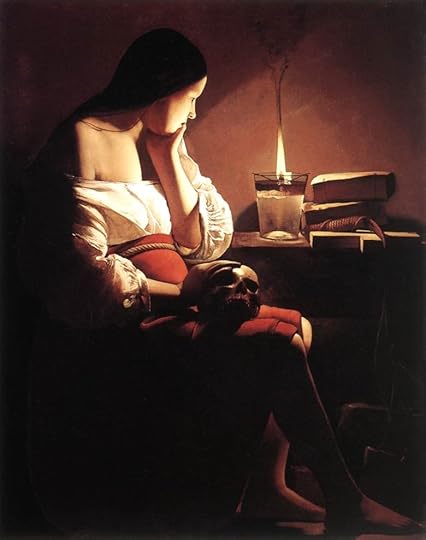
Not all the pleasures of the book were biological in nature; in addition to the cover, I became aware of this painting by French Baroque painter George de la Tour. He chose this image to lead off his chapter on death and dying:
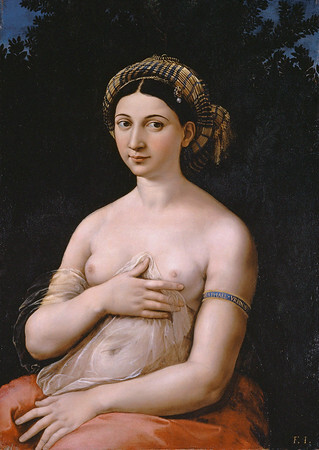
I've been working my way backwards through this book toward the beginning. Let's have a look at this beauty, the painting that adorns Page 1 of this book. It was one of the last paintings from the Italian painter Raphael, who died at the height of his fame of a fever, aged 37. The woman was his lover at the time of his death:
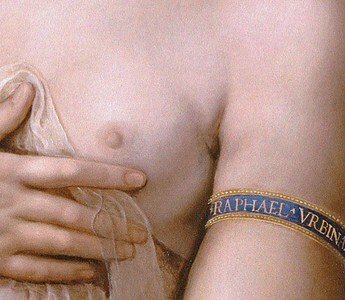
After taking in her beautiful torso, elegant neck and liquid eyes, let our eyes wander non-pruriently down:
I skimmed this, and was emphatically the wrong audience for it. However, I'm awarding it four stars because, for people who are interested in this sort of thing, it's doubtless one of the best examples out there. I cannot stress enough how I hate having my time wasted by discussions of Paracelsus' opinion of the homunculus in the King's sperm, or the goddess who was turned into a cicada by a more powerful god. A late chapter exemplifies both my admiration and my distress:
Many of us are aware of Dolly the sheep, the first sizable cloned mammal. I have long assumed that Dolly, who died of a retrovirus-induced lung cancer but was until then perfectly healthy, was proof positive that the only thing preventing human cloning were ethics and legal ramifications thereof. So I was grateful to learn that Dolly was the sole survivor of a batch of 277 cloning attempts; since then, the success rate of cloning in mammals has risen to two to four percent -- not exactly an ironclad process.
In Szczeklik's artful style, this morphed into a more general discussion of stem cells. Stem cells can be thought of as proto-cells, innocent of any particular function, that can be converted to any type of cell the body requires. Stem cells occur naturally (but very sporadically) within bone marrow, and are also present in fertilized eggs than have not yet implanted in the uterus -- two sources that make them rather inconvenient for study. But in 2012 a Kyoto scientist named Tachibana introduced a virus to some human skin cells, a virus with four genes, and these genes rather miraculously re-engineered the skin cells and turned them back into stem cells. And after this fun, lengthy and fact-packed progression, the author finally argued that the work of Tachibana was tantamount to turning a clock backwards, and then digressed into several pages of myths and legends related to time travel and immortality. Don't ask me for details; like most chapters, I found myself skipping ahead.
But there's so much good stuff here! We have all just endured a coronavirus pandemic that has claimed seven million lives around the globe; one hundred times that number have caught it and recovered. In just over a year, the so-called Spanish Flu carried off over a hundred million kores, in a world that had about two-thirds fewer people to begin with. In 1998, the body of an Innuit woman in Canada was found frozen in the ice; a woman who had died from Spanish Flu and still had the virus well-preserved within her. In a secret lab in the United States, a lab only accessible to three people, some of this virus was brewed up and a batch of blameless mice were infected with it. In a study of its virulence, the scientists determined that Spanish Flu was thirty-nine time more virulent than normal winter flu.
Okay, apologies, I'm being cute here. It wasn't thirty-nine times more virulent; it was thirty-nine thousand times more virulent (meaning it reproduced within the body nearly forty thousand times as fast as normal flu.) This is impressive, and scary. And you know what else is scary? The odds are pretty high that the Innuit woman wasn't the only dead body frozen in ice somewhere, awaiting re-emergence.
Given the large number of topics covered, and the large number of pages wasted on ignorant drivel, this book mostly served as a jumping-off point for topics I'd like to learn more about. Another example is the exact functioning of the HIV virus, which is diabolically clever, for a snip of hydrocarbon that isn't, technically speaking, even alive; or the ethics around people in a vegetative state; transcription virus and their role in our DNA, etc.
Not all the pleasures of the book were biological in nature; in addition to the cover, I became aware of this painting by French Baroque painter George de la Tour. He chose this image to lead off his chapter on death and dying:
I've been working my way backwards through this book toward the beginning. Let's have a look at this beauty, the painting that adorns Page 1 of this book. It was one of the last paintings from the Italian painter Raphael, who died at the height of his fame of a fever, aged 37. The woman was his lover at the time of his death:
After taking in her beautiful torso, elegant neck and liquid eyes, let our eyes wander non-pruriently down:
"The woman's hand is resting on her naked left breast, with the fingers pointing towards the right side and the armpit. If we follow this pointer, we might notice a slightly darker coloring at the edge of the breast, which is a very pale shade of blue. However, it is not a shadow, because the skin is drawn tight, bulging as if there is a lump, and so is the underarm area on the same side. If we take the analysis further by applying some special photographic techniques, it turns out that to render this bit of the portrait Raphael layered at least nine colors on top of each other, including some dark shades, while on the other side pink and cream were enough. A medical diagnosis was made for the first time in 2002, which declared it a cancer of the left breast with probable metastasis to the axillary lymph nodes."

April 4, 2022
"El alma, la esencia del ser. Si volvemos la mirada hacia ella, podremos preguntarnos de nuevo si existe el alma de la medicina. Podemos quedarnos mirándola fijamente, como hemos hecho en todos los ámbitos en los que la medicina ha estado presente: en algún lugar entre la vida y la muerte, entre la salud y la enfermedad, la ciencia y el arte, también el amor. [...] La niña, Core, se nos presenta en la pupila del enfermo. Sale a la luz, clara y nítida justo en el momento en que escucha nuestra llamada: "Estaré contigo. No te abandonaré. No te quedarás solo". ▪️ Desde que tengo recuerdos los libros y revistas de salud han permanecido dando vueltas en casa de mi abuela. La primera vez que vi los músculos y los huesos fue en las láminas de uno de sus atlas de anatomía. La primera vez que leí sobre el beneficio de las nueces, de la manzanilla o el limón, fue en una de sus revistas de nutrición. Ella nunca pudo estudiar medicina, aunque siempre quiso hacerlo. Lo que permanece ahora es una especie de terror hacia la enfermedad y la muerte que llega incluso a rozar el amor. -"El día que estés mala de verdad, a ver cómo solucionamos esto" - se repite en mi familia. Y así, entre la salud y la enfermedad, entre la vida y la muerte, nacen relatos e historias en mi familia que casi son leyendas urbanas sobre la vecina a la que operaron y le implantaron un riñón, sobre la amiga de la tía que dijo que iba a morir pronto, sobre el señor aquel que un día amaneció sin más y dejó de respirar. La medicina para mí tiene un significado especial, pero de eso tal vez escriba en otra ocasión. Lo ahora relevante es que desde que me he "reconciliado" con ella comprendo que muchas de las respuestas -y también de las preguntas- que durante mucho tiempo han acompañado al ser humano terminan llevando, como un camino lleno de rosas y espinas, a la ciencia médica. El libro del que os hablo hoy es un recopilatorio de algunas de esas cuestiones desde la perspectiva de un médico (y diría que también humanista) que recoge hitos históricos, mitología, ciencia y filosofía y lo mezcla todo para escribir un hermoso resumen. Lo que más me ha gustado es que plantea la medicina como algo inseparable de la dignidad humana y permanece esa idea detrás de todo lo que expone en la obra. Las células madre, los tumores, la muerte, el amor y sus filtros amorosos, el cerebro, el diagnóstico y la búsqueda de los síntomas son solo algunos temas que el autor trata con mucha sensibilidad y de los que también plantea algunos debates en los que merece la pena pararse a pensar. Si algo tiene la medicina y la terapia que tanto me llama la atención es que está llena de decisiones y de cuestiones éticas porque atraviesa lo más preciado de nuestra existencia: la vida. Diría que "Core" es un libro que te anima a querer ayudar a todos aquellos que, por desgracia, se están alejando de ella. 🌹
May 12, 2026
Profesor Szczeklik to był gość
This entire review has been hidden because of spoilers.

February 15, 2019
Dentro de los muchos ensayos interesantes de este libro que reúnen experiencias personales como médico de Szczeklik e historia de la medicina, creo que el capítulo de las alergias es sencillamente magistral, no sólo por la manera completa en la que aborda el tema (desde una óptica científica y sicológica) sino también porque es una lección sobre tolerancia, hipersensibilidad y las vocaciones científicas. Muy bueno.

December 31, 2012
No experience necessary; the reader need only approach with a love of the human body, its relationship to emotional experience, and stories. In the tradition of physician-auteurs, Dr. Andrzej Szczeklik (Catharsis: On the Art of Medicine) has created a tome that is poetry, history, philosophy, biology, and theology at once—and yet none of the above. He opens with diagnosis of the subject of a well-known painting by Raphael, where presumed breast cancer is subtly uncovered in paint. In stories like that of Joseph Babinski, whose last name is eponymous in medicine for a seriously abnormal neurologic sign, historical figures are humanized and hewed from the page. At times, it’s unclear what or if there is a logical progression within chapters. The book sails energetically through Dr. Szczeklik’s own stream-of-consciousness, in one notable instance from Roman myths to Norman invasions to Terri Schiavo. Life is carefully defined by NASA [188] and death by medicine, but the recurring voice of wisdom is that of Polish poet and Nobel Laureate Czeslaw Milosz. In a rare moment near the end of the book, Szczeklik pronounces his own firm dicta on whether doctors should always tell patients the truth (for him, no). Otherwise, “radiology is the science of shadows,” and so is all of medicine, as he questions distinctions between ancient theories and modern technology. The title refers to the Greek for “little girl,” in Latin, “pupilla”, the derivation of pupil, the eye’s window into the brain. He writes “The master clinician had once again summoned up the spirit of the illness…” Just so to his readers, who are unlikely to forget this book.
http://www.publishersweekly.com/978-1...
http://www.publishersweekly.com/978-1...

January 11, 2022
Piękna. Daje nadzieję. W medycynie jedyna stała to ciągła zmiana.
January 23, 2026
Momentami inspirująca, momentami irytująca, przez większość czasu męcząca. No i przepięknie wydana.

September 24, 2019
Navegando por el catálogo de una de mis editoriales favoritas –Acantilado– encontré estas dos joyas: Catarsis. Sobre el poder curativo de la naturaleza y el arte y Core. Sobre enfermos, enfermedades y la búsqueda del alma de la medicina.
Cuando leo libros sobre ciencia o sobre humanismo, siempre me encuentro con mundos totalmente separados. Sin embargo, los libros de Andrzej Szczeklik aúnan estos dos mundos, que para mi son un todo.
Los libros están escritos como pequeños ensayos centrados en la medicina, pero no se quedan simplemente en eso, sino que encontramos muchas reflexiones sobre filosofía, mitología y arte.
Sus páginas nos recuerdan que la medicina y el arte tienen su origen en la magia, y cómo los médicos –chamanes y sacerdotes– con la experiencia acumulada durante muchas generaciones han ido desvelando los misterios del cuerpo humano.
Hipócrates, Aristóteles, Galeno, Paracelso, Vesalio, William Harvey, Robert Hooke, Edward Jenner, Charles Darwin, Ramón y Cajal, Francis Crick, James Watson… son algunos de los nombres que nos acompañarán eternamente.
Cuando leo libros sobre ciencia o sobre humanismo, siempre me encuentro con mundos totalmente separados. Sin embargo, los libros de Andrzej Szczeklik aúnan estos dos mundos, que para mi son un todo.
Los libros están escritos como pequeños ensayos centrados en la medicina, pero no se quedan simplemente en eso, sino que encontramos muchas reflexiones sobre filosofía, mitología y arte.
Sus páginas nos recuerdan que la medicina y el arte tienen su origen en la magia, y cómo los médicos –chamanes y sacerdotes– con la experiencia acumulada durante muchas generaciones han ido desvelando los misterios del cuerpo humano.
Hipócrates, Aristóteles, Galeno, Paracelso, Vesalio, William Harvey, Robert Hooke, Edward Jenner, Charles Darwin, Ramón y Cajal, Francis Crick, James Watson… son algunos de los nombres que nos acompañarán eternamente.

February 26, 2013
This seems like it should be interesting but didn't know what it wanted to be and had a lot of potential but didn't go anywhere. Very disjointed and no flow it cohesion.

January 29, 2023
A fascinating exploration of how despite our developments in technology, science, and medicine, there is still an underpinning search for deeper meanings of sickness, health, and death. Drawing on classical philosophy, mythology, and the history of medicine, this book is an accessible look at medical anthropology and a subtle critique of modern bioethics in terms of addressing how medical paternalism is sometimes necessary for the best of a patient's overall well-being - a contentious point of view in many fields.

May 19, 2023
Me gusto mucho la expresividad y escritura ,fue una bella exposición de arte y su relación con la medicina .
No soy alguien que este relacionado con la medicina y menos con los conceptos ,me imagino que para alguien que lo ejerce será este libro una joya que aportara y cambiara su forma de ver esta bella profesión.
Si tienes la oportunidad de leerlo estés o no en el área de medicina ,hazlo no te decepcionará.
No soy alguien que este relacionado con la medicina y menos con los conceptos ,me imagino que para alguien que lo ejerce será este libro una joya que aportara y cambiara su forma de ver esta bella profesión.
Si tienes la oportunidad de leerlo estés o no en el área de medicina ,hazlo no te decepcionará.
August 19, 2021
Książka na swój sposób niezwykła. To, co widać na każdej stronie, to wielka erudycja autora. Porusza się z łatwością w świecie medycyny, nauk ścisłych, sztuki, historia i filozofii. Łączy wątki, przerzuca mosty i spina różne dziedziny, by odkryć duszę medycyny - to, co czyni z niej domenę boską, a jednocześnie tak dogłębnie ludzką.

May 7, 2023
Man pasirodė nenuosekli, fragmentiška knyga, kažkoks minčių kratinys, net be aiškios autoriaus krypties. Susidaro įspūdis, kad skaitai žmogaus užrašus, kuriuose jis rašo bet ką, ką sugebėjo nugirsti ar kažkur kažką sužinoti, vargu ar ką nors norėdamas pasakyti skaitytojui. Nepadėjo ir daugybė sakinių, besibaigiančių klaustuku.

January 11, 2025
Sceptycznie podchodziłem do tej książki i się niestety nie pomyliłem.
Bez wątpienia autor był człowiekiem renesansu, ale mieszanie medycyny z religijną duchowością pachnie mi "klauzulą sumienia". Tutaj co prawda ten wątek się nie pojawia, ale są inne, niewiele mniej niepokojące. I jest też, powracająca co jakiś czas, postać JPII w wariancie pomnikowym. Niezbyt dobrze się ta książka zastarzała.
Bez wątpienia autor był człowiekiem renesansu, ale mieszanie medycyny z religijną duchowością pachnie mi "klauzulą sumienia". Tutaj co prawda ten wątek się nie pojawia, ale są inne, niewiele mniej niepokojące. I jest też, powracająca co jakiś czas, postać JPII w wariancie pomnikowym. Niezbyt dobrze się ta książka zastarzała.

November 28, 2019
Leído en español, en la preciosa edición de Acantilado. Interesantísimo ensayo de un médico humanista, desde la antigüedad clásica hasta los problemas éticos de las últimas técnicas biomédicas

October 27, 2022
męczące, bez żadnej konkretnej fabuły, byle napisać esej na zaliczenie i do widzenia
December 31, 2024
I reread bits of this book every year
June 14, 2019
The classicism of Kore is a refreshment within modern medical storytelling, a genre so often lacking in abstraction or any dealings with the soul. Five stars for a satisfying melding of medicine and literature. Now on to Sontag...

August 1, 2025
Hermosas e ilustradas reflexiones de alguien que cree en el alma, la medicina y la búsqueda del alma de la medicina.

May 25, 2013
Definitivamente cautivante, una perspectiva muy especial de ver la medicina, pero si me quedara con un capítulo me quedo con el último, donde me identifico completamente con el autor.
Tal vez, creo yo, haría falta explorar más en otras religiones, creo que se centra mucho en el catolicismo quizás por pertenecer a él y en los griegos de quienes es experto, pero faltan más visiones, incluso la del agnóstico ante la enfermedad, el sufrimiento y la muerte.
Tal vez, creo yo, haría falta explorar más en otras religiones, creo que se centra mucho en el catolicismo quizás por pertenecer a él y en los griegos de quienes es experto, pero faltan más visiones, incluso la del agnóstico ante la enfermedad, el sufrimiento y la muerte.
September 21, 2016
Not sure why Goodreads only has this listed in Polish. It's out there in English and is a very fascinating read on our increasing technology in medicine and whether or not our search for a soul is still relevant.

December 12, 2013
Dobrze się czyta książki ludzi, którzy mają coś do powiedzenia, posiadają wiedzę, a jednocześnie piszą w sposób przystępny.
O chorobach, mitologii, dylematach lekarzy napisane ładnym językiem.
O chorobach, mitologii, dylematach lekarzy napisane ładnym językiem.
March 14, 2022
Interesante, bellamente escrito. Obra de un médico humanistico, rara avis hoy difícil de encontrar.
El gran "pero" radica en que se ha quedado anticuado en varias secciones.
El gran "pero" radica en que se ha quedado anticuado en varias secciones.
Displaying 1 - 23 of 23 reviews