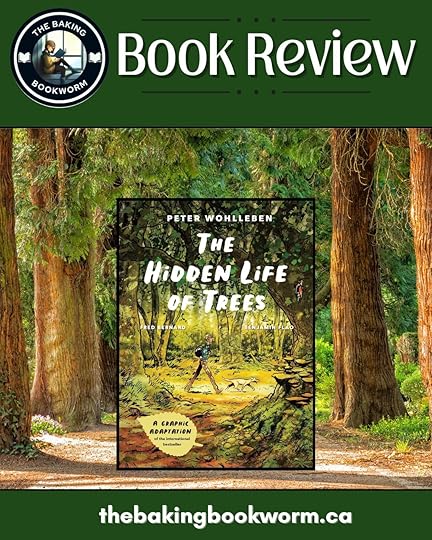
I tried reading the actual book, and couldn’t get very far in before I lost interest. It was a bit dense, but had very interesting tidbits mixed in. So I read the graphic novel. Which had lovely illustrations and much science and much environmentalism and was still dense (but less so) with some still very interesting tidbits mixed in. Here are my favorites:
- trees can keep neighboring stumps alive by feeding them nutrients through their roots! Wow! But then I wonder, what are the conditions under which this happens? Because it’s definitely not an all the time event!
- When you walk in a forest, you only see 1/3 of the trees! The rest is under ground
- There are more organisms living in one handful of soil than there are humans on earth. Whoa!
- trees need “sleep” - if they are under artificial light and warm temps 24/7 they die (example given was an oak, specifically)
- trees release phytoncides that repel parasites and microbes. People with some types allergies or asthma can feel immediate benefits from a forest walk! And walks in the forest can improve blood pressure and decrease anxiety for humans
- trees with both make and female cones ripen days apart to prevent self fertilization (which would diminish diversity). Cherry blossoms somehow know if its own pollen was used for fertilization, and will abort.
- certain trees like beeches and oaks will have scarce seed production for a few years, which means the animals who subsist on those will have a population decline, and then after 5 years or so the tree will have a bumper crop and there will be many seeds yet won’t be as many animals to eat them (better chance of survival for those tree seeds)
- trees in cities don’t live as long. They are over pruned, cut off from their tree networks, have condensed roots, and are in compacted soil. The urban ground areas release heat at night, which is when the trees need coolness. And they are absorbing a lot of soot, etc.
- young trees in a forest will leaf out before the larger trees in spring, and will hold onto their leaves longer in the fall, to absorb as much light as possible
- a small “sapling” tree by a much larger tree in the forest could be a lot older than it looks, 80 years is the example of one he aged, staying small as it awaits its turn to take over when a large tree falls
- I loved the idea of a forest cemetery, (like in Switzerland and Germany) where ashes are buried at the bases of various trees and you visit your loved ones by strolling through the forest
- the “roots” of fungi (mycelium) connect to 90% of terrestrial plant life. Some fungi will only pair with certain species, whereas some trees are connected to upwards of 100 different fungi species!
- one type of fungi will release a toxin if the pine it is symbiotic with needs nitrogen. This kills the insects in the ground in the area and provides nitrogen through the bug “fertilizer”
- a tree that is hit by lightning can transfer that jolt to other trees through the network of the roots, and they both get zapped
- some trees of the same species will appear more weathered than their companions of a same age (just like people)
- Beech trees still get hit by lightning, they just don’t show the scars as well on their smooth bark
- acacia trees send chemicals out when they are being munched on. This makes their leaves taste bad, and warns other acacias down wind
- I found the two experiments on pg 178 and 179 about plant “memory” (sensitive plant learning to not close up when water droplets were applied at recurring intervals) and “problem solving” (passion flower where stake kept getting moved 2 inches ahead just before the plant reached it learned to overshoot and grow to where the stake would be after 4 or 5 repetitions) very interesting
- trees can recognize their own seedlings, and offer them nutritional support through their roots but will not do this to a seedling of the same species that isn’t theirs
- trees of the same species will give neighbors a small amount of space, so they all get light in the canopy. They will not do that for other species
- trees can release chemicals that attract predators of their parasites
- trees can identify different species of predator by their saliva
- planted tree farms (and cultivated farmland) do not communicate the way their wild relatives do
- an Australian study found that roots of grain crops emit a faint clicking sound. And roots of seedlings who weren’t in the experiment turned toward the sound.
- even ringed trees (where a wide swath of bark is removed from the circumference of a tree to kill it by preventing transfer of nutrients and water) can survive with the help of their root networks
- all living things on Earth are made of the same atoms throughout history that keep getting re-used.
- Fruit flies dream
- Switzerland has dignity for living beings (plants and animals) in its constitution (even mowing grass by the roadside is frowned upon
- some trees produce their own insecticide
- and, of course, I loved his dog’s name (Max ❤️). The author had panic attacks etc along his journey of being a forester and realizing how we are harming the environment