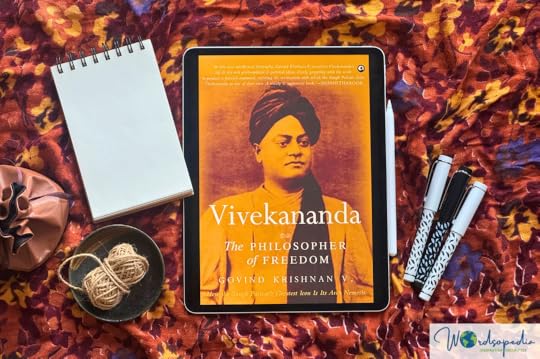
Known by many but understood by few, Swami Vivekananda is a figure shrouded in mystery. However, in recent years there has been a greater tendency to understand, explain, and appropriate the monk and his legacy, especially by the Hindu Right. In The Philosopher of Freedom, Govind Krishnan V. contests the Hindu Right’s appropriation of Swami Vivekananda, arguably one of the most influential and defining figures of modern Hinduism. He attempts to show the reader that Vivekananda’s religious philosophy, social thought, and ideology are the very antithesis of Hindutva. Divided into three sections, this book brings into focus multiple facets of Vivekananda’s short but eventful life. ‘Part Life, Ideology, and Historical Context’ begins with a short biography of Swami Vivekananda before examining how the RSS and the Sangh have used Hindu symbols, motifs, and issues like Ram Janmabhoomi, and contrasting this usage with Vivekananda’s Hinduism. It then explores Vivekananda’s early understanding of and relationship with Islam and Christianity. The section ends with an examination of the role Western civilization plays in Vivekananda’s and the RSS’s respective world views and the obvious clash between the former’s internationalism and the latter’s nativism. ‘Part Hinduism, the Sangh, and the West’ introduces the reader to important features of Vivekananda’s writing and thinking which have become lost to our public memory. It explores Vivekananda’s views on themes relevant to the Hindutva Indian civilization, society, and culture; the nature of the caste system and rahminism; the history of Islam in India; attitudes towards Islam and Christianity; Hindu mythology, belief, and rituals; individual liberty; attitudes towards the West; and so on. Finally, it situates Vivekananda’s public life in the global context during a period of much change in fin de siècle Europe and America. Also surveyed is the cultural and intellectual framework of colonialism within which Vivekananda operated. The last section of the book, ‘Part Vivekananda’s Philosophy’, begins with an exposition of Vivekananda’s philosophy of universal religion and his theoretical framework and an explication of his famous assertion that religion should conform to reason as much as science does. The closing part of the book deals with Vivekananda’s position on caste and gender and posits him as an anti-caste and proto-feminist reformer of his time. Cogently argued, The Philosopher of Freedom pulls back the curtain on Vivekananda’s outlook and shows why the great monk deserves to be reins ated as a liberal thinker in the popular cultural imagination.
Vivekananda: The Philosopher of Freedom by Govind Krishnan V is a comprehensive exploration of Swami’s religious philosophies, thoughts and ideologies. The book is divided into three sections, with each section exploring various facets of Swami’s life and spiritual journey. According to the author, “The book attempts to give the reader a set of conceptual tools through which to approach and understand Vivekananda’s life and work.”
The book is meticulously researched and the detailed bibliography and references showcase the various resources used by the author.
Never having read any books on Vivekananda and his life, I jumped at the opportunity to read this one and gain insights from his works. However, I have to say, this book fell short of my expectations.
As a reader, I believe the title plays an important role in setting the right expectations. In this case, the title was misleading as it did not give a clear picture of the content. I approached the book, hoping to learn more about Swami’s philosophies, Advaita, and Paramahamsa. I thought it would be akin to reading some of the original works in his life. Sadly, this book focussed on the author’s disapproval of RSS, Sangh Parivar, and Hindutva, deviating from the original topic.
Vivekananda: The Philosopher of Freedom makes for an interesting read, providing profound insights into Swami’s life, values, and philosophies. It could have been an even more valuable resource if the title had set clearer expectations regarding the scope of the content.
Wordsopedia Rating 2.45/5
_________________________________________________ Connect with me on Twitter | Instagram | Blog and let’s talk BOOKS!!
Swami Vivekananda, born in 1863, was a prominent spiritual leader, philosopher, and social reformer in India. He played a crucial role in the revival of Hinduism and introduced Vedanta and Yoga philosophies to the Western world. Vivekananda was not a traditional Hindu monk, but a modern ascetic with a scientific and materialist outlook. His writings have been widely read, and author Govind Krishnan V published "Vivekananda-The Philosopher Of Freedom" by Aleph Books. The book is divided into three parts, each providing valuable insights into Vivekananda's philosophy and his portrayal by the Sangh Parivar.
Marathon reading today. This is an extremely well researched book. Kudos to the author. Clearly dispels the myth that Vivekananda ever thought of supporting Hindutva. Excellent read.
Yes its a comprehensive analytical insight into Vivekananda philosophy and views which is contradictory to what the right wing Hindutva has been propagating as their model. Well written and beautifully articulated it is a delight to read