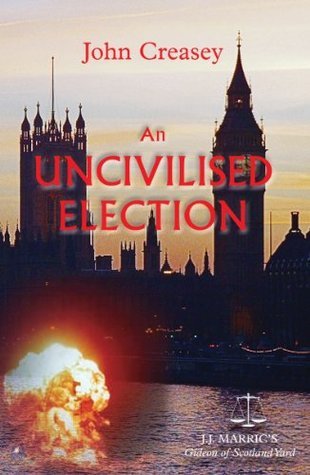
Scotland Yard's Commander George Gideon thought he had seen it all, and still remained convinced that London was civilized. However, he is forced to reconsider when the usually polite politics of the upcoming election turn into something ugly. Matters take an even stranger turn when it is discovered that a warhead and a small nuclear reactor are missing. Is there a connection? It would seem so and Gideon is left to work it out ....
John Creasey (September 17, 1908 - June 9, 1973) was born in Southfields, Surrey, England and died in New Hall, Bodenham, Salisbury Wiltshire, England. He was the seventh of nine children in a working class home. He became an English author of crime thrillers, published in excess of 600 books under 20+ different pseudonyms. He invented many famous characters who would appear in a whole series of novels. Probably the most famous of these is Gideon of Scotland Yard, the basis for the television program Gideon's Way but others include Department Z, Dr. Palfrey, The Toff, Inspector Roger West, and The Baron (which was also made into a television series). In 1962, Creasey won an Edgar Award for Best Novel, from the Mystery Writers of America, for Gideon's Fire, written under the pen name J. J. Marric. And in 1969 he was given the MWA's highest honor, the Grand Master Award.
Fun. Good solid realistic (or realistic-feeling) story of real people and police work and the bad guys being foiled by both good policing and the general decency and good sense of the common Englishman. Also takes place in a world where if you have an unmarried young woman who is pregnant and deathly afraid her father will find out, of COURSE the right thing to do is to have a local policeman tell her father about it and bring the father to get her; what could go wrong?
If only the world were really so simple and benign, there would be nothing in the least problematic about this comforting little book.
The government has fallen, and an election is scheduled for the day after Guy Fawkes Day. As if that weren't inflammatory enough, the major conflict between parties is the Ban the Bomb party and the paramilitary Q Men, who would like to make their leader dictator. Violence is soon the major lead-up to polling day. It's up to Gideon not to jump to conclusions. Any error he makes could lead to international disaster. Suspenseful.
Some real excitement in a secondary subplot, a little less in another subplot, and little at all in the main subplot. This triple subplot business no doubt makes for the author having an easier job; the frame of standard characters and place make the reader’s job easier and more pleasurable, too; but John Creasy’s best writing is in the smaller, more personal subplots. His descriptions of life and psychology in England are a steady source of pleasure, too.
Besides the usual crimes Gideon is faced with an election campaign to deal with. Two groups are especially of concern. One is a ban the bomb group called Fight for Peace and the other a right wing group known as the Q-Men, named for their leader Roland Quatrain. While someone is targeting the Q-Men candidates the FFP, or at least some of its members, are planning a major demonstration. Meanwhile one candidate has to decide if using some old information about one of his opponents is the proper thing to do. One other major case involves a chap passing himself as a doctor and taking temporary positions replacing doctors going on holiday. He has been doing this for some time now and the police are waiting for him to make the mistake that will allow them to catch him. Finally as a nice bit of continuity Ray Cox who was the Deputy Commander of Uniform in Gideon’s March appears at the end of this book as that division’s commander. This was among my favourite books in this series. Possibly that is because politics has always interested me. For whatever reason I highly recommend this one.
#10 in the Commander Gideon of New Scotland Yard mystery series. Set in 1960's London and focuses upon a plot to to disrupt the upcoming British National elections with various actions and plots.