Jump to ratings and reviews
Rate this book

What Was It?

Rate this book
First published by Harper's Magazine in 1859.

14 pages

First published March 1, 1859

4 people are currently reading
92 people want to read

About the author

Fitz-James O'Brien

256 books26 followers
He was born Michael O'Brien in County Cork, and was very young when the family moved to Limerick, Ireland. He attended the University of Dublin, and is believed to have been at one time a soldier in the British Army. On leaving college he went to London, and in the course of four years spent his inheritance of £8,000, meanwhile editing a periodical in aid of the World's Fair of 1851. About 1852 he came to the United States, in the process changing his name to Fitz James and thenceforth he devoted his attention to literature.

While he was in college he had shown an aptitude for writing verse, and two of his poems—"Loch Ine" and "Irish Castles"—were published in The Ballads of Ireland (1856).

His earliest writings in the United States were contributed to The Lantern, which was then edited by John Brougham. Subsequently he wrote for The Home Journal, The New York Times, and The American Whig Review. His first important literary connection was with Harper's Magazine, and beginning in February 1853, with The Two Skulls, he contributed more than sixty articles in prose and verse to that periodical. He likewise wrote for the New York Saturday Press, Putnam's Magazine, Vanity Fair, and The Atlantic Monthly. To the latter he sent "The Diamond Lens" (1858) and "The Wondersmith" (1859), which are unsurpassed as creations of the imagination, and are unique among short magazine stories. "The Diamond Lens" is probably his most famous short story, and tells the story of a scientist who invents a powerful microscope discovers a beautiful female in a microscopic world inside a drop of water. "The Wondersmith" is an early predecessor of robot rebellion, where toys possessed by evil spirits are transformed into living automatons who turns against their creators. His 1858 short called "Horrors Unknown" has been referred to as "the single most striking example of surrealistic fiction to pre-date Alice in Wonderland" (Sam Moskowitz, 1971). "What Was It? A Mystery" (1859) is one of the earliest known examples of invisibility in fiction.

His pen was also employed in writing plays. For James W. Wallack he made A Gentleman from Ireland, that held the boards for a generation. He also wrote and adapted other pieces for the theatres, but they had a shorter existence.

In New York he at once associated with the brilliant set of Bohemians of that day, among whom he was ranked as the most able. At the weekly dinners that were given by John Brougham, or at the nightly suppers at Pfaff's on Broadway, he was the soul of the entertainment.

In 1861 he joined the 7th regiment of the New York National Guard, hoping to be sent to the front, and he was in Camp Cameron before Washington for six weeks. When his regiment returned to New York he received an appointment on the staff of General Frederick W. Lander. He was severely wounded in a skirmish on February 26, 1862, and lingered until April, when he died at Cumberland, Maryland.

From Wikipedia.

Ratings & Reviews

What do you think?
Rate this book

Friends & Following

Create a free account to discover what your friends think of this book!

Community Reviews

5 stars
41 (13%)
4 stars
108 (36%)
3 stars
114 (38%)
2 stars
25 (8%)
1 star
6 (2%)
Displaying 1 - 30 of 38 reviews
Profile Image for Peter.
4,077 reviews805 followers
January 29, 2020
Harry and Hammond are boarders in a presumably haunted house. One day they talk about the "King of Terrors", e.g. what the most terrible thing or experience might be. Then Harry has an invisible being in his room he can overcome. Who or better what is this mysterious invisible entity? Will the riddle be solved at the end and or how does the story go on? A well plotted and eerie piece of fiction with a great climax of horror. Recommended!
Profile Image for Federico DN.
1,163 reviews4,421 followers
November 25, 2024
Nice. Very Nice!

An unnamed narrator with friends and several guests decide, on a daring bet, to spend some nights in a NY boarding house which is said to be haunted. The merry enthusiastic group have their fun for a time, until some worrisome incidents start occurring around them; nothing as preposterous as to suggest a horrible demon, yet neither something to confirm otherwise— evil spirits are not reputed to leave tangible evidence.

Another fantastic delivery by Fitz-James O'Brien; I'm starting to really appreciate the author. Thus far I've greatly enjoyed his horror style. The almost credible scientific touch he imbues his stories with makes the lingering horror after finishing them so much more palpable! Ultimately I enjoyed The Diamond Lens more but this was a very close call. So far there has only been winners, so very much looking forward to reading more of his writings, and in time, possibly all of them.

It’s public domain. You can find it HERE.


-----------------------------------------------
PERSONAL NOTE :
[1859] [14p] [Horror] [3.5] [Recommendable]
-----------------------------------------------

★★★★☆ The Diamond Lens.
★★★★☆ What Was It? [3.5]

-----------------------------------------------

Bueno ¡Muy bueno!

Un narrador anónimo con amigos y varios invitados deciden en una atrevida apuesta pasar algunas noches en una pensión de Nueva York que se dice está embrujada. El entusiasta y alegre grupo se divierte por un tiempo, hasta que empiezan a ocurrir algunos preocupantes incidentes a su alrededor; nada tan absurdo como sugerir un horrible demonio, pero tampoco algo que confirme lo contrario— los espíritus malignos no tienen fama de dejar evidencia tangible.

Otra entrega fantástica de Fitz-James O'Brien; estoy empezando a apreciar mucho al autor. Hasta ahora realmente he disfrutado mucho su estilo de terror. El toque científico casi creíble que le da a sus historias hace que el horror persistente después de terminarlas sea mucho más palpable! Al final disfruté más de The Diamond Lens, pero estuvo muy muy cerca. Hasta ahora sólo ganadores, así que con muchas ganas de leer más de sus escritos, y en tiempo, posiblemente todos!

Es dominio público, lo pueden encontrar ACA.


-----------------------------------------------
NOTA PERSONAL :
[1859] [14p] [Horror] [3.5] [Recomendable]
-----------------------------------------------
Profile Image for Althea Ann.
2,255 reviews1,208 followers
November 29, 2014
(1859)
A very Hammer-Horror feel to this short horror story.
The proprietress of a boarding house decides to move the location of her premises from Bleecker Street to a bit further uptown, 26th St. She's got a great deal, because the house she's moving into is reputed to be haunted.

Her boarders are more enthused than otherwise about the move. Indeed, it sparks a veritable craze for the supernatural. The common area is all abuzz with the possibility of ghosts.. but for quite some time, nothing unusual occurs.

However, one night, after two men have been smoking perhaps a bit too much opium, something does happen...

No morals or allegories here, just a fun, spooky story. Loved the New York City setting.
Profile Image for Orçun Güzer.
Author 1 book57 followers
December 29, 2019
It is not a perfectly built ghost story, but the way it deals with "the unknown" is remarkable. While reading, one idea came to my mind: Opium makes you perceive the things invisible to others; if there was really an invisible creature, then you would not differentiate it from the effects of opium. I wish the writer could eloborate this idea, instead of focusing on other details.
Profile Image for Richie  Kercenna .
256 reviews17 followers
November 27, 2021
Is it just a ghost story? Probably not..
This entertaining piece was written in 1859; an era during which a lot of taboo matters were enigmatically alluded to in literature. And as far as I am concerned, these are the two interpretations I can think of:

1- Drug-use: Championed by opium, drugs were largely consumed by Victorian Britons especially by the turn of the century. There are many books which refer to the issue; The Picture of Dorian Gray, The Strange Case of Dr. Jekyll and Mr. Hyde, The Mystery of Edwin Drood and many others. Opium can cause all sorts of hallucination, so you can read the tale as one more manifestation of drug use

2- Invisible Threats: The Victorian age had brought with it an emphasis on invisible threats. Dracula features a monster no one knows the appearance of which, and who can accordingly parade the streets in quest of his next victim before the eyes of an oblivious population. Hawley Griffin in The Invisible Man has literally full access to any household on account of his invisibility. This obsession with the invisible is but the reflection of the Victorian fear of such figures as Jack the Ripper who was believed then to be part of the Jewish community who had accordingly sheltered his identity. Fear of immigration drove the English of that era frantic with the thought of foreign and invisible threats.


Profile Image for Benjamin Stahl.
2,274 reviews73 followers
June 21, 2019
Creepy and unique. Fitz-James O'Brien was a good writer of short horror.
Profile Image for Keith.
942 reviews12 followers
October 22, 2022
“A Something dropped, as it seemed, from the ceiling, plumb upon my chest, and the next instant I felt two bony hands encircling my throat, endeavoring to choke me.”

“What Was It?” (1859) by Fitz-James O’Brien is a solid horror story that is made particularly effective by the matter-of-fact, concise manner the author depicts a bizarre supernatural event.

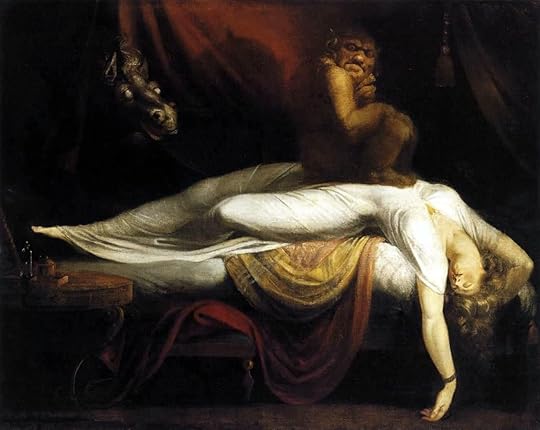
[Frayling (1992), in his book, Vampyres: Lord Byron to Count Dracula argues that this story “represents a literary version” (Gracey, 2013) of Henry Fuseli’s 1781 oil painting, the Nightmare. The initial attack of a monster upon our sleeping narrator is most reminiscent of this painting.]

H.P. Lovecraft refers to “What Was It?” in his book-length literary essay Supernatural Horror in Literature (1927):
Among the earliest of Poe’s disciples may be reckoned the brilliant young Irishman Fitz-James O’Brien (1828–1862), who became naturalised as an American and perished honourably in the Civil War. It is he who gave us “What Was It?”, the first well-shaped short story of a tangible but invisible being, and the prototype of de Maupassant’s “Horla”; he also who created the inimitable “Diamond Lens”, in which a young microscopist falls in love with a maiden of an infinitesimal world which he has discovered in a drop of water. O’Brien’s early death undoubtedly deprived us of some masterful tales of strangeness and terror, though his genius was not, properly speaking, of the same titan quality which characterised Poe and Hawthorne.
Indeed, I can’t think of any earlier example of a “tangible but invisible being” used in a story. In addition to influencing “Horla,” this story had an influence on H.G. Wells’ novel The Invisible Man (1897).

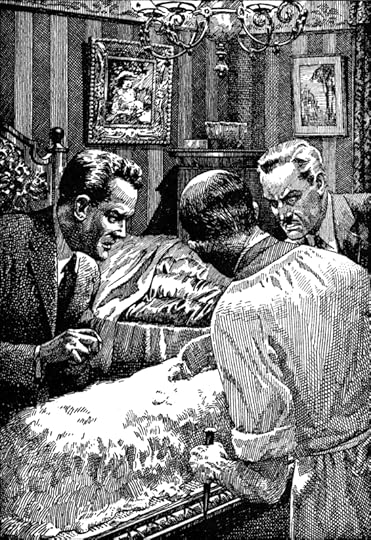
Illustration for “What Was It?” from Famous Fantastic Mysteries

The humans in the story manage to capture the creature and proceed to attempt to study it. I found the captivity and of the monster to be the most terrifying aspect of the whole tale. O’Brien manages to build sympathy for this deeply inexplicable and inhuman being. In the end, the characters never find out the mysteries of it. I love that. Such ambiguity is quite effective in a weird tale.

“What Was It?” is the eighth oldest story in The Literature of Lovecraft, Volume 1 (2021) and that is where I listened to it. The audiobook is excellent. I have a list of the stories in it posted at the end of this review.

Title: “What Was It?”
Author: Fitz-James O'Brien
Dates: 1859
Genre: Fiction - Short story*, horror
Word count: 5,139 words*
Date(s) read: 6/21/22
Reading journal entry #195 in 2022

Link to the story: http://www.eastoftheweb.com/short-sto...
Link to Lovecraft’s essay: https://www.hplovecraft.com/writings/...

Sources:
Gracey, James. (2013, April 7). Short story showcase: What was it? by Fitz-James O’Brien. Behind the Couch. http://watchinghorrorfilmsfrombehindt...

Fifer, C., & Lackey, C. (2013, January 3). Episode 141 – What Was It?. H.P. Lovecraft Literary Podcast. https://www.hppodcraft.com/list/2013/...

Frayling, C. (1992). Vampyres: Lord Byron to Count Dracula. Faber. https://archive.org/details/isbn_9780...

Lovecraft, H. P., & Joshi, S. T. (2012). The annotated supernatural horror in literature (second edition). Hippocampus Press. https://www.hplovecraft.com/writings/... (Original work published 1927)

O'Brien, F. (2021). What was it?. In H.P. Lovecraft Historical Society (Ed.), The literature of H.P. Lovecraft (S. Branney, Narr.; A. Leman, Narr.) [Audiobook]. HPLHS. https://www.hplhs.org/lol.php (Original work published 1859)

Link to the images: http://watchinghorrorfilmsfrombehindt...

The contents of The Literature of H.P. Lovecraft, Volume 1 are:
"The Adventure of the German Student" by Washington Irving
"The Avenger of Perdóndaris" by Lord Dunsany
"The Bad Lands" by John Metcalfe
"The Black Stone" by Robert E. Howard
The Boats of the "Glen Carrig" by William Hope Hodgson
"Count Magnus" by M.R. James
"The Dead Valley" by Ralph Adams Cram
"The Death Mask" by Henrietta Everett
"The Fall of the House of Usher" by Edgar Allan Poe
"The Ghost of Fear" by H.G. Wells (also called “The Red Room”)
"The Ghostly Kiss" by Lafcadio Hearn
"The Horla" by Guy de Maupassant
"The House and the Brain" by Edward Bulwer-Lytton
"The House of Sounds" by Matthew Phipps Shiel
"Idle Days on the Yann" by Lord Dunsany
"Lot #249" by Arthur Conan Doyle
"The Man-Wolf" by Erckmann-Chatrian
"The Middle Toe of the Right Foot" by Ambrose Bierce
"The Minister's Black Veil" by Nathaniel Hawthorne
"The Monkey's Paw" by W.W. Jacobs
"One of Cleopatra's Nights" by Théophile Gautier
"The Phantom Rickshaw" by Rudyard Kipling
The Place Called Dagon by Herbert Gorman
"Seaton's Aunt" by Walter de la Mare
"The Shadows on the Wall" by Mary E. Wilkins
"A Shop in Go-By Street" by Lord Dunsany
"The Signal-Man" by Charles Dickens
"Skule Skerry" by John Buchan
"The Spider" by Hanns Heinz Ewers
"The Story of a Panic" by E.M. Forster
"The Strange Case of Dr. Jekyll and Mr. Hyde" by Robert Louis Stevenson
"The Tale of Satampra Zeiros" by Clark Ashton Smith
"The Tapestried Chamber" by Sir Walter Scott
"The Upper Berth" by F. Marion Crawford
"The Vampyre" by John Polidori
"The Venus of Ille" by Prosper Mérimée
"The Were Wolf" by Clemence Housman
"What Was It?" by Fitz-James O'Brien
"The White People" by Arthur Machen
"The White Wolf of the Hartz Mountains" by Frederick Marryat
"The Willows" by Algernon Blackwood
"The Yellow Sign" by Robert W. Chambers
"The Yellow Wallpaper" by Charlotte Perkins Gilman

If you want to hear the stories in the order in which they were written, here's a guide.
The Vampyre (1819) - Chapter 46
The Adventure of the German Student (1824) - Chapter 1
The Tapestried Chamber (1828) - Chapter 44
The Minister's Black Veil (1836) - Chapter 25
The Venus of Ille (1837) - Chapter 47
The White Wolf of the Hartz Mountains (1839) - Chapter 51
The Fall of the House of Usher (1839) - Chapter 13
What Was It? (1859) - Chapter 49

The House and the Brain (1859) - Chapter 17
The Signal-Man (1866) - Chapter 37
The Man-Wolf (1876) - Chapters 21-23
The Ghostly Kiss (1880) - Chapter 15
One of Cleopatra's Nights (1882)
The Upper Berth (1886)
The Strange Case of Dr. Jekyll and Mr. Hyde (1886)
The Horla (1887)
The Phantom Rickshaw (1888)
The Middle Toe of the Right Foot (1891)
Lot #249 (1892)
The Yellow Wallpaper (1892)
The Ghost of Fear (1894) - also called The Red Room
The Yellow Sign (1895)
The Dead Valley (1895)
The Were-Wolf (1896)
The Monkey's Paw (1902)
The Shadows on the Wall (1903)
Count Magnus (1904)
The White People (1904)
The Willows (1907)
The Boats of the "Glen Carrig" (1907)
Idle Days on the Yann (1910)
The Story of a Panic (1911)
The House of Sounds (1911)
A Shop in Go-By Street (1912)
The Avenger of Perdóndaris (1912)
The Spider (1915)
The Death Mask (1920)
The Bad Lands (1920)
Seaton's Aunt (1922)
The Place Called Dagon (1927)
Skule Skerry (1928)
The Tale of Satampra Zeiros (1929)
The Black Stone (1931)

The review was written on 6/27/22

My reviews for all of the stories, read in the order that they were written:
The Vampyre (1819) by John William Polidori
The Adventure of the German Student (1824) by Washington Irving
The Tapestried Chamber (1828) by Walter Scott
The Minister's Black Veil (1836) by Nathaniel Hawthorne
The Venus of Ille (1837) by Prosper Mérimée
The White Wolf of the Hartz Mountains (1839) by Frederick Marryat
The Fall of the House of Usher (1839) by Edgar Allan Poe
What Was It? (1859) by Fitz-James O'Brien
The House and the Brain (1859) by Edward Bulwer-Lytton
The Signal-Man (1866) by Charles Dickens
The Man-Wolf by Erckmann-Chatrian
The Ghostly Kiss (1880) by Lafcadio Hearn
One of Cleopatra's Nights (1882) by Théophile Gautier
The Upper Berth (1886) by F. Marion Crawford
The Strange Case of Dr. Jekyll and Mr. Hyde (1886) by Robert Louis Stevenson
The Horla (1887) by Guy de Maupassant
The Phantom Rickshaw (1888) by Rudyard Kipling
”The Middle Toe of the Right Foot” (1891) by Ambrose Bierce
Lot #249 (1892) by Arthur Conan Doyle
The Yellow Wallpaper (1892) by Charlotte Perkins Gilman
The Ghost of Fear (1894) by H.G. Wells- also called The Red Room
The Yellow Sign (1895) by Robert W. Chambers
The Dead Valley (1895) by Ralph Adams Cram
The Were-Wolf (1896) by Clemence Housman
The Monkey's Paw (1902) by W.W. Jacobs
The Shadows on the Wall (1903) by Mary E. Wilkins
Count Magnus (1904) by M.R. James
The White People (1904) by Arthur Machen
The Willows (1907) by Algernon Blackwood
The Boats of the "Glen Carrig" (1907) by William Hope Hodgson
Idle Days on the Yann (1910) by Lord Dunsany
The Story of a Panic (1911) by E.M. Forster
The House of Sounds (1911) by Matthew Phipps Shiel
A Shop in Go-By Street (1912) by Lord Dunsany
The Avenger of Perdóndaris (1912) by Lord Dunsany
The Spider (1915) by Hanns Heinz Ewer
The Death Mask (1920) by H.D. Everett
The Bad Lands (1920) by John Metcalfe
Seaton's Aunt (1922) by Walter de la Mare
The Place Called Dagon (1927) by Herbert S. Gorman
Skule Skerry (1928) by John Buchan
The Tale of Satampra Zeiros (1929) by Clark Ashton Smith
The Black Stone (1931) by Robert E. Howard
Profile Image for RuWithTheBooks.
163 reviews2 followers
January 18, 2025
This is the first entry in Doorway to Dilemma, an anthology of short stories based on the dark fantasy genre.

I am really impressed with this because it's super readable for something written/published in 1859. The prose is really good in places where the author seeks to describe. The author did absolute amazing work in the span of such little pages.

The reveal is quite silly and makes the title into quite a good tongue in cheek kinda joke. I think if the "reveal" was better (albeit still "unexplainable" it maybe would have been less of a copout.

Actually nuts for an 18 page story.

4/5
Profile Image for Kelsey Doll.
210 reviews
July 14, 2019
This story was good. It deals with a haunted house and an invisible creature that the protagonist captures in the said house. Was it entertaining? Yes. But I don’t think the underlying themes were too extraordinary. This is a sci-fi story, so i’ve seen this theme tossed around before. From what I was able to gather, the biggest message this story gives is that men destroy mysterious things without meaning to do it, yet because the thing is mysterious, men do not know how to properly care for it. Its a paradox that still is applicable in the scientific community today.
Profile Image for Per.
1,259 reviews14 followers
February 7, 2021
https://archive.org/details/WeirdTale...
http://www.gutenberg.org/files/15143/...

Weird Tales reprint of a short story, first published in 1859.

There are three books referenced in this short story:
"I feel my capacity to experience a terror greater than anything yet conceived by the human mind;—something combining in fearful and unnatural amalgamation hitherto supposed incompatible elements. The calling of the voices in Brockden Brown's novel of Wieland is awful; so is the picture of the Dweller of the Threshold, in Bulwer's Zanoni; but," he added, shaking his head gloomily, "there is something more horrible still than those." [...]
I opened the volume as soon as I had laid my head upon the pillow, and instantly flung it to the other side of the room. It was Goudon's History of Monsters,—a curious French work, which I had lately imported from Paris, but which, in the state of mind I had then reached, was anything but an agreeable companion.


Wieland; Or, The Transformation: An American Tale (1798) by Charles Brockden Brown
https://en.wikipedia.org/wiki/Wieland..., [...] sometimes considered the first American Gothic novel [...] categorized under several subgenres [...] including horror, psychological fiction and epistolary fiction [...].
http://www.gutenberg.org/ebooks/792

Zanoni (1842) by Baron Edward Bulwer Lytton
https://en.wikipedia.org/wiki/Zanoni, [...] a story of love and occult aspiration [...] tells the story of its protagonist Zanoni, who possesses occult powers and knows the secret of eternal life.
http://www.gutenberg.org/ebooks/2664

Goudon's History of Monsters seems to be an invention by the author.
Profile Image for Thomas Houghton.
189 reviews4 followers
October 25, 2023
Sometimes you encounter literary works that are relatively devoid in terms of plot or memorable characters, but are written so intricately and mesmerisingly that they become works of art in their own right. This is an example of such a story; the protagonist stays in a supposedly-haunted house and is attacked by an invisible assailant, which then ultimately dies. There is little to it, and yet the sense of paranoia that builds throughout, alongside the eponymous mystery of what this creature actually is, results in a must-read horror story.
This entire review has been hidden because of spoilers.
Profile Image for Agustina.
140 reviews
April 4, 2018
Cuento de horror bastante corto, pero tiene unas descripciones increíbles y la narración te transporta al momento de la historia. No puedo decir que me asustó y me produjo piel de gallina, pero sí fue algo distinto a todos los cuentos de horror que leí hasta ahora (todo Poe y algunos de Lovecraft). Espero con ganas volver a leer otro cuento de este autor.
Profile Image for Glen Engel-Cox.
Author 5 books63 followers
October 7, 2019
An invisible assailant that the protagonist manages to capture and take a mold of, that has supposedly haunted the house, but then dies for lack of sustenance and is buried. The mystery is never solved. The being is invisible, other than what the mold reveals, but the entire story hinges on its insolvable nature. Interesting, but unrewarding.
This entire review has been hidden because of spoilers.
Profile Image for Eduardo Vardheren.
206 reviews16 followers
July 7, 2022
Tremendo relato. Fitz-James O'Brien lleva el relato de terror a un punto especulativo muy interesante (hablando desde el contexto y época) porque los personajes no desean exterminar a lo Otro, más bien intentan comprenderlo y el final tiene un poco de amargura por la empatía sentida hacia el ser. Recomendable.
7 reviews
August 18, 2023
James O'brien manages to tell an eerie tale of an invisible creature that is captured by our main characters. Prior to the climax of the story the two characters discuss what humans fear. It dives into the subject of what makes horror scary and is clearly an inspiration to H.P Lovecraft. Especially since Lovecraft mentions the short story in his essay "Supernatural Horror in Literature".
Profile Image for Owen Bridson.
65 reviews
February 22, 2024
A short piece of fiction concerning an invisible creature who attacks the narrator after an opium filled night. This had a taste of Wells’ ‘Invisible Man’ although this obviously predates it by many years. I found the story to be sincere and charming without dragging itself out too long. Worth the read.
Profile Image for Vicky.
110 reviews14 followers
August 12, 2019
A well written and very unusual classic ghost story by an author new to me.On occasion,LIBRIVOX produce a volunteer narrator who can read like a professional.Peter Yearsley-who read this story-is one of them.
489 reviews1 follower
August 21, 2019
Worthy of 3 stars because it is the earliest known work that deals with an invisible character. It was not much of an ending and I wonder if the monster died of not eating or drinking, why would it not have suffocated when they poured plaster over the body?
This entire review has been hidden because of spoilers.
6,726 reviews5 followers
January 19, 2023
Enertaining listening 🎧
Another will written ghost👻 story by Fitz-James O'Brien. I listened to this as part of the free book Famous Ghost 👻 Stories by various authors. I would highly recommend to readers of paramormal fantasy novels ✨🎉 2023
Profile Image for Rochdi .
66 reviews21 followers
November 15, 2025
A supposedly scary short story about two friends who sculpt and mold a captured spirit, let it die, bury it and give the molding to an exhibition.. 0.75 just for the flair and evocativeness in the writing ⭐️
This entire review has been hidden because of spoilers.
Profile Image for Pasan Mendis.
78 reviews
October 12, 2023
It remains a mystery.

A story about a haunted house and what the narrator found in that house. The narration was good, it allowed the reader to develop imagery.
Profile Image for Nick.
24 reviews
June 7, 2024
Weird, fun tale that ranges from creepy to humorous to even a little sad by the end.
Profile Image for Lev.
236 reviews2 followers
February 4, 2024
That was...interesting, genuinely. The way Victorian writers imagine the monstrous is fun to examine, also because so much of it has been reused so often. Can't say I've come across this yet! It does feel somewhat incomplete, but this is also interesting in itself, sometimes you just don't know what to make of a weird thing that happened to you and there isn't a moral.
Displaying 1 - 30 of 38 reviews

Can't find what you're looking for?

Get help and learn more about the design.