Naja is a killer pledged to serve a top secret crime network. Since childhood, she has been unable to feel pain, either physical or psychological. But when she encounters an unknown person from her past, it begins a downward spiral of hate and violence. The non-linear narrative is perfectly fluid, and the drawing, lively and precise, is sharp as a knife.
What a shame. The comic had an interesting concept and started off pretty well but in the end, ended up really lacking. Naja is a badass but she has almost no personality. She was the stereotypical ruthless femme fatale and not much more than that. The other assassins from Zero’s organization were interesting and the fights were memorable. I just wish I could have cared more about Naja. The plot drags for the first few volumes and I had wished for a little more from the story. I ended up regretting that wish.
The more that was revealed, the more it just seemed like torture porn. The sad part is, even after some traumatic experiences from Naja’s past were revealed, I didn’t find myself feeling much more for her character. The comic crashed and burned spectacularly with the final volume which honestly left me feeling rather angry and disgusted. It seemed to me that the story was almost like a twisted retelling of Romeo and Juliet, tragic star-crossed lovers with a sprinkling of incest. It was disturbing in the worst way possible and I honestly wish I hadn’t finished the series off.
On the bright side, the art style is modern and edgy and very easily one of the best aspects of the comic. The action sequences are fast and bloody and were fun to read. Overall I can’t recommend this one given the weak story, but Bengal’s art is definitely something to admire.
Naja is also a woman who feels no pain, neither inside, nor out. It makes her the perfect assassin; number three in Zero's arsenal. She does not question her purpose. When Zero gives an order, she follows it. Until she discovers that number one and number two are out to kill her, by order of Zero.
Naja's story is narrated by a mysterious third party who has done his or her research on Naja and knows far more than any casual observer should know. It's an interesting concept and the art is sharp, capturing Naja's cold stillness in one moment, and swift and deadly action in the next.
In spite of a strong set up, the story plods along, such that by the time it gets to the big reveal, I'd already lost interest. Both the characters and the story had a lot of potential, but it ultimately lacked the depth and pacing to keep my attention.
Naja hates everything and everyone. She is the number three assassin of the organisation she works for. She doesn't know who her boss is, doesn't question why she has to kill, doesn't feel anything... other than hate. Well guess what, Naja? Other than "loving" the main character, I got to a point where I lost my interest in the story too, and it's really a shame since I loved it at first. Nothing is explained in the first half, it all seems very random and while I am sure it gets explained (hopefully) later on, at that point I couldn't have cared less.
Writing Oh dear. This was, sadly, not the best comic I've ever read. It was all over the place, and not in a good way. I did care about the characters, and I liked Naja a lot, but I absolutely could not get past some of the very weird plot twists and turns. The idea was original, but the writing itself left a lot to be desired.
It was hard to follow and, honestly, a bit porn-y in parts (yes, that's a technical term). I'm not automatically turned off by sex and nudity in comics, but in this one it had that salacious, only-there-for-titillation feeling. I feel like in a comic about a tough, merciless female assassin, the "sexy" parts didn't add to the story and were there just to be there. It didn't fit with my view of Naja - she's presented as this hardcore, heartless killer, but she's given no sexual agency. The nude/sex scenes don't show her as taking any action, only being acted upon, most commonly against her will/while restrained. It just didn't fit her character and felt very male-gaze directed.
Entertainment Value Despite my complaints about the writing, I do have to say that I stayed late at work in order to finish this one. It's not all bad - as I mentioned above, I liked the plot (for the most part) and I liked Naja's characters (with the exception of her sex scenes). I was into the story and wanted to find out how things would turn out. But I was HUGELY disappointed with the ending. Things took such a bizarre and unrelatable/unlikable turn at the end that I felt really let down.
Overall I mean, it's not the worst I've ever read, but, ultimately, it's also not one I'm going to recommend to others. There were interesting, edge of my seat parts, but they were overshadowed by the salacious-feeling sex and the crazy ending.
Naja kicks ass. She kicks SO MUCH ass. The action never stopped, and I loved that each issue brought more details into individual characters, all while keeping Naja as the focus. The writing was solid and the colours we stunning. it's rare to find a graphic novel that keeps you on your toes to such an extreme. The OMFG factor is incredibly high. I was content with how they explained the abuse Naja experienced, but slightly annoyed that once again a woman could only be violent because of prior assaults. Also, the "immune to pain" thing was interesting, but then became creepy. I admit to still being a little confused by the ending (pre-epilogue), but I enjoyed the prior issues so much that they negated any confusion. I'm excited for the next volume, and I hope that they explain more about relationships and emotions. There is so much I want to say about this, but alas I want you to read it for yourself. But message me if you want to flail/discuss more!
The art was decent here and the oversize book is very well put together. But, the narrator is never revealed the ending falls a bit flat in the big reveal at the end.
I received this book from netgalley in exchange for an honest review.
I have mixed feelings about this graphic novel. It started off strong but slowly spiraled into…negativity. At first I liked Naja but as it went on she became more irritating (or the way she was portrayed did), the sly comments about different cultures really irritated me and she came across as really lifeless. She seemed really one-dimensional rather than an actual complex character.
I loved the drawing style but sometimes it often seemed over sexualized (especially the violence) but the actual style was really interesting.
The ending just read like a bad episode of Hollyoaks. There isn't really much I can say about it as it was just really strange and slightly disturbing (especially the consent issues). I felt like the author was trying to portray Naja as a ‘strong female character’ *eye roll* but instead just objectified and sexualized her as a lot of male writers tend to do when writing female characters. I’d definitely research the triggers it contains if that is something that could affect you.
This makes me seem really negative but it was just a really bizarre story.
it got confusing towards the moment everything revealed, even after excluding the back and forth timelines. and the narration sounds like trying too hard to be... cynical. and i really don't get the 'epilogue' part, at all.
It's taken me years to get through this because my French wasn't strong enough, but I finally reached a point this year where I could read the entire thing front to back (yes, I could've bought the English translation, but the whole point of reading French graphic novels for me is to improve my French!). Strong start, decent middle as things start to tie together, falls flat in the fifth volume when it suddenly turns into sort of a weird southern gothic, complete with incest. It can be pretty male-gaze-y at times, with a lot of panty shots and top-half nudity (but essentially no actual sex, barring a surgery scene that substitutes for that type of intimacy). Absolutely worth it for Bengal's stunning and unique art style - I've been a fan since 2001 or so. Just go into it knowing it's going to get weird, a little eye-roll-y, and a little uncomfortable at the end.
There's something about a comic that waits until the last issue to provide a bunch of exposition that really irks me.
The story is fairly fast paced with little dialogue, driven entirely by narration and art. Then, suddenly, issue five is all explanation of how this person did this and they're actually this person or related to so and so, and it's just poor writing.
Provide an explanation throughout or leave it open ended, don't spoon feed us a bunch of "twists" at the end, it's too much and seems forced.
Maybe worth a flip through for the art but, beyond that, this can be skipped.
A graphic novel for a change. It's not the most original throughout, but it has a very interesting graphic style and is written well. It's short and reaches a conclusion, which is important to me in a graphic novel. I liked the censoring of names, it adds to the feeling of the story. The last part was a bit jumbled-up, but overall it was a nice read.
Some lovely art and a decent (if not familiar)concept that are completely upended by the absolute shit-the-bed conclusion that explains absolutely nothing and completely abandons the protagonist’s story. About as bad a final issue as one could have.
I was enjoying the book up until that horrible ending. I didn't understand the ending and I was so disappointed in it that I decided not to bother to reread it
The pseudo re-renaissance of European comics now trickling into the U.S. market is not new -- it never is -- but it feels like it, because when it snakes around the corner, with titles like NAJA, the whiplash leaves us breathless.
One should not be so shocked or amused by the cleverness or aesthetic peculiarities of French, or more broadly, European comics, but the fact of the matter is that U.S. readers are so far spoiled (infatuated) with our own collaborations, multiverses, and film-adaptations, reigniting the memory comic book authenticity as articulated by other, more intuitive minds again, feels new, even when it shouldn't.
NAJA is Jean-David Morvan and Bengal's socio-ethical rumble between the classes and between the lines. Naja is third-most among a shady crime organization's top crew of assassins. She has luminous, cosmic blue hair (and eyes), she does not smile, and she has orchestrated a life built around death and depression that suckles a worldview, the reader is led to presume, of cynicism, hysteria, and even more depression. So then, why Naja? Because there is unrest in the organization. Naja is being hunted, manipulated, and yes, lusted over.
Morvan and Bengal have reached a beautiful, symbiotic alignment. Morvan rarely over-writes, and possesses the rare and genuine capacity to guide emotion and sensibility with discipline and economy of word. Bengal, notably, uses economy of motion, unpredictable composition, tragically good pacing, and a mastery of soft palettes. In NAJA, both the story and the character are the fast and violent coagulation of distrust and misplaced affection. Morvan and Bengal artfully manipulate their available wares to suit this reality.
Naja is purported to feel no emotion, but there's plenty of inconsistencies in noting this. She has sex (she can feel pleasure), she grits her teeth and refuses to tell the truth (she can feel despair), and she is perfectly fine at yelling her way through an interrogation (she can feel anger). What Naja lacks is means of unblocking pain -- physical pain -- and means to effectively translate this into the dark and merciless world that demands her services. And yet, interesting though this may sound, NAJA does not take this angle. Rather, the graphic novel focuses more on Naja's lack of focus, her constant unraveling at losing opportunity after opportunity to resolve this problem herself.
To wit, this story, of Naja fighting off assassins and learning the origin of her misbegotten youth, is not about the beautiful blue-haired woman finally making something of herself; it's about tearing her down. It's clever, but it's contrived. NAJA seeks to destroy its characters before allowing them the grace of living life on their own terms. Sometimes it works, but more often than not, it doesn't.
Zero is the codename given to Naja's boss and handler. His identity is a secret until the final chapter. But while the revelation of Zero and of Zero's motives is a good twist, reconciling his inevitable destruction in the supernova of everyone else's fall from grace seems less impactful, indeed, less relevant by measure. Morvan doesn't go so far as to kill everybody, but he certainly brings them all to their knees. Which begs the question: Is a fairytale in which the lesson-learned is as redundant as it is facile worth pursuing? It's difficult to say.
NAJA defies gravity. Energetic action, punctual art direction, and brilliant composition maneuver readers in and out of suburbs, slums, and sleazy metropolitan oases. However, in the graphic novel's blatant usurpation of the dynamic, the occasional inclination for handling the subtle or the sublime is lost.
Naja is another one of those amazing books that prove so convincingly that graphic novels can very much be an art form. A highly nuanced, layered, and engaging story is paired with beautiful graphics that tell the story perfectly. Illustrations work with words, neither separable, to tell one heck of a hair raising tale. Naja collects all of the comics, a complete story, into this graphic novel.
Story: Naja is an assassin, number 3 in her organization. A lifetime of abuse has left her little ability to feel emotion or pain. But when she is defeated by a stranger in her own home, she is told that the organization's number one man has decided to take her out. Thus in chasing him down will Naja face betrayals, her past, love, and if only for a small moment, truth and redemption.
The synopsis is very brief; it would be impossible to summarize the full story in any meaningful way. The narrative is mature yet conversational, with pithy commentary and observational bon mots on societies and society, human nature and the dramatis personae throughout. And while the observations are being made, something completely different may be happening visually and linked up only at the very last words.
Although there is a solid arc, beginning and ending, the story moves like quicksilver through the various scenes, sometimes fast forwarding to a night in Tokyo and then reverting back to a hotel in Varanasi or a house in Liverpool. The thoughts on the cultures are well placed: they are never info dumps and expertly placed to enhance the experience of the characters but never overshadow or upstage them. This truly is an expertly written graphic novel that peels back the layers on her characters yet never reveals prematurely.
The art is beautiful. Clean and professional, focusing in or pulling back as needed to tell the story. A lot of scenes reminded me of manga and I definitely saw a lot of that influence in there (especially in Naja's hair and number 2's crazy eyes). It's the type of graphic novel that you stop and really look at the pictures to take in what is happening. Not because you have to - but because you very much want to take everything in.
Naja is not an easy read. There are no sympathetic heroes in here and there are several very rough scenes that will shake you out of any complacency you might have fallen into while reading. But that arresting nature also is a testament to the skills of both the writer and the illustrator. You don't end the story disaffected.
This book impressed me greatly and had me enthralled from the first page. It has a LOT of plot, a complete story, and the illustrations are vivid and consistent throughout. I read online and the colors were beautiful - this looks to be a book to be enjoyed either with a tablet/computer or in book form.
Questa nuova edizione di Naja della Magnetic Press raccoglie tutti i cinque volumi dell’omonima serie a fumetti, scritta da J.D. Morvan e illustrata da Bengal.
Protagonista assoluta e indiscutibilmente originale è Naja, una ragazza dai capelli blu elettrico e la pelle bianchissima, che non prova alcun dolore fisico. Di professione è un killer e durante un’operazione un altro assassino della sua organizzazione si rivolge a lei per ragioni sconosciute. Questo coinvolgerà Naja in inaspettati avvenimenti, cosa che darà alla protagonista l’occasione anche di indagare di più su stessa, sul suo passato e le enigmatiche persone che incontra.
Naja è un personaggio affatto singolare e accattivante, fin dal suo aspetto fisico, che per la sua personalità. Colpisce molto soprattutto la componente piscologica e com’è resa nella graphic novel, ovvero un’assassina inesorabile, fredda e meticolosa, ma che al contempo vive un forte tormento interiore, dovuto principalmente al fatto di non sapere il motivo per cui non prova dolore. Tutto ciò talora mina la sua lucidità e la porta ad arrischiarsi in situazioni e ad avvicinarsi a persone che la mettono in pericolo. Alcune tavole nella quali Naja si interroga sul suo pregio e al contempo menomazione sono davvero toccanti, poiché rendono vividamente la sua angustia, le sue domande senza risposta prendere vita nei suoi sguardi carichi di interrogativi irrisolti.
La storia scorre incalzante, con un ritmo veloce, c’è tanta azione, ma ci sono anche momenti di pausa, di introspezione e riflessione narrativa, in particolare quando lo zoom si sposta sull’interiorità di Naja oppure si focalizzano su istanti significativi.
Talora il ritmo grafico e quello del testo, per lo più alquanto scarno, sembrano quasi in contraddizione: le immagini si muovono molto celermente, mentre lo scritto prende il suo tempo. Talvolta, è il contrario. In realtà, solo in apparenza è una sorta di paradosso tra linea temporale del testo e della grafica, poiché il gioco è voluto per creare un andamento narrativo più coinvolgente e non banale.
Le tavole, inoltre, sono composte nella loro organizzazione e nei colori anche per essere perfetta controparte della storia e dei personaggi. Questo si vede fin da subito, ad esempio, nella protagonista stessa. L’aspetto di Naja, infatti, è stato concepito per sottolineare la sua personalità, far risaltare ancor di più l’idea di una spietata assassina, glaciale e insensibile, e per questo le cicatrici delle ferite autoinflitte che le solcano la candida pelle spiccano ancor di più, non solo graficamente.
Un insieme di storie interessanti, grazie anche a un cast di personaggi spesso borderline e a vicende dal ritmo mozzafiato, non senza l’attenzione per la componente interiore dei personaggi principali e di Naja stessa soprattutto.
*I received this book as an eARC from Diamond Book Distributors/Magnetic Press on NetGalley in exchange for an honest review*
Naja is a really interesting character with a very troubled past that has led to her becoming the perfect assassin. She can literally feel no pain, physically or emotionally. She follows her orders and kills without regret, simply because her orders tell her to. But then, a mysterious stranger enters her life and warms her cold, unfeeling heart.
And that's only the beginning of the tangled web that is Naja's life. I mean, I've read some pretty convoluted stories, but Naja definitely takes the cake. Nothing is as it seems, no one is who they say they are or who they appear to be, and Naja's life is way more ridiculous than anyone could ever have guessed. Throw in some assassins, assassins fighting assassins, assassins fighting armies, and even a Columbian prison, and this story is also pretty epic.
One of my favorite parts about this graphic novel was the way that it's told. Everything is seen through the eyes of an outside narrator. We don't find out his (or her) identity until near the end of the story, but I thoroughly enjoyed reading about Naja's life and her past and this story through the eyes of someone who may or may not be connected to it all. There are flashbacks throughout the story, and I thought they were well placed within the story happening in the present.
I also really enjoyed the artwork in this graphic novel. It fit very well with the story - the colors match the mood and what's going on. Each character is distinct and it's easy to tell who is who and who might be related and all of that. I've never heard of Bengal before, but I will definitely be looking more into his works just to see his art!
Overall, I really enjoyed this graphic novel. There is quite a bit of nudity, blood and gore, and some totally messed up familial connections (especially near the conclusion), so I would recommend this book for mature audiences. I don't think a younger audience would really understand a lot of what's going on anyway. If you love assassins and are looking for a different story featuring them that includes excellent story-telling and artwork, you should definitely pick up Naja! 4/5.
There were so many curse words going through my mind when I turned that last page. I just can’t...
It was like Morvan gift wrapped me a book full of all the crazy-’NO’ EFFING WAY---and made it into--’WAYYYY EFFING YES.’
Zero. Number One. Number. Two. Number. Three = Naja. He.
I had to take a break and re-read scenes to make sure---I was comprehending the scope of Naja's life. Often times, when the puzzle slowly begins to piece together---I want to scream and shout
Yet, you will NOT put the book down. I was addicted to reading for an hour ride to the beach. I immediately told friends, I could not be a part of the conversation. I was completely not living in the moment due to the engrossing nature of this book. You are reading this book mostly through Naja’s screwed up mind, her unsettling life---and therein lies the bittersweet beauty. In her narration, her interaction with life, with others----and your interaction of figuring out who is Naja? Why can't Naja feel? Why does Number One want to kill her? Who is Zero----and why is the world so screwed up?! The more pressing question is----WHAT WILL 'HE' DECIDE?!
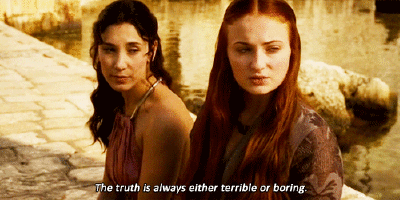
I'm just impressed at the book's execution! I am okay if 'He' goes the GoT route. GoT said it best,
This truth was eons away from boring.
Thanks for ARC Netgalley
This entire review has been hidden because of spoilers.
Naja once again features the amazing art of Bengal, but is a different kind of story all together. Turning trauma into a superpower is an interesting trope. A character often experiences awful abuse or a horrific accident or attack, and their response is to become a hyper-aware revenge machine.
Sometimes they have a “code,” like Batman or Dexter. Other times they become seemingly-remorsless killers. I can tell you that this is a very unlikely outcome of childhood trauma, but it nonetheless seems to be a common way to create a morally-compromised hero. In Naja’s case, she is left emotionally blank and without the ability to feel physical pain. (In most true-life cases, the reverse is true.) It’s easy to see how the hyper-vigilance often displayed by trauma victims could be useful in life as a super spy/assassin, but the physical exhausting that accompanies that “ability” is often left out.
But Naja and her fellow assassins are not typical survivors of trauma. Indeed, they are extraordinarily skilled, and are the top three assassins in the world. In Naja’s case, she kills because it is a job that pays well, and because she has somehow become particularly skilled at it. Her fellow assassins represent two alternative motives for killing: Killing only for “good” causes, whether real or simply believed; and simple psychopathy.
Naja’s tale is told by a rather interesting and wholly unreliable narrator, and his motivations both deepen and become more opaque as the story progresses. Meanwhile, Naja becomes both more unlikeable (her misanthropy knows no limits) and more sympathetic as the tragedy of her backstory is revealed.
First of all, the artist does an amazing job of conveying the story -- the emotional impact, the action, and the connectedness of the unfolding plot -- through illustration.
Secondly, the storytelling is really quite excellent as well . . . until the end approaches, and the revelations that draw the plot together feel a bit rushed, almost like the writer had trouble figuring out how to let things unfold naturally, so he ended up just kinda dumping it in the reader's lap via awkward in-character exposition.
I found the wrap-up a bit jumbled, and the "big reveal" that draws the plot together somewhat difficult to swallow in its over-the-top drama, but the story as a whole was so well put together up to that point in every way that it still managed to warrant four stars, in my estimation. I have found that graphic novels from the French "comic book" market seem to enjoy some of the same virtues, and suffer some of the same vices, as the writing in Naja carried with it -- which makes sense, given the writer evidently got his start there. I think some US comic book writers could learn some things about storytelling by both reading and writing in the French market some more, and some French comic book writers could learn some things about how to tie a plot together by both reading and writing in the US market some more.
In addition to being a great read, the hardbound edition of this story is beautiful. It's going to look fantastic sitting on my shelf.