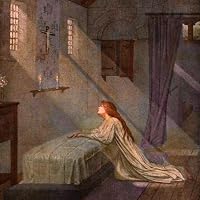
Lovely Davina Milne refused to stay away from Starvelings because of its sinister reputation. Village talk about the evil Lord Stanyon and his reclusive wife could not keep her from the youthful heir of the manor who so clearly and painfully needed her.
But when the lovely young girl entered the bleak mansion, she found herself moving ever deeper into a labyrinth of fearful secrets. And when suddenly she could no longer ignore the dark chasm opening before her unbelieving eyes, she realized escape had become impossible…
Evelyn Domenica Berckman was a British author of post-war detective fiction, horror and naval history, with a gift for engaging titles, featuring no one detective but a series of independent young women. The Evil of Time, for instance, features an archaeologist involved in tracing and restoring works of art stolen and hidden by the Nazis. Slightly marred by occasional fluffy love scenes, but presented with competence and an obvious knowledge of and love for the subject.
Many of her other novels made use of strong backgrounds. For example, A Simple Case of Ill-Will involves intrigue at a bridge club. In addition, The Heir of Starvelings (published as a Gothic), set in a ruined British mansion full of neglected and damaged antiques, was dedicated to the memory of Rupert Gunnis (1899-1965), an expert in antiquities. Also, The Voice of Air has a strong background involving antique automatons.
Evelyn Berckman was born in Philadelphia and moved to London in 1960. For many years she was a pianist and composer, and wrote plays and (mainly historical) non-fiction in addition to her novels. Her musical career was sidelined by injury for a number of years -- she suffered from temporary paralysis brought on by long sessions of practice on the piano. Her writing career didn't really start until the 1940s.
Evelyn Berckman died on September 18, 1978. The Mugar Memorial Library of Boston University houses a collection of Berckman's manuscripts.
Very well-written and set in 1855, "The Heir of Starvelings" is Gothic in the sense that it contains many of the elements that define lesser examples of the popular novels from the 1960s-70s: a gloomy house, a child in potential danger, a family mystery. What sets this novel apart is its elegant prose,its palpable sense of evil and menace--and its thoroughly attractive heroine, Davina Milne, who is head and shoulders above the usual damsel in distress of such novels. Equally unusually, the novel contains a lengthy epilogue that leaves the reader feeling poignant. Highly recommended.
Gothic, moralistic, heartstring-splitting. The experience of engaging with the book as both physical object, archival repository, and as "a novel of innocence and evil", as its subtitled, are prompting further reflections, which I'll begin unravelling soon. It's deeply, deeply fascinating to explore the Gothic romance form in what I presume was one of its heydays, and I have a lot of thoughts about the narrative mode of expression, the ideas assumed around goodness, degeneracy, formal breeding, and shame, and the redemptive power of love that ribbons the book throughout, like a renegade pennant.
This was billed as 'a Gothic novel' and I suppose it is. The main protagonist is a young woman who has just lost her fiancé in the Crimean War, and who is seeking to distract herself with a suitably exhausting labour; the one she takes on is the education and civilisation of a feral small boy, who happens to be the neglected heir of a horrible old aristocrat living in a crumbling and sinister mansion surrounded by overgrown woods to which local superstition attributes monsters (or at least vicious guard-dogs). Lord Stanyon was once a dissolute Regency buck, who in his crippled old age has defied his family by marrying an uneducated peasant and producing a son to spite his heirs-presumptive, but the boy --thanks as much to the equally evil manservant's malignity as to his father's scorn for his wife and child-- is not only filthy and illiterate, but half-deaf and backward in his development as a result.
Much of the book is about the increasing attachment of our heroine, Davina, to her small charge, who proves to be inherently sweet-natured and eager to please, and to the social and educational progress she manages to make with him (which is what makes the epilogue something of a kick in the teeth). But she is also busy investigating the house and the mystery of her employer's family affairs. There is a strand concerning her fiancé's interest in old documents and antiquities and her own attempts to emulate him, but that doesn't really go anywhere much, beyond suggesting that there really isn't any family treasure to find (and cleaning up a couple of portraits that show a likeness to the boy). On the other hand, Davina's ongoing sense of loss and connection to the man she loves -- and her feeling of betrayal when she starts to find herself 'coming to life' in the course of this new occupation -- is a continuing background element, and one that does pay off quite unexpectedly. In fact, to be frank, that's a major reason why I rated the book as high as I did.
It's not a 'Gothic romance' in that there is no love-interest. Nobody rescues the heroine, and being a strong-minded young woman she is more frustrated than intimidated by the ominous atmosphere and the inexplicable terror of the ineligible wife, who is doing the work of a skivvy in the kitchen (her husband will no longer even tolerate her in his presence, although I don't think it is ever explained why). Davina considers marriage with an aging respectable suitor --with the somewhat optimistic reflection that perhaps after a few years it will be more like the familiar life with her father -- but circumstances intervene. There is an underground passage (the Folly) of which the little boy is terrified, and which appears to have been the scene of Hellfire-Club-type outrages in the past, but again she doesn't really *discover* anything there; it's just the setting for a thriller-style confrontation from which she escapes almost coincidentally.
One can see why the publishers probably had difficulty working out how to market this; there are lots of disparate elements floating around, and it doesn't really fit into any one genre. 'Gothic' is fair enough, but it isn't really going to satisfy those looking for Mr Rochester, and nor is it thriller enough to accompany the novels of Mary Stewart. Despite some period details it barely feels like historical fiction (it was actually a shock to realise that when 'the Queen' appears, it's Queen Victoria!) The protagonist is too sensible and level-headed for there to be many horror elements, and Lord Stanyon's would-be lechery is less of a threat than he would like to imagine. The twisted relationship between the old man and his manservant, on whom he is physically dependent but over whom he holds a psychological ascendency, is noted at points but not really explored. There are some almost magical realist moments in the expedition to London, when all the dreams seem to be coming true. And there's also a Helen Keller element in the painstaking attempts to develop the child, which is why it's a bit of a shock to meet him in the epilogue as clearly severely subnormal in old age; it's suggested that he may be now regressing into senility, and have been more independent in the past, but it feels like a blow to all Davina's faith in his potential against the prognostications of the uncaring adults.
It's very well written. Overall I'm not quite sure it hangs together, although many elements are well set up in advance (the introduction of the alms-houses as a source of dissension between Davina and her father right at the start, for instance). And I'm not sure the writer was quite sure what sort of book she was planning to write -- but I did enjoy a lot of it a lot.
What an unexpectedly lovely gothic drama! Very well written and gently haunting. The epilogue brought tears to my eyes, which has only happened a handful of times. I loved this little book and only wish it had been longer with a bit more romance.