August of 1914 was truly a calamitous month. The First World War broke out on the fourth day of August; and by the end of that month, the imperial Russian Army had suffered one of the most catastrophic defeats in military history. At the Battle of Tannenberg in East Prussia, virtually all of Russia’s 2nd Army was killed, wounded, or captured. The casualty figures range from 70,000 to 120,000 for the Russians, as opposed to less than 15,000 for their imperial German adversaries. In the battle’s aftermath, the Russian commander, General Alexander Samsonov, shot himself.
To call the story of Tannenberg epic would be almost an understatement; and for that reason, it is understandable that the great Russian novelist Aleksandr Solzhenitsyn was drawn to it. In his 1971 novel August 1914, Solzhenitsyn sets forth his view that the disasters of that month reveal much regarding the historical factors that led to the Russian revolution of 1917, the destruction of the tsarist regime in Russia, and the establishment of the Soviet regime that replaced it.
Solzhenitsyn gained fame as a dissident writer within the Soviet Union. Imprisoned for eight years for critical comments about Stalin in a private letter, Solzhenitsyn used his experiences in the Soviet prison-camp system as a basis for his first novel, One Day in the Life of Ivan Denisovich (1962). His chronicling, in both fiction and non-fiction, of the flaws and failings of the Soviet system won him the Nobel Prize for Literature in 1970, and resulted in his expulsion from the U.S.S.R. four years later. August 1914, published right in the middle of that period, drew a large and appreciative audience in the West. I still have vivid childhood memories of seeing a hardback copy of the book on a shelf in my grandparents’ apartment in Washington, D.C.
August 1914 includes historical figures from the time of the Tannenberg battle as well as fictional characters. General Samsonov is, of course, an important character in the novel, and Solzhenitsyn’s portrayal of him is striking. The book’s Samsonov is old, slow-thinking, used to obeying orders, accustomed to moving up in the system by following orders without question. At the same time, however, Solzhenitsyn suggests that Samsonov is the product of a system that, for centuries, has discouraged initiative and rewarded blind obedience to absolute commands from on high:
Samsonov would have been happier if he could have carried out orders just as he received them. But what if the orders made no sense? What if they were obviously detrimental to the motherland?
He had not been given a general objective and told to use his own method of achieving it; the way had been prescribed down to the minutest detail, and the slightest deviation brought a sharp rebuke. The Army Commander was left no more freedom than a hobbled horse. (p. 155)
In stark contrast with the unfit-for-command General Samsonov is Colonel Georgii Vorotyntsev, who represents the might-have-beens of August 1914. Vorotynstev is an able young officer who exhibits personal courage in response to the physical and psychological stresses of combat; after one sleepless night, with the prospect of at least a week of pitched battle in East Prussia ahead of him, he reflects that “This was what he was born to do. These were the greatest days of his life – the days for which every regular officer lives. He did not feel downcast; he felt buoyant and light-hearted. He was beyond caring whether or not he ate or slept” (p. 202).
Moreover, Vorotyntsev has new ideas for how a modern army could wage a modern war, and he emerges as a skilled leader who might have brought the battle of Tannenberg to a quite different conclusion. At one point, he volunteers to go to a particularly crucial part of the front, and gets there in spite of many dangers, insisting to both superiors and subordinates that “Just another hour could change the whole situation.” He finds two battalion commanders and a regimental adjutant, convenes an informal council of war, and gets right to work: “Corps HQ is ten versts away, and as you see, they have sent nobody over. Army regulations allow a ‘council of the senior officers present’ to take command when necessary” (p. 403).
Vorotyntsev’s ideas for redeployment strike a chord: “The bright flame of his assurance kindled an answering glow in the senior infantry officers. They were not stick-in-the-muds – while the battle was being decided in the thunder of guns all around them, impotent inaction was a torment” (p. 409). The situation on this part of the front, for the beleaguered Russians, is relieved; but sadly, Vorotynstsev is not in command of the whole Russian Army, and the history-minded reader already knows that, under Samsonov’s command, the Russians are doomed to catastrophic defeat.
What Vorotyntsev sees regarding the incompetence of high command is also seen by junior officers exercising tactical command on the battlefield. Two battery commanders in a strategically important portion of the battlefield meditate upon the uncomfortable nature of their situation:
If the 2nd Army had entered Prussia like the head of a charging bull, those now at Rothfliess station were the tip of its right horn. The horn had penetrated the body of East Prussia to two-fifths of its depth. While they held Rothfliess station they were cutting the main line, the last line but one by which the Germans could switch their forces laterally across Prussia. Clearly, the Germans would want that station at any price. It would have been sensible to put the whole of the 6th Corps right there.
But fate had been kind in one way: they no longer had any brainless busybodies over them. That was the worst possible position to be in. Their fragile handful was the tip of the horn, but it was at least in their power not to do silly things. (p. 300)
In a manner that might remind some readers of Leo Tolstoy’s War and Peace, Solzhenitsyn also provides the perspective of participants at lower level levels of leadership. Sasha Lenartovich, a revolution-minded young man commanding a platoon in the fighting around Neidenburg, feels at one point that “He could not have got into a more ridiculous situation. To die for the autocracy at twenty-four!” (p. 501). Yet as his forces start to engage the Germans, Sasha finds that he is “enlisted” in the fight in spite of himself: “Although he had no desire for victory and would make no effort toward it, Lenartovich was gratified to note that the Germans were outgunned” (p. 503).
When the Russian forces achieve success on this portion of the front, Sasha finds that “He was bursting with a strange feeling of triumph: his first victory won not in debate, but won with his body, with his arms and legs….How easy everything now seemed! The cup of hope was running over. He would survive this war! How precious life was!” (p. 509). Unfortunately, it is not long before such assessments come to seem grossly over-optimistic. Here, Solzhenitsyn seems to be commenting on the effect that war can have on those who are fighting in it.
Solzhenitsyn, as mentioned above, is interested in Tannenberg and August 1914 in term of what it reveals about Russian society on the verge of revolution. A scholar named Varsonofiev engages in conversation with two students named Sanya and Kotya who are on their way to the battle, and offers critiques of the Marxist view of “history” as a rational, mathematically precise process that can be predicted and tracked by a person with the “correct” theoretical orientation.
When Kotya asks about the social order, Varsonofiev says, “Don’t get carried away with the idea that you can invent a model society and then twist your beloved people into the right shape to fit it”, and adds that “History…is not governed by reason” (p. 601). When Sanya asks what history is governed by, Varsonofiev sternly replies that “History is irrational, young men. It has its own organic fabric which may be beyond our understanding” (p. 601).
The reader also gets to hear civilians reflecting on the prospects for revolutionary change in Russia. When a young woman named Veronika objects to individual murder as a means of bringing about that sort of social change, her revolution-minded Aunt Agnessa responds in terms that sound quite Soviet, insisting that “It isn’t murder!...We have been left with no hope of breaking through except by way of violence. In the long run, what we need is a general revolution, of course. But terror, and only terror, leads revolution by the hand! Without terror to guide it, revolution would simply get bogged down in the Russian mud and clay. Only the winged horse of terror can drag it out. You must not look at terror itself, but at its lofty aims. Terrorists do not kill this or that individual – in his person, they are endeavouring to kill evil itself!” (p. 800) In Aunt Agnessa’s words, one senses Solzhenitsyn looking ahead to the time of the Cheka and the N.K.V.D. and SMERSH and the K.G.B.
Other civilians simply express concern regarding the human cost of war. Another young woman, Ksenia, is visiting with the Kharitonovs, a family that has tried to protect Ksenia from her autocratic father. Once the war has started, a school headmistress named Aglaida Fedoseevna shows Ksenia “a graduation photograph of Yarik [Kharitonov] in second lieutenant’s uniform!” Ksenia, looking at the photo with the headmistress, finds that Yarik “looked even more like a little boy, in that huge cap and with that high collar, than he did in shirt sleeves around the house. He had tightened his straps till they were vertical, and looked so pleased with himself!” Aglaida Fedoseevna says with sadness that Yarik “could have been a third-year student now, and no one would have touched him”, and then shows Ksenia the postmark on Yarik’s letter. “[T]here’s the Ostrolenka postmark, which means it’s the southern army, Samsonov’s – He’s right in the middle of it all”. The narrator then records that “suddenly the most ordinary of teardrops fell on to the seven of hearts” (p. 1307).
There are also some interesting experimental novelistic techniques at work throughout August 1914. Sometimes, a passage of conventional prose will be interrupted by the word “SCREEN,” followed by what seems more like a screenplay. In one of the book’s later battle passages, for instance, an advance guard under the command of one Colonel Pervushin is trapped in a very bad place, surrounded by Germans. The narrator records that “Each little success seemed only to make things worse for the Russians. Their strength was ebbing, they were getting hungrier, thirstier (the wells had been blocked), their ammunition was running out, they had more wounded on their hands, the ambushing forces were stronger all the time. Their only hope was a bayonet charge” (pp. 703-04). As Colonel Pervushin, already wounded twice by enemy bayonets, gives the order for the charge, the word “SCREEN” appears, and then we are in the midst of what looks and feels like a cinema treatment or scenario:
Close-up. We see
Pervushin, moving cautiously because of his wounds. The blood on his face, his neck, his tunic.
The hole in his cap. His cap is tilted, not at the regulation angle.
His fierce mustaches are drooping. There is no defiance and no humour now in his wide-eyed stare, only desperation.
He speaks to no one, and no one comes near him. These few minutes of reflection may be the last in his fifty-four years of life. (p. 704)
I’m not sure why Solzhenitsyn engaged in that particular bit of literary experimentation, but it certainly was dynamic and attention-getting.
In Chapter 65 of August 1914, there is a drastic change of pace. Solzhenitsyn veers over into a long digression on the life and career of Pyotr Stolypin (1862-1911), a pre-World War I prime minister remembered for his energetic and comprehensive reform efforts.
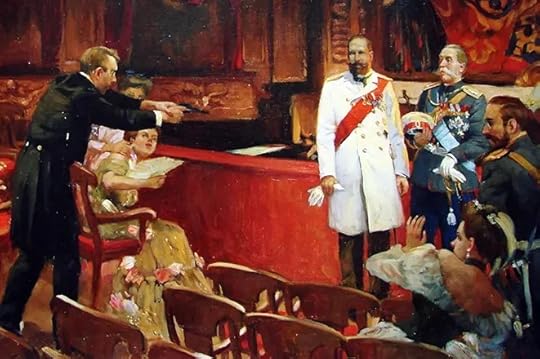
In Solzhenitsyn’s telling, Stolypin emerges as a sympathetic figure, whose efforts at reform are meant to strengthen the Russian state and forestall the possibility of violent revolution. Yet many of his reform initiatives are stymied due to the whims of Tsar Nicholas II and his family, and Stolypin himself is eventually assassinated by a revolutionary, at the Kyiv Opera House, within sight of the tsar and his attendants.
August 1914 is part of a larger cycle of three novels called The Red Wheel, and the long section on Stolypin no doubt makes more sense within that larger context. For me, the Stolypin section was informative in historical terms, but I found Solzhenitsyn’s depiction of the battle of Tannenberg more compelling. It was what I went to August 1914 for, and I found the novel to be a sad and powerful depiction of the horrors of war and the drama of historical change.





 http://www.bbc.co.uk/programmes/b04fyd8h
 Your average Russian 'Boris' is still being fed daily doses of misinformation, and hazard to guess that should a war footing be declared, they would fare no better next time around. For that very reason, this book is still relevent today. Current misinformation comes no fouler than out of the mouth of a certain Vladimir Medinsky:
Medinsky is so keen to demonstrate Russia’s superiority to other nations that he has even said that Russia’s perseverance in the face of all twentieth-century catastrophes, indicates that “our people have an extra chromosome.”.Source
 Take a moment to think about those who have lost their lives so senselessly.


