

What do you think?

The Story of Ain't: America, Its Language, and the Most Controversial Dictionary Ever Published
The Story of Ain’t by David Skinner is the captivating true chronicle of the creation of Merriam Webster’s Third New International Dictionary in 1961, the most controversial dictionary ever published.
Created by the most respected American publisher of dictionaries and supervised by the editor Philip Gove, Webster's Third broke with tradition, adding thousands of new words and eliminating "artificial notions of correctness," basing proper usage on how language was actually spoken. The dictionary's revolutionary style sparked what David Foster Wallace called "the Fort Sumter of the Usage Wars." Editors and scholars howled for Gove's blood, calling him an enemy of clear thinking, a great relativist who was trying to sweep the English language into chaos.
Skinner’s surprising and witty account will enthrall fans of Winchester’s The Professor and the Madman and The Meaning of Everything, and The Know-It-All by A.J. Jacobs, as it explores a culture in transition and the brilliant, colorful individuals behind it.
Entertaining and erudite, The Story of Ain't describes a great societal metamorphosis, revealing the fallout of the world wars, the rise of an educated middle class, the emergence of America as the undisputed leader of the free world, and how those forces shaped our language. Never before or since has a dictionary so embodied the cultural transformation of the United States.
Created by the most respected American publisher of dictionaries and supervised by the editor Philip Gove, Webster's Third broke with tradition, adding thousands of new words and eliminating "artificial notions of correctness," basing proper usage on how language was actually spoken. The dictionary's revolutionary style sparked what David Foster Wallace called "the Fort Sumter of the Usage Wars." Editors and scholars howled for Gove's blood, calling him an enemy of clear thinking, a great relativist who was trying to sweep the English language into chaos.
Skinner’s surprising and witty account will enthrall fans of Winchester’s The Professor and the Madman and The Meaning of Everything, and The Know-It-All by A.J. Jacobs, as it explores a culture in transition and the brilliant, colorful individuals behind it.
Entertaining and erudite, The Story of Ain't describes a great societal metamorphosis, revealing the fallout of the world wars, the rise of an educated middle class, the emergence of America as the undisputed leader of the free world, and how those forces shaped our language. Never before or since has a dictionary so embodied the cultural transformation of the United States.
351 pages, Hardcover
First published October 9, 2012
About the author
David Skinner
58 books7 followersUnlike the characters in his stories, David Skinner is strikingly human and, according to some people, quite likable. He currently lives in the badlands of suburban Colorado Springs with his wife, Jenn, and his pug, award-winning snuggler and chewer-of-things-that-are-not-his, Howie. “The Antichrist of Kokomo County” is Skinner’s debut novel.
Ratings & Reviews
Friends & Following
Create a free account to discover what your friends think of this book!
Community Reviews
Displaying 1 - 30 of 105 reviews

February 1, 2013
Dear Friends: Please don't hate me because this is so long. I hope that it's readable and informative.
Ours, the American language, is a hospitable language composed of so many influences from outside the United States of America. Hopefully, we welcome with open arms people from other freedom loving counties and their languages. We have been incorporating their influence and their words into our own version of English for hundreds of years. I’ve read more than one time that our language is always evolving but until the 1961 publication of Webster’s Third New International Dictionary by G. & C. Merriam Company we just took the fact for granted without seeing it in black and white, bound and in our schools and libraries. That changed with the publication of only the third edition of the famous Webster’s Dictionary.
Webster’s Third, W3 as it was called, was immediately lambasted by scholars, linguists and specifically The New York Times which stated it should be immediately withdrawn and replaced by Webster’s New International Dictionary, Second Edition, Unabridged, now referred to as W2. W2 which was published in 1934, during The Depression contained among other words, ain’t* although in W3 it was the rallying cry for the critics of the newest Webster edition. The word had even been published in other lesser known dictionaries previous to 1961.
The book begins with a biographical sketch (some longer than others) of the ‘who’s who’ in the book, those important players. The Dramatis Personae (Latin, of course, which I thought odd) is a short bio sketch of the persons referenced in the book and was located at the back of the book with notes and an index. I referred to the Dramatis Personae frequently. (It occurred to me that James Lee Burke might consider doing the same because of the high number of characters in his books.)
The brouhaha arose after the book was published in 1961 with the editor, Dr. Philip Gove considered mostly responsible for the new edition. He (with the support of Gordon Gallan, president of Merriam when W3 was published) along with their already ‘in-house’ scholars, kept all changes prior to publication very secretive in “Black Books” which were never to leave the premises.
It was unfortunate that the PR firm which Merriam hired to announce the new edition had inaccurate information in their first press release. It was soon corrected; the inaccurate information was that the word ‘ain’t’ was seen for the first time in a dictionary in W3. The word was also listed in W2 as a colloquialism but this time colloquialism was dropped from the definition which to linguists, high school English teachers and college English professors (including their respective national organizations) made a big difference.
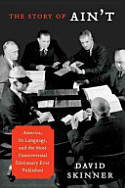
Photo on cover of book which was contributed by Merriam but no one was identified
In W3 one-quarter million words were dropped from the 1934 edition with “all remaining entries …revised” for a total of 450,000 words and 100,000 quotations “from more than 14,000 authors.” Had there not been any words and/or entries dropped, Merriam would have had to print two volumes which was not considered cost effective much less the bulk of two volumes. I can recall the sturdy stand at the inside the door of our high school library. The dictionary was huge and needed a sturdy stand.
As stated, W3 was attacked and extolled by various college professors in history and the humanities, language scholars, editors of literature reviews, TV hosts (TV and TV dinners were both new listings), newspapers and their columnists, grammarians, intellectuals, magazine editors and published authors with all stating their varied positions.
The New York Times stated W3 should be immediately withdrawn and W2 republished. Further, the international newspaper was not going to use W3 as the last word for spelling usage and information (who was the 31 president of the U.S.?) and that they would continue to use W2. The NYTimes considered their highfalutin opinion basically the end of the story. It would single handedly be the catalyst for putting W3 away forever. (Remember strong peronalities and egos were involved here.) Unfortunately, their first story on W3 contained inaccuracies which they later had to publicly correct and/or retract. Not off to a great start, NYT.
Take that! (I was tickled that author David Skinner said that numerous times throughout the book when opposing opinions shot back with a zinger.)
Some newspapers and opponents of W3 said its publication was the end of the English language as we knew it. English, our language, was going to hell in a handbag because of its publication. And well respected newspapers across the nation offered their opinion. They were mostly detractors of the newer edition of Webster’s Dictionary some repeating the inaccuracies stated by other newspapers, without researching the facts themselves.
Well, yes, English, the proper use of the English language in America was changing due in part to a changing culture in America. America was no longer an elitist society where the common, average, middle American was still somewhat illiterate and uneducated.
Without going into all the cultural changes America went through from 1932 to 1961, of course our language would change; W3 was based on our speaking language NOT how we should say things, but how we DO say things. (A study was made using mostly handwritten letters to the U. S. Army with words written by a broad spectrum of Americans about their benefits from the government. The study was used and referred to by Dr. Gove and his core group at Merriam to support decisions made in the Black Book.)
Gove’s small group, who looked at each and every entry of W3, was always quiet working, not speaking to each other within their work area. He strongly encouraged them to look at the words as becoming more pedestrian, looking at the writings of Mickey Spillane, Gypsy R. Lee, Fred Allen, Walter Winchell and Al Capp. They all used standard English. Of Webster’s Second, the 1934 edition, Gove said it “represents a luxury of a bygone age.” We were fully in and embracing the 20th Century.
Think how America, after World War II, how the G.I. Bill allowed returning soldiers the opportunity to graduate with a college degree. College professors didn’t teach the now worldly and older (24, not 18-19 years old) soldiers to speak the “Kings English.” They spoke American English using words normally spoken in normal conversations. Clearly English speaking terms such as “whilst” was considered snobbish and elitist and the language spoken by a more English society where there was a more clear delineation of classes. Here in America, we were more democratic, with “all men created equal” attitude…so, professor, “don’t get uppity with me.”
Take that!
The discussion went on for years with Merriam actively responding to criticism. They said such things as “the King’s English was going democratic.” Other supporters praised the foresight and courage of Merriam for the printing of W3. The support, of course, received Gove and Gallan’s blessings.
Why American English?
“In 1905, Henry James, after years of living in England, had lectured at Bryn Mawr on “The Question of Our Speech.” That Americans lacked ‘good breeding’ and “American circumstances had imposed on the mother tongue in general…” Mark Twain, no surprise here, took the opposite view of our language and used “hain’t” freely in his writing, (that’s how those guys talked, eh?) and out the window went double negatives…”he never not minded” that rule and American loved and embraced Twain.
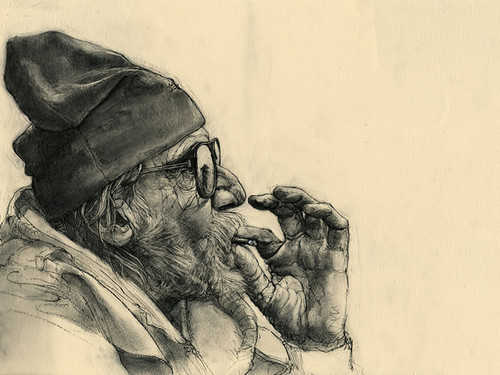
Old Beatnik, Old Stoner
Where, Oh Where, Would We Be Without W3?
Take the word beatnik which comes from the Russian word Sputnik which was launched in 1957. Beatnik, which is defined as “a person, especially a member or follower of the Beat Generation, whose behavior, views, and often style of dress is pointedly unconventional.” Visions of Kerouac dancing in your head? Of course. And we can thank Herb Caen of the San Francisco Chronicle when he coined the word Beatnik in 1958. San Francisco, no surprise there, eh? Harks back to Jack Kerouac, too, who that same year published The Dharma Bums and “helped popularize Zen, as in Zen Buddhism.” Zen which was also a new entry in W3.
I always thought vulgar English was just four letter words in English, those words not usually used in public. Linguists would know, of course, that it’s the English used by the semi-illiterate, the uneducated. I received a great education reading this book learned something new about every page. (No discussion here on “dirty words” in W3, just let me say there are plenty in W3 and a discussion on just that topic would be again, the length of this review.)
The definition of journalistic in W2 embarrassing states “characteristic of journalism…hence of a style characterized by evidence of haste, superficiality of thought, inaccuracies of detail. Colloquialisms and sensationalism, journalese. “ I believe Edward R. Murrow would be (perhaps was) offended by that definition and characterization.
It took me more time than usual to read this average sized book and not because I was busy either. I found myself getting side-lined, looking up words I was not familiar with, looking through bookshelves seeing what dictionaries I had (and I have a lot), and browsing through books on words, going off on all kinds of tangents related to words and dictionaries and the English language in general.
Obviously, based on the dictionaries and books that I have around, I have loved our written word, our spoken word, our language which I now hope to refer to as American English.
As an aside, having family in the Smokey Mountains, I recall reading an article that inhabitants of the Smokies and the Appalachian Mountains spoke more the “Kings English” than those of us who live scattered over America. The article went on to say that was because they were secluded and did not have the outside influences those of us who engaged with others. Makes more sense to me now than it did when I read it years ago.
Glancing through other reviews, I see where some said it was boring, sluggish…well, if you have no curiosity about our language and the written word, pass this by. However, if you’re curious, as I am, about words in general, you would either like this or love it like me.
And lastly, when I began the book, it occurred to me that I wished that I had had a more ‘classy’ maybe, literary education from Harvard, Yale, one of those uppity universities where when students graduate they freely use words which I now have to look up in a dictionary (on-line but mostly on my Kindle). But after reading the book which I so thoroughly enjoyed to the nth degree, I’m happy with my education. It’ mine, it’s a basic, run of the mill, average education in journalism and political science from a basic state university, all American, nothing English, our Mother Land English about it.
Take that.
*My own spell check shows this is not a word and offers corrections. Now odd to me after reading the book because ain’t is a word.
Ours, the American language, is a hospitable language composed of so many influences from outside the United States of America. Hopefully, we welcome with open arms people from other freedom loving counties and their languages. We have been incorporating their influence and their words into our own version of English for hundreds of years. I’ve read more than one time that our language is always evolving but until the 1961 publication of Webster’s Third New International Dictionary by G. & C. Merriam Company we just took the fact for granted without seeing it in black and white, bound and in our schools and libraries. That changed with the publication of only the third edition of the famous Webster’s Dictionary.
Webster’s Third, W3 as it was called, was immediately lambasted by scholars, linguists and specifically The New York Times which stated it should be immediately withdrawn and replaced by Webster’s New International Dictionary, Second Edition, Unabridged, now referred to as W2. W2 which was published in 1934, during The Depression contained among other words, ain’t* although in W3 it was the rallying cry for the critics of the newest Webster edition. The word had even been published in other lesser known dictionaries previous to 1961.
The book begins with a biographical sketch (some longer than others) of the ‘who’s who’ in the book, those important players. The Dramatis Personae (Latin, of course, which I thought odd) is a short bio sketch of the persons referenced in the book and was located at the back of the book with notes and an index. I referred to the Dramatis Personae frequently. (It occurred to me that James Lee Burke might consider doing the same because of the high number of characters in his books.)
The brouhaha arose after the book was published in 1961 with the editor, Dr. Philip Gove considered mostly responsible for the new edition. He (with the support of Gordon Gallan, president of Merriam when W3 was published) along with their already ‘in-house’ scholars, kept all changes prior to publication very secretive in “Black Books” which were never to leave the premises.
It was unfortunate that the PR firm which Merriam hired to announce the new edition had inaccurate information in their first press release. It was soon corrected; the inaccurate information was that the word ‘ain’t’ was seen for the first time in a dictionary in W3. The word was also listed in W2 as a colloquialism but this time colloquialism was dropped from the definition which to linguists, high school English teachers and college English professors (including their respective national organizations) made a big difference.
Photo on cover of book which was contributed by Merriam but no one was identified
In W3 one-quarter million words were dropped from the 1934 edition with “all remaining entries …revised” for a total of 450,000 words and 100,000 quotations “from more than 14,000 authors.” Had there not been any words and/or entries dropped, Merriam would have had to print two volumes which was not considered cost effective much less the bulk of two volumes. I can recall the sturdy stand at the inside the door of our high school library. The dictionary was huge and needed a sturdy stand.
As stated, W3 was attacked and extolled by various college professors in history and the humanities, language scholars, editors of literature reviews, TV hosts (TV and TV dinners were both new listings), newspapers and their columnists, grammarians, intellectuals, magazine editors and published authors with all stating their varied positions.
The New York Times stated W3 should be immediately withdrawn and W2 republished. Further, the international newspaper was not going to use W3 as the last word for spelling usage and information (who was the 31 president of the U.S.?) and that they would continue to use W2. The NYTimes considered their highfalutin opinion basically the end of the story. It would single handedly be the catalyst for putting W3 away forever. (Remember strong peronalities and egos were involved here.) Unfortunately, their first story on W3 contained inaccuracies which they later had to publicly correct and/or retract. Not off to a great start, NYT.
Take that! (I was tickled that author David Skinner said that numerous times throughout the book when opposing opinions shot back with a zinger.)
Some newspapers and opponents of W3 said its publication was the end of the English language as we knew it. English, our language, was going to hell in a handbag because of its publication. And well respected newspapers across the nation offered their opinion. They were mostly detractors of the newer edition of Webster’s Dictionary some repeating the inaccuracies stated by other newspapers, without researching the facts themselves.
Well, yes, English, the proper use of the English language in America was changing due in part to a changing culture in America. America was no longer an elitist society where the common, average, middle American was still somewhat illiterate and uneducated.
Without going into all the cultural changes America went through from 1932 to 1961, of course our language would change; W3 was based on our speaking language NOT how we should say things, but how we DO say things. (A study was made using mostly handwritten letters to the U. S. Army with words written by a broad spectrum of Americans about their benefits from the government. The study was used and referred to by Dr. Gove and his core group at Merriam to support decisions made in the Black Book.)
Gove’s small group, who looked at each and every entry of W3, was always quiet working, not speaking to each other within their work area. He strongly encouraged them to look at the words as becoming more pedestrian, looking at the writings of Mickey Spillane, Gypsy R. Lee, Fred Allen, Walter Winchell and Al Capp. They all used standard English. Of Webster’s Second, the 1934 edition, Gove said it “represents a luxury of a bygone age.” We were fully in and embracing the 20th Century.
Think how America, after World War II, how the G.I. Bill allowed returning soldiers the opportunity to graduate with a college degree. College professors didn’t teach the now worldly and older (24, not 18-19 years old) soldiers to speak the “Kings English.” They spoke American English using words normally spoken in normal conversations. Clearly English speaking terms such as “whilst” was considered snobbish and elitist and the language spoken by a more English society where there was a more clear delineation of classes. Here in America, we were more democratic, with “all men created equal” attitude…so, professor, “don’t get uppity with me.”
Take that!
The discussion went on for years with Merriam actively responding to criticism. They said such things as “the King’s English was going democratic.” Other supporters praised the foresight and courage of Merriam for the printing of W3. The support, of course, received Gove and Gallan’s blessings.
Why American English?
“In 1905, Henry James, after years of living in England, had lectured at Bryn Mawr on “The Question of Our Speech.” That Americans lacked ‘good breeding’ and “American circumstances had imposed on the mother tongue in general…” Mark Twain, no surprise here, took the opposite view of our language and used “hain’t” freely in his writing, (that’s how those guys talked, eh?) and out the window went double negatives…”he never not minded” that rule and American loved and embraced Twain.
Old Beatnik, Old Stoner
Where, Oh Where, Would We Be Without W3?
Take the word beatnik which comes from the Russian word Sputnik which was launched in 1957. Beatnik, which is defined as “a person, especially a member or follower of the Beat Generation, whose behavior, views, and often style of dress is pointedly unconventional.” Visions of Kerouac dancing in your head? Of course. And we can thank Herb Caen of the San Francisco Chronicle when he coined the word Beatnik in 1958. San Francisco, no surprise there, eh? Harks back to Jack Kerouac, too, who that same year published The Dharma Bums and “helped popularize Zen, as in Zen Buddhism.” Zen which was also a new entry in W3.
I always thought vulgar English was just four letter words in English, those words not usually used in public. Linguists would know, of course, that it’s the English used by the semi-illiterate, the uneducated. I received a great education reading this book learned something new about every page. (No discussion here on “dirty words” in W3, just let me say there are plenty in W3 and a discussion on just that topic would be again, the length of this review.)
The definition of journalistic in W2 embarrassing states “characteristic of journalism…hence of a style characterized by evidence of haste, superficiality of thought, inaccuracies of detail. Colloquialisms and sensationalism, journalese. “ I believe Edward R. Murrow would be (perhaps was) offended by that definition and characterization.
It took me more time than usual to read this average sized book and not because I was busy either. I found myself getting side-lined, looking up words I was not familiar with, looking through bookshelves seeing what dictionaries I had (and I have a lot), and browsing through books on words, going off on all kinds of tangents related to words and dictionaries and the English language in general.
Obviously, based on the dictionaries and books that I have around, I have loved our written word, our spoken word, our language which I now hope to refer to as American English.
As an aside, having family in the Smokey Mountains, I recall reading an article that inhabitants of the Smokies and the Appalachian Mountains spoke more the “Kings English” than those of us who live scattered over America. The article went on to say that was because they were secluded and did not have the outside influences those of us who engaged with others. Makes more sense to me now than it did when I read it years ago.
Glancing through other reviews, I see where some said it was boring, sluggish…well, if you have no curiosity about our language and the written word, pass this by. However, if you’re curious, as I am, about words in general, you would either like this or love it like me.
And lastly, when I began the book, it occurred to me that I wished that I had had a more ‘classy’ maybe, literary education from Harvard, Yale, one of those uppity universities where when students graduate they freely use words which I now have to look up in a dictionary (on-line but mostly on my Kindle). But after reading the book which I so thoroughly enjoyed to the nth degree, I’m happy with my education. It’ mine, it’s a basic, run of the mill, average education in journalism and political science from a basic state university, all American, nothing English, our Mother Land English about it.
Take that.
*My own spell check shows this is not a word and offers corrections. Now odd to me after reading the book because ain’t is a word.

October 20, 2012
I really like linguistics and books about linguistics. I like books about the history of language (and history in general). I like "dry" non-fiction books. Unfortunately, this book was overall BORING. Too many dry facts presented without color or wit, not enough of a 'plot' to keep me turning pages, and just overall boring. Such promise in this one... yet so disappointing.
April 22, 2013
If you are part of that quirky minority who entertain themselves by staying up until 2 a.m. reading "Fowler's Modern English Usage," then you should place this book on your "must read" list.
This is the story of "Webster's Third New International Dictionary, Unabridged", issued in 1961 and triggering the greatest linguistic war in American history. Its incendiary premise was that dictionaries should reflect, not the ex cathedra pronouncements of haughty "experts", but the actual usages of ordinary people. "Descriptive, not prescriptive" as chief editor Philip Gove said.
The "Ain't" in the title refers to the Dictionary's then-astonishing pronouncement that the word is "used orally in most parts of the U.S. by cultivated speakers." The uproar was humorously caught in a New Yorker cartoon in which the receptionist at G. & C. Merriam Company tells a visitor, "Sorry. Dr. Gove ain't in."
The uproar was overdone and in many respects misguided. Gove's dictionary did not endorse "ain't", or "due to" or "different than" or "galore" or "scads" or "scrumptious" or "knowed" or any of a thousand other common locutions that pompous pendants like (no, I mean "as") Dwight MacDonald claimed portended the end of civilization just by being listed. What it DID do was restrain judgment by eliminating the Webster's Second practice of attaching "vulgar" or "colloq." to disfavored words and instead substituting, sometimes, "not standard."
What makes this book so fascinating is that it shows how passionate people can be about the trivialities of usage. One commentator called W-3 "Bolshevist."
The subject will not captivate everyone. But if you are one who happily ends sentences with prepositions, splits infinitives, uses "none" as plural, and insists (correctly) that "I ain't home yet" is proper English, you will have fun with this tale of linguistic pettiness, told with wit, irony, and flair.
This is the story of "Webster's Third New International Dictionary, Unabridged", issued in 1961 and triggering the greatest linguistic war in American history. Its incendiary premise was that dictionaries should reflect, not the ex cathedra pronouncements of haughty "experts", but the actual usages of ordinary people. "Descriptive, not prescriptive" as chief editor Philip Gove said.
The "Ain't" in the title refers to the Dictionary's then-astonishing pronouncement that the word is "used orally in most parts of the U.S. by cultivated speakers." The uproar was humorously caught in a New Yorker cartoon in which the receptionist at G. & C. Merriam Company tells a visitor, "Sorry. Dr. Gove ain't in."
The uproar was overdone and in many respects misguided. Gove's dictionary did not endorse "ain't", or "due to" or "different than" or "galore" or "scads" or "scrumptious" or "knowed" or any of a thousand other common locutions that pompous pendants like (no, I mean "as") Dwight MacDonald claimed portended the end of civilization just by being listed. What it DID do was restrain judgment by eliminating the Webster's Second practice of attaching "vulgar" or "colloq." to disfavored words and instead substituting, sometimes, "not standard."
What makes this book so fascinating is that it shows how passionate people can be about the trivialities of usage. One commentator called W-3 "Bolshevist."
The subject will not captivate everyone. But if you are one who happily ends sentences with prepositions, splits infinitives, uses "none" as plural, and insists (correctly) that "I ain't home yet" is proper English, you will have fun with this tale of linguistic pettiness, told with wit, irony, and flair.

January 6, 2013
I thought this was going to be the story of how "ain't" was accepted into the dictionary, but it ended up being the story of some of the men who were involved in that decision. That in itself wouldn't be a problem but the writing is wordy, somewhat pretentious, and tedious. I couldn't get past the boredom factor. This is one of the rare books I didn't bother finishing.

January 15, 2023
Sigma Philip Gove haters can stay mad.

July 6, 2019
There are many bitter feuds and rivalries in history: Hatfields and McCoys, Yankees and Red Sox, Playstation vs Xbox vs Nintendo, Taylor Swift and Kanye. All of these are playground squabblings compared to the holy war between lexicographic prescriptivists, who believe a dictionary should describe how one should write, and lexicographic descriptivists, who believe that a dictionary should catalog how people actually use words. Perhaps the bitterest battle in this war is the 1961 Webster's Third New International Dictionary. David Foster Wallace decried the slipshod mediocrity of the Third in one of his essays written 40 years after the thing was published. Supreme Court Justice Antonio Scalia's official portrait has him resting his hand on the Second Edition, before the philistines ruined English.
The Story of Ain't is a cultural history of Webster's Third. "Ain't" was one word to get a definition, and served as the first shot fired over the role of the new dictionary. I get the sense of publisher muddling in the title. To tell the story, Skinner loops through the whole early 20th century culture of letters, as America shook off the lingering vestiges of an anglophile and Classics oriented sensibility towards words, and found a new jazzy vernacular, rooted in new media like radio and TV, and the new sciences and technologies of the transformative period bookended by the Jazz Age and the Space Age.
Skinner's book wanders at the start, eventually finding a protagonist in Webster editor Philip Gove, and antagonist in literary critic Dwight MacDonald. Along the way is the emergence of linguistics as a field, educational reform, political movements, the Second World War, and an attempted corporate take-over. The book is a little scattershot, but manages to make this story almost thrilling.
The Story of Ain't is a cultural history of Webster's Third. "Ain't" was one word to get a definition, and served as the first shot fired over the role of the new dictionary. I get the sense of publisher muddling in the title. To tell the story, Skinner loops through the whole early 20th century culture of letters, as America shook off the lingering vestiges of an anglophile and Classics oriented sensibility towards words, and found a new jazzy vernacular, rooted in new media like radio and TV, and the new sciences and technologies of the transformative period bookended by the Jazz Age and the Space Age.
Skinner's book wanders at the start, eventually finding a protagonist in Webster editor Philip Gove, and antagonist in literary critic Dwight MacDonald. Along the way is the emergence of linguistics as a field, educational reform, political movements, the Second World War, and an attempted corporate take-over. The book is a little scattershot, but manages to make this story almost thrilling.

October 18, 2012
This was kind of a slog for me - definitely one of those books where the content was interesting, but the writing left a lot to be desired. I would love to hear this story in the words of a different author -- I double majored in English and linguistics, and as such I've long been interested in the concept of prescriptive versus descriptive linguistics. This topic had such potential in that department -- but really fell flat.

September 23, 2020
My mother went ballistic when Webster’s Third New International Dictionary of the English Language appeared in 1961. She’d taught English for a time during the Depression. Then, there was a right way and a wrong way to express yourself. Rules were rules—and English teachers knew exactly what they were. But even back then the linguists had arrived on the scene with the peculiar notion that the ways people actually spoke the language more accurately reflected what was “right” than the rules of grammar as laid down in classrooms like my mother’s. And that was the perspective that guided the preparation of Webster’s Third, as David Skinner relates so entertainingly in The Story of Ain’t.
A permissive approach to the rules of grammar
In fact, by 1961, that same accepting approach had already come to be adopted among many English teachers. The new “progressive” or “permissive” ethos had long since surfaced in Dr. Benjamin Spock‘s The Common Sense Book of Baby and Child Care, first published in 1946. And that was only the beginning of civilization’s downfall, as so many warned. Progressive education was identified in the USA with the work of John Dewey in the 1930s, and my mother . . . Did. Not. Like. It. At. All. Disturbingly, the editors of the new Webster’s Third had treated that approach as gospel.
Reactions so violent the critics never studied the book
Well, my mother was by no means alone in her uncharacteristically intemperate reaction to the book. Virtually every major newspaper in the country editorialized its disapproval—verging on disgust—with the dictionary. In many cases, the editors (including those at the New York Times) made clear they hadn’t actually studied the book. In fact, “the vilification of Webster’s Third had reached the point where even the prestigious Phi Beta Kappa Society felt no compunction about denouncing a dictionary its officers freely acknowledged not having read.” (I suspect it was that action that set off my mother. She was a proud member.)
“Nothing less than the end of the world”
David Skinner has little patience for this shameful behavior. “Why did Americans in 1961,” he writes, “become so exercised—so irate—that several otherwise sane and distinguished persons said a mere dictionary, however imperfect, represented nothing less than the end of the world?” In commenting on a typical overreaction from public intellectual Jacques Barzun, he suggests that “nutty appears to be the new standard.” All this, because the editors of a dictionary had had the temerity to imply that the rules of grammar were no longer valid.
Not that Skinner doesn’t perceive faults in the dictionary or in Philip Gove’s decisions as editor. He cites many shortcomings. But on the whole he sides with the linguists and other scholars whose later, more measured verdicts about the book were full of praise. And in the end all the controversy paid off in a big way for the Merriam-Webster company, which made a great deal of money from much higher-than-expected sales. Take that, M. Barzun!
A massive undertaking
Webster’s Third was a massive undertaking, a decade and a half in the making. “The dictionary weighed thirteen and a half pounds and featured 100,000 new words and senses . . . With 450,000 total entries, the new dictionary contained 100,000 quotations from more than 14,000 authors.” It cost $3.5 million to make, the equivalent in 2020 of about $35 million. Yet all this effort was reduced to a joke when the PR agency hired by the company failed to mention in its press release that the dictionary’s editors didn’t actually approve the use of the word ain’t but had simply included it as an example of the language as it was actually spoken in some parts of the country. This led to newspaper headlines such as “Saying Ain’t Ain’t Wrong,” “It Ain’t Good,” and “Ain’t Nothing Wrong with the Use of Ain’t.” The New York Times actually called for the dictionary to be remade. Of course, my mother agreed. Ain’t no surprise there!
Rules of grammar? Rules, schmules!
Viewed from the perspective of more than half a century, the controversy about Webster’s Third appears comical in the extreme. Of course, there are still numerous scholars who celebrate a prescriptive approach to teaching language as opposed to the descriptive method embodied in the book. But today there is wider recognition that language doesn’t sit still. “Teachers could correct their students, mothers their children, and bosses their underlings, but the language moved and changed of its own accord,” as Skinner reminds us. A pedantic instructor might insist on careful recognition of the distinction between shall and will, but nearly everyone speaking today in the USA will ignore it. I certainly will. Rules of grammar? Rules, schmules!
Philip Gove’s approach to Webster’s Third was grounded in the five principles advanced by structural linguists in the 1920s and 30s:
Language changes constantly.
Change is normal.
Spoken language is the language.
Correctness rests upon usage.
All usage is relative.
A cast of fascinating characters
Skinner tells The Story of Ain’t largely through the often amusing efforts of some two dozen individuals involved either in the evolution of Merriam-Webster’s approach to writing dictionaries or as critics of their work. Among them are Noah Webster, journalist and satirist H. L. Mencken, Harvard president Charles William Eliot, and Columbia University history professor Jacques Barzun. (They’re all listed in the Dramatis Personae at the back of the book.) But only a handful merit Skinner’s full attention: the noted mid-century social critic Dwight Macdonald; William Allan Neilson, editor-in-chief of Webster’s Second; and Philip Gove, editor of Webster’s Third. Perhaps because he was such a colorful and often contradictory figure—and because his critique of the dictionary was so savage and so widely quoted—the word count on Macdonald exceeds that on any of the others.
In his review of the book in the Washington Post (October 6, 2012), Jonathan Yardley noted that “David Skinner, who edits Humanities, the magazine of the National Endowment for the Humanities, argues that the damage was largely self-inflicted.” Given Philip Gove’s poor decisions, such as eliminating the use of capital letters in header words, and the blunder by his PR agency, it’s hard to take issue with this assessment.
A permissive approach to the rules of grammar
In fact, by 1961, that same accepting approach had already come to be adopted among many English teachers. The new “progressive” or “permissive” ethos had long since surfaced in Dr. Benjamin Spock‘s The Common Sense Book of Baby and Child Care, first published in 1946. And that was only the beginning of civilization’s downfall, as so many warned. Progressive education was identified in the USA with the work of John Dewey in the 1930s, and my mother . . . Did. Not. Like. It. At. All. Disturbingly, the editors of the new Webster’s Third had treated that approach as gospel.
Reactions so violent the critics never studied the book
Well, my mother was by no means alone in her uncharacteristically intemperate reaction to the book. Virtually every major newspaper in the country editorialized its disapproval—verging on disgust—with the dictionary. In many cases, the editors (including those at the New York Times) made clear they hadn’t actually studied the book. In fact, “the vilification of Webster’s Third had reached the point where even the prestigious Phi Beta Kappa Society felt no compunction about denouncing a dictionary its officers freely acknowledged not having read.” (I suspect it was that action that set off my mother. She was a proud member.)
“Nothing less than the end of the world”
David Skinner has little patience for this shameful behavior. “Why did Americans in 1961,” he writes, “become so exercised—so irate—that several otherwise sane and distinguished persons said a mere dictionary, however imperfect, represented nothing less than the end of the world?” In commenting on a typical overreaction from public intellectual Jacques Barzun, he suggests that “nutty appears to be the new standard.” All this, because the editors of a dictionary had had the temerity to imply that the rules of grammar were no longer valid.
Not that Skinner doesn’t perceive faults in the dictionary or in Philip Gove’s decisions as editor. He cites many shortcomings. But on the whole he sides with the linguists and other scholars whose later, more measured verdicts about the book were full of praise. And in the end all the controversy paid off in a big way for the Merriam-Webster company, which made a great deal of money from much higher-than-expected sales. Take that, M. Barzun!
A massive undertaking
Webster’s Third was a massive undertaking, a decade and a half in the making. “The dictionary weighed thirteen and a half pounds and featured 100,000 new words and senses . . . With 450,000 total entries, the new dictionary contained 100,000 quotations from more than 14,000 authors.” It cost $3.5 million to make, the equivalent in 2020 of about $35 million. Yet all this effort was reduced to a joke when the PR agency hired by the company failed to mention in its press release that the dictionary’s editors didn’t actually approve the use of the word ain’t but had simply included it as an example of the language as it was actually spoken in some parts of the country. This led to newspaper headlines such as “Saying Ain’t Ain’t Wrong,” “It Ain’t Good,” and “Ain’t Nothing Wrong with the Use of Ain’t.” The New York Times actually called for the dictionary to be remade. Of course, my mother agreed. Ain’t no surprise there!
Rules of grammar? Rules, schmules!
Viewed from the perspective of more than half a century, the controversy about Webster’s Third appears comical in the extreme. Of course, there are still numerous scholars who celebrate a prescriptive approach to teaching language as opposed to the descriptive method embodied in the book. But today there is wider recognition that language doesn’t sit still. “Teachers could correct their students, mothers their children, and bosses their underlings, but the language moved and changed of its own accord,” as Skinner reminds us. A pedantic instructor might insist on careful recognition of the distinction between shall and will, but nearly everyone speaking today in the USA will ignore it. I certainly will. Rules of grammar? Rules, schmules!
Philip Gove’s approach to Webster’s Third was grounded in the five principles advanced by structural linguists in the 1920s and 30s:
Language changes constantly.
Change is normal.
Spoken language is the language.
Correctness rests upon usage.
All usage is relative.
A cast of fascinating characters
Skinner tells The Story of Ain’t largely through the often amusing efforts of some two dozen individuals involved either in the evolution of Merriam-Webster’s approach to writing dictionaries or as critics of their work. Among them are Noah Webster, journalist and satirist H. L. Mencken, Harvard president Charles William Eliot, and Columbia University history professor Jacques Barzun. (They’re all listed in the Dramatis Personae at the back of the book.) But only a handful merit Skinner’s full attention: the noted mid-century social critic Dwight Macdonald; William Allan Neilson, editor-in-chief of Webster’s Second; and Philip Gove, editor of Webster’s Third. Perhaps because he was such a colorful and often contradictory figure—and because his critique of the dictionary was so savage and so widely quoted—the word count on Macdonald exceeds that on any of the others.
In his review of the book in the Washington Post (October 6, 2012), Jonathan Yardley noted that “David Skinner, who edits Humanities, the magazine of the National Endowment for the Humanities, argues that the damage was largely self-inflicted.” Given Philip Gove’s poor decisions, such as eliminating the use of capital letters in header words, and the blunder by his PR agency, it’s hard to take issue with this assessment.

Did Not Finish
October 17, 2012I read a few chapters and lost interest. I couldn't keep straight the names and what year the story was being told in. It was written as narrative, but I would have liked the chapters to be titled and grouped. I couldn't decide how far I would have to go to get to the meat of the story so I put it down.
Maybe I'll try again another day...
Maybe I'll try again another day...

August 24, 2015
This ain't the story of ain't. The title of the book is something of a misnomer and is most definitely nothing short of a bait-and-switch (the subtitle being more accurate).
It is a slog of a read through the history of a time when dictionary making in America was a big thing.... or rather the history of some of the people involved with said dictionary making. It felt disjointed and unconnected. It was really so dull as that I do not even bother to remember (or look up) the people it talks about.
On the whole, it was forgettable and not worthy of your time.
If you want an interesting book about dictionary making and some people involved, check out The Professor and the Madman: A Tale of Murder, Insanity and the Making of the Oxford English Dictionary . The story of James Murray and WC Minor and the making of the OED. Much better narrative and history. Or if you want something that may give you a different look at the History of English Our Magnificent Bastard Tongue: The Untold History of English. But you can skip Skinner's book without missing anything.
It is a slog of a read through the history of a time when dictionary making in America was a big thing.... or rather the history of some of the people involved with said dictionary making. It felt disjointed and unconnected. It was really so dull as that I do not even bother to remember (or look up) the people it talks about.
On the whole, it was forgettable and not worthy of your time.
If you want an interesting book about dictionary making and some people involved, check out The Professor and the Madman: A Tale of Murder, Insanity and the Making of the Oxford English Dictionary . The story of James Murray and WC Minor and the making of the OED. Much better narrative and history. Or if you want something that may give you a different look at the History of English Our Magnificent Bastard Tongue: The Untold History of English. But you can skip Skinner's book without missing anything.

January 23, 2015
How interesting can a book be that recounts the history of a dictionary, and people who dote on words and language? The answer is - pretty entertaining. Dictionaries were at one point dictatorial, but they have evolved to deal with common usage. That transition hasn't been an easy one, especially in the United States. Long after the Oxford English Dictionary had based itself almost entirely on usage, American dictionaries, epitomized by Webster's, were definition based, and saw themselves as the arbiters of usage. This is the story of Webster's transition, but it's also the story of many of the major literary and language people of the early and mid twentieth century. I'll admit that I'm a long time owner of the OED, so that may have influenced my interest in the book, but it's a pretty entertaining read. It takes the reader from the stodgy period early in the twentieth century, when Websters sought endorsements from politicians, famous authors, and other leading persona, up through the dictionary's transition to modernity, and its changed position in society. This is certainly not the equal of Simon Winchester's "The Meaning of Everything," about the creation of the Oxford English Dictionary, but it's a good read.

October 28, 2012
By the end of the first chapter of this smart, witty book I already knew enough to answer how the word "ain't" came to be in the dictionary! There were so many incredible gems of knowledge in this lexiturgical journey, including that many people used to eat ice cream with forks because spoons were considered vulgar - who knew? The author is an incredible wordsmith who creates an interesting glimpse into the complexity and politics involved in American English.
I almost felt that the first chapter should go later in the book, since the uncorrected review copy I received had the back story following the first chapter. The phrase "take that" was also very overused. However, this is possibly something that was fixed in the final editing.
I think this book made me more aware of my "language snobbery" because often we are expected to write a certain grammatical way but we speak a completely different way, resulting in some mixed use.
Overall, this was a superb read and I highly recommend it! :)
I almost felt that the first chapter should go later in the book, since the uncorrected review copy I received had the back story following the first chapter. The phrase "take that" was also very overused. However, this is possibly something that was fixed in the final editing.
I think this book made me more aware of my "language snobbery" because often we are expected to write a certain grammatical way but we speak a completely different way, resulting in some mixed use.
Overall, this was a superb read and I highly recommend it! :)

February 6, 2014
The subtitle says it all. The dictionary in question was Webster’s Third Edition, published in 1961, which created the most extraordinary controversy. As the blurb puts it, the dictionary eliminated artificial notions of correctness’, abandoning the use of the word ‘colloquial’ and therefore giving the impression that ‘ain’t’ was perfectly acceptable in formal usage. You can imagine the sort of thing that hit the fan.
I’d have made the book 10% shorter and left out some of the details of the private lives of the people involved, but other than that it’s a fascinating account of how a dictionary is put together and the great argument that continues to rage as to whether a dictionary should prescribe ‘correct’ language or ‘tell it like it is’.
I’d have made the book 10% shorter and left out some of the details of the private lives of the people involved, but other than that it’s a fascinating account of how a dictionary is put together and the great argument that continues to rage as to whether a dictionary should prescribe ‘correct’ language or ‘tell it like it is’.

February 8, 2013
Too many tangents, too little time.

February 8, 2016
Way to much biography and not enough discussion of the actual conflict and the philosophical implications of the how language is viewed.

April 16, 2020
Remember dictionaries? Those big bulky tomes of word definitions that used to be on almost everyone's bookshelf? The big bulky books that we probably don't use anymore or got rid of because now we can always look up a word online?
Before the Internet, printed dictionaries mattered a lot more than they do now because they were a) big money-makers; b) the perceived authority about language; and last but not least: c) an indication of how "cultured" you were.
"The Story of Ain't" is a mostly entertaining account of the making of Merriam Webster's Third New International Dictionary in 1961, which turned into a battle of words, egos, and changing perceptions of what it means to be "cultivated."
However, this book is also just as much about the personalities who were behind this controversy as it is about how the word "ain't" ended up in dictionaries. Much of the book consists of brief biographies of these people.
This book might be a good introduction to the subject. But if you want a more in-depth look into exactly how dictionaries are made, you might want to read some of the books the author used as sources.
Before the Internet, printed dictionaries mattered a lot more than they do now because they were a) big money-makers; b) the perceived authority about language; and last but not least: c) an indication of how "cultured" you were.
"The Story of Ain't" is a mostly entertaining account of the making of Merriam Webster's Third New International Dictionary in 1961, which turned into a battle of words, egos, and changing perceptions of what it means to be "cultivated."
However, this book is also just as much about the personalities who were behind this controversy as it is about how the word "ain't" ended up in dictionaries. Much of the book consists of brief biographies of these people.
This book might be a good introduction to the subject. But if you want a more in-depth look into exactly how dictionaries are made, you might want to read some of the books the author used as sources.
February 27, 2023
Witty, entertaining, and well-narrated, it is a fascinating story of cultural change. Definitely a fun read for this English major. My only complaint is that I struggled to track with the many names and “players.” The author seemed to follow a sort of cyclical pattern in the focus of his chapters, and some sort of organization if them or signal to that end would have helped me track better with the overall story he constructed.
October 27, 2020
This book was a chore to read. It took me over three weeks. It didn't start to get interesting until the last 30 pages. The majority of the book felt like background information being dumped on me like a bucket of cold water.

October 20, 2012
This ain't an easy read.
Sorry. Couldn't resist.
I'm not going to mince words here: this book is tedious.
I know. You're probably thinking, "Well, what did you expect from a book about the writing of Webster's Third New International Dictionary, Unabridged? Of course it's going to be tedious."
True that. But I've come to like my nonfiction a little bit on the entertaining side, and with the exception of a few portions of a couple chapters, The Story of Ain't is rather dry.
Let's start with the positives. I found the premise of the book kind of fascinating - and I think anyone who is a word nerd would too. Skinner traces American culture and history through the decades between the time of the publication of Webster's Second (in 1934) and Webster's Third (1961). The idea is that historical events (the World Wars, namely) as well as pop culture, demographics, and lifestyle changes during those decades all produced new words and phrases. Webster's Third would include "100,000 new words and senses, a massive amount that Merriam called 'the greatest vocabulary explosion in history.'" (pg. 241)
By the 1960s, this meant that the dictionary needed to be a much larger book than before - which required considerable debate and discussion by an Editorial Board about what, exactly constituted a dictionary. In those days, the dictionary was akin to an encyclopedia - with lists and tables and facts.
I felt myself wanting to yell back in time at them that they were wasting their time, that we really won't give a damn by 2014 whether tables of archery rounds were included in the dictionary. That - hate to break it to you - things are reeeaalllllly gonna change and it ain't gonna matter too much.
Also, there was way too much detail on the biographical information on the Editorial Board members and the various other players involved in the dictionaries. That's where The Story of Ain't lost me, because I was simply not interested in these people. They annoyed me. Maybe I've sat in too many of these kinds of meetings or dealt with too many of these sort of people.
"But the board also slowed down the works. The minutes of the Editorial Board's meetings stretched to two thousand pages, filling eleven volumes.
'To me,' Gove told the current eight members of the board, 'that represents a stupendous, if not stultifying, waste of time.' In one instance, he said, the Webster's Second board had spent at least an hour discussing whether hot dog should be in the dictionary." (pg. 175
Anyone who has ever sat in any kind of committee meeting can relate to these sort of goings-on.
But here's the thing (and another thing I found intriguing from a marketing and sales perspective): back then, all this really was important because there were also commercial and marketing considerations to think about, too. The dictionary was a very important money-maker.
"Sales of dictionaries in 1958 totaled $25 million [and] were, according to some, second only to Bibles among all-time bestsellers, but they were more expensive to make. The American College Dictionary had reportedly cost Random House $2 million to make from scratch. The Webster's New World had reportedly cost $1 million in 1950." (pg. 236-238).
It's kind of funny in a time when we're so accustomed to SpellCheck and dictionary.com, but there really was once upon a time when the dictionary was iconic, truly a coffee table book, a treasured centerpiece in the living room, the source of all knowledge.
Now, it's a relic and the controversy that surrounded the publication of Webster's Third - starting with its own press release touting the inclusion of the word ain't in the dictionary- is all but forgotten. The discussion of such, which is one of the tenets of the book, seems to come almost too late for the reader to be fully invested, because of the ... um, wordiness, of the previous pages. I found myself almost skimming over this section, wanting to just be finished.
Skinner's book is a reminder of when language mattered in a way that is different than the politically correct form in which we've come to know it. The Story of Ain't is, ultimately, America's story about the evolution of our history and culture - and the words and phrases that live on today as part of that history and culture.
2.5 stars out of 5
Sorry. Couldn't resist.
I'm not going to mince words here: this book is tedious.
I know. You're probably thinking, "Well, what did you expect from a book about the writing of Webster's Third New International Dictionary, Unabridged? Of course it's going to be tedious."
True that. But I've come to like my nonfiction a little bit on the entertaining side, and with the exception of a few portions of a couple chapters, The Story of Ain't is rather dry.
Let's start with the positives. I found the premise of the book kind of fascinating - and I think anyone who is a word nerd would too. Skinner traces American culture and history through the decades between the time of the publication of Webster's Second (in 1934) and Webster's Third (1961). The idea is that historical events (the World Wars, namely) as well as pop culture, demographics, and lifestyle changes during those decades all produced new words and phrases. Webster's Third would include "100,000 new words and senses, a massive amount that Merriam called 'the greatest vocabulary explosion in history.'" (pg. 241)
By the 1960s, this meant that the dictionary needed to be a much larger book than before - which required considerable debate and discussion by an Editorial Board about what, exactly constituted a dictionary. In those days, the dictionary was akin to an encyclopedia - with lists and tables and facts.
I felt myself wanting to yell back in time at them that they were wasting their time, that we really won't give a damn by 2014 whether tables of archery rounds were included in the dictionary. That - hate to break it to you - things are reeeaalllllly gonna change and it ain't gonna matter too much.
Also, there was way too much detail on the biographical information on the Editorial Board members and the various other players involved in the dictionaries. That's where The Story of Ain't lost me, because I was simply not interested in these people. They annoyed me. Maybe I've sat in too many of these kinds of meetings or dealt with too many of these sort of people.
"But the board also slowed down the works. The minutes of the Editorial Board's meetings stretched to two thousand pages, filling eleven volumes.
'To me,' Gove told the current eight members of the board, 'that represents a stupendous, if not stultifying, waste of time.' In one instance, he said, the Webster's Second board had spent at least an hour discussing whether hot dog should be in the dictionary." (pg. 175
Anyone who has ever sat in any kind of committee meeting can relate to these sort of goings-on.
But here's the thing (and another thing I found intriguing from a marketing and sales perspective): back then, all this really was important because there were also commercial and marketing considerations to think about, too. The dictionary was a very important money-maker.
"Sales of dictionaries in 1958 totaled $25 million [and] were, according to some, second only to Bibles among all-time bestsellers, but they were more expensive to make. The American College Dictionary had reportedly cost Random House $2 million to make from scratch. The Webster's New World had reportedly cost $1 million in 1950." (pg. 236-238).
It's kind of funny in a time when we're so accustomed to SpellCheck and dictionary.com, but there really was once upon a time when the dictionary was iconic, truly a coffee table book, a treasured centerpiece in the living room, the source of all knowledge.
Now, it's a relic and the controversy that surrounded the publication of Webster's Third - starting with its own press release touting the inclusion of the word ain't in the dictionary- is all but forgotten. The discussion of such, which is one of the tenets of the book, seems to come almost too late for the reader to be fully invested, because of the ... um, wordiness, of the previous pages. I found myself almost skimming over this section, wanting to just be finished.
Skinner's book is a reminder of when language mattered in a way that is different than the politically correct form in which we've come to know it. The Story of Ain't is, ultimately, America's story about the evolution of our history and culture - and the words and phrases that live on today as part of that history and culture.
2.5 stars out of 5
July 15, 2013
Twenty-seven years separated the 1934 publication of Webster's New International Dictionary, 2nd Edition, Unabridged, and the subsequent 1961 3rd Edition. As Skinner points out, both in his Preface and throughout this history of that controversial 3rd edition, a lot happened during that time. Several of the chapters in The Story of Ain't explore those changes, with detours into the worlds of war, technology, and politics. The underlying story here is how the philosophy of the dictionary's editor, Philip Gove, resulted in the controversial Webster's 3rd, a reference work that, if some of its critics were to be believed, threatened to completely undermine American society. It raises a lot of intriguing issues, having to do with culture, pedagogy, and language, but suffers from the lack of a solid structure. Toward the end, the writing becomes more self-conscious, with the author injecting himself into the work via first-person asides. It's distracting, especially since it doesn't really happen for the first 200+ pages.
That said, I found the story of Webster's 3rd a provocative one and ended up mentioning the book to several friends. Surprisingly, "I'm reading a history of the 1961 Webster's unabridged dictionary" was a most effective conversation killer.
That said, I found the story of Webster's 3rd a provocative one and ended up mentioning the book to several friends. Surprisingly, "I'm reading a history of the 1961 Webster's unabridged dictionary" was a most effective conversation killer.

October 18, 2015
THE STORY OF AIN'T
========================
A story of linguistic and/or grammatical controversy? Yes, please!
A tale of a nerd "throw-down"? Sign me up!
A gripping underdog story of the little word that can't? Indeed!
Except...
What is happening?
I'm drowning in names!
So many people!
When does "ain't" come in?
In short, this may actually be the story of a wandering research trail with good packaging and marketing but little focus.
(For more detail of similar sentiments, see P D's or Patricia's reviews.)

February 17, 2013
This book had so much potential, and it was about things I really enjoy. Unfortunately, the too-short chapters jump between a LOT of characters, and it's hard to keep track of or stay interested in them when we move around so quickly. It's a dictionary about a dictionary: listing many things that are barely relevant, giving no real narrative structure, and is in the end unsatisfying. My nonfiction in the end should make me FEEL something about an issue, and this book, like a dictionary, does not. It gets a little better towards the end (when Webster's Third is actually published!) but, contrary to my usual nature, I had to skim through A LOT to finish it.

November 2, 2012
Never got past page 25 of this book. Booorrrrinnngggg

January 1, 2013
Bogged down like you wouldn't believe. I ain't got time for this.

January 6, 2013
I was excited by the prospect of this book--grammar nerd's paradise! However, I agree with the other reviews. It was slow- moving and not terribly interesting.

May 16, 2013
I didn't like this at all. I didn't even finish it.

March 6, 2014
A terrific history; one of those books you hate to see end.
June 9, 2014
Boring, returned to library mostly unread. "Life is too short to read bad books"

January 29, 2019
Creating a dictionary (in this case, Webster's Third in 1961) requires the lexicographers to remain true to one central idea: a dictionary is a *record* of a language, more than a guide. When it came time to update Webster's Second, the team did the hard work of diving into questions such as "how is language actually used, as opposed to how it is taught?" and "does establishing a normative grammar cement a mental block of class prejudice?" and "does the desire to speak/sound/write in from a monolithic correctness result in bland textbooks and stalled education?"
Like Webster's Second, Webster's Third would be received as the most comprehensive record on American English, as it existed in 1961 -- there was no real competition from other publishing houses. At the same time, the team made an important distinction: A dictionary is NOT the language itself, it's a selective inventory. A "universal dictionary" or "supreme authority" is impossible, because a) language is infinitely complicated and b) we can never fully know what a word means to another person. Of the 9-person executive team, none of them could agree on a final definition for the word "girl." In reality, the spoken language is the language. (This is all VERY POMO.)
After years of compiling carefully considered definitions, pronunciations, and usage examples (and editing all of Webster's Second, by the way), Webster's Third was released...and the backlash was immediate and cutthroat. Unfairly, the media latched on to one shining example: the definition of "ain't" was no longer labeled incorrect, because of a function of the dictionary to not use judgmental usage labels. Even though it was labeled "substandard" and "used orally by many educated speakers," within weeks the headlines screamed, "Saying Ain't Ain't Wrong!" and the geekiest scandal you can imagine played out in the op-ed sections of newspapers across the country. Webster's Third was charged with "literary anarchy" and sabotage on the English language.
For a while, people wondered if the Mirriam-Webster company would last, but as we see, they did. In fact, sales of Webster's Third were excellent. I like to think it sold so well because it was the dictionary that finally cut the cord from British English standards, and legitimized the language of the people who spoke it, but the scandal probably inspired most people to get the dictionary, just to look up "ain't", or "get hep", or the 26 ways to pronounce "lingerie".
I loved the drama here, and the fun facts (ex: in WW1, Americans renamed sauerkraut "liberty cabbage" proving that "freedom fries" was not only dumb but unoriginal.) If you like wordplay at all, you'll love this book.
Like Webster's Second, Webster's Third would be received as the most comprehensive record on American English, as it existed in 1961 -- there was no real competition from other publishing houses. At the same time, the team made an important distinction: A dictionary is NOT the language itself, it's a selective inventory. A "universal dictionary" or "supreme authority" is impossible, because a) language is infinitely complicated and b) we can never fully know what a word means to another person. Of the 9-person executive team, none of them could agree on a final definition for the word "girl." In reality, the spoken language is the language. (This is all VERY POMO.)
After years of compiling carefully considered definitions, pronunciations, and usage examples (and editing all of Webster's Second, by the way), Webster's Third was released...and the backlash was immediate and cutthroat. Unfairly, the media latched on to one shining example: the definition of "ain't" was no longer labeled incorrect, because of a function of the dictionary to not use judgmental usage labels. Even though it was labeled "substandard" and "used orally by many educated speakers," within weeks the headlines screamed, "Saying Ain't Ain't Wrong!" and the geekiest scandal you can imagine played out in the op-ed sections of newspapers across the country. Webster's Third was charged with "literary anarchy" and sabotage on the English language.
For a while, people wondered if the Mirriam-Webster company would last, but as we see, they did. In fact, sales of Webster's Third were excellent. I like to think it sold so well because it was the dictionary that finally cut the cord from British English standards, and legitimized the language of the people who spoke it, but the scandal probably inspired most people to get the dictionary, just to look up "ain't", or "get hep", or the 26 ways to pronounce "lingerie".
I loved the drama here, and the fun facts (ex: in WW1, Americans renamed sauerkraut "liberty cabbage" proving that "freedom fries" was not only dumb but unoriginal.) If you like wordplay at all, you'll love this book.

June 4, 2021
I have used, from time to time, the contraction ‘ain’t’ which is at the forefront (somewhat) of this particular book, and an affront to my wife’s grammatical taste. My ancestors are from the hollers of eastern Kentucky and so my backsliding into the vernacular is inherited honestly. Truth is, I do not find the word distasteful. It fills a certain hollow spot when one is looking to express oneself in a certain manner. Lest this become one of those ‘recipe’ reviews where a story must be told before getting to the ingredients list, I digress.
You would think that in the heating up of the Cold War, the onset of the Vietnam War, and the turmoil of racial segregation would have kept people busy enough to not get bogged down in the revising of a dictionary. Apparently, you’d be wrong. It seems that a lot of folks had an opinion on the editorial stylings for Webster’s Third International, the use of language in America, and the existence of ain’t. There was a lot of ‘If Webster’s Second was good enough for my granddaddy...’ and even more ‘Webster’s Third signals the downfall of American language, culture, and possibly the nation.’ A lot of which was posited even by folks who had never even cracked the spine, relying instead on the ‘expert’ testimony of people who pretended to the throne of maintaining order and values among linguistic anarchy.
David Skinner has faithfully researched the creation of Webster’s Third and gives a pleasant accounting of the problems inherent in re-examining a dictionary that ‘has all the answers’ while heeding the marketability of a single volume tome. Unfortunately, in his efforts to make it entertaining (because let’s face it, the story of lexicographical editing is not page turning), he misses the mark. Discussions of board meetings and missives back and forth are not exactly the stuff of thrillers. Still, if you find yourself interested in the art of the dictionary, this is mildly interesting, if for no other reason than the kerfuffle that Webster’s Third created when it burst onto the scene.
You would think that in the heating up of the Cold War, the onset of the Vietnam War, and the turmoil of racial segregation would have kept people busy enough to not get bogged down in the revising of a dictionary. Apparently, you’d be wrong. It seems that a lot of folks had an opinion on the editorial stylings for Webster’s Third International, the use of language in America, and the existence of ain’t. There was a lot of ‘If Webster’s Second was good enough for my granddaddy...’ and even more ‘Webster’s Third signals the downfall of American language, culture, and possibly the nation.’ A lot of which was posited even by folks who had never even cracked the spine, relying instead on the ‘expert’ testimony of people who pretended to the throne of maintaining order and values among linguistic anarchy.
David Skinner has faithfully researched the creation of Webster’s Third and gives a pleasant accounting of the problems inherent in re-examining a dictionary that ‘has all the answers’ while heeding the marketability of a single volume tome. Unfortunately, in his efforts to make it entertaining (because let’s face it, the story of lexicographical editing is not page turning), he misses the mark. Discussions of board meetings and missives back and forth are not exactly the stuff of thrillers. Still, if you find yourself interested in the art of the dictionary, this is mildly interesting, if for no other reason than the kerfuffle that Webster’s Third created when it burst onto the scene.
Displaying 1 - 30 of 105 reviews