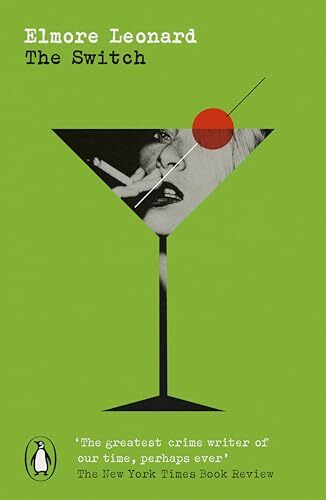
My annual dive into the pulp fiction of Elmore Leonard begins with The Switch, the 1978 novel that introduced small time crooks Ordell Robbie & Louis Gara and globetrotting pothead Melanie Ralston who sticks her big toe into the men's business. Leonard had so much fun with the trio that he reunited them in 1992 for Rum Punch, which Quentin Tarantino adapted to film as Jackie Brown with Samuel L. Jackson, Robert DeNiro and Bridget Fonda in the roles. Their literary debut not only lacks compelling protagonists but flaunts their ineptitude as extortionists to the point it was hard for me to believe any of them would still be breathing.
The story opens in the northern suburbs of Detroit, where an embattled housewife named Mickey Dawson rides shotgun while her inebriated business developer husband Frank careens his white Mark V into the garage following his latest golf tournament victory. The couple have a teenage son named Bo whose shortcomings on the tennis court are the result of his breeding by an image conscious father and excuse-generating mother. Mickey is unhappy but too intimidated to voice her feelings. When Frank announces he's going out of town to Freeport, Grand Bahamas on business for a week, Mickey has little to say in the matter.
Meanwhile, Ordell Robbie reunites with his friend Louis Gara, who's spent the last three years in Huntsville State Penitentiary.
They even looked somewhat alike, considering Ordell Robbie was a male Negro, 31, and Louis Gara was a male Caucasian, 34. Ordell was light-skinned and Louis was dark-skinned and that put them about even in shade. Ordell had a semi-full round afro, trimmed beard and bandit mustache. Louis had the mustache, and his head was working on a black curly natural, growing it out again after his time at Huntsville. Both were about six feet and stringy looking, weighing in around 160. Ordell wore gold frame Spectra-Shades; he liked sunglasses and beads and rings. Louis wore a cap--this summer a faded tan cap--straight and low over his eyes. Louis didn't go in for jewelry; a watch was enough, a $1,200 Benrus he'd picked up at the Flamingo Motor Hotel, McAllen, Texas.
Ordell sells stolen appliances to a property developer who buys buildings cheap and improves them cheaper, renting in cash, declaring sixty percent occupancy and stashing the ill-gotten gains. Ordell's plan is to kidnap the developer's wife while he's in the Bahamas and ransom her for a million dollars. In on the scam is Richard Edgar Monk, the rent-a-cop fired for looking the other way while Ordell unloaded appliances from a warehouse into his van. Richard has a fetish for the Third Reich, but needs money to get his estranged wife back from California and Ordell knows just how to play him.
Wearing Halloween masks, Ordell, Louis and Richard kidnap Mickey while she's home alone. Mickey puts up no fight, but the kidnapping goes awry when a golfing buddy of Frank's named Marshall Taylor, who invites himself over in a full court press to get in Mickey's warmups and ends up pistol whipped by Ordell and left for dead. While Ordell and Louis stash their hostage at Richard's house on State Street, Frank Dawson galivants in Freeport with his mistress, Melanie Ralston, the best character in the book.
Still, Frank believed Melanie was one in a million. Maybe she was. At any given time there could be ten thousand or more healthy young Melanies lying on the beaches of the world, sitting at chic sidewalk tables with their backpacks stowed away, and each would be one in a million; though Frank would never realize there were so many. Melanie was from Santa Barbara, a California girl. She had been all over the Mediterranean, from Marbella to the Middle East. She had lived with a Hollywood director Frank had never heard of while the director was shooting a western in Spain. She had bunked with Italian film people at a Cannes Festival, moved onto Rome and Cinecittà with a second assistant cameraman--bad for the image, moving down in the ranks--escaped to Piraeus and did the Greek islands on the motor-sailer of a dark little man who imported John Deere tractors, skipped down to Eilat--Israel's Miami Beach on the Gulf of Aqaba--with another film crew, no one in particular. Then, from Eilat to Copenhagen to London to Barbados to Freeport, Grand Bahama, where she'd finally had enough of her British photo-journalist friend, his quaaludes and rum, his cold sweats and crazy-talk in the middle of the night, and connected with Frank at Tano Beach over a bowl of conch chowder and a pint of dark, ten months ago. Mr. Frank A. Dawson from Detroit, with a bank account and development interests in the Bahamas. Melanie could read Frank's mind, anticipate his moods and keep him turned on without shifting into third gear. After some of the others, Frank was like a rest stop.
When Frank refuses to negotiate for the safe return of his wife, Ordell heads down to the Bahamas to investigate. Louis stays in Detroit to make sure no harm comes to their captive. Mickey has already put a cigarette in Richard's eye when she caught him spying on her through a peephole in the wall. Louis, on the other hand, is a nice guy. He later tells Mickey that he was sent to Huntsville for running over a prick foreman during a farmworkers' strike Louis was participating in down in Brownsville, Texas. Ordell is unable to find Frank, but gets enough information out of Melanie to realize he has the wrong partner and that Mickey is worth more to him dead than alive.
There are two types of Elmore Leonard novels: the ones where characters are good at their work and the ones where characters are lousy at their work. Stick and Killshot are a joy to read because the characters demonstrate finesse at what it is they do. It's thrilling to watch one craftsman match skills with another. The "lousy" efforts like Get Shorty and its sequel Be Cool are full of talkers whose self-aggrandizement, while providing some comic relief, isn't nearly as compelling. To their credit, the "lousy" novels may be satirizing the pulp fiction Leonard was justifiably bored by, casting idiots, not tough guys, as his lead characters.
The Switch is one of the lousy novels. For starters, Leonard focuses on the wrong character. Mickey Dawson is more of a whimper than a protagonist. She tries to annoy her husband and protect her son, but not nearly as much as she should. She has no discernible skill and is dependent on the bumbling or good will of stronger characters to survive. Leonard seems fascinated by Ordell Robbie, a bandit comfortable with violence but who would prefer to talk someone else into doing his work. Leonard seems enamored by him, a trickster using his ears and his mouth to outsmart the man. Ordell isn't intelligent, he's dependent on the reduced intelligence of others to profit.
The novel lights up like casino neon when Melanie Ralston enters. She's clearly the author's favorite character, a rolling stone who sees the bottom of the hill coming and is constantly underestimated by the big shots and loud talkers of the world. She isn't a role model, but a character with her history and survival skills can't help but be fascinating. By focusing on the kidnapping scam, The Switch kept circling back to characters I was bored with discussing details I didn't care about. The novel was adapted to film in 2014 under the title Life of Crime with Jennifer Aniston as Mickey, Mos Def as Ordell Robbie, John Hawkes as Louis Gara, Tim Robbins as Frank and Isla Fisher as Melanie.