

What do you think?
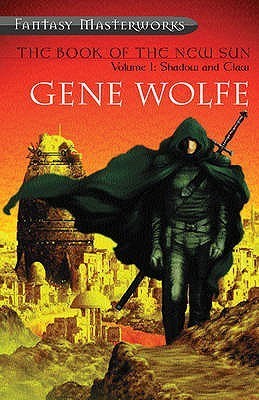
The Book of the New Sun #1-2
Shadow and Claw
One of the most acclaimed "science fantasies" ever, Gene Wolfe's The Book of the New Sun is a long, magical novel in four volumes. Shadow & Claw contains the first two: The Shadow of the Torturer and The Claw of the Conciliator, which respectively won the World Fantasy and Nebula Awards.
This is the first-person narrative of Severian, a lowly apprentice torturer blessed and cursed with a photographic memory, whose travels lead him through the marvels of far-future Urth, and who--as revealed near the beginning--eventually becomes his land's sole ruler or Autarch. On the surface it's a colorful story with all the classic ingredients: growing up, adventure, sex, betrayal, murder, exile, battle, monsters, and mysteries to be solved. (Only well into book 2 do we realize what saved Severian's life in chapter 1.) For lovers of literary allusions, they are plenty here: a Dickensian cemetery scene, a torture-engine from Kafka, a wonderful library out of Borges, and familiar fables changed by eons of retelling. Wolfe evokes a chilly sense of time's vastness, with an age-old, much-restored painting of a golden-visored "knight," really an astronaut standing on the moon, and an ancient citadel of metal towers, actually grounded spacecraft. Even the sun is senile and dying, and so Urth needs a new sun.
The Book of the New Sun is almost heartbreakingly good, full of riches and subtleties that improve with each rereading. It is Gene Wolfe's masterpiece. --David Langford, Amazon.co.uk
603 pages, Paperback
First published October 15, 1994
About the author
Gene Wolfe
527 books3,795 followersGene Wolfe was an American science fiction and fantasy writer. He was noted for his dense, allusive prose as well as the strong influence of his Catholic faith, to which he converted after marrying a Catholic. He was a prolific short story writer and a novelist, and has won many awards in the field.
While attending Texas A&M University Wolfe published his first speculative fiction in The Commentator, a student literary journal. Wolfe dropped out during his junior year, and was drafted to fight in the Korean War. After returning to the United States he earned a degree from the University of Houston and became an industrial engineer. He edited the journal Plant Engineering for many years before retiring to write full-time, but his most famous professional engineering achievement was a contribution to the machine used to make Pringles potato crisps. He lived in Barrington, Illinois, a suburb of Chicago.
A frequent Hugo nominee without a win, Wolfe nevertheless picked up several Nebula and Locus Awards, among others, including the World Fantasy Award for Life Achievement and the 2012 Damon Knight Memorial Grand Master Award. He was also a member of the Science Fiction Hall of Fame.
http://us.macmillan.com/author/genewolfe
While attending Texas A&M University Wolfe published his first speculative fiction in The Commentator, a student literary journal. Wolfe dropped out during his junior year, and was drafted to fight in the Korean War. After returning to the United States he earned a degree from the University of Houston and became an industrial engineer. He edited the journal Plant Engineering for many years before retiring to write full-time, but his most famous professional engineering achievement was a contribution to the machine used to make Pringles potato crisps. He lived in Barrington, Illinois, a suburb of Chicago.
A frequent Hugo nominee without a win, Wolfe nevertheless picked up several Nebula and Locus Awards, among others, including the World Fantasy Award for Life Achievement and the 2012 Damon Knight Memorial Grand Master Award. He was also a member of the Science Fiction Hall of Fame.
http://us.macmillan.com/author/genewolfe
Ratings & Reviews
Friends & Following
Create a free account to discover what your friends think of this book!
Community Reviews
Displaying 1 - 30 of 1,929 reviews

September 25, 2007
Wolfe has an almost legendary status amongst fellow authors; Gaiman called him 'a ferocious intellect', Swanwick said he's "the greatest writer in the English language alive today", and Disch called this series "a tetralogy of couth, intelligence, and suavity".
You can rarely trust the popular market to single out good authors, but you'd think it might be safe to listen to the opinions of other writers (especially an assemblage of Nebula and Hugo winners in their own right). I will give his fans one concession: Wolfe is an author who defies expectations. Unfortunately, I was expecting him to be remarkable and interesting.
This book had been sitting on my shelf for months, along with other highly-praised works I've been looking forward to, but I bade my time, waiting for the mood to strike. Few live up to their reputation, but most at least deliver part of the promise.
I would expect any author mentioned in the same breath as Peake to have an original and vibrant style, but I found Wolfe's writing to be simple without being elegant. His language and structure serves its purpose, only occasionally rising above mere utilitarianism, and then he rushes to florid flourishes that fall flat as often as they succeed. Sometimes, it is downright dull. The prose of the second book is stronger than the first, but its plot and characters are more linear and predictable.
I appreciated his 'created language' more than most fantasy authors, but I didn't find it particularly mysterious or difficult, because all of his words are based on recognizable Germanic or Romantic roots. Then again, after three years of writing stories about Roman whores in Latin, I had little problem with 'meretriculous'. Even those words I wasn't familiar with seemed clear by their use.
The terms are scattered throughout the book, but rarely contribute to a more pervasive linguistic style, as might be seen in The Worm Ouroboros, The Lord of the Rings, Gormenghast, or The King of Elfland's Daughter. Wolfe's terms pepper otherwise and unremarkable modern style, which hardly helps to throw us into a strange world.
He is better than the average fantasy author, but he resembles them more than he differs from them. His protagonist started off interestingly enough: an apparently weak and intelligent man, which made it all the more disappointing when he suddenly transformed into a laconic, wench-loving buttkicker who masters sword-fighting, finds the Super Magic Thing and follows the path of his Awesome Foretold Fate. Again, I must agree with Nick Lowe: Wolfe's plot owes more to magic and convenience than good storytelling.
It relies on the same tricks over and over: any time a character is about to give important information to us, there will be a sudden attack or other interruption, as convenient and annoying as the moment when the dying man says "I was killed by . . . aargh". We also get problems solved by divine intervention whenever things start to slow, which doesn't leave the characters much room to be active.
He also seems to suffer from the same sexual discomfort that plagues so many fantasy authors. There is an undercurrent of obsession with women and their sexuality, complete with the sexualization of rape and murder. It's not so much a case of misogyny as it is an inequality in how characters behave.
The women always seem to end up as playtoys for the narrator, running around naked, desiring him, sparring with him coyly, but ultimately, conquered; and the camera pans away. They always approach him, desire him, pretending they don't want him, then give themselves up to him. It's the same old story of an awkward, emotionless male protagonist who is inexplicably followed and harangued by women who fall in love with him for no given reason, familiar to anyone who's seen a harem anime.
I will grant that the women have more character than the average fantasy heroine, but it still doesn't leave them with much. Instead of giving into love at first sight, they fight it as long as they can, making it that much sweeter when the narrator finally 'wins'. The sexuality was not new, interesting, arousing, or mutual, it was merely the old game of 'overcoming the strong woman' that is familiar to readers of the Gor books.
The sense of 'love' in The New Sun is even more unsettling. It descends on the characters suddenly and nonsensically, springing to life without build or motivation. The word never comes up in connection with any psychological development, nor does it ever seem to match the relationships as they are depicted. More often than not, it seems love is only mentioned so the narrator can coldly break his lover's trust in the next chapter.
Several times, the narrator tries to excuse himself for objectifying women by mentioning that he also objectifies ugly women. What this convolution of misogyny is supposed to represent, I couldn't say. The narrator seems very interested in this fact, and is convinced that it makes him a unique person. It made it very clear to me why the most interesting antiheroes tend to be gruff and laconic, because listening to a chauvinistic sociopath talk about himself is insufferable.
Then there is the fact that every character you meet in the story turns up again, hundreds of miles away, to reveal that they are someone else and have been secretly controlling the action of the plot. It feels like the entire world is populated by about fifteen people who follow the narrator around wherever he goes. If the next two books continue along the same lines, then the big reveal will be that the world is entirely populated by no more than three superpowered shapeshifters.
Everyone in the book has secret identities, secret connections to grand conspiracies, and important plot elements that they conveniently hide until the last minute, only doling out clues here and there. There are no normal people in this world, only double agents and kings in disguise. Every analysis I've read of this book mentions that even the narrator is unreliable.
This can be an effective technique, but in combination with a world of infinite, unpredictable intrigue, Wolfe's story begins to evoke something between a soap opera and a convoluted mystery novel, relying on impossible and contradictory scenarios to mislead the audience. Apparently, this is the thing his fans most appreciate about him--I find it to be an insulting and artificial game.
I agree with this reviewer that there is simply not enough structure to the story to make the narrator's unreliability meaningful. In order for unreliable narration to be effective, there must be some clear and evident counter-story that undermines it. Without that, it is not possible to determine meaning, because there's nowhere to start: everything is equally shaky.
At that point, it's just a trick--adding complexity to the surface of the story without actually producing any new meaning. I know most sci fi and fantasy authors seem to love complexity for its own sake, but it's a cardinal sin of storytelling: don't add something into your story unless it needs to be there. Covering the story with a lot of vagaries and noise may impress some, but won't stand up to careful reading.
Fantasy novels are often centered on masculinity, violence, and power struggles, and so by making the narrator an emotionally distant manipulator with sociopathic tendencies, Wolfe's story is certainly going to resemble other genre outings. If Severian is meant to be a subversion of the grim antihero, I would expect a lot of clever contradiction which revealed him. His unreliability would have to leave gaping holes that point to another, more likely conclusion. If the protagonist's mendacious chauvinism is not soundly contradicted, then there is really nothing separating him from what he is supposed to be mocking.
Poe's Law states that it can be difficult to tell whether something is an act of mockery or an example of genuine extremism, and perhaps that's what's going on here: Wolfe's mockery is so on-the-nose that it is indistinguishable from other cliche genre fantasy. But even if that were true, then the only thing separating Wolfe from the average author is the fact that he's doing it on purpose, which is hardly much of a distinction. If a guy punches himself in the nose and then insists "I meant to do that", I don't think that makes him any less of a dumbass.
Human psychology and politics are fraught enough without deliberately obfuscating them. Unfortunately, Wolfe does not have the mastery of psychology to make a realistically complicated text, only a cliched text that is meta-complicated.
After finishing the book, I tried to figure out why it had garnered so much praise. I stumbled across a number of articles, including this one by Gaiman and this one by an author who wrote a book of literary analysis about the New Sun series.
Both stressed that Wolfe was playing a deliberate meta-fictional game with his readers, creating mysteries and clues in his book for them to follow, so that they must reread the text over and over to try to discern what is actually happening. I won't claim this isn't a technical feat, but I would suggest that if Wolfe wanted us to read his book over and over, he might have written it with verve, style, character, and originality. As the above critic says:
Perhaps I'm alone in this, but I have no interest in reading your average sword-wielding badass gender-challenged fantasy book over and over in the hopes that it will get better. If Wolfe is capable of writing an original and interesting story, why cover it with a dull and occasionally insulting one?
I have enjoyed complex books before, books with hidden messages and allusions, but they were interesting both in their depths and on the surface. I didn't find the New Sun books particularly complex or difficult. His followers have said that he isn't 'concerned with being conspicuously witty', but I'd suggest he's merely incapable of being vibrant or intriguing.
There were interesting ideas and moments in the book, and I did appreciate what originality Wolfe did have, but I found it strange that such a different mind would produce such hidebound prose, tired descriptions, convenient plots, and unappealing characters. It has usually been my experience that someone who is capable of thinking remarkable things is capable of writing remarkable things.
Sure, there were some interesting Vancian moments, where you realize that some apparently magical effect is actual a piece of sci fi detritus: this character is a robot, that tower is actually a rocket, a painting of a mythical figure clearly depicts an astronaut--but this doesn't actually add anything to the story, they weren't important facts, they were just details thrown in.
It didn't matter that any of those things were revealed to be something else than they appeared, because it didn't change anything about the story, or the characters, or the themes or ideas. These weren't vital and strange ideas to be explored, like the mix of sci fi and fantasy in Vance, Le Guin, or M. John Harrison, but inconsequential 'easter eggs' for obsessing fans to dig up.
As Clarke's Third Law says: any sufficiently advanced technology is indistinguishable from magic. Therefore, switching back and forth between magical explanations and super-technological ones doesn't mean much, on its own. They're indistinguishable. Star Wars may use the trappings of sci fi, but it's just a fantasy story about wizards and knights in space. In order to make the distinction meaningful, you've got to put some kind of spin on it.
Overall, I found nothing unique in Wolfe. Perhaps it's because I've read quite a bit of odd fantasy; if all I read was mainstream stuff, then I'd surely find Wolfe unpredictable, since he is a step above them. But compared to Leiber, Howard, Dunsany, Eddison, Kipling, Haggard, Peake, Mieville, or Moorcock, Wolfe is nothing special.
Perhaps I just got my hopes up too high. I imagined something that might evoke Peake or Leiber (at his best), perhaps with a complexity and depth gesturing toward Milton or Ariosto. I could hardly imagine a better book than that, but even a book half that good would be a delight--or a book that was nothing like that, but was unpredictable and seductive in some other way.
I kept waiting for something to happen, but it never really did. It all plods along without much rise or fall, just the constant moving action to make us think something interesting is happening. I did find some promise, some moments that I would have loved to see the author explore, particularly those odd moments where Silver Age Sci Fi crept in, but each time he touched upon these, he would return immediately to the smallness of his plot and his annoying prick of a narrator. I never found the book to be difficult or complex, merely tiring. the unusual parts were evasive and vague, and the dull parts constant and repetitive.
The whole structure (or lack of it) does leave things up to interpretation, and perhaps that's what some readers find appealing: that they can superimpose their own thoughts and values onto the narrator, and onto the plot itself. But at that point, they don't like the book Wolfe wrote, they like the book they are writing between his lines.
I'll lend the book out to some fantasy-loving friends and they'll buy the next one, which I'll then have to borrow from them so I can see if there's ever a real payoff. Then again, if Sevarian's adolescent sexuality is any evidence, the climax will be as underwhelming as the self-assured, fumbling foreplay. If I don't learn to stop giving my heart away, it's just going to get broken again.
Ah well, once more unto the breach.
My Fantasy Book Suggestions
You can rarely trust the popular market to single out good authors, but you'd think it might be safe to listen to the opinions of other writers (especially an assemblage of Nebula and Hugo winners in their own right). I will give his fans one concession: Wolfe is an author who defies expectations. Unfortunately, I was expecting him to be remarkable and interesting.
This book had been sitting on my shelf for months, along with other highly-praised works I've been looking forward to, but I bade my time, waiting for the mood to strike. Few live up to their reputation, but most at least deliver part of the promise.
I would expect any author mentioned in the same breath as Peake to have an original and vibrant style, but I found Wolfe's writing to be simple without being elegant. His language and structure serves its purpose, only occasionally rising above mere utilitarianism, and then he rushes to florid flourishes that fall flat as often as they succeed. Sometimes, it is downright dull. The prose of the second book is stronger than the first, but its plot and characters are more linear and predictable.
I appreciated his 'created language' more than most fantasy authors, but I didn't find it particularly mysterious or difficult, because all of his words are based on recognizable Germanic or Romantic roots. Then again, after three years of writing stories about Roman whores in Latin, I had little problem with 'meretriculous'. Even those words I wasn't familiar with seemed clear by their use.
The terms are scattered throughout the book, but rarely contribute to a more pervasive linguistic style, as might be seen in The Worm Ouroboros, The Lord of the Rings, Gormenghast, or The King of Elfland's Daughter. Wolfe's terms pepper otherwise and unremarkable modern style, which hardly helps to throw us into a strange world.
He is better than the average fantasy author, but he resembles them more than he differs from them. His protagonist started off interestingly enough: an apparently weak and intelligent man, which made it all the more disappointing when he suddenly transformed into a laconic, wench-loving buttkicker who masters sword-fighting, finds the Super Magic Thing and follows the path of his Awesome Foretold Fate. Again, I must agree with Nick Lowe: Wolfe's plot owes more to magic and convenience than good storytelling.
It relies on the same tricks over and over: any time a character is about to give important information to us, there will be a sudden attack or other interruption, as convenient and annoying as the moment when the dying man says "I was killed by . . . aargh". We also get problems solved by divine intervention whenever things start to slow, which doesn't leave the characters much room to be active.
He also seems to suffer from the same sexual discomfort that plagues so many fantasy authors. There is an undercurrent of obsession with women and their sexuality, complete with the sexualization of rape and murder. It's not so much a case of misogyny as it is an inequality in how characters behave.
The women always seem to end up as playtoys for the narrator, running around naked, desiring him, sparring with him coyly, but ultimately, conquered; and the camera pans away. They always approach him, desire him, pretending they don't want him, then give themselves up to him. It's the same old story of an awkward, emotionless male protagonist who is inexplicably followed and harangued by women who fall in love with him for no given reason, familiar to anyone who's seen a harem anime.
I will grant that the women have more character than the average fantasy heroine, but it still doesn't leave them with much. Instead of giving into love at first sight, they fight it as long as they can, making it that much sweeter when the narrator finally 'wins'. The sexuality was not new, interesting, arousing, or mutual, it was merely the old game of 'overcoming the strong woman' that is familiar to readers of the Gor books.
The sense of 'love' in The New Sun is even more unsettling. It descends on the characters suddenly and nonsensically, springing to life without build or motivation. The word never comes up in connection with any psychological development, nor does it ever seem to match the relationships as they are depicted. More often than not, it seems love is only mentioned so the narrator can coldly break his lover's trust in the next chapter.
Several times, the narrator tries to excuse himself for objectifying women by mentioning that he also objectifies ugly women. What this convolution of misogyny is supposed to represent, I couldn't say. The narrator seems very interested in this fact, and is convinced that it makes him a unique person. It made it very clear to me why the most interesting antiheroes tend to be gruff and laconic, because listening to a chauvinistic sociopath talk about himself is insufferable.
Then there is the fact that every character you meet in the story turns up again, hundreds of miles away, to reveal that they are someone else and have been secretly controlling the action of the plot. It feels like the entire world is populated by about fifteen people who follow the narrator around wherever he goes. If the next two books continue along the same lines, then the big reveal will be that the world is entirely populated by no more than three superpowered shapeshifters.
Everyone in the book has secret identities, secret connections to grand conspiracies, and important plot elements that they conveniently hide until the last minute, only doling out clues here and there. There are no normal people in this world, only double agents and kings in disguise. Every analysis I've read of this book mentions that even the narrator is unreliable.
This can be an effective technique, but in combination with a world of infinite, unpredictable intrigue, Wolfe's story begins to evoke something between a soap opera and a convoluted mystery novel, relying on impossible and contradictory scenarios to mislead the audience. Apparently, this is the thing his fans most appreciate about him--I find it to be an insulting and artificial game.
I agree with this reviewer that there is simply not enough structure to the story to make the narrator's unreliability meaningful. In order for unreliable narration to be effective, there must be some clear and evident counter-story that undermines it. Without that, it is not possible to determine meaning, because there's nowhere to start: everything is equally shaky.
At that point, it's just a trick--adding complexity to the surface of the story without actually producing any new meaning. I know most sci fi and fantasy authors seem to love complexity for its own sake, but it's a cardinal sin of storytelling: don't add something into your story unless it needs to be there. Covering the story with a lot of vagaries and noise may impress some, but won't stand up to careful reading.
Fantasy novels are often centered on masculinity, violence, and power struggles, and so by making the narrator an emotionally distant manipulator with sociopathic tendencies, Wolfe's story is certainly going to resemble other genre outings. If Severian is meant to be a subversion of the grim antihero, I would expect a lot of clever contradiction which revealed him. His unreliability would have to leave gaping holes that point to another, more likely conclusion. If the protagonist's mendacious chauvinism is not soundly contradicted, then there is really nothing separating him from what he is supposed to be mocking.
Poe's Law states that it can be difficult to tell whether something is an act of mockery or an example of genuine extremism, and perhaps that's what's going on here: Wolfe's mockery is so on-the-nose that it is indistinguishable from other cliche genre fantasy. But even if that were true, then the only thing separating Wolfe from the average author is the fact that he's doing it on purpose, which is hardly much of a distinction. If a guy punches himself in the nose and then insists "I meant to do that", I don't think that makes him any less of a dumbass.
Human psychology and politics are fraught enough without deliberately obfuscating them. Unfortunately, Wolfe does not have the mastery of psychology to make a realistically complicated text, only a cliched text that is meta-complicated.
After finishing the book, I tried to figure out why it had garnered so much praise. I stumbled across a number of articles, including this one by Gaiman and this one by an author who wrote a book of literary analysis about the New Sun series.
Both stressed that Wolfe was playing a deliberate meta-fictional game with his readers, creating mysteries and clues in his book for them to follow, so that they must reread the text over and over to try to discern what is actually happening. I won't claim this isn't a technical feat, but I would suggest that if Wolfe wanted us to read his book over and over, he might have written it with verve, style, character, and originality. As the above critic says:
"On a first, superficial reading, there is little to distinguish Wolfe’s tetralogy from many other sf and fantasy novels . . . The plot itself is apparently unremarkable."
Perhaps I'm alone in this, but I have no interest in reading your average sword-wielding badass gender-challenged fantasy book over and over in the hopes that it will get better. If Wolfe is capable of writing an original and interesting story, why cover it with a dull and occasionally insulting one?
I have enjoyed complex books before, books with hidden messages and allusions, but they were interesting both in their depths and on the surface. I didn't find the New Sun books particularly complex or difficult. His followers have said that he isn't 'concerned with being conspicuously witty', but I'd suggest he's merely incapable of being vibrant or intriguing.
There were interesting ideas and moments in the book, and I did appreciate what originality Wolfe did have, but I found it strange that such a different mind would produce such hidebound prose, tired descriptions, convenient plots, and unappealing characters. It has usually been my experience that someone who is capable of thinking remarkable things is capable of writing remarkable things.
Sure, there were some interesting Vancian moments, where you realize that some apparently magical effect is actual a piece of sci fi detritus: this character is a robot, that tower is actually a rocket, a painting of a mythical figure clearly depicts an astronaut--but this doesn't actually add anything to the story, they weren't important facts, they were just details thrown in.
It didn't matter that any of those things were revealed to be something else than they appeared, because it didn't change anything about the story, or the characters, or the themes or ideas. These weren't vital and strange ideas to be explored, like the mix of sci fi and fantasy in Vance, Le Guin, or M. John Harrison, but inconsequential 'easter eggs' for obsessing fans to dig up.
As Clarke's Third Law says: any sufficiently advanced technology is indistinguishable from magic. Therefore, switching back and forth between magical explanations and super-technological ones doesn't mean much, on its own. They're indistinguishable. Star Wars may use the trappings of sci fi, but it's just a fantasy story about wizards and knights in space. In order to make the distinction meaningful, you've got to put some kind of spin on it.
Overall, I found nothing unique in Wolfe. Perhaps it's because I've read quite a bit of odd fantasy; if all I read was mainstream stuff, then I'd surely find Wolfe unpredictable, since he is a step above them. But compared to Leiber, Howard, Dunsany, Eddison, Kipling, Haggard, Peake, Mieville, or Moorcock, Wolfe is nothing special.
Perhaps I just got my hopes up too high. I imagined something that might evoke Peake or Leiber (at his best), perhaps with a complexity and depth gesturing toward Milton or Ariosto. I could hardly imagine a better book than that, but even a book half that good would be a delight--or a book that was nothing like that, but was unpredictable and seductive in some other way.
I kept waiting for something to happen, but it never really did. It all plods along without much rise or fall, just the constant moving action to make us think something interesting is happening. I did find some promise, some moments that I would have loved to see the author explore, particularly those odd moments where Silver Age Sci Fi crept in, but each time he touched upon these, he would return immediately to the smallness of his plot and his annoying prick of a narrator. I never found the book to be difficult or complex, merely tiring. the unusual parts were evasive and vague, and the dull parts constant and repetitive.
The whole structure (or lack of it) does leave things up to interpretation, and perhaps that's what some readers find appealing: that they can superimpose their own thoughts and values onto the narrator, and onto the plot itself. But at that point, they don't like the book Wolfe wrote, they like the book they are writing between his lines.
I'll lend the book out to some fantasy-loving friends and they'll buy the next one, which I'll then have to borrow from them so I can see if there's ever a real payoff. Then again, if Sevarian's adolescent sexuality is any evidence, the climax will be as underwhelming as the self-assured, fumbling foreplay. If I don't learn to stop giving my heart away, it's just going to get broken again.
Ah well, once more unto the breach.
My Fantasy Book Suggestions

April 17, 2008
Update 5/26: finally finished. Man, this is an intense book. I was tempted to give up on it at various points because it's so thoroughly dick lit -- I mean, the hero carries around a sword that he unsheathes, oils, and re-sheaths routinely throughout his travels, and he sleeps with nearly every woman he encounters, but usually in the most patronizing way imaginable (there's actually an extremely painful, cringeworthy attempt at some sort of epiphanic look into the male psyche, wherein it is brought to the reader's attention that men don't only want the hot chicks! They don't discriminate! They want the not-so-hot chicks, too! Preferably simultaneously!) ...all of which would be fine, if the whole thing weren't trying desperately to be something much less transparent than that.
Parts of this were delightfully magical -- actually, most of it was, imagery-wise. It's definitely a pleasure to feel like you've tapped into the mind of someone on a really good, permanent acid trip. But I think I need to go build back up my estrogen reserves before continuing on to the second half.
-------------------
I'll have whatever drugs this author is on. Kthxbai.
Parts of this were delightfully magical -- actually, most of it was, imagery-wise. It's definitely a pleasure to feel like you've tapped into the mind of someone on a really good, permanent acid trip. But I think I need to go build back up my estrogen reserves before continuing on to the second half.
-------------------
I'll have whatever drugs this author is on. Kthxbai.

February 6, 2008
The Shadow of the Torturer: Apprentice torturer Severian shows mercy for an imprisoned woman and helps her commit suicide rather than endure weeks of torture. For his crimes, Severian is sentenced to travel too the village of Thrax and take up the post of carnifex. Will Severian make it to Thrax alive?
The Shadow of the Torturer isn't your grandmother's fantasy. The tale of Severian isn't the hopeful quest story that's been written and re-written umpteen times in the past fifty years. The setting reminds me of Jack Vance's Dying Earth but much more developed and with the specter of space opera hanging in the background. Gene Wolfe takes the bare bones of the standard quest story and clothes it with literary merit, from the unreliable narrator, Severian, to references to classic works. The scene in the necropolis near the beginning is straight out of Great Expectations. Or straight out of Great Expectations if Pip was an apprentice torturer and helped Magwitch in a fight rather than fetch him a file...
Wolfe's writing is baroque and reminds me of the New Weird authors like China Mieville. The Book of the New Sun definitely isn't a beach read. Be prepared to divine the meaning of words from the context.
Apart from Severian, the cast isn't all that developed, but then, the unreliable narrator should probably be the center of attention. Dr. Talos and Baldanders steal the show with what little screen time they're given.
That's about all I can say without giving too much away. The world Wolfe has built is full of fresh ideas. How many other books do you know that feature two men fighting with flowers with razor sharp leaves?
The Claw of the Conciliator: Severian's journey to Thrax continues and his path brings him into contact with both friend and foe. Will he ever make it to Thrax?
Claw of the Conciliator continues Severian's rise from apprentice torturer to eventual Autarch. Wolfe's inventiveness grows as Severian encounters man-apes, a giantess, witches, an androgyne who might be The Autarch, a giantess, and many other interesting characters, including Dr. Talos and company. More is revealed about the Claw of the Conciliator, though much mystery remains. I get the feeling a lot of secrets are still lurking in the background.
One aspect of The Book of the New Sun I really enjoy is how Gene Wolfe has a lot of sci-fi elements lurking in the background, like aliens, wormholes and the true nature of Jonas, and the casual mention of what might in fact be laser guns. Wolfe's a sly one.
I don't want to spoil too much but I enjoyed Claw more than Shadow, possibly because I was used to Wolfe's style. While I felt like I was still in the dark, Wolfe knows how to reveal just enough to keep you firmly ensnared. Like Severian says, it's a hard road. I can't wait to see where it finally leads.
2012 Note: I went ahead and bumped this up to a 5. I'm not sure if it deserves it but I still catch myself thinking about this book almost a year after I finished it.
The Shadow of the Torturer isn't your grandmother's fantasy. The tale of Severian isn't the hopeful quest story that's been written and re-written umpteen times in the past fifty years. The setting reminds me of Jack Vance's Dying Earth but much more developed and with the specter of space opera hanging in the background. Gene Wolfe takes the bare bones of the standard quest story and clothes it with literary merit, from the unreliable narrator, Severian, to references to classic works. The scene in the necropolis near the beginning is straight out of Great Expectations. Or straight out of Great Expectations if Pip was an apprentice torturer and helped Magwitch in a fight rather than fetch him a file...
Wolfe's writing is baroque and reminds me of the New Weird authors like China Mieville. The Book of the New Sun definitely isn't a beach read. Be prepared to divine the meaning of words from the context.
Apart from Severian, the cast isn't all that developed, but then, the unreliable narrator should probably be the center of attention. Dr. Talos and Baldanders steal the show with what little screen time they're given.
That's about all I can say without giving too much away. The world Wolfe has built is full of fresh ideas. How many other books do you know that feature two men fighting with flowers with razor sharp leaves?
The Claw of the Conciliator: Severian's journey to Thrax continues and his path brings him into contact with both friend and foe. Will he ever make it to Thrax?
Claw of the Conciliator continues Severian's rise from apprentice torturer to eventual Autarch. Wolfe's inventiveness grows as Severian encounters man-apes, a giantess, witches, an androgyne who might be The Autarch, a giantess, and many other interesting characters, including Dr. Talos and company. More is revealed about the Claw of the Conciliator, though much mystery remains. I get the feeling a lot of secrets are still lurking in the background.
One aspect of The Book of the New Sun I really enjoy is how Gene Wolfe has a lot of sci-fi elements lurking in the background, like aliens, wormholes and the true nature of Jonas, and the casual mention of what might in fact be laser guns. Wolfe's a sly one.
I don't want to spoil too much but I enjoyed Claw more than Shadow, possibly because I was used to Wolfe's style. While I felt like I was still in the dark, Wolfe knows how to reveal just enough to keep you firmly ensnared. Like Severian says, it's a hard road. I can't wait to see where it finally leads.
2012 Note: I went ahead and bumped this up to a 5. I'm not sure if it deserves it but I still catch myself thinking about this book almost a year after I finished it.

January 6, 2017
Fantastic Conjunctivitis
Wolfe is most often compared to Tolkien and Lewis. However this is regurgitation of marketing hype. There is little in terms of style or symbology to link Wolfe with either. Aside from the genre of fantasy and a clear talent for creative world-building, Wolfe dwells in a very different universe, a universe not all that dissimilar from Mervyn Peake's Gormenghast trilogy.
The physical environment of Wolfe's city of Nessus could easily fit into Peake's Gormenghast Castle and vice-versa: A vast, half-ruined, place, unknown except locally to its inhabitants. A gothic labyrinth that harbours all manner of surprises and threats.
Both sets of works play off a background of ancient but incomprehensible tradition that establishes the rigid conditions from which the protagonist must escape. Unlike Severian, Titus knows his forebears, but this difference makes no difference to the comprehensive social discipline and constraint applied to both of them.
Both Titus in Peake and Severian in Wolfe are sympathetic characters who struggle against the bonds of convention to capture some sort of independent identity. Both have only a vague notion of what lies outside the boundaries of the city/castle but they yearn toward it with a clearly erotic drive.
Many of the other characters also are inter-changeable. The Chief Archivist and his assistant in Wolfe could be copies of Peake's Barquentine and the villainous Steerpike. Bellgrove in Peake could be one of Wolfe's Masters.
Peake wrote Gormenghast between 1946 and 1959. It inspired several other works, most notably China Mieville's 2000 steampunk fantasy Perdido Street Station. Wolfe's three (or four) books were written between 1980 and 1983. I have been unable to find any mention of Peake (who died in 1968) by Wolfe or in critical analyses of his work. In a 2014 interview with Wolfe specifically about writers who had influenced him, he makes no mention of Peake (https://www.technologyreview.com/s/52...).
So an interesting case of parallel inspiration or a demonstration of the anxiety of influence? Any views are welcome.
Wolfe is most often compared to Tolkien and Lewis. However this is regurgitation of marketing hype. There is little in terms of style or symbology to link Wolfe with either. Aside from the genre of fantasy and a clear talent for creative world-building, Wolfe dwells in a very different universe, a universe not all that dissimilar from Mervyn Peake's Gormenghast trilogy.
The physical environment of Wolfe's city of Nessus could easily fit into Peake's Gormenghast Castle and vice-versa: A vast, half-ruined, place, unknown except locally to its inhabitants. A gothic labyrinth that harbours all manner of surprises and threats.
Both sets of works play off a background of ancient but incomprehensible tradition that establishes the rigid conditions from which the protagonist must escape. Unlike Severian, Titus knows his forebears, but this difference makes no difference to the comprehensive social discipline and constraint applied to both of them.
Both Titus in Peake and Severian in Wolfe are sympathetic characters who struggle against the bonds of convention to capture some sort of independent identity. Both have only a vague notion of what lies outside the boundaries of the city/castle but they yearn toward it with a clearly erotic drive.
Many of the other characters also are inter-changeable. The Chief Archivist and his assistant in Wolfe could be copies of Peake's Barquentine and the villainous Steerpike. Bellgrove in Peake could be one of Wolfe's Masters.
Peake wrote Gormenghast between 1946 and 1959. It inspired several other works, most notably China Mieville's 2000 steampunk fantasy Perdido Street Station. Wolfe's three (or four) books were written between 1980 and 1983. I have been unable to find any mention of Peake (who died in 1968) by Wolfe or in critical analyses of his work. In a 2014 interview with Wolfe specifically about writers who had influenced him, he makes no mention of Peake (https://www.technologyreview.com/s/52...).
So an interesting case of parallel inspiration or a demonstration of the anxiety of influence? Any views are welcome.
May 29, 2011
Gene Wolfe is not a misgynist??!!
Before all the sensitive types start in on Gene Wolfe's treatment of women in Shadow and Claw, I thought I would head off such criticisms by exploring women's freedom in Wolfe's Urth.
On Urth, women are:
1. Permitted to learn to read. There are actually a number of women in the narrative that not only can read but also can read and understand something akin to Latin. But, don't you dare call it Latin, because it's not. Gene Wolfe said so.
2. Free to wear clothes or not as they see fit. Much care is taken that women should be offered to wear clothes and even clean clothes when their pathetic nature raises our empathy and pity. Yet, a woman is also apparently free to disrobe and thrown herself naked and pleading to exchange sex for the life of a loved one.
3. Free to sell her body for money legally. Money? Good. Sex? Very good. Sex for money? Men have money; a woman, her sex. How can that be wrong?
4. Free to be beaten. That a woman should be suffered to live for giving offense to a man is a blessing onto her. She may be beaten and pushed down and she is not hurt much.
5. Free to be imprisoned unjustly. In this enlightened age of the far future Urth, women are suffered to live despite they give offense to men and the law of Men. The expense and time to imprison and persecute...err...prosecute a woman in light of her actual value to society is a charity granted to her and her sex.
6. Free to be tortured. That the Order of the Seekers for Truth and Penitence should seek to imprison and torture women clearly indicates that women are thought to be capable of speaking truth or even knowing truth. Similarly, this would also suppose that a woman has a soul capable of penitence or that a woman possesses a soul at all.
7. Free to be publicly maimed and executed. The branding and public execution of a woman suggests the physical vessel of the woman's body contains a space for moral instruction through ritualized excruciation and killing. A woman is no mere animal that can be killed or beaten without conscience. Her body and her life are valued enough to bring forth a physical and moral revulsion to a public branding and execution that is not only a moment of moral teaching but also Thanatonic catharsis.
8. Free to be raped in prison. Make no mistake. In past ages a woman in captivity was the rape toy of every guard and low level official in the prison system. Under the care of the Order, a woman may only be raped as a form of torture by the head inquisitor or his designee. She may be bartered amongst the inquisitor and his inferiors, but she shall not be abused by any other men.
These are only some of the many freedoms that women enjoy in the world of Urth so lovingly and intellectually crafted by Gene Wolfe. I for one salute his feminist spirit and his magnanimity to grant women a dignified and full existence in the world of his own creation.
And in case my sarcasm isn't clear, F*** you, Gene Wolfe!
Before all the sensitive types start in on Gene Wolfe's treatment of women in Shadow and Claw, I thought I would head off such criticisms by exploring women's freedom in Wolfe's Urth.
On Urth, women are:
1. Permitted to learn to read. There are actually a number of women in the narrative that not only can read but also can read and understand something akin to Latin. But, don't you dare call it Latin, because it's not. Gene Wolfe said so.
2. Free to wear clothes or not as they see fit. Much care is taken that women should be offered to wear clothes and even clean clothes when their pathetic nature raises our empathy and pity. Yet, a woman is also apparently free to disrobe and thrown herself naked and pleading to exchange sex for the life of a loved one.
3. Free to sell her body for money legally. Money? Good. Sex? Very good. Sex for money? Men have money; a woman, her sex. How can that be wrong?
4. Free to be beaten. That a woman should be suffered to live for giving offense to a man is a blessing onto her. She may be beaten and pushed down and she is not hurt much.
5. Free to be imprisoned unjustly. In this enlightened age of the far future Urth, women are suffered to live despite they give offense to men and the law of Men. The expense and time to imprison and persecute...err...prosecute a woman in light of her actual value to society is a charity granted to her and her sex.
6. Free to be tortured. That the Order of the Seekers for Truth and Penitence should seek to imprison and torture women clearly indicates that women are thought to be capable of speaking truth or even knowing truth. Similarly, this would also suppose that a woman has a soul capable of penitence or that a woman possesses a soul at all.
7. Free to be publicly maimed and executed. The branding and public execution of a woman suggests the physical vessel of the woman's body contains a space for moral instruction through ritualized excruciation and killing. A woman is no mere animal that can be killed or beaten without conscience. Her body and her life are valued enough to bring forth a physical and moral revulsion to a public branding and execution that is not only a moment of moral teaching but also Thanatonic catharsis.
8. Free to be raped in prison. Make no mistake. In past ages a woman in captivity was the rape toy of every guard and low level official in the prison system. Under the care of the Order, a woman may only be raped as a form of torture by the head inquisitor or his designee. She may be bartered amongst the inquisitor and his inferiors, but she shall not be abused by any other men.
These are only some of the many freedoms that women enjoy in the world of Urth so lovingly and intellectually crafted by Gene Wolfe. I for one salute his feminist spirit and his magnanimity to grant women a dignified and full existence in the world of his own creation.
And in case my sarcasm isn't clear, F*** you, Gene Wolfe!

December 22, 2007
My three favorite novels in the world are Dune by Frank Herbert, The Name of the Rose by Umberto Eco, and The Book of the New Sun by Gene Wolfe. I bet that many of you have read, and many more have heard of, the first two, but I wonder how many have read the last. The Book of the New Sun is less accessible than The Name of the Rose and weirder than Dune. The mind-bending future world, where the sun is so close to dead that you can see the stars in the daytime, is on par with Dune in its richness and complexity. The (mostly religious) philosophy, which the characters often discuss in casual conversation without it seeming contrived, is on par with The Name of the Rose or better. But the characterization is better than either. Although the main character is male, the female characters are far more real, vivid, and varied than almost anything I've encountered in fiction, and particularly science fiction.
The book is full of hints and allusions and puzzles. Despite what some readers may say, all the pieces are there and it's quite possible to put them together, though it might take a second read-through and some thought. I think many readers come away frustrated because they read the first volume alone and find that they have more questions than answers. There's also Gene Wolfe's love of obscure vocabulary--he doesn't make up words, he just resurrects them. I liked learning that an epopt is the opposite of a neophyte and that a carnifex is another word for executioner. You can get by with context, but if you're a word nerd the OED will beckon you. Every now and again the narrative pauses while the characters read a story from a book of tales or have a story-telling contest. The narrator-main character tries to fool you into thinking that it's just an interlude included for his sense of completeness, but like many of things he says, it's just a subtle lie or perhaps self-deception.
It's one of those books that I wish fervently my friends would all read, because it's such a pleasure to discuss. I'm not sure I've done a good job of convincing anyone, but if you're a fan of difficult pleasures, this is a book for you.
The book is full of hints and allusions and puzzles. Despite what some readers may say, all the pieces are there and it's quite possible to put them together, though it might take a second read-through and some thought. I think many readers come away frustrated because they read the first volume alone and find that they have more questions than answers. There's also Gene Wolfe's love of obscure vocabulary--he doesn't make up words, he just resurrects them. I liked learning that an epopt is the opposite of a neophyte and that a carnifex is another word for executioner. You can get by with context, but if you're a word nerd the OED will beckon you. Every now and again the narrative pauses while the characters read a story from a book of tales or have a story-telling contest. The narrator-main character tries to fool you into thinking that it's just an interlude included for his sense of completeness, but like many of things he says, it's just a subtle lie or perhaps self-deception.
It's one of those books that I wish fervently my friends would all read, because it's such a pleasure to discuss. I'm not sure I've done a good job of convincing anyone, but if you're a fan of difficult pleasures, this is a book for you.

August 15, 2021
4.0 Stars
This is a wonderfully deep and complex fantasy series. As a science fiction reader, I particularly loved the hints of sci-fi hidden within the story. The author does not info dump at all, but rather slowly reveals the world throughout the course of the story. Readers are told to very patient and pay attention to the small details, which should eventually provide deeper meaning. Admittedly, I wanted more from these first two volumes and became impatient for the world to reveal itself.
On the surface level, the story is not difficult to follow yet so much more is hidden underneath. The prose itself was beautiful without ever being flowery or too dense. I appreciate the use of vocabulary, which brought more to the reading experience.
This was a reread and I definitely pick up more details this time around. I completely understand why people read this series multiple time.
Overall, I really enjoyed this first bund and would highly recommend it to seasoned fantasy and science fiction readers alike. I am thankful that it is getting a new life within the Tor Essentials line.
Disclaimer: I received the second bindup of this series from the publisher for review.
This is a wonderfully deep and complex fantasy series. As a science fiction reader, I particularly loved the hints of sci-fi hidden within the story. The author does not info dump at all, but rather slowly reveals the world throughout the course of the story. Readers are told to very patient and pay attention to the small details, which should eventually provide deeper meaning. Admittedly, I wanted more from these first two volumes and became impatient for the world to reveal itself.
On the surface level, the story is not difficult to follow yet so much more is hidden underneath. The prose itself was beautiful without ever being flowery or too dense. I appreciate the use of vocabulary, which brought more to the reading experience.
This was a reread and I definitely pick up more details this time around. I completely understand why people read this series multiple time.
Overall, I really enjoyed this first bund and would highly recommend it to seasoned fantasy and science fiction readers alike. I am thankful that it is getting a new life within the Tor Essentials line.
Disclaimer: I received the second bindup of this series from the publisher for review.

March 26, 2016
I stopped after The Shadow of the Torturer.
It was ok, and I fully grasp the idea that a reader should be doing a lot of the work when reading a book. But not this much work.
It was ok, and I fully grasp the idea that a reader should be doing a lot of the work when reading a book. But not this much work.

March 11, 2017
There are certain books that can be considered life-changing experiences. Gene Wolfe is an author who has written one of those for me. The Shadow of the Torturer may very well be my favorite fantasy book of all-time if you pinned me down and forced me to give you an answer. I first read it in my early twenties, and recently picked it up again because I wanted to visit the world of Urth again. In many ways, The Shadow of the Torturer has everything that I look for in a great read: awesome world-building, post-apocalyptic setting, mysterious and complicated characters, an engaging and interesting plot, and just a really cool protagonist. The story takes place in what can only be considered a ravaged Earth (called Urth) which is now suffering under a dying sun. The world has been thrown backward into an almost medieval setting and the people both dress and behave in the same manner. However, it is obvious that something is wrong and that underneath everything, the secret to what has occurred will slowly be revealed, whether it be by the end of this book or in subsequent books to follow. This fact alone made me devour the book when I first picked it up all of those years ago. I have always been drawn to a mysterious underlying history in the books that I read. Shadow of the Torturer has that in spades. Severian is a young man who is an apprentice to the Guild of Torturers in a sinister place called the citidel. We get an early impression that Severian does not necessarily relish the opportunity to join the torturers guild, it is just something that he sees as a natural progression of his studies. Severian feels a sense of loyalty to the guild since they raised him after he was left at their doorstep as a child. When a young woman named Thecla is brought to the citidel to be tortured, Severian soon forms a friendship with her. Needless to say, it is frowned upon for any torturer to form any kind of bond with their subjects as their grisly work mandates that no emotion be felt. When it comes time for Thecla to be tortured, Severian commits the ultimate sin of showing mercy to his victim and assists her in committing suicide to end her suffering. At this point, Severian is cast out of the citidel and left to wander the shattered land alone with only his cloak and sword Terminus Est. It is here where the true brilliance of the story takes hold and we get to experience the horrifically beautiful world that Gene Wolfe has created. I will warn most readers that this isn't a light and easy to read fantasy. It requires that you pay attention to every word and every sentence. Things happen that are foreshadows of events that occur later in the book and also the series. But if you feel like reading one of the more impressive monuments of dark fantasy ever imagined, then give Shadow of the Torturer your time. You will not be disappointed. This is an omnibus version which also includes the second Book of the New Sun - Claw of the Conciliator. Claw is also a tremendous continuation of the series. Just pick up all four books, whether they be the single-volume editions or the omnibus versions. You'll see what true fantasy writing can be when in the hands of a master like Gene Wolfe.

November 7, 2010
----- update 12/2/2015 -----
On this, my first re-reading, I'm stopping with Shadow of the Torturer in a "for now" kind of moment. There are some other things I'd like to read as 2015 winds down. Not sure if I enjoyed the story more or about the same this time around. Certainly not less.
----- original review -----
My first pass through Gene Wolfe's Shadow of the Torturer/Claw of the Conciliator was summed up with a status update I made about two-thirds of the way through:
I did not dislike the book, and I expect to re-read it and enjoy it even more some day; but it did not strike me thus. Not on this first reading.
Aerin said it well:
And (and Aerin hints at this, as well) -- there is this tendency to wink-and-nudge your way through a book like this. There's some High Vocabulary, and there is an Intricate Plot, and recognizably Epic Characters. And you know for a fact that Gene Wolfe is no dummy; he is a talented storyteller and a gifted author. And who wants to be left behind? Wolfe is gifted and talented and this is a great and convoluted-and-complex-but-epic story and so... it must be brilliant. Who wants to admit that they're left behind? that they didn't get it? that they were frustrated by it, even as they enjoyed it? (Or at least wanted to enjoy it?)
And that's where I landed with this one. I wanted to enjoy it, and I believe that there is an enjoyable novel in there--but unless you're going to give it the extra effort on the first pass (or unless you're a preternaturally brilliant ascetic), expect to be a little frustrated on that first pass.
On this, my first re-reading, I'm stopping with Shadow of the Torturer in a "for now" kind of moment. There are some other things I'd like to read as 2015 winds down. Not sure if I enjoyed the story more or about the same this time around. Certainly not less.
----- original review -----
My first pass through Gene Wolfe's Shadow of the Torturer/Claw of the Conciliator was summed up with a status update I made about two-thirds of the way through:
Flashes of brilliance between swaths of tedium.
I did not dislike the book, and I expect to re-read it and enjoy it even more some day; but it did not strike me thus. Not on this first reading.
Aerin said it well:
Reading these books is like trying to watch a foreign movie without subtitles - from two miles away with a crappy set of binoculars, and the audio coming over a fuzzy radio frequency, mixed with three other simultaneous broadcasts. [...] most of the time you're just watching incomprehensible things happening, thinking if you could only see things a little more clearly and understand what the hell people were saying, this might be a really interesting story.
And (and Aerin hints at this, as well) -- there is this tendency to wink-and-nudge your way through a book like this. There's some High Vocabulary, and there is an Intricate Plot, and recognizably Epic Characters. And you know for a fact that Gene Wolfe is no dummy; he is a talented storyteller and a gifted author. And who wants to be left behind? Wolfe is gifted and talented and this is a great and convoluted-and-complex-but-epic story and so... it must be brilliant. Who wants to admit that they're left behind? that they didn't get it? that they were frustrated by it, even as they enjoyed it? (Or at least wanted to enjoy it?)
And that's where I landed with this one. I wanted to enjoy it, and I believe that there is an enjoyable novel in there--but unless you're going to give it the extra effort on the first pass (or unless you're a preternaturally brilliant ascetic), expect to be a little frustrated on that first pass.

January 18, 2015
The book’s cover offers a blurb from Neil Gaiman: "The best SF novel of the last century."
Yeah, okay Neil, I thought to myself. I bet you say that to all the pretty books.
Then I read the book. And he was right. At least, right if you define "best" as "none better" rather than "better than all." Book of the New Sun belongs in a class of its own. If there's anything to compare it with, I haven't read it.
With this quartet, Gene Wolfe did for speculative literature what Raymond Chandler did to detective fiction back in the 50s: He raised it above its humble genre trappings. Chandler opened my eyes to a new type of writing. Prior to cracking open the pages of The Long Goodbye, I perceived literature as a dichotomy: entertaining genre “trash” and high-falutin’ Literary tomes. The former focuses on the ‘what’ while the latter focuses on the ‘how’ but both possess merit. Chandler's fiction blurs that line. His plots are as entertaining as they come, yet much of a reader's delight arises from the sharp style and tremendous wit with which he wrote.
So it is with The Book of the New Sun, though Wolfe’s style could not be more different than Chandler’s. While Chandler’s Marlowe narrates with sharp, forceful prose, Wolfe’s Severian - an apprentice torturer - narrates this old earth science fantasy blend with meandering complexity and guile, unreliable even in his claim that he’s a liar. Does he lie? Yes – but not in the manner you might think. He lies not by shape, but by weight, giving you the facts plainly enough but hiding their import.
Such subversion exists throughout the quartet. It is entirely readable as a straight-forward hero’s journey of the Campbellian variety. It’s an adventure in the same way Chandler’s novels are mysteries. They entertain at the surface level. But they are also so much more than that. In Chandler’s case, his novels are a how-to manual for dealing with a world (that is, our world) so reliant on manipulation that we take for granted the deception we encounter, and might even feel lost without our daily dosage of bullshit advertising, politicking, journalism, and TV drama. In the Book of the New Sun, the adventure masks an allusive labyrinthe, a riddle of time and meaning, that must be traversed by careful reading.
Which, if we’re being honest, is problematic these days. Most people are not careful readers and don’t want to be. That is their prerogative, though as a writer myself, I find it frustrating. The defining trait of modern entertainment is its ease of consumption. Book of the New Sun is not easily consumed. With long, tortured sentences, complex diction, discursive asides, and more than a few instances of elision, even a superficial reading requires work. To attain any sort of depth requires even more.
But this work does not go unrewarded. The complexity doesn't exist for the sake of complexity, but rather to ambush the reader with a delightfully refreshing subversion and to present a complete picture of a character's mind and life. I even found the book rewarding on a sentence-by-sentence level. It is peppered throughout with insight and interesting prose.
In short, Book of the New Sun is very much like a trek through a hilly country. More difficult than taking a car to be sure, but not all that challenging, and I never knew what new beauty I'd find over the next hill.
To be shorter still, I loved this book. I absolutely loved it. It changed me the way a good love affair changes you. It taught me to expect more from my literature.
Yeah, okay Neil, I thought to myself. I bet you say that to all the pretty books.
Then I read the book. And he was right. At least, right if you define "best" as "none better" rather than "better than all." Book of the New Sun belongs in a class of its own. If there's anything to compare it with, I haven't read it.
With this quartet, Gene Wolfe did for speculative literature what Raymond Chandler did to detective fiction back in the 50s: He raised it above its humble genre trappings. Chandler opened my eyes to a new type of writing. Prior to cracking open the pages of The Long Goodbye, I perceived literature as a dichotomy: entertaining genre “trash” and high-falutin’ Literary tomes. The former focuses on the ‘what’ while the latter focuses on the ‘how’ but both possess merit. Chandler's fiction blurs that line. His plots are as entertaining as they come, yet much of a reader's delight arises from the sharp style and tremendous wit with which he wrote.
So it is with The Book of the New Sun, though Wolfe’s style could not be more different than Chandler’s. While Chandler’s Marlowe narrates with sharp, forceful prose, Wolfe’s Severian - an apprentice torturer - narrates this old earth science fantasy blend with meandering complexity and guile, unreliable even in his claim that he’s a liar. Does he lie? Yes – but not in the manner you might think. He lies not by shape, but by weight, giving you the facts plainly enough but hiding their import.
Such subversion exists throughout the quartet. It is entirely readable as a straight-forward hero’s journey of the Campbellian variety. It’s an adventure in the same way Chandler’s novels are mysteries. They entertain at the surface level. But they are also so much more than that. In Chandler’s case, his novels are a how-to manual for dealing with a world (that is, our world) so reliant on manipulation that we take for granted the deception we encounter, and might even feel lost without our daily dosage of bullshit advertising, politicking, journalism, and TV drama. In the Book of the New Sun, the adventure masks an allusive labyrinthe, a riddle of time and meaning, that must be traversed by careful reading.
Which, if we’re being honest, is problematic these days. Most people are not careful readers and don’t want to be. That is their prerogative, though as a writer myself, I find it frustrating. The defining trait of modern entertainment is its ease of consumption. Book of the New Sun is not easily consumed. With long, tortured sentences, complex diction, discursive asides, and more than a few instances of elision, even a superficial reading requires work. To attain any sort of depth requires even more.
But this work does not go unrewarded. The complexity doesn't exist for the sake of complexity, but rather to ambush the reader with a delightfully refreshing subversion and to present a complete picture of a character's mind and life. I even found the book rewarding on a sentence-by-sentence level. It is peppered throughout with insight and interesting prose.
In short, Book of the New Sun is very much like a trek through a hilly country. More difficult than taking a car to be sure, but not all that challenging, and I never knew what new beauty I'd find over the next hill.
To be shorter still, I loved this book. I absolutely loved it. It changed me the way a good love affair changes you. It taught me to expect more from my literature.

March 21, 2016
I just finished reading Shadow & Claw, the first half of The Book of the New Sun by Gene Wolfe. It is, without a doubt, one of the most impressive sci-fi/fantasy books I’ve ever read. The prose is gorgeous: a unique and wonderful mixture of language that employs all sorts of ancient and otherwise unused words to evoke a far different time and place. I’m not done with the series yet, so I’m not sure how it’s going to end, but so far, I’ve found the story dark and mysterious and enthralling. The main character, Severian, is an apprentice torturer, but don’t let that put you off; the violence is handled discreetly and with tact, and while it’s an important part of the story, it never feels exploitative. In some ways Shadow & Claw reminded me of Jack Vance’s work but more cohesive, so if you enjoy that sort of thing, I think you’ll like this as well. Overall, I’d say the story and the world reminds me of a dream—a dream of gods and shadows and hidden meanings. A dream of questions and hard-fought answers.

May 26, 2021
This is a prime example of a book that I should have DNFed at the 100 page mark. Alas, it is for book club, so I did not have that option, and consequently, my impression of the book probably suffered for the resentment of having to continue to read something I wasn't in the mood for. I can totally see that there would be folks who would enjoy this, but for me, the pacing was so all over the place that the book simultaneously felt like nothing was happening and everything was happening. And the misogyny... look, if I had been enjoying the rest of the book more, I probably could have rolled my eyes at it but mostly chalked it up to being "of its time." But it ended up being an annoying cherry on a cruddy sundae. Anyways- TLDR = this was probably a better book than I'm giving it credit for, but I did not care for this one.

Want to Read
February 8, 2016MUST read at first available opportunity, b/c Servo is an ode to one of Pierce Brown's favorite characters in literature,
Severian the Torturer
.

April 1, 2022
?????/5 stars for The Shadow of the Torturer
3/5 star for The Claw of the Conciliator
Shadow of the Torturer is the first installment of Gene Wolfe's very far future The Book of the New Sun. It follows the childhood and early adulthood of a young man named Severian, a member of the Torturers' Guild. When he he is still a boy, he witnesses the revolutionary Vodalus and two of his cronies grave-robbing. After defending Vodalus from an attack, Severian spends his upbringing wondering what the man was up to. Soon, a young woman named Thecla (shout-out to the name of one of my favorite saints) is imprisoned by the guild because her sister is one of Vodalus' cronies and lover. Severian falls in love with her but he is ordered to be her torturer. Thecla wishes to take her own life and Severian helps her and smuggles her knife so she can do the deed. Severian has broken an oath in the guild, and instead of executing him they send him to another city to fulfil his role as executioner.
The sequel The Claw of the Conciliator takes place after the abrupt ending of the previous book and follows Severian, now journeying with his companion Jonas. Severian is now in possession of the eponymous gemstone and seeks to return it to the religious order of women called the Pelerines. However, the background struggle between the forces of the Autarch, the Ascians, the cult of the New Sun, and the followers of some obscure eldritch beings constantly spill over into Severian's plight and friends and enemies cross his path. Severian, and the reader, soon get the idea that there is much more going on.
I want to address some things first: I read The Shadow of the Torture about four years ago and didn't really like it. As time has past, I don't find myself disliking it AS much, though some of my criticisms still stand. However, I will confess that some parts of my review were inane. For example, I complained that about the "thick paragraphs and a lot of people talking about a lot of stuff that sometimes didn't matter or was incomprehensible." There are people on TikTok who criticize book like this and I feel utterly embarrassed I ever made such a complaint. I've grown since then, hopefully. If there was one thing I needed to do during my read of The Shadow of the Torture was to simply just trust the process.
However, I will still stand on the fact that it's pacing was a drag. The pacing in the beginning of the book was fine. A little slow, but not totally unbearable. The pacing after Severian leaves the citadel is so much slower and disappointing. Severian's narration needed, I don't know, something less lethargic going on in it. At times, Severian just seems so casual or even disinterested in his past events; perhaps this was intentional on Wolfe's part. Honestly, the one of the only two saving graces (I'll discuss the other in a bit) for the book is the prose. I came to appreciate Wolfe's prose much more after reading The Fifth Head of Cerberus, a book I actually liked and felt much stronger to The Shadow of the Torturer. I don't know, maybe Wolfe just excels more at shorter and standalone works than series.
However, I felt that the narration was vastly improved in The Claw of the Conciliator. I don't know how to it explain it. Perhaps it's just because I've read a bit more Wolfe, read more prose styles in general, or have interacted with fans a bit more, but something about the second book's narration and pacing just clicked more for me.
I think another reason is that, in contrast to the first book, The Claw of the Conciliator feels like a more interesting novel. It's not an utterly fantastic book, but better. And I think the reason is that we see more of the world here, as much as Wolfe reveals it to us in his own way. It also has to do with Severian himself. Severian is not meant to be a good person and while I wouldn't say he's a "better" person in The Claw of the Conciliator, I would say that he's a little less egotistical here. Also, The Claw of the Conciliator is just weirder than The Shadow of the Torturer, and I mean that in a good way. Although The Book of the New Sun is a different beast all on its own (thus far) compared to other grandiose sci-fi and fantasy works out there, and is clearly a mash-up of the old pulp stories and epic fantasy, what weakens The Shadow of the Torturer is that Wolfe keeps the story way too constrained with what he shows to us. It feels too much like a straightforward anti-hero's journey though there's some extra flare to it. The second book, thankfully, abandons this structure and lets loose.
This brings us to the second saving grace which is what The Claw of the Conciliator a bit more polish: the worldbuilding. Remember that this is the very far future. Urth, Severian's world, is implied to be either our Earth after some sort of apocalypse and then subsequent rebuilding, or is another planet altogether as the guild's citadel is literally a derelict space ship. Wolfe sometimes just references or alludes to certain things about the world's history. It keeps your curiosity peaked and wonders at the deeper mystery. Wolfe is essentially the FromSoftware of sci-fi and fantasy worldbuilding. It's mostly implied and you are left to study the pages and ruminate on what's there. Now, I won't say that I understood everything going in Urth, but I did get an idea of the grand cosmic scale of things when reading The Claw of the Conciliator. There is so much going on beneath the surface. Political machinations and warfare which, while not the central driving plot here, still give you a hint that Severian's journey is more urgent than it appears and subtly raises the stakes. A dying sun with a power that might not even be totally understood by its followers.
And the eldritch beings. Oh, the eldritch beings! I do not proclaim to know what Erebus, Abaia, and the undines are all up to. Drowning Urth, maybe? Nonetheless, despite only the undines and some other creatures appearing on page, whether literally right in front of Severian or within a story he's reading, their presence and power can still be felt.
The epitome of the worldbuilding, and Wolfe's talent for portraying it, is Dr. Talos' play. Again, i won't pretend I understood everything in the play and it was fun determining who was in what roles, but it's also a tale about the origins of this world and the eternal recurrence it has locked itself into.
In general, the world of Urth is just frankly a grim place. Executions are exalted and praised publicly, people seem to almost mindlessly follow their political leaders (some quite literally), witches who were the former female tortures have gone absolutely insane, and women aren't treated too well in this world.
And this brings us to Agia, Thecla, and Jolenta. I initially disliked the treatment of Agia in The Shadow of the Torturer, and I still kind of do, but The Claw of the Conciliator does give her a more elevated role despite what little presence she has. I still feel bad for her, even thought her goals, if accomplished, might bring about the world's end, maybe. Obviously, depiction does not equal endorsement, I do praise Agia for being one of the few women to bite back at Severian. Meanwhile, Severian still loves Thecla even after her death. In The Shadow of the Torturer, all we got out of Thecla was that she was pretty, tall, and spirited, but we get a bit more in the second book. This because Severian eats her charred flesh and her consciousness melds with his. Sometimes, Severian sees Thecla's memories, sometimes his narration is clearly interrupted by hers, and sometimes you wonder if his narration has seamlessly transitioned into hers. We get to see another side of Thecla, and her sister Thea, and she might not have always been a good person. I'm glad Wolfe added more mystery to her, but we need more of her. Though, i guess we are getting more of her because she's technically Severian now.
And Jolenta. Poor Jolenta. I won't dwell on this too much as what happens to Jolenta in The Claw of the Conciliator is one of the most talked about things of the book; apparently fans would even ask Wolfe about it at cons. It is greatly implied that Severian rapes Jolenta in the second book--I honestly I do believe that's what happens--and neither she nor him bring back up during the rest of the book; she was asleep during it, but still. There are discussions as to why Severian did this. Perhaps Thecla highjacked him. Perhaps he's just that much of a monster. Severian does seem rather cruel to Jolenta throughout the rest of the book, though he and Dorcas due try to heal her after she was attacked by...something? Severian suggested it was some bat creature, but who knows with this story. Could've been herself after Dr. Talos abandoning her or it could've been Dorcas, possibly feeling possessive over Severian or feeling guilty that she was attracted to her (it is said that Jolenta was so ridiculously beautiful she could make women attracted to her). Jolenta's body is so oversexed it is almost beyond parody. This turns off a lot of readers and it's understandable. I wasn't as turned off, but some of the descriptions did make me shake my head a little.
I really don't know what else to say about Jolenta other than I pitied her and that it feels like, from what I've read and heard from other fans, than maybe Wolfe regretted writing this part.
And so that brings us to Severian himself. In the beginning, he is a curious boy. Curious about the guild, the world, and Thecla. It is probably the most interesting part of the narration. But after leaving the guild as a young adult he is at worse annoying and at best uncompelling throughout The Shadow of the Torturer. His recorded reactions to some things and people is a very "meh" attitude, or almost like he didn't even care about what happened. I will admit that when I read the first book I did find his falling in love with almost every woman annoying and, well, it still kind of is, but it does fit his character. He grew up in a guild filled only with men and boys and the first women he meets, Valeria and Thecla, are almost mystiques to him and the next women he meets are all a bunch of prostitutes in a brothel he's implored to have sex with. His romance with Dorcas isn't fleshed out in the first book, though in the second it does feel like he genuinely loves her, or believes he does. Again, I tie this character development to first book's weaker narration.
In The Claw of the Conciliator, Severian's interiority grows more. He becomes more aware of his flaws, though never quite overcoming them, he's more interested in the world around him, and his possession of the claw of the conciliator itself pushes him more towards a, sort of, hero role. The larger worldbuilding and the forces in the background reflect back onto Severian causing him, and Thecla, to think more deeper about things. Also, just the overall melding with Thecla's mind has cracked open Severian's shell and made us look more at that interiority, thought perhaps this says more about Thecla and her affects on Severian than the torturer himself.
And this brings me to something that I have long thought about with these first two books: the shadow women, the khaibits, and women as shadows to men. The khaibits in the series are clones of exultant women whose blood helps restore the beauty of the women they're cloned from; they are also used a prostitutes and concubines. The word is Egyptian in origin and means "shadow," and was believed to be the part of a person's being that could detach itself from the body. I think Wolf is doing something more here though. I would not say he's doing any sort of feminist critique, but there does seem to be this repeating element of women being shadows to Severian. Not shadows of himself, except for Thecla maybe, but shadows that he himself rejects as unwanted or frightening i. e. Agia, Jolenta, the witches, and Merryn the Cumaean at the end. It's possible, Wolfe took inspiration from Jungian psychology here as Ursula K. Le Guin did for her book A Wizard of Earthsea. With Thecla it is more wanted and more literal as her consciousness melds with his and his entire mind seems to begin to undergo a change. Again, I don't think Wolfe is doing some sort of intentional deconstruction or critique, but it is still an interesting detail. And truthfully, I don't think Severian knows about women given his upbringings. Women might as well be shadows in his sight and behind him. He knows they're there, but does he ever truly see into them? Does he see who or what they are?
So, years later, I think The Shadow of the Torturer is just kind of an okay read. The Claw of the Conciliator is much better, but Wolfe hasn't quite wowed me despite some interesting things in this world and some good prose. Still waiting to feel what I felt when I read The Fifth Head of Cerberus.
3/5 star for The Claw of the Conciliator
Shadow of the Torturer is the first installment of Gene Wolfe's very far future The Book of the New Sun. It follows the childhood and early adulthood of a young man named Severian, a member of the Torturers' Guild. When he he is still a boy, he witnesses the revolutionary Vodalus and two of his cronies grave-robbing. After defending Vodalus from an attack, Severian spends his upbringing wondering what the man was up to. Soon, a young woman named Thecla (shout-out to the name of one of my favorite saints) is imprisoned by the guild because her sister is one of Vodalus' cronies and lover. Severian falls in love with her but he is ordered to be her torturer. Thecla wishes to take her own life and Severian helps her and smuggles her knife so she can do the deed. Severian has broken an oath in the guild, and instead of executing him they send him to another city to fulfil his role as executioner.
The sequel The Claw of the Conciliator takes place after the abrupt ending of the previous book and follows Severian, now journeying with his companion Jonas. Severian is now in possession of the eponymous gemstone and seeks to return it to the religious order of women called the Pelerines. However, the background struggle between the forces of the Autarch, the Ascians, the cult of the New Sun, and the followers of some obscure eldritch beings constantly spill over into Severian's plight and friends and enemies cross his path. Severian, and the reader, soon get the idea that there is much more going on.
I want to address some things first: I read The Shadow of the Torture about four years ago and didn't really like it. As time has past, I don't find myself disliking it AS much, though some of my criticisms still stand. However, I will confess that some parts of my review were inane. For example, I complained that about the "thick paragraphs and a lot of people talking about a lot of stuff that sometimes didn't matter or was incomprehensible." There are people on TikTok who criticize book like this and I feel utterly embarrassed I ever made such a complaint. I've grown since then, hopefully. If there was one thing I needed to do during my read of The Shadow of the Torture was to simply just trust the process.
However, I will still stand on the fact that it's pacing was a drag. The pacing in the beginning of the book was fine. A little slow, but not totally unbearable. The pacing after Severian leaves the citadel is so much slower and disappointing. Severian's narration needed, I don't know, something less lethargic going on in it. At times, Severian just seems so casual or even disinterested in his past events; perhaps this was intentional on Wolfe's part. Honestly, the one of the only two saving graces (I'll discuss the other in a bit) for the book is the prose. I came to appreciate Wolfe's prose much more after reading The Fifth Head of Cerberus, a book I actually liked and felt much stronger to The Shadow of the Torturer. I don't know, maybe Wolfe just excels more at shorter and standalone works than series.
However, I felt that the narration was vastly improved in The Claw of the Conciliator. I don't know how to it explain it. Perhaps it's just because I've read a bit more Wolfe, read more prose styles in general, or have interacted with fans a bit more, but something about the second book's narration and pacing just clicked more for me.
I think another reason is that, in contrast to the first book, The Claw of the Conciliator feels like a more interesting novel. It's not an utterly fantastic book, but better. And I think the reason is that we see more of the world here, as much as Wolfe reveals it to us in his own way. It also has to do with Severian himself. Severian is not meant to be a good person and while I wouldn't say he's a "better" person in The Claw of the Conciliator, I would say that he's a little less egotistical here. Also, The Claw of the Conciliator is just weirder than The Shadow of the Torturer, and I mean that in a good way. Although The Book of the New Sun is a different beast all on its own (thus far) compared to other grandiose sci-fi and fantasy works out there, and is clearly a mash-up of the old pulp stories and epic fantasy, what weakens The Shadow of the Torturer is that Wolfe keeps the story way too constrained with what he shows to us. It feels too much like a straightforward anti-hero's journey though there's some extra flare to it. The second book, thankfully, abandons this structure and lets loose.
This brings us to the second saving grace which is what The Claw of the Conciliator a bit more polish: the worldbuilding. Remember that this is the very far future. Urth, Severian's world, is implied to be either our Earth after some sort of apocalypse and then subsequent rebuilding, or is another planet altogether as the guild's citadel is literally a derelict space ship. Wolfe sometimes just references or alludes to certain things about the world's history. It keeps your curiosity peaked and wonders at the deeper mystery. Wolfe is essentially the FromSoftware of sci-fi and fantasy worldbuilding. It's mostly implied and you are left to study the pages and ruminate on what's there. Now, I won't say that I understood everything going in Urth, but I did get an idea of the grand cosmic scale of things when reading The Claw of the Conciliator. There is so much going on beneath the surface. Political machinations and warfare which, while not the central driving plot here, still give you a hint that Severian's journey is more urgent than it appears and subtly raises the stakes. A dying sun with a power that might not even be totally understood by its followers.
And the eldritch beings. Oh, the eldritch beings! I do not proclaim to know what Erebus, Abaia, and the undines are all up to. Drowning Urth, maybe? Nonetheless, despite only the undines and some other creatures appearing on page, whether literally right in front of Severian or within a story he's reading, their presence and power can still be felt.
The epitome of the worldbuilding, and Wolfe's talent for portraying it, is Dr. Talos' play. Again, i won't pretend I understood everything in the play and it was fun determining who was in what roles, but it's also a tale about the origins of this world and the eternal recurrence it has locked itself into.
In general, the world of Urth is just frankly a grim place. Executions are exalted and praised publicly, people seem to almost mindlessly follow their political leaders (some quite literally), witches who were the former female tortures have gone absolutely insane, and women aren't treated too well in this world.
And this brings us to Agia, Thecla, and Jolenta. I initially disliked the treatment of Agia in The Shadow of the Torturer, and I still kind of do, but The Claw of the Conciliator does give her a more elevated role despite what little presence she has. I still feel bad for her, even thought her goals, if accomplished, might bring about the world's end, maybe. Obviously, depiction does not equal endorsement, I do praise Agia for being one of the few women to bite back at Severian. Meanwhile, Severian still loves Thecla even after her death. In The Shadow of the Torturer, all we got out of Thecla was that she was pretty, tall, and spirited, but we get a bit more in the second book. This because Severian eats her charred flesh and her consciousness melds with his. Sometimes, Severian sees Thecla's memories, sometimes his narration is clearly interrupted by hers, and sometimes you wonder if his narration has seamlessly transitioned into hers. We get to see another side of Thecla, and her sister Thea, and she might not have always been a good person. I'm glad Wolfe added more mystery to her, but we need more of her. Though, i guess we are getting more of her because she's technically Severian now.
And Jolenta. Poor Jolenta. I won't dwell on this too much as what happens to Jolenta in The Claw of the Conciliator is one of the most talked about things of the book; apparently fans would even ask Wolfe about it at cons. It is greatly implied that Severian rapes Jolenta in the second book--I honestly I do believe that's what happens--and neither she nor him bring back up during the rest of the book; she was asleep during it, but still. There are discussions as to why Severian did this. Perhaps Thecla highjacked him. Perhaps he's just that much of a monster. Severian does seem rather cruel to Jolenta throughout the rest of the book, though he and Dorcas due try to heal her after she was attacked by...something? Severian suggested it was some bat creature, but who knows with this story. Could've been herself after Dr. Talos abandoning her or it could've been Dorcas, possibly feeling possessive over Severian or feeling guilty that she was attracted to her (it is said that Jolenta was so ridiculously beautiful she could make women attracted to her). Jolenta's body is so oversexed it is almost beyond parody. This turns off a lot of readers and it's understandable. I wasn't as turned off, but some of the descriptions did make me shake my head a little.
I really don't know what else to say about Jolenta other than I pitied her and that it feels like, from what I've read and heard from other fans, than maybe Wolfe regretted writing this part.
And so that brings us to Severian himself. In the beginning, he is a curious boy. Curious about the guild, the world, and Thecla. It is probably the most interesting part of the narration. But after leaving the guild as a young adult he is at worse annoying and at best uncompelling throughout The Shadow of the Torturer. His recorded reactions to some things and people is a very "meh" attitude, or almost like he didn't even care about what happened. I will admit that when I read the first book I did find his falling in love with almost every woman annoying and, well, it still kind of is, but it does fit his character. He grew up in a guild filled only with men and boys and the first women he meets, Valeria and Thecla, are almost mystiques to him and the next women he meets are all a bunch of prostitutes in a brothel he's implored to have sex with. His romance with Dorcas isn't fleshed out in the first book, though in the second it does feel like he genuinely loves her, or believes he does. Again, I tie this character development to first book's weaker narration.
In The Claw of the Conciliator, Severian's interiority grows more. He becomes more aware of his flaws, though never quite overcoming them, he's more interested in the world around him, and his possession of the claw of the conciliator itself pushes him more towards a, sort of, hero role. The larger worldbuilding and the forces in the background reflect back onto Severian causing him, and Thecla, to think more deeper about things. Also, just the overall melding with Thecla's mind has cracked open Severian's shell and made us look more at that interiority, thought perhaps this says more about Thecla and her affects on Severian than the torturer himself.
And this brings me to something that I have long thought about with these first two books: the shadow women, the khaibits, and women as shadows to men. The khaibits in the series are clones of exultant women whose blood helps restore the beauty of the women they're cloned from; they are also used a prostitutes and concubines. The word is Egyptian in origin and means "shadow," and was believed to be the part of a person's being that could detach itself from the body. I think Wolf is doing something more here though. I would not say he's doing any sort of feminist critique, but there does seem to be this repeating element of women being shadows to Severian. Not shadows of himself, except for Thecla maybe, but shadows that he himself rejects as unwanted or frightening i. e. Agia, Jolenta, the witches, and Merryn the Cumaean at the end. It's possible, Wolfe took inspiration from Jungian psychology here as Ursula K. Le Guin did for her book A Wizard of Earthsea. With Thecla it is more wanted and more literal as her consciousness melds with his and his entire mind seems to begin to undergo a change. Again, I don't think Wolfe is doing some sort of intentional deconstruction or critique, but it is still an interesting detail. And truthfully, I don't think Severian knows about women given his upbringings. Women might as well be shadows in his sight and behind him. He knows they're there, but does he ever truly see into them? Does he see who or what they are?
So, years later, I think The Shadow of the Torturer is just kind of an okay read. The Claw of the Conciliator is much better, but Wolfe hasn't quite wowed me despite some interesting things in this world and some good prose. Still waiting to feel what I felt when I read The Fifth Head of Cerberus.

December 3, 2016
DNF at page 291
After a lot of torturing ourselves, my reading partner and I agreed to just DNF this. In the beginning, the book was kept afloat by curious hints at really interesting world-building, interest in seeing how we arrive at the frame narrative that is also hinted at, and the author having some moments of literary writing that balanced out the moments of painfully cliched or awkward prose.
For a very long time, we were willing to forgive a lot and make excuses for everything from the lack of character development or cohesive plot to the incredibly uneven prose and the blatant misogyny (well, my partner moreso than me on the last part). "It's not Wolfe," we told ourselves and one another in moments of frustration. "It's Severian that is unreliable and wooden."
Well, here's the thing: it doesn't matter if it's the author or the narrator clumsily fapping to how clever and badass they are. Either way, I'm the one who has to read it. And I can only read about Severian doing stupid shit for so long before I start to want either a cohesive writing style, an interesting character, or a plot that actually starts to form in a linear way.
This was 290 pages of Severian just reacting to events in stupid ways and Wolfe using archaic words and purple prose to try to hide that nothing worth reading has happened the entire fucking time. No matter how many random characters you bring back from the first hundred pages that turn out to be ~~totally important whoa!!!~~ it won't change the face that the book was terribly-paced, unevenly written, and populated by wooden puppets instead of people.
Listen. I don't have enough time in my life to wade through a river of utter crap just to get to the treasure at the end, which everyone swears is worth it. I don't care how good it is. It's not worth it. And it doesn't matter how many times you use words that seem really impressive because no one uses them, it won't change that what they're saying is empty.
I read the Wheel of Time series. I'm a patient girl. The difference? Good writing, fantastic characters, and a plot that made sense from page to page. Not a bunch of crap like this:
"oh i met a guy on page one and i kept him from getting killed. i now will talk nonstop about how i am super devoted to him even though i will never ever ever give any history or background or other indication that i knew who he was!"
"this guy had a GF who was super hot and apparently coos like a bird all the goddamn time instead of talking (and walks like a prehistoric ostrich, according to the narrator). i saw her from a distance for 15 seconds. i'm in love with her, again with absolutely no insight or description of these feelings!"
meet a guy in the street that you might recognize? race him in your chariot. fuck it. why not. crash into the tentchurch. steal a plot device. go ahead.
pull a girl out of a swamp? Better fuck her! Make sure to talk a lot about how much it will hurt her because you're so big. Oh, and how she has the body of a child! and amnesia! (dingdingding pedo alarm!!!) Also be sure to point out that you definitely did it twice, you absolute heartthrob!
also! she's your grandma maybe??????
It's okay to hit women, especially if you're backhanding them.
"hey i have this ridiculous plot device hidden in my boot so i guess i'll press it to a dead guy's head to see if it revives him even though i have no reason in hell to think it might!"
"This sword isn't for combat except when it is... which is when i will kill 3 guys in seconds with it even though they were taking me to the guy i'm loyal to and have been looking for, and weren't gonna hurt me at all."
"Cannabalism for personal growth!"
After a lot of torturing ourselves, my reading partner and I agreed to just DNF this. In the beginning, the book was kept afloat by curious hints at really interesting world-building, interest in seeing how we arrive at the frame narrative that is also hinted at, and the author having some moments of literary writing that balanced out the moments of painfully cliched or awkward prose.
For a very long time, we were willing to forgive a lot and make excuses for everything from the lack of character development or cohesive plot to the incredibly uneven prose and the blatant misogyny (well, my partner moreso than me on the last part). "It's not Wolfe," we told ourselves and one another in moments of frustration. "It's Severian that is unreliable and wooden."
Well, here's the thing: it doesn't matter if it's the author or the narrator clumsily fapping to how clever and badass they are. Either way, I'm the one who has to read it. And I can only read about Severian doing stupid shit for so long before I start to want either a cohesive writing style, an interesting character, or a plot that actually starts to form in a linear way.
This was 290 pages of Severian just reacting to events in stupid ways and Wolfe using archaic words and purple prose to try to hide that nothing worth reading has happened the entire fucking time. No matter how many random characters you bring back from the first hundred pages that turn out to be ~~totally important whoa!!!~~ it won't change the face that the book was terribly-paced, unevenly written, and populated by wooden puppets instead of people.
Listen. I don't have enough time in my life to wade through a river of utter crap just to get to the treasure at the end, which everyone swears is worth it. I don't care how good it is. It's not worth it. And it doesn't matter how many times you use words that seem really impressive because no one uses them, it won't change that what they're saying is empty.
I read the Wheel of Time series. I'm a patient girl. The difference? Good writing, fantastic characters, and a plot that made sense from page to page. Not a bunch of crap like this:
"oh i met a guy on page one and i kept him from getting killed. i now will talk nonstop about how i am super devoted to him even though i will never ever ever give any history or background or other indication that i knew who he was!"
"this guy had a GF who was super hot and apparently coos like a bird all the goddamn time instead of talking (and walks like a prehistoric ostrich, according to the narrator). i saw her from a distance for 15 seconds. i'm in love with her, again with absolutely no insight or description of these feelings!"
meet a guy in the street that you might recognize? race him in your chariot. fuck it. why not. crash into the tentchurch. steal a plot device. go ahead.
pull a girl out of a swamp? Better fuck her! Make sure to talk a lot about how much it will hurt her because you're so big. Oh, and how she has the body of a child! and amnesia! (dingdingding pedo alarm!!!) Also be sure to point out that you definitely did it twice, you absolute heartthrob!
also! she's your grandma maybe??????
It's okay to hit women, especially if you're backhanding them.
"hey i have this ridiculous plot device hidden in my boot so i guess i'll press it to a dead guy's head to see if it revives him even though i have no reason in hell to think it might!"
"This sword isn't for combat except when it is... which is when i will kill 3 guys in seconds with it even though they were taking me to the guy i'm loyal to and have been looking for, and weren't gonna hurt me at all."
"Cannabalism for personal growth!"

March 18, 2012
Gene Wolfe's The Book of the New Sun is one of the most revered severed series of all time. Neil Gaiman, Ursula Le Guin, GRRM and goodness knows what other celebs swear by them, not to mention armies of fans among sf readers everywhere. With this kind of adulation writing a review for the books is a risky undertaking. I mean you are fine if you love the books unconditionally and happy to declare yourself a convert, but what if you don't?
Fortunately for me I like the book (part 1 & 2) well enough to be able to show some appreciation of its merit, less fortunate is the fact that I don't actually love it.
"Shadow & Claw" is an omnibus volume comprised of the first two books of the 'The Book of the New Sun': Volume 1: The Shadow of the Torturer and Volume 2: The Claw of the Conciliator. The series is often described as “a novel in four parts” so having read just parts 1 & 2 so far I can not claim to have read the entire book. In fact my attempt to review The Shadow of the Torturer after I finished it was a miserable failure because 25% of a book is too little to write about. Worse still, I first read “The Shadow of the Torturer” on audiobook and in that format most of it was incomprehensible for me, these books need to be read attentively and I can not do that while jogging. I always find printed books to be more intimate and easier to follow any way.
The first thing I noticed about Wolfe’s writing is the prose, it is florid, literate and complex, I often had to read sentences or whole passages twice to decipher their meaning. His writing is also often highly evocative, for example this particular sentence is till rattling around in my head:
I have never seen a flower growing in shadow but the sentence conjured up a feeling of hopelessness very clearly for me.
Many reviews of this book mention that it demands multiple reading for full comprehension. Personally there is at least 15% of the book that I do not quite understand, perhaps after a few days of digesting it more details will fall into place. The author has a habit of suddenly going off on tangents that leave me floundering. There is a whole chapter describing a play put on by the characters that at the time of writing makes no sense to me.
The protagonist and narrator of the story Severian is not exactly likable as he seldom shows any emotion, even though his actions are often driven by his feelings. The female characters are all very well developed and I really feel for their plights, including the more villainous ones.
OK, that is the best I can do at this point (pathetic, I know), once I finish the remaining volumes I will try to add more substance to this review. This brings me to this passage from the end of the first and second volumes:
Definitely no easy road, but I’m game!
Fortunately for me I like the book (part 1 & 2) well enough to be able to show some appreciation of its merit, less fortunate is the fact that I don't actually love it.
"Shadow & Claw" is an omnibus volume comprised of the first two books of the 'The Book of the New Sun': Volume 1: The Shadow of the Torturer and Volume 2: The Claw of the Conciliator. The series is often described as “a novel in four parts” so having read just parts 1 & 2 so far I can not claim to have read the entire book. In fact my attempt to review The Shadow of the Torturer after I finished it was a miserable failure because 25% of a book is too little to write about. Worse still, I first read “The Shadow of the Torturer” on audiobook and in that format most of it was incomprehensible for me, these books need to be read attentively and I can not do that while jogging. I always find printed books to be more intimate and easier to follow any way.
The first thing I noticed about Wolfe’s writing is the prose, it is florid, literate and complex, I often had to read sentences or whole passages twice to decipher their meaning. His writing is also often highly evocative, for example this particular sentence is till rattling around in my head:
“The hope in her voice now made me think of a flower growing in shadow.”
I have never seen a flower growing in shadow but the sentence conjured up a feeling of hopelessness very clearly for me.
Many reviews of this book mention that it demands multiple reading for full comprehension. Personally there is at least 15% of the book that I do not quite understand, perhaps after a few days of digesting it more details will fall into place. The author has a habit of suddenly going off on tangents that leave me floundering. There is a whole chapter describing a play put on by the characters that at the time of writing makes no sense to me.
The protagonist and narrator of the story Severian is not exactly likable as he seldom shows any emotion, even though his actions are often driven by his feelings. The female characters are all very well developed and I really feel for their plights, including the more villainous ones.
OK, that is the best I can do at this point (pathetic, I know), once I finish the remaining volumes I will try to add more substance to this review. This brings me to this passage from the end of the first and second volumes:
“Here I pause. If you wish to walk no farther with me, reader, I cannot blame you. It is no easy road.”
Definitely no easy road, but I’m game!

Read
October 10, 2026I… well… um…. Books. Reading. Me talk wrong for this. Let’s wait until I finish. There’s two more books to go here. Details and stuff.
This is challenging me in interesting ways.
This is challenging me in interesting ways.

June 22, 2007
Forming the first half of Gene Wolfe’s dying earth tetralogy The Book of the New Sun, Shadow and Claw collects the series’ first two books, Shadow of the Torturer and Claw of the Conciliator. The conceit of the The Book of the New Sun is fairly unique, presenting itself as Gene Wolfe’s translation (also the case with Wolfe’s Latro in the Mist) of a memoir from the far future, forming a sort of bildungsroman of a torturer’s apprentice named Severian (which sounds so much like Severin from Leopold von Sacher-Masoch’s Venus in Furs that I can’t help but wonder if the latter inspired Wolfe’s naming of the former), following his journey from youth to manhood (and beyond) over the course of a single summer. Wolfe’s literary language is sublime, choosing archaisms over neologisms to present a universe that, on the one hand, fits nicely into the “dying earth” subgenre of science fiction pioneered by Jack Vance, yet, on the other, is wholly original (though I did detect a nod to Walter M. Miller, Jr.’s A Canticle for Leibowitz in Severian’s descriptions of the monastic lives lived by those in his Guild of Torturers. Set pieces, including a to-the-death duel with giant (and deadly) flowers, a surprising mystery play performed by primary and secondary characters, and the against-genre-expectations (but character correct) use to which Severian first puts his sword, are satisfying, startling, and occasionally shocking. Great stuff. Come for the banquet, stay for the alzabo… and dessert.

June 15, 2024
Reread nr 1:
zajęło to zaledwie 7,5 miesiąca, ale właśnie skończyłam pierwszy reread Cienia i Pazura! Podtrzymuję moje zdanie, że jest to niesamowita książka, której każde zdanie zostało dokładnie przemyślane i zaplanowane. Ta historia została wręcz zaprojektowana! Ilość informacji i wskazówek, które kryją się w zwykłych z pozoru zdaniach przytłacza, wzbudza podziw (i czasem kompleksy u czytającego, który zaczyna kwestionować poziom swojej inteligencji i spostrzegawczości). Na pewno będę wracała do tej książki za kilka-kilkanaście lat po więcej rozrywki z najwyższej półki.
Oba tomy z tego zbiorczego wydania oceniam na 5 ⭐
Po pierwsze zacznijmy od tego, że nie jest to książka dla wszystkich. Jeśli liczysz na prostą historię jakiegoś kata, to się srogo przeliczysz. Historia jest o kacie, ale fabuła jest strasznie poplątana, narracja też może być dla niektórych nie do przejścia.
Ta książka to puzzle. Te w szalonych kształtach, i dodatkowo bez końcowego obrazka. Jeśli nie będziesz w czasie lektury chciał zagrać w grę zaproponowaną przez autora i złożyć tych puzzli, to nie będziesz się bawić dobrze.
Jak widać po ocenie, ja podjęłam wyzwanie i gram z nim w tę grę, i mi się bardzo podoba. Satysfakcja jaką się czuje z kminienia tego o czym jest ta książka, gdzie się dzieje, co tak naprawdę skrywa się pod pewnymi pojęciami jest nieporównywalna do satysfakcji z przeczytania żadnej innej książki.
zajęło to zaledwie 7,5 miesiąca, ale właśnie skończyłam pierwszy reread Cienia i Pazura! Podtrzymuję moje zdanie, że jest to niesamowita książka, której każde zdanie zostało dokładnie przemyślane i zaplanowane. Ta historia została wręcz zaprojektowana! Ilość informacji i wskazówek, które kryją się w zwykłych z pozoru zdaniach przytłacza, wzbudza podziw (i czasem kompleksy u czytającego, który zaczyna kwestionować poziom swojej inteligencji i spostrzegawczości). Na pewno będę wracała do tej książki za kilka-kilkanaście lat po więcej rozrywki z najwyższej półki.
Oba tomy z tego zbiorczego wydania oceniam na 5 ⭐
Po pierwsze zacznijmy od tego, że nie jest to książka dla wszystkich. Jeśli liczysz na prostą historię jakiegoś kata, to się srogo przeliczysz. Historia jest o kacie, ale fabuła jest strasznie poplątana, narracja też może być dla niektórych nie do przejścia.
Ta książka to puzzle. Te w szalonych kształtach, i dodatkowo bez końcowego obrazka. Jeśli nie będziesz w czasie lektury chciał zagrać w grę zaproponowaną przez autora i złożyć tych puzzli, to nie będziesz się bawić dobrze.
Jak widać po ocenie, ja podjęłam wyzwanie i gram z nim w tę grę, i mi się bardzo podoba. Satysfakcja jaką się czuje z kminienia tego o czym jest ta książka, gdzie się dzieje, co tak naprawdę skrywa się pod pewnymi pojęciami jest nieporównywalna do satysfakcji z przeczytania żadnej innej książki.

June 25, 2014
I started into this series with trepidation—I wasn’t sure exactly how I would feel about a torturer as a main character. But Severian (get it, severe, sever) turns out to be charming in his own way—he is intelligent, empathetic, and friendly. Most of all, torture is just a job. He does it because it is he is a member of the guild, not because he has some psychopathic joy in the process. He does what needs to be done, follows the rules of his guild (except that one time that gets him into trouble), and generally just tries to do a good job. His one characteristic that annoys me is his tendency to “love” which ever woman is closest to him—and they change over fairly regularly and then change back. So far (end of book 2), he hasn’t found a woman that he isn’t interested in nor has he found one who rivets his attention.
In some ways he reminds me of the Knight, Sir Percival. There are repeated mentions of his “noble looks,” suggesting that he may be the illegitimate son of someone of importance. Just as Percival spent his childhood in the forests, “ignorant of the ways of men,” so Severian spends his youth confined to a small part of the Citadel, learning his trade as torturer and very little else. Around the age of 15, when Sir Percival had his life-changing encounter with King Arthur’s knights in the forest, Severian has his life-changing evening in the necropolis where he encounters and assists the outlaw Vodalus. Like Percival, his ignorance of the ways of the world outside the Citadel often place him in perilous situations, which he comes through due to his basic honesty and ability to make friends who have the needed skills.
Urth is an interesting world too—a very old Earth, apparently formerly space-faring and technological, very much reduced to the rather Medieval state that Severian inhabits. There are occasional bits of technology that still work, continuously reminding the reader that this is in the far future, when the sun has dimmed just as the civilization has.
Wolfe’s conceit in these novels is that they are translations from a future language, hence the plethora of words that sound like we ought to know the meanings, but it takes a little bit of thought to figure out exactly where they come from. I’m always interested in linguistics and I like it when an author is too.
I’ll definitely be reading the third book in the very near future.
Since this volume is actually two books, it counts as 159 & 160 for me from the NPR list of classic science fiction and fantasy.
In some ways he reminds me of the Knight, Sir Percival. There are repeated mentions of his “noble looks,” suggesting that he may be the illegitimate son of someone of importance. Just as Percival spent his childhood in the forests, “ignorant of the ways of men,” so Severian spends his youth confined to a small part of the Citadel, learning his trade as torturer and very little else. Around the age of 15, when Sir Percival had his life-changing encounter with King Arthur’s knights in the forest, Severian has his life-changing evening in the necropolis where he encounters and assists the outlaw Vodalus. Like Percival, his ignorance of the ways of the world outside the Citadel often place him in perilous situations, which he comes through due to his basic honesty and ability to make friends who have the needed skills.
Urth is an interesting world too—a very old Earth, apparently formerly space-faring and technological, very much reduced to the rather Medieval state that Severian inhabits. There are occasional bits of technology that still work, continuously reminding the reader that this is in the far future, when the sun has dimmed just as the civilization has.
Wolfe’s conceit in these novels is that they are translations from a future language, hence the plethora of words that sound like we ought to know the meanings, but it takes a little bit of thought to figure out exactly where they come from. I’m always interested in linguistics and I like it when an author is too.
I’ll definitely be reading the third book in the very near future.
Since this volume is actually two books, it counts as 159 & 160 for me from the NPR list of classic science fiction and fantasy.

March 17, 2011
Warning: this is not so much a review as a jumble of thoughts about Severian and his story, as well as how people approach Wolfe in general. The basics are that this the first half of a far-future, post-apocalyptic, dying-earth tale of a young torturer-cum-saviour as he wanders through his world and “backs into the throne” (this is not a spoiler). It’s a much vaunted classic and also a ‘difficult’ book. I’d also be remiss if I didn’t add that I think these two beginning volumes of Severian’s saga are my least favourite. For all of their interesting moments, bizarre characters, and deep, though often merely implied, world-building I think the concluding volumes of the cycle (let’s leave the coda, _Urth of the New Sun_, out of this) are far superior.
I’m not sure anymore how many times I’ve read these books. This must be *at least* my third time through them, though I think it more likely to be the fourth or fifth…it might even be number six. Regardless of what the case may be I am still filled with the same emotions as I experienced on my first reading: astonishment, wonder, boredom, confusion, impatience, enjoyment, and frustration. I still have many, if not quite all, of the same questions: How much of what Severian tells us of his life is true? How much is an outright lie? How much is simply a skewed personal perspective on actual events? Does it really even matter as long as we enjoyed it?
I think it's fair to opine that in the halls of speculative fiction Severian is the poster-boy for the ‘unreliable narrator’. Throughout his tale we come across contradictions, omissions, and obscurities that make knowing what actually happened difficult to ascertain (to say the least)…and that’s assuming we are willing to take the words written on the page at face value. Add to that the fact that Severian is a character who is ‘problematic’ to say the least: a boy raised in the nurturing arms of the Guild of Torturers, kept isolated from the wider world and largely ignorant of its ways until the beginning of the story, and then thrust into a series of picaresque adventures that lead him to the highest seat of power (from which vantage he is retrospectively telling his story with an obvious agenda) and we are already on ground that is far from solid. Further, he is apparently and we are definitely in uncharted, and unsafe, territory.
Suffice it to say that I find it nearly impossible to come at the character of Severian with anything like objectivity. It seems obvious we are meant to judge him, and probably harshly, but I have to admit that I find his voice so charming, and his somewhat bizarre naivete so disarming, that I can’t help but usually see him as the ‘good guy’ he wants us to perceive even though I know that this is far from the truth. The additional roadblocks Wolfe puts in the text (as enumerated above) seem to make the task of approaching Severian’s story with objectivity nearly impossible…at least so I have found. Is this just Wolfe’s much vaunted trickiness? Or are things more straightforward than that? Are we simply seeing that *any* life, when we try to look backwards and make of it a story it will always fit into a mold that may indeed give it coherence, but doesn’t guarantee truth? I wanted to try and discover for myself if Severian is good or evil, but I find it hard to trust my judgement, or more accurately I find myself unable to make a final judgement.
I hope I may be permitted to make a short aside regarding Wolfe in general: I don’t for a moment doubt the complexity of Wolfe’s prose or discount the occult (in the strictest sense of the word) nature of his stories, but I still find the endless churn of Wolfe commentary ultimately tiring and somewhat dubious. While I have come to see that even some of the strangest and most arcane of Wolfe theories may hold kernels of truth, I still feel that much of the Wolfe theorizing out on the vast inter-webs seem to generate far more heat than light and its all become something of a cottage industry that feeds on itself. It has amusingly (and I think accurately) been called the 'Gene Wolfe Industrial Complex' by a recent podcast and I would agree with the opinion that much of this commentary is far too concerned with ‘solving’ Wolfe and arriving at the ‘correct’ theory for his work. I was starting to believe that this was the only way one could approach Wolfe, but now I have some hope that instead of being required to wriggle out obscure plot points to create baroque narrative structures maybe it’s okay for a reader to take a more conventional approach. I think Wolfe’s most important story elements may lie more in what he is trying to tell us about character, or more accurately human nature, and that the other mysteries are really only important inasmuch as they enlighten, or cast shadow, upon his characters. Perhaps it’s fair to say that Wolfe uses these fabled ‘tricks’ such as archaism, obscurity, and omission as tools to evoke a mood or idea as opposed to as keys to ‘find the right meaning/reference’ and ‘get it right’. Maybe Wolfe’s intentional ambiguity is ultimately undermined in this search for the ‘correct reading’. Or maybe I’m still just too dense to get it.
I’m not sure anymore how many times I’ve read these books. This must be *at least* my third time through them, though I think it more likely to be the fourth or fifth…it might even be number six. Regardless of what the case may be I am still filled with the same emotions as I experienced on my first reading: astonishment, wonder, boredom, confusion, impatience, enjoyment, and frustration. I still have many, if not quite all, of the same questions: How much of what Severian tells us of his life is true? How much is an outright lie? How much is simply a skewed personal perspective on actual events? Does it really even matter as long as we enjoyed it?
I think it's fair to opine that in the halls of speculative fiction Severian is the poster-boy for the ‘unreliable narrator’. Throughout his tale we come across contradictions, omissions, and obscurities that make knowing what actually happened difficult to ascertain (to say the least)…and that’s assuming we are willing to take the words written on the page at face value. Add to that the fact that Severian is a character who is ‘problematic’ to say the least: a boy raised in the nurturing arms of the Guild of Torturers, kept isolated from the wider world and largely ignorant of its ways until the beginning of the story, and then thrust into a series of picaresque adventures that lead him to the highest seat of power (from which vantage he is retrospectively telling his story with an obvious agenda) and we are already on ground that is far from solid. Further, he is apparently and we are definitely in uncharted, and unsafe, territory.
Suffice it to say that I find it nearly impossible to come at the character of Severian with anything like objectivity. It seems obvious we are meant to judge him, and probably harshly, but I have to admit that I find his voice so charming, and his somewhat bizarre naivete so disarming, that I can’t help but usually see him as the ‘good guy’ he wants us to perceive even though I know that this is far from the truth. The additional roadblocks Wolfe puts in the text (as enumerated above) seem to make the task of approaching Severian’s story with objectivity nearly impossible…at least so I have found. Is this just Wolfe’s much vaunted trickiness? Or are things more straightforward than that? Are we simply seeing that *any* life, when we try to look backwards and make of it a story it will always fit into a mold that may indeed give it coherence, but doesn’t guarantee truth? I wanted to try and discover for myself if Severian is good or evil, but I find it hard to trust my judgement, or more accurately I find myself unable to make a final judgement.
I hope I may be permitted to make a short aside regarding Wolfe in general: I don’t for a moment doubt the complexity of Wolfe’s prose or discount the occult (in the strictest sense of the word) nature of his stories, but I still find the endless churn of Wolfe commentary ultimately tiring and somewhat dubious. While I have come to see that even some of the strangest and most arcane of Wolfe theories may hold kernels of truth, I still feel that much of the Wolfe theorizing out on the vast inter-webs seem to generate far more heat than light and its all become something of a cottage industry that feeds on itself. It has amusingly (and I think accurately) been called the 'Gene Wolfe Industrial Complex' by a recent podcast and I would agree with the opinion that much of this commentary is far too concerned with ‘solving’ Wolfe and arriving at the ‘correct’ theory for his work. I was starting to believe that this was the only way one could approach Wolfe, but now I have some hope that instead of being required to wriggle out obscure plot points to create baroque narrative structures maybe it’s okay for a reader to take a more conventional approach. I think Wolfe’s most important story elements may lie more in what he is trying to tell us about character, or more accurately human nature, and that the other mysteries are really only important inasmuch as they enlighten, or cast shadow, upon his characters. Perhaps it’s fair to say that Wolfe uses these fabled ‘tricks’ such as archaism, obscurity, and omission as tools to evoke a mood or idea as opposed to as keys to ‘find the right meaning/reference’ and ‘get it right’. Maybe Wolfe’s intentional ambiguity is ultimately undermined in this search for the ‘correct reading’. Or maybe I’m still just too dense to get it.

Read
December 17, 2018That we are capable only of being what we are remains our unforgivable sin.
RIP Gene Wolfe, 1931 - 2019. On hearing news of his death earlier this month, I felt inspired to pick up his masterpiece again, even though it had been less than half a year since I read it the first time.
I can now confirm what Neil Gaiman and everyone else in the know says about the late Mr Wolfe: his books yield greater mysteries and wonders on being reread.
Book of the New Sun has one of the most haunting openings in literature. The first 80 or so pages - up to Thecla's {spoiler} - are an astonishing tour de force. I don't know of anything else like it. After that, things can get rather bewildering. Subplots pile on subplots, and it's not always clear if Severian's adventures are happening in the same world at all. A second time through, this was all much easier to navigate. Being already somewhat familiar with Urth, I was able to to catch internal consistencies I'd missed before... Much is still obscure, it hardly needs to be said.
...
The book begins in a moral abyss, and Severian's act of mercy, however audacious, remains equivocal. He acts more from a momentary lapse of discipline than anything like a moral conversion. Afterwards he continues perpetrating hideous evil with hardly a second thought. Is he a savior figure, or is it rather that the possibility of grace may enter even the most twisted and hopeless sinner in moments of weakness?
The whole book, from prose to characters and all the things described, aches with a longing for salvation. This too is more apparent on a second reading. To take but one example, I barely noticed Master Gurloes the first time; on this reading he started to seem like a major character, at once horrifying and terribly poignant. He understands more than most, possibly more than Severian himself.
The salvation at hand is highly ambiguous. For those doomed to experience it, it likely won't be distinguishable from total destruction. Salvation maybe, but for who?
If you've read any of the obituaries, you're probably aware that Wolfe was a devout Catholic. Happily, this does not mean Aslan the lion. This is much more a Good Friday than an Easter book. Even better, a book of symbols rather than allegory
We believe that we invent symbols. The truth is that they invent us; we are their creatures, shaped by their hard, defining edges.
Prous, Faulkner, the Church Fathers, Conan the Barbarian. Philosophy, art, pulp are fused in an impossibly seamless whole. Religious, yes, but never reductive. The scene in Claw of the Conciliator (#2) where he eats the corpse of his beloved a month or so after her death is one of the most beautiful depictions of love I know in literature.
At one instant we walked mutely together in what surely must have been the paradise the New Sun is said to open to all who, in their final moments, call upon him; and though the wise teach that it is closed to those who are their own executioners, yet I cannot but think that he who forgives so much must sometimes forgive that as well.
*************************************************************************************************************************************************************************************
Somewhere among the swirling worlds I am so soon to explore, there lives a race like and yet unlike the human. They are no taller than we. Their bodies are like ours save they are perfect, and that the standard to which they adhere is wholly alien to us. Like us, they have eyes, a nose, a mouth; but they use these features (which are, as I have said, perfect) to express emotions we have never felt , so that for us to see their faces is to look upon some ancient and terrible alphabet of feeling, at once supremely important and utterly unintelligible.
Beautiful, haunting, strange.
This is just the first of two volumes, but I'd say the series is in the running to match or exceed Perdido Street Station as my personal favorite work of sci fi/fantasy. The New Sun is a significantly more arduous read than Mieville's great book. Wolfe writes like Proust or Faulkner. I've stopped periodically throughout to go back and read a chapter a second time.
Often difficult to follow the logic by which certain genre classics break into the mainstream - or postmodern - literary canon. A lot of pulp actually does just kind of suck (*cough*Neuromancer), but in this one case I have to say, Believe the hype.

December 13, 2020
Utterly intense, dreamlike, amoral, and mystical. With some of the most beautiful prose ever written in the genre.

June 10, 2008
I must say that when I picked up the book I was not expecting this. Assasin's guild sounds interesting, but it was the worst book I have ever read.
The world Gene Wolf created is great, but the characters...Bleck. Severian is just this random kid who falls in love with every single woman he sees; I though it was so stupid that I continued on with the story. Now, I don't know why I wasted my time.
What was with the greenhouse that took up most of the book? And the flower to fight people with, what is that?
A friend of mine also read the book and we can't stop laughing about it!
So if you want to read a book that's so stupid it's funny, this would be a good one.
The world Gene Wolf created is great, but the characters...Bleck. Severian is just this random kid who falls in love with every single woman he sees; I though it was so stupid that I continued on with the story. Now, I don't know why I wasted my time.
What was with the greenhouse that took up most of the book? And the flower to fight people with, what is that?
A friend of mine also read the book and we can't stop laughing about it!
So if you want to read a book that's so stupid it's funny, this would be a good one.

July 12, 2017
"I hope he doesn't get ghettoized. Anybody who likes Borges and Garcia Marquez is going to like this guy."
—Ursula K. Le Guin
"The technique is simple; when some big name -- John Barth, say -- writes speculative fiction, the critics pretend it is not speculative fiction."
—Gene Wolfe
New Sun is the only sci-fi/fantasy work I've ever read that is anywhere in the vicinity of great literature. A few others have come close: W. Gibson, Gaiman, Ballard, Herbert, Lovecraft, Tolkien, C. S. Lewis, Le Guin (very close indeed), Z. Mason . . . and of course some authors have occasionally written literature that, if you squint just the right way, could be considered science fiction; Borges, Pynchon, C. McCarthy, Ishiguro, Atwood, Orwell, et al. (Video games, such as Mass Effect, and various films have gotten most of the way there in other media.)
But unlike literally all other scifi/fantasy writers since the 19th century, Gene Wolfe is a legitimately talented prose stylist, an actual writer, in my opinion one of the best of the twentieth century (?!), though to be fair, his post-1990 work is pretty bad. New Sun manages to achieve something I'd been searching for since adolescence: a combination of the best of 'high' fiction (writing talent) with the best of 'low' fiction (the narrative possibilities of scifi/fantasy, which are so much wider than those found in so-called realistic fiction). Reading Wolfe is one of the few times that I've been able to enjoy brilliant speculative fiction without being constantly irritated and distracted by cliche-filled prose written at an eighth-grade reading level. New Sun is the answer to the question, "what if Proust wrote science fiction?" (notably, Wolfe was a huge fan of Proust) -- not in the sense of, like, Albertine being a sorceress, but Proust's talents being applied to a wholly different topic.
It's an added bonus that the story of New Sun happens to be extremely good -- a curious hybrid of soft scifi, disguised as fantasy (at first). The plot is vaguely reminiscent of Jack Vance et al., but Wolfe makes the "dying earth" genre his own. The character development is amazing -- Severian as protagonist/unreliable narrator is a stroke of genius on Wolfe's part, but so many other characters are memorable as well -- and the world-building is impressive enough on its own, but New Sun is also the best example I've ever seen of 'unexplored vistas' and reader participation in SFF. Slowly putting together the pieces in terms of figuring out what happened in the history of this far-future Earth is absurdly satisfying.
Le Guin has compared Wolfe to Melville; Neil Gaiman has said that Book of the New Sun is the greatest work of speculative fiction written in the twentieth century. I agree. But not only that -- New Sun is one of the best 20 or so novels (of any kind) written in the twentieth century. Purely in terms of novels that I love the most (a separate category from quality as such), I think I only love Ulysses more.
edit: started a second reading in December 2024 . . . literally cannot believe how good this book is, like I'm turning each page and I'm vaguely angry that other books aren't as good as this? The depth of Wolfe's writing is already ensuring that subsequent readings will be more impressive than the first. As ever, the only fair comparison is Ulysses imo
—Ursula K. Le Guin
"The technique is simple; when some big name -- John Barth, say -- writes speculative fiction, the critics pretend it is not speculative fiction."
—Gene Wolfe
New Sun is the only sci-fi/fantasy work I've ever read that is anywhere in the vicinity of great literature. A few others have come close: W. Gibson, Gaiman, Ballard, Herbert, Lovecraft, Tolkien, C. S. Lewis, Le Guin (very close indeed), Z. Mason . . . and of course some authors have occasionally written literature that, if you squint just the right way, could be considered science fiction; Borges, Pynchon, C. McCarthy, Ishiguro, Atwood, Orwell, et al. (Video games, such as Mass Effect, and various films have gotten most of the way there in other media.)
But unlike literally all other scifi/fantasy writers since the 19th century, Gene Wolfe is a legitimately talented prose stylist, an actual writer, in my opinion one of the best of the twentieth century (?!), though to be fair, his post-1990 work is pretty bad. New Sun manages to achieve something I'd been searching for since adolescence: a combination of the best of 'high' fiction (writing talent) with the best of 'low' fiction (the narrative possibilities of scifi/fantasy, which are so much wider than those found in so-called realistic fiction). Reading Wolfe is one of the few times that I've been able to enjoy brilliant speculative fiction without being constantly irritated and distracted by cliche-filled prose written at an eighth-grade reading level. New Sun is the answer to the question, "what if Proust wrote science fiction?" (notably, Wolfe was a huge fan of Proust) -- not in the sense of, like, Albertine being a sorceress, but Proust's talents being applied to a wholly different topic.
It's an added bonus that the story of New Sun happens to be extremely good -- a curious hybrid of soft scifi, disguised as fantasy (at first). The plot is vaguely reminiscent of Jack Vance et al., but Wolfe makes the "dying earth" genre his own. The character development is amazing -- Severian as protagonist/unreliable narrator is a stroke of genius on Wolfe's part, but so many other characters are memorable as well -- and the world-building is impressive enough on its own, but New Sun is also the best example I've ever seen of 'unexplored vistas' and reader participation in SFF. Slowly putting together the pieces in terms of figuring out what happened in the history of this far-future Earth is absurdly satisfying.
Le Guin has compared Wolfe to Melville; Neil Gaiman has said that Book of the New Sun is the greatest work of speculative fiction written in the twentieth century. I agree. But not only that -- New Sun is one of the best 20 or so novels (of any kind) written in the twentieth century. Purely in terms of novels that I love the most (a separate category from quality as such), I think I only love Ulysses more.
edit: started a second reading in December 2024 . . . literally cannot believe how good this book is, like I'm turning each page and I'm vaguely angry that other books aren't as good as this? The depth of Wolfe's writing is already ensuring that subsequent readings will be more impressive than the first. As ever, the only fair comparison is Ulysses imo

December 30, 2018
If slow-burn misogynism peaking in an off-hand, unexamined rape sounds like your idea of great SF, this here's the novel for you. That's probably all I have to say for most people.
If that sounds like something you can stomach in a book with a ton of other stuff, it might still be the book for you, but probably not. First, the prose. It's florid, densely florid, and run though with vocabulary that seems annoyingly arbitrary at first, then sort of rational if you read the afterword, then annoying again when I lost faith that it was being consistently applied. I'm cool with a lot of excessive verbiage in the service of beauty or in the service of detailing a truly novel world, but here it seems like cheap decoration occluding a world that's largely TBD.
When my brother saw I was ~50 pages into this, he asked what I thought about it and I told him it was pretty awful at first but it was growing on me. "Just seemed like torture porn to me," he said of his 10 page effort, which was not entirely accurate of the following 40+ pages, but also not entirely inaccurate, so yes, also a problem. I can't even remember why I thought it was growing on me. There's a lot of intriguing density, mostly in culture of the torturers, but things spin out of control pretty quick after that. Did I mention the entire boring play that I skipped over 3/4 of the way through?
While I've mostly lost faith in Neil Gaiman's vote of confidence on a cover blurb, I generally think one by Ursula K. LeGuin means something, which was the only reason I kept reading until the end, but I remain confused why this book retains any currency as we head into 2019. If anyone can provide a link to when / where LeGuin wrote anything about Wolfe, I'd appreciate it.
If that sounds like something you can stomach in a book with a ton of other stuff, it might still be the book for you, but probably not. First, the prose. It's florid, densely florid, and run though with vocabulary that seems annoyingly arbitrary at first, then sort of rational if you read the afterword, then annoying again when I lost faith that it was being consistently applied. I'm cool with a lot of excessive verbiage in the service of beauty or in the service of detailing a truly novel world, but here it seems like cheap decoration occluding a world that's largely TBD.
When my brother saw I was ~50 pages into this, he asked what I thought about it and I told him it was pretty awful at first but it was growing on me. "Just seemed like torture porn to me," he said of his 10 page effort, which was not entirely accurate of the following 40+ pages, but also not entirely inaccurate, so yes, also a problem. I can't even remember why I thought it was growing on me. There's a lot of intriguing density, mostly in culture of the torturers, but things spin out of control pretty quick after that. Did I mention the entire boring play that I skipped over 3/4 of the way through?
While I've mostly lost faith in Neil Gaiman's vote of confidence on a cover blurb, I generally think one by Ursula K. LeGuin means something, which was the only reason I kept reading until the end, but I remain confused why this book retains any currency as we head into 2019. If anyone can provide a link to when / where LeGuin wrote anything about Wolfe, I'd appreciate it.

May 29, 2021
For a more in depth discussion, check out the Blades & Bodice Rippers Book Club live show here: https://www.youtube.com/watch?v=pIZU9...
Shadow & Claw is a modern classic of sci-fantasy and is the sort of book you will probably either love or hate. I was really into it. Set in a distant future where things have degraded to the point of reading like fantasy, this follows a young man who is a member of the torturers guild. The writing is dense and requires close reading, though I found it to be quite rewarding. It references mythology, religion, literature, philosophy and more. It's a puzzle box that you can pull apart and untangle and it intentionally depicts a subversive or perverse version of Catholicism in the text. The author was Catholic and that feels very clear. (one example is ritualistic cannibalism as a sort of disturbing version of communion) If you're into that sort of book, I think it's a very good version of it. But if you're not, maybe pass on it.
The main downside for me is there is a LOT of misogyny. The main character essentially objectifies every woman he meets, has sex with many of them, and has really f*cked up ideas about consent. Now, I think we are supposed to see this as a perverse and off-putting thing, but there is still a lot of it on page. If there had been less of that, this would have been an easy 5 star for me. For some people, that is just the final nail in the coffin to a book they already disliked. And I get it. This is not the kind of thing everyone will like. But I really enjoyed unpacking the world-building, the clues to what's going on, the references etc. ALL the content warnings.
Shadow & Claw is a modern classic of sci-fantasy and is the sort of book you will probably either love or hate. I was really into it. Set in a distant future where things have degraded to the point of reading like fantasy, this follows a young man who is a member of the torturers guild. The writing is dense and requires close reading, though I found it to be quite rewarding. It references mythology, religion, literature, philosophy and more. It's a puzzle box that you can pull apart and untangle and it intentionally depicts a subversive or perverse version of Catholicism in the text. The author was Catholic and that feels very clear. (one example is ritualistic cannibalism as a sort of disturbing version of communion) If you're into that sort of book, I think it's a very good version of it. But if you're not, maybe pass on it.
The main downside for me is there is a LOT of misogyny. The main character essentially objectifies every woman he meets, has sex with many of them, and has really f*cked up ideas about consent. Now, I think we are supposed to see this as a perverse and off-putting thing, but there is still a lot of it on page. If there had been less of that, this would have been an easy 5 star for me. For some people, that is just the final nail in the coffin to a book they already disliked. And I get it. This is not the kind of thing everyone will like. But I really enjoyed unpacking the world-building, the clues to what's going on, the references etc. ALL the content warnings.

February 19, 2021
This was my first foray into the writing of Gene Wolfe and, I find myself asking, why did it take me so long? This was an absolutely incredible book.
Wolfe's prose is extremely poetic and whimsical. Reading this novel is dream-like, almost trance-like; very few times have I read something that has so thoroughly taken me straight out of reality. Gorgeous writing.
The story itself isn't quite as strong as Wolfe's writing ability however. The first half of the book, 'Shadow of the Torturer' is definitely the better installment than the second, 'Claw of the Conciliator'. That being said the second half certainly had some creative chapters that were mind blowing...namely one short story that is read by the main character 'Severian' to his injured associate.
This novel is defined as a science-fiction novel. While that may technically be the case, it certainly does not read like one.
I'm hesitant to recommend this novel to everyone; I would say it is an acquired literary taste. However, for those that have the imagination, attention span and open mind to enjoy reading this type of book, you will be immensely rewarded for your time and effort.
Wolfe's prose is extremely poetic and whimsical. Reading this novel is dream-like, almost trance-like; very few times have I read something that has so thoroughly taken me straight out of reality. Gorgeous writing.
The story itself isn't quite as strong as Wolfe's writing ability however. The first half of the book, 'Shadow of the Torturer' is definitely the better installment than the second, 'Claw of the Conciliator'. That being said the second half certainly had some creative chapters that were mind blowing...namely one short story that is read by the main character 'Severian' to his injured associate.
This novel is defined as a science-fiction novel. While that may technically be the case, it certainly does not read like one.
I'm hesitant to recommend this novel to everyone; I would say it is an acquired literary taste. However, for those that have the imagination, attention span and open mind to enjoy reading this type of book, you will be immensely rewarded for your time and effort.

November 14, 2009
Gene Wolfe, the poetically accented writer of intricate fantasy/science-fiction hybrids like this exquisite tetralogy, was inspired by that other pen-wielding magician Jack Vance's
Tales of the Dying Earth
: Wolfe's series also takes place on a radically altered Earth in the far, far future when the Sun's fuel is running dangerously low. Amidst the wreckage of past civilizations lies the sprawling, endless city of Wolfe's protagonist torturer-apprentice Severian. Beginning as a gauzy, haunting bildungsroman, influenced subtly throughout by the Roman Catholic faith of the author and homages to other great works, Severian, cursed and blessed with a flawless memory that may or may not be allergic to the truth, makes a moral choice that leads to his flight from the vast metropolis, a journey requiring literally days of travel. As the story progresses while the fuligin-clad youth ventures forth past the city walls into unknown lands - and companions attach themselves to Severian in pursuit of unknown ends - the itinerant torturer becomes aware of troubles at the court of the Autarch, the all-powerful, myth-shrouded monarch of the torturer's world, who faces scheming rebel courtiers and consults with the enigmatic Hierodules. Severian will also hear rumors of a fierce war with strange-speaking foreigners from the alien culture of the north.
Each of the four books that comprise the tetralogy unfold with a subtle shift in tone and tincture. In my opinion, the opening book possesses itself of an atmospheric wonder rarely achieved in the field of fantasy fiction. Whereas Tolkien's The Fellowship of the Ring begins with a localized and bucolic expedition that little hints at the historic importance of the quest vaguely discernible upon the horizon, and Stephen Donaldson's Lord Foul's Bane initiates the reader into the grim, isolated and self-loathing existence of an embittered leper whose first overwhelming experience with The Land inspires him to an act of rape that jars the reader out of the moment, Wolfe's The Shadow of the Torturer is, in many ways, the strongest book in the series. From the opening sentences the reader is immersed in the portentous but ineffable shimmering of a mysterious civilization aged in its incantatory urban flavor like an oaken whiskey; the entirety a smoothly flowing, warming, and immensely enjoyable unfolding as the words daub every action, puzzle, and rumination with the purplish shadows of myth-in-itself. Severian's story is a narrative dream hatched from the timbered depths of moral perturbability and painted in the hues of enigmatic unbinding. The aura of lush decay that permeates the first book provides an ambiance Wolfe can never quite attain to, let alone transcend, in the following three pieces; but the route each of the three provides for the journey towards self-realization for the Torturer Apprentice are, nonetheless, worthy companions to the opening act.
This is neither a Tolkien clone nor a genre-checklist fantasy-lite: Wolfe is a gifted writer who excels at painting sombre moods and shifting scenery, at casting mysterious strangers to beset the torturer and scattering hints that Severian's story is not all what it seems; and he expects the reader to make the effort to puzzle through his mysteries and render his veils. A thoroughly enjoyable and sublime series that only gets better with further readings.
Each of the four books that comprise the tetralogy unfold with a subtle shift in tone and tincture. In my opinion, the opening book possesses itself of an atmospheric wonder rarely achieved in the field of fantasy fiction. Whereas Tolkien's The Fellowship of the Ring begins with a localized and bucolic expedition that little hints at the historic importance of the quest vaguely discernible upon the horizon, and Stephen Donaldson's Lord Foul's Bane initiates the reader into the grim, isolated and self-loathing existence of an embittered leper whose first overwhelming experience with The Land inspires him to an act of rape that jars the reader out of the moment, Wolfe's The Shadow of the Torturer is, in many ways, the strongest book in the series. From the opening sentences the reader is immersed in the portentous but ineffable shimmering of a mysterious civilization aged in its incantatory urban flavor like an oaken whiskey; the entirety a smoothly flowing, warming, and immensely enjoyable unfolding as the words daub every action, puzzle, and rumination with the purplish shadows of myth-in-itself. Severian's story is a narrative dream hatched from the timbered depths of moral perturbability and painted in the hues of enigmatic unbinding. The aura of lush decay that permeates the first book provides an ambiance Wolfe can never quite attain to, let alone transcend, in the following three pieces; but the route each of the three provides for the journey towards self-realization for the Torturer Apprentice are, nonetheless, worthy companions to the opening act.
This is neither a Tolkien clone nor a genre-checklist fantasy-lite: Wolfe is a gifted writer who excels at painting sombre moods and shifting scenery, at casting mysterious strangers to beset the torturer and scattering hints that Severian's story is not all what it seems; and he expects the reader to make the effort to puzzle through his mysteries and render his veils. A thoroughly enjoyable and sublime series that only gets better with further readings.
Displaying 1 - 30 of 1,929 reviews