

What do you think?

The Mountain
In 1968, Papua New Guinea is on the brink of independence, and everything is about to change. Amidst the turmoil filmmaker Leonard arrives from England with his Dutch wife, Rika, to study and film an isolated village high in the mountains. The villagers' customs and art have been passed down through generations, and Rika is immediately struck by their paintings on a cloth made of bark. Rika and Leonard are also confronted with the new university in Moresby, where intellectual ambition and the idealism of youth are creating friction among locals such as Milton — a hot-headed young playwright — and visiting westerners, such as Martha, to whom Rika becomes close. But it is when Rika meets brothers Jacob and Aaron that all their lives are changed for ever. Drusilla Modjeska's sweeping novel takes us deep into this fascinating, complex country, whose culture and people cannot escape the march of modernity that threatens to overwhelm them. It is a riveting story of love, loss, grief, and betrayal.
448 pages, Paperback
First published January 1, 2012
About the author
Drusilla Modjeska
26 books51 followersDrusilla Modjeska was born in England and lived in Papua New Guinea before arriving in Australia in 1971. She studied at the Australian National University and the University of New South Wales completing a PhD which was published as Exiles at Home: Australian Women Writers 1925-1945 (1981).
Modjeska's writing often explores the boundaries between fiction and non-fiction. The best known of her work are Poppy (1990), a fictionalised biography of her mother, and Stravinsky's Lunch (2001), a feminist reappraisal of the lives and work of Australian painters Stella Bowen and Grace Cossington Smith. She has also edited several volumes of stories, poems and essays, including the work of Lesbia Harford and a 'Focus on Papua New Guinea' issue for the literary magazine Meanjin.
In 2006 she was a Senior Research Fellow at the University of Sydney, "investigating the interplay of race, gender and the arts in post-colonial Papua New Guinea".
Modjeska's writing often explores the boundaries between fiction and non-fiction. The best known of her work are Poppy (1990), a fictionalised biography of her mother, and Stravinsky's Lunch (2001), a feminist reappraisal of the lives and work of Australian painters Stella Bowen and Grace Cossington Smith. She has also edited several volumes of stories, poems and essays, including the work of Lesbia Harford and a 'Focus on Papua New Guinea' issue for the literary magazine Meanjin.
In 2006 she was a Senior Research Fellow at the University of Sydney, "investigating the interplay of race, gender and the arts in post-colonial Papua New Guinea".
Ratings & Reviews
Friends & Following
Create a free account to discover what your friends think of this book!
Community Reviews
Displaying 1 - 30 of 83 reviews

May 10, 2012
Before reading this book, I must admit that I’d never heard of Drusilla Modjeska so I thought I would look her up and find out a bit about this book before starting The Mountain. I would never have picked up this book if it wasn’t for the fact that I needed to read this book for my local bookclub. Yes, this was the same book club that made me read A Perfectly Good Man by Patrick Gale and The Hanging Garden by Patrick White so I was prepared not to enjoy, or even hate, this book. Modjeska is an award winning Australian author known for blurring the lines between Non-Fiction and Fiction. She has written three books in the past; Poppy (1990), The Orchard (1997) and Stravinsky’s Lunch (1999); all three books won the NSW Premier’s Literary Award for Non-Fiction.
The Mountain I believe was her first attempt at a purely fiction novel, but even this book has a lot of elements that might be considered non-fiction. I do like a book that uses real events and builds a story around them and I think Drusilla Modjeska did a decent job at doing just that. The first part of this book is a real coming of age story in Papua New Guinea during a time of colonialism. While there seemed to be a handful of characters this story covers (including Rika, Leonard, Jacob, Martha and Laedi) the books does a nice job of introducing each of the characters in this part of the book. The second part of the novel deals with a new generation who are dealing with the effects of everything that has happened. This generation is questioning their identity and the fallout of independence.
I really enjoyed learning more about Papua New Guinea’s history, featuring Whitlam government granting them independence and his dismissal. It was also nice to see the book revolving around other aspects of Papua New Guinea other than the Kokoda Track; which does feature but not in a huge way. Drusilla Modjeska took an interesting approach of making The Mountain the centre of this novel and almost took it to a point where she was making The Mountain a central character. This tactic helped drive the story a little for me; it was almost like the mountain has some secrets it didn’t want to tell.
I really wanted to enjoy this book more than I did but I felt the book ended up being too nice. While there are a lot of bad things happening during this book, the story itself felt too cutesy for me to enjoy properly. I think the characters were decent but I never felt like I knew them well enough to care about the struggles that they faced. I read this book right after reading another character driven book, The Red House by Mark Haddon, and I think Modjeska’s story was nice, but Haddon’s The Red House seemed to outshine The Mountain in terms of characters and exploring their personal struggles.
The Mountain I believe was her first attempt at a purely fiction novel, but even this book has a lot of elements that might be considered non-fiction. I do like a book that uses real events and builds a story around them and I think Drusilla Modjeska did a decent job at doing just that. The first part of this book is a real coming of age story in Papua New Guinea during a time of colonialism. While there seemed to be a handful of characters this story covers (including Rika, Leonard, Jacob, Martha and Laedi) the books does a nice job of introducing each of the characters in this part of the book. The second part of the novel deals with a new generation who are dealing with the effects of everything that has happened. This generation is questioning their identity and the fallout of independence.
I really enjoyed learning more about Papua New Guinea’s history, featuring Whitlam government granting them independence and his dismissal. It was also nice to see the book revolving around other aspects of Papua New Guinea other than the Kokoda Track; which does feature but not in a huge way. Drusilla Modjeska took an interesting approach of making The Mountain the centre of this novel and almost took it to a point where she was making The Mountain a central character. This tactic helped drive the story a little for me; it was almost like the mountain has some secrets it didn’t want to tell.
I really wanted to enjoy this book more than I did but I felt the book ended up being too nice. While there are a lot of bad things happening during this book, the story itself felt too cutesy for me to enjoy properly. I think the characters were decent but I never felt like I knew them well enough to care about the struggles that they faced. I read this book right after reading another character driven book, The Red House by Mark Haddon, and I think Modjeska’s story was nice, but Haddon’s The Red House seemed to outshine The Mountain in terms of characters and exploring their personal struggles.

February 10, 2017
This is as good as it gets by an ex-pat writing about the complexities of PNG.
The book covers a group of academics who are working at the newly open university in Port Moresby just prior to independence. There is the usual ex-pat world of drinking and affairs but in this book their relationship with the local is explored much detail, including a white woman having an affair with a local. The second part of the book is set 30 years later and looks back at the impact of independence.
And while various love affairs are the background of the book, it is more about the difficulties of joining the modern Western world with the tribal practices of loyalty, wantok, beliefs and superstitions. The suitability of the Governmental system hoisted on the country, the hopes and disappointments of a country where the people have received few benefits, the animosity between highlanders clans and highlanders and the rest of PNG, the lack of education and health facilities, and the despoiling of the country which benefits the few are all in this book. It is written with great respect for the people and provides so much about life in PNG.
The book covers a group of academics who are working at the newly open university in Port Moresby just prior to independence. There is the usual ex-pat world of drinking and affairs but in this book their relationship with the local is explored much detail, including a white woman having an affair with a local. The second part of the book is set 30 years later and looks back at the impact of independence.
And while various love affairs are the background of the book, it is more about the difficulties of joining the modern Western world with the tribal practices of loyalty, wantok, beliefs and superstitions. The suitability of the Governmental system hoisted on the country, the hopes and disappointments of a country where the people have received few benefits, the animosity between highlanders clans and highlanders and the rest of PNG, the lack of education and health facilities, and the despoiling of the country which benefits the few are all in this book. It is written with great respect for the people and provides so much about life in PNG.

September 29, 2013
I was 19 or 20 the first time I remember thinking consciously about Papua New Guinea. At ANU, I met and developed a crush on a young man from PNG who got involved in the campaign against post-graduate fees. I learned his village were sponsoring him at uni, and that they expected him to return to the country. I sensed a deep well of emotion around this, but was unable, at that age, to see it in anything other than egocentric terms. Perhaps he didn't want to go back? I realised, with a shock, that PNG had once been part of Australia. Two decades in Australia, and I had never realised.
I have no idea what happened to him, nor can I remember his name, but I promptly forgot about PNG again until I picked up this book. While reading it, in one of those weird life coincidences, I attended the 50th wedding anniversary celebrations of some of my wonderful in-laws, who had lived most of their adult lives in PNG, arriving in the early 1960s, and departing in the mid-1980s. The evening came across, to my just-finished-the-Mountain eyes, as somewhat of a love story to the country, and the impact it had had on these middle-class white doctors and their children.
So it becomes difficult now, to coldly analyse a book which drew me into a new world with such warmth, and challenged me to think about new aspects of my own country. Like all of Modjeska's writing, the book draws the reader into a kind of embrace, the language inviting interpretation along a defined path, and revealing the internal life of the characters in a way that almost makes you feel clever for having spotted it.
The first half of the books sings more beautifully, the sense of time and place that clearly means so much to the author comes through so clearly, I wanted to stay there forever. The second half suffers somewhat from the sensation that the reader is a child dragged from the park to go to the pool before ready. But up on the mountain, it is easy to slip back into the rhythm of the book.
Perhaps the book's biggest strength is how deftly it navigates the topic of difference, and tourism and expatriation and home: what it means to be a well-meaning stranger in someone else's land. Her characters struggle to belong to worlds they flit between. Lacking in the sense of place, the ownership of ground of garden, that secure life in the villages. Like the main character's camera, the novel is observational not judgemental. It is not a treatise about what is right or wrong about the country, more a song sung to it, with evident love.
I have no idea what happened to him, nor can I remember his name, but I promptly forgot about PNG again until I picked up this book. While reading it, in one of those weird life coincidences, I attended the 50th wedding anniversary celebrations of some of my wonderful in-laws, who had lived most of their adult lives in PNG, arriving in the early 1960s, and departing in the mid-1980s. The evening came across, to my just-finished-the-Mountain eyes, as somewhat of a love story to the country, and the impact it had had on these middle-class white doctors and their children.
So it becomes difficult now, to coldly analyse a book which drew me into a new world with such warmth, and challenged me to think about new aspects of my own country. Like all of Modjeska's writing, the book draws the reader into a kind of embrace, the language inviting interpretation along a defined path, and revealing the internal life of the characters in a way that almost makes you feel clever for having spotted it.
The first half of the books sings more beautifully, the sense of time and place that clearly means so much to the author comes through so clearly, I wanted to stay there forever. The second half suffers somewhat from the sensation that the reader is a child dragged from the park to go to the pool before ready. But up on the mountain, it is easy to slip back into the rhythm of the book.
Perhaps the book's biggest strength is how deftly it navigates the topic of difference, and tourism and expatriation and home: what it means to be a well-meaning stranger in someone else's land. Her characters struggle to belong to worlds they flit between. Lacking in the sense of place, the ownership of ground of garden, that secure life in the villages. Like the main character's camera, the novel is observational not judgemental. It is not a treatise about what is right or wrong about the country, more a song sung to it, with evident love.

May 18, 2012
Drusilla Modjeska is a highly respected Australian non-fiction author, and this is her first foray into fiction. I had read a few of her earlier works (Poppy, in particular, stands out, though I also enjoyed Stravinsky’s Lunch) so to be presented with this book was like a special treat.
The story is in two parts. The first, set in 1968 and the years following, tells the story of Dutch-born photographer Rika and her English anthropologist husband Leonard, as they come to Papua New Guinea to make a film about the indigenous population, in the process falling in with the locals, both indigenous and colonial, who are making lives for themselves in this Australian colony seeking independence. The second part, set in 2005, looks at the experiences of the next generation as they try to make sense of what their country has become.
I’m hesitant to say too much because most of what I say could be considered spoilers, but at the risk of ruining things for others I will make some comments. Modjeska is very good at hinting at things without saying them outright, therefore making exposition seem more natural, but there were times that I wished she would just come out and say what she meant. The second part of the book, for example, seeks to explore why the tight friendship between Rika, Australian expat Martha and local Laedi fell apart and why Rika felt betrayed by the others, yet even when the events were revealed I still wasn’t really sure what the issue was. I had trouble with some of the clan relationships, too; Jacob and Aaron were said to be brothers, yet were from rival clans. It’s possible that this was explained away and on both my read-throughs I just missed it, but I did feel that the occasional clear explanation would have been merited.
Furthermore, I felt that the experience would have been enriched if there was more description of what the bark-cloth paintings actually entailed; how the bark-cloth was made, its texture, and maybe even a photograph of similar art on the back cover to really give the reader a feel for it. I spent much of the story trying to work out what bark-cloth actually was, and while the illustrations on the inside front and back covers give an idea, they still don’t really indicate what a work of art the finished product is.
That said, though, it was certainly a haunting book. Rika’s experiences with Aaron, her estrangement from his clan (whether real or imagined initially, it was obviously there at the end) and I could feel Jericho’s frustration in the second part as no one seemed to be able (or perhaps willing) to explain things to him. Milton’s story, for a while seeming to be there almost as comic relief, became much more poignant as the book went on, and the progress of not only Laedi and Jacob during the years of independence, but also Bili (and, across the seas, Jericho) felt only fitting to how they had been depicted in the first part. There was a real sense of place; Port Moresby, the Mountain of the title, the fjords and Collingwood Bay – I could picture them all, and almost felt I had been there. The setting, and the characters within, are nothing if not evocative. The clans, too, were real and very human, from the subjects of Leonard’s film on the Mountain, to Aaron’s family in the fjords. All had strong characters and easily understood motivations, even if their cultures were unfamiliar. In that, she did an incredible job.
Equally, the politics of the time was captured incredibly well,with the reluctance of some of the indigenous population to accept a relationship between a black man and a white woman, the violence, the move towards independence and the struggles some of those living outside the capital had in making sense of what was happening. Modjeska truly captured the feel of a country torn in two as it tries to establish itself.
All in all, The Mountain is a very well-written and researched book, and I have certainly learned much about Papua New Guinea and its history from reading it. There was something missing, however – whatever it is that makes you want to read on at any cost, that need to know more. I appreciated this book and I respect it. I only wish I could have enjoyed it more.
The story is in two parts. The first, set in 1968 and the years following, tells the story of Dutch-born photographer Rika and her English anthropologist husband Leonard, as they come to Papua New Guinea to make a film about the indigenous population, in the process falling in with the locals, both indigenous and colonial, who are making lives for themselves in this Australian colony seeking independence. The second part, set in 2005, looks at the experiences of the next generation as they try to make sense of what their country has become.
I’m hesitant to say too much because most of what I say could be considered spoilers, but at the risk of ruining things for others I will make some comments. Modjeska is very good at hinting at things without saying them outright, therefore making exposition seem more natural, but there were times that I wished she would just come out and say what she meant. The second part of the book, for example, seeks to explore why the tight friendship between Rika, Australian expat Martha and local Laedi fell apart and why Rika felt betrayed by the others, yet even when the events were revealed I still wasn’t really sure what the issue was. I had trouble with some of the clan relationships, too; Jacob and Aaron were said to be brothers, yet were from rival clans. It’s possible that this was explained away and on both my read-throughs I just missed it, but I did feel that the occasional clear explanation would have been merited.
Furthermore, I felt that the experience would have been enriched if there was more description of what the bark-cloth paintings actually entailed; how the bark-cloth was made, its texture, and maybe even a photograph of similar art on the back cover to really give the reader a feel for it. I spent much of the story trying to work out what bark-cloth actually was, and while the illustrations on the inside front and back covers give an idea, they still don’t really indicate what a work of art the finished product is.
That said, though, it was certainly a haunting book. Rika’s experiences with Aaron, her estrangement from his clan (whether real or imagined initially, it was obviously there at the end) and I could feel Jericho’s frustration in the second part as no one seemed to be able (or perhaps willing) to explain things to him. Milton’s story, for a while seeming to be there almost as comic relief, became much more poignant as the book went on, and the progress of not only Laedi and Jacob during the years of independence, but also Bili (and, across the seas, Jericho) felt only fitting to how they had been depicted in the first part. There was a real sense of place; Port Moresby, the Mountain of the title, the fjords and Collingwood Bay – I could picture them all, and almost felt I had been there. The setting, and the characters within, are nothing if not evocative. The clans, too, were real and very human, from the subjects of Leonard’s film on the Mountain, to Aaron’s family in the fjords. All had strong characters and easily understood motivations, even if their cultures were unfamiliar. In that, she did an incredible job.
Equally, the politics of the time was captured incredibly well,with the reluctance of some of the indigenous population to accept a relationship between a black man and a white woman, the violence, the move towards independence and the struggles some of those living outside the capital had in making sense of what was happening. Modjeska truly captured the feel of a country torn in two as it tries to establish itself.
All in all, The Mountain is a very well-written and researched book, and I have certainly learned much about Papua New Guinea and its history from reading it. There was something missing, however – whatever it is that makes you want to read on at any cost, that need to know more. I appreciated this book and I respect it. I only wish I could have enjoyed it more.

January 14, 2013
I have loved Drusilla Modjeska's nonfiction for a long time. I fondly remember listening to her speak at Jimmy Watson's wine bar many years ago before I had children. This novel is an amazing story set in a country that is so near to Australia but we know so little of it's history and culture. It is in two parts, the first dealing with characters who arrive before independence and are directly involved in the politics of the time. It is evocative, suspenseful and has well drawn characters. The prologue is in 2005 and by stories end we have an epilogue in 2006. I enjoyed the first part of the novel best and felt somewhat disappointed that one of the main characters, Rika is so absent in the second half of the novel. Drusilla's insight and love of art comes through in this novel just as it does in her nonfiction work. The novel has made me very curious to look into the history of Papua New Guinea.
The complexity and beauty of Papua New Guinea is palpable. In the second part of the novel we are with a new generation who are trying to forge a life in a country beset by many problems. Issues of mining, development and land rights are woven into a plot that involves the past so well portrayed in part one of the novel. I highly recommend this novel. I am finding it hard to move to the next book as this one swirls around in my head.
The complexity and beauty of Papua New Guinea is palpable. In the second part of the novel we are with a new generation who are trying to forge a life in a country beset by many problems. Issues of mining, development and land rights are woven into a plot that involves the past so well portrayed in part one of the novel. I highly recommend this novel. I am finding it hard to move to the next book as this one swirls around in my head.
June 10, 2012
Really loved this story and learnt a lot about PNG. It was a great blend of romance, anthropology and mystery. Excellent writing style too - serious and literary but not the least bit wanky or hard to read.

May 1, 2012
The novel is in two parts, the first set in the heady days when Papua New Guinea (PNG) was experiencing its political coming-of-age, on the verge of achieving its independence after long years of colonialism; Part II takes place in 2005 when a younger generation is dealing with the fallout of rapid development and personal questions of identity.
The Mountain captures the ferment of change in all sorts of contexts. The book is full of fascinating insights about this country so close to Australia, and yet most of us have never been there and know nothing about its history or its culture. It’s a safe bet that most Australians have no idea that Australia ever had a colony of its own, though those of us of a certain age may remember that Gough Whitlam’s Labor government granted PNG its independence in September 1975, not long before the infamous Dismissal. Aficionados of military history know about the Kokoda Track in the Owen Stanley Ranges because it was the site of the first defeat of the Japanese in WW2, and some Australians regard it as a form of homage to the dead to trek it, a feat that is now de rigueur with a certain type of male politician.
To read the rest of my review please visithttp://anzlitlovers.com/2012/05/01/th...
The Mountain captures the ferment of change in all sorts of contexts. The book is full of fascinating insights about this country so close to Australia, and yet most of us have never been there and know nothing about its history or its culture. It’s a safe bet that most Australians have no idea that Australia ever had a colony of its own, though those of us of a certain age may remember that Gough Whitlam’s Labor government granted PNG its independence in September 1975, not long before the infamous Dismissal. Aficionados of military history know about the Kokoda Track in the Owen Stanley Ranges because it was the site of the first defeat of the Japanese in WW2, and some Australians regard it as a form of homage to the dead to trek it, a feat that is now de rigueur with a certain type of male politician.
To read the rest of my review please visithttp://anzlitlovers.com/2012/05/01/th...

April 21, 2014
I really enjoyed and savoured this book. I like the complexity of the world it creates - the mix of personal motivation and community process. It paints a picture of conflicting ways; not just between local and colonial cultures, but between personal needs and drives. The characters are all rounded and respected. Corruption occurs in any situation where profit is possible, compassion and caring can be found in unlikely places. Politics looks grubby - working through the resolution of messy, and massive, human conflicts is untidy, exhausting, never-ending work with mostly small advances and larger mountains looming. For the most part, human lives echo this - persistence and integrity providing threads to hold together a life of small decisions, patterns, hopes and desires.
The Papua New Guinea setting is powerfully portrayed and added a dimension to my reading. The story, however, is universal. It fits well with Tolstoy's dictum (with the usual male language translation amended): "All great literature is one of two stories; a person goes on a journey or a stranger comes to town" .
The Papua New Guinea setting is powerfully portrayed and added a dimension to my reading. The story, however, is universal. It fits well with Tolstoy's dictum (with the usual male language translation amended): "All great literature is one of two stories; a person goes on a journey or a stranger comes to town" .

April 4, 2020
As something to keep me amused during Covid-lockdown (and beyond...for however long overseas travel is unrealistic!) I am undertaking an 'around the world in 80 books' armchair travel challenge. 80 books from 80 different countries. The countries must border each other (or be reachable directly across a body of water from each other). The idea is to circumnavigate the globe and wind up back in Australia. No time limit! For each book I will attempt a short review with some key points to record my journeys 😊🌏
Book 1: Papua New Guinea
Centres on the stories of Rika (a young Dutch photographer who follows her anthropologist husband to Papua New Guinea in the late 1960s) and Jericho (Rika's adopted son, who returns to his family village in PNG as an adult in the early 2000s, after growing up in the UK). Beautifully written and really conveyed a sense of the landscape. Sensitively explored issues of culture and colonialism.
Setting: moves between the dusty streets of Port Moresby, the sometimes oppressive green/brown lushness of the eponymous mountain's jungle, and the tropical fjords, captured evocatively by Matisse's metaphor of "the deep golden goblet" of the Tahitian sky.
Transport: long arduous journeys by foot, charter planes, canoes and PMV (public motor vehicle).
Food: sweet potato cooked in ash, coconut rice and banana bread, sugar cane, yam and baked banana. Dry yam is the hangover cure for nights on the local moonshine.
What I learnt: I was pretty ignorant about PNG politics going into this book and while I'm still far from having my head around it, I did get a picture of the country's relationship with Australia and factors leading to its independence in 1975. It also gave me an appreciation for the number of different tribal cultures in PNG and some traditional practices and beliefs. The book is written by a white Australian woman which limits its view to an outsider's perspective (which she acknowledges).
Next stop: Indonesia.
Book 1: Papua New Guinea
Centres on the stories of Rika (a young Dutch photographer who follows her anthropologist husband to Papua New Guinea in the late 1960s) and Jericho (Rika's adopted son, who returns to his family village in PNG as an adult in the early 2000s, after growing up in the UK). Beautifully written and really conveyed a sense of the landscape. Sensitively explored issues of culture and colonialism.
Setting: moves between the dusty streets of Port Moresby, the sometimes oppressive green/brown lushness of the eponymous mountain's jungle, and the tropical fjords, captured evocatively by Matisse's metaphor of "the deep golden goblet" of the Tahitian sky.
Transport: long arduous journeys by foot, charter planes, canoes and PMV (public motor vehicle).
Food: sweet potato cooked in ash, coconut rice and banana bread, sugar cane, yam and baked banana. Dry yam is the hangover cure for nights on the local moonshine.
What I learnt: I was pretty ignorant about PNG politics going into this book and while I'm still far from having my head around it, I did get a picture of the country's relationship with Australia and factors leading to its independence in 1975. It also gave me an appreciation for the number of different tribal cultures in PNG and some traditional practices and beliefs. The book is written by a white Australian woman which limits its view to an outsider's perspective (which she acknowledges).
Next stop: Indonesia.

October 6, 2013
The Mountain was chosen for me by my bookclub and before that I only knew of one person who had read it, and they were very complimentary. From what I knew I was not convinced this was a book I would have picked up of my own accord, but I was curious enough to give it a go. In the end, what I read felt very different to what I was promised by the blurb and by other people.
The Mountain is set in Papua New Guinea where the campaign for self governance or independence is gaining momentum. Dutch born Rika travels to Papua New Guinea with her husband, Leonard, an anthropologist who is filming a documentary about life on the mountain. As Rika explores the land and begins to make a life for herself, she becomes involved in the politics of the nation with some rather devastating personal results.
The strength of this novel lies in its exploration of the history of Papua New Guinea. This is a subject about which I knew next to nothing, including that originally, Papua and New Guinea were two separate colonies ruled at various times by Portugal, Germany, England and Australia. I was fascinated by what I learnt about Papua New Guinea from this novel and enjoyed the greater understanding of the culture, politics and history of such a diverse nation. I appreciated that Rika, as an outsider, truly made a great effort to ingratiate herself with the locals and learn and adopt their customs. Rika really comes in to her own as she travels and takes photos of her friends and adopted family during her explorations of the country.
Unfortunately, my praise for Rika ends there. Rika begins the novel a fairly naive and sheltered young woman – her marriage to Leonard appears to be more about social acceptability and escape rather than love – and she is still recovering from the loss of her mother and a scandalous affair that resulted in a terminated pregnancy. In the early days of Rika's time in Papua New Guinea I did have the greatest of respect for her and her desire to present a true photographic representation of the country, but it was not long before my feelings about her changed. It is not far into the novel before it becomes clear that Rika's affections lie elsewhere, mainly in the local rising political star Aaron, and it is from this point onwards that Rika's narration becomes a lot more self centred. Rika turns from her passion of representing local customs and culture to an utterly consuming obsession with her desire for children and the belief that Aaron will be killed with sorcery. I found myself actively avoiding reading the book as Rika becomes more shrill and panicked with every page and begins to turn on and lash out at her longtime friends and family.
While the political tensions between the many factions of people in Papua New Guinea, the political leaders of the country and the politicians of Australia were excellently explored in the novel, through Rika's narration these take the backseat to her personal issues and I was disappointed that the moment of self governance and independence to which I thought the novel was building were glossed over and then skipped entirely. On the eve of the announcement, the half of the story told from Rika's point of view ends abruptly and we are then taken 30 years ahead to the present day where the story continues with Jericho instead.
The current climate of Papua New Guinea is given a very bleak depiction through Jericho's - a native who was raised in London – perspective. His extended family on the mountain believe that now he has returned it is his job to provide for the village and bring in the much needed income to the residents. Jericho has lived the last thirty years in the Western world and finds bridging the gap between his current life and past life very difficult. I did not warm to Jericho as a character, and though I was grateful to escape from the overly anxious views of Rika, I did not have any initial affection for him to propel me through to the finish.
As I said before, it is a very bleak world that Jericho has come back to – there are high rates of alcoholism among the younger men as well as a great sense of dispossession. The elders of the mountain decide which children will be sent away for schooling so that they can make money for the village, while others it is clear cannot cope with the change in lifestyle. There is a great divide across the nation over how to best make money: mainly through oil palm plantations which are destroying the land. Thankfully, Jericho and his family on the mountain are able to come up with a much more environmentally friendly, culturally rich way to draw and income for their survival.
At the start of Jericho's section it is clear that he is suffering from a lack of direction and identity crisis which sparks his need to travel back to the country of his birth. His quest to understand his mother country, the circumstances surrounding his birth and adoption out of the tribe and their desire for him to return were all very interesting concepts in theory, but failed to win me over. I felt that Jericho's journey was dragged out and ended up being much slower and longer than was necessary. Jericho is also determined to discover the truth of an incident he witnessed as a small child where he witnessed the death of someone very important to him. From the prologue, this event is given such a strong air of mystery and became a defining moment for all the characters in the novel. When the events of that day are finally revealed, it felt rather anticlimactic to me and I was disappointed that this was what the novel had been slowly building towards for 400 pages.
As I said before, the exploration of Papua New Guinea is the strongest point of the novel, and it is clear Modjeska has put a lot of research into fairly representing all the different factions of politics surrounding self governance and independence and I am glad I read The Mountain for that reason.
The Mountain is set in Papua New Guinea where the campaign for self governance or independence is gaining momentum. Dutch born Rika travels to Papua New Guinea with her husband, Leonard, an anthropologist who is filming a documentary about life on the mountain. As Rika explores the land and begins to make a life for herself, she becomes involved in the politics of the nation with some rather devastating personal results.
The strength of this novel lies in its exploration of the history of Papua New Guinea. This is a subject about which I knew next to nothing, including that originally, Papua and New Guinea were two separate colonies ruled at various times by Portugal, Germany, England and Australia. I was fascinated by what I learnt about Papua New Guinea from this novel and enjoyed the greater understanding of the culture, politics and history of such a diverse nation. I appreciated that Rika, as an outsider, truly made a great effort to ingratiate herself with the locals and learn and adopt their customs. Rika really comes in to her own as she travels and takes photos of her friends and adopted family during her explorations of the country.
Unfortunately, my praise for Rika ends there. Rika begins the novel a fairly naive and sheltered young woman – her marriage to Leonard appears to be more about social acceptability and escape rather than love – and she is still recovering from the loss of her mother and a scandalous affair that resulted in a terminated pregnancy. In the early days of Rika's time in Papua New Guinea I did have the greatest of respect for her and her desire to present a true photographic representation of the country, but it was not long before my feelings about her changed. It is not far into the novel before it becomes clear that Rika's affections lie elsewhere, mainly in the local rising political star Aaron, and it is from this point onwards that Rika's narration becomes a lot more self centred. Rika turns from her passion of representing local customs and culture to an utterly consuming obsession with her desire for children and the belief that Aaron will be killed with sorcery. I found myself actively avoiding reading the book as Rika becomes more shrill and panicked with every page and begins to turn on and lash out at her longtime friends and family.
While the political tensions between the many factions of people in Papua New Guinea, the political leaders of the country and the politicians of Australia were excellently explored in the novel, through Rika's narration these take the backseat to her personal issues and I was disappointed that the moment of self governance and independence to which I thought the novel was building were glossed over and then skipped entirely. On the eve of the announcement, the half of the story told from Rika's point of view ends abruptly and we are then taken 30 years ahead to the present day where the story continues with Jericho instead.
The current climate of Papua New Guinea is given a very bleak depiction through Jericho's - a native who was raised in London – perspective. His extended family on the mountain believe that now he has returned it is his job to provide for the village and bring in the much needed income to the residents. Jericho has lived the last thirty years in the Western world and finds bridging the gap between his current life and past life very difficult. I did not warm to Jericho as a character, and though I was grateful to escape from the overly anxious views of Rika, I did not have any initial affection for him to propel me through to the finish.
As I said before, it is a very bleak world that Jericho has come back to – there are high rates of alcoholism among the younger men as well as a great sense of dispossession. The elders of the mountain decide which children will be sent away for schooling so that they can make money for the village, while others it is clear cannot cope with the change in lifestyle. There is a great divide across the nation over how to best make money: mainly through oil palm plantations which are destroying the land. Thankfully, Jericho and his family on the mountain are able to come up with a much more environmentally friendly, culturally rich way to draw and income for their survival.
At the start of Jericho's section it is clear that he is suffering from a lack of direction and identity crisis which sparks his need to travel back to the country of his birth. His quest to understand his mother country, the circumstances surrounding his birth and adoption out of the tribe and their desire for him to return were all very interesting concepts in theory, but failed to win me over. I felt that Jericho's journey was dragged out and ended up being much slower and longer than was necessary. Jericho is also determined to discover the truth of an incident he witnessed as a small child where he witnessed the death of someone very important to him. From the prologue, this event is given such a strong air of mystery and became a defining moment for all the characters in the novel. When the events of that day are finally revealed, it felt rather anticlimactic to me and I was disappointed that this was what the novel had been slowly building towards for 400 pages.
As I said before, the exploration of Papua New Guinea is the strongest point of the novel, and it is clear Modjeska has put a lot of research into fairly representing all the different factions of politics surrounding self governance and independence and I am glad I read The Mountain for that reason.
July 17, 2012
Rika and Leonard journey to Port Moresby to take Leonard's teaching position at the new University in Papua New Guinea. It is just before independence from Australia and anything seems possible. The University is staffed by academics from around the world, though mostly from Australia and the Commonwealth, with bright Papuans, who are studying there. Leonard, an anthropologist, is studying the people who live on The Mountain, a remote community, whose only access is by foot, after a long and grueling day walk. While he is away on The Mountain, Rika falls in love with Aaron, a charismatic Papuan, who will go on to work at the University, and for the new government under Michael Somare.
Rika must journey to the Mountain to tell Leonard that she wishes to leave him. While there, she begins to see the lives of the natives on the Mountain, and begins to understand their connection to their past. She and Aaron make a life in New Guinea, though their idealism is undermined by the social tensions in the new country. When Aaron dies in mysterious circumstances, perhaps due to sorcery, Rika leaves the country with Jericho, the son gifted to her from the Mountain, and returns him to his father, Leonard, in Wales.
Rika's friends, both Australian and New Guinean come together again, when Jericho returns from the Cortaud Gallery to his original home on the Mountain, to celebrate the anniversary of Aaron's death. Jericho must decide if his future lies in corrupt New Guinea, or in the Old World.
This is a marvellous book. It was so interesting to read of this period of New Guinea history. And the novel is beautifully written. A joy to read.
Rika must journey to the Mountain to tell Leonard that she wishes to leave him. While there, she begins to see the lives of the natives on the Mountain, and begins to understand their connection to their past. She and Aaron make a life in New Guinea, though their idealism is undermined by the social tensions in the new country. When Aaron dies in mysterious circumstances, perhaps due to sorcery, Rika leaves the country with Jericho, the son gifted to her from the Mountain, and returns him to his father, Leonard, in Wales.
Rika's friends, both Australian and New Guinean come together again, when Jericho returns from the Cortaud Gallery to his original home on the Mountain, to celebrate the anniversary of Aaron's death. Jericho must decide if his future lies in corrupt New Guinea, or in the Old World.
This is a marvellous book. It was so interesting to read of this period of New Guinea history. And the novel is beautifully written. A joy to read.
This entire review has been hidden because of spoilers.

March 7, 2016
I loved The Orchard and I loved Stravinsky's Lunch....this I did not love....it irritated me....there were moments of the beautiful prose that I associate DM with but they often got lost in the dislocated and much too long story which at times verged on twee (Rika and Aaron).....and I can't imagine it has made anybody want to visit PNG.....2 and a half stars.....come on Drusilla what about a novel set in Glebe and Newtown featuring down and out but desperately talented artists etc searching for meaning and a deposit on a terrace house....
March 15, 2016
Whew, glad to be finished. It took me about a week to read this book. I got into it quickly and enjoyed learning about the characters and the country. I then found it got a bit too detailed and I struggled for a while in the middle of the book. As a result I skim read a bit and probably missed some very relevant issues. In summary I enjoyed the book but thought the story could have been covered just as well in a shorter book. After this marathon I think I might attempt War and Peace next!

March 27, 2013
The story itself wasn't especially gripping, but it was told in an interesting way and covered a lot of territory. It was slow to get into, and the ending got a little messy, but the middle was really great. I loved the tension between the anthropologists, between the colonial/independence politics, and between tradition and modernity. Recommend to all anthropologists!
May 5, 2013
Excellent, thoroughly enjoyed it. Fascinating insight into Papua New Guinea's Independence background/history and I particularly liked the detail of tribal/clan culture in the Highlands and their assimilation into urban living and the growing modernisation of this country and people. The fiction was a terrific added bonus. Certainly worthy of the Franklin shortlist.

September 1, 2013
We had a fantastic discussion about The Mountain at book club this evening. We had a great group turn up to discuss the novel and it was helped by having someone who had taught in PNG prior to independence there to give his perspective, and to show us his bark paintings that had been given to them as gifts - thanks Peter!
We scored this one:
9.5/7/9/7.5/7.5/8/6.5/7/7.5/9
We scored this one:
9.5/7/9/7.5/7.5/8/6.5/7/7.5/9
January 7, 2015
Took a while to get into the story, but when I did, I enjoyed it very much. There is great depth in the writing, and skill and nuance in the interpretation of black and white cultures. Rekindled memories of of my time in PNG, which coincided with the period written about in the book.

July 11, 2017
(Más información en www.carlosbattaglini.es)
El que no escriba bien, a la cárcel. Si hasta hace poco decía en un post que tal vez habría que crear clasificaciones literarias para evitar los bodrios y realzar la auténtica calidad escrita, ahora pienso que se podría ir incluso un poco más lejos, instaurando un código civil en la literatura que sancionase a los escritores mediocres, y si me apuran también un código penal que castigase con penas de cárcel (¿literaria?) a los escritores que causasen daños y sufrimientos irreparables a los inocentes lectores.
Lo he pensado varias veces mientras leía The Mountain (La Montaña), una novela de la escritora australiana Drusilla Modjeska quien cuenta conviene decirlo, con el respeto de la crítica y público de su país. Una buena reputación que me deja un poco anonadado, pues lo único que me ha dado este libro es sufrimiento del malo.
Vayamos por partes. Me había bajado esta novela al kindle (¿se dice así?) después de que me la recomendase una amiga australiana a la que por cierto ya no voy a hacer caso nunca más, puesto que fue ella también la que me recomendó que leyese The Beloved, de Annah Faulkner, otro autora que también debería ser juzgada por el tribunal penal y además con agravantes por haber dañado tan sagrado apellido.
Pero ustedes me perdonarán: cuando uno vive en Papúa Nueva Guinea (PNG), cae en este tipo de aventuras. Tratas de acercarte a la cultura del país, a su literatura, intentas leer libros de gente que ha vivido aquí y todo eso, con la simple intención de saber más e integrarte mejor.
Si bien esta noble disposición me ha permitido descubrir algunos magníficos escritores del Pacífico como el gran Epeli Hauʻofa, lo cierto es que los autores australianos que he leído hasta ahora y para ser más preciso, las autoras australianas, me han parecido un auténtico fiasco.
¿De qué va The Mountain? Pues nos encontramos en los prolegómenos de la independencia de PNG, allá por el año 1968, principios de la década de los 70. Un país que hasta el otro día era una colonia de Australia, se prepara para emprender el camino autónomo de la soberanía. Rike, una holandesa llega con su marido Leonard a Port Moresby, donde éste último trabajará en la universidad de PNG en asuntos antropológicos.
La muchacha (que tal vez sea la misma Drusilla quién vivió en PNG por aquella época…) no tarda en enamorarse de Aaron, un papú muy guay que lucha por la independencia de su país. Rike decide abandonar a su marido e irse con Aaron y así iniciar una nueva vida. Alrededor de la pareja, pululan todo tipo de personajes, tanto locales como expatriados, gente que va desde bohemios escritores, profesores, hasta locales buenos y locales ambiciosos como Jacob, el hermano de Aaron.
Aunque Rike y Aaron son felices juntos, hay algo que no funciona, ya que se trata de una unión que nunca acaba de tener el beneplácito de la comunidad de Aaron, y lo que es más doloroso para Rike: no consigue darle un hijo.
En la segunda parte, PNG ya es independiente desde hace tiempo, pero la evolución del país no ha transcurrido como muchos soñaron. Esta vez el protagonista es Jericho, el hijo que Leonard tuvo con Janape, una mujer local. Jericho regresa al Pacífico para conocer a parte de su familia y descubrir sus orígenes melanesios.
Pero Jericho también vuelve para saber que le pasó a Aaron, que le pasó a Rike y qué le pasó a todo ese grupo de amigos que hoy en día está totalmente fragmentado, cuando no muertos. Jericho vivirá un tiempo en la montaña donde se curte en la vida local y en el entorno de la comunidad. Allí descubre que es una especie de elegido, un regalo de los dioses.
Por fin Martha, una amiga de Rike que acabó muy mal con ella, le revela lo sucedido con Aaron y lo que ocurrió entre todos esos amigos, esa generación que estaba destinada a vivir un cambio, una nueva sociedad y que en cambio se encontró con el factor humano y la dura realidad de la vida que antepone el dinero y el poder a todo lo demás.
Y después de páginas y más páginas, y más páginas, el libro llega a su fin. Leí la última con una mezcla de hartazgo, indignación y alivio. Lo curioso es que cuando me pregunté por qué no me había gustado el libro, en qué fallaba, no me resultó tan fácil adivinarlo. Debo admitir incluso que hasta me llegaron a gustar las primeras páginas, pero al poco, ya no podía más con The Mountain.
Me estaba pareciendo un rollo de mucho cuidado, tejido por una retórica vacua, simplona, compuesto por unas costuras literarias muy sueltas, con bastantes tópicos del tipo local bueno vs hombre blanco malo e ignorante, y con unos personajes confusos, mal articulados (cuando no irritables como muchas veces la propia Rike que al final queda descolgada, al igual que Aaron) e incomprendidos, de los que quizás solo escape el escritor bohemio Milton.
Como telón de fondo, asistimos a una ausencia de conflicto, o a unos muy débiles si aceptamos que la incógnita que el futuro de PNG suponía puede ser considerado como tal, al igual que la relación imposible entre Aaron y Rike que también resulta muy mal tramada. Luego se nos dice que había un misterio que tenía que ver con la muerte de Aaron y la extraña relación de todo el grupo.
Pero en lugar de desvelar el hipotético misterio de manera gradual, éste se resuelve de manera facilona, poniéndolo en la boca de un personaje, en este caso Martha, para que suelte la parrafada final y resuelva un misterio que ni siquiera se ha construido correctamente. Un mal recurso que por cierto recuerda al utilizado por J.K. Rowling en Harry Potter y la Orden del Fénix.
En definitiva, The Mountain no emociona para nada, ni siquiera cuando pretende explorar los entresijos de PNG (poco emocionantes para los que hemos vivido aquí) y su mundo local, la convivencia con la comunidad, la montaña, el barkclothe… No funciona, no hay solidez y definitivamente no hay calidad.
Y eso que Drusilla Modjeska se metió un buen curro, como parece asumirse después de leer las últimas páginas del libro, donde informa de todo su trabajo de investigación y las numerosas entrevistas que llevó a cabo, los continuos viajes a PNG… Pero ni aun así.
Lo gracioso es que después de acabar el libro, me dirigí a Goodreads a ver lo que decían otros lectores, y me encontré con una retahíla lisonjera alrededor de The Mountain. Muchos de los opinadores tenían el mismo perfil: mujeres australianas de 35 a 60 años a las que les había encantado la “novela”, como te hacía sentir PNG y todo eso. Ver para creer.
Con todos mis respetos, mi humilde impresión es que toda esta gente no ha leído a escritores buenos de verdad, más bien parecen haber navegado siempre en las corrientes del chicklit y otras naderías. Y lo que es más grave, esta gente y muchos otros, considera que Modjeska es de lo mejorcito de la literatura australiana, lo que nos lleva a resolver que la literatura australiana tiene un problema. Un serio problema.
De todos modos, si algo bueno tiene este libro para mí, es que seguramente a partir de ahora, no seguiré leyendo libros malos o libros que después de veinte páginas me aburran soberanamente. Hasta ahora, contra viento y marea, he continuado leyendo hasta el final lo que fuese, incapaz de cerrar un libro sin haber leído antes la última letra del mismo. Ya está bien.
Lo dicho, un código civil en literatura que castigue a los infractores de la calidad literaria, no es ninguna idea descabellada, tampoco lo es un código penal que contemple los delitos literarios más flagrantes.
Drusilla Modjeska nació en Londres pero está asentada en Australia desde 1971. Ha publicado varias novelas como Poppy o The Orchard. También ha recibido varios premios incluido el New South Wales Premier’s Literary Awards que lo ha ganado varias veces.
Más información en www.carlosbattaglini.es
El que no escriba bien, a la cárcel. Si hasta hace poco decía en un post que tal vez habría que crear clasificaciones literarias para evitar los bodrios y realzar la auténtica calidad escrita, ahora pienso que se podría ir incluso un poco más lejos, instaurando un código civil en la literatura que sancionase a los escritores mediocres, y si me apuran también un código penal que castigase con penas de cárcel (¿literaria?) a los escritores que causasen daños y sufrimientos irreparables a los inocentes lectores.
Lo he pensado varias veces mientras leía The Mountain (La Montaña), una novela de la escritora australiana Drusilla Modjeska quien cuenta conviene decirlo, con el respeto de la crítica y público de su país. Una buena reputación que me deja un poco anonadado, pues lo único que me ha dado este libro es sufrimiento del malo.
Vayamos por partes. Me había bajado esta novela al kindle (¿se dice así?) después de que me la recomendase una amiga australiana a la que por cierto ya no voy a hacer caso nunca más, puesto que fue ella también la que me recomendó que leyese The Beloved, de Annah Faulkner, otro autora que también debería ser juzgada por el tribunal penal y además con agravantes por haber dañado tan sagrado apellido.
Pero ustedes me perdonarán: cuando uno vive en Papúa Nueva Guinea (PNG), cae en este tipo de aventuras. Tratas de acercarte a la cultura del país, a su literatura, intentas leer libros de gente que ha vivido aquí y todo eso, con la simple intención de saber más e integrarte mejor.
Si bien esta noble disposición me ha permitido descubrir algunos magníficos escritores del Pacífico como el gran Epeli Hauʻofa, lo cierto es que los autores australianos que he leído hasta ahora y para ser más preciso, las autoras australianas, me han parecido un auténtico fiasco.
¿De qué va The Mountain? Pues nos encontramos en los prolegómenos de la independencia de PNG, allá por el año 1968, principios de la década de los 70. Un país que hasta el otro día era una colonia de Australia, se prepara para emprender el camino autónomo de la soberanía. Rike, una holandesa llega con su marido Leonard a Port Moresby, donde éste último trabajará en la universidad de PNG en asuntos antropológicos.
La muchacha (que tal vez sea la misma Drusilla quién vivió en PNG por aquella época…) no tarda en enamorarse de Aaron, un papú muy guay que lucha por la independencia de su país. Rike decide abandonar a su marido e irse con Aaron y así iniciar una nueva vida. Alrededor de la pareja, pululan todo tipo de personajes, tanto locales como expatriados, gente que va desde bohemios escritores, profesores, hasta locales buenos y locales ambiciosos como Jacob, el hermano de Aaron.
Aunque Rike y Aaron son felices juntos, hay algo que no funciona, ya que se trata de una unión que nunca acaba de tener el beneplácito de la comunidad de Aaron, y lo que es más doloroso para Rike: no consigue darle un hijo.
En la segunda parte, PNG ya es independiente desde hace tiempo, pero la evolución del país no ha transcurrido como muchos soñaron. Esta vez el protagonista es Jericho, el hijo que Leonard tuvo con Janape, una mujer local. Jericho regresa al Pacífico para conocer a parte de su familia y descubrir sus orígenes melanesios.
Pero Jericho también vuelve para saber que le pasó a Aaron, que le pasó a Rike y qué le pasó a todo ese grupo de amigos que hoy en día está totalmente fragmentado, cuando no muertos. Jericho vivirá un tiempo en la montaña donde se curte en la vida local y en el entorno de la comunidad. Allí descubre que es una especie de elegido, un regalo de los dioses.
Por fin Martha, una amiga de Rike que acabó muy mal con ella, le revela lo sucedido con Aaron y lo que ocurrió entre todos esos amigos, esa generación que estaba destinada a vivir un cambio, una nueva sociedad y que en cambio se encontró con el factor humano y la dura realidad de la vida que antepone el dinero y el poder a todo lo demás.
Y después de páginas y más páginas, y más páginas, el libro llega a su fin. Leí la última con una mezcla de hartazgo, indignación y alivio. Lo curioso es que cuando me pregunté por qué no me había gustado el libro, en qué fallaba, no me resultó tan fácil adivinarlo. Debo admitir incluso que hasta me llegaron a gustar las primeras páginas, pero al poco, ya no podía más con The Mountain.
Me estaba pareciendo un rollo de mucho cuidado, tejido por una retórica vacua, simplona, compuesto por unas costuras literarias muy sueltas, con bastantes tópicos del tipo local bueno vs hombre blanco malo e ignorante, y con unos personajes confusos, mal articulados (cuando no irritables como muchas veces la propia Rike que al final queda descolgada, al igual que Aaron) e incomprendidos, de los que quizás solo escape el escritor bohemio Milton.
Como telón de fondo, asistimos a una ausencia de conflicto, o a unos muy débiles si aceptamos que la incógnita que el futuro de PNG suponía puede ser considerado como tal, al igual que la relación imposible entre Aaron y Rike que también resulta muy mal tramada. Luego se nos dice que había un misterio que tenía que ver con la muerte de Aaron y la extraña relación de todo el grupo.
Pero en lugar de desvelar el hipotético misterio de manera gradual, éste se resuelve de manera facilona, poniéndolo en la boca de un personaje, en este caso Martha, para que suelte la parrafada final y resuelva un misterio que ni siquiera se ha construido correctamente. Un mal recurso que por cierto recuerda al utilizado por J.K. Rowling en Harry Potter y la Orden del Fénix.
En definitiva, The Mountain no emociona para nada, ni siquiera cuando pretende explorar los entresijos de PNG (poco emocionantes para los que hemos vivido aquí) y su mundo local, la convivencia con la comunidad, la montaña, el barkclothe… No funciona, no hay solidez y definitivamente no hay calidad.
Y eso que Drusilla Modjeska se metió un buen curro, como parece asumirse después de leer las últimas páginas del libro, donde informa de todo su trabajo de investigación y las numerosas entrevistas que llevó a cabo, los continuos viajes a PNG… Pero ni aun así.
Lo gracioso es que después de acabar el libro, me dirigí a Goodreads a ver lo que decían otros lectores, y me encontré con una retahíla lisonjera alrededor de The Mountain. Muchos de los opinadores tenían el mismo perfil: mujeres australianas de 35 a 60 años a las que les había encantado la “novela”, como te hacía sentir PNG y todo eso. Ver para creer.
Con todos mis respetos, mi humilde impresión es que toda esta gente no ha leído a escritores buenos de verdad, más bien parecen haber navegado siempre en las corrientes del chicklit y otras naderías. Y lo que es más grave, esta gente y muchos otros, considera que Modjeska es de lo mejorcito de la literatura australiana, lo que nos lleva a resolver que la literatura australiana tiene un problema. Un serio problema.
De todos modos, si algo bueno tiene este libro para mí, es que seguramente a partir de ahora, no seguiré leyendo libros malos o libros que después de veinte páginas me aburran soberanamente. Hasta ahora, contra viento y marea, he continuado leyendo hasta el final lo que fuese, incapaz de cerrar un libro sin haber leído antes la última letra del mismo. Ya está bien.
Lo dicho, un código civil en literatura que castigue a los infractores de la calidad literaria, no es ninguna idea descabellada, tampoco lo es un código penal que contemple los delitos literarios más flagrantes.
Drusilla Modjeska nació en Londres pero está asentada en Australia desde 1971. Ha publicado varias novelas como Poppy o The Orchard. También ha recibido varios premios incluido el New South Wales Premier’s Literary Awards que lo ha ganado varias veces.
Más información en www.carlosbattaglini.es
May 13, 2025
This is an epic tale of a turbulent country on the edge of independence. Everyone is on edge, those who want change versus those who don't and for those who enter into this domain, there are many challenges to navigate.
When Rika and Leonard arrive in PNG, they confront the turmoil of a new university being established in Moresby, where factions are clashing and relationships are tested. Leonard is absorbed by his work and when he goes up into the highlands, Rika is left behind for a short time and finds herself treading on potentially dangerous territory.
Her relationship with brothers, Jacob and Aaron, but especially Aaron, sparks rumours and has the potential to not only cause them trouble but also cause problems for her husband.
It is a fascinating journey into a beautifully rugged country which puts culture against culture, traditional against so-called modernity, and people against people.
When Rika and Leonard arrive in PNG, they confront the turmoil of a new university being established in Moresby, where factions are clashing and relationships are tested. Leonard is absorbed by his work and when he goes up into the highlands, Rika is left behind for a short time and finds herself treading on potentially dangerous territory.
Her relationship with brothers, Jacob and Aaron, but especially Aaron, sparks rumours and has the potential to not only cause them trouble but also cause problems for her husband.
It is a fascinating journey into a beautifully rugged country which puts culture against culture, traditional against so-called modernity, and people against people.

May 15, 2017
The Mountain, Drusilla Modjeska
Well, I really tried. I got to page 266 and book two and just can't go any further. Had high hopes for this novel set in Papua New Guinea on the cusp of independence. There were visits to villages up in the mountains by anthropologists, where old ways were still the norm. There were inter-racial love stories and babies made and babies desired, and friendships among women, but the main character annoyed me - her insecurity and depression, and her selfishness and immaturity. I got to the point in the book where 30 years have passed since Rika first go to the island and I don't have the energy to go on. Always feel guilty when I can't finish a book - but so many books, so little time!
Well, I really tried. I got to page 266 and book two and just can't go any further. Had high hopes for this novel set in Papua New Guinea on the cusp of independence. There were visits to villages up in the mountains by anthropologists, where old ways were still the norm. There were inter-racial love stories and babies made and babies desired, and friendships among women, but the main character annoyed me - her insecurity and depression, and her selfishness and immaturity. I got to the point in the book where 30 years have passed since Rika first go to the island and I don't have the energy to go on. Always feel guilty when I can't finish a book - but so many books, so little time!
June 16, 2017
In 'The Mountain' you step into the complexities, contradictions and chaos of the interwoven lives of all the characters. The setting is Papua New Guinea before and after Independence, with a growing light shed on what it must have been like before and after colonization as well. Like Kate Grenville's 'The Secret River', the invisible world that is paradoxically in front of us, comes to the forefront. What stays with the reader is the pride and yet the powerlessness; the cruel injustices and indignities; the immense capacity overrun by devastation, corruption and greed.
I took a while to get into the book, but found it compelling.
I took a while to get into the book, but found it compelling.

December 31, 2024
Set in the stunning yet turbulent landscapes of Papua New Guinea, The Mountain is a rich exploration of love, culture, and identity against the backdrop of the country’s struggle for independence. Modjeska weaves fiction and history beautifully, capturing the clash between traditional ways of life and modern influences. The characters are vivid, and the setting feels alive, almost like a character itself. It’s a thoughtful, immersive read that shines a light on Papua New Guinea’s complex history and cultural resilience.

August 30, 2026
Kokoda — the word evokes a pivotal moment in Australia's national mythmaking as much as the lives of those who were affected by it. In The Mountain, though, Drusilla Modjeska reminds us that Kokoda took place on land tended for millennia, and tangles the story of brave anti-imperial resistance with Australia's own colonial ambitions: a brief mention of the execution of Papuans who collaborated with the Japanese army by the Australian military slices through this novel. Read more on my blog

December 29, 2025
There are so many layers to this book - a country emerging into independence; the life of expat academics in a university; relationships between expats and indigenous people; the tension between indigenous people making life in the new reality and those wishing to maintain a traditional lifestyle. I found the whole fascinating.
September 23, 2026
This was an epic novel. The story is quite complex with lots of characters.
I have not read anything previously set in Papua New Guinea and I don't know a lot about this period of history around becoming an independent country.
Beautiful descriptions of people, and landscapes, of art and culture.
Very complex characters and interactions between the characters.
I have not read anything previously set in Papua New Guinea and I don't know a lot about this period of history around becoming an independent country.
Beautiful descriptions of people, and landscapes, of art and culture.
Very complex characters and interactions between the characters.

Read
May 4, 2013How can you start to talk of a book that holds so much? Drusilla Modjeska’s The Mountain is a story of a group of people in Port Morseby in the years leading up to Papua New Guinea’s independence in 1975. There are the usual suspects in colonial society: the anthropologists, their wives, the Papuan New Guinea students some straight from villages and others with education in Australia and post graduate degrees from Europe, and the villagers themselves. All of them, like the hapkas, are coming to terms with straddling at least two worlds. The story centres on Rika, the wife of an anthropologist, passionate photographer, and lover of Aaron, a village man from the Fjords, educated in Europe and holding the hopes of his village for their future good and for the future of the new nation.
The story is a good one, told tru it feels, of the wonder and delight and discomfort of Westerners finding new ways of being in the humid, beautiful, wet and muddy tropics, in the late 1960’s and early 1970’s; of the strong, clever young men and woman who will carry their country into this fast paced independence; the revolutionary politics in speech and action amongst the young university students growing up on post-colonial literature and Black Power; and always the question of the villagers and their traditional life so important to them, so seductive to the Westerners, and yet apparently destined to be over-ridden by ‘progress’. Modjeska creates a palpable feel for the place and for the actions. I could feel the pounding of Jericho’s feet as he took up the rhythm of the dance; I could feel the warm tropical water as Aaron slid under to bring up a star fish.
Modjeska gives us more. As the story centres on Rika, we see a portrayal of creativity. Modjeska brings to this something entirely new. She shows us in hurtful detail the cost of the creative life (better and more dangerous than any love affair). This is not just the cost for Rika, but the cost also to others. It is a portrayal in raw detail. Rika can be ‘not nice’. She is ‘not one of the good ones.’ Her passionate nature leads her to harm others because her pain is so great; but it also draws others to her as it creates such a vortex of passion. Interestingly, and powerfully tru, is the depiction of the way a passionate creative nature is as much a creature of sorcery as the most primitive of villagers. Rika creates (unconsciously) that which she fears most. Hers is the sorcery created by the power of imagination spiralling around fear. This feel for both the artist and for those around her is indeed telling, disconcerting, and yet like so much of the story I recognise as told tru.
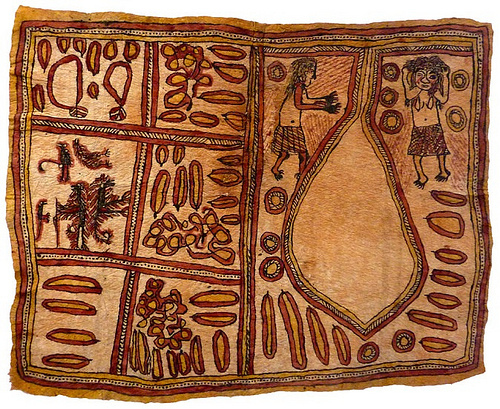
To place creativity even more at the centre of this story, the story focusses on Rika’s inability to have a child and the intensity of her pain and loss. Rather amazingly, this story is situated alongside the ancestor story of the Mountain village: where man creates woman as a child-bearer by cleaving her as he does a tree, and at the same point of creation, woman similarly splits bark and creates a bark-cloth which she decorates and gives to the man in gratitude for his gift. Art is here central to creation, even more so, perhaps, than childbearing. Is this a tru creation story? It would be wonderful to know. But it leaves me, too like Martha and too little like Rika, with the feeling that this may be just a wish on the author’s part. For the women of the Mountain village were not passionate about their art in the same way as Rika is. Art does not destroy what is around them. It is their life.
Oime bark-cloth art: Fate Savari (Isawdi)- Insa and the wedding gift
In the end, so magnificent is Modjeska’s evocation of Papua New Guinea, that it left me with the same longing experienced by the Surrealists the irresistible need to possess … hardly equalled in any other domain (p. 67). I very highly recommend it to anyone interested in Papua New Guinea, post-colonial societies, the nature of creativity, women and creativity, women and fertility. Equally strongly, I recommend it to anyone who just likes a good read. The new setting, so beautifully evoked, is sufficient on its own. I particularly recommend it to reading groups. I would imagine they could talk for weeks about it. I have not given it any stars – for I’m not giving out stars now for they seem to me to diminish the work to a particular place on a very small continuum. Fortunately, life and books are much more complex than that.
Drusilla Modjeska’s The Mountain is short listed for the Miles Franklin Award, Australia’s most prestigious literary award: http://www.milesfranklin.com.au/ That is not surprising at all.
Modjeska, is still involved with the Papua New Guinea she first saw as the wife of an anthropologist in the late 1960’s. Her recent work has involved promoting the exhibitions of Öime bark-cloth art: http://www.omieartists.com/ She has also lent her writing to the promotion of bisnis for village tourism in the Fjords: http://www.themonthly.com.au/issue/20...
The story is a good one, told tru it feels, of the wonder and delight and discomfort of Westerners finding new ways of being in the humid, beautiful, wet and muddy tropics, in the late 1960’s and early 1970’s; of the strong, clever young men and woman who will carry their country into this fast paced independence; the revolutionary politics in speech and action amongst the young university students growing up on post-colonial literature and Black Power; and always the question of the villagers and their traditional life so important to them, so seductive to the Westerners, and yet apparently destined to be over-ridden by ‘progress’. Modjeska creates a palpable feel for the place and for the actions. I could feel the pounding of Jericho’s feet as he took up the rhythm of the dance; I could feel the warm tropical water as Aaron slid under to bring up a star fish.
Modjeska gives us more. As the story centres on Rika, we see a portrayal of creativity. Modjeska brings to this something entirely new. She shows us in hurtful detail the cost of the creative life (better and more dangerous than any love affair). This is not just the cost for Rika, but the cost also to others. It is a portrayal in raw detail. Rika can be ‘not nice’. She is ‘not one of the good ones.’ Her passionate nature leads her to harm others because her pain is so great; but it also draws others to her as it creates such a vortex of passion. Interestingly, and powerfully tru, is the depiction of the way a passionate creative nature is as much a creature of sorcery as the most primitive of villagers. Rika creates (unconsciously) that which she fears most. Hers is the sorcery created by the power of imagination spiralling around fear. This feel for both the artist and for those around her is indeed telling, disconcerting, and yet like so much of the story I recognise as told tru.
To place creativity even more at the centre of this story, the story focusses on Rika’s inability to have a child and the intensity of her pain and loss. Rather amazingly, this story is situated alongside the ancestor story of the Mountain village: where man creates woman as a child-bearer by cleaving her as he does a tree, and at the same point of creation, woman similarly splits bark and creates a bark-cloth which she decorates and gives to the man in gratitude for his gift. Art is here central to creation, even more so, perhaps, than childbearing. Is this a tru creation story? It would be wonderful to know. But it leaves me, too like Martha and too little like Rika, with the feeling that this may be just a wish on the author’s part. For the women of the Mountain village were not passionate about their art in the same way as Rika is. Art does not destroy what is around them. It is their life.
Oime bark-cloth art: Fate Savari (Isawdi)- Insa and the wedding gift
In the end, so magnificent is Modjeska’s evocation of Papua New Guinea, that it left me with the same longing experienced by the Surrealists the irresistible need to possess … hardly equalled in any other domain (p. 67). I very highly recommend it to anyone interested in Papua New Guinea, post-colonial societies, the nature of creativity, women and creativity, women and fertility. Equally strongly, I recommend it to anyone who just likes a good read. The new setting, so beautifully evoked, is sufficient on its own. I particularly recommend it to reading groups. I would imagine they could talk for weeks about it. I have not given it any stars – for I’m not giving out stars now for they seem to me to diminish the work to a particular place on a very small continuum. Fortunately, life and books are much more complex than that.
Drusilla Modjeska’s The Mountain is short listed for the Miles Franklin Award, Australia’s most prestigious literary award: http://www.milesfranklin.com.au/ That is not surprising at all.
Modjeska, is still involved with the Papua New Guinea she first saw as the wife of an anthropologist in the late 1960’s. Her recent work has involved promoting the exhibitions of Öime bark-cloth art: http://www.omieartists.com/ She has also lent her writing to the promotion of bisnis for village tourism in the Fjords: http://www.themonthly.com.au/issue/20...

March 14, 2018
A unique, insightful and captivating novel. Strong well developed characters with excellent imagery. Very well researched. A moving tale of intersecting cultures within modern Papuan New Guinea.

June 3, 2018
I really struggled with this book. I chose it because it was based in PNG and it sounded interesting, but I found it very hard to read.
January 16, 2022
I really enjoyed this book. It gives an interesting insight into PNG life and culture. Things I didn’t know.
March 8, 2022
First half of book was not too bad but then the second half, just dragged and dragged, and the story wasn't as good. I really dad to push myself to finish this book.
Displaying 1 - 30 of 83 reviews