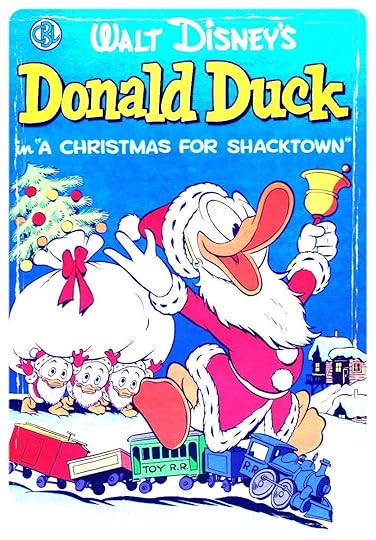
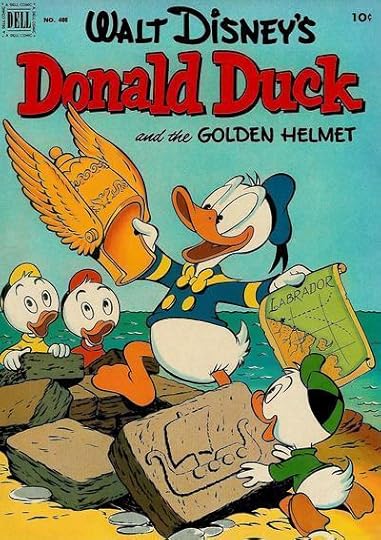
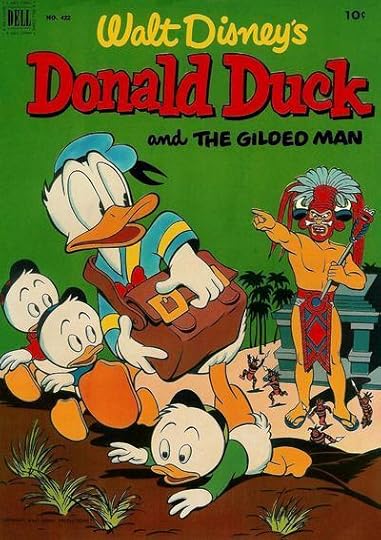
The third volume of Fantagraphics' reprinting of Carl Barks' classic Donald Duck and Uncle Scrooge work -- like last spring's Uncle Scrooge: Only a Poor Old Man -- focuses on the early 1950s, universally considered one of Barks s very peak periods. Originally published in 1951, A Christmas for Shacktown is one of Barks' masterpieces: A rare, 32-pager that stays within the confines of Duckburg, featuring a storyline in which the Duck family works hard to raise money to throw a Christmas party for the poor children of the city's slums (depicted by Barks with surprisingly Dickensian grittiness), and climaxing in one of the most memorable images Barks ever created, the terrifying bottomless pit that swallows up all of Scrooge's money. But there's lots more gold to be found in this volume (literally), which features both The Golden Helmet (a quest off the coast of Labrador for a relic that might grant the finder ownership of America, reducing more than one cast member to a state of Gollum-like covetousness), while The Gilded Man features a hunt for a rare stamp in South America; two more of Barks' thrilling full-length adventure stories. But that's less than half the volume! This volume also features ten of Barks's smart and funny 10-pagers, including a double whammy of yarns co-starring Donald's insufferable cousin (Gladstone's Usual Very Good Year and Gladstone's Terrible Secret); as well as another nine of Barks' rarely seen, one-page Duck gags all painstakingly recolored to match the original coloring as exactly as possible, and supplemented with an extensive series of notes and behind-the-scenes essays by the foremost Duck experts in the world.
Carl Barks was an American cartoonist, author, and painter. He is best known for his work in Disney comic books, as the writer and artist of the first Donald Duck stories and as the creator of Scrooge McDuck. He worked anonymously until late in his career; fans dubbed him "The Duck Man" and "The Good Duck Artist". In 1987, Barks was one of the three inaugural inductees of the Will Eisner Comic Book Hall of Fame. Barks worked for the Disney Studio and Western Publishing where he created Duckburg and many of its inhabitants, such as Scrooge McDuck (1947), Gladstone Gander (1948), the Beagle Boys (1951), The Junior Woodchucks (1951), Gyro Gearloose (1952), Cornelius Coot (1952), Flintheart Glomgold (1956), John D. Rockerduck (1961) and Magica De Spell (1961). He has been named by animation historian Leonard Maltin as "the most popular and widely read artist-writer in the world". Will Eisner called him "the Hans Christian Andersen of comic books." Beginning especially in the 1980s, Barks' artistic contributions would be a primary source for animated adaptations such as DuckTales and its 2017 remake.
هي ليست أول قراءة في 2015, وبالتأكيد ليست أخر قراءات 2014 هي مجرد أعادة قراءة , نوستالجيا الزمن الجميل مجلدات الأعمال الكاملة لكارل باركس مجموعة متميزة لقصصه, بدأها في 1942 وحتي أواخر الستينات بهذا الجزء مجموعة متميزه من القصص التي قدمها بالخمسينات أهمها القصص الطويلة التي اعشقها والتي تزيد عن 24 صفحة وتصل ل32 صفحة كثيرا بالقصص هنا تطور في الشخصيات الأولاد مثلا اكثر ذكاءا من القصص في المجلدات السابقة, بداية فكرة انضمامهم للكشافة شخصية دهب "سكرووج" صارت اكثر وضوحا وقربا للقصص التي عشنا معاها لاحقا
ربما ليست بقوة المغامرات اللاحقة كالجزء التالي للمجموعة والتي سنجوب معها العالم مع عم دهب وبطوط والأولاد والتي سنتعرف معها على الكثير من ثقافات الشعوب في العالم..ربما سوي مغامرة هنا للرجل الذهبي والتي يقابله بطوط والأولاد في أمريكا الجنوبية ومغامرة الخوذة الذهبية والتي بها فكرة أن الفايكينج القدامى هم مكتشفوا أمريكا الشمالية الاصليين
ولكنها تظل مجموعة مميزة فعلا وأعادتني لذلك الزمن الجميل الخالي من الهموم
والي مجلدات قادمة أن شاء الله
محمد العربي من 22 ديسمبر 2014 الي 5 يناير 2015
ملحوظة: حصاد العام اخر الأسبوع ان شاء الله بعد كتابة أخر 2 ريفيو لكتب 2014
Not a single story in this volume that's less than three-and-a-half, and the title story is an easy five-star. Probably the first five-star Barks story I read in my life, way back when, as a kid. I don't think nostalgia's clouding my eyes too bad.
It's hard to find fault with Carl Barks; these collections (Donald Duck and Scrooge McDuck) are always an enjoyable read, and a fun addition to any book lover's shelf. None of the comics in this particular collection stood out as exceptionally noteworthy, but each is satisfying in its own way. The production value of these books is worth a mention. They're beautifully bound and present the comics in bright colors and clean layouts that place all the emphasis on the contents. And, there's a bonus at the back: mini essays on the comics, written by a variety of experts in the field. For the most part, these provide an additional layer of interest, oftentimes with fascinating tidbits of history or background that add depth to the experience. Unfortunately, R. Fiore's contributions are overblown and irritating, serving only to demonstrate his ability to use Big Words Just For The Sake Of It while dragging the focus to his own sense of self-importance rather than to a true investigation of Barks's work. The rest, though, are capably and thoughtfully written.
This is the third volume published in Fantagraphics’ reprints of Barks’s comics, but it’ll be the eleventh in the entire series, if all goes according to plan. I’m not sure why they aren’t just printing them in order, but people who are familiar with Barks’s work have suggested that they’re starting with the strongest material in order to build interest. It seems like the wrong time of year to be reading a volume with a title like that, and there are a few Christmas-related comics in addition to the title story, but most of it doesn’t relate to any particular date. The lead story has Donald, Daisy, Huey, Dewey, and Louie trying to raise money to give a good Christmas to the kids in the poor part of Duckburg, but has a few twists along the way, eventually leading to Donald’s nephews helping Scrooge rescue his money from an underground cavern. Scrooge plays a quite prominent role in several of these stories, including one where Donald goads him into competing with the Maharajah of Howdyustan at building statues. At the end, the Maharajah goes broke, but Scrooge still has plenty of money left. Royalty just can’t compete with businessmen in this day and age, I suppose. Another has Scrooge being forced to spend money because it won’t fit in his money bin, with Donald helping him by making reckless and extravagant purchases, and an ironic ending. The most expensive food item he can find is broiled bosom of Caledonian chickadee, which apparently isn’t a real bird, unless Donald and Scrooge just ate all of them. I know people have been disturbed in the past at seeing Donald eating turkey (and, in fact, one of the stories in this volume is about him trying to win a raffle for a free turkey), so I have to wonder what they’d think of his eating chickadee. This volume also features the earliest appearances of eccentric inventor Gyro Gearloose, and quite a bit of Donald’s lucky but lazy Gladstone Gander. Gladstone is essentially a villain, because even though he generally isn’t actively trying to be mean, the fact that he gets everything he wants for nothing is both irritating to others and often results in Donald losing out. In one comic, we learn that Gladstone’s secret shame is that he once actually worked a job, demonstrating that in his mind his luck and laziness are linked. Gladstone also features as a foil in the adventure story “The Gilded Man,” in which Donald meets El Dorado in his search for a rare postage stamp. The other main adventure comic in this volume is “The Golden Helmet,” which has Donald racing a guy named Azure Blue in a search for a Viking helmet that could theoretically enable its owner to rule all of North America (at least if the crooked lawyer Sharky has anything to say about it). It’s definitely worth a read, but you probably already knew that, right?
Collecting stories from 1951 and 1952, this book has more side characters in it than earlier volumes. Scrooge is all over the book (his solo series premiered at this time), as is Gladstone Gander. Daisy is in a few stories. We also see the debut of the chicken inventor, Gyro Gearloose, and the Beagle Boys. The Duck world is expanding before our eyes. I’m not familiar with some of these characters/elements, so it’s interesting to read about them here.
Scrooge is still a greedy bully but he’s hilarious. He builds a gigantic money bin on top of the hill and hates spending his money. Although he does compete in a spending contest in one story, which is a highlight of the book. I also loved the last 10-pager where he reluctantly allows Donald to spend his cash so he can free up space in the money bin. The last page was perfect!
The three long adventures are all solid. The title story, “A Christmas for Shacktown,” has some great Scrooge and Donald moments, reading like Barks’ version of A Christmas Carol. It’s a rare Duck adventure that stays in Duckburg.
Another lively, entertaining, and satisfying entry in the Barks library.
This is my second volume of the Carl Barks, Donald Duck collection. This one I liked better than the first. It is the 11th volume out of I think 14. There were characters that I was familiar with from my Ducktales watching days, Gladstone, Gyro and of course Uncle Scrooge. Once again the art is beautiful and the stories fun and humorous. Standout stories: Gladstone's Usual Good Year, Statuesque Spendthrifts, Rocket Wing Saves The Day, Gladstone's Terrible Secret, The Golden Helmet and The Gilded Man.
Probably the highest praise for these is that my four year old still looks forward to hearing about Donald and the boys each night(I read the dialog and he reads the narration). He's getting the second box set for Christmas, Lost in the Andes and Trail of the Unicorn. I'm looking forward to those as they are praised as the best of the Barks bunch.
Volume 11 in the Carl Banks library, Walt Disney’s Donald Duck: A Christmas For Shacktown is a terrific collection of Golden Age comics. Featuring “A Christmas For Shacktown,” “The Big Bin on Killmotor Hill,” “The Screaming Cowboy,” and “The Golden Helmet,” over 20 full length and one page comics are included. Of particular interesting is the introduction of Uncle Scrooge’s money bin and the nefarious Beagle Boys to the series. Some of the stories are a little zanier than usual, but overall they’re fun and entertaining adventures. And the humor is rather clever, with some well-timed slapstick. Also included are a Carol Bank biography and a Story Notes section with critic commentaries on the individual comics. Walt Disney’s Donald Duck: A Christmas For Shacktown delivers a lot of laughs and heightens one’s appreciation for the comic series.
A couple of nice Uncle Scrooge stories here, including the first appearance of the money bin and a great tale about Donald actually being hired to spend Scrooge's money.
There are also several Gladstone Gander stories --- Barks makes Gander's incredible and predictable luck a source of frustation to Donald on several occasions. I was intrigued to see the plotting similarities with the Scrooge stories (both characters have immense resources which Donald can't access and yet Donald needs to have some success by the end of the tale).
Another great collection of Carl Barks cartoons. The quality here is just as good as it was in the previous volume of Donald Duck stories. And one of the stories included should live forever as the first appearance of Uncle Scrooge's money bin.
Also on a par with the early volume are the "Story Notes" at the back of the book, but don't mistake that as a compliment. Following the pattern in this series, they range from passable to a bit much, and some even achieve being really annoying. But you can't hold that against Barks, and it doesn't detract a bit from the enjoyment of the stories.
A most entertaining collection of Carl Barks' Donald Duck comics from the early 1950s. In the title story, Scrooge McDuck unwillingly and unintentionally provides a merry Christmas for the poor children in Shacktown. Many of the stories feature Uncle Scrooge and his Money Bin, and the ridiculously lucky Gladstone Gander makes several appearances.
Fine artwork, excellent storytelling, a sturdy hardcover binding, and great color reproduction make this (along with the other volumes in the series) a fun, lively, engaging collection of duck tales for kids and adults alike.
This was my second Barks book, after "Just a Poor Old Man," which I absolutely loved. "Shacktown" is a little bit lower on my list, not sure why. Perhaps I find Scrooge McDuck such an interesting, and funny, character, and he figures less prominently in this collection. "Shacktown" is certainly a great book, better than 99.987% of the comics out there, and I'll definitely be reading more-- "Lost in the Andes" is already at my bedside.
Oh man, Carl Barks duck comics are the best. There's some great stuff in this volume, including the introductions of Uncle Scrooge's money bin and the Beagle Boys, stories about Donald fighting against his cousin Gladstone's freakish luck, some awesome adventure stories involving travel to exotic lands in search of rare artifacts, and a great story about Donald going on a spending spree with Uncle Scrooge's money that ends with a genius twist. I love this stuff.
Carl Barks' duck tales make you ask: "Mickey who?"
This volume includes the first appearance of Scrooge's Money Bin. Barks not only created the Money Bin, but he created the character of Uncle Scrooge. It is fun to see the moments where these characters and ideas appear for the first time. Reading later stories when I was younger, it seemed like these elements were always existed. This series shows the creative process in motion.
Despite this book's title, this is not strictly a holiday collection. 'A Christmas For Shacktown' is the 11th volume in Fantagraphics' extensive collection of works by Carl Barks.
Carl Barks started his career with Disney as part of the animation department. Working as an 'in-betweener', Barks was involved in several early Donald Duck shorts including Donald's Nephews which saw the debut of Huey, Dewey & Louie in 1938.
Unhappy with the way animated films were made 'by committee' and deteriorated war-time work conditions, Barks quit working at Disney Studios in 1942. He then tried his hand at chicken farming. During this time, Barks' supplemented his agricultural income by taking on freelance assignments with Western Publishing. 1943's The Victory Garden would be the first of over 500 works during this period of his life that Barks would create for Western; which Fantagraphics is working to release a 30 plus volume library of.
Along with A Christmas For Shacktown in which the citizens of Duckburg rally to make it a Merry Christmas for the residents of that city's slums, volume 11 includes several other classics. The Guilded Man sees Donald and his nephews heading to South America, seeking a rare stamp. The Bin on Killmotor Hill introduces readers to the security measures of Uncle Scrooge's fortress-like money bin. But perhaps the most well known story in this collection is 1952's The Golden Helmet which sees the fate of North America in the hands of Donald as he races for a Viking artifact hidden in the Arctic Circle!
As of now, 27 volumes of the Carl Barks Library have been released. While many fans are eagerly awaiting the final 4 volumes of the proposed 30 volume set, readers such as myself, are wondering what happened to volumes 1-4. According to the insert that lists the other books in the series, the Carl Barks Library began at Volume 5. A search of Fantagraphics' website unfortunately yields no answer to this mystery.
With an average cover price of $35, one hoping to collect the entire Carl Barks Library will shell out over $1000 when the entire set is released. Just because these books star funny animals, there's a level of sophistication to them. That's because Carl Barks treated his characters as human beings and on more than one occasion, the characters inside refer to themselves as humans: dogs and ducks alike! While child readers love the wacky characters and mix of zany and swashbuckling adventures, to adult readers, these stories come alive with inside jokes, clever puns and social themes such as the nuclear arms race and capitalism.
I believe this is my sixth book in this Fantagraphics' collection I have read and I'll rate it in the middle. All are great - I love this collection of Carl Barks Duck Tales - but it is safe to say some are MORE great than others. As an Uncle Scrooge fan (for the adventures and the development of the three nephews as smart helpers instead of annoying pests) these Donald Duck focused tales have delighted me more than I thought they would. Barks didn't paint Donald like the cartoons as a hot headed moron he is more fully developed and likeable.
There are some great tales here - the Gilded Man was a fav for me - the Golden Helmet is a classic and the title of the book was fun although odd in the big twist of what happens to Scrooge's money.
My one complaint here is Gladstone Gander and his luck drives a few too many stories. I like the character but less is more since he doesn't have many layers other than being lucky and never wanting to work.
Overall - a solid collection in a fantastic series.
I had heard before from multiple comic book enthusiasts on YouTube and other social media that the works Carl Barks created for Disney are among the greatest comics ever published. To me, that claim seemed very strange in the same way it would be strange to claim the Magic Treehouse books are among the greatest fantasy literature ever published. Still, I've been curious about why these comics are so renowned, I wanted something light to read before Christmas, and this particular collection is considered one of the best starting points.
After reading through all the stories in "A Christmas for Shacktown," I still don't really understand the reverence, but I enjoyed them more than I thought I would regardless. They're certainly better than most comics made specifically for children. The art is consistently expressive, the satirical humor mostly lands, and there are even a few moments of genuinely intense action.
In 'A Christmas in Shacktown' we find Carl Barks in optima forma. The title story is the best of all his Christmas stories, in the next he introduces Uncle Scrooge's famous money bin, and this one also sees the return of the Beagle Boys. In some later ten-pagers he also introduces the "dizzy inventor" Gyro Gearloose. Then there are superb ten-pagers involving Gladstone Gander, Donald's song 'The Screaming Cowboy', the maharajah of Howduyustan (introducing that famous founder of Duckburg, Cornelius Coot), and then there are the classic adventures 'The Golden Helmet' and 'The Gilded Man'. Most hilarious of all must be the ten-pager in which Donald is allowed to spend as much of Uncle Scrooge's money has possible. In other words, this is a marvelous volume, and essential for all comic lovers.
Beautiful, lively art. Perfectly consistent and creates a whole world. Incredibly smooth and easy to follow storytelling. Inventive, clever plots. Sharply defined, dynamic personalities. Donald Duck (and Uncle Scrooge) are the best American comics ever made.
The title story is a gem. The setup is familiar — the ducks have to raise money to put on a Christmas show for the poor kids of shacktown. But the complications are zany and brilliant — a ravenous rat, and an unexpected cave-in, which requires the consultation of experts from around the world. In the end, a toy train proves it has its use after all.
Some stories are ok, some are great fun. I especially liked Donald tasked with spending all Scrooge’s money, The Golden Helmet, and the Gladstone capers. The stories do a get a little repetitive, but it’s great to have them, and they weren’t intended for this format to begin with. I look forward to getting to more Scrooge stories (it was great seeing the money bin and Beagle Boys!).
More great Carl Barks art. At this point, Barks is drawing the definite version of Donald Duck and his supporting cast.
A standout story in this collection for me was "The Golden Helmet". I had read a reprint of this comic as a child and it was nice to get reacquainted with it.
Overall an entertaining collection of stories even if they are also products of their time.
Another excellent collection! Inevitably some of the stories don’t click with me but these are highly entertaining yarns and I keep finding more I never read as a child! I love this stuff and it’s comforting in this time of national and international worries!