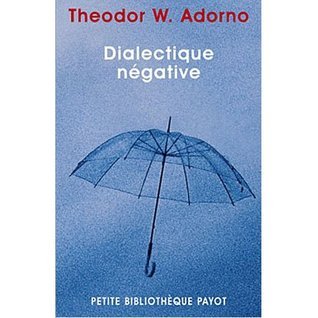
I have finally made sufficient progress in my reading that I felt I could tackle the Negative Dialectics, a book Ivan and I long speculated as planning on reading -- but only after we had ascended our Magic Mountain of philosophical and speculative heights of perception. Well, for me, that time has finally arrived. To proceed....
Q: Why does Heidegger's moment of truth necessarily level off into an irrationalist Weltanschauung?
Heidegger’s "moment of truth" (Augenblick), conceived as an authentic, pre-conceptual unveiling of Being, often slides into irrationalism because it rejects the rationalist, subject-object, and logical-representational framework necessary for objective validation. By privileging ineffable, existential disclosures over conceptual thought, this "moment" falls into an arbitrary or subjective Weltanschauung (worldview) that cannot be formally justified, often resulting in fatalism, poeticized truth, or historical arbitrariness, as argued by critics like Adorno.
Key reasons this "moment" is viewed as leveling into irrationalism:
Rejection of Subject-Object Dualism: Heidegger rejects the traditional notion that truth lies in a proposition (subject) corresponding to an object, instead favoring the aletheia (unconcealment) of Being.
The Ineffable Nature of Being: Because Being cannot be "taken" or conceptualized as an object, the experience of it is often described in terms that bypass logic, leading to accusations of irrationalism (e.g., Seyn as poetic).
Neglect of Particularity: Critics argue Heidegger emphasizes a totalizing concept of Being over particular beings and historical realities, replacing objective, rational inquiry with a "subjective-idealist" and "poeticized" worldview.
Adorno's Critique: Theodor Adorno argued that attempting to eliminate the subject-object divide through existential "moment" causes rationality to turn irrational, leading to a "terminological camouflaging" of subjective arbitrariness.
In essence, by aiming to cut under the opposition of rationalism and irrationalism, Heidegger is perceived to lose the tools of rational critique, making his "truth" seem grounded in an arbitrary or romanticized "life-philosophy."
Q: Why is it necessarily postmodernist to say that today, as in Kant's time, philosophy demands a rationalist critique of reason, rather than its banishment?
Saying that today, as in Kant's time, philosophy demands a rationalist critique of reason rather than its banishment is often interpreted within a postmodern framework because it uses the tools of Enlightenment reason (critique) to accept and limit that same reason.
While postmodernism is sometimes loosely equated with a "banishment" or rejection of reason, a central, more nuanced postmodern approach is actually to "enlighten the enlightenment about itself," treating the critique of reason as its self-cannibalization, rather than its total elimination.
Here is why this position is associated with a postmodernist approach:
Critique without Transcendental Grounding: Postmodernism often takes Kant’s critique and cuts out the noumena (the things-in-themselves), disavowing the existence of an immanent, stable foundation for reason. The demand for a "rationalist critique" today implies analyzing the limits of reason from within, without appealing to a secure, objective foundation outside of it—a hallmark of postmodern skepticism toward foundational truths.
Echoing Kant's Critique: This approach recognizes that contemporary "farewell to reason" arguments echo the original Kantian critique, which argued that reason must be limited in order to make room for other things (faith, action, or social performance).
The "Anti-CI" and Power: Postmodernism, in this context, critiques the Kantian autonomous, rational subject by reducing rational maxims to social behaviors and performances. By focusing on the critique of reason rather than its banishment, it aims to show how reason is regulated by people in positions of power, rather than being an objective, universal arbiter.
Self-Reflexivity and Limits: Postmodern thought often employs instruments of reason to demonstrate that reason cannot provide an objective, totalizing view of truth. Thus, the "critique of reason" becomes a "critical reflection" used to show how reason's "totalizing" claims are unfounded, a key move in postmodern theory.
In summary, this perspective is postmodern because it maintains a rigorous dedication to critique—a rationalist method—while simultaneously dismantling the "rationalist" faith in reason's capacity to provide universal or objective truths.
Q: What are the psychological effects of the subjects being assailed by the ups and downs of living in a capitalist society?
The psychological effects of navigating a capitalist society include high rates of anxiety, depression, chronic stress, and feelings of inadequacy or shame. Constant economic instability and pressure to compete lead to loneliness, reduced trust, and lower self-esteem, as personal worth is often wrongly tied to financial success or material possessions.
Key Psychological Effects
Anxiety and Fear: Unpredictable economic cycles, such as job instability, create chronic anxiety.
Depression and Loneliness: Prioritizing work over social connections and the relentless pursuit of profit often lead to profound loneliness and isolation.
Shame and Inadequacy: The intense focus on individualism and material success causes people to blame themselves for systemic failings, fostering a sense of failure.
Reduced Empathy and Trust: Competitive, market-oriented environments reduce interpersonal trust and undermine empathy.
Dehumanization: Being reduced to a unit of production or a consumer leads to feeling objectified and undervalued.
Structural Drivers of Distress
Privatization of Stress: Social and economic problems, like poverty or overwork, are frequently framed as internal, personal mental health issues rather than systemic issues.
Constant Comparison: A culture that emphasizes wealth accumulation encourages perpetual status anxiety, as individuals constantly measure themselves against higher earners.
Financialization of Basic Needs: The marketization of essential services like healthcare and housing creates insecurity, forcing individuals to work longer hours to meet basic needs, increasing stress.
These effects are more pronounced in societies with higher wealth inequality and a stronger adherence to market-oriented, individualistic values.
Q: Why is radical modern art hated by the general population?
A: Because it reminds us of our missed chances and opportunities for a better live and the prospect that it is possible that we ought to live in a better world than the one we inhabit. This is in accordance with the fact that, through the sheer existence of abstract art, it points out the underlying structural defect and the dubiousness of our heteronomous conception of the correctness of the existence world-order. Because the subjective consciousness of men is too enfeebled to burst the social world it is imprisoned in, instead, it undergoes a process of adaptation while simultaneously mourning the absence of its will to reach a peak experience of self. If the goal is reification of self, this above stands as an explanation how capitalism functions according to a psychological system severed from a society structured through rewards and punishments.
Furthermore, the primitive wish-fulfillments the culture industry feeds to the masses, who do not really believe in them, are general substitutes for an ontology that they have been divested of. While they pride themselves that they are no longer deluded as God-fearing subjects, the need for something solid to hold onto is the most urgent need people have, and the more this need is blocked by the extent forms of society, the most desperately people cling to a capitalist viewpoint that is both desperate and self-preserving. Adorno says the capitalist world-picture of society relies on an image of overpowering and omnipresent terror which exudes a dizziness that potentially overcomes society and threatens it with total destruction. This dynamic is essentially how capitalism functions today, all predicated on an invisible God who pulls the strings, whose existence is now taken for granted as the believers in Dante once understood the purpose of religion in their own time.
Q: Is Adorno correct when he suggests that if the threat that capitalism promotes the belief in suddenly vanished, its positive reversal, which is itself nothing but its abstract negation, would probably vanish along with it?
Theodor Adorno's suggestion that the positive reversal of capitalism—its abstract negation—would vanish if the threat posed by capitalism disappeared is consistent with his core philosophical position on negative dialectics and the critique of false totality.
Adorno argues that in a "wrong" society (late capitalism), opposition to the system is often structured by the system itself, making it a mere reflection or "abstract negation" that fails to offer a truly free alternative.
Here is an analysis of this argument based on his work:
1. The Relationship Between Threat and Opposition
"Negative Dialectics" is a Response to the Wrong Life: Adorno famously stated that "there is no right life in the false one." He believed that modern capitalism is a "black hole" that distorts all human relations, making them "reified" or treated as things.
The Myth of Positive Change: Adorno was deeply skeptical of straightforward, positive solutions or "revolutions" that simply invert capitalist power structures. He saw such oppositions as "abstract negations" that, because they originate within the same system, ultimately "vanish" or become part of the dominant structure once the immediate threat is gone.
Capitalism's "Threat" Structures Thought: The "threat" refers to the constant, often invisible pressure of a society organized around profit, which creates the anxiety that fuels both compliance and, ironically, the "pseudo-resistance" to it.
2. Why the Positive Reversal Vanishes
The "Positive" is Fetishistic: Adorno considered it "fetishistic" to believe that the existing state of productive forces, or their direct negation, could produce a new, truly free life, as the "needs" currently satisfied by capitalism are themselves products of that system's "direct or indirect terror".
Abstraction as a Failure of Negation: By "abstract negation," Adorno means an opposition that negates the current situation without truly understanding or transcending the underlying reality. If the threat disappears, this kind of hollow, superficial opposition loses its purpose.
3. The Alternative: "Determinate Negation"
"Right Condition" Free from Dialectics: Adorno believed a truly "right" condition would be one where society is no longer defined by inherent antagonisms.
Genuine Resistance is Negative: Instead of advocating a "positive" alternative that might turn out to be another form of domination, Adorno argues for a "negative dialectic"—a rigorous critique of existing conditions that does not pretend to hold the solution in its hand. He believed that only by acknowledging the "non-identical"—that which the system cannot consume—can genuine, non-oppressive change begin.
Adorno’s insight is generally considered correct within his theoretical framework, as he viewed "positive" transformations that originate from within the capitalist system as being inherently flawed and doomed to reproduce that system. He argued that truly transformative resistance must come from outside the logic of "identity thinking" and the "exchange principle".
In my opinion, the reason why the present state of the world is one that seeks to seduce us into believing in a world dominated by the truth of surface meanings is that, to conform to the spirit of capitalism, essence must be disguised and covered up, for to deny essence is to side with appearance and with the total ideology which existence has become. Thus, men are unfree because they are beholden to externality, and this externality also consists of the men themselves. If we are free at all, we are only free to the extent that we are chained by freedom's shackles and by our own belief in determinism, which posits freedom as a historical construct. Four stars.