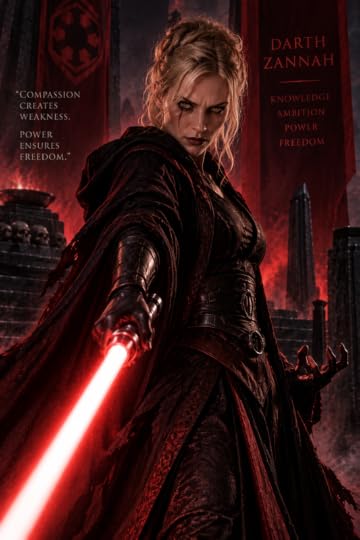
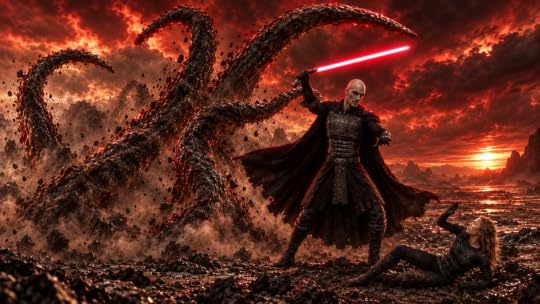
Twenty years have passed since Darth Bane, reigning Dark Lord of the Sith, demolished the ancient order devoted to the dark side and reinvented it as a circle of two: one Master to wield the power and pass on the wisdom, and one apprentice to learn, challenge, and ultimately usurp the Dark Lord in a duel to the death. But Bane’s acolyte, Zannah, has yet to engage her Master in mortal combat and prove herself a worthy successor. Determined that the Sith dream of galactic domination will not die with him, Bane vows to learn the secret of a forgotten Dark Lord that will assure the Sith’s immortality–and his own.
A perfect opportunity arises when a Jedi emissary is assassinated on the troubled mining planet Doan, giving Bane an excuse to dispatch his apprentice on a fact-finding mission–while he himself sets out in secret to capture the ancient holocron of Darth Andeddu and its precious knowledge. But Zannah is no fool. She knows that her ruthless Master has begun to doubt her, and she senses that he is hiding something crucial to her future. If she is going to claim the power she craves, she must take action now.
While Bane storms the remote stronghold of a fanatical Sith cult, Zannah prepares for her Master’s downfall by choosing an apprentice of her own: a rogue Jedi cunning and cold-blooded enough to embrace the Sith way and to stand beside her when she at last wrests from Bane the mantle of Dark Lord of the Sith.
But Zannah is not the only one with the desire and power to destroy Darth Bane. Princess Serra of the Doan royal family is haunted by memories of the monstrous Sith soldier who murdered her father and tortured her when she was a child. Bent on retribution, she hires a merciless assassin to find her tormentor–and bring him back alive to taste her wrath.
Only a Sith who has taken down her own Master can become Dark Lord of the Sith. So when Bane suddenly vanishes, Zannah must find him–possibly even rescue him–before she can kill him. And so she pursues her quarry from the grim depths of a ravaged world on the brink of catastrophe to the barren reaches of a desert outpost, where the future of the dark side’s most powerful disciples will be decided, once and for all, by the final, fatal stroke of a lightsaber.
Drew Karpyshyn is a Canadian author and game designer. After working at a credit union for some time, he eventually became a game developer. He joined BioWare towards the end of the Baldur's Gate series, and wrote the tie-in novel for Baldur's Gate II: Throne of Bhaal. He stayed with BioWare, where he worked on Neverwinter Nights, and became the Senior Writer on the critically acclaimed Star Wars: Knights of the Old Republic.
This Star Wars connection gave him the opportunity to write Darth Bane: Path of Destruction, his first hardcover. Karpyshyn still works for BioWare where he is the lead writer for the Mass Effect series.
Peace is a lie, there is only passion. Through passion, I gain strength. Through strength, I gain power. Through power, I gain victory. Through victory, my chains are broken. The Force shall free me. - The Sith Code
Path of Destruction was the beginning of an epic Star Wars story. Rule of Two was the captivating continuation. With Dynasty of Evil, Drew Karpyshyn, true master of storytelling and characterisation, wrote the perfect conclusion to his trilogy on the great Darth Bane, and my personal favourite Star Wars novel.
This book is the only Star Wars book on my very exclusive favourites list, and the only story set in this universe that even comes close to the unreachable heights of KotOR.
I have talked enough about Bane and Karpyshyn and the reasons why I ended up liking this series. Now let me talk about the one thing that made me love it. This review is a tribute to one of my favourite Star Wars characters...
"You have done well, Zannah. I underestimated you. Had I known your plans, I would never have asked you to kill me." "You still have much to teach me. I will continue to study at your feet, Master. I will learn from your wisdom. I will discover your secrets, unlocking them one by one until everything you know—all your knowledge and all your power—is mine. And once you are no longer of use to me, I will destroy you."
The Bane trilogy, in addition to being a rather interesting story about a conflicted man and his mission to reform the forces of darkness, is also a fascinating coming-of-age story, albeit one that’s rather different from the usual stories of that kind.
This is the story of Rain, a ten-year-old little girl who loses her friends to the flames of war. In her grief and loneliness, she befriends a simple creature native to the planet she finds herself on. A couple of Jedi knights come across her, and since the creature is dangerous, they kill it to save the girl.
So the little girl unwittingly grasps the power of the Dark Side of the Force and breaks their necks.
Thus begins the story of Rain, who would become Zannah, who would become Darth Bane’s apprentice and learn under him to achieve mastery of Sith sorcery.
"I can use my powers to conjure up your worst nightmares and bring them to life before your eyes. I can drive you mad with fear, shred your sanity, and leave you a raving lunatic for the rest of your life."
Zannah is just so delightfully evil. There’s something special about reading a story set from the viewpoint of not just antiheroes, but outright villains. Bane and Zannah are the perfect Sith duo, and their like has never been seen in the Star Wars universe.
Sadly the infamous Rule of Two decrees that one of the two must go, and so, when Zannah finally challenges the reign of her master on the world of Ambria, the two battle it out with all their might in one final duel to the death that will decide which of them will carry on the legacy of the Dark Side of the Force, and begin the Dynasty of Evil...
No Star Wars novel is ever going to be chosen for BBC Radio Four's Book Club but when they're done well they can be highly entertaining and great fun. Happily, Dynasty of Evil is such an example. In fact the whole trilogy would keep any Star Wars fan happy. Darth Bane is a great character and I very much enjoyed what was a satisfying conclusion to this series. 3.75 🌟
Star Wars: Darth Bane #3: Dynasty of Evil, by Drew Karpyshyn
"Dynasty of Evil" is, in my opinion, the best book in the Darth Bane series. This book picks up the story of Bane and his apprentice, Zannah, about a decade after the previous book. Bane is highly disappointed in Zannah because she has not yet followed his Rule of Two by challenging and beating him for the role of Sith Master. He believes that she is biding her time until he weakens from age, and this goes against his beliefs - if Zannah ousts him from his position by waiting, she will not be strong enough to continue the Sith order. And then everything Bane has worked for will fall.
But what is Bane to do? He is aging faster than normal due to his use of the Dark Side and his ordeal with orbalisk armor, and doesn't have the time left in his life to train another apprentice. Then, in an ancient scroll, he finds mention of Darth Andeddu, a Sith who discovered a way to extend his life indefinitely. This is Bane's answer - if he can find Andeddu's Holocron, his Sith Order will survive.
However, Bane can't set off to find the Holocron without sending Zannah away as well, to divert her attention from him. Although Zannah hasn't yet challenged him, Bane isn't sure who would survive in a fight between the two; he can't risk dying before finding the secret of immortality. So he sends his apprentice to Doan, an insignificant mining planet, and also the site of a Jedi's murder. On Doan Zannah finds the trail of a Dark Jedi, one who she believes could have the potential to be her own apprentice.
It's best to read the other two Darth Bane novels before "Dynasty of Evil," as Karpyshyn brings back characters from the first novel, "Path of Destruction," and winds them into a twisting plot. His writing is the best it's been yet, with the exception of a few passages that needed better proofreading. At first I couldn't believe the coincidences of so many characters meeting again, but as the novel went on, I understood how it all worked in a bigger context, and I wasn't in disbelief anymore.
I rushed through this book, eager to see how everything would end, and continued until I finished it (even though I had a pretty bad headache). "Dynasty of Evil" kept my attention from beginning to end, and as I said in the beginning, I think this is the best Darth Bane book. Karpyshyn keeps the plot just unpredictable enough that you're unsure who will be victorious, and the ending is a surprise.
“Only the strong survive, because only the strong deserve to” Ten years have passed since Darth Bane lost his orbalisk armor, and he realized what we all do at one time: that he is growing old and weak. The problem is that Zannah, as his apprentice, hasn't challenged his position as Master, making Bane wonder if she is strong enough for the position. Now, he must find the “Fountain of Youth” so that he can find a new apprentice to train.
I Liked: Ever since the hardcover came out, I've been chomping at the bit to sink my teeth into this novel. The entire Darth Bane series had been amazing, and I really wanted to know how it all ended (even if I could guess). Would Karpyshyn be able to make this series three for three? In short, the answer is a loud, boisterous “Yes!” Darth Bane and Darth Zannah are rejoined this time by Serra, the daughter of Caleb the healer. In what proves to be a smart move, Karpyshyn keeps his character list down; our character list is rounded out with Lucia, Serra's bodyguard, Set Harth, a Dark Jedi, and the Huntress, an Iktotchi assassin. Darth Bane continues to floor me. He is an astoundingly good character, even if he is the “villain”. He is smart, he thinks of the future, and, more importantly, he doesn't kill just because. Any time he does kill, it is meaningful. He even says at one point how it doesn't prove strength by killing everyone in his path. If one is weak, there is no point to “prove” your strength by blasting one to smithereens, even if you are powerful enough to completely destroy your antagonist. I like this pragmatic approach. Very appropriate for the secret order of the Sith. Darth Zannah also is remarkable. I like how she was planning to get rid of Bane, but first wanted to find an apprentice. Planning and patience are her keys. This next compliment is going to sound very strange coming from me, but Zannah is probably the only female character I've ever found who can use her sexuality as a tool withOUT coming off as too sexualized. One of my biggest complaints is the “sexy villainess”, that girl who would practically jump anything at any time to get what she wants. Zannah isn't that kind of woman. She is patient, cunning, calculating, and doesn't over-rely on her sexuality to compensate for her other skills (never once did I forget she could kill in the blink of an eye). And in my book, that is absolutely awesome. The new characters are really good as well. I liked how Serra could remember Darth Bane, and I liked seeing her storyline wrapped up. Even though I was pretty sure I knew how her story would end, I was still biting my teeth. Further, I liked how Karpyshyn actually had her get married (and for love!). There is too little of that in Star Wars. Lucia was a clever twist; her being part of the Gloom Walkers, her being under Des/Bane's command was a REALLY interesting obstacle, particularly when you consider how Serra views Bane as an evil man while Lucia is eager to repay him for his heroic actions in the war. Set Harth was well-written as a Dark Jedi. I definitely felt there was a difference between the darkness in him and the darkness in the Sith. Lastly, the Huntress, while having a slightly blasé name, was a good addition. She had an interesting talent and came into the story in a unique way. The story is, again, brilliant. Zannah isn't challenging Bane, so he has to think of the future—and how to extend his. In many ways, this is the book we've been anticipating from Path of Destruction: who is going to win, Bane or Zannah? Or will both lose and someone new rise in their places? We've got several characters who might take up the mantle—Set, the Huntress, even Serra. Although a portion of the novel focuses on finding Andeddu's Holocron, the story is more than just a video game “Find X to get Y”. It is about the rise and growth and passing of the torch of the new Order of the Sith; yes, some of that requires hunting for Holocrons, but the Holocron search is, in my opinion, a distant second objective to the story (who will be the master?). I also know that a lot of the book relies on miscommunication and coincidences. That is true, but I did like how the characters didn't have sudden knowledge of what the others were doing (Zannah thinks that Bane was captured because of the Holocron; Bane thinks Zannah is out to kill him; the Jedi think that they were attacked because of the Sith artifacts). Too many Star Wars novels (even my favorites by Zahn) rely on telepathy of sorts. As for miscommunication, I will say it made sense in all the cases (Bane and Zannah distrust each other, Serra kept her past a secret, etc.). Lastly, writing style. Karpyshyn's writing is engaging, quick paced, and delightful. There were times I would be reading, glance at the page count and be shocked that forty pages had gone by. He definitely keeps you interested, and there are no “saggy” sections, in which characters sit and talk about nonsense for pages on end. And yet, this isn't mindless action, there are great character moments for all our major characters as well as the differences between Jedi and Sith.
I Didn't Like: I have exactly two problems with the novel. The first deals with the characters/writing and the second deals with the ending. I will denote the ending problem with big SPOILERS. It's that characters tend to summarize their life stories at odd places. The most egregious example is when Serra returns to her father's shack and then gives us a summary of the pages we've already read and then basically said: “And the moral of the story is...” This completely slows the pace to a crawl, doesn't add anything the readers, who have already read Serra's journey, already know, and feels completely out of place in such a dark novel (“Beware the Dark Side...now let's watch the Sith fight to be Master”). My final complaint is the ending. While I like the duel, the outcome is most decidedly unclear and leaves up much for interpretation. I would prefer a little more closure...
SPOILER The way the novel is written, it appears that Bane might have overtaken Zannah's mind. However, reading Karpyshyn's website, he intended Bane to have been defeated, but a part of him remained. This was not, as I said above, very clear in the novel. When Zannah's hand twitches, we could easily assume that Bane won and lied when Cognus/Huntress asked if she was Bane. END SPOILER
Dialogue/Sexual Situations/Violence: I can't recall anything. If there was anything, it was likely Star Wars swears. Zannah often uses her sexuality to flirt information from people. Kinda heavy. A character dies early on (within the first three or four chapters), and the body count rises as it continues. One of the more gruesome scenes involves Bane escaping prison and killing multiple guards with his bare hands.
Overall: The Darth Bane trilogy has been a breath of fresh air in the somewhat stagnant Star Wars universe. By this time, you really know the characters, and you greatly anticipate the “passing of the torch”. Even the ambiguous ending can't mar the great journey that Karpyshyn has taken us on. In short, if you liked the previous two, you will definitely like this one.
The storyline of this concluding book is much more focused than Rule of Two. In this book, the focus is very much on the inevitable duel between Darth Bane and Darth Zannah and the question of who will emerge the victor, a question which overarches the entire book and provides the connecting plot point. However, this greater focus brings with it its own problems and downsides. The reader knows that this is going to be the climactic ending of the book, and as a result, quite a lot of the preceding build up feels like unnecessary window dressing, kinda like the author has sat down and said to themselves "okay, I gotta write this story about this final duel but I gotta get a whole book out of this material... what can I do to fill up the rest of these 300 pages?" The answer to that is send Zannah off on a pointless side trip , then send Bane off to get the macguffin which happens to solve the problems in the plot and waste time, and finally throw in a pointless side plot with Serra which means that people have to run all over the galaxy for a bit on a wild goose chase, and voila, 300 pages filled!
The other problem is that the Rule of Two, as Bane explains it, means that the Sith Order is perpetuated because every apprentice is destined to kill their master and take up the mantle. This means essentially that the Sith Order, under the Rule of Two, can only function if the apprentice defeats the master and renews the cycle (or at the least, the master has more than one apprentice and is defeated by the final challenger). Therefore the reader almost knows well before the actual deciding duel that
There’s also the issue that the book is 300 pages, which is usually considered the minimum for a decent novel. Just short of 300 pages, to be exact, and it’s no surprise that other books that short in the Star Wars series have come under criticism because they could easily have been made more concise and merged with another book in order to create one solid and meatier story instead of two separate, rather sparse stories. I definitely think that this book and Rule of Two could have been condensed into one book; cutting out the unnecessary chaff from both, producing a novel meatier and grander in scope than a rather sparse 300-page offering. Lots of the action felt engineered by the author, particularly with Bane’s macguffin hunting, but also the side plot with Serra which didn’t really affect the outcome of the overall plot at all – notice how the plot with Serra is only sparked off when by pure chance, Serra learns of her father’s death and that Bane is still alive, a random discovery so unlikely that you can definitely see the author’s hand in it.
My last criticism is that the characters in this, and also in Rule of Two as well, were too vague and not fleshed out enough. Rule of Two pretty much only had four main characters. Dynasty of Evil expands upon this to a grand total of six significant characters – Bane, Zannah, Serra, Lucia, Set Harth and the Iktotchi – and the other characters are barely more than references. Even these six feel lacking somehow. We’re often shown what they do, but their motivations and reasons for doing so are hard to fathom, and in some cases as a result, this must be explained in an expositional scene delving into the thoughts of the character. This is a far cry from the Bane we met in Path of Destruction. Path of Destruction Bane was fleshed out, his situation and background clear to us and permeating his choices in the present, his feelings and motivations stark and desperate, creating an anti-hero that you could understand and empathise with even as he trod ever darker paths on the journey to becoming a Sith Lord. He doesn’t do terribly much in either the previous book or this, and it feels a little bit like Bane sits on his hands whilst sending Zannah out to do all the dirty work. This is a far cry from the Bane of Path of Destruction, gripping his destiny with both hands and pursuing in relentlessly. Bane just doesn’t feel quite active enough after cutting a swathe of destruction through Path. Of all three books in the trilogy, I have to say Path of Destruction is my personal choice.
That said, the story was logical and trotted along at a fair pace, enough to make me keep wanting to turn the page, and I finished the book in an afternoon, although that might be due to the book being so short. But there was a certain eagerness to finish it and read just one more chapter. The writing was competent, although it felt rather sparse and some parts felt like padded filler, it was more a sense of competent writing not reaching its potential and instead striving to spread out a thin story, rather than truly terrible writing. A competent read, certainly not atrocious and will provide decent enough entertainment, but you could miss it without any real problems.
“Dynasty of Evil”, the third book in Drew Karpyshyn’s Darth Bane trilogy, is a more-than-satisfactory conclusion to one of the best series in the Star Wars Expanded Universe (SWEU) old canon/Legends collection. It personally surprised me how good this series was, mainly because I didn’t think it was possible to sustain a three-book series around an anti-hero as evil as Bane. Somehow, though, it worked.
Now, this series may not be for everyone. It’s extremely violent, for one. Far more violent and bloody than anything in the SWEU, including Joe Schreiber’s zombies-on-an-Imperial-cruiser horror novel “Death Troopers”, which was pretty gory for a Star Wars novel. (I loved that one, too.)
There are also no likable characters to latch onto. At least, none that actually survive. That’s not really a spoiler, either, because the inevitability of death—-and a violent one, at that—-looms over every character in these books, even the two main protagonists, Darth Bane and his Sith-trainee, Darth Zannah.
Coming to terms with, and accepting, one’s own death is central to the story of Darth Bane.
For everyone in his path—-Jedi, Sith, soldier, civilian—-Bane is simply a force of nature, like a hurricane. There is no negotiating with a hurricane. Occasionally, the hurricane will veer off and show mercy to someone, but it is completely arbitrary. When one encounters Darth Bane, one does not expect to survive the encounter.
Death comes for Bane as well. Part of his brilliant strategy as a Sith Lord is the philosophy of the Rule of Two, which states that there should only ever be two Sith Lords. One is the Master and one is the Master-to-be. At some point, the Sith underling must kill the Master. Then, it is his or her duty to find an acolyte to do the same. It is meant to ensure that each succeeding generation of Sith Lords is better—-stronger, smarter—-than the previous. It is a philosophy that explains why Darth Sidious (Emperor Palpatine) solely grooms Anakin Skywalker to eventually succeed him as Darth Vader.
It would be impossible, and frankly dull, to sustain interest in a villain that was totally evil. The internal struggle between good and evil was what eventually redeemed Vader in “Episode VI: Return of the Jedi”. Likewise, a similar struggle exists within Bane, although, unlike Vader, Bane has had little to no experience with compassion or love. Karpyshyn is clearly on the side of “nurture” over “nature”: evil is made, not born.
This trilogy apparently started an entire series devoted to the Sith mythos within the SWEU. Sadly, Karpyshyn never wrote anything else within the SWEU.
I guess this book is now officially part of the "Legends" canon, which means it didn't really (or necessarily?) happen in the mainstream Star Wars cinematic universe, which is a shame as the events depicted happened so long before even the first film I don't imagine it could affect their plotting...or could they?
OK, I've held back long enough, the fact of the matter is that this book introduces not one, but two potential candidates for the true identity of Supreme Leader Snoke: Bane himself, who is heavily implied to have taken possession of his apprentice's body in the final throes of their final confrontation, or the cowardly but resourceful dark Jedi Harth Set, who steals the ancient Sith holocron Bane used to learn how to transfer his essence. Ultimately I don't foresee either of these possibilities happening in Episode VIII or IX, but it would be sooo cool...
The finale of the series does well to keep things tight, only a small number of characters to follow and, though their actions will have great consequence on the destiny of the Sith and the galaxy writ large, ultimately what is presented is a series of very personal struggles- Bane versus Zannah for the future of the Sith, Serra versus Bane on a quest for revenge, former Sith Army soldier Lucia versus her own conscience when she realizes that she shares an old bond with the hulking Dark Lord, and so on. The enigmatic character of the Huntress and the self-serving fallen Jedi Set introduce wild variables into these struggles that will have surprising effects on the outcomes.
It's not a perfect book, alas- for one, I was surprised that the Jedi did not press their investigation into the murdered Knight from the opening pages, for example. But on the whole, for those intrigued by old times Star Wars lore, this is a cracking book and one I highly recommend.
This finishes the Darth Bane trilogy. After the events in the second book, decades have passed. Darth Bane seeks more hidden Sith knowledge and hunts down the Holocron of Darth Addendu to find the secrets of eternal life. Meanwhile, his apprentice, Darth Zannah, is worried about challenging her master. She recruits a Dark Jedi to be her apprentice and seeks to supplant Bane.
As Bane, coming full circle, runs into the daughter of the healer Caleb and causes her to fall to the dark side, but in her frenzied attempts to capture Darth Bane, she introduces him to another potential apprentice after he decides that Zannah is unworthy. This will cause an epic showdown as Zannah and Bane must fight each other to see who will achieve dominance. No spoilers.
A great story and a great look at the "Rule of Two" Sith Order. Darth Bane is a great character and this entire series is a must-read for Star Wars fans.
Dynasty of Evil, the last book in Drew Karpyshyn’s Darth Bane trilogy, is a solid conclusion to the story of one of the most important Sith in Star Wars lore. For me, the first book (Path of Destruction) is still the high point of the trilogy — it had this raw energy and freshness that really pulled me in. Books two and three don’t quite hit that same level, but they’re still very entertaining and definitely worth reading.
This final entry really leans into the tension between Bane and his apprentice, Zannah. Bane’s getting older and paranoid, worried that she might not have the ruthlessness to truly carry on the Rule of Two. That master–apprentice conflict is the heart of the story and it builds up to a pretty epic showdown that had me turning the pages quickly.
That being said, I didn’t feel the same sense of discovery or excitement that I had with the first book. The world-building and “wow” factor are already established by now, so this one relies more on character conflict and scheming. That’s not a bad thing — it just makes the book feel a little different in tone compared to where the trilogy started.
Karpyshyn’s writing is fast-paced and easy to get lost in, and he really knows how to make Star Wars stories feel cinematic. Even though I liked book one the best, I’d still say the whole trilogy is a must-read for anyone interested in the Old Republic or the history of the Sith. 7/10
The entire trilogy was awesome, although I hold the first book as my favourite. I always like to learn more about the Sith so this trilogy was definitely up my alley. It's quite the change reading a book where the protagonist is also the villain. Wouldn't mind reading more books like that in the future.
4/5 for this book and 4.5/5 for the entire trilogy.
Loved reading this book; it's a great finish to an amazing trilogy! While it doesn't reach the heights of the first book, it's much better than the second one.
The story in Dynasty of Evil flowed much more naturally than Rule of Two and it also felt like there were real stakes this time around. Since it's the finale, there was a sense of urgency throughout and the whole book seemed to be building up to the eventual fight between Master and Apprentice which made it all the more suspenseful.
The writing as usual is on point. It just pulls you in and keeps you wanting to read 'one more chapter' until you realize you've actually finished the book. Loved all the characters, the old ones and new. I wasn't such a huge fan of Zannah in the second book but I liked her more this time around. The ending made me wish that we could see more of this era and maybe another trilogy about the events that follow after the finale. Sadly, since Disney cancelled the EU, we'll prolly never get it. Guess I'll just have to make do with re-reading this series in the future.
But in conclusion, this trilogy was REALLY good and it's definitely a set a high benchmark for any future star wars books that I read. if you are a SW fan, you definitely need to read it!
What a chilling and fitting ending to the trilogy. I wouldn’t say I ever found myself rooting for Bane, but I did find myself rooting against Zannah. I felt this one was such a great ending to an overall really fantastic trilogy. The suspense was perfect. The darkness was ever present. I left this trilogy feeling I have a much higher sense of what the dark side really is now. Bravo.
The writing quality is the same as the first two books. The plot is an upgrade - with 2 hours left there were 6 distinctly motivated characters headed for an all time cage match with some seriously juicy twists available to play. Sadly I think the author chose one of the more boring ways for it to play out.
Credit for telling a Star Wars story with zero easter eggs or cameos, and a topic that's at least relevant to the original stories.
The narrator is not very good, but I loved the crazy use of Star Wars sounds - there was a literal alarm going off for the last 90 min of the book! Kept it from getting too stale, unhinged as it was.
Not very well written - the author had a problematic tendency to infodump a character's thoughts, feelings and personal history. These would flow better if they arose as part of a conversation, or were discovered by other characters as a natural exploration of the plot.
Still, I had much more fun reading it than I expected, and it was by far the best in the Darth Bane trilogy.
Dynasty of Evil is the thrilling conclusion to the Darth Bane trilogy and by far my favorite part of the Star Wars Expanded Universe. It’s dark, violent, and intense—far more so than anything else I’ve read in the EU. Darth Bane himself is completely irredeemable, never turning toward the light, which makes him both terrifying and fascinating. His ambition, cunning, and sheer force of will drive the story, and watching him navigate the deadly politics of the Sith is compelling, especially as his age and physical vulnerabilities start to show.
The book picks up ten years after the events of the previous installment, with the Sith thought to be extinct and the galaxy unaware of the danger lurking in the shadows. The story reintroduces Serra, Caleb’s daughter from the first book, who is on a personal quest for revenge against Bane. The first half focuses on new characters and Bane’s growing doubts about Zannah, building tension and making the slower pacing feel purposeful. By the second half, the carefully constructed conflicts come to life, with nearly every character scheming against someone else, creating a constant sense of mistrust and intrigue. Meanwhile, Bane searches for a new apprentice and grapples with the signs of age, like a trembling hand, adding layers to his character as a legendary yet fallible Sith Lord.
By the end, it’s hinted that Bane uses what he learned from a holocron to transfer his essence into Zannah after being defeated, leaving his ultimate fate mysterious and opening up fascinating possibilities for what might happen beyond the trilogy.
Overall, the Darth Bane trilogy is a brilliant mix of dark storytelling, political intrigue, and complex character work. It’s brutal and intense, but that’s exactly what makes it so memorable. The series stays with you long after the final page, and for me, it’s hands-down the most compelling and thrilling part of the Expanded Universe.
Background:Darth Bane: Dynasty of Evil was written by Drew Karpyshyn and released in December of 2009, two years after the second book in the trilogy Rule of Two (my review).
Dynasty of Evil begins 10 years after Rule of Two (20 years after Path of Destruction, my review), or 980 years before the Battle of Yavin. In addition to referencing the rest of the trilogy, elements first introduced in Jedi vs. Sith (my review) continue to play a major role in the plot. As in the other books in the trilogy, Darth Bane goes on a mission to recover a Sith holocron, this time one belonging to Darth Andeddu. The action takes place across several planets, including Coruscant and Nal Hutta.
Summary: 10 years have passed since Darth Bane lost the orbalisk armor that had covered his body, granting him near-invulnerability, when it nearly killed him. However, his apprentice, Darth Zannah, seems no closer to challenging him for supremacy as the Dark Lord of the Sith, and Bane is beginning to think she never will. Distracting Zannah with a side-mission, Bane hunts for lost Sith secrets that may extend his life, hoping to buy himself more time to find and train a more worthy apprentice. Actually, Zannah is far more ready than he suspects, but a figure from Bane's past is about to throw a hydrospanner right into the middle of both their plans.
Review: As the Darth Bane saga draws to an end, building to the inevitable confrontation between Sith Master and Sith Apprentice, it would be easy for Karpyshyn to just plot a straightforward course to the final showdown and call it good. But that would also be pretty boring, and he's too good for that. Instead, he weaves together unexpected callbacks to seemingly minor events in the earlier books that suddenly have a major role to play in this one, and introduces a few great new characters (at least one of whom will become the apprentice to whichever of our two protagonists survives the final battle).
One of the best things about this novel is the lack of dull Jedi-related subplots. The Jedi make a few minor token appearances here and there, but they are no longer the major players that they were in the other two books. The focus stays exactly where it should (given the entire premise of this trilogy): On the bad guys. Even the non-Sith POV characters aren't exactly paragons of virtue, which is a refreshing change from the flatness of some of the characters in the previous books. In fact, I really liked all of the subplots. There weren't any that made me want to put the book down when the perspective shifted to them.
Mileage on this may vary for some. One of the major plot threads in Dynasty of Evil relies on a couple of connections that could be regarded as a pretty significant coincidence. I decided pretty early on that it didn't bother me, mostly because I really appreciated the connections with events from earlier in the trilogy and the potential for drama and tying up a few loose ends. Other readers might not be so forgiving, but I won't argue out the case here for the sake of keeping things spoiler-free.
I do feel pretty confident asserting that the favorite new character is undoubtedly The Huntress, an Iktotchi assassin with, shall we say, a very particular set of skills. Like John Jackson Miller's Star Wars: Knight Errant (my review) and the related comic series, Karpyshyn does a great job of differentiating between his various dark Force user characters, in this case by giving them a vastly different array of special talents and abilities. In particular, Zannah and the Huntress are such a brilliant and complementary pair that I kind of feel robbed of stories featuring them collaborating.
Anyway, while he takes an unexpected and engaging route to get there, the climax of this story is never in doubt: A winner-takes-all duel for supremacy between Bane and Zannah. It is no criticism to say that their battle can't quite live up to the explosive excitement of the climax in Rule of Two, because it's hard to imagine what could. But it's still good, exciting, and as well-written as I've come to expect. The outcome never seems inevitable, and in fact, there is an ambiguity that leaves a few lingering question marks, just to mess with your head. I shouldn't say anymore than that, but I really appreciated the open-ended conclusion, even though I know that now it will remain so forever.
All in all, this is a worthy conclusion to a rock-solid trilogy, and the first book series (chronologically) that I would whole-heartedly recommend. There have been some truly great comic stories and series, but other than the excellent Lost Tribe of the Sith: The Collected Stories (my review), the books of this era have been mediocre or worse. If more of them had been like the Darth Bane trilogy, I wouldn't be so excited to leap nearly a millennium forward in time for the next item in the timeline. Anyway, definitely check these out for some quick and enjoyable reading.
i dont do reviews, but after this myyyy godddd i just had too.
this is the first trilogy and books for that matter that i have enjoyed EVERY. SINGLE. PAGE. i mean for even being me that's just insane and should not be possible. there was never any moment i regretted picking up these books and questioned it. for being a super ultra mega star wars fan this was just incredible.
the character development was just incredible. even though there was a whole decade between each book, you still had a connection too both Bane and Zannah. it was like i never left. and if that's not impressive then i don't know what is.
and for being pro jedi and not so much sith before... well my eyes are wide open. i can't wait too read another sith story.
Peace is a lie, there is only passion Through passion, I gain strength Through strength, I gain power Through power, I gain victory Through victory, my chain are broken
This entire review has been hidden because of spoilers.
A great end to the Bane trilogy. The loose ends are tied up. It's fast paced, and it leaves one, dare I say it, cheering for the dark side? There are a few twists and turns that defy expectations. Thankfully, the narrator for the first two books returns for this book and he does an excellent job finishing the story. I can easily see how this trilogy fits into Sith legends, and though it's not cannon, it provides a necessary storyline which gives more perspective to the Star Wars universe.
A great trilogy. I didn’t know how I’d take to it since it’s all new characters but I loved the exploration it took of the Dark Side, something a bit lacking in the films.
Hooboy, the things I read out of various obligations.
As with the other Darth books, I read this because a friend keeps loaning them to me, much the same logic that got me to read all those Orson Scott Card books. Since this is apparently the last book in this series, I finished it with a certain sense of relief, as though a Dark Force had peeled away from my soul.
Darthticle (a variation of my earlier nickname, but super fun to say aloud) isn't sure his apprentice is going to slip him the saber, so he's hedging his bets by going out to look for a Sith immortality spell.
Since you have to kill your master to become a master under the rule of two, the whole books has a romantic comedy, "will she/won't she" dynamic that maintains an odd sort of tension.
There's a lot of exciting things going on here, and I can't bring myself to really hate Karpyshyn since he's involved in one of my favorite game series (Mass Effect, which you should at the very least try), but as a prose writer he comes off as damn near amateurish.
I'm going to pluck a random paragraph out of his book and articulate my issues here:
"Sometimes the history of a place was faint, washed away by the passage of mundane events and insignificant people. Here the memories were strong, preserved by isolation and trapped in the currents of the Force that permeated the camp."
The junkiness comes from the constant over-explained structure. A lean 250 page book ends up bloated with needless exposition and tired passive phrasing. I won't suggest I could do Karpyshyn's job better, but perhaps:
"The passage of mundane events and insignificant people could wash away the history of a place. Here currents of the Force had permeated the camp, preserving strong memories, aided by isolation."
Not perfect by any means, just spitballing here, but having to slog through writing this clunky to get at an action-packed story really starts to break me down after a while. Just because you're writing licensed fiction doesn't mean a refresher on the Elements of Style can't help you out.
A triumph ending to a wonderful trilogy. I loved how the final battle was left to open interpretation. . .
It is also a path opened to Darth Sidious, who apparently survived according to the sequel trilogy. (Sorry, I am still not a fan, Disney.)
Bane was still the smartest of the Sith and how his rules are still implented in the order. I loved his character and, of course, the mitculous planning of everything.
I loved Zannah, even though she was a bit naive but brilliantly written.
Serra, I think, would have made a brilliant Sith apprentice, but . . . She was the redemption character.
The final battle wasn't prolonged, and I enjoyed it. I must say - I didn't know who to root for. Long live the Sith.
Disney, shame on you for rating this as non cannon. This would have made an excellent series.
The conclusion the Bane trilogy and spoiler alert, Bane dies.
To have Bane be the creator of the Rule of Two and then so easily succumb to the fate of it seems like lazy writing. I’m a big fan of Karpyshyn but he could have ended this story a little better.
Most of the book follows characters other than Bane and then ends with one of the most powerful Sith dying rather easily. There even seems to be a “cliff hanger” of his possible survival but Karpyshyn came out and contradicted his own writing on that. If Bane failed essence transfer no part of him survived and lives on in Zannah. He would be in the void. Contradictory writing and a lazy answer in my opinion.
Still a great series and a fun read through the trilogy, but with all that time invested I expected a different outcome. Maybe that’s why so many write fan fiction.
This entire review has been hidden because of spoilers.
My original opinion of dynasty of evil was that it was even better than rule of two. After reading it a second time, I believe it's easily the weakest of the trilogy. All of the flaws of the book stood out to me, and I was left wondering how I didn't care about them more the first time around. The huntress felt like a chacter who's only trait was plot convenience. There were some other extremely convenient plot elements but they could be passable if it wasn't for the absolute train wreck of the huntress.
I thought it was better than the second book but not quite as good as the first. I’ll give it 4.6 stars. There’s a tease at the end that I enjoyed. It tied up a lot of loose ends and I really appreciated that.