Jump to ratings and reviews
Rate this book

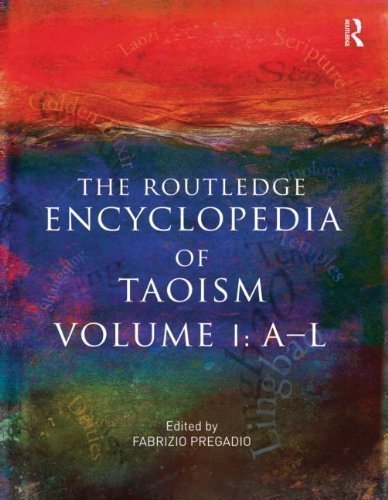
The Routledge Encyclopedia of Taoism: Volume One: A-l by Fabrizio Pregadio

Rate this book
The Encyclopedia of Taoism provides comprehensive coverage of Taoist religion, thought and history, reflecting the current state of Taoist scholarship. Taoist studies have progressed beyond any expectation in recent years. Researchers in a number of languages have investigated topics virtually unknown only a few years previously, while others have surveyed for the first time textual, doctrinal and ritual corpora. The Encyclopedia presents the full gamut of this new research.The work contains approximately 1,750 entries, which fall into the following broad surveys of general topics; schools and traditions; persons; texts; terms; deities; immortals; temples and other sacred sites. Terms are given in their original characters, transliterated and translated. Entries are thoroughly cross-referenced and, in addition, 'see also' listings are given at the foot of many entries. Attached to each entry are references taking the reader to a master bibliography at the end of the work. There is chronology of Taoism and the whole is thoroughly indexed.There is no reference work comparable to the Encyclopedia of Taoism in scope and focus. Authored by an international body of experts, the Encyclopedia will be an essential addition to libraries serving students and scholars in the fields of religious studies, philosophy and religion, and Asian history and culture.

Paperback

First published November 15, 2004

2 people are currently reading
85 people want to read

About the author

Fabrizio Pregadio

28 books25 followers
Fabrizio Pregadio has taught at different universities in Italy, Germany, the United States, and Canada. He is the author of Great Clarity Daoism and Alchemy in Early Medieval China (Stanford University Press, 2006) and the editor of The Encyclopedia of Taoism (Routledge, 2008).

In addition to his scholarly activities, he publishes translations of original texts on Taoism and Taoist Internal Alchemy (Neidan) addressed to a wider audience. These translations, all published by Golden Elixir Press, include the The Seal of the Unity of the Three (Cantong qi); the Awakening to Reality (Wuzhen pian); the Commentary on the Mirror for Compounding the Medicine (Ruyao jing); and Cultivating the Tao , a work by the eminent Taoist master, Liu Yiming (1734-1821).

Ratings & Reviews

What do you think?
Rate this book

Friends & Following

Create a free account to discover what your friends think of this book!

Community Reviews

5 stars
13 (72%)
4 stars
2 (11%)
3 stars
3 (16%)
2 stars
0 (0%)
1 star
0 (0%)
Displaying 1 - 2 of 2 reviews
Profile Image for Laura Marx.
14 reviews33 followers
September 4, 2021
here is my belief. when reading anything in translation one should have a subject encyclopedia to hand. why is this my belief? because many of the words we encounter in other languages, especially classical ones, do not translate for free. there is a surcharge we must pay to hear the word in English. one English word might fit well, but it may carry additional connotations. equally the original word may not find any English word which carries all of its original connotations. this is especially true in the enigmatic texts of the Daozang, who's authors made use of innovative linguistic devices, made jargon of words with many senses and played with their multiple meanings, or else used words in a nonstandard way. they were written to put up interpretive barriers for contemporary native readers; to us, two milennia and half a world away, they are incredibly difficult to interpret. take for example this passage from the Dao De Jing (hereafter DDJ) 8:
居善地,心善淵,與善仁,言善信,政善治,事善能,動善時。
Roger Ames and David Hall (2004) render this as so:
in dwelling the question is where is the right place?
in thinking and feeling it is how deeply?
in giving it is how much like nature's bounty?
in speaking it is how credibly?
in governing it is how effectively?
in serving it is how capably?
in acting it is how timely?
this beautiful translation renders it as a series of questions, and those questions are about the quantity of the subject. how deeply should i think, how credibly should i speak? now we think that it is interesting that the answer was not obvious to Laozi: it is not simply as deeply as possible, as credibly as possible. we might file this along with other things in the DDJ that caution us against excesses: we shouldn't learn too much (5), we shouldn't fill things until they are too full (9), and so forth. but what happens when we look at another translation? Gia-Fu Feng and Jane English (1989) translated it this way:
in dwelling, be close to the land.
in meditation, go deep in the heart.
in dealing with others, be gentle and kind.
in speech, be true.
in ruling, be just.
in daily life, be competent.
in action, be aware of the time and the season.
it is no longer a series of questions, and they no longer address the quantity of things but their qualities. Laozi is very certain when he recommends that we be true in our speech and just in our ruling. we no longer make the same connection as we did before. all together we interpret this passage very differently. what's going on?

the way this is written in the original Chinese follows a formula. each are two characters separated by the word 善 (shàn), which means "good". so the second line is 心善淵, xīn shàn yuān, literally "heart good deep" or "mind good deep". i beleive [low confidence] that this follows the topic-comment grammatical structure, so the first character is the topic and the other two comment on it. therefore we might [low confidence] understand it to say: minds that are good are deep ones. then we would interpret it as a bit like the passages in the Neiye about exemplary mental states: "the excellent mind, the stable mind and so forth" (Roth, 1999, pg. 220). or we might [low confidence] interpret it as saying: what is good about minds is that they are deep. the former is how it appears in Legge's 1981 translation: "the excellence of a residence is in (the suitability of) the place" (available on yellowbridge). [be advised that i don't speak a word of this language]

why do Feng & English interpret them as commands, and Hall & Ames as questions? as someone who cannot read literary Chinese i cannot know, but i am sure they have their reasons and they might be good ones. though it has sometimes been the case that this ambiguity was a property of the original text. unable to preserve the ambiguity translators have stamped their own interpretation on it and hoped for the best, and this has sometimes led to long-standing misinterpretations. take for example this passage of the Art of War (hereafter AW) 3:1:
全國為上,破國次之
Sun Tzu scholar (and former officer of the U.S. military) John F. Sullivan quotes the Giles' 1910 translation, which renders it this way: "the best thing of all is to take the enemy's country whole and intact; to shatter and destroy it is not so good" and Ralph Sawyer's 2002 translation, which renders it this way: "Preserving the [enemy's] state capital is best, destroying their state capital is second-best." both are exemplary; virtually every translator followed Giles' interpretation and understood it to refer to taking the enemy's capital. but, as Sawyer's translation admits with the boxed brackets, this is a bit of editorializing. the original only uses the word 國, guó, "state". Sun Tzu does not specify if he means the enemy's state or your own. Sullivan gives a very literal rendering to demonstrate: "preserve state be best, destroy state inferior this." what Giles renders "take the enemy's country whole and intact" is only the first two characters: preserve state. Giles imposes a clarity on the line that the original does not have.

the rest of AW 3:1 follows a poetical formula similar to DDJ 8. the next sentence reads "preserve army be best, destroy army inferior this", then "preserve battalion . . .", "preserve company . . .", etc., at successively smaller units of organization. if you follow Giles' interpretation then Sun Tzu is saying that destroying anything is worse than capturing it. this might be reasonable, but Sun Tzu does not talk about capturing men anywhere else; he only talks about destroying them. if he thought that you should always capture things when possible, you think he would talk about it more. for this and some other reasons Sullivan concludes that Sun Tzu isn't actually referring to taking the enemy's state in tact. he is saying: it is better to preserve your own state than to destroy the enemy's state. and it is better to preserve your own army than destroy the enemy's, and so forth. i find his account convincing, but i would also like for him to explain why the original Chinese is so ambiguous. would Sun Tzu's contemporaries have known what he meant? if so, because of what context clues? if not, what role does the ambiguity serve?

Fabrizio Pregadio does not really have our back in either of these examples. the Encyclopedia of Taoism doesn't discuss the grammatical structure of classical Chinese, and unfortunately it doesn't have an entry on Sun Tzu (his reevaluation as a proto-Daoist in western scholarship seems to have come after this work was published and, in any case, the AW is included in the Daozang only in the Tàiqīng group which also includes non-Daoists like Mozi). it doesn't even have an entry for shàn (New Advent's Catholic Encyclopedia does have an entry on Good; does this illustrate something about the difference between these two religions or only these two encyclopedias?). unfortunately the reader will need to have more to hand than just this one text. i was made aware of the issue with the translation of the DDJ 8 by my amazing girlfriend who is a translator and knows an impressive amount about languages. it is also my belief that the reader of translations should likewise acquire such a woman; perhaps one specializing in each language you would like to read (there was a man who followed this philosophy named Lou Bega). until then, something like the Chinese Text Project will be sufficient. but when dealing with the concepts peculiar to Daoism and the Daozang Pregadio and his team will be a great resource to you.

when you read the Neiye (hereafter N), for example, you will encounter a long and sophisticated discussion of three substances: 精, 氣, and 神—jing, qi, shen. Roth's 1999 translation is excellent; he provides both a detailed discussion of the relationship between these substances, as well as their relationship to other jargon like 心, xīn and 道, dao. but he will not really clue you into the fact that these three things together form an important triad; in the section Technical Terminology he does not discuss them all together. it was only when i tried to look up qi in the Encyclopedia of Taoism that i was directed to the entry for jing, qi and shen and its detailed discussion of the inseperable and mercurial nature of the three substances. it isn't clear to me whether this is because they are not understood as a connected triad in N or if Roth is not placing adequate weight on their connection; regardless it is no doubt useful for readers of N to know the future-history of the cosmology that is embryonic in that text.

even more importantly however is that referring to Pregadio et al.'s account will rescue us from a particular pitfall that Roth sets us up for. it is this one: he translates jing as "vital essence". he cleverly uses the term "vital" to make the connection to qi explicit, which he translates as "vital energy" (he translates shen as "numinous", leaving it unconnected to the other two). but the term "essence" for jing, while traditional, can very easily mislead. ordinarily we think that an "essence" is essential; the essence of things is whatever is essential of them, what must be true of them. sometimes this has a normative character: someone might miss the particulars but grasp the 'essence' of something and we would say that they 'get it' after all. none of these senses are proper to jing. jing is not the necessary component of something's identity; jing is a substance that everything partakes of, from the dao itself to any individual animal. jing is 'essential' to living beings in the sense that we die when we run out of it, but it is not 'essentially' present; in fact we are always running out of it. if it is essential it is essential in the restricted sense of essential fatty acids; organisms depend on it. the Encyclopedia points us to DDJ 21, which reads (my paraphrase of Hall & Ames, leaving the jargon untranslated):
as for the dao, it is vague and indistinct.
though it is vague and indistinct there are images within it.
though it is vague and indistinct there are events within it.
though it is vague and indistinct jing is within it.
for Laozi jing is not the 'essence' of dao, it is one thing in the dao along with other things. as Pregadio et al. put it, it is "the life germ contained within the dao". living things partake of the jing within the dao. N provides us with a detailed (though characteristically gnomic) description for how this is accomplished, for example in N 5 and N 6. but for the N poet(s) this partaking is quantative; something can have more or less jing. and it is normative; a certain amount is recommended. and it is manipulable; much of the text deals with acquiring it. the right way to see this relationship might be, in some sense, dialectical. N 7 provides the model (Roth):
for the heavens, the ruling principle is to be aligned.
for the earth, the ruling principle is to be level.
for humans beings the ruling principle is to be tranquil.
spring, autumn, winter and summer are the seasons of the heavens.
mountains, hills, rivers and valleys are the resources of the earth.
pleasure and anger, accepting and rejecting are the devices of human beings.
while the ruling principle (主, zhŭ, ruler, host; Roth's translation is very elegant) of the heavens is alignment (正, zhèng, straight, pure), their actual state in nature is to pass through seasonal extremes. alignment is certainly not an essential feature of the identity of the heavens; it is never even actually present. but the N poet(s) consider it to be in some sense normative of the heavens. it is also not the telos of the heavens; its tendency is towards disorder, not order. the human being will naturally use up their jing and die; conserving it is worth striving for but is ultimately impossible. the N poet(s) seem to operate on a negative dialectics; the essence of things are precisely what they lack.

these were some reflections made possible by the Encyclopedia and resources like it. all things considered it is not fair, in terms of demanding a star rating; it must receive 5 stars because it is indispensible. it so informs my approach to the field that i am not sure how anyone got along before it. perhaps they did not get along so well; most translations and commentaries on works of the Daozang are quite ignorant of the later tradition. in fact, most of them are addressed to quite a different audience than the Encyclopedia. the Encyclopedia is really for students of Daoism as a religion; it is for anthropologists, sociologists, and so forth, who specialize in China, East Asian religions, comparative religion and so forth. unlike the philological tradition of English-language Daozang scholarship, which focuses almost exclusively on the Eastern Zhōu period, Pregadio et al. strongly emphasize its later, common era history; formal, religious capital-D Daoism, its practices, corpus and personae. thus, the great majority of its 16000 pages (!) are devoted not to the abstruse ontology of the proto-Daoist poets but to legendary figures with long names like the Jade Woman of Mysterious Radiance of Great Yin, Mother of the Dao and the Immortal Red Infant, wife of the King Lord of the East (pg. 1207, yunü). if you are approaching the Daozang from the direction i am all of this will be very exotic to you. but it will serve you to be exposed to it, even in the small doses one imbibes flipping through the pages to get to the jargon (only to find that, half of the time, it isn't there).
Displaying 1 - 2 of 2 reviews

Can't find what you're looking for?

Get help and learn more about the design.