Daniel Chandler (born 1952) is a British visual semiotician based (since 2001) at the department of Theatre, Film and Television Studies at Aberystwyth University (where he has taught since 1989). His best-known publication is Semiotics: The Basics (Routledge: 1st edn 2002, 2nd edn 2007), which is frequently used as a basis for University courses in semiotics,and the online version 'Semiotics for Beginners' (online since 1995). He has a particular interest in the visual semiotics of gender and advertising.
Trained as a schoolteacher at Magdalene College, Cambridge, Chandler began his career teaching English in middle and high school classrooms in the 1970s and 1980s. He adopted a progressive, constructivist philosophy of education at a time when microcomputers were first introduced into the classroom. Resisting the hyped image of computing in education as a boon to instructional productivity, Chandler recognized the computer as a tool for learning, but he rejected a prevailing objectivism that considered data as information, and information as knowledge. He held a constructivist view that data is translated into information by human beings, not computers, and humans negotiate the meaning of information by means of dialog and discussion (Chandler, 1990a). The computer, for Chandler, was not a teaching machine, but a medium of expression for young learners. His early adoption of computers in the classroom led to the publication of several authored and edited texts related to computing in education. He left the classroom in 1981 and set up an independent consultancy, notably serving as a design consultant for Acornsoft on the development of educational software for use by the BBC.
In 1989, Chandler returned to academia, joining the Education department at Aberystwyth University. His initial role as a lecturer in educational technology soon shifted to that of a lecturer in media theory, and in 2001 he moved to the department of Theatre, Film, and Television Studies as a lecturer in Media and Communication Studies.
His (1993) dissertation on 'The Experience of Writing' focused on the phenomenology of writing. That work led to the (1995) text, 'The Act of Writing' which he posted freely on the World Wide Web. Where the tendency of most authors had been to withhold their work from online access for multiple reasons, Chandler was never so inhibited. Self publishing 'The Act of Writing' was one of multiple experiments that he launched in an exploration of the Web's possibilities as a medium for teaching. In 1994 he began placing lecture materials online for use by his own students. This practice of open access proved successful and rewarding. As the richness of this material evolved in the ensuing months, and as the population of Internet users exploded in the mid 1990s, Chandler's site quickly attracted an international audience of students, scholars, and mediaphiles hungry for rewarding academic content. The MCS Web offered tangible content that went beyond the typical outlines, bibliographies and promotional material hosted on most academic and commercial sites of the time. The Media and Communications Studies site established itself as a premier online academic resource for theoretical and educational material in the fields of Rhetoric, Communication Studies, Semiotics, Media, and Contemporary Philosophy.
Chandler's teaching has straddled the spectrum of communication studies, though a significant focus of his work has centered on contemporary philosophies of communication, and specifically on Semiotics. Chandler's initial frustration as a lecturer was the severe lack of lucid and cogent introductory texts on the subject (Chandler, 2002, p. xv). This led him to prepare a series of materials on semiotics, written in a language and style that would be comprehensible to his own undergraduate students. He placed these lectures on the World Wide Web to augment the already rich set of openly accessible materials that he had p
This is an online version of Chandler's introduction to semiotics in which he covers all of the basics in an extremely clear, lucid and accessible way.
As I said about one of his printed books: this is the ultimate introductory guide for those who tend to feel slightly lost at times when reading the works of the classic instigators of semiotics like Saussure, Peirce, Lacan, Foucault, Eco, Derrida and Barthes.
I promised a longer review, but what does one cherry-pick to write about a subject so vast, and so potentially technical? Where does one start? Perhaps one could try to sketch the basics and then perhaps an application or two?
See, the thing is that this subject is as huge as the world, because our entire world is made up of signs, and semiotics or semiology is the study of signs, of how humans interpret the world. So, in a certain way, one could say it is a branch of epistemology.
We can apply semiotics to almost anything, from linguistics, to psychology to the arts-- even to music. We can even look at signs in nature-- the signs and body-language animals make; although this is not the usual field of study of semiotics--it is most often applied in studying human culture and cognition; in studying the various ways in which humans make sense of the world.
To give an example of how it is applied, we could, for instance apply it to folklore (I quote from Chandler): "In... The Morphology of the Folktale (1928), Vladimir Propp interpreted a hundred fairy tales in terms of 31 'functions' or basic units of action." (Propp was one of the early Russian formalists who started the movement called "narratology", which studies the structure or form of narratives. )
Let's see how this works in practice using another example as it is applied to narratology. Remember Umberto Eco who wrote The Name of the Rose? Besides being a pretty cool author of fiction, he is also a semiotician. I'd been afraid of reading his work in this field (it looked frightfully complicated) until I came across a rather interesting subject of his study: the James Bond phenomenon.
Yip! Umberto Eco studied Ian Fleming's James Bond. He wanted to try and figure out why Bond was such a huge hit. So he did a structural and contextual study of the James Bond novels.
Eco concluded that the novels were racist, sexist and prejudiced against communists. The novels were written during the cold war when having "Reds" as your enemy was cool, and Bond stood as a symbol for the West and British arrogance.
So the novels functioned as a model of the world in which a British guy bested "Reds" all the time, but besides this, the narrative would follow a specific pattern. Eco identified 14 constant binary groups which would follow a specific pattern, as in: Bond as hero, Bond as victim, Villian as victim, the Soviet union, the Anglo-Saxon West, sexy female, etc.
Eco analysed the James Bond novels in terms of a series of oppositions: Bond vs. villain; West vs. Soviet Union; anglo-saxon vs. other countries; ideals vs. cupidity; chance vs. planning; excess vs. moderation; perversion vs. innocence; loyalty vs. disloyalty.
These would follow a "formula" as in : (I quote from Chandler:) Umberto Eco interpreted the James Bond novels (one could do much the same with the films) in terms of a basic narrative scheme: • M moves and gives a task to Bond. • The villain moves and appears to Bond. • Bond moves and gives a first check to the villain or the villain gives first check to Bond. • Woman moves and shows herself to Bond. • Bond consumes woman: possesses her or begins her seduction. • The villain captures Bond. • The villain tortures Bond. • Bond conquers the villain. • Bond convalescing enjoys woman, whom he then loses.
But I'm digressing from actual semiotics here with my Bond/narratology fascination. (Getting distracted while trying to talk about semiotics is pretty damn easy). All right, so let me try to sum up the general areas of semiotics as they are divided into chapters in Chandler's book:... or no, nevermind, that may prove boring.
Let's say the main components are codes and signs. Signs, according to semiotic theory, represent all our thoughts. Our thoughts are signs (or in semiotic language, a subdivision of a sign, called the signified), because in our minds, we represent reality with thoughts--what we see and think and hear, are not the real things, but a representation of real things. So thoughts or words or images (in our minds) of a dog are the signified, the word made up of the letters D-O-G is the signifier, and that which is being represented (the dog itself) is the referent. And signifier and signified together (the thought and the word) make up a sign - in this case, the sign for a 'dog'. Of course, a picture of a dog also constitutes a signifier for a dog, and will also conjure the idea of a dog in our minds.
Okay, so as you can see, this can be applied to a lot of areas: texts, photographs, visual art, film, language, and so on, and each area of application has its own set of signs and codes and terminology applying to those signs and codes, for instance when analyzing a photograph, we'd be looking at color, tone, lighting, 'vectors' (lines in the photograph) depth of field, and so forth.
We could, for instance, do a study of how violence is portrayed in various media. Get the idea how this field can just go on and on? Let me give an example of some codes: you get logical codes (maths, the alphabet, road signs), aesthetic codes (poetry, paintings, music, decor) and social codes such as dress codes ( Scotsmen wear Kilts, Bobbies wear a certain uniform, cheerleaders wear short skirts) or table manners; (we eat a hamburger with our hands, steak with knife and fork and Chinese with chopsticks ) and so on and so on.
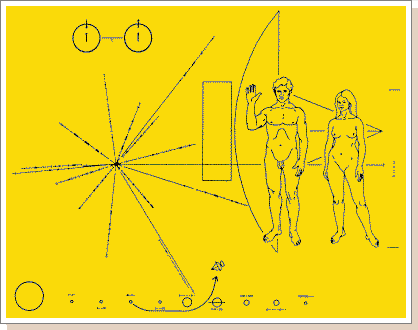
Oh, wait, here is an interesting thing to quote out of Chandler. You know that picture that they included with the space probe Pioneer 10? It looks like this:
Per Chandler: The art historian Ernst Gombrich offers an insightful commentary on this: The National Aeronautics and Space Administration has equipped a deep-space probe with a pictorial message 'on the off-chance that somewhere on the way it is intercepted by intelligent scientifically educated beings.' It is unlikely that their effort was meant to be taken quite seriously, but what if we try?
These beings would first of all have to be equipped with 'receivers' among their sense organs that respond to the same band of electromagnetic waves as our eyes do. Even in that unlikely case they could not possibly get the message. Reading an image, like the reception of any other message, is dependent on prior knowledge of possibilities; we can only recognize what we know.
Even the sight of the awkward naked figures in the illustration cannot be separated in our mind from our knowledge. We know that feet are for standing and eyes are for looking and we project this knowledge onto these configurations, which would look 'like nothing on earth' without this prior information. It is this information alone that enables us to separate the code from the message; we see which of the lines are intended as contours and which are intended as conventional modelling.
Our 'scientifically educated' fellow creatures in space might be forgiven if they saw the figures as wire constructs with loose bits and pieces hovering weightlessly in between. Even if they deciphered this aspect of the code, what would they make of the woman's right arm that tapers off like a flamingo's neck and beak?
The creatures are 'drawn to scale against the outline of the spacecraft,' but if the recipients are supposed to understand foreshortening, they might also expect to see perspective and conceive the craft as being further back, which would make the scale of the manikins minute.
As for the fact that 'the man has his right hand raised in greeting' (the female of the species presumably being less outgoing), not even an earthly Chinese or Indian would be able to correctly interpret this gesture from his own repertory. The representation of humans is accompanied by a chart: a pattern of lines beside the figures standing for the 14 pulsars of the Milky Way, the whole being designed to locate the sun of our universe.
A second drawing (how are they to know it is not part of the same chart?) 'shows the earth and the other planets in relation to the sun and the path of Pioneer from earth and swinging past Jupiter.' The trajectory, it will be noticed, is endowed with a directional arrowhead; it seems to have escaped the designers that this is a conventional symbol unknown to a race that never had the equivalent of bows and arrows. (Gombrich 1974, 255-8; Gombrich 1982, 150-151).
Gombrich's commentary on this attempt at communication with alien beings highlights the importance of what semioticians call codes. The concept of the 'code' is fundamental in semiotics. Whilst Saussure dealt only with the overall code of language, he did of course stress that signs are not meaningful in isolation, but only when they are interpreted in relation to each other.
It was another linguistic structuralist, Roman Jakobson, who emphasized that the production and interpretation of texts depends upon the existence of codes or conventions for communication (Jakobson 1971). Since the meaning of a sign depends on the code within which it is situated, codes provide a framework within which signs make sense. Indeed, we cannot grant something the status of a sign if it does not function within a code."
You get the idea. Hah, so much for the space drawing... oh well, it must have made the cosmologists launching the spacecraft feel good, or maybe it was done to impress the public?
Well, dear reader, hopefully I have included enough to give you a taste of both semiotics and of Chandler's intro to it.
I do understand if you decide it's all a bit much though, even broken up into simple bits a la Chandler. It is for me, I must admit - I can only handle so much at a time. Still, in my opinion, (but I am no semiotician, mind), this is one of your best bets to lead you into the world of signs. There are some good books discussing content analysis and discourse analysis out there of course, but to me, this work is as far I have found up to now, the most encompassing when it comes to the subject of semiotics in particular.
A great introduction to semiotics, but don't let the name fool you, definitely it's not an easy read. I had to give the book a second try to finish it after reading parts about syntagms and paradigms a while ago. It's really worth my effort at the end but I would recommend to read some text on textual analysis as an auxiliary.
Great introduction to the subject from the perspective of someone who knew very little previously. Tough going in places but inevitable given the subject. Has tons of quotes and reading suggestions. Doesn't really cover what a semiotic analysis would be like but an excellent book.
Me ayudo mucho a pulir mis dudas con respecto a unos conceptos. También ofrece guía a ciertos análisis que competen. Muy buen libro, se los recomiendo.