Jump to ratings and reviews
Rate this book

Lord Byron #1

Imposture (Byron Trilogy) by Benjamin Markovits

Rate this book
Having been dismissed from Lord Byron's service, Dr John Polidori had fallen on hard times. And now a young woman mistakes the doctor for the poet. As the pair fall in love, Polidori knows that he can only emerge from Byron's shadow if he confesses his true identity to the deluded girl.

Paperback

First published January 31, 2007

28 people are currently reading
280 people want to read

About the author

Benjamin Markovits

21 books110 followers

Ratings & Reviews

What do you think?
Rate this book

Friends & Following

Create a free account to discover what your friends think of this book!

Community Reviews

5 stars
11 (5%)
4 stars
51 (26%)
3 stars
77 (39%)
2 stars
42 (21%)
1 star
14 (7%)
Displaying 1 - 30 of 37 reviews
Profile Image for Ian "Marvin" Graye.
946 reviews2,777 followers
July 27, 2022
CRITIQUE:

Dr John

The real life John William Polidori (aka Polly) was a doctor of medicine who acted as the personal physician to the poet, Lord Byron, on his travels of Europe.

He was also a writer who participated in the literary game/competition at the Villa Diodati that inspired Mary Shelley to conceive and write her Gothic novel, "Frankenstein".

Polly wrote a story called "The Vampyre", which is believed to have been Polly's "development" based on the "groundwork" or fragments of a novel composed by Lord Byron. When first published, it was falsely attributed to Lord Byron, which possibly accounted for some of its high sales.

Polly wasn't responsible for the false attribution (unsurprisingly, that was the publisher himself), although this novel is an historical fiction (wrapped in a metafictional artifice) based on Polly's supposed imposture of Lord Byron, literarily, apparently and romantically:

"It was impossible to compare Lord Byron and Doctor John William Polidori. Yet they were in some ways very much alike and had on more than one occasion been mistaken for each other. A fact he considered highly suggestive..."

"We might have been brothers."

Ironically, Lord Ruthven, the vampire in "The Vampyre", is supposed to have been based on the character of Lord Byron, so there are multiple levels of impersonation and imposture.

description
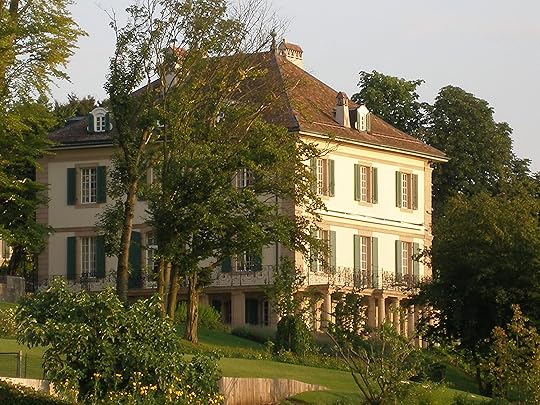
Villa Diodati, Cologny near Lake Geneva in Switzerland

The Deferred Imposture

The novel consists of 18 chapters of an average 11 pages each.

The narrative doesn't follow a linear pattern, not that there is much of it. However, it's only in the last four chapters that the imposture (and its victim) is made explicit.

Up until this point, the novel lacks direction and momentum. The imposture though, when it arrives, is a climax worth waiting for.

The language is more expansive and sentimental, and alters your impression of the novel as a whole. It reminded me of Flaubert's "Madame Bovary", except that the romanticism surrounds a nobleman poet (or somebody who is mistaken for one, through no fault of his own). Not to mention vampires:

"Whatever [they] touched, [they] corrupted."


POLLY-MORPHOUS PER-VERSE CITY

Once Bitten, Twice Shy
[Couplets Writ in Blood]


It was Byron's greatest folly
To cross Bohemia with Polly.
They played games with Perce and Mary:
Of vampires, they were unwary.

Once bitten, friends became twice shy;
No need to ask the reason why -
Byron arrived a nervous wreck,
Worried Polly would bite his neck.


SOUNDTRACK:
Profile Image for lucy✨.
315 reviews672 followers
April 13, 2022
2.5 stars

Imposture chronicles Polidori’s aspirations to create his own legacy. Polidori was the physician of Byron and is forever shadowed by his glory, which Polidori is desperate to outdo.

The novel is saturated with instances of doubling, most prominently with Polidori and Eliza who claim another’s identity to endow themselves with glamour. The story that Polidori wrote - The Vampyre - is almost replicated in their desire to infuse themselves with the essence of another. With their insatiable thirst to claim the force of someone else, the characters become willing to sacrifice parts of themselves.

I found this novel entertaining in its portrayal of ambition, but ultimately it won’t have a lasting impact on me. I also felt that Eliza’s impetuousness, which results in a willingness to destroy her livelihood, was not nuanced enough. It didn’t seem to emphasise the reality of the consequences. So, despite its provocative language and exploration of human ambition, the plot and characters didn’t come alive for me.
25 reviews
November 9, 2010
Wanted to like this. High concept, interesting period. Author clearly a "wordsmith", but this effort seems self-consciously literary and mannered (as in, descriptions that "sound good" but don't bear reasoned analysis, and distracting sentence fragments) First half of book a bit of a slog, then pace picked up. One wants to know how the situation will be resolved. But characters uniformly unattractive -- because so needy and unformed? I found I didn't care. Self-immolating "heroine" not one to steer by.
Profile Image for Sandra.
Author 33 books838 followers
November 29, 2007
This is a literary historical novel to read slowly, relishing each delicious sentence. Highly recommended.
Profile Image for Nelson.
620 reviews22 followers
May 24, 2016
Novel opens with the self-consciously hoary premise of a found manuscript being released into the world. The story itself is a fictionalized version of the events around John Polidori's return to England after his dismissal from the poet Byron's service. The novel seems reasonably solid on period details but doesn't make a major production out of them. Instead, the focus is on the dramatic situation of Polidori's being mistaken for Byron by a young dreamer. He continues the imposture (initially) out of boredom. She is also pretending, pretending to be her older sister who once shamelessly flirted with Byron prior to his final departure from England. Markovits makes less of her pretending, focusing rather more on Polidori's lies and subsequent self-lacerations. Laced throughout the book are Polidori's memories of his time with Byron, who comes into view as less of the monster he was often caricatured as, and more as a selfish, privileged, insightful and frequently patient master tolerating the literary and other pretensions of his oft-dissatisfied physician. Markovits does a lot with doubling in the novel. Besides the obvious Polidori / Byron physical resemblance, there is their fraught relationship with sisters, Polidori's fraught relationship with his father paralleling that of Eliza with hers, Polidori's relationship with his sensible sister betrayed into a liaison with Byron and Eliza's relationship with her sensible sister (just before she betrays herself into a liaison with a pseudo-Byron) and so on. There is some nice writing throughout, but this is a dour tale about two rather deceived young people only one of whom achieves some measure of very limited self-understanding before the novel comes to a close.
Profile Image for Rachel Pollock.
Author 11 books80 followers
January 25, 2014
I must've been in exactly the right melancholy mood to read this sad and slow-flowering book. I think that at another time i might have hated it, or been bored by it, but instead i was infected with a sort of grim charm for these deeply lonely characters.

I was disappointed that the author brought the plot to its climax, but then basically only wrote a conclusion for Polly, abandoning any pretense of denouement for Eliza, whose consequences i was just as interested to read about, but no such luck.

It seems several reviews mention frustration with the device of the preface, and specifically its lack of a bookending afterword. But a preface stands alone, and i think of them as a lagniappe--you can read a book without reading the preface at all and it's fine, and such is the case with this one. It's a device underscoring the imposture through-line, diverting enough i guess but not requisite to the enjoyment(?) of the novel.
3,508 reviews174 followers
April 6, 2024
This novel is a challenge to review and rate because I loved the first quarter and gradually lost interest until I just skimmed the last third and to be honest I did so with disengagement and my persistence in discovering the denouement, or to be accurate confirming what I had guessed, was almost an act of apology for not reading the novel. Why? because it is a very well written and constructed story - my problem is I don't care about Polidori, as a historical footnote in Byron's life, the creation of 'The Vampyre' or any other aspect of the so famous summer at the Villa Diodati. I am not interested in the real Polidori and Markovit's doesn't make me care about his fictional one.

But the failure is not Benjamin Markovit's - he is a brilliant writer and I am sure many readers will enjoy this novel and his others - I do wish to discourage anyone from reading him.

In honesty the problem is mine - Byron is a fascinating personage (though not one I have read much of - who does read Byron these days?) but it is more as an idol/icon or, to be honest a cliche - what adolescent/teenage boy doesn't (or didn't - what do I know of teenage boys today? Even if I did I probably wouldn't admit it least the worst conclusions be drawn) dream of being 'mad, bad and dangerous to know' whether as a poet, rock star or simply a celebrity bad boy. Byron is the man who gets the boys or girls, depending on which taste you wish to emphasise; he is beautiful, though more often overweight - he is the original celebrity dieter; an artist, poet and rebel; but also the first real celebrity known more for the scandal of his life than his works. But he was also an English nobleman with the arrogance of his class and his lavish kindnesses were often no more than the condescension of his class.

But we do not read Byron - we read about him - this novel is another contribution to that mountain of works, fiction and nonfiction, inspired by Byron. I can imagine Byron as a friend, I am sure I would have gone to bed with him (though I don't flatter myself that even when young he would have fancied me) but none of this makes it any more likely that I will read him and ultimately Byron is a writer, a poet, and if you aren't reading his works why read about his life?

Of course this isn't a Byron novel, it is a novel of the effect Byron had on others, But Polidori was also an author, if he matters it should be because of 'The Vampyre' - but I will never read it so again, why am I reading about him.

I am giving the novel three stars, it probably deserves four, but I can't be any kinder to a work, no matter how well written, that failed to hold my interest.
1 review
July 27, 2013
I personally didn't like this book. I thought the description was annoyingly detailed-too much so. The character Eliza was upsetting; why should a teenager, 16 in the beginning, 19 by the end, be described as being a "spinster" with "crows feet", and be treated like she has no hope in the future; to me that is the essence of misogyny. Even in the 19th century a teenager would not have been considered an "old maid". The attention paid to female beauty would not have been paid to a man in the same position. This author clearly does not like women very much!! A woman does not get old, even with the absence of dentistry, at 19!! Do not read this book it is stupid.
Profile Image for Megan Chance.
Author 32 books699 followers
May 2, 2012
This is a 4.5 star book for me. I really really liked it. I'd read Markovits before and liked him very much. This book is not just about imposture but about self-delusion. It's beautifully written, entirely character-driven, and a very thoughtful meditation on failure and vanity and expectation. The characters are beautifully drawn, with an overlaying aura of melancholy that reminded me of Henry James. I think this will have to go on my favorites shelf.
Profile Image for Fiona Squires.
50 reviews2 followers
July 31, 2011
When I finally got into this it was reasonably enjoyable. Unfortunately the main character is entirely unsympathetic which meant that reading it was more of a slog. I found the female lead more interesting and was disappointed that there was not more of her end story. That said, I thought the various ideas about disguise were interesting.
Profile Image for Rachel.
17 reviews8 followers
March 8, 2014
It took me a while to get into this book, it wasn't until I got half way through that I could say I was enjoying it. I found the first half very slow and can't say I warmed to either of the two main characters. However I have to admit I knew nothing of Lord Byron and Polidori before reading this book, so perhaps that hindered my enjoyment of the novel.
Profile Image for Val.
2,425 reviews88 followers
October 20, 2014
John Polidori was Lord Byron's doctor and wrote "The Vampyre". A lot of people thought Byron wrote it. This book takes that idea and weaves a sad love story out of it.
I liked the idea of the book more than reading it, although it did improve as I got used to the style and the rather pathetic characters.

The average group rating was 2.8
Profile Image for Derek Collett.
Author 6 books1 follower
December 8, 2015
Extremely well written, interesting and engrossing and Markovits judiciously utilizes the period detail. The characters are good (especially Byron and Polidori), there are some engaging set-pieces and one learns a lot about the life and literature of the time. However, the lack of story development makes it ultimately a little frustrating. An author worth looking out for though.
Profile Image for Lynne.
349 reviews
February 1, 2013
I only gave this 3 stars as I had to force myself to finish the book. It never quite lived up to its premise. When I was finished reading it, I was relieved. :(
The language was very flowery and expressive which made the reading ability slow.
Profile Image for Barbara Sibbald.
Author 5 books10 followers
June 23, 2013
A modern venture into Gothic lit -- and the cult of author adoration. Markovits pulls off some astounding sentences and manages to spin a complex tale with excellent verisimilitude. I enjoyed this a great deal and someone more familiar with Byron's oeuvre would doubtless enjoy it even more.
1,355 reviews11 followers
March 17, 2016
If you are fascinated by the Shelley/Wollstonecraft/Shelley Romantic circle, you will thoroughly enjoy this novel. It isn't quite the roast beef of those authors, but, then, who compares? Definitely time well spent.
Profile Image for Elizabeth.
79 reviews1 follower
June 8, 2007
Overblown, overdramatic portrait of John Polidori, Lord Byron's personal physician. Female character portrait is particularly Over the Top.
39 reviews
October 3, 2008
The premise is interesting, and Markovits can write, but that crucial spark is missing.
Profile Image for Beth (bibliobeth).
1,944 reviews57 followers
Read
July 23, 2011
I read this as a bookclub choice and didn't really get on with it. The writing was excellent but the only character I really warmed to was Eliza and was left feeling a little disappointed.
162 reviews2 followers
August 8, 2011
Want to read something mediocre? Read this. I quite enjoyed the Byron and Polidori backstory but the actual plot was contrived and laughable.
Profile Image for Carey.
893 reviews42 followers
October 6, 2011
I really wanted to like this, but I wasn't engaged by any of the characters, couldn't care what the hell happened to any of them. Having read a very good biography of Byron, I'll leave it at that.
Profile Image for Bettie.
9,981 reviews5 followers
noway-josé
March 6, 2014
not for me at this time
This entire review has been hidden because of spoilers.
50 reviews
May 21, 2012
This novel received very mixed reviews during the discussion at Discuss It Book Group, earning an overall group rating of 2.8 out of 5.
Profile Image for Michael Brown.
120 reviews11 followers
June 20, 2014
Intelligent, well-written and full of evocative period fillips, but in its habit of saying rather than showing comes across as didactic instead of diverting.
Profile Image for Heberquijano.
137 reviews
April 26, 2016
A great book with many poetry moments that thrills me... Polidori´s character is despicable, and lovely for it an example of the good writing of Markovits
613 reviews17 followers
February 23, 2023
I was hooked by the prologue which reads like a short story that can stand alone. Then, the historical fiction of the novel itself unfolds to capitalize upon that.
A beautifully written novel and a fascinating tale of a period in history set in the lifetime of Lord Byron and his one-time doctor, John Polidori.
This is the first in a Lord Byron series.
Displaying 1 - 30 of 37 reviews

Can't find what you're looking for?

Get help and learn more about the design.