Brer Rabbit is a folk hero, and tales about him are perennially popular. I remember loving these stories when I was a child, and have fond memories of my father reading tales of Brer Rabbit, the trickster, to me at bedtime. Originally written by Joel Chandler Harris, there are many retellings available which attempt to make the Southern States vernacular more accessible to English children.
Joel Chandler Harris was born in Georgia U.S.A., in the middle of the 19th century. An illegitimate child with Irish ancestry, he excelled in reading and writing, but did not care for school. He had a habit of truancy, and was mostly known for his pranks, mischief, and sense of humour. Perhaps such practical jokes helped him to overcome his shyness, and the insecurity he felt about his red hair, and humble origins. During his teenage years, Joel Chandler Harris was an apprentice on a plantation. Then as an adult he worked as a journalist, and an associate editor for a newspaper.
We see his background and personality coming through clearly in his writings. What he is best remembered for now are his seven collections of “Uncle Remus” stories, and his many “Brer Rabbit” stories. Joel Chandler Harris collected many of these stories, which had originated in African folklore. When the stories were transmitted by African slaves to the New World, they there acquired additional attributes of similar native American tricksters, and a new character was born. Joel Chandler Harris fleshed him out into Brer, or Brother, Rabbit, representing a trickster figure, and in retelling many of his adventures, he gave them a potent and contemporary significant message. Brer Rabbit embodies the idea which is universal among oppressed peoples—that a small, weak, but intelligent and clever force can overcome a larger, stronger, but dull-witted one. Hence, Brer Rabbit always outsmarts his natural enemies, Brer Fox, Brer Wolf, and Brer Bear. They are stories of courage and survival, with Brer Rabbit as a true anti-hero.
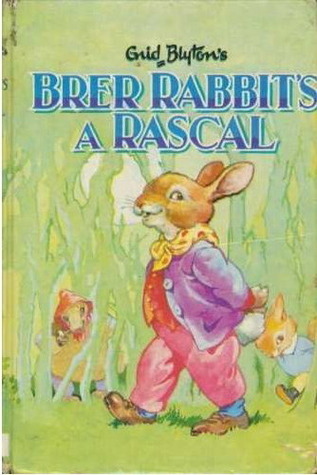
As I think back, I can remember little blue cloth-bound books with silver lettering, from which my father read these stories to me, but I can’t quite grasp the publisher. There were also some retold by Enid Blyton. Enid Blyton is one of the most popular children’s authors of all time, with 762 books to her credit. She made 8 separate collections from Joel Chandler Harris’s tales in the 1940s, the first being in 1948, with more in 1958, and again through the early 1960s. They have been reissued many times, at first with around 40 stories in each collection, with a few line drawings, and latterly individually, with large colour illustrations.
It is perhaps surprising that Enid Blyton should have felt drawn to these tales, as her books for older children are largely adventure stories featuring middle-class white children, far away from the African-American oral tradition. However, her output was so colossal that at one time some people disbelieved that all this could come from one person, and suspected other “ghost writers” working under her name. Of course Enid Blyton vehemently denied this.
She wrote many books with a fantasy element, for younger children, which were not so harshly criticised for their simplistic language and stereotypical children. She wrote of other creatures: pixies, fairies, brownies and dwarfs. She also wrote quite a few factual books on Nature. In these “Brer Rabbit” stories, she tries to include some of the feeling of the Southern States, mostly by using expressions such as “mighty fine” or “mighty biggety” or the American verb “gotten”, which is a past tense of “get”, and archaic here in England.
We find many of the favourite tales, and meet all Brer Rabbit’s friends, Brer Terrapin, Brer Ram, Brer Turkey-buzzard and so on—and his enemies. Brer Rabbit is presented as a mischievous impish, lovable rogue, with many friends. His natural enemies: Brer Fox, Brer Wolf and Brer Bear, are always destined to come to a sticky end. In these stories, Brer Rabbit delights in pretending to be their friend, and then craftily manipulating circumstances. Brer Fox, Brer Wolf or Brer Bear would without fail be left in a humiliating situation, needing to be rescued, or going back to their home very much the worse for wear.
I am not a fan of much of Enid Blyton’s work, but these retellings are as good as any I have found, for English children. Brer Rabbit’s a Rascal! is one of three collections she made in the 1960s, with line illustrations by Grace Lodge. The other two are “Brer Rabbit Again” and “The Brer Rabbit Book”.
The stories in Brer Rabbit’s a Rascal! were originally published in the magazine “Teachers World” in the 1930s, or the 8 Brer Rabbit story books in the 1950s, or in the children’s magazine “Sunny Stories”.
Here are the titles:
Brer Rabbit’s a Rascal!
You Can’t Trick Brer Rabbit!
A Happy New Year!
Brer Rabbit’s New Year Gift
Brer Bear’s Eggs
Bobs Meets Brer Rabbit
Pull His Ears, Brer Fox!
Brer Rabbit Gets Caught
Brer Wolf’s Dinner-Party
Brer Rabbit and Brer Turkey-Buzzard
Brer Rabbit’s Fence
Brer Rabbit Joins the Party
Brer Rabbit and the Teapot
Bobs Meets Brer Rabbit Again
Brer Rabbit’s New Shoes
Brer Wolf and Brer Fox
Brer Rabbit and Mr. Man
How Brer Rabbit Got the Meat
Brer Fox Has a Surprise
Brer Rabbit and the Flower-Pot
Brer Fox is Much Too Smart
Good For You, Brer Rabbit
Mr. Benjamin Ram and His Fiddle
Brer Rabbit’s Astonishing Prank
Brer Fox Tricks Brer Terrapin
Brer Rabbit’s Shilling
Brer Bear Goes to the Well
Brer Rabbit Goes to the Party
Brer Fox and Brer Terrapin
Brer Rabbit Tricks Brer Fox
Brer Rabbit and the Moon
Brer Rabbit Scares His Friends
Brer Fox is a Snowman
Mr. Lion Hunts For Mr. Man
Brer Bear’s Red Carrots
Brer Turkey-Buzzard in Trouble
Brer Rabbit’s Apple Tree
Brer Fox Goes to Market
Brer Rabbit and the Guy
Brer Rabbit and the Little Girl