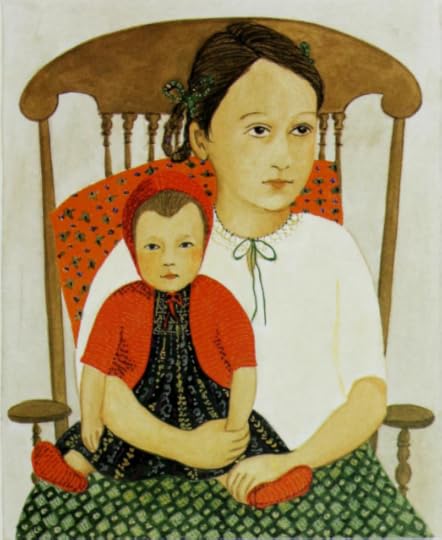
Forced to leave behind her beloved doll when her family leaves Germany during the Second World War, a young girl is delighted and amazed to find her doll years later in an American antique shop, in a story based on real-life events.
Claire Nivola writes: “I was born in 1947 in New York City. When I was a year old my parents bought an old farmhouse in The Springs on Long Island—the seashore town that appears in Elisabeth (FSG). The “country,” as it still was then; animals; being read to; and reading were among the passions of my childhood. The daughter of an artist father and mother, I drew and sculpted from earliest childhood and took art for granted, like breathing and walking. I was also a conscientious student. After attending Radcliffe College, where I majored in history and literature, I stayed in the Boston area for ten years. Soon after graduating, in 1970, I illustrated my first children’s book. My father had been asked by Fabio Coen, head of children’s books at Pantheon and a fellow Italian, if he would illustrate The Disobedient Eels and Other Italian Tales by Maria Cimino. My father gave the job to me. Over the next eight years, Fabio Coen asked me to illustrate The Messy Rabbit, written by my mother Ruth Nivola, and Save the Earth by Betty Miles, a book on ecology whose editor, a young woman named Frances Foster, was in the office next door at Knopf. During those years I also tried my hand at mural painting and graphic design, and occasionally exhibited my paintings and sculptures in private and group shows. I did all this as an extension of how I had grown up, with little idea of building a career.
“In 1980 I moved back to Manhattan and joined the art department at Newsweek magazine. In 1982 I married, a year later my son was born, and three years after that, my daughter. Being a mother absorbed my heart and intellect. Unlike many of my contemporaries, I stayed home with my children and did little work of my own. When they were older, in 1992, as a rare exception, I took on a commission for fifty-three bas-relief panels telling the story of man’s changing relationship to the Tennessee River for the Chattanooga Aquarium. I worked on a raised table in the playroom off the kitchen after my children went to bed at night and my children often commented on panels before they were shipped out for casting.
“In 1994, great good fortune chanced to put me back in touch with Frances Foster, now, twenty years later, a revered children’s book editor. I illustrated for her Tell Me a Real Adoption Story (Knopf) by Betty Jean Lifton, and since she has moved to Farrar, Straus & Giroux with her own imprint, we have worked together on four more books: Elisabeth, my telling of my mother’s story of her childhood doll; The Mouse of Amherst (FSG) by Elizabeth Spires, and my own two books, The Forest (FSG) and Planting the Trees of Kenya: The Story of Wangari Maathai Amherst (FSG) Frances has been my invaluable friend and inspiration.
“In recent years, I have also worked with publishers in Boston, illustrating The Friday Nights of Nana by Amy Hest for Candlewick Press, and for Houghton Mifflin, The Flag Maker by Susan Campbell Bartoletti and The Silent Witness by Robin Friedman.
“Having spent many years reading, often more than once, the books I loved as a child to my own children, and discovering new ones, my appreciation for the best of children’s literature has only grown. Writing for children is a serious business. Even if the result is to delight one’s small readers, the words and images are destined to become a vivid and lasting part of a child’s live experience.”
Such a touching story of a little Jewish girl that left behind her dolly in Germany at the beginning of the Holocaust when her family escaped racial discrimination by Hitler's regime. So sad, it nearly broke my heart.
In fleeing the Nazi's rise to power, Ruth Guggenheim Nivola's family escaped to Italy with none of their possessions--nothing that might portend they were leaving their home in Munich behind. Young Ruth could not take her beloved doll, Elisabeth, and regretted that greatly.
Ruth's story, told to her daughter, Claire, begins with Ruth's acquisition of that doll, and the circle of her life thereafter--one that surprises us. This story, told in "short prose and in pictures rich with detail" (from the end flap) moves swiftly, keeping attention on the feelings of Ruth in the first person. It is, in fact, a short memoir, whose message is that life is full of surprises one can never anticipate-- compelling read aloud for grades 1-8 as we acquire and lose precious things in our lives.
I liked the book, but I was also a bit disappointed, as I had expected it to have more text and include a longer story. I still think the concept is great. This book will be great to use for reading strategies, but I am worried that the less complex text will bore middle schoolers; and that the subject is too complex to use for higher elementary. I still love the story though.
Gorgeous illustrations, moving story. I found myself tearing up in the middle of the afternoon at this story of a girl who becomes a woman and a mother and the bit of providence that adds some balm to her deep wounds.
Amazing,poignant, and beautifully haunting, this true story of a girl and her favorite doll,separated during the Holocaust and-miraculously-reunited decades later will touch readers of all ages.
As a young girl in Germany, Ruth's life revolved around her family and her favorite doll, Elisabeth. Then Hitler took over and Ruth was forced to fell Germany with her Jewish family, leaving behind all their possessions including the beloved Elisabeth. Fast forward many years and Ruth is now a mother. She is searching antique shops for a special doll to give to her daughter on her birthday. Imagine her surprise when she finds Elisabeth sitting on a shelf! She knows it is Elisabeth because there are holes in the doll's arm where she was bitten by the family dog. Ruth is thrilled to introduce her childhood friend to her own daughter! The story is based on fact and many children reading the story will relate to losing a beloved toy perhaps even during a hasty move. It is ultimately a story filled with hope and the love of family.