Tells the story of Robert Guiscard, perhaps the most extraordinary European adventurer between Caesar and Napoleon. This book also tells the story of his brother Roger, thanks to whom he conquered Sicily from the Saracens; and of Roger's descendants, notably his son Roger II.
John Julius Norwich was an English historian, writer, and broadcaster known for his engaging books on European history and culture. The son of diplomat and politician Duff Cooper and socialite Lady Diana Manners, he received an elite education at Eton, Strasbourg, and Oxford, and served in the Foreign Service before dedicating himself to writing full-time. He authored acclaimed works on Norman Sicily, Venice, Byzantium, the Mediterranean, and the Papacy, as well as popular anthologies like Christmas Crackers. He was also a familiar voice and face in British media, presenting numerous television documentaries and radio programs. A champion of cultural heritage, he supported causes such as the Venice in Peril Fund and the World Monuments Fund. Norwich’s wide-ranging output, wit, and accessible style made him a beloved figure in historical writing.
History of the lead-up to and foundation of the Norman, Kingdom of Sicily.
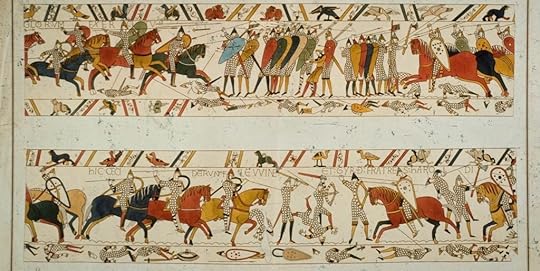
Bayeux Tapestry, period piece (1066 A.D.) showing Norman knights and supporting infantry with characteristic 'kite-shaped' shields.
My dead tree, format, book was a modest 355-pages which included footnotes, appendices, maps, illustrations, Bibliography and an index. It had a UK 1967 copyright.
John Julius Norwich was a British historian and writer of popular nonfiction. He was the author of more than forty books. He passed in 2018. This was the first book in his The Normans in Sicily series. This was the first book I’ve read by the author.
Firstly, this was an intermediate-level text on the High Middle Ages in the central Mediterranean. It would be very helpful for a reader to already have a good background on early-Middle Ages in the Mediterranean to fully appreciate this book.
This was a well-written, history in the Old Skool. That is, it was the history of personalities, mostly men but sometimes women, events, diplomacy, and wars (the failure of diplomacy) over a period of less than 120-years during which the Normans conquered southern Italy and the island of Sicily.
The Normans were an immigrant population from the Normandy region in Northern France. They first arrived as mercenary units to fight in the endemic small-scale wars of southern Italy at the very beginning of the High Middle Ages. The Norman mercenary units were typically led by a charismatic knight leader and made-up of a core group of knight supporters - such as family members and friends. Many of these leaders were the sons, but not heirs, of Norman nobles hoping to carve out their own fiefdom as a reward for service. Remarkably, it was two scions of a single, Norman (de Hauteville ) noble, who in two generations subdued the: indigenous, feudal, Lombards; waning, Byzantine Empire's holdings; distant, Holy Roman Empire's interventions; Papacy with its waxing power; settled, Islamic conquerors; and their own, fractious, transplanted, Norman fellows to become suzerain of Southern Italy and Sicily.
Norwich was a good writer. The narrative was very clear and factual. It’s very much in the bygone, British public school-style. (Folks could write upon graduation.) Descriptions were well done. In particular, the author showed a preference for: architecture, art and geography. Since the author also was a travel writer, this could be expected. The general tenor of the book was measured and somewhere between popular and academic.
Use of maps was OK. However, they were all of too large a scale. A period map of Rome, which was a focus of many events would have been helpful. Use of tables and charts, was restricted to only genealogies. (A picture is worth a thousand words.). The photographs provided were good. Although, the majority were architectural of churches and cathedrals.
The book was written in the old-style of history that emphasizes personalities. Men and sometimes women drove history. Julius Caesar conquered the Britons, William the Conqueror (A Norman of the book’s period) conquered the Saxons, and Robert Guiscard (Norman uncle to the future King of Sicily) conquered the Sicilian Saracens. Along the way, the reader gains historical context. For example, learning that life in the High Middle Ages was nasty, brutish, and short for the great majority of folks. Also that a lot of: churches, cathedrals, monasteries and abbeys got built by short-lived folks. Norwich’s book lacked a large amount of context. Despite, having a general knowledge of the period, many times I was wondering, “How did that ‘guy’ (Norman noble, Pope, Byzantine, Saracen, Lombard) do that?”
Modern, general histories tend to expand beyond just personalities. Personalities are still important. Although, absent critical circumstances, men and women don’t change history by their lonesome. Its men and women, technologies, organizations and external events that effect history.
For example, Medieval Norman society was a martial culture. If Normans didn’t have a external enemy, they’d happily fight amongst themselves. In Italy and Sicily, much smaller, military, formations of Normans regularly defeated larger formations of Mediterranean origin. Norwich attributes this to being, “schooled in warfare, close-knit, and heavily armoured”. Miliary doctrine is a technology. The Normans had a superior one. (It was a disruptive technology.) Without it they would not have been successful in the Italian region's endemic conflicts. Norwich offers few insights into how Normans were so militarily successful.
Another example, was the Papacy. The Latin Church in Western Europe was a pervasive influence. Southern Italy and Sicily were in a region under the direct influence of the Pope in Rome. (Norwich makes medieval, distance travel seem trivial in his narrative.) Norwich goes into great detail on individual Popes during the period. Part of which was the function (or dysfunction) of the papal court (curia) in electing a new, mostly short-lived, Pope. However, Norwich offers little insight into the organization and ‘normal’ operations of the curia. Note an exception was the schism between the Byzantine Empire’s, Greek Orthodox Church and the Holy Roman Empire’s Latin Church of 1054.
A final example was the region’s medieval economy. Obviously, it was largely agrarian and land-based. What were the engines of the economy? Monasteries and abbeys appeared to have been important. Were they religious, communes operated like a fiefdom? Fortified towns and minor cities were also important. Mostly, they were discussed in the context of, threats to an army’s line-of-supply and needing to be besieged. Sicily’s Palermo was the largest metropolis in the central Mediterranean. It was a trade hub for the entire Mediterranean. What was it trading? How did taxes from Palermo make the de Hauteville’s so wealthy, they could become royalty? (This was never discussed.)
Norwich’s narrative was of personalities, events, and diplomacy (including wars). The personalities were all: nobles (or soon to be), generals, kings, queens, emperors, empresses, princes, princesses, popes, abbots (no abbesses), emirs, monks and court functionaries. Occasionally, traitors of lower birth are included in the narrative. It’s easy to follow the thread of the initially, landless, Normans like the de Hauteville’s path to royalty in about 120-years. However, a lot of context on the medieval world was missing. Only the most superficial analysis of events is given. Many times, I found acts and events to be unexplained and unexplainable. I spent a significant amount of time researching those events. At one point, I might have assumed that Belladonna (Deadly Nightshade) poisonings killed more Roman notables than “the fever” (likely typhus fever). I would have finished with the book a lot earlier, if it had included more background on medieval life. As it is, this book was the story of Medieval Italian Celebrities. It’s a Rags Armour to Riches story of a gifted, group of immigrants imposing their order on a region ripe for change.
I’ll be reading the second book in the series, The Kingdom in the Sun 1130-1194 shortly.
The Normans in the South, 1016-1130 John Julius Norwich Read it in Paper-Back at 355 including Biblio+Apendix+Maps
This is actually a re-issue/re-print of Norwich's original 'The Normans in Sicily: The Normans in the South 1016-1130 and the Kingdom in the Sun 1130-1194' now split into two, with this being the first. Mr. Norwich is many things but a historian, arguably not. A fan of history, it would seem so and in his writings I find all of the exuberance, interest, and understanding of any 'blooded' historian I have read. It's a good thing to be friends with Historians I suppose. I couldn't really find any definitive text that covered the Kingdom of Sicily (in the High Middle) as an independent work, save this.
The Normans seem to be affected with a wanderlust that saw them all over Europe. Sicily and the Mediterranean were no different. A group of sightseers saw opportunity in split southern Italy. This is the initial story of those men who saw opportunity and were bold enough to take it. Through feats of arms and domineering politics these Northern Frenchmen were able to forge the Kingdom of the Sun. Early Norman Sicily has some really interesting characters (The Guiscard, Richard, William, Bohemund, etc.) and Norwich is fantastic at delivering them to the reader and also pays a lot of attention to the papacy, which was a key player in the foundation of this Kingdom through brutal politics on both sides. Legitimacy is earned it would seem and the road was slow.
Something that is kind of nice about Norwich that I don't get from other historians, is that he describes the towns, palaces, and castles as a tourist. All details are rich and written with a care to really give the reader the exact idea of a place that pictures can't convey. As this is the only works that I have found on High-Middle Sicily, this is highly recommended for anyone with interest.
Magistral historia de la llegada y consolidación de los normandos en Sicilia y el sur de Italia. Con una prosa que engancha desde el principio y que transmite el ambiente de la época a la perfección.
I knew I would like this book. For a long time I’ve wanted to read about the Norman conquests of South Italy. Norwich’s writing is superb and he tells the history of these events wonderfully, weaving together the myriad of geographically distant though concurrently occurring events expertly. Norwich has that imperious style of an old historian that I enjoy greatly, though his voice never feels dated. Keen to read part two of this tale!
Il primo volume prende le mosse nel lontano 1016 quando i Normanni partirono dal nord della Francia per arrivare nell'Italia Meridionale allora sotto il dominio di longobardi e bizantini. La loro conquista non fu facile e immediata, anzi fu un processo lungo e drammatico protrattosi fino al 1130. Fondamentali all'inizio della narrazione sono le battaglie e la danza delle alleanze che caratterizzarono i primi anni dell'invasione normanna, infatti i primi gruppi arrivati sulla penisola non erano altro che eserciti mercenari pronti a schierarsi dalla parte di chi pagava di più per i loro servigi; ma ben presto furono conquistati dalla volontà di non essere ospiti in un territorio straniero ma di diventarne signori e padroni essi stessi. La narrazione è veloce, fluida, i fatti esposti sono frutto di attenta ricerca e un ampio corredo di note esplicative aiuta a chiarire dubbi o a fornire versioni alternative qualora ci si trovi di fronte a fatti poco documentati o ormai diventati leggenda. Anche quando il tessuto narrativo si riempie di personaggi, e ciò non deve meravigliare dato il proliferare di stati e staterelli e il continuo avvicendarsi di duchi, principi, re, imperatori e soprattutto papi, non si perde mai il filo del discorso. Si narra di figli cadetti partiti all'avventura che hanno saputo costruire dal nulla un solido stato, partendo da piccole concessioni terriere fatte dal Papa di turno, fino ad assoggettare l'intera Italia del Sud ed arrivando a tenere sotto controllo una buona parte dell'Africa Settentrionale e a non far dormire sonni tranquilli nemmeno agli imperatori dei più importati regni del tempo: il Sacro Romano Impero e l'Impero Bizantino. Figure di spicco di questa prima parte della storia sono sicuramente Roberto il Guiscardo e Ruggero, fratelli del casato degli Altavilla, mentre al primo spetta sicuramente il merito di aver saputo approfittare di ogni situazione favorevole per ottenere sempre più potere, il più grande successo del secondo, Ruggero, è sicuramente la conquista della Sicilia all'epoca in mano ai saraceni e la creazione di un regno multiculturale e multirazziale (convivevano pacificamente latini, greci e musulmani) che per tanti anni sarebbe stato ammirato ed invidiato da tutti. Si assiste a continue ascese e ricadute come sempre accadeva in un'epoca in cui nulla era certo e tutto poteva cambiare in un batter di ciglia. Pregio di questo volume è sicuramente la capacità di fondere storia e cultura, soprattutto storia e arte, dando la possibilità a chi legge di poter meglio comprendere e apprezzare quell'epoca storica e di rintracciarne le ormai, purtroppo, modeste tracce che tutt'oggi si conservano. Si assiste ad un'attenta descrizione di palazzi, chiese e fortificazioni. La narrazione si chiude trionfalmente con la Sicilia che diventa ufficialmente un regno e Ruggero II, figlio di Ruggero d'Altavilla, incoronato re il 25 dicembre 1130 a Palermo.
An interesting enough look at how the Normans managed to find themselves in the South of Italy, Sicily, and how they tried sticking their feet in the doors of the Levant, Byzantine Empire, and North Africa.
Somewhat of an enlightened look at events from Norwich, who stresses that in Sicily the winning formula wasn't a crusading spirit, but a deep respect of Muslim and Orthodox subjects - where unlike the First Crusade there was no massacre, but instead religious freedom as well as a social freedom that allowed Muslim and Orthodox Sicilians to, unmolested and unbound, reach an economic and cultural blossoming. Muslim rulers remained emirs, and eventually Normans became emirs, too - then in time amirals, and eventually admirals.
Norwich goes as far as to say that Norman Sicily's cultural and religious harmony could be a formula for our societies 'today' - written in 1967, a year before Enoch Powell's 'Rivers of Blood' speech - here we find, as always, an aristocrat with a little more humanity than an economically, culturally insecure lower middle-class tory. Noblesse oblige has yet to work its way down to the rank and file of the would-be yeomanry in a land where a shopkeeper's shop floor is his kingdom. Perhaps what has kept revolution at bay in Great Britain is the degree to which the lower middle-classes have committed to being the most aggressive antagonist of the poor.
After that diversion, worth mentioning that Norwich can be a little thin on details at time - we get a lot about some dukes and next to nothing about others. Roger Borsa is clearly a footnote to Norwich in getting where he wants to be - Roger II becoming king of Sicily.
Worth a read as there's little on the topic and Norwich is an interesting writer - and, Norwich is right, this is a cultural 'moment' for us to learn something from.
What a feeling to read such a book that is exactly in your age ;)) Fantastic discovery, simply eye opening! I used to read a lot about crusades, about Norman conquer of Britain, Byzantium, but all those Sicilian adventures were almost unknown to me. And what a fascinating history! How brilliantly told! Will need to struggle a lot not to reach for the second volume at once 😁
A well researched look at the fascinating history of the "other" Norman conquest, from the initial influx of the Normans as mercenaries, through the rise of the de Hautvilles, to the eventual founding of the Kingdom of Sicily.
Some of the periods covered are not well documented in history, and certainly not very well known, and few of the primary or even secondary sources covering the period have never been translated into English. This work by the eminent historian John Julius Norwich is an excellent work for anyone interested in the remarkable, if not always particularly likeable, people who made South Italy their home and forged it into something great.
This is honestly just a great book. What lead me here was that I’m really into English history with the monarchy as my central operating area. I mean it’s just nice to have some interesting characters to explore things around & I mean, these people are the drivers so to speak imo.
Anyway, in my studies on England post Norman Conquest I occasionally read passing parts referencing the Normans in Sicily. How in Warren’s Henry II I believe, he infers how Henry delt with Ireland in a way to prevent another Sicily from happening. So I guess a bunch of Anglo-Normans or whatever from going over there & creating their own kingdom.
So stemming from this I had developed an interest in learning about how Normans also ended up in Sicily & finally got around to it while waiting for the release on a book on Henry III of England to release. A king who in the 13th century had an opportunity to put his son Edmund on Sicily’s throne though that fell apart. Well I looked into books on Norman Sicily and alas found Norwich’s work.
This first volume covering Norman conquest of South Italy & Sicily is an exception work of popular history imo. A great just general read for anyone looking to learn something. I’ll admit early on it’s quite confusing with the various historical figures, but the book really picks up once it starts focusing on the Guiscard & Roger I. From there you get some insane history especially regarding the exploits of Robert that just seems insane & of course Roger’s government of Sicily which formulated one of the coolest kingdom’s in the medieval period if not the coolest as it was this melting pop of Christian, Muslim, Greek, Italian, believe some Jewish, etc…
Needless to say, I enjoy this book immensely and recommend it to anyone wanting to learn about one of the most interesting kingdoms/principalities I suppose of the Medieval period. An entity both diverse and was able to stand seemingly alone in opposition to many great powers like the Holy Roman Empire, the Pope, Byzantium, and so on. Impressive stuff.
Norwich proclaims at the outset that no tale of the period seems as much like a romance as the story of the sons of Tancred de Hauteville, and their rise from sell-sword knights errant in Normandy to the throne of Sicily. His intentions, then, are clear: this book is basically a modernized chanson de geste. Norwich begins by denying any original scholarship and admitting he has no knowledge of the languages of the primary sources. Various more academic monographs and articles are listed in the bibliography; the author here has only synthesized them into an eminently readable narrative, with minimal footnoting. One wonders what scholarly contributions have been made in the last half-century—there is some reference to and use of Muslim chronicles, and the Alexiad is also drawn upon—but a more recent book could probably make better use of non-Latin sources. The general attitude towards the fractious Oriental and the scheming Byzantine is rather dated. Norwich praises the religious tolerance of the Counts Roger, and their administrative ability, but is a little light on the details beyond a chronicle of battlefield actions and the many treaties signed between squabbling barons. Still, in all, a well-stylized and enjoyable read.
A really enjoyable read in the style of history books as escapism, something that seems dulled with our contemporary academically grounded and erudite professional historians. This really was one of those books you looked forward to reading a few pages of each evening.
The author is self deprecating about being an enthusiast rather than an academic, so the story is a little uneven and the context is patchy. It can be a bit disorienting with knights rushing hither and thither to beat down the pesky Lombards and Saracens etc. It’s almost like an extended match of tin soldiers, with the author’s favourite Rogers leading the charges.
Yet the enthusiasm and energy of both the author and the Normans is infectious and always wins the day. Highly recommended.
Mine was a first edition Longmans of 1967 borrowed from the university library. That was before ISBN numbers (ca 1970) so I’m guessing it doesn’t “exist” here. I chose to attach this to an ebook edition just to be ironic. In fact, my “real” book still had the original issuing card in its pocket. Authentic!
Being 1000 year-old history, it's mostly births, marriages and wars, but very readable and with some lovely details scattered through the book. Like when the Normans executed someone by sewing them in a sack with a monkey, a chicken and a snake, and throwing the sack in the water. Or when they stopped a battle to hold a funeral in the town which they were invading - a Norman jumped out of the coffin, which was full of swords, and they took the town. Another town they captured by first nabbing the leader, then strapping him to a wattle screen - basically a piece of fence - and marching forward with the fence held in front, the town's leader begging his troops to surrender. Or when Robert Guiscard took Salerno, demanded the tooth of St Matthew from the defeated ruler Gisulf and, on discovering he'd been given a jew's tooth instead, threatened to pull all of Gisulf's teeth out.
A remarkable book (and maybe the only one) about how the Normans carved out a Kingdom of South Italia (starting before the battle of Hastings). The author navigates the complex story well into an enjoyable read, focusing on Richard Guiscard (who tried to become Byzantine Emperor) and Roger (his brother who became ruler of Sicily), but you also get to know other interesting personalities like Sichelgaita (the closest you get to a living valkyrie), Bohemund (son of Richard who became ruler of Antioch) and a lot of popes (excommunication each other and Normans on regular basis).
A really delightful history book, and the best of John Julius Norwich that I have read so far. It is a fairly obscure part of medieval European history, but immensely interesting and entertainingly told. Sometimes easy to get a bit lost in all the various characters, cities, battles and intrigues and it probably helps if you have some prior knowledge of the period. I was certainly hooked enough to decide to buy the second volume in this 2-volume series.
The first half of a detailed history of Norman Italy in the 11th & 12th centuries. Thoroughly enjoyed it and although at times the phrasing can seem clumsy it is overall very well written, it is engaging and keeps the narrative moving without feeling like merely a list of events & dates.
It also has the one thing which every history book should be legally obliged to include which is maps, it becomes so much easier to follow when they're included,
La historia puede ser taaaaaan entretenida. Seguir puntualmente a cada personaje historico no me fue posible, con absoluta honestidad. Me perdía con tantos nombres parecidos, porque habían quienes lo heredaban tal cual lo tenía su ancestro. Aún así, son increíbles los giros que da la historia. Juego de Tronos, en ocasiones, se queda corto. La forma tan digerible en la que Norwich narra absolutamente todo me pareció sumamente disfrutable. Ya quiero leer más.
Very informative and detailed, but intensely boring and confusing. Depending on your level of interest in this topic you may or may not agree with me, but I can’t get behind this narrative style of one small point and minor figure listed one after another.
The authors obvious love for his chosen subject is so infectious that I now love the subject too. It brings his work and the characters to life in a way that no other history writer has yet managed to do.
Absolutely loved this book and gave me a new I fight in a new part of the medieval world. I love the fact that William the Conqueror had a picture of Robert Guiscard on his bedroom wall to improve his courage.
A timely reminder to never read any one Goodreads review in its entirety. If these people were good enough to write books or articles, they would. 6000 words for two valid points and four likes. Madonna che depressione
A ripping yarn. An excellent narrative of the rise of the Normans in Italy until the coronation of Roger II as the first King of Sicily. He clearly has a sneaking respect for the swashbuckling group, while under no illusion about their despicable behaviours.
The writing can be dense at times and remembering all the relationships can be confusing, but well worth the read if you are interested in the Normans or Italian, specifically southern Italian history.
quello che in Sicilia cercavo e non avevo trovato, I Normanni in Sicilia e tutti i contemporanei, Raccontato come una chiacchierata non accademica. Un piacere leggerlo.
Masterful scholarship and well-written, benefitting from Lord Norwich's extensive knowledge and research and also the inherently swashbuckling narrative of the Guiscard and his Normans.
The Normans in the South, 1016–1130 By John Julius Norwich
The book runs 328 pages long, not including the acknowledgements, introduction, bibliography and index.
Norwich explains that he wrote this book because he developed an interest in the subject but found very little available for the general English reader. He set out to fill that gap himself—and he certainly succeeded.
The book is extremely accessible and easy to read. It never feels like a college textbook; the language is clear, engaging, and consistently informative. At no point did it feel like a “dry read.”
Norwich begins with the earliest Norman involvement in southern Italy in the early 11th century. He guides the reader through the rise of the first Norman leader, Rainulf Drengot, who became count of Aversa, and then introduces the first of the Hautevilles—William Iron-Arm, Drogo, and Humphrey—as they begin to make their mark.
Before long, it becomes clear that the central figures of the narrative are Robert Guiscard and Roger I. They are remarkable characters, and Norwich describes in detail how they arrived, how they conquered, and how they used both force and diplomacy to lay the foundations for the future Kingdom of Sicily. The achievements of these two men are essential to the story he tells.
Norwich also emphasizes the unique cultural and religious landscape of southern Italy and Sicily at the time. It was a region of many peoples—Greeks, Lombards, Saracens, and Normans—and many faiths, including Eastern Orthodoxy, Islam, and Roman Catholicism. He explains how this diversity complicated politics and governance, and how the Normans ultimately managed to rule over such a varied population.
My one complaint arises once the narrative reaches the era of the First Crusade. At this point I began to notice Norwich being fast and happy to criticize the Christians, but when he discusses Muslim aggression he never offers any condemnation. I get the impression Norwich has a underlying bias either towards Islam, or against Christianity.
That said, these moments make up only a small fraction of the book. They would not stop me from recommending it to anyone interested in the history of the Normans in the south.