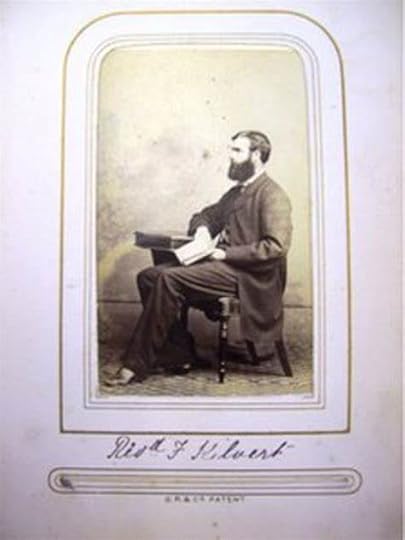
The Reverend Francis Kilvert kept a diary from January 1870 for nine years until his premature death. He has bequeathed to us a unique day by day documentary of life as a village clergyman. Only a small fraction of what he recorded has survived. This is a selection edited and introduced by William Plomer.
Robert Francis Kilvert always known as Francis, or Frank, was an English clergyman remembered for his diaries reflecting rural life in the 1870s, which were published over fifty years after his death.
After his death from peritonitis, his diaries were edited and censored, possibly by his widow. Later they were passed on to William Plomer who transcribed the remaining diaries and edited and published a three-volume selection Selections from the Diary of the Rev. Francis Kilvert (Jonathan Cape, Vol I: 1870-1871 pub. 1938, Vol II: 1871-1874 pub.1939, Vol III: 1874-1879 pub.1940), and later a one-volume selection Kilvert's Diary, 1870-1879.
You know that weird, poignant vibe you get from old photos—all those smiling people, so interesting and life-like, and all so dead, dead, dead? That’s the feeling Kilvert’s Diary gives me: a kind of naïve melancholy. To think that these colourful personalities, these vivid moments, are simply gone. And then to reflect that we’re going too, and just as fast. Hate to bring you down, kids, but there it is.
Maybe I’m projecting my morbid anxieties onto the book, but I don’t think so; I think this sense of the heartbreaking ephemerality of things is woven into the text by Kilvert himself. But that’s one reason people keep diaries, isn’t it? To salvage a few odds and ends before it all goes under. It may not add up to much, it may not make a damn bit of sense, but it happened and it was real and if we don’t hold on to it, who will?
All of which is very human and touching, until you remember that the average person’s diary is a vain, tedious little chronicle (unless you happen to be sleeping with that person, in which case it’s bound to be shattering, so just don’t.). Personally, I can hardly bear to look at my old diaries now, and when I do, the former self I meet there isn’t the sort of guy I’d want to chill out and play X-box with; usually he’s the sort of guy I’d want to knee in the groin.
So what makes Kilvert different? Well, unlike so many of us today for whom “blog” and “journal” are verbs, Kilvert just wasn’t that interested in himself. He didn’t waste a lot of time staring at the glittery snow globe of his inner life. The world was enough for him. It was a small, quiet, circumscribed world, but it gave him all the nourishment he needed.
As a curate in a rural corner of Victorian England, Kilvert saw his share of life’s unpleasantness. His duties brought him into daily contact with the poor and infirm; he visited their homes, drank their tea and listened to their stories (and horrifying stories they are, too: murders, suicides, insanity—my God, the insanity: every other house in nineteenth-century England seemed to have a mad relative stashed away in some upsairs room).
And he noticed things. That’s what I love about him: his endless delight in the quirks of human behaviour:
...A note was brought to me from David Vaughan and his son William was waiting outside. So I had him in and gave him some beer. He was rather shy and constrained and sat for a long time still with the tumbler of beer in his hand and looking at nothing. I could not conceive why he did not drink the beer. Then I thought he was ill. At last he faced round on his chair half wheel and pronounced solemnly and formally, ‘My best respects to you, Sir.’ After having delivered himself of this respectful sentiment he imbibed some beer. It was a bit of perfect good breeding.
It’s nothing much, I guess—just some guy drinking beer. But it’s characteristic of Kilvert that he picks up on the man’s exaggerated refinement. He’s clearly amused, but it’s a good-natured amusement; it’s generous.
The diary is full of moments like this, tiny, luminous moments that are just...there. When he’s at his best, his eye for the stray, telling detail is almost Tolstoyan:
[I:] tried to catch the 8.45 train but while Henry Dew and I were running along the line to the station we heard the train coming behind us and it glided past close blazing with lamps into the station where it stopped half a minute and was off again to Hay in spite of Henry Dew’s running and hooting. So I walked home. Past and left behind one roaring brook after another, Brilley, Rhydspence, Cabalva. Over the border out of England into Wales in the dark, and one man was bringing another deadly sick out of the Brilley Rhysdpence Inn, the old timbered house, into the road.
The lights of the train, the border crossed in the dark, the sick man carried out of the “timbered house”: he makes you see it all.
Every diary has its longueurs, and Kilvert’s is no exception. An amateur, sub-Wordsworthian poet, he’s always going into raptures over the landscapes he crosses on his long walks around the countryside. These are fine in small doses, but as a dedicated urbanite, I find beautiful scenery kind of blah. Give me a nice, flat parking lot to look at, a strip mall— anything but some boring old mountain.
One other thing. Kilvert was a sexually-frustrated bachelor for most of the period covered by the diary. You get the sense he was quite the charmer, but even so it couldn’t have been easy for an upright, single clergyman to get laid back then. So there are a lot of impassioned descriptions of pretty women where the poor guy’s longing is embarrassingly obvious. And, okay, I can understand. But he also writes just as yearningly about very young girls. I’m talking eight, nine years old. It’s creepy—all the more so because he doesn’t seem to realize that he’s sexualizing them. What was it with Victorian men and their little-girl fantasies? No, don’t tell me. I don’t want to know.
"Why do I keep this voluminous journal? I can hardly tell. Partly because life appears to me such a curious and wonderful thing that it almost seems a pity that even such a humble and uneventful life as mine should pass altogether away without some such record as this, and partly too because I think the record may amuse and interest some who come after me." The above quote comes about two thirds of the way into this version of 'Kilvert's Diary', and it works so well within the context of what I was reading, but that last part especially struck me, as this diary ended up meaning a great deal to many people who came after Kilvert.
As part of my reading to learn more about the Victorian era, I greatly appreciated this insight into his life, in particular the things he observed on his walks, from wildlife, difficult weather, and various people. Often the writing is picturesque, providing a vivid glimpse into the changing seasons. Charming is typically what I thought, although he never shied away from recording some of the more difficult aspects of life around him, in particular illness, death, and a few brutal suicides. I became very invested in his observances, as well as the women he tended to fall in love with. Knowing from the introduction that none of these ladies were the one he married, it was a bit painful but oddly timeless to see him pinning all his future hopes on this one particular woman, knowing something was going to prevent that match.
The more invested I became the more I regretted the lost volumes of his journals. According to the introduction, after his death at only 38, his wife, "...inherited the Diary and is said to have destroyed two large sections of it for personal reasons: one section is thought to have recorded Kilvert's courtship of her. What was left was contained in twenty-two notebooks. Only three of these now survive, the rest having been destroyed by an elderly niece of Kilvert who had inherited them from her brother." It's a shame - if all volumes had survived, I would be thrilled to read them, after using this shorter version as an introduction. Still, at least we have some of it, and it is both enjoyable and informative.
very charming. I had no idea the late Victorians played such wild games of croquet (up to six games taking place on one lawn at once), and also I am a bit aggrieved that archery is never offered to me as a standard party activity. Kilvert is a keen observer of place (in this case, mostly the Hay valley area of Wales) and a great describer, and often quite amusing. Here is part of the first diary entry, about a woman who had a wood owl. "She wanted to call the owl "Eve" but Mrs. Bridge [her sister] said it should be called "Ruth." She and her sister stranded in London at night went to London Bridge hotel....with little money and no luggage except the owl in a basket. The owl hooted all night in spite of their putting it up the chimney, before the looking glass, under the bedclothes, and in a circle of lighted candles which they hoped it would mistake for the sun....Miss Child asked the waiter to get some mice for "Ruth" but none could be got." My only complaint is that I'd have liked more general narrative and character background (I kept wanting to flip to the end to see how the story ended, but it never became a real story....) Still, very interesting, soothing reading.
This book was enchanting with snippits of rural life. The changing seasons, the ringing of the bells for New Year and weddings. The customs and the people. It seems that some things haven't changed. I loved it!
This book was a gift from a very dear friend who mentioned his favorite entries in the diary. It was fun to come across those and get a transatlantic laugh together. Kilvert is so lovely and enjoys his life to crying at the beauty of it - all the pretty children he loves and the trees and fields he loves and his funny welsh parishioners who tell him such great stories... It's fun to look up all the history Kilvert is living through, but the best parts come when he describes his 11 mile hikes to farms and hermits and villages.
Kilvet's diary paints an excellent picture of Victorian country life; as a clergyman, he interacted with pretty much all classes, and he was sympathetic to the problems of the poor (which is not exactly a given with the Church of England in the 19th Century). In addition to his personal, professional and family life, Kilvet writes about local history, social events, crimes, religion, gossip, folktales, and superstitions, with the occasional digression on national events. This edition is not especially annotated, and the diary wasn't written for public consumption, so parts may be pretty obscure to a 21st Century reader. Google is your friend in these cases. While he generally comes off as a pretty sympathetic narrator, he often walks the line between a romantic appreciation of feminine beauty and being kind of a creeper. Also, even making allowances for how people wrote about children in the Victorian era, Kilvet may well have been a pedophile, whether he acted on these impulses or not. 3 stars.
This is an outstanding, and often hilarious, account of adventures in Victorian Life. Francis Kilvert is so full of foibles and so matter-of-factly recounts even the most gruesome scenes that the writing seems surprisingly modern. I especially enjoyed his accounts of dining and drunkeness, and the carefree way people of leisure spent their free time. A must for anyone interested in diaries, memoirs or Victorian life.
Fascinating insight into life in a Victorian Rural setting. The Gores in the book are some of my distant relatives so this was particularly helpful in my family history research..
The only reason for getting this book was the reference to the churches & places I know and have been to in the book. Many of the churches I visited for a blog I write and it is interesting to know the background of the places. As a book it is awful and I found it too a long time to read but then it is a diary after all with a lot of editing by his wife who I suspect did not want people to know what he go up to. Some of his actions and thoughts seemed a little suspicious and if he had been around now the guy would be locked up. It's not a book I would recommend unless you want it for the historic side of it. The version I bought was on Amazon and had not a version I have reviewed as I could not find the one I had on Goodreads, a problem I also have with other books
Pedophile. That is the inescapable fact that comes to mind as you read the diaries of a man who died over a 130 years ago. Robert Francis Kilvert was a parson on the Welsh/English border in the 1870s and his work took him all over the villages in the clyro area. He fondly talks of rural life of the time and he is particularly fond of underage girls which as a father of a daughter was difficult to read, however he didn't seem to act on this and indeed tried to marry once or twice. The thing I enjoyed most about this though was its history from someone who was actually alive at the time. For fans of rural history only.
One of my father's favorite books is this set of three, which he passed to me. My dad was an American clergyman who loved the countryside in which the book is set, on the Welsh border, though he spent little time there and certainly did not walk the hills as Parson K. did. Happily inconsequential to us now, though filled with birth, death, sickness, joys and disappointments. Some lyric flights. Most valuable as rural social history. Kilvert was shy but gregarious.
Bought this book in Hay on Wye as Kilvert was curate at Clyro, near Hay. His diary talks a lot about the area and the people. He has a lovely way of noticing nature and people, very descriptive. And a sense of humour. Turns out we were staying in the Chapel at Bronydd (Bronith in the book) which made it even more interesting. The book has it's detractors as Kilvert is sometimes over familiar with female characters, not very pc in today's society, but I found it fascinating for it's social and natural history. Sad that he wasn't able to carry on longer with his diary.
What a strange affair! Equally disturbing and fascinating. Kilvert was not the stereotypical clergymen at all. The best parts of the diary are the early sections set in Wales. Kilvert is a fine observer of rural life and nature. And he writes with C18 Romantic clarity and C17 mock-heroic charm. He is a clear window into the nineteenth century. But would a reader expect a respectable, whiskered, Victorian clergyman to bathe nude and display Adam in all his glory before watching Eves?
The disturbing element, however, is not male nudity, but Kilvert's fascination with little girls. There are hints of this in the first quarter of the diaries -- a voyeuristic Kilvert looks delightfully up a little girl's dress as if he is back in Eden before the Fall. The final quarter, however, throbs with desire. At the crisis point, he is warned off by a certain Etty's parents, as they have intercepted correspondence between adult and child. Kilvert recognises that his judgement is wrong, but this does not stop a page of pulsating erotic prose.
Ultimately, the diaries are a real challenge. They become hard to balance. (As with Lewis Carroll, Algernon Charles Swinburne, John Ruskin etc.) With Kilvert, the Father image becomes a useful deception. The man who suffers the little children to come unto him, and visits schools benevolently, becomes something else when he walks ten miles to kiss his latest little scholar on the lips!
There is so much in this book that is wonderful - the lovely descriptions of nature, sunrises and sunsets, the quirky characters Kilvert meets on his daily rounds of the parish, the insights into everyday life in the 1870s. But try as I might I ended up disturbed by the passages about young girls. It didn’t help that googling for articles about Kilvert I found myself on a blog that I suddenly realised was attempting to normalise sex between adults and children. I felt contaminated and unhappy and blamed poor old Kilvert. I hate that I even feel I have to include this paragraph. I wish I could just say ‘different times’ and move on. I do think little children are beautiful and hope that in the end this is all he meant. It’s tragic that so many of the diaries were destroyed - so many stories are left unfinished and that is frustrating. Overall I’m very glad he recorded his life, and sad that he died so young. I ultimately think he was a good and kind man, if a bit emotionally dense at times!
Oddly endearing Victorian clergyman's diary. The nature writing is very strong, as are the descriptions of rural life and the memories of the elderly parishioners he visits, some of whom remember back into the previous century. Justifiably considered a classic of diary literature, and you can't help feeling sorry for Kilvert's various ill-starred love affairs and clerical ambitions.
Beautiful, enlightening, brutal and sad. A private and personal account of life in a remote Welsh village which somehow or another seems to reach out from this obscurity to touch and recognise our modern lives.
Kilvert's diary is a treasure trove of sweet and beautiful scenes from the 19th-century Welsh countryside. Far from being the monotonous ramblings of any one man, this Diary possesses a sort of magic that keeps you wanting more of Kilvert's feelings and the images he conjures.
Kilvert had an evidently very keen eye for everyday things. His account brings us the absolute beauty of nature as it was, and perhaps still is, around Radnorshire and Herefordshire, Clyro and Langley Burrell. His constant striving for the right word to accurately depict the quiet countryside is only matched in effect by his ecstasies when encountering a particularly beautiful scene, such as the mountains he is struck by on his way to see the Solitary for example. He writes about it so well that it would give anyone the urge to go see those places for themselves.
On top of the natural world, his entries shed a particularly sharp and illuminating light on the little everyday scenes of rural society: the sweet moments at weddings, or family life pictures when the diarist calls on the other villagers... but also the individual tragedies and crises of these people, such as the loss of a child, accidents leaving some paralyzed, floods affecting the whole area, all of which form a vivid picture of the lives of which we don't necessarily think about. It also helps that Kilvert is understood to be a particularly likable character. He records many, many relatable reactions to pretty women and is understood to have a weakness for them; I particularly was touched by his several failures in matters of love and marriage, as he records several affairs with women to whom he dedicates his heart entirely, and his reflections on the matter as well as short-lived attempts to harden his heart would I think be universally understood. He seems to be a very kind and attentive clergyman who calls often on his parishioners even at the cost of his own health. The latter, as well as the reader, come to like him extremely, and the many gifts of gratitude and lamentations he receives upon his departure from Clyro attest to his virtues.
For a pleasant, tranquil read and a dive into 19th-century Britain when 3 pounds was a fortune, I do recommend heartily this diary. It is only a shame that most of the full diary has been destroyed during the 20th century.
Intriguing source of information about mid Victorian rural Wales and England. Whilst in some respects Kilvert was a mainstream C of E clergyman, theologically conventional, in other respects he was quite a free thinker, highly knowledgeable about the natural world, observant of the human world, and, despite a few prejudices, flexible, energetic and sensitive in his activities. It is hard to judge his partly paedophile proclivities from a current perspective - the dubious sentiments of older men for younger girls seem to have been more accepted then - if not acted on - though his belief that those subjected to his attentions always adored and felt comfortable with him, was not necessarily right. As with Lewis Carroll, the ambiguities are unlikely to be resolved. Illness, suffering and death feature prominently, but grief isn't blunted by their familiarity. Some scenes are very touching. The account of a mass brawl between men of neighbouring communities is unusually vivid, though reported second hand. The church is very much integrated in the community - Kilvert, though a solid Anglican, is generally fair to Catholics and nonconformists, though I suspect wouldn't be very accommodating to sceptics or atheist, and he shows the Church world as varied in character and virtue as any other. Given that the book is only fragments of the original diary ( to an extent positively reduced to a manageable size) there is a great deal in here about rural life, Victorian mindsets, and the landscape, and incidentally the class system, to maintain interest.
I first read extracts from Kilvert's Diary as a 12 year old - I was definitely an odd child! As a country lad growing up in the middle of the Wicklow Mountains in Ireland of the 1960s/70s - a very rural place a lot more socially sedate than nowadays - Kilvert's world actually seemed very familiar to me and even more so now in nostalgic retrospect as a lot of the older ways died with the older folk (who would have had a lot in common with Kilvert's contemporaries) of my childhood passing. As well as mourning the untimely end of the man - a very Goth feeling - I was impressed by his deft descriptions of people and place and have remained so during a few sporadic partial readings since. I have now decided to thoroughly re-read the diaries as a 2024 reading goal.
This was a book I’d been planning to read for several years as some of my relatives are mentioned in it- my great grandfather was born in and grew up at Bridge House, Bredwardine and his mother was in service at Moccas Park. It is a lovely, gentle account of the life of a country clergyman. Killers writes beautifully about the Welsh border lands and about the people in his parishes. It left me wanting to know a bit more about him and his relationships. I would have liked to have known more about his courtship and marriage but it seems that these diaries were sadly destroyed by his wife.
Some interesting bits, some dull bits. The social stuff is interesting - He describes seeing his first postcard and a bit later sending his first postcards. He also goes swimming in the sea and is given swimming trunks to wear. He complains that they fall off and writes that if women don’t want to see things they shouldn’t they shouldn’t be there. The scenic descriptions were dull.
I never read somebody's diary and this was very interesting to read. I enjoyed the historical context and the references to events. Also the lives of the people where he lived. Although his vivid description of young girls is a little bit suspect.
I found this book/diary incredibly interesting, it helped that I knew many of the areas spoken about around Clyro and Bredwardine. FK seems to be a fascinating person, one that you would like to meet until you realise that he died 139 years ago. He describes nature in a beautiful way and is constantly surprised by it “I fear those grey old men of Moccas, those grey gnarled, low-browed, knock-kneed, bowed, bent, huge, strange, long-armed, deformed, hunch-backed, misshapen oak men that stand waiting century after century” -this is how he describes the old oak trees, I’m glad to say they are still there! He also mentions historical events such as the death of Napoleon III, and gets the people he meets to reminisce about events that they experienced eg the coronation of George IV, when he refused to allow his wife Queen Caroline be crowned with him! Then there are his love affairs- we only get the earlier ones in detail as his wife seems to have censored some of it eg leaving an 18 month gap! He also likes bathing outdoors in the nude and has “romps” (his words) with young children- perhaps those are the bits his widow should have cut out!