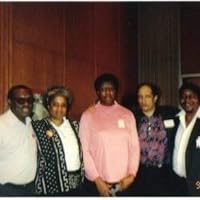
Buchi Emecheta OBE was a Nigerian novelist who has published over 20 books, including Second-Class Citizen (1974), The Bride Price (1976), The Slave Girl (1977) and The Joys of Motherhood (1979). Her themes of child slavery, motherhood, female independence and freedom through education have won her considerable critical acclaim and honours, including an Order of the British Empire in 2005. Emecheta once described her stories as "stories of the world…[where]… women face the universal problems of poverty and oppression, and the longer they stay, no matter where they have come from originally, the more the problems become identical."
From 1965 to 1969, Emecheta worked as a library officer for the British Museum in London. From 1969 to 1976 she was a youth worker and sociologist for the Inner London Education Authority, and from 1976 to 1978 she was a community worker.
Following her success as an author, Emecheta travelled widely as a visiting professor and lecturer. From 1972 to 1979 she visited several American universities, including Pennsylvania State University, Rutgers University, the University of California, Los Angeles, and the University of Illinois at Urbana-Champaign.
From 1980 to 1981, she was senior resident fellow and visiting professor of English, University of Calabar, Nigeria. In 1982 she lectured at Yale University, and the University of London, as well as holding a fellowship at the University of London in 1986. From 1982 to 1983 Buchi Emecheta, together with her journalist son Sylvester, ran the Ogwugwu Afor Publishing Company.
A very good book, but then again the late Emecheta was a world class writer. She was also a tough single minded lady who did not believe that women should be shrinking violets. Hence here she writes about the cruelty, evil and brutality of war without being squeamish. The tragic realities of blood, gore, inhumane cruelty, rape etc that accompany war. But really I am very impressed with the character of Debbie Ogedemgbe here, the young brave female soldier. She is well educated, sophisticated yet understands the constraints of indigenous society, the biases against women. In modern times what does it matter if a woman is confident, does not regard a man as "superior ", and smokes? And why can't men move on and stop regarding women as sex objects and inferior? Recently the universities' sex scandal broke in west Africa (exposed by BBC) which again shows how hapless and vulnerable women still are. Why should women have to pleasure male lecturers before they can succeed academically? This book was published many decades ago but the lessons are still there for us all - the futility of war, the precarious state of women, suspect sexist attitudes...
Yes it's true. It took me 9 days to read this short 246 pages because I was deeply involved in the long delayed drywalling of my garage.
This is my third Emecheta (a popular author among the AWS I suppose). And this one pleased me more than the other two. Not that it blew me out of the water with its fictioning or its prose ; all of which is rather average ; but just the subject. Lots of politics. But too even more slaughter and rape and general blood letting which won't be to everyone's taste. Characters don't hesitate to get themselves killed. As is the case with politics.
Rating: 3.5 I would say the rating reflects my reading experience more than the novel itself. The novel was an excellent representation of the war and provides a very balanced perspective. The scope is huge, it begins with the independence movement, provides a scathing critique of western involvement and also attempts to give us a micro level view of the war, through the protagonist's perspective. My qualms are with the latter attempt, the characters do not come alive at all. Her political understanding is excellent but the interiority of the characters did not come across. That being said, I would still HIGHLY RECOMMEND people to read this novel to get a nuanced perspective on the Biafran War. It is very well researched and etched in pain and loss.
I read this because I was intrigued by the nation of Biafra after having read Chimamanda Ngozi Adichie's _Half of a Yellow Sun_. Half of a Yellow Sun is much better. But this one's good for other reasons--it has more about how outside nations influenced (and continue to influence) what happens in Nigeria, more about the politics. That being said, the characters are pretty flat and it's sometimes hard to get into. But worth the read.
The funny thing about reading fiction based on things I know very little about, though, like Nigeria's independence and subsequent civil wars, is that then I have a big-picture understanding but don't know which details are true:)
A Postcolonial Feminist Analysis of Destination Biafra by Buchi Emecheta Postcolnial Feminism is a form of women's movement that evolved as a response to feminism focusing only on the experiences of women in western cultures. Postcolnial feminism seeks to explain how racism and the long-term political, economic and cultural effects on colonialism affect non-whites and non-western women in the post-colonial world.[1] Women in the East are often treated as victims of backward religion and pateriarchal structures, helpless, and ill-informed about the seriousness of their plight. The lens of post-colonial feminism calls for special attention to the continuing damage caused by European-American imperialism and global capitalism to people in "Eastern" countries, and the resulting violent exploitation of women outside Europe - America [2] Destination Biafra is a powerful novel, which is moving the painful birth of the Republic of Biafan in the late 1960s, focuses on Deby Ojedempeg, the educated daughter of a corrupt Nigerian cabinet minister. The story centers around Deby's mixed feelings about her role as a traditional Nigerian woman and her desire to participate actively in the Biafra conflicts. [3] As named in the novel " I would rather say owr destination is "Biafra", since as far as I am concerned we're not yet independent...I think this country needs a military respite, and so to Biafra we will go. Destination Biafra." (57) In an attempt to reconstruct what was destroyed of the Nigerian Biafran civil war of the late 60s. Debbie Ogedemgbe is the heroine of Emechta's, who when her father, the newely independent government's finance minister, is killed along with the prime minister and other leaders. Debbie, however, gathered up the courage to make the decision of joining the Army, a dream she has always had even before the coup. Soldiers sought advantages in Debbie's joining to the army, especially with her Educated level in English as she can manage the Whites matters through communications. Debbie was overwhelmed with excitment " -younger soldiers creeping up on them and unarming them, an all under the command of a woman! Debbie's large eyes sparkled with excitement and fear." (79) One could argue that for a very long time ago, women were never allowed to even think about such an unfamiliar decision, and even if they dared, they would never trully fulfill it. But as the two terms " Postcolonialism and Feminism" started to emerge gradually to the surface, embracing the diversity and unpredictability of political, economic, and social life. As Leela Ghandhi notes, " it is the encounter with feminism that encourages postcolonialism to produce a more critical and self reflexive account of cultural nationalism." [4] " One or tow of the officers who had briefly contemplated fighting their way to freedom gave up the idea and took the refuge in staring at Debbie Ogedemgbe and her small group with undisguised amusement as if to say, " whatever you do, however much you are armed and in command now, you are still a woman." Emecheta75. these exact words are an underestimation of women at the time, as if being a woman is a humiliation itself. But women as strong as men or even stronger prouved throughout history that they are worthy of respect, worthy of equality in opportunities, brave enough to take challenges and transform them into a winning battle. What is impressive is Debbie's reaction as if she heard absolutely nothing of what had been said, she was entirely focusing on her job, accepting the so called opportunity valiantly. Still, it was too early to celebrate the achievement for Debbie, for what is coming ahead of her is of no easiness. she had fights to go through that seem to cost her, even her life. What worth putting light on is that not all women understood the concept of feminism appropriately. Some even stood against certain calls of equality. One of this women is Debbie's mother who had in several occasions lectured her daughter about how women should actually behave and this can be noticed in the page 104: " I don't know what comes over you girls. We all want freedom for women, but i doubt if we are ready for this type of freedom where young women smoke and carry guns instead of looking after husbands and nursing babies." In fact, as this statement can contain some truth within. One can not deny the role of women in the family from giving births to raising, and taking all the responsibilities lay on their backs. But no one ever has the right to limit women's lives or the way they sould behave and act as wars were to change things once and for all. As Kakuzō Okakura in The Book of Tea said: “The art of life lies in a constant readjustment to our surroundings.” [5] Debbie had to change or adopt herself to the changes surrounding her as it was a War case, and so all women had to adjust to the new way of living such as Babs. In other words it is the human nature to adopt his self to the surrounding environment as a way of survival; yet, there is no doubt that wars changed matters throughout history whether for women or men positively or negatively. In a culturally speaking, postcolonialism brought civilization and gave women more equal rights and opportunities regardless of the terribly awful crimes committed against innocent people for which they were only statistics or war casualties. Another example of how can colonialism change even the traditions of the colonized country is explicitly illustarted in the page 108: " Debbie settled herself on one piece of her wrapper, spread on the golden-white sand, remarking, " One thing i like about our native clothes is that you can take one layer off without upsetting the whole outfit" Yes, but don't they say that women who are still unmarried aren't supposed to wear that second waist piece? Alan asked, sitting down by her. the trouble with you, white men is that you know much more than is good for you. Anyway, nobody observes such traditions these days. When those taboos were made all girls married before they reached the grand age of twenty, so that wearing one piece only enhance a girl's slim figure" Debbie explained easily. What Busi Emecheta did is that, in her novel, she had embedded the post-colonial changes through Debbie's conversations, her protagonist, who cleverly presented the transformation made. Debbie went on justifying her position by adding: " But when you're over twenty and have been through what i have been through, yet are still expected to play the innocent, there must be something really wrong.". What Debbie tried to say is that what she has been through seperated her, somehow, from her native traditions. That she is no longer tied up to what things have been before. Teteku, another character of the novel had explained things even further : " In the distant past in that part of Africa women were treated almost as men's equals, But with the arrival of colonialism their frail claim to equality had been taken away. Now with the coming of independence, young women like these were determined to play their part in the new nation, and this in turn was making the army boys more brutal to unlucky women caught in any helpless situation. There were stories of women being beaten and sexually assaulted by soldiers, whose commander would only say, " It is war, and in war situation, men lose their self-control, as if that were explanation enough" (113) Teteku shows clearly the brutality of men toward women when women calls for equality, which is something quite expected as men felt threatened of the women performance. and made sure to practice their manliness shamelessly whenever the chance comes. This also shows what postcolonial feminism has brought into the field of a yet new nation, it may as well serve as a summary to the reaction of equality between men and women before and after.
A mixed read. The structure of the novel and the plotting could use some work. Some of the themes of postcolonial nation state formation are explored well, others less so.
The text does a good job making explicit how nation state formation betrays the women who help create it. The main character idealistically believes in a utopian Nigerian nation state, but is betrayed repeatedly by both her own state and the defectors at every turn. Her at times heroic actions are demeaned and undervalued. Ultimately, the contested nation states all view her as their property and not as a citizen. This ties in closely to writings on women’s bodies being used in social discourse as markers of community and, hence, as communal property to be subjected to violence during times of social cataclysm.
The book could have benefitted by spending more time exploring every day people’s understanding of these competing nationalisms. The text attributed much of the conflict to the deranged power struggles of a few British educated military men. But everyday people also signed up for these armies for reasons beyond economic necessity. What did they thinK? Why did they fight? There could be an interesting reading here where these nascent nationalisms are linked to a fear of small numbers style argument.
The text also spends too much time talking about Britain and other western countries complicity in selling weapons for oil rights. Obviously former colonial powers would do this. This is exactly how these powers colonized the region to begin with: trading arms for commodities. Why would you expect them to behave any differently five years after they left? However, the decisions to use genocidal violence were not made by western advisors. Nor were the poorly thought out coups and secession attempts. I am reminded of the literature on Partition, where certainly the British are complicit, but ultimate responsibility lies with morally corrupt South Asians. Something similar is at work here.
I must express confusion at the main character. In many ways I find her hopelessly naive. Even through to the end of the novel she remains committed to the ideal of a new nationalism. I guess this is meant to be a heroic post colonial figure, trying to create a new political vision out of the decaying political order of the old colonial powers. But she is sympathetic to tactics like coups and the people who conduct them as a way of achieving this new vision. It remains difficult for me to tell if much of the main characters decisions are mainly to serve as a foil to the events unfolding or if they can be reconciled into a coherent pattern.
This was a tough read for me, primarily due to its graphic nature (in terms of the level of violence); never the less I'm quite glad I read it. I was completely unfamiliar with the period in w. African history before my roommate recommended I give it a read.
It is a pretty accurate account of some of the events that took place during the Biafran conflict, and I found the motivations of the characters presented both fascinating & horrifying.
I took a break from reading the book about midway through because it disturbed me so deeply. After completing it, I was spurred to learn more about the real life events that inspired this work.
I Loved the Joys of Motherhood, and her other works that have approached the story of life from the angle of women in a third world country. This one was just different. I think she may have had the same thing in mind when her goal was completely different, overall it was just too uninteresting and not her best work. However I won't let that stop me from reading more by Ms. Emecheta.
An outstanding novel based on the facts of the Biafran war. Buchie actually disguised herself and entered the institution where secret papers were stored in order to confirm the information she had obtained while doing research about this historic and inhumane event which occured in her homeland.
If you know nothing about the Biafran War, i recommend this as an easy introduction. Emecheta's novel covers the events in an historically accurate way, showing important people through the lives of ordinary Nigerians. It's an easy read, too.
I’ve been really interested in reading more about the Nigerian Civil War, and the only real comparison I had going into this was Half of a Yellow Sun. That book showed one side of the war, but the characters were so alive—it stayed with me for a long time and is definitely one of my favorite reads. So I really wanted to pick this up to deepen my understanding.
I’m not going to lie—the beginning was a struggle. I found it confusing and a bit flat, and I genuinely debated whether I should stop or keep going. In the end, I powered through, and I’m glad I did… but also not, if that makes sense.
I’m glad because I learned so much more about the war—the neocolonialism, the tribalism, the Nigerian side and the Biafran side. It really broadened my perspective. But at the same time, this book is heavy. If I had stopped early, I would have spared myself from a lot of darkness—harrowing pain, despair, and death. So, so, so much death.
What really stood out to me was the perspective of a woman in the war. That added a layer I hadn’t fully seen before, and it made everything feel even more raw and personal.
And honestly—screw Alan. And screw the people in power who think that the deaths of civilians are just collateral in their power plays. It’s infuriating. So many wasted lives. Such a tragedy.
This isn’t an easy read, and it’s not one I would say I “enjoyed” in the traditional sense, but it’s powerful, and it taught me a lot. Sometimes that’s what matters more.
One of the finest book to capture the most dangerous civil war than the war itself. Although it records what happened in Nigeria, it simply resonates wherever people suffered from civil war. Compelling read