

What do you think?

Franklin Delano Roosevelt: Champion of Freedom
Franklin Delano Roosevelt stands astride American history like a colossus, having pulled the nation out of the Great Depression and led it to victory in the Second World War. Elected to four terms as president, he transformed an inward-looking country into the greatest superpower the world had ever known. Only Abraham Lincoln did more to save America from destruction. But FDR is such a large figure that historians tend to take him as part of the landscape, focusing on smaller aspects of his achievements or carping about where he ought to have done things differently. Few have tried to assess the totality of FDR's life and career.
Conrad Black rises to the challenge. In this magisterial biography, Black makes the case that FDR was the most important person of the twentieth century, transforming his nation and the world through his unparalleled skill as a domestic politician, war leader, strategist, and global visionary--all of which he accomplished despite a physical infirmity that could easily have ended his public life at age thirty-nine. Black also takes on the great critics of FDR, especially those who accuse him of betraying the West at Yalta. Black opens a new chapter in our understanding of this great man, whose example is even more inspiring as a new generation embarks on its own rendezvous with destiny.
Conrad Black rises to the challenge. In this magisterial biography, Black makes the case that FDR was the most important person of the twentieth century, transforming his nation and the world through his unparalleled skill as a domestic politician, war leader, strategist, and global visionary--all of which he accomplished despite a physical infirmity that could easily have ended his public life at age thirty-nine. Black also takes on the great critics of FDR, especially those who accuse him of betraying the West at Yalta. Black opens a new chapter in our understanding of this great man, whose example is even more inspiring as a new generation embarks on its own rendezvous with destiny.
1328 pages, Paperback
First published November 4, 2003
About the author
Conrad Black
58 books80 followersConrad Black is a Canadian-born British peer, and former publisher of the London Daily Telegraph, The Spectator, the Chicago Sun-Times, the Jerusalem Post, and founder of Canada's National Post.
He is a columnist and regular contributor to several publications, including National Review Online, The New Criterion, The National Interest, American Greatness, the New York Sun, and the National Post.
As an acclaimed author and biographer, Lord Black has published comprehensive histories of both Canada and the United States, as well as authoritative biographies of Maurice Duplessis, and presidents Franklin D. Roosevelt, Richard Nixon, and Donald Trump.
Lord Black is also a television and radio commentator and a sporadic participant in the current affairs programming of CNN, Fox News, CTV, CBC, BBC, and Radio Canada.
He is a columnist and regular contributor to several publications, including National Review Online, The New Criterion, The National Interest, American Greatness, the New York Sun, and the National Post.
As an acclaimed author and biographer, Lord Black has published comprehensive histories of both Canada and the United States, as well as authoritative biographies of Maurice Duplessis, and presidents Franklin D. Roosevelt, Richard Nixon, and Donald Trump.
Lord Black is also a television and radio commentator and a sporadic participant in the current affairs programming of CNN, Fox News, CTV, CBC, BBC, and Radio Canada.
Ratings & Reviews
Friends & Following
Create a free account to discover what your friends think of this book!
Community Reviews
Displaying 1 - 30 of 86 reviews

May 26, 2012
Conrad Black's Franklin Delano Roosevelt: Champion of Freedom is excellent — a comprehensive, balanced biography of FDR. Roosevelt's life generally inspires biographies that are either hagiographic or hatchet jobs. Black disdains these simplistic interpretations. What he gives us instead is an incredibly detailed, strongly opinionated, but remarkably fair analysis of the man who was perhaps the greatest of twentieth century America's giants.
This is a massive book, running to 1134 pages. Rather than concentrating on a particular aspect of Roosevelt's life or career, Black has tackled the whole of it, both public and private. Roosevelt's pedigree and privileged childhood, his schooling, complex marriage, family relationships, rise in politics, life-changing illness, and presidency are all covered here in great detail. The significant appointments, political moves policies and legislation, political allies and enemies, and the crisis of each of his four presidential terms are covered in depth. Black writes engagingly, and does a masterful job of turning what could have been dull, dry details into a fascinating tale of political gamesmanship.
Black's FDR is compelling and complex. Born to privilege, the last great American figure to follow the old code of noblesse oblige, Roosevelt seems to have been genuinely concerned with the welfare of the masses, while at the same time being curiously indifferent to the feelings of those he knew personally. While not an intellectual, he possessed the most remarkable political instincts of any man of his time. Both gregarious and aloof, visionary and Machiavellian, he was, as he himself noted, sphinx-like and unfathomable.
Black has written what is sure to become the definitive biography of Franklin Roosevelt - immediate required reading for all that would study his life. Though written to appeal to both the scholar and those with a general interest, it is not the biography to read if you have only a casual interest in FDR and wish a quick introduction to his life. Black's tour de force biography comes very close to saying everything that needs to be said about Roosevelt's extraordinary life. It is powerful, provocative, and highly recommended.
This is a massive book, running to 1134 pages. Rather than concentrating on a particular aspect of Roosevelt's life or career, Black has tackled the whole of it, both public and private. Roosevelt's pedigree and privileged childhood, his schooling, complex marriage, family relationships, rise in politics, life-changing illness, and presidency are all covered here in great detail. The significant appointments, political moves policies and legislation, political allies and enemies, and the crisis of each of his four presidential terms are covered in depth. Black writes engagingly, and does a masterful job of turning what could have been dull, dry details into a fascinating tale of political gamesmanship.
Black's FDR is compelling and complex. Born to privilege, the last great American figure to follow the old code of noblesse oblige, Roosevelt seems to have been genuinely concerned with the welfare of the masses, while at the same time being curiously indifferent to the feelings of those he knew personally. While not an intellectual, he possessed the most remarkable political instincts of any man of his time. Both gregarious and aloof, visionary and Machiavellian, he was, as he himself noted, sphinx-like and unfathomable.
Black has written what is sure to become the definitive biography of Franklin Roosevelt - immediate required reading for all that would study his life. Though written to appeal to both the scholar and those with a general interest, it is not the biography to read if you have only a casual interest in FDR and wish a quick introduction to his life. Black's tour de force biography comes very close to saying everything that needs to be said about Roosevelt's extraordinary life. It is powerful, provocative, and highly recommended.

April 17, 2018
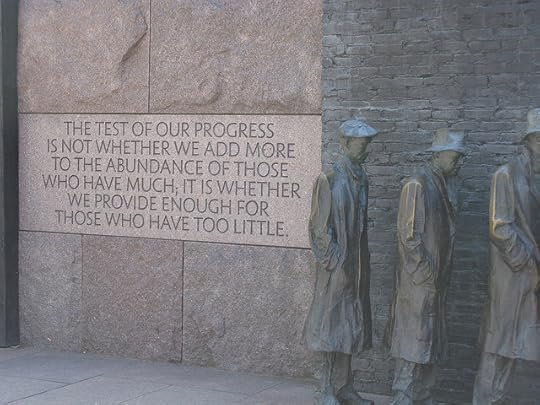
Franklin Delano Roosevelt Memorial, Washington DC
This is a monumental biography. Conrad Black is obviously in admiration of the many achievements of Franklin Roosevelt. When Roosevelt took office in March 1933 his country was in total despair (he was elected in November 1932, but became de facto president in March). When Roosevelt died in April of 1945 the United States was at the epicenter of the world politically and militarily. And it was continuing its cultural spread across the globe.
Mr. Black argues forcefully, that if not for the progressive legislation that Roosevelt passed during the 1930’s, the United States would have splintered into either (or both) right and left wing extremism. His vast panoply of aid programs provided employment, gave electricity to rural areas, social security was introduced, bank deposits were insured, aid was given to farmers, prohibition was ended... Roosevelt spoke to the American people and gave them hope and reassurance that their government was working for them.
Page 310 (my book) Franklin Roosevelt 1933
“If we cannot do this one way we will do it another. Do it we will.”
Page 278 John Dos Passos on Franklin Roosevelt’s radio broadcasts
“People edge their chairs up to the radio. There is a man... speaking clearly and cordially so that you and me will completely understand that he has his fingers on all the switchboards of the federal government, operating the intricate machinery of the departments, drafting codes and regulations and bills for the benefit of you and me worried about things, sitting close to the radio in small houses on rainy nights, for the benefit of us wage earners, us homeowners, us farmers, us mechanics, us miners, us mortgagees, us processors, us mortgageholders, us bank depositors, us consumers, retail merchants, bankers, brokers, stockholders, bondholders, creditors, debtors, jobless and jobholders.”
Roosevelt never followed a formula – his vast aid programs could often conflict and overlap. He was always willing to experiment.
Conrad Black delves into Roosevelt’s personality. He was a complex man – and many found him difficult to fathom. Many came away finding him pleasingly agreeable, only later to become aware that their ideas were discarded and possibly they themselves brushed aside. Franklin Roosevelt was the supreme politician and wily.
Very interestingly Mr. Black discusses Franklin Roosevelt’s polio affliction. It would have been very easy for Roosevelt after he contracted polio in 1921 to retire and live a sedentary life with his wife, family, and mother at their Hyde Park house above the Hudson River.
Page 180
Al Smith [an early political competitor of Roosevelt] never seems to have considered the consequences... from a man with a casual exterior who [inside] was fanatically determined to become president of the United States. Smith hadn’t noticed that in pursuit of that objective Roosevelt had risen up from paralysis, rebuilt his body, virtually invented a new method of locomotion, and convinced the world that although half of him had atrophied, and he couldn’t stand up for more than forty-five minutes... Roosevelt certainly knew the game that he was playing, but it is not clear whether he realized how completely Smith did not.
Roosevelt also prepared America for war. He knew the evil that Hitler represented in the early 1930’s. He knew that the appeasement of England and France in the later 1930’s was in vain. He knew that this would have to be faced militarily at some stage. He pushed war preparedness legislation as much as he could, despite strong opposition from isolationists. Roosevelt was the sole leader of the democratic world who, by the outbreak of World War II in September of 1939, remained popular and dignified. The ascension of the dynamic Winston Churchill to leadership in May 1940 helped persuade America to look seriously at the dire Nazi threats.

Franklin Delano Roosevelt Memorial, Washington DC
the four principals of the Atlantic Charter
Roosevelt learnt well from the mistakes of Woodrow Wilson. He started to plan the United Nations, in August 1941, with the Atlantic Charter. He brought several Republicans on board for both the war effort and the future after the war. He made the U.S. foresee the United Nations as being the key to keeping America involved beyond their borders. As an aside I am aware that the U.N. is far from perfect, but the League of Nations was a shambles – and Europe lived in relative blissful peace and prosperity in the last half of the 20th century compared to the first 45 years.
Mr. Black is not always glowing with praise for Franklin Roosevelt. He condemns his rounding up of and incarceration of American citizens of Japanese origin after Pearl Harbor. Also Roosevelt completely dismissed de Gaulle. He should have realized much earlier (like Churchill) that de Gaulle, despite his haughty moods, was the answer to rejuvenate France. Roosevelt would go after his political enemies using the IRS to relentlessly investigate their taxes. He was the first president to utilize this dubious method of going after opponents.
Mr. Black is very severe with Eleanor Roosevelt. He should have acknowledged more her great influence on her husband. There are times in the book where he admits her insights, but at times he is very dismissive of her to the point of being a chauvinist.
The analysis on the two “Big Three Summits” (Teheran and Yalta) of Roosevelt, Churchill, and Stalin are very enlightening. Mr. Black rejects entirely the canard that Roosevelt and Churchill were duped and/or caved in to Stalin. It is Stalin who did not live up to his agreements for “free and unfettered” elections in Poland and the “Declaration on Liberated Europe”. With millions of Red Army troops in Eastern Europe there was little to do about this, aside from war.
This is an essential book for any Roosevelt aficionado. It is eruditely written with great zest and verve. Mr. Black is opinionated and this resounds on every page, I loved it!
At 1,134 pages (and the book weighs a ton, should I get a kindle!) it still reads exceptionally well, not dry at all. We come out with great admiration for the extraordinary life of Franklin Delano Roosevelt.
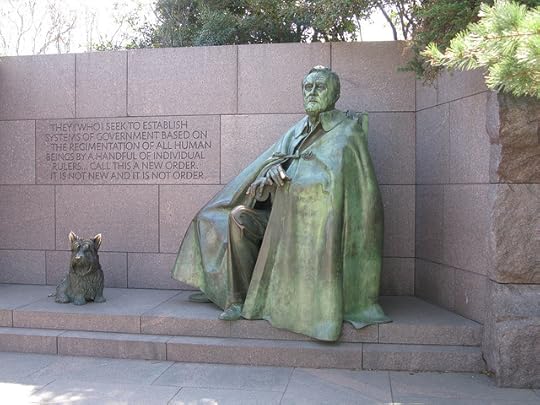
Franklin Delano Roosevelt Memorial, Washington DC

May 7, 2013
http://bestpresidentialbios.com/2016/...
“Franklin Delano Roosevelt: Champion of Freedom” is Conrad Black’s hefty 2003 biography of FDR. Black is a Canadian-born former media magnate and author. In 2007 he was convicted of obstruction of justice and mail fraud (some of those convictions have been overturned). The story of Black’s encounter with the U.S. legal system is the subject of his most recent book “A Matter of Principle.”
Black’s biography of FDR is impressive in both scope and size – it weighs in at 1,134 pages…and about four pounds. This book is obviously the result of exhaustive research by the author and much to his credit Black seems to have read the memoirs and/or a biography of every major player in Roosevelt’s life.
As a result, this review of FDR’s life is not merely comprehensive, it is encyclopedic. From the microscopic examination of Roosevelt’s ancestry through his final months of life, it is hard to imagine there will ever be a single-volume biography which more thoroughly covers FDR. And despite rumors of the author’s fondness for Roosevelt, this book proves surprisingly balanced.
Insight and analysis do not pervade this biography, but Black periodically offers nuggets of wisdom which are extremely perceptive and provide significant clarity for the reader. And among the most compelling sections of this book are Black’s extensive coverage of German atrocities against the Jews and his coverage of the Yalta Conference.
Unfortunately, Black’s writing style is not particularly elegant or easy to digest. Instead it is matter-of-fact and detail-rich with esoteric language sprinkled liberally throughout. The book’s flow is uneven with some chapters flowing effortlessly while others require significant patience and great fortitude.
One of the book’s most significant weaknesses is posed by its brainstorm of facts, anecdotes and observations. The blizzard of detail provided on any given topic often muddies, rather than clarifies, an issue. Black is curiously predisposed to presenting a dizzying array of facts without distinguishing between the trivial and the truly paramount.
This issue might be alleviated by thoughtful introductions to each section, a series of overarching central themes binding disparate facts, or by distillations at the end of each chapter providing the historical essence of preceding events. But Black rarely pauses to provide the bigger picture; he is usually too busy painting his image of the forest floor to review the broader features of the landscape.
Also disappointing is that Black has difficulty humanizing relationships or describing events with vibrancy. FDR’s relationships with his mother, Winston Churchill and Lucy Mercer, in particular, are described with all the care and excitement of a microwave oven owner’s manual.
It is often through a person’s relationships with family, friends and colleagues that the essence of that individual can truly be understood and appreciated. In this book that type of familiarity with FDR is missing. But this challenge is not unique to characters in Black’s biography – events themselves also fall prey to this shortcoming. The famous Doolittle Raid, for instance, is described in a way that makes it hard to imagine the audacious raid being the subject of a dramatic Spencer Tracy movie.
Overall, Conrad Black’s “Franklin Delano Roosevelt: Champion of Freedom” is a comprehensive and extremely thorough review of the life and legacy of one of America’s most highly regarded presidents. A patient scholar will find much to enjoy in this careful biography…but a mere presidential enthusiast will find it daunting and the rewards smaller than the book’s size would suggest.
Overall rating: 3½ stars
“Franklin Delano Roosevelt: Champion of Freedom” is Conrad Black’s hefty 2003 biography of FDR. Black is a Canadian-born former media magnate and author. In 2007 he was convicted of obstruction of justice and mail fraud (some of those convictions have been overturned). The story of Black’s encounter with the U.S. legal system is the subject of his most recent book “A Matter of Principle.”
Black’s biography of FDR is impressive in both scope and size – it weighs in at 1,134 pages…and about four pounds. This book is obviously the result of exhaustive research by the author and much to his credit Black seems to have read the memoirs and/or a biography of every major player in Roosevelt’s life.
As a result, this review of FDR’s life is not merely comprehensive, it is encyclopedic. From the microscopic examination of Roosevelt’s ancestry through his final months of life, it is hard to imagine there will ever be a single-volume biography which more thoroughly covers FDR. And despite rumors of the author’s fondness for Roosevelt, this book proves surprisingly balanced.
Insight and analysis do not pervade this biography, but Black periodically offers nuggets of wisdom which are extremely perceptive and provide significant clarity for the reader. And among the most compelling sections of this book are Black’s extensive coverage of German atrocities against the Jews and his coverage of the Yalta Conference.
Unfortunately, Black’s writing style is not particularly elegant or easy to digest. Instead it is matter-of-fact and detail-rich with esoteric language sprinkled liberally throughout. The book’s flow is uneven with some chapters flowing effortlessly while others require significant patience and great fortitude.
One of the book’s most significant weaknesses is posed by its brainstorm of facts, anecdotes and observations. The blizzard of detail provided on any given topic often muddies, rather than clarifies, an issue. Black is curiously predisposed to presenting a dizzying array of facts without distinguishing between the trivial and the truly paramount.
This issue might be alleviated by thoughtful introductions to each section, a series of overarching central themes binding disparate facts, or by distillations at the end of each chapter providing the historical essence of preceding events. But Black rarely pauses to provide the bigger picture; he is usually too busy painting his image of the forest floor to review the broader features of the landscape.
Also disappointing is that Black has difficulty humanizing relationships or describing events with vibrancy. FDR’s relationships with his mother, Winston Churchill and Lucy Mercer, in particular, are described with all the care and excitement of a microwave oven owner’s manual.
It is often through a person’s relationships with family, friends and colleagues that the essence of that individual can truly be understood and appreciated. In this book that type of familiarity with FDR is missing. But this challenge is not unique to characters in Black’s biography – events themselves also fall prey to this shortcoming. The famous Doolittle Raid, for instance, is described in a way that makes it hard to imagine the audacious raid being the subject of a dramatic Spencer Tracy movie.
Overall, Conrad Black’s “Franklin Delano Roosevelt: Champion of Freedom” is a comprehensive and extremely thorough review of the life and legacy of one of America’s most highly regarded presidents. A patient scholar will find much to enjoy in this careful biography…but a mere presidential enthusiast will find it daunting and the rewards smaller than the book’s size would suggest.
Overall rating: 3½ stars

March 12, 2012
(Written in 2006)
I was so impressed by this book that I felt I had to share my comments on the aspects of this book that I enjoyed the most.
When I first saw this book at Waldenbooks, I was struck by the sheer size of the tome. At 1280 pages (including notes and index; 1134 pages of text), this is a huge book. I really love to read books full of detail, rather than books that are overviews or otherwise introductory. Of course that size does have some drawbacks. It's not a book you'd want to pack around on a trip. I also became rather anxious to reach the end after spending many weeks with it.
If I had not seen this book at the store, I don't know that I ever would have been interested in reading it, or any book about Roosevelt. My political philosophy is directly opposite his...or so I thought. After reading it, I believe Roosevelt is not quite the liberal/socialist I might have assumed. In fact, when I told a friend that I was getting this book, he was quite surprised and referred to FDR as a socialist.
Anyone would have to say that Roosevelt did "liberalize" the United States. But given the economic and political upheaval of the '20s and '30s, we are probably lucky that initiatives even closer to socialism weren't introduced. With socialist agitators jockeying for position on the left, and isolationist conservatives on the right, it really is remarkable that Roosevelt could navigate what I would have to call a fairly centrist course.
While full of detail, the book moves very quickly. By page 137 he is stricken with polio, by page 249 he is president. The first third of the book, as you would expect, deals with the Great Depression and FDR's New Deal legislation. I found this section of the book rather tedious. But, with my newfound understanding of economics and finance, I hope to make sense of it when I read it again.
The book really got good for me on page 455, when the author, Conrad Black begins to dissect the events that led up to the Munich appeasement. This chapter (51 pages) is a tour de force and really sets the stage well for the run-up to Pearl Harbor (page 683).
Between the wars, most of America was blissfully isolationist. The strength of the these chapter is that Black shows us how FDR, who could surmise Hitler's intentions from the beginning, carefully and patiently moved public opinion towards a readiness to fight the Nazis and, of course, the Japanese. A consummate political leader, FDR in essence established the public opinion, rather than following it.
Once America is in the war, the last half of the book takes us through FDR's efforts to work with Churchill and Stalin to defeat the Axis.
Black concludes with an excellent analysis of the FDR's main achievements. Many historians criticize FDR for failing Eastern Europe at Yalta, but Black makes convincing arguments that given the military and political realities with which he was faced, Roosevelt proved successful.
Throughout this biography, Conrad Black proves himself not only a fair and detailed biographer, but also an exceptionally eloquent writer.
I was so impressed by this book that I felt I had to share my comments on the aspects of this book that I enjoyed the most.
When I first saw this book at Waldenbooks, I was struck by the sheer size of the tome. At 1280 pages (including notes and index; 1134 pages of text), this is a huge book. I really love to read books full of detail, rather than books that are overviews or otherwise introductory. Of course that size does have some drawbacks. It's not a book you'd want to pack around on a trip. I also became rather anxious to reach the end after spending many weeks with it.
If I had not seen this book at the store, I don't know that I ever would have been interested in reading it, or any book about Roosevelt. My political philosophy is directly opposite his...or so I thought. After reading it, I believe Roosevelt is not quite the liberal/socialist I might have assumed. In fact, when I told a friend that I was getting this book, he was quite surprised and referred to FDR as a socialist.
Anyone would have to say that Roosevelt did "liberalize" the United States. But given the economic and political upheaval of the '20s and '30s, we are probably lucky that initiatives even closer to socialism weren't introduced. With socialist agitators jockeying for position on the left, and isolationist conservatives on the right, it really is remarkable that Roosevelt could navigate what I would have to call a fairly centrist course.
While full of detail, the book moves very quickly. By page 137 he is stricken with polio, by page 249 he is president. The first third of the book, as you would expect, deals with the Great Depression and FDR's New Deal legislation. I found this section of the book rather tedious. But, with my newfound understanding of economics and finance, I hope to make sense of it when I read it again.
The book really got good for me on page 455, when the author, Conrad Black begins to dissect the events that led up to the Munich appeasement. This chapter (51 pages) is a tour de force and really sets the stage well for the run-up to Pearl Harbor (page 683).
Between the wars, most of America was blissfully isolationist. The strength of the these chapter is that Black shows us how FDR, who could surmise Hitler's intentions from the beginning, carefully and patiently moved public opinion towards a readiness to fight the Nazis and, of course, the Japanese. A consummate political leader, FDR in essence established the public opinion, rather than following it.
Once America is in the war, the last half of the book takes us through FDR's efforts to work with Churchill and Stalin to defeat the Axis.
Black concludes with an excellent analysis of the FDR's main achievements. Many historians criticize FDR for failing Eastern Europe at Yalta, but Black makes convincing arguments that given the military and political realities with which he was faced, Roosevelt proved successful.
Throughout this biography, Conrad Black proves himself not only a fair and detailed biographer, but also an exceptionally eloquent writer.

May 25, 2014
Convicted felon, Conrad Black is probably the greatest historian that Canada has ever produced. His intellectual rigour and analytical skill appear to far surpass his ethical standards.
One important advantage to this book about a great left-of-centre American president is that it is written by a right of centre business man with connections and known affinities for the Republicans. Black is not a partisan hack. He is a true historian anxious to show the greatness of a figure whose politics differ from his.
We all remember seeing pictures of Roosevelt drinking a beer on the day he puts an end to the ban of liquor sales in the US and jauntily waving a cigarette in his holder. In truth Roosevelt led an ascetic life. He hatde partying and devoted almost all his leisure time to physical training in order to compensate for the polio that he contracted in the 1920s and which left him a cripple.
In domestic politics Roosevelt pursued a brilliant policy of state interventionism that restored prosperity to American, gave hope to the common man and which did not damage America's remarkable capitalist economy.
In the area of foreign policy, Roosevelt was even more brilliant. The disastrous First World War left America extremely hostile to the idea of participating in a second war in Europe. Roosevelt very early on realized that America needed to participate. Thus he carefully nurtured this idea in Americans and was eventually able to join in the Allied War effort with the strong backing of the entire American populace.
He admired the British and was in awe of Churchill for his intelligence and courage. Nonetheless, he understood that the imperialistic world system that the British had created could not be allowed to continue once the war was over. A new era of national sovereignty would have to be initiated with multilateral alliances filling the void left by the disappearance of the colonial empires.
This is a wonderful book about a thoroughly wonderful man.
One important advantage to this book about a great left-of-centre American president is that it is written by a right of centre business man with connections and known affinities for the Republicans. Black is not a partisan hack. He is a true historian anxious to show the greatness of a figure whose politics differ from his.
We all remember seeing pictures of Roosevelt drinking a beer on the day he puts an end to the ban of liquor sales in the US and jauntily waving a cigarette in his holder. In truth Roosevelt led an ascetic life. He hatde partying and devoted almost all his leisure time to physical training in order to compensate for the polio that he contracted in the 1920s and which left him a cripple.
In domestic politics Roosevelt pursued a brilliant policy of state interventionism that restored prosperity to American, gave hope to the common man and which did not damage America's remarkable capitalist economy.
In the area of foreign policy, Roosevelt was even more brilliant. The disastrous First World War left America extremely hostile to the idea of participating in a second war in Europe. Roosevelt very early on realized that America needed to participate. Thus he carefully nurtured this idea in Americans and was eventually able to join in the Allied War effort with the strong backing of the entire American populace.
He admired the British and was in awe of Churchill for his intelligence and courage. Nonetheless, he understood that the imperialistic world system that the British had created could not be allowed to continue once the war was over. A new era of national sovereignty would have to be initiated with multilateral alliances filling the void left by the disappearance of the colonial empires.
This is a wonderful book about a thoroughly wonderful man.
want-to-obtain
March 10, 2024I found a clipping about this book inside of a book that I have called the Roosevelt Myth by John T Flynn. Feb 15, 2004 Houston Chronicle. The take on this book, which I don't own yet is that Black says FDR was more of a businessman's friend than most realize. The earlier book by Flynn takes a much different tact, it is an attack from the right from 1948.

June 22, 2007
An exhaustive (and somewhat exhausting) study of the life and times of FDR. Yes, it took me about four years to finish, but it was well worth the effort. The quantity and quality of information about the cast of characters in FDR's life as well as in the US and foreign governments is interesting and impressive, and the analysis of FDR's background, his achievements, and why he is the most important statesman of the 20th century, while occasionally overly detailed and repetitious, is really well done. I feel as if I should have earned 3 credits.

January 19, 2020
Franklin D. Roosevelt with his 4 terms elected president and his presiding over 2 crises, the Great
Depression and World War II gets a lot of study from historians. There are biographies a plenty on
FDR. What makes this one unique is that it is from a British/Canadian author. In a massive 1100+
pages one volume work, Conrad Black even rates FDR as far more important to both his countries
survival. Roosevelt had a great instinct toward how events would proceed long after his demise
which the author and I believe was approaching in 1945.
FDR was born in 1882 in the Hyde Park residence of his father James Roosevelt and his was certainly
a life of comfort and privilege. He was graduating Harvard around the same time an assassin's
bullet made his Republican 5th cousin Theodore Roosevelt the 26th president in 19o1. He also in
that decade married another Roosevelt, Eleanor who was TR's niece.
FDR's rise was similar to TR's. Both served in the state legislature, TR in the Assembly, FDR in the
State Senate 1911-1913. Both became Assistant Secretaries of the Navy, TR 1897-1898 before he
went to Cuba with the Rough Riders, FDR for the whole 8 years of Woodrow Wilson's administration 1913-1921. Both ran for Vice President, TR won in 1900. FDR lost in 1920 when he
and presidential candidate James M. Cox were buried in a Republican landslide.
Partly because of his upper class background a lot of people got the impression he was a nice man,
good speaker, good company, but an intellectual lightweight. Even after his attack of infantile
paralysis which was as most biographers including this one as the seminal event of his life, people
still thought so. All that charm, couldn't be any real substance there. His struggle with polio is
documented in Dore Schary's play Sunrise At Campobello better than in any book.
The guy who underestimated FDR the most was New York Governor Alfred E. Smith. When Smith
ran for president in 1928 he handpicked FDR as the Democratic candidate for governor. Smith
lost and lost New York State, but FDR in his closest election beat Republican Attorney General
Albert Ottinger. Smith who practically appointed Governor Roosevelt's whole administration was
shocked to learn FDR intended to be governor in fact as well as named. He put Roosevelt people
in and this led to a nasty break between the two men that went wide open when FDR defeated
Smith and others for the presidential nomination in 1932.
There was never a chance that he would not be elected president against Herbert Hoover. The
Republicans took credit for the prosperity of the 20s, they overdid it and got stuck with blame for
the Great Depression, Hoover more so, a bit unfairly.
As for the programs and policies of the New Deal, some worked some didn't. But Roosevelt in
doing these things conveyed the image he cared and he was trying. Hoover was stuck in the dogma
of free enterprise and he was a stiff cold man in public for all his reputation as the Great Engineer.
Radio and sound motion pictures were around and FDR with radio addresses called Fireside chats
by him made him the first president to master electronic media. Movies which were 10 cents in
those days also publicized him as newsreels made the public see and hear their president and his
first lady who traveled many places a crippled president just couldn't make.
FDR was re-elected easily in 1936 and then unprecedentedly for a third term in 1940 with war
threatening. Black mentions that part of his boyhood was spent abroad and it included a term in
school in Germany, a new united Germany under the Hohenzollerns and their Chancellor Otto Von
Bismarck. As a kld Roosevelt disliked the militaristic state he saw being built. He really disliked
the new chancellor of Germany coming to power around the same time he did, Adolph Hitler. Black
feels Roosevelt knew from the day he took office war would come.
Come it did with the attack on Pearl Harbor. Isolationist opponents disappeared and were made
irrelevant after 12/7/41 and FDR was shrewd enough to built bipartisan support to win the war.
His war aims were sound. Of the three major allied leaders himself, Churchill, and Stalin he was
the one who looked toward a future with countries like India and China becoming major powers.
He was wrong that China would do it with Chiang Kai-Shek, but right in that he saw it becoming
a capitalist market economy state as it is now. As for India, Churchill was so wrong about that
future good thing he wasn't prime minister when India became independent.
His biggest mistake was in the handling of France. But admittedly Charles DeGaulle was a handful
that future presidents also found. FDR had good strategic sense and the best military advisers
around with George Marshall as Army Chief of Staff and Admiral Chester Nimitz running the Pacific
naval war against Japan. He was right and the British wrong in that the European war would not
be won without a cross channel invasion to France, it was only a question of timing. And he got
good use out of the Republican party's favorite general Douglas MacArthur in the Pacific even in
the face of MacArthur coyly hinting at his availability to run for president.
When he died days short of the end of the European part of World War II he was universally mourned. We could certainly use a president like him now as author Black and I agree.
Depression and World War II gets a lot of study from historians. There are biographies a plenty on
FDR. What makes this one unique is that it is from a British/Canadian author. In a massive 1100+
pages one volume work, Conrad Black even rates FDR as far more important to both his countries
survival. Roosevelt had a great instinct toward how events would proceed long after his demise
which the author and I believe was approaching in 1945.
FDR was born in 1882 in the Hyde Park residence of his father James Roosevelt and his was certainly
a life of comfort and privilege. He was graduating Harvard around the same time an assassin's
bullet made his Republican 5th cousin Theodore Roosevelt the 26th president in 19o1. He also in
that decade married another Roosevelt, Eleanor who was TR's niece.
FDR's rise was similar to TR's. Both served in the state legislature, TR in the Assembly, FDR in the
State Senate 1911-1913. Both became Assistant Secretaries of the Navy, TR 1897-1898 before he
went to Cuba with the Rough Riders, FDR for the whole 8 years of Woodrow Wilson's administration 1913-1921. Both ran for Vice President, TR won in 1900. FDR lost in 1920 when he
and presidential candidate James M. Cox were buried in a Republican landslide.
Partly because of his upper class background a lot of people got the impression he was a nice man,
good speaker, good company, but an intellectual lightweight. Even after his attack of infantile
paralysis which was as most biographers including this one as the seminal event of his life, people
still thought so. All that charm, couldn't be any real substance there. His struggle with polio is
documented in Dore Schary's play Sunrise At Campobello better than in any book.
The guy who underestimated FDR the most was New York Governor Alfred E. Smith. When Smith
ran for president in 1928 he handpicked FDR as the Democratic candidate for governor. Smith
lost and lost New York State, but FDR in his closest election beat Republican Attorney General
Albert Ottinger. Smith who practically appointed Governor Roosevelt's whole administration was
shocked to learn FDR intended to be governor in fact as well as named. He put Roosevelt people
in and this led to a nasty break between the two men that went wide open when FDR defeated
Smith and others for the presidential nomination in 1932.
There was never a chance that he would not be elected president against Herbert Hoover. The
Republicans took credit for the prosperity of the 20s, they overdid it and got stuck with blame for
the Great Depression, Hoover more so, a bit unfairly.
As for the programs and policies of the New Deal, some worked some didn't. But Roosevelt in
doing these things conveyed the image he cared and he was trying. Hoover was stuck in the dogma
of free enterprise and he was a stiff cold man in public for all his reputation as the Great Engineer.
Radio and sound motion pictures were around and FDR with radio addresses called Fireside chats
by him made him the first president to master electronic media. Movies which were 10 cents in
those days also publicized him as newsreels made the public see and hear their president and his
first lady who traveled many places a crippled president just couldn't make.
FDR was re-elected easily in 1936 and then unprecedentedly for a third term in 1940 with war
threatening. Black mentions that part of his boyhood was spent abroad and it included a term in
school in Germany, a new united Germany under the Hohenzollerns and their Chancellor Otto Von
Bismarck. As a kld Roosevelt disliked the militaristic state he saw being built. He really disliked
the new chancellor of Germany coming to power around the same time he did, Adolph Hitler. Black
feels Roosevelt knew from the day he took office war would come.
Come it did with the attack on Pearl Harbor. Isolationist opponents disappeared and were made
irrelevant after 12/7/41 and FDR was shrewd enough to built bipartisan support to win the war.
His war aims were sound. Of the three major allied leaders himself, Churchill, and Stalin he was
the one who looked toward a future with countries like India and China becoming major powers.
He was wrong that China would do it with Chiang Kai-Shek, but right in that he saw it becoming
a capitalist market economy state as it is now. As for India, Churchill was so wrong about that
future good thing he wasn't prime minister when India became independent.
His biggest mistake was in the handling of France. But admittedly Charles DeGaulle was a handful
that future presidents also found. FDR had good strategic sense and the best military advisers
around with George Marshall as Army Chief of Staff and Admiral Chester Nimitz running the Pacific
naval war against Japan. He was right and the British wrong in that the European war would not
be won without a cross channel invasion to France, it was only a question of timing. And he got
good use out of the Republican party's favorite general Douglas MacArthur in the Pacific even in
the face of MacArthur coyly hinting at his availability to run for president.
When he died days short of the end of the European part of World War II he was universally mourned. We could certainly use a president like him now as author Black and I agree.
April 25, 2020
This biography of FDR is, by far, the most comprehensive I have read to date. At 1,280 pages, it is not a short read. However, the time it takes to read it is more than made up for by the depth of exploration of FDR the man. His character and personality shine through. This is not a glossy portrait with no flaws. I felt as though I saw more of a complete characterization of FDR, including his extraordinary achievements as well as his flaws. It was a great read.

July 31, 2018
As Americans there are three great Presidents we all have an obligation to know: (1) George Washington, (2) Abraham Lincoln and (3) Franklin Delano Roosevelt. Washington created America, Lincoln perserved America and FDR transposed America.
At the beginning of FDR’s Presidency, America was a broke, desolate failing state and at the end of FDR’s Presidency, America was the undisputed military and economic leader nation of the free world and co-savior of western civilization.
It is hard to phenomenon, maybe one in 7 billion could be found, who could be so perfectly suited to an ages needs and to think he was a handicapped man, when handicapped people were viewed as liabilities. And just as he transposed America he transposed his handicap into a strength, he said, that to one who spent six months laying on his back trying to move one toe, nothing is difficult.
When one looks over his four terms there are four grand achievements:
(1) With Churchill, he saved western civilization. When WWII broke out, America was an isolationist country, FDR reshaped public opinion and prepared the country to join the war effort, and then led the war effort like no other war President, there were few loses besides the surpise Pearl Harbor attack and a temporary set back in the Philippines. His command appointments were all excellent - Marshall, Nimitz, MacArthur, King & Eisenhower. He authorized the creation of the atomic energy, he insisted on the Doolittle air raid that created the momentum for our victory at Midway. He pushed for channel crossing and D-Day against British reluctance, he concieved the Torch landings in North Africa, he insisted on the Anvil invasion of southern france, he made the decison to retake Philippines and guided America into become the greatest military power ever seen.
(2) FDR forsaw the threat of Stalin’s dicatorship and created the Allied post war order that led to the UN and NATO and contained communism and made the world safe for democracy.
(3) FDR political power was unmatched in 12 years as President his only defeats were a SCOUS packing bill and his limited success in a 1938 political purge. These both are minor compared to the avalanche of electoral and legislative successes.
(4) FDR bought America out of its immature shell and out of the great depression. He reinvented the role of the state and capitalism, repealed prohibition, created the new deal, resurrected the banking industry, created deposit guarantees, social security, and the GI bill and proved marxism wrong that capitalism only exploited by adding child labor laws, minumim wages, 40 hour work week and workplace safety laws.
Lastly, I have to say my word about Conrad Black. This book was close to 1200 pages of small font. Conrad was clearly a conservative and had his biases, but thankfully unlike the radical right of today he did not cherry pick his facts. The book is comprehensively detailed. I will not read another Black history but just as I enjoyed Lane Fox’s history on St. Augustine with Lane being an atheist, I enjoyed this fair conservative take on FDR.
At the beginning of FDR’s Presidency, America was a broke, desolate failing state and at the end of FDR’s Presidency, America was the undisputed military and economic leader nation of the free world and co-savior of western civilization.
It is hard to phenomenon, maybe one in 7 billion could be found, who could be so perfectly suited to an ages needs and to think he was a handicapped man, when handicapped people were viewed as liabilities. And just as he transposed America he transposed his handicap into a strength, he said, that to one who spent six months laying on his back trying to move one toe, nothing is difficult.
When one looks over his four terms there are four grand achievements:
(1) With Churchill, he saved western civilization. When WWII broke out, America was an isolationist country, FDR reshaped public opinion and prepared the country to join the war effort, and then led the war effort like no other war President, there were few loses besides the surpise Pearl Harbor attack and a temporary set back in the Philippines. His command appointments were all excellent - Marshall, Nimitz, MacArthur, King & Eisenhower. He authorized the creation of the atomic energy, he insisted on the Doolittle air raid that created the momentum for our victory at Midway. He pushed for channel crossing and D-Day against British reluctance, he concieved the Torch landings in North Africa, he insisted on the Anvil invasion of southern france, he made the decison to retake Philippines and guided America into become the greatest military power ever seen.
(2) FDR forsaw the threat of Stalin’s dicatorship and created the Allied post war order that led to the UN and NATO and contained communism and made the world safe for democracy.
(3) FDR political power was unmatched in 12 years as President his only defeats were a SCOUS packing bill and his limited success in a 1938 political purge. These both are minor compared to the avalanche of electoral and legislative successes.
(4) FDR bought America out of its immature shell and out of the great depression. He reinvented the role of the state and capitalism, repealed prohibition, created the new deal, resurrected the banking industry, created deposit guarantees, social security, and the GI bill and proved marxism wrong that capitalism only exploited by adding child labor laws, minumim wages, 40 hour work week and workplace safety laws.
Lastly, I have to say my word about Conrad Black. This book was close to 1200 pages of small font. Conrad was clearly a conservative and had his biases, but thankfully unlike the radical right of today he did not cherry pick his facts. The book is comprehensively detailed. I will not read another Black history but just as I enjoyed Lane Fox’s history on St. Augustine with Lane being an atheist, I enjoyed this fair conservative take on FDR.

November 5, 2012
This massive book tells the full story of the life of Franklin Roosevelt from birth to death, skipping over little as far as I can tell. With a cast of hundreds, and political issues by the dozen, and years and years of an unprecedented stay in political power, the book moves relentlessly on. I was never bored. Even not knowing much about the people involved in the New Deal or the politics of the 20's, the author brought me along.
The author views FDR with a cold-blooded clarity and does not romanticize FDR & Eleanor as so many books have lately. Black punches hard, calling FDR all sorts of unpleasant things, but at the same time giving credit where credit is due. Is he a fan? Yes. Is he a debunker? Yes. Best of all Conrad Black has a gift for words. Here's an example describing FDR's acceptance of the Democratic nomination and Hoover's reaction: "The effect of Roosevelt's sudden aerial appearance and of his dramatic and eloquent message was galvanizing. He was already the president elect. The hapless Hoover was going through the motions. He was like a conscientious convict, not exactly penitent but resigned to his execution as inevitable, if excessive." That gives you a taste of the gusto of his writing.
In spite of some snarky criticism of FDR and deep skepticism about some of his policies, Black makes the case for FDR being one of the three greatest presidents, joining the ranks for Lincoln and Washington. After reading so much about Washington and Lincoln, and now adding in FDR, I think FDR faced bigger challenges and overcame more obstacles. FDR gets my vote as the greatest president of them all. I highly recommend this book, it's a page turner, even though there are 1,100 of them.
The author views FDR with a cold-blooded clarity and does not romanticize FDR & Eleanor as so many books have lately. Black punches hard, calling FDR all sorts of unpleasant things, but at the same time giving credit where credit is due. Is he a fan? Yes. Is he a debunker? Yes. Best of all Conrad Black has a gift for words. Here's an example describing FDR's acceptance of the Democratic nomination and Hoover's reaction: "The effect of Roosevelt's sudden aerial appearance and of his dramatic and eloquent message was galvanizing. He was already the president elect. The hapless Hoover was going through the motions. He was like a conscientious convict, not exactly penitent but resigned to his execution as inevitable, if excessive." That gives you a taste of the gusto of his writing.
In spite of some snarky criticism of FDR and deep skepticism about some of his policies, Black makes the case for FDR being one of the three greatest presidents, joining the ranks for Lincoln and Washington. After reading so much about Washington and Lincoln, and now adding in FDR, I think FDR faced bigger challenges and overcame more obstacles. FDR gets my vote as the greatest president of them all. I highly recommend this book, it's a page turner, even though there are 1,100 of them.
February 5, 2014
This is by by far the most scholarly work on Franklin Roosevelt. Not only have I read it five times, but the fact that it has never gotten boring as many times as I read it. The work may be cumbersome at times with the excruciatingly studdied detail on every fact of Mr. Roosevelt's life and may be dry at times. But with Mr. Black's work, it is a shame he has not written a biography this indepth on Sir Winston Churchill.
The book would only be entertaining for serious study on this great man. His Thirteen years as President (the longest in our history) carried us through the Great Depression and to the End of the World War in Europe. It is a shame that Mr. Roosevelt did not survive his last term as President to see the United Nations form and like Mr. Wilson before him see the honors that the country bestowed on him.
All in all for scholars on Franklin Roosevelt this is a MUST read. Over the 1000 and some pages, gives you insight into the man like no other biography has before, his struggle with polio, his romances with Lucy Mercer, Missy LeHand and others, his relationship with Eleanor and his infatuation with his Uncle "Teddy". How he followed Theodore Roosevelt's footsteps exactly to the White House and how he leard from TR to never retire until you are absolutely ready.
Conard Black is a great historian and I anxiously await his next work.
The book would only be entertaining for serious study on this great man. His Thirteen years as President (the longest in our history) carried us through the Great Depression and to the End of the World War in Europe. It is a shame that Mr. Roosevelt did not survive his last term as President to see the United Nations form and like Mr. Wilson before him see the honors that the country bestowed on him.
All in all for scholars on Franklin Roosevelt this is a MUST read. Over the 1000 and some pages, gives you insight into the man like no other biography has before, his struggle with polio, his romances with Lucy Mercer, Missy LeHand and others, his relationship with Eleanor and his infatuation with his Uncle "Teddy". How he followed Theodore Roosevelt's footsteps exactly to the White House and how he leard from TR to never retire until you are absolutely ready.
Conard Black is a great historian and I anxiously await his next work.

September 30, 2014
Lord Conrad Black's plus one thousand-page biography of President Franklin D. Roosevelt is one heck of a read. It is not only long but you are going to want to find a thesaurus while going through it. Your knowledge of vocabulary will rise a few points once you are done with this book. This book is both my second biography I have read about FDR and the second book that I have read by Lord Black. What I appreciated about Black is his ability to examine issues from multiple angles before coming to an opinion of them. Lord Black is a conservative politically, which makes his take on Roosevelt as a historical figure mostly championed by the left very intriguing. The recent right wing has taken to a renewed attack on the welfare state. Black not only defends it--for conservative reasons--he goes on to declare the Roosevelt was the most important person of the twentieth century.
Lord Black begins with the standard look at Roosevelt's ancestry and the world that grew up in. The same thing was covered in Smith's biography and I will not go into any detail here only to say that Roosevelt was a child of extreme economic privilege. Black goes on to discuss his marriage to his distant cousin[1], who so happened to be the niece of the great President Theodore Roosevelt, and FDR's early entry into politics.
FDR rises fast and ends of becoming the Assistant Secretary of the Navy for President Wilson--the same job TR had when joining the McKinley Administration. Roosevelt was successful at his job with the Navy Department--so much that Wilson did not let him leave to put on a uniform and fight in the field. When the war was over he was the Democratic Party's nominee for Vice President. Roosevelt showed the party that he was a natural campaigner.
"Roosevelt was a popular performer on the campaign trail and fulfilled the expectations Cox had when he chose him as his running mate. He was remarkably impressive in appearance, a confident and eloquent speaker already endowed with the melodious voice, rich inflection and animated gestures that would eventually become world famous. And he was a tireless campaigner, prepared to go anywhere, no matter how remote or politically hostile. He had not, however, completely cured himself of the habit of talking liberties with the truth that the press could expose." (p.128)
Franklin Roosevelt was distantly related to Theodore Roosevelt. They were from separate branches of the family whose most common ancestor was a man named Nicholas Roosevelt who lived in New Amsterdam (New York) when it was a Dutch colony. His son Johannes would father the branch that became the Oyster Bay Roosevelts (TR and Eleanor) and the son Jacobus would father the branch that would become the Hudson Valley Roosevelts (Franklin). Oyster Bay was a Republican branch, and Hudson Valley Roosevelts were Democrats. Yet Franklin would assume the mantle and legacy of the whole Roosevelt family, so much that it would bother Theodore Roosevelt's children, especially the one named Theodore Roosevelt.
Lord Black goes on to describe how Roosevelt viewed issues such as race and bigotry. His views were advanced for his times although they are mostly behind ours. To Black, Roosevelt general open-mindedness contributed to his humanitarian polices and his ability to identify with what would become his core constituency, the American underdogs.
"To Roosevelt bigotry was a good deal more un-American than any individuals or groups who were the victims of it. Beyond that, he was eventually offended by the failure of his natural peers to support him as he set out to make safe their sheltered world, which the Great Depression so morally threatened.
This heightened his appreciation of the groups that they despised and that voted in overwhelming numbers for him. He enjoyed ethnic jokes, including those directed against WASPS, but not ethnic or sectarian slurs. He believed in himself and in the Anglo-Saxon, Protestant, Yankee sociological type of which he was such an exemplar. But he was more impressed with those who strove and achieved in American society with a few initial advantages than he was with those who claimed for themselves from the existence of their well-placed forebears a license to condescend to the less fortunate." (p.155)
One of the subjects that Lord Black dives into that I find fascinating is the personal and political relationship between Franklin Roosevelt and Alfred E. Smith. Smith and Roosevelt were occasional allies but also adversaries. Roosevelt had aided Smith in his gubernatorial and presidential campaigns. When Smith received the Democratic Nomination for President in 1928 he realized that despite being a popular governor he was weak in his home state. To help the party against Herbert Hoover, Smith drafts Roosevelt to run to replace himself as Governor of New York. Smith believes that with popular Roosevelt running for governor would get more democrats to vote and turn the election in his favor.
"Roosevelt conducted a vigorous campaign for governor, violently attacking bigotry in every form, which endured him to the huge Catholic and Jewish (and perhaps even black) populations of New York. He promised to complete the reforms sought by Al Smith, especially the eight-hour and forty-eight hour work week for women and children industrial workers. He called for an old-age pension and, in moving terms, for the abrogation `forever and ever' of the Poor Law and the County Poor House. Even more evocative was his cal for better care for handicapped and crippled people. He referred straightforwardly to his own experience, asserting that only his and his family's resources had enabled him to make the recovery he had, and that the same care should be available to everyone (as it was in Warm Springs)." (p.184)
In many ways Smith created a monster. Smith lost the presidential election and now the chief executive position of one the largest and richest states was no longer his. Roosevelt was now in the driver's seat.
"In barely six weeks, Al Smith had been eclipsed by Franklin D. Roosevelt, who had wanted to remain a while longer in the shadows. But he was now the unofficial leader of the opposition. Should anything go awry with the endless prosperity of the time, he would be the president in waiting. At the decisive moments of their political lives, Al Smith's judgment was defective, Franklin D. Roosevelt's luck was good, and Herbert Hoover would prove to be both lacking in judgment and highly unlucky. Thus were the greatest political fortunes won and lost and the world changed." (p.188)
Smith would find himself completely usurped. When the Great Depression hit it was Governor Roosevelt not Governor Smith who was active in taking action. When the 1932 Democratic Convention assembled Smith discovered the monster he created. Smith encountered the hard bitter truth that most of those who get the presidential bug have to eventually swallow: you will never be the President of the United States.
"A disgusted Smith left the hall in Chicago before the vote was officially announced, without releasing his delegates, preventing the customary move to unanimous acclamation. Roosevelt's old adversary and now ardent recent supporter James Gerard, the party treasurer, sent Mrs. Charles Dana Gibson, a close friend of Smith's, to the gallery to ask Smith to move a unanimous nomination. She returned after a few minutes with Smith's reply: `I won't do it,' repeated mindlessly and fixedly as in a mantra. The proportions of his underestimation of Roosevelt and the madness take his place as governor of New York must have finally become evident to him. It was an unsportsmanlike and therefore uncharacteristic and unseemly end to Smith's great career as the official Democratic Party leader. Even now he could have salvaged a significant role for himself, albeit in a subordinate position to someone formally junior to him, had he behaved sensibly. Instead he opted for a bitter exile and was marginalized as an ever-popular figure of a receding past." (p.237)
The part of President Roosevelt's New Deal that is still felt today is the Social Security system. Politicians since do not want to mess with it and those who do generally get burned in the attempt. Paul Ryan attempted to and backlash was so that he had to change his tune. In 2012, while running for Vice President, he had to go around the county calling Obama a Medicare Scrooge.
"Social Security was an idea whose hour had come. At a time when the United States had been stricken by an economic crisis that had left nearly a third of the county destitute, it gave promise of an imminent time when there would be emergency support for everyone. This measure raised the hope of the nation that it would never again be defenseless against the vagaries of economic fortune, which had shown itself more capricious and dangerous than most Americans had ever imagined possible." (p.343)
New Deal-bashing has been become very popular in modern times especially by those who would like to dismantle the welfare state and go back to the world of the 1890s. The current `Tea Party' movement on the ground and some of the higher end think tanks have often criticized the New Deal with revisionist history. Black debunks critics and praises the New Deal from a conservative point of view.
"The myth has lingered that the New Deal was ineffectual, because progress in the private-sector reduction of unemployment was sluggish until late in the thirties. But the Roosevelt administration's policies greatly alleviated the condition of most of the needy and permanently reformed the economic system without greatly disrupting it. The New Deal bears comparison with the performance of other advanced industrial countries and was certainly judged preferable to what was on offer from the domestic opposition." (p.382)
One of the more interesting points that Black raises is how Roosevelt's example helped other nations see the legitimacy of liberal democracy. In a time of international economic depression, young republics and developing nations were looking for systems to emulate. Franklin Roosevelt's United States provided a good democratic example as opposed to Britain or France.
"By 1937, as had been demonstrated in South America, Franklin D. Roosevelt enjoyed very great prestige not only in every region of the United States but throughout the world. He was the only leader of a major county who appeared decisive, energetic, and benign. The French and British statesmen seemed dyspeptic, ineffective, and unimaginative, as, with few exceptions, they were. The same adjectives could not be applied to Hitler, Mussolini, and Stalin, and they all had their admirers in the Western democracies. But to the great majority in the democratic countries, these were sinister men with blood-stained hands preaching and practicing hatred and violence. There were much-admired leaders in secondary countries, but only Roosevelt carried the ideals of Western liberal democracy with the originality, courage, and panache that could universally attract admirers, reassure democratic believers, and refute the widespread theory that democracy was doomed to be surpassed by the Fascists or the Communists." (p.403)
"If Hitler were allowed to consolidate this position, not only could Germany rival America as an industrial power, but Nazism could more successfully compete with democracy for imitators than it already had. This competition could become bothersome in Latin America, where attachment to democracy was tenuous, and where Hitler and Mussolini had no shortage of swaggering emulators in overstuffed uniforms." (p.564)
In the early days of World War II the British Government, with Roosevelt's approval, began courting American public. The largest propaganda push came with the arrival of King George VI and his wife Queen Elizabeth. Over one hundred and seventy years prior Americans revolted against their current guest's great-great-great-grandfather, King George III. Yet, you would not have been able to guess Americans harbored any ill feelings against any British king with the amount of enthusiastic crowds welcoming the first British monarch to visit America[2].
"The king and queen made a great and very positive impression on American opinion. They were not physically imposing people as Franklin D. Roosevelt was, but were regal gracious and pleasant looking. The king was rather handsome and the queen quite pretty. There was not a hint of British stiffness, much less condescension. Millions of Americans realized for the first time how close their country really was to Great Britain, especially in a world where strident dictators apply brute force in domestic and international affairs were so prevalent." (p.524)
1940 would be the most important presidential election since 1864. It would decide the fate of the world. Roosevelt was breaking a tradition that had been held since the days of President George Washington: that the President of the United States serve no more than two terms. Black presents in his book a Roosevelt who vanquishes all of his enemies.
"Willkie's mighty effort broke the momentum of his career. Disliked by and disliking the conservative Republicans, he became friendlier with his opponent than his erstwhile followers. But his health and political fortunes began to deteriorate. John L. Lewis resigned as head of the CIO as he promised he would. He came back as head of the United Mine Workers, but never had a fraction of the credibility in the country he had enjoyed though Roosevelt's first two terms. Charles Lindbergh continued to speak to smaller and less respectable audiences about the virtues of isolationism, but he would forever be seen as almost a neo-Nazi." (p.600)
Lord Black makes a strong case that United States under President Roosevelt was fighting World War II long before the United States was officially fighting it. While doing this Black also gives an incredible explanation to why Hitler attacked the Soviet Union that I have never heard before: Hitler was afraid that Stalin was going to use the U.S. entry into the war as a means of blackmailing him.
When reading Black's take on Hitler I kept thinking about the Joker in the second Nolan Batman movie `the Dark Knight'. In the movie Alfred explains to Bruce Wayne that Batman forced the mob in desperation to turn to the Joker a man `who they didn't understand'. Germany, humiliated at Versailles and broken by the continued failures of the Weimar Republic, was in a desperate position. In desperation they turn to man, named Hitler, who in many ways they didn't totally understand.
Black also treats Eleanor Roosevelt as fairly as Franklin. Although she is not the subject of the book, as his wife she is hard to ignore. From Black's point of view Eleanor was in some ways politically naive, especially to the faults of the far left. Yet she was an absolute hero when it came for championing the rights of the oppressed and the ignored. This ended up helping the U.S. war effort by taking up the cause of African-American servicemen who would do a great deal of damage to Hitler's domain in the skies of Europe.
"Eleanor Roosevelt also played an important and entirely admirable role in improving the lot of African-American servicemen. The beautiful and talented black singer Lena Horne concluded that German prisoners of war had a better chance of hearing her when she performed than her own people in the U.S. armed forces did. Eleanor received a great quantity of information about the segregation of African-American service and bombarded General Marshall with such a volume of questions and suggestions on the subject that he ultimately had to engage two assistants just to deal with that one important correspondent." (p.824)
I also enjoyed Black's take on President Roosevelt's view on the Post-War World. When you see the big three of Roosevelt, Stalin, and Churchill; you have the representative of the former great Hyperpower of British Empire that was now in the final phases of decline, and the two great Superpowers that would battle to replace it.
"Roosevelt's attitude was not greatly more positive of Communism as much as Churchill did, he was less afraid of it. He was convinced that progressive democratic government would easily be seen as preferable in every way to Communism, as long as the West did not become mired in lost causes such as the defense of untenable imperial commitments." (p.984)
Also Black takes apart the Yalta myth that Roosevelt was too old or too sick to deal with Yalta effectively. Black correctly points out that the Yalta meeting was handled very well. The problem was not what happened at Yalta the problem was what happened after.
"At Yalta the United States and its leaders achieved virtually everything they sought. If the agreement had been adhered to, it would have been a triumph of diplomacy. That this proved not to be the case was because of the noncompliance of the Soviet Union with the agreements. The forty-five year Cold War ensued, which had many vicissitudes, but never a shot fired between Soviet and Western forces, and eventually the Western victory in the Second World War was completed with the total disintegration of the Soviet Union." (p.1079)
I would say in conclusion that this is a very advanced look into the life of President Franklin Roosevelt. I would still recommend Jean Edward Smith's book to a person who is just discovering an interest in President Roosevelt; Black's work is for the advanced reader.
[1] Fifth cousin, so it's not so icky.
[2] I should add `while on the throne', many British monarchs came to the United States prior to becoming monarch.
Lord Black begins with the standard look at Roosevelt's ancestry and the world that grew up in. The same thing was covered in Smith's biography and I will not go into any detail here only to say that Roosevelt was a child of extreme economic privilege. Black goes on to discuss his marriage to his distant cousin[1], who so happened to be the niece of the great President Theodore Roosevelt, and FDR's early entry into politics.
FDR rises fast and ends of becoming the Assistant Secretary of the Navy for President Wilson--the same job TR had when joining the McKinley Administration. Roosevelt was successful at his job with the Navy Department--so much that Wilson did not let him leave to put on a uniform and fight in the field. When the war was over he was the Democratic Party's nominee for Vice President. Roosevelt showed the party that he was a natural campaigner.
"Roosevelt was a popular performer on the campaign trail and fulfilled the expectations Cox had when he chose him as his running mate. He was remarkably impressive in appearance, a confident and eloquent speaker already endowed with the melodious voice, rich inflection and animated gestures that would eventually become world famous. And he was a tireless campaigner, prepared to go anywhere, no matter how remote or politically hostile. He had not, however, completely cured himself of the habit of talking liberties with the truth that the press could expose." (p.128)
Franklin Roosevelt was distantly related to Theodore Roosevelt. They were from separate branches of the family whose most common ancestor was a man named Nicholas Roosevelt who lived in New Amsterdam (New York) when it was a Dutch colony. His son Johannes would father the branch that became the Oyster Bay Roosevelts (TR and Eleanor) and the son Jacobus would father the branch that would become the Hudson Valley Roosevelts (Franklin). Oyster Bay was a Republican branch, and Hudson Valley Roosevelts were Democrats. Yet Franklin would assume the mantle and legacy of the whole Roosevelt family, so much that it would bother Theodore Roosevelt's children, especially the one named Theodore Roosevelt.
Lord Black goes on to describe how Roosevelt viewed issues such as race and bigotry. His views were advanced for his times although they are mostly behind ours. To Black, Roosevelt general open-mindedness contributed to his humanitarian polices and his ability to identify with what would become his core constituency, the American underdogs.
"To Roosevelt bigotry was a good deal more un-American than any individuals or groups who were the victims of it. Beyond that, he was eventually offended by the failure of his natural peers to support him as he set out to make safe their sheltered world, which the Great Depression so morally threatened.
This heightened his appreciation of the groups that they despised and that voted in overwhelming numbers for him. He enjoyed ethnic jokes, including those directed against WASPS, but not ethnic or sectarian slurs. He believed in himself and in the Anglo-Saxon, Protestant, Yankee sociological type of which he was such an exemplar. But he was more impressed with those who strove and achieved in American society with a few initial advantages than he was with those who claimed for themselves from the existence of their well-placed forebears a license to condescend to the less fortunate." (p.155)
One of the subjects that Lord Black dives into that I find fascinating is the personal and political relationship between Franklin Roosevelt and Alfred E. Smith. Smith and Roosevelt were occasional allies but also adversaries. Roosevelt had aided Smith in his gubernatorial and presidential campaigns. When Smith received the Democratic Nomination for President in 1928 he realized that despite being a popular governor he was weak in his home state. To help the party against Herbert Hoover, Smith drafts Roosevelt to run to replace himself as Governor of New York. Smith believes that with popular Roosevelt running for governor would get more democrats to vote and turn the election in his favor.
"Roosevelt conducted a vigorous campaign for governor, violently attacking bigotry in every form, which endured him to the huge Catholic and Jewish (and perhaps even black) populations of New York. He promised to complete the reforms sought by Al Smith, especially the eight-hour and forty-eight hour work week for women and children industrial workers. He called for an old-age pension and, in moving terms, for the abrogation `forever and ever' of the Poor Law and the County Poor House. Even more evocative was his cal for better care for handicapped and crippled people. He referred straightforwardly to his own experience, asserting that only his and his family's resources had enabled him to make the recovery he had, and that the same care should be available to everyone (as it was in Warm Springs)." (p.184)
In many ways Smith created a monster. Smith lost the presidential election and now the chief executive position of one the largest and richest states was no longer his. Roosevelt was now in the driver's seat.
"In barely six weeks, Al Smith had been eclipsed by Franklin D. Roosevelt, who had wanted to remain a while longer in the shadows. But he was now the unofficial leader of the opposition. Should anything go awry with the endless prosperity of the time, he would be the president in waiting. At the decisive moments of their political lives, Al Smith's judgment was defective, Franklin D. Roosevelt's luck was good, and Herbert Hoover would prove to be both lacking in judgment and highly unlucky. Thus were the greatest political fortunes won and lost and the world changed." (p.188)
Smith would find himself completely usurped. When the Great Depression hit it was Governor Roosevelt not Governor Smith who was active in taking action. When the 1932 Democratic Convention assembled Smith discovered the monster he created. Smith encountered the hard bitter truth that most of those who get the presidential bug have to eventually swallow: you will never be the President of the United States.
"A disgusted Smith left the hall in Chicago before the vote was officially announced, without releasing his delegates, preventing the customary move to unanimous acclamation. Roosevelt's old adversary and now ardent recent supporter James Gerard, the party treasurer, sent Mrs. Charles Dana Gibson, a close friend of Smith's, to the gallery to ask Smith to move a unanimous nomination. She returned after a few minutes with Smith's reply: `I won't do it,' repeated mindlessly and fixedly as in a mantra. The proportions of his underestimation of Roosevelt and the madness take his place as governor of New York must have finally become evident to him. It was an unsportsmanlike and therefore uncharacteristic and unseemly end to Smith's great career as the official Democratic Party leader. Even now he could have salvaged a significant role for himself, albeit in a subordinate position to someone formally junior to him, had he behaved sensibly. Instead he opted for a bitter exile and was marginalized as an ever-popular figure of a receding past." (p.237)
The part of President Roosevelt's New Deal that is still felt today is the Social Security system. Politicians since do not want to mess with it and those who do generally get burned in the attempt. Paul Ryan attempted to and backlash was so that he had to change his tune. In 2012, while running for Vice President, he had to go around the county calling Obama a Medicare Scrooge.
"Social Security was an idea whose hour had come. At a time when the United States had been stricken by an economic crisis that had left nearly a third of the county destitute, it gave promise of an imminent time when there would be emergency support for everyone. This measure raised the hope of the nation that it would never again be defenseless against the vagaries of economic fortune, which had shown itself more capricious and dangerous than most Americans had ever imagined possible." (p.343)
New Deal-bashing has been become very popular in modern times especially by those who would like to dismantle the welfare state and go back to the world of the 1890s. The current `Tea Party' movement on the ground and some of the higher end think tanks have often criticized the New Deal with revisionist history. Black debunks critics and praises the New Deal from a conservative point of view.
"The myth has lingered that the New Deal was ineffectual, because progress in the private-sector reduction of unemployment was sluggish until late in the thirties. But the Roosevelt administration's policies greatly alleviated the condition of most of the needy and permanently reformed the economic system without greatly disrupting it. The New Deal bears comparison with the performance of other advanced industrial countries and was certainly judged preferable to what was on offer from the domestic opposition." (p.382)
One of the more interesting points that Black raises is how Roosevelt's example helped other nations see the legitimacy of liberal democracy. In a time of international economic depression, young republics and developing nations were looking for systems to emulate. Franklin Roosevelt's United States provided a good democratic example as opposed to Britain or France.
"By 1937, as had been demonstrated in South America, Franklin D. Roosevelt enjoyed very great prestige not only in every region of the United States but throughout the world. He was the only leader of a major county who appeared decisive, energetic, and benign. The French and British statesmen seemed dyspeptic, ineffective, and unimaginative, as, with few exceptions, they were. The same adjectives could not be applied to Hitler, Mussolini, and Stalin, and they all had their admirers in the Western democracies. But to the great majority in the democratic countries, these were sinister men with blood-stained hands preaching and practicing hatred and violence. There were much-admired leaders in secondary countries, but only Roosevelt carried the ideals of Western liberal democracy with the originality, courage, and panache that could universally attract admirers, reassure democratic believers, and refute the widespread theory that democracy was doomed to be surpassed by the Fascists or the Communists." (p.403)
"If Hitler were allowed to consolidate this position, not only could Germany rival America as an industrial power, but Nazism could more successfully compete with democracy for imitators than it already had. This competition could become bothersome in Latin America, where attachment to democracy was tenuous, and where Hitler and Mussolini had no shortage of swaggering emulators in overstuffed uniforms." (p.564)
In the early days of World War II the British Government, with Roosevelt's approval, began courting American public. The largest propaganda push came with the arrival of King George VI and his wife Queen Elizabeth. Over one hundred and seventy years prior Americans revolted against their current guest's great-great-great-grandfather, King George III. Yet, you would not have been able to guess Americans harbored any ill feelings against any British king with the amount of enthusiastic crowds welcoming the first British monarch to visit America[2].
"The king and queen made a great and very positive impression on American opinion. They were not physically imposing people as Franklin D. Roosevelt was, but were regal gracious and pleasant looking. The king was rather handsome and the queen quite pretty. There was not a hint of British stiffness, much less condescension. Millions of Americans realized for the first time how close their country really was to Great Britain, especially in a world where strident dictators apply brute force in domestic and international affairs were so prevalent." (p.524)
1940 would be the most important presidential election since 1864. It would decide the fate of the world. Roosevelt was breaking a tradition that had been held since the days of President George Washington: that the President of the United States serve no more than two terms. Black presents in his book a Roosevelt who vanquishes all of his enemies.
"Willkie's mighty effort broke the momentum of his career. Disliked by and disliking the conservative Republicans, he became friendlier with his opponent than his erstwhile followers. But his health and political fortunes began to deteriorate. John L. Lewis resigned as head of the CIO as he promised he would. He came back as head of the United Mine Workers, but never had a fraction of the credibility in the country he had enjoyed though Roosevelt's first two terms. Charles Lindbergh continued to speak to smaller and less respectable audiences about the virtues of isolationism, but he would forever be seen as almost a neo-Nazi." (p.600)
Lord Black makes a strong case that United States under President Roosevelt was fighting World War II long before the United States was officially fighting it. While doing this Black also gives an incredible explanation to why Hitler attacked the Soviet Union that I have never heard before: Hitler was afraid that Stalin was going to use the U.S. entry into the war as a means of blackmailing him.
When reading Black's take on Hitler I kept thinking about the Joker in the second Nolan Batman movie `the Dark Knight'. In the movie Alfred explains to Bruce Wayne that Batman forced the mob in desperation to turn to the Joker a man `who they didn't understand'. Germany, humiliated at Versailles and broken by the continued failures of the Weimar Republic, was in a desperate position. In desperation they turn to man, named Hitler, who in many ways they didn't totally understand.
Black also treats Eleanor Roosevelt as fairly as Franklin. Although she is not the subject of the book, as his wife she is hard to ignore. From Black's point of view Eleanor was in some ways politically naive, especially to the faults of the far left. Yet she was an absolute hero when it came for championing the rights of the oppressed and the ignored. This ended up helping the U.S. war effort by taking up the cause of African-American servicemen who would do a great deal of damage to Hitler's domain in the skies of Europe.
"Eleanor Roosevelt also played an important and entirely admirable role in improving the lot of African-American servicemen. The beautiful and talented black singer Lena Horne concluded that German prisoners of war had a better chance of hearing her when she performed than her own people in the U.S. armed forces did. Eleanor received a great quantity of information about the segregation of African-American service and bombarded General Marshall with such a volume of questions and suggestions on the subject that he ultimately had to engage two assistants just to deal with that one important correspondent." (p.824)
I also enjoyed Black's take on President Roosevelt's view on the Post-War World. When you see the big three of Roosevelt, Stalin, and Churchill; you have the representative of the former great Hyperpower of British Empire that was now in the final phases of decline, and the two great Superpowers that would battle to replace it.
"Roosevelt's attitude was not greatly more positive of Communism as much as Churchill did, he was less afraid of it. He was convinced that progressive democratic government would easily be seen as preferable in every way to Communism, as long as the West did not become mired in lost causes such as the defense of untenable imperial commitments." (p.984)
Also Black takes apart the Yalta myth that Roosevelt was too old or too sick to deal with Yalta effectively. Black correctly points out that the Yalta meeting was handled very well. The problem was not what happened at Yalta the problem was what happened after.
"At Yalta the United States and its leaders achieved virtually everything they sought. If the agreement had been adhered to, it would have been a triumph of diplomacy. That this proved not to be the case was because of the noncompliance of the Soviet Union with the agreements. The forty-five year Cold War ensued, which had many vicissitudes, but never a shot fired between Soviet and Western forces, and eventually the Western victory in the Second World War was completed with the total disintegration of the Soviet Union." (p.1079)
I would say in conclusion that this is a very advanced look into the life of President Franklin Roosevelt. I would still recommend Jean Edward Smith's book to a person who is just discovering an interest in President Roosevelt; Black's work is for the advanced reader.
[1] Fifth cousin, so it's not so icky.
[2] I should add `while on the throne', many British monarchs came to the United States prior to becoming monarch.
April 29, 2022
Franklin Delano Roosevelt: Champion of Freedom by Conrad Black consists of five parts which each consists of five chapters covering the totality of FDR’s life from January 1882 to April 1945 in 1,134 pages. I believe this is the longest single-volume biography of Franklin D. Roosevelt.
Conrad Black, who’s written books on Nixon and Trump, is not the first person to come to mind to author a biography of FDR, but here we are. This book is surprisingly balanced and, in fact, looks rather favorably upon FDR’s life and legacy, often by making comparisons to Lincoln’s. Black goes so far as to lay partial blame for the Great Depression on Hoover and “reactionary” Republicans, for example, which isn’t at all a common refrain within conservative circles. But FDR’s warts are revealed here—and enough of them to discredit any notion of this being a hagiography.
FDR’s childhood is hardly covered in this book. Only 15 pages are devoted to his life from 0-18 years old. Moreover, FDR becomes President-elect on page 249, which means that the following 885 pages are about his presidency. Just something to keep in mind.
With Eleanor Roosevelt Black presents her as an argumentative, naive, unrealistic, staid, “harridanly” wife who found her husband’s initial politicking boring and surrounded herself with “mannish” women friends who together “didn’t represent anyone except a few feminists and socialists around Washington Square.” At least Black refutes the mean-spirited rumors that she had ever engaged in lesbianism. And he isn’t unsympathetic to Eleanor’s cruel upbringing and her difficult marriage to a man as aloof and womanizing as FDR. Eleanor is given moments to shine here, especially for her noble efforts on behalf of human rights, Black Americans, and children.
The rest of FDR’s family (with the exception of his progenitors and TR) is not really mentioned in-depth until page 900.
FDR’s humor comes through, too. He had called the attempt by New York Republicans to nominate an anti-prohibition (wet) gubernatorial candidate with a pro-prohibition (dry) candidate for Lt. Governor “amphibian.” FDR also had a routine of introducing his balding son, James, on the 1932 campaign trail as having “less hair than I do,” which James inevitably got pretty tired of. When at Tehran in 1943, Stalin proposed executing 50,000 Germans after the war to Churchill’s vocal dissent FDR quipped that perhaps they could settle for 49,000 Germans. When at Yalta in 1945, Churchill said he had given Wendell Willkie a copy of his statement “on the subject of the compliance of the [undemocratic] British Empire to the democratic rules of the Atlantic Charter” FDR amusedly asked if this had caused Willkie’s premature death.
Although I commend Black for this well-researched biography of an illusive man, on the whole this read like a mere recitation of facts without the elucidative prose of other biographers such as McCullough, Caro, or Chernow. It also didn’t help that the author felt the need to describe seemingly every person who ever came into contact with FDR. It did, however, get more interesting once world war broke out on page 528, but even that eventually became turgid. I appreciated Black’s beautiful homage to FDR at the end.
Overall, this book read like a thousand Wikipedia pages.
“I am like a cat. I make a quick stroke, and then I relax.”
— Franklin Delano Roosevelt, a proud dog owner (p.1118)
Conrad Black, who’s written books on Nixon and Trump, is not the first person to come to mind to author a biography of FDR, but here we are. This book is surprisingly balanced and, in fact, looks rather favorably upon FDR’s life and legacy, often by making comparisons to Lincoln’s. Black goes so far as to lay partial blame for the Great Depression on Hoover and “reactionary” Republicans, for example, which isn’t at all a common refrain within conservative circles. But FDR’s warts are revealed here—and enough of them to discredit any notion of this being a hagiography.
FDR’s childhood is hardly covered in this book. Only 15 pages are devoted to his life from 0-18 years old. Moreover, FDR becomes President-elect on page 249, which means that the following 885 pages are about his presidency. Just something to keep in mind.
With Eleanor Roosevelt Black presents her as an argumentative, naive, unrealistic, staid, “harridanly” wife who found her husband’s initial politicking boring and surrounded herself with “mannish” women friends who together “didn’t represent anyone except a few feminists and socialists around Washington Square.” At least Black refutes the mean-spirited rumors that she had ever engaged in lesbianism. And he isn’t unsympathetic to Eleanor’s cruel upbringing and her difficult marriage to a man as aloof and womanizing as FDR. Eleanor is given moments to shine here, especially for her noble efforts on behalf of human rights, Black Americans, and children.
The rest of FDR’s family (with the exception of his progenitors and TR) is not really mentioned in-depth until page 900.
FDR’s humor comes through, too. He had called the attempt by New York Republicans to nominate an anti-prohibition (wet) gubernatorial candidate with a pro-prohibition (dry) candidate for Lt. Governor “amphibian.” FDR also had a routine of introducing his balding son, James, on the 1932 campaign trail as having “less hair than I do,” which James inevitably got pretty tired of. When at Tehran in 1943, Stalin proposed executing 50,000 Germans after the war to Churchill’s vocal dissent FDR quipped that perhaps they could settle for 49,000 Germans. When at Yalta in 1945, Churchill said he had given Wendell Willkie a copy of his statement “on the subject of the compliance of the [undemocratic] British Empire to the democratic rules of the Atlantic Charter” FDR amusedly asked if this had caused Willkie’s premature death.
Although I commend Black for this well-researched biography of an illusive man, on the whole this read like a mere recitation of facts without the elucidative prose of other biographers such as McCullough, Caro, or Chernow. It also didn’t help that the author felt the need to describe seemingly every person who ever came into contact with FDR. It did, however, get more interesting once world war broke out on page 528, but even that eventually became turgid. I appreciated Black’s beautiful homage to FDR at the end.
Overall, this book read like a thousand Wikipedia pages.
“I am like a cat. I make a quick stroke, and then I relax.”
— Franklin Delano Roosevelt, a proud dog owner (p.1118)

April 25, 2024
Having read biographies of his wife, Eleanor and fifth cousin, Theodore, I wanted to read more about the man referred to several times in the other two biographies. Again, another great American who was there when America desperately needed him.
FDR grew up in a wealthy, privileged family. As a child he'd traveled extensively, and met such famous men as Mark Twain and even PRESIDENT Grover Cleveland! His life was idyllic until he was 14 years old and sent off to Groton Boarding School.
Most youth in his social class attended private boarding schools to ready them for the tough world of adulthood. He was far from pampered there. Nonathletic, not popular, not a leader, he was humbled until he mustered up determination to change this miserable experience. He took up boxing, became a dorm prefect, joined the debate team, and totally changed in place in society there before he left for Harvard.
He excelled at Harvard. He made a football team there, and by his senior year he was editor of the prestigious Harvard Crimson newspaper. He passed his bar exam, so he didn't need to finish law school to become a lawyer.
He married distant cousin, Eleanor in 1905. They had six children. In 1918 they almost divorced when Eleanor discovered a pack of love letters from her social secretary, Lucy Mercer. FDR didn't want a divorce. He knew this would harm his political agenda, so they stayed together in a pretty much platonic marriage, and he excelled politically.
He was NY state senator, Sec. of the Navy, ran for VP with Cox (losing to Warren Harding & Calvin Coolidge). Then in 1921 he contracted polio. Eleanor--despite their strained relwtionship--became wonderful motivator and encouraged him to continue his political aspirations.
He became governor of NY in 1928 and won the presidential election in 1935. He was a great man for the job, not letting the disability hinder him. He took the country out of the major depression with his "New Deal" program and led us during WWII.
An interesting fact is his concern with the aging Supreme Court. He proposed a bill proclaiming that judges MUST retire at 70 years old, and if not, the president has the authority to add an additional judge. The president should be allowed to add up to 6 new judges. Of course this didn't pass congress. So funny, when I think of today's major politicians, including the two leading presidential hopefuls, Trump & Biden who are both elderly.
I very much enjoyed this book. It's full of melodrama woven in, including the bickering of two high strung women in FDR's life. His daughter, Anna, is really a "trip". She even encouraged Lucy and FDR to keep up their affair, even arranging for their trysts! And then there is distant cousin, Anna who is Teddy Roosevelt's daughter and Eleanor's niece. She gets her nose is everything. She constantly bickers with her stepmother. Her rude personality comes glowing through with this quote from her,"FDR deserves a good time, (referring to his affairs) he is married to Eleanor!"
The book was both entertaining and informative.
FDR grew up in a wealthy, privileged family. As a child he'd traveled extensively, and met such famous men as Mark Twain and even PRESIDENT Grover Cleveland! His life was idyllic until he was 14 years old and sent off to Groton Boarding School.
Most youth in his social class attended private boarding schools to ready them for the tough world of adulthood. He was far from pampered there. Nonathletic, not popular, not a leader, he was humbled until he mustered up determination to change this miserable experience. He took up boxing, became a dorm prefect, joined the debate team, and totally changed in place in society there before he left for Harvard.
He excelled at Harvard. He made a football team there, and by his senior year he was editor of the prestigious Harvard Crimson newspaper. He passed his bar exam, so he didn't need to finish law school to become a lawyer.
He married distant cousin, Eleanor in 1905. They had six children. In 1918 they almost divorced when Eleanor discovered a pack of love letters from her social secretary, Lucy Mercer. FDR didn't want a divorce. He knew this would harm his political agenda, so they stayed together in a pretty much platonic marriage, and he excelled politically.
He was NY state senator, Sec. of the Navy, ran for VP with Cox (losing to Warren Harding & Calvin Coolidge). Then in 1921 he contracted polio. Eleanor--despite their strained relwtionship--became wonderful motivator and encouraged him to continue his political aspirations.
He became governor of NY in 1928 and won the presidential election in 1935. He was a great man for the job, not letting the disability hinder him. He took the country out of the major depression with his "New Deal" program and led us during WWII.
An interesting fact is his concern with the aging Supreme Court. He proposed a bill proclaiming that judges MUST retire at 70 years old, and if not, the president has the authority to add an additional judge. The president should be allowed to add up to 6 new judges. Of course this didn't pass congress. So funny, when I think of today's major politicians, including the two leading presidential hopefuls, Trump & Biden who are both elderly.
I very much enjoyed this book. It's full of melodrama woven in, including the bickering of two high strung women in FDR's life. His daughter, Anna, is really a "trip". She even encouraged Lucy and FDR to keep up their affair, even arranging for their trysts! And then there is distant cousin, Anna who is Teddy Roosevelt's daughter and Eleanor's niece. She gets her nose is everything. She constantly bickers with her stepmother. Her rude personality comes glowing through with this quote from her,"FDR deserves a good time, (referring to his affairs) he is married to Eleanor!"
The book was both entertaining and informative.

December 13, 2017
In the most tumultuous of times, he was stability. From the moment he contracted polio his life was a struggle and in that struggle he carried the weight of the world. It's difficult to read a book about FDR and not come away wondering how vastly different, and likely worse, the world and America would be if almost anyone else (save probably Lincoln) was president during the Depression and World War Two. The appealing and unappealing aspects of his personal character are shown time and again but there is no questioning which carried more weight. I knew his relationship with Eleanor was sub-optimal but the extent of their differences surprised me. I found the pre-war years more difficult to take in because of my lack of knowledge of the key (and sometimes not so key, it is a quite exhaustive study) personalities of that time. The war years largely focused on the relations and negotiations between FDR and Churchill, with Stalin joining in
in time. I would have expected more on George Marshall and some of the generals but, while they were mentioned, the president's relationship with them was never a focal point. Black wasn't afraid to point out mistakes and flaws in Roosevelt's presidency, which is essential to any biography. No matter how much we wish to believe great historical figures are infallible they never actually are. The overall view is that FDR deserves a place alongside Washington and Lincoln as the greatest presidents in American history, considering the personal and political obstacles in his way and the size of his accomplishments compared with his mistakes, I would have to agree. Leave no stone unturned must have been the motto for this book, minute in detail (and crippling to the wrists) this book certainly is, Franklin Delano Roosevelt: Champion of Freedom certainly lives up to the title of an 'exhaustive study'. Only a multi-volume set can compare to the detail included in this book. Well worth the time for anyone looking to learn more about FDR, as this is the only FDR biography I've read I can't really judge if it adds to scholarly debate.
Side note: Have a dictionary handy.
in time. I would have expected more on George Marshall and some of the generals but, while they were mentioned, the president's relationship with them was never a focal point. Black wasn't afraid to point out mistakes and flaws in Roosevelt's presidency, which is essential to any biography. No matter how much we wish to believe great historical figures are infallible they never actually are. The overall view is that FDR deserves a place alongside Washington and Lincoln as the greatest presidents in American history, considering the personal and political obstacles in his way and the size of his accomplishments compared with his mistakes, I would have to agree. Leave no stone unturned must have been the motto for this book, minute in detail (and crippling to the wrists) this book certainly is, Franklin Delano Roosevelt: Champion of Freedom certainly lives up to the title of an 'exhaustive study'. Only a multi-volume set can compare to the detail included in this book. Well worth the time for anyone looking to learn more about FDR, as this is the only FDR biography I've read I can't really judge if it adds to scholarly debate.
Side note: Have a dictionary handy.

October 12, 2024
I was curious to read Conrad Black’s enormous biography of Franklin Delano Roosevelt for quite some time. Clocking in at 1,300 pages, this has often been regarded as one of the best single-volume biographies of the 32nd president. Unfortunately, as I waded my way through this text slowly (this taking me over three months to read) I found that while, yes, this covers most everything one could hope to learn about Roosevelt, one’s enjoyment and engagement with the text may suffer considerably with each passing chapter. While Roosevelt’s life is detailed extensively, this is, frankly, painfully dry. In many ways, Franklin Delano Roosevelt: Champion of Freedom reads like the longest section from an encyclopedia. Conrad Black is an interesting figure, which is part of why I wanted to read this. A conservative, Canadian media mogul who would go on to write glowing biographies of Richard Nixon and Donald Trump, and who would be convicted of fraud in 2019 (and subsequently be pardoned by Trump), I wanted to know what drew him to write such a singular work on Roosevelt? The research is here, the praise is here, but the voice or the general interest in the subject matter feels surprisingly thin. Roosevelt helped guide the United States and western allies, like Canada, through the Great Depression and World War II. Yes…and? In its totality, Champion of Freedom offers a great resource text on Roosevelt, but as a book to enjoy and feel captivated by, perhaps look elsewhere. Black is no Ron Chernow, Robert Caro, or David McCullough.

August 6, 2023
The sheer length of Black's biography (the text runs to 1134 pages) is both its strength and its greatest weakness. On the positive side, Black has a lively writing style and goes into great detail in analyzing the events, particularly those about politics and the War, using extensive quotes and summaries of the relevant documents. While fairly hagiographic, the reader is left with no uncertainty about what made FDR arguably the greatest president in American history and THE great world leader of the 20th century.
However, on the negative side, Black spends a lot of time on events that have little to do with a Roosevelt biography. For example we get pages about a Churchill visit to Moscow to meet with Stalin and about the battle of Leyte Gulf in the Pacific, neither of which FDR had much to do with. Even more Black spends a lot of ink psychoanalyzing not only FDR but his political cronies as well as Churchill, Stalin, DeGaulle, etc etc. To make this worse, he is highly repetitive in this analysis going back to it over and over. With some significant editing, the book could easily have been half as long and still as comprehensive about the actual subject of the book.
In the end, I found this to be quite a slog but despite this I am glad I read it. Roosevelt was quite the leader and Black shows why.
However, on the negative side, Black spends a lot of time on events that have little to do with a Roosevelt biography. For example we get pages about a Churchill visit to Moscow to meet with Stalin and about the battle of Leyte Gulf in the Pacific, neither of which FDR had much to do with. Even more Black spends a lot of ink psychoanalyzing not only FDR but his political cronies as well as Churchill, Stalin, DeGaulle, etc etc. To make this worse, he is highly repetitive in this analysis going back to it over and over. With some significant editing, the book could easily have been half as long and still as comprehensive about the actual subject of the book.
In the end, I found this to be quite a slog but despite this I am glad I read it. Roosevelt was quite the leader and Black shows why.

August 18, 2021
This book is a must read for anyone interested in understanding the essential importance of the Presidency to our representative democracy. Conrad Black has arguably written the definitive single volume biography of one of the three best Presidents to ever serve in that office. By presenting an objective assessment of Franklin D. Roosevelt in all of his humanity, Black leads the reader to an insightful understanding of not only FDR's emminent qualifications to be President, but the impact of his triumph by sheer force of will and gracious dignity over his devastating handicap had in shaping his character as a man and statesman. It was this character that enabled him to lead our nationfrom the depths of economic depression, to triumph as the leader of the Allied Powers in WWII, and ultimately the leader of the free world into our present time. Finally, and perhaps most importantly, by helping us better understand the challenges faced by FDR and his performance as President, Conrad Black helps us better understand the momentous social, economic and political challenges of our own time. Franklin Delano Roosevelt: Champion of Freedom, is a story so captivating and well written that it leaves the reader with a desire to read it again upon finishing it.

September 2, 2026
This is a very detailed study of the life of Franklin D Roosevelt and a useful aid to those studying the history of this period. It throws up some interesting contrasts. One example is the reaction of national legislators to the ‘Great Depression’ which afflicted much of the World during the 1930’s. Roosevelt deliberately chose not to create and blame scapegoats to apportion blame but to create economic programmes including public works (the Hoover Dam is an example) to get the economy growing again. At around the same time, Hitler chose to pursue scapegoats concocted in his own brutal and perverted mind which ultimately led to the greatest cataclysm ever to befall mankind. Roosevelt’s programmes enabled the United States to recover some vital confidence but it was the Second World War which actually brought mass unemployment to an end and enabled the USA to emerge as the World’s largest and dominant economy. As his health was ailing Roosevelt greatly misjudged the brutal and evil pragmatist that was Joseph Stalin arguably conceding ground perhaps that aggravated the, in my opinion, inevitable horrors of the ‘Cold War’.
Overall a detailed and absorbing portrait of one of the great and influential figures of the twentieth century. Recommended.
Overall a detailed and absorbing portrait of one of the great and influential figures of the twentieth century. Recommended.

November 4, 2018
Overall a good and thorough book on the life and presidency of FDR. Though some of the narrative I found myself questioning. I found that Black's narrative of the transition period between Hoover and Roosevelt was heavily exaggerated and that Hoover's intentions were more benign than the author records. The resulting conflict between the two presidents in that period was more of an example of FDR's political ruthlessness than Hoover trying to spring a trap. Also, Black confuses his facts at times in some embarrassing and humorous ways... such as stating that the Hoover Dam is in Boulder, Colorado. This is forgivable since Black is not an American author, but at the same time it is the equivalent of saying the Empire State Building is not in New York City.

April 18, 2021
I wanted to dislike this book, because Conrad Black is an odious figure. But his command of the written word is astonishing (I had to run to the dictionary for "resipiscence"), and I'm a complete sucker for the Tory hauteur of his narrative. Clearly a work of wealth and privilege, the book runs gossipy at times, but is up to task of documenting the epic thrust of FDR's life and work. Black gores some surprising oxen in his takedowns of conservative interpretations of the New Deal and Yalta, and the concluding chapter makes an elegant and sweeping case for Roosevelt's historical preeminence. If you loved Gore Vidal's presumptive essays on American history, you'll love this book.
April 30, 2024
An exhaustive and penetrating treatment of not just the events and accomplishments which FDR is well known for, Black’s work revealed the complexities, anachronisms, and contradictions which were part of this most political man’s upbringing, character, and presidency. While unquestionably a flawed man, the courage with which he faced his personal physical challenges and constancy with which he led the United States through perhaps its most difficult decade must leave an objective reader appreciative of a legacy which continues nearly 80 years after FDR’s death.
October 2, 2020
1134 pages so it took quite a while to get through it.
I always enjoy Conrad Black's writing and he is a great historian. He writes about FDR in a very candid and helpful way, I know a lot more about the man than I ever did before.
I read the first half of the book more than a year ago and stopped just before the build up to WWII. I then resumed a couple months ago. I would recommend that, given the amount of info to digest about FDR.
A great book, I thoroughly enjoyed it.
I always enjoy Conrad Black's writing and he is a great historian. He writes about FDR in a very candid and helpful way, I know a lot more about the man than I ever did before.
I read the first half of the book more than a year ago and stopped just before the build up to WWII. I then resumed a couple months ago. I would recommend that, given the amount of info to digest about FDR.
A great book, I thoroughly enjoyed it.

November 8, 2019
It took me a year and a half. Still a monumental book about an astonishing man who lead a depressed and isolated nation to become a singular world power. Clear eyed about Roosevelt’s faults and machinations, he is nevertheless had strategic vision and a the ability to articulate a moral core for the country. The book is an excellent walk through essential US and world history.

March 12, 2022
A massive, though lively chronicle of Roosevelt’s life and achievements. Never dull for a moment, and consistently highly opinionated, it’s a biography as told by an incorrigible, sometimes irascible raconteur.

October 30, 2023
An exhaustive biography of a powerful and great president. The author clearly is an admirer of this great man and sets FDR in the pantheon of great presidents with Washington and Lincoln. A very good read and highly recommended. We need another FDR in our time.

July 17, 2017
Well-written and concise book about our 32nd president, FDR.
December 3, 2020
One of the best books of the 20th century, it really tells the story of FDR in a great deal of detail.

July 8, 2023
Didn't finish. 1000 pages referencing people and events I don't know was just too much.
Displaying 1 - 30 of 86 reviews