

What do you think?

Little White Duck: A Childhood in China
The world is changing for two girls in China in the 1970s.
Da Qin—Big Piano—and her younger sister, Xiao Qin—Little Piano—live in the city of Wuhan with their parents. For decades, China's government had kept the country separated from the rest of the world. When their country's leader, Chairman Mao, dies, new opportunities begin to emerge. Da Qin and Xiao Qin soon learn that their childhood will be much different than the upbringing their parents experienced.
Eight short stories—based on the author's own life—give readers a unique look at what it was like to grow up in China during this important time in history.
Da Qin—Big Piano—and her younger sister, Xiao Qin—Little Piano—live in the city of Wuhan with their parents. For decades, China's government had kept the country separated from the rest of the world. When their country's leader, Chairman Mao, dies, new opportunities begin to emerge. Da Qin and Xiao Qin soon learn that their childhood will be much different than the upbringing their parents experienced.
Eight short stories—based on the author's own life—give readers a unique look at what it was like to grow up in China during this important time in history.
108 pages, Paperback
First published October 1, 2012
Ratings & Reviews
Friends & Following
Create a free account to discover what your friends think of this book!
Community Reviews
Displaying 1 - 30 of 462 reviews

March 5, 2020
A curious graphic novel comic-strip collection of eight episodes from the author’s childhood, between 1976 and 1980, when she was aged three to seven, and China was just beginning to open up to the world. It’s personal and educational.
It is illustrated by her husband, and produced for their young daughter, born and raised in the USA, so it’s suitable for children as young as six or seven. It gently describes hardship, politics, and propaganda, balanced by more generic childhood emotions and experiences, portrayed with charm.
The colour palette is muted, and toned down further for the flashbacks to her parents’ youth.
As well as the eight chapters, there’s a glossary, timeline (see below), Na Liu’s autobiography (she moved to the US in her twenties, as a medical researcher, and is now a doctor), translations of Chinese characters used in poems and posters in the illustrations, and a simple map of China, and of Hubei province. In the book, she’s known by her childhood nickname, Da Qin.
Eight varied memories
Wuhan, China
After meeting her family, we have a bird’s eye view of Da Qin's home city.
A Sad, Sad Day
The profound national shock and sadness at Mao’s death creates deep but uncomprehending sadness in Da Qin. Her parents explain how Mao improved opportunities for people like them.
The Four Pests
Small children have a part to play in ridding the nation of pests - but it’s not pretty. Da Qin’s memories are followed by a page explaining the earlier disaster of including sparrows as pests: they’d been exterminated on the assumption they ate too much grain, but without them eating insects, harvest plummeted, triggering famine.
"Don't Waste Your Food - Children are Starving in China"
Her parents survival of that famine is why they won’t tolerate waste.
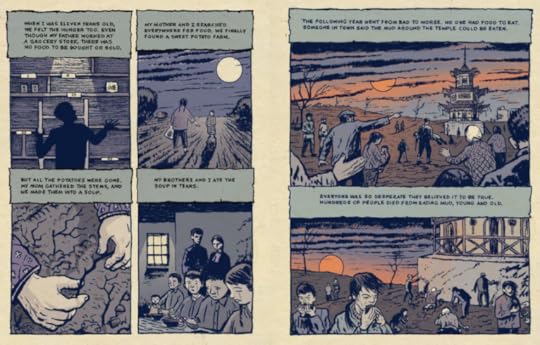
Image: Flashback to famine (using darker colours than the main stories)
March 6 is Lei Feng Day
Good intentions go horribly (comically?) awry, as Da Qin and her younger sister try to emulate Lei Feng by helping others.
“The cult of Mao and the cult of Lei Feng were two faces of the same coin: one was the cult of personality; the other, its essential corollary, was the cult of impersonality.”
Jung Chang in Wild Swans (see my review HERE).
Happy New Year: The Story of Nian the Monster
An origin myth for dragons and fireworks at Chinese New Year, and a typical children’s story of a monster vanquished (more or less). The scariest picture, of Nian chasing people through the town, is diluted by the fact they're adults, plus the addition of a couple of comical ducks and a few other animals.
My New Year Feast
Food, especially at festivals, is a deep part of culture and memories. This reminiscence includes close-ups of the feast.

Image: Grandmother's house, looking like a dolls’ house
Little White Duck
The final story starts with book-loving Da Qin’s reticence at meeting the grandmother she doesn’t remember and that her mother doesn’t like. She’s excited to travel on a train (smarter than some I used more recently), but reels at the culture shock of a poor village, where the children are illiterate. That prompts introspection - and gratitude for what she has.
Ducks and cranes
The book's title comes from an embroidered duck on Da Qin's favourite jacket that features in the final piece (above), but white cranes are the recurring motif (see cranes in Chinese mythology), often with Da Qin and Xiao Qin flying on one.
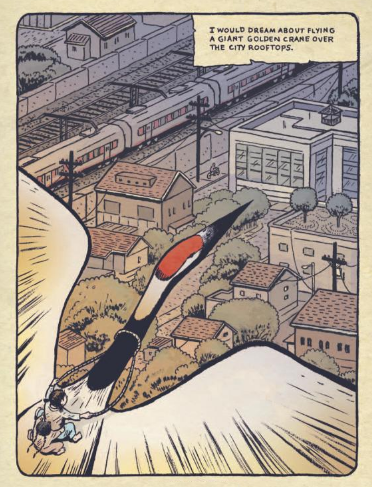
Image: Flying above the city
Wuhan - my memories
When I ordered this, I didn’t know that it’s set in Wuhan, nor that by the time it arrived, I would be under lockdown because of the COVID-19 pandemic which started in that city.
But I just ate lunch in my garden, in cool bright spring sunshine. I'm currently well, and I have happy memories of China: friendly people, delicious food, stunning scenery, and amazing sights, though we only spent a few hours in Wuhan itself.
A comment brought me back to this review almost exactly a year later. We're still in lockdown (only schools and essential shops open), though there was partial relaxation last summer, and now that half the UK adults have had their first vaccine jab, plans to relax restrictions gradually in coming weeks.
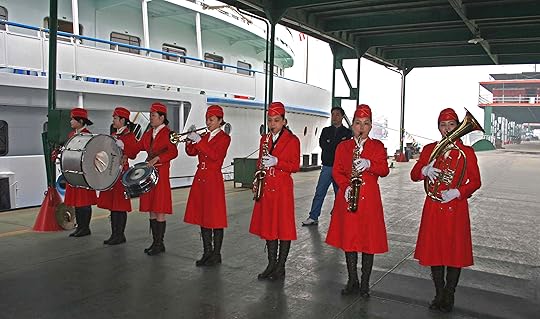
Image: Being “piped” ashore, Wuhan, 2008
Chinese history timeline
Summarised in just seven points (there’s a little more detail in the book):
* 551 BCE, Confucius born.
* 246 BCE - 1912 CE, Imperial era.
* 1927 - 1949, civil war between Chinese Nationalist Party and Communist Party.
* 1943, Mao Zedong becomes leader of the Communist Party.
* 1949, People’s Republic of China created.
* 1958 - 1961, the Great Leap Forward, including The Four Pests campaign and the Great Famine.
* 1962, Lei Feng, of the People’s Liberation Army, dies in an accident aged 22 and is touted as a role model.
* 1966 - 1976, the Cultural Revolution.
* 1976, Chairman Mao dies, and China begins to loosen up and open up.
Thanks to Swaroop and David S for putting this on my radar.
It is illustrated by her husband, and produced for their young daughter, born and raised in the USA, so it’s suitable for children as young as six or seven. It gently describes hardship, politics, and propaganda, balanced by more generic childhood emotions and experiences, portrayed with charm.
The colour palette is muted, and toned down further for the flashbacks to her parents’ youth.
As well as the eight chapters, there’s a glossary, timeline (see below), Na Liu’s autobiography (she moved to the US in her twenties, as a medical researcher, and is now a doctor), translations of Chinese characters used in poems and posters in the illustrations, and a simple map of China, and of Hubei province. In the book, she’s known by her childhood nickname, Da Qin.
Eight varied memories
Wuhan, China
After meeting her family, we have a bird’s eye view of Da Qin's home city.
A Sad, Sad Day
The profound national shock and sadness at Mao’s death creates deep but uncomprehending sadness in Da Qin. Her parents explain how Mao improved opportunities for people like them.
The Four Pests
Small children have a part to play in ridding the nation of pests - but it’s not pretty. Da Qin’s memories are followed by a page explaining the earlier disaster of including sparrows as pests: they’d been exterminated on the assumption they ate too much grain, but without them eating insects, harvest plummeted, triggering famine.
"Don't Waste Your Food - Children are Starving in China"
Her parents survival of that famine is why they won’t tolerate waste.
Image: Flashback to famine (using darker colours than the main stories)
March 6 is Lei Feng Day
Good intentions go horribly (comically?) awry, as Da Qin and her younger sister try to emulate Lei Feng by helping others.
“The cult of Mao and the cult of Lei Feng were two faces of the same coin: one was the cult of personality; the other, its essential corollary, was the cult of impersonality.”
Jung Chang in Wild Swans (see my review HERE).
Happy New Year: The Story of Nian the Monster
An origin myth for dragons and fireworks at Chinese New Year, and a typical children’s story of a monster vanquished (more or less). The scariest picture, of Nian chasing people through the town, is diluted by the fact they're adults, plus the addition of a couple of comical ducks and a few other animals.
My New Year Feast
Food, especially at festivals, is a deep part of culture and memories. This reminiscence includes close-ups of the feast.
Image: Grandmother's house, looking like a dolls’ house
Little White Duck
The final story starts with book-loving Da Qin’s reticence at meeting the grandmother she doesn’t remember and that her mother doesn’t like. She’s excited to travel on a train (smarter than some I used more recently), but reels at the culture shock of a poor village, where the children are illiterate. That prompts introspection - and gratitude for what she has.
Ducks and cranes
The book's title comes from an embroidered duck on Da Qin's favourite jacket that features in the final piece (above), but white cranes are the recurring motif (see cranes in Chinese mythology), often with Da Qin and Xiao Qin flying on one.
Image: Flying above the city
Wuhan - my memories
When I ordered this, I didn’t know that it’s set in Wuhan, nor that by the time it arrived, I would be under lockdown because of the COVID-19 pandemic which started in that city.
But I just ate lunch in my garden, in cool bright spring sunshine. I'm currently well, and I have happy memories of China: friendly people, delicious food, stunning scenery, and amazing sights, though we only spent a few hours in Wuhan itself.
A comment brought me back to this review almost exactly a year later. We're still in lockdown (only schools and essential shops open), though there was partial relaxation last summer, and now that half the UK adults have had their first vaccine jab, plans to relax restrictions gradually in coming weeks.
Image: Being “piped” ashore, Wuhan, 2008
Chinese history timeline
Summarised in just seven points (there’s a little more detail in the book):
* 551 BCE, Confucius born.
* 246 BCE - 1912 CE, Imperial era.
* 1927 - 1949, civil war between Chinese Nationalist Party and Communist Party.
* 1943, Mao Zedong becomes leader of the Communist Party.
* 1949, People’s Republic of China created.
* 1958 - 1961, the Great Leap Forward, including The Four Pests campaign and the Great Famine.
* 1962, Lei Feng, of the People’s Liberation Army, dies in an accident aged 22 and is touted as a role model.
* 1966 - 1976, the Cultural Revolution.
* 1976, Chairman Mao dies, and China begins to loosen up and open up.
Thanks to Swaroop and David S for putting this on my radar.

November 2, 2017
I'm rating this on my personal enjoyment of this book. The author and illustrator did do what they set out to do - a snapshot of life for two girls growing up around the time of chairman Mao's death. I found the way killing either by accident or on purpose, and torture of birds, animals and insects in the story really disturbing when shown surrounded by smiling children. Obviously the author is describing events that happened. The description of what I can only call the anal rape of an animal with an object by children was horrible, especially when it was shown in an almost comical way. The rest of the book is interesting, informative and depressing. Most readers seemed to have enjoyed this book.

September 8, 2017
A graphic memoir for tweens (and perhaps somewhat younger children) by a wife and husband team, Na Liu and illustrator Andres Vera Martinez. Liu grew up in Hubei Province of China and helps me learn of a world I knew little about, from a child’s perspective. We learn of life in rural China after the death of Chairman Mao, whom her family revered; we learn about The Four Pests and the misguided and tragic killing of one of them, millions of sparrows, which brought on The Great Famine. We learn of Chinese New Year as it was practiced there, we learn of great poverty and sadness and small joys, friendships, but ach! That sad cover painting of An Liu! Told in eight vignettes, illustrated appropriately for the time period and informed by cultural research and memory. 3.5, for me, rounded up because of the art.
Here’s a look:
http://www.andresvera.com/little-whit...
Here’s a look:
http://www.andresvera.com/little-whit...

September 4, 2012
It's funny to think about, but the fact of the matter is that we're still in the early days of the graphic novel memoir for children. Adult graphic novel memoirs are capable of winning top literary awards, like the Pulitzer or the National Book Award. On the kid side of things the options are far more limited. The top literary prize for kids, the Newbery, has never been handed to a comic work, nor does the American Library Association have a prize for comics of any sort. All this comes to mind when I pick up a book like Little White Duck. Couched in the memories of its author, this groundbreaking work is perhaps the finest marriage of world history and comic art for kids I've seen in a very long time. A must read for young and old alike.
Told in eight short stories, the book follows Da Qin the middle class daughter of two parents, living in the late 1970s/early 80s. Through her eyes we see a number of small stories about growing up in a post-Mao China. There's the tale of how she and her younger sister attempted to emulate their nation's heroes by helping some thirsty chicks (to an unfortunate end, I'm afraid), or the one about having to bring in rat tails to prove she was great at pest control. There's the story of how Mao's death affected the nation, and useful facts about China during this era. Most impressive is the titular story about Da Qin and what happened to the white velvet duck on her jacket when she and her father visited the village where he was born. Honest, sometimes funny, and unusually touching, this glimpse into another life in another world rings distinctly true.
This book has been a reason for serious debate amongst the librarians of my system. Some wondered about the seemingly unconnected stories and whether or not they gelled properly. Others fretted that there wasn't enough context given about growing up in China during the post-Mao era. Still others wondered about the authenticity. The book was then handed to a co-worker of mine who grew up in China during the same time period as Na Liu she was floored. The details of the book were straight out of her own childhood. She held up one picture to me of popped rice, explaining what it was and how she had never seen it portrayed in a book before. So on the reality front the book certainly ranks an A.
Actually, when I asked my Chinese co-worker to read the book in the first place she was hugely reluctant. Turned out, she just didn't want to read yet another kid's book about the Cultural Revolution, and who could blame her? I would say that the vast swath of books for kids set in China are solely interested in Cultural Revolution stuff (stuff that my poor co-worker would be forced to vet time and time again). Part of what makes Little White Duck work is that without didacticism it simply tells a true story about some of the people who were helped by Mao's rule. Da Qin's parents were poor and thanks to changes were able to get an education and treated for polio. The book makes no bones about the hungry times under Mao, but it's rare to get a nuanced view in a work for youth. Heck, the first story in the book is about the massive weeping that occurred in Da Qin's village when Mao died and about her very realistic child response of crying because everyone else was crying around her. That's honestly Liu's greatest strength with this book. She creates universal stories from her youth that anybody can enjoy, even as she sets them in a very specific time and place. That's why the fact that they are individual stories rather than one overarching storyline work for me. Each one is like a little glimpse into a realistic kid's life.
Not to mention the fact that the book deals with class in a remarkable way. I've a real penchant for children's books that know how to deal with class differences. Bad works of children's literature will usually feature a poor kid hating a rich kid and then inevitably discovering "Gee whiz, we're not so different after all.". Smart books for kids handle this enormously complex idea in candid, thoughtful ways. Anna Hibiscus could do it by showing the difference between middle and lower classes in contemporary Nigeria. Little White Duck is the same, using its titular story to tell the tale of Da Qin and her father visiting the poor village where he grew up. Reading that story I went into it confident that I knew how it would work. When Da Qin's father tells her to go play with the village kids I was sure they'd be mean to her and she'd learn something. Instead they're perfectly cordial. They are, admittedly, fascinated by the little white velvet duck on her coat and the dirt on their hands coat it black with all their petting. Then for fun, because they can't afford books like she can, they put sticks up buzzing insects and run about. The next shot is a shell-shocked Da Qin sitting on a train seat while her father asks obliviously, "Did you have a good time?" I loved that. I loved seeing her encounter kids with less at such a young age and coming to an understanding of how lucky she was.
One librarian I spoke too worried that because there are so few books for kids out there, children reading this book today might assume that it shows contemporary China and not the China of the past. Honestly I don't think that's a huge danger. It's possible that will happen, sure, but Liu covers her bases for the most part, and the brown palette of the art gives everything a historical taste. Now the art poses an interesting question. Created by Texan artist Andres Vera Martinez, this is at least his second foray into graphic novels for kids. The style is perfect for the story too. Filled with details realistic, but also fun, it's a properly moving tone for a book that is sometimes thoughtful, sometimes sad, sometimes funny, and always interesting. Now that brown palette I alluded to earlier could potentially prove detrimental. There is an understanding out there that kids will not read black and white comics. True. There is also and understanding that kids will not read books with brown covers. Also true. So what do we make of books that are comics colored in a lot of brown? I'm not quite sure but I'm confident that any kid who reads a story or two in the book will be hugely inclined to continue to do so. Good art and writing win out.
Liu says in the book that she wrote it so that her daughter might get a glimpse into what it was like growing up. Sometimes family stories just aren't enough. You've gotta show, not tell. Even now, when I show a book like this to adults, some of them will say to me, "But what kid would ever read it?". There's this continuing perception that unless a comic has superheroes or manga characters it, no kid will want to read it. This does kids a serious injustice. We don't ask why kids would ever pick up a memoir like Diary of a Young Girl even when there are copies of Harry Potter available. The wonderful thing about kids and comics is that some readers will pick up anything, just so long as there are panels and speech balloons to be had. In other cases you have kids that like comics but aren't big fiction and fantasy readers. For them we hand over this book. Perhaps the strongest graphic novels for kids of the year and undoubtedly unique, this is one way of teaching world history through a lens that cannot be matched. Thoroughly and entirely remarkable.
For ages 9-12.
Told in eight short stories, the book follows Da Qin the middle class daughter of two parents, living in the late 1970s/early 80s. Through her eyes we see a number of small stories about growing up in a post-Mao China. There's the tale of how she and her younger sister attempted to emulate their nation's heroes by helping some thirsty chicks (to an unfortunate end, I'm afraid), or the one about having to bring in rat tails to prove she was great at pest control. There's the story of how Mao's death affected the nation, and useful facts about China during this era. Most impressive is the titular story about Da Qin and what happened to the white velvet duck on her jacket when she and her father visited the village where he was born. Honest, sometimes funny, and unusually touching, this glimpse into another life in another world rings distinctly true.
This book has been a reason for serious debate amongst the librarians of my system. Some wondered about the seemingly unconnected stories and whether or not they gelled properly. Others fretted that there wasn't enough context given about growing up in China during the post-Mao era. Still others wondered about the authenticity. The book was then handed to a co-worker of mine who grew up in China during the same time period as Na Liu she was floored. The details of the book were straight out of her own childhood. She held up one picture to me of popped rice, explaining what it was and how she had never seen it portrayed in a book before. So on the reality front the book certainly ranks an A.
Actually, when I asked my Chinese co-worker to read the book in the first place she was hugely reluctant. Turned out, she just didn't want to read yet another kid's book about the Cultural Revolution, and who could blame her? I would say that the vast swath of books for kids set in China are solely interested in Cultural Revolution stuff (stuff that my poor co-worker would be forced to vet time and time again). Part of what makes Little White Duck work is that without didacticism it simply tells a true story about some of the people who were helped by Mao's rule. Da Qin's parents were poor and thanks to changes were able to get an education and treated for polio. The book makes no bones about the hungry times under Mao, but it's rare to get a nuanced view in a work for youth. Heck, the first story in the book is about the massive weeping that occurred in Da Qin's village when Mao died and about her very realistic child response of crying because everyone else was crying around her. That's honestly Liu's greatest strength with this book. She creates universal stories from her youth that anybody can enjoy, even as she sets them in a very specific time and place. That's why the fact that they are individual stories rather than one overarching storyline work for me. Each one is like a little glimpse into a realistic kid's life.
Not to mention the fact that the book deals with class in a remarkable way. I've a real penchant for children's books that know how to deal with class differences. Bad works of children's literature will usually feature a poor kid hating a rich kid and then inevitably discovering "Gee whiz, we're not so different after all.". Smart books for kids handle this enormously complex idea in candid, thoughtful ways. Anna Hibiscus could do it by showing the difference between middle and lower classes in contemporary Nigeria. Little White Duck is the same, using its titular story to tell the tale of Da Qin and her father visiting the poor village where he grew up. Reading that story I went into it confident that I knew how it would work. When Da Qin's father tells her to go play with the village kids I was sure they'd be mean to her and she'd learn something. Instead they're perfectly cordial. They are, admittedly, fascinated by the little white velvet duck on her coat and the dirt on their hands coat it black with all their petting. Then for fun, because they can't afford books like she can, they put sticks up buzzing insects and run about. The next shot is a shell-shocked Da Qin sitting on a train seat while her father asks obliviously, "Did you have a good time?" I loved that. I loved seeing her encounter kids with less at such a young age and coming to an understanding of how lucky she was.
One librarian I spoke too worried that because there are so few books for kids out there, children reading this book today might assume that it shows contemporary China and not the China of the past. Honestly I don't think that's a huge danger. It's possible that will happen, sure, but Liu covers her bases for the most part, and the brown palette of the art gives everything a historical taste. Now the art poses an interesting question. Created by Texan artist Andres Vera Martinez, this is at least his second foray into graphic novels for kids. The style is perfect for the story too. Filled with details realistic, but also fun, it's a properly moving tone for a book that is sometimes thoughtful, sometimes sad, sometimes funny, and always interesting. Now that brown palette I alluded to earlier could potentially prove detrimental. There is an understanding out there that kids will not read black and white comics. True. There is also and understanding that kids will not read books with brown covers. Also true. So what do we make of books that are comics colored in a lot of brown? I'm not quite sure but I'm confident that any kid who reads a story or two in the book will be hugely inclined to continue to do so. Good art and writing win out.
Liu says in the book that she wrote it so that her daughter might get a glimpse into what it was like growing up. Sometimes family stories just aren't enough. You've gotta show, not tell. Even now, when I show a book like this to adults, some of them will say to me, "But what kid would ever read it?". There's this continuing perception that unless a comic has superheroes or manga characters it, no kid will want to read it. This does kids a serious injustice. We don't ask why kids would ever pick up a memoir like Diary of a Young Girl even when there are copies of Harry Potter available. The wonderful thing about kids and comics is that some readers will pick up anything, just so long as there are panels and speech balloons to be had. In other cases you have kids that like comics but aren't big fiction and fantasy readers. For them we hand over this book. Perhaps the strongest graphic novels for kids of the year and undoubtedly unique, this is one way of teaching world history through a lens that cannot be matched. Thoroughly and entirely remarkable.
For ages 9-12.

December 14, 2021
Significantly-flawed message
Don't get me wrong, I love how this book tries to tell the author's story. I love the rich culture that she includes. I even love the illustrations (although the book itself practically has no plot whatsoever...) What I can't love... In fact, what I hate about this book is how positively it portrays Mao Zedong and the Communist Party in China. I'm sorry if I'm using strong language here but I feel very passionately for what I'm going to talk about. I understand that this is a children's book which means everything needs to be toned down a bit and nothing too disturbing needs to be portrayed, but what is not okay is acting like Chairman Mao was a super great guy who fixed everything. In fact, he was just the opposite, and this book makes it seem like he made China a much better nation when the truth is that he practically ruined it.
Little White Duck gets all nitty-gritty about everything except for the Mao Zedong and the Communist Party. How could the author act like Mao swooped in and saved the common people from their famines and their sufferings when it was literally he himself that issued the sparrow command that ended up causing the Great Chinese Famine?! One thing the author did get right is that the people did suffer and die in millions from that famine. What she didn't say (in fact, she completely ignored it), was that her precious Chairman Mao was a significant reason why the famine happened in the first place. And what about the Tiananmen Square massacre of young students? What about the One-Child Policy with forced abortions, contraception, and crippling fines for those who didn't obey? (The author did mention this policy briefly, but all she said was that it didn't much affect her family and then carried on being positive about Mao Zedong...) What about Mao forcing everyone to literally worship him? What about him attempting to destroy the centuries of culture and literacy that made up China before? What about the government encouraging children to betray their own parents and turn them into the police? What about law enforcement beating elderly men on the streets and dragging elderly women out of their homes? For God's sake! How in the world can Na Liu grow up seeing and hearing these things happen and still praise such a government?
Sure, you can say that she was brainwashed then, but why write a book now, too, that acts as if China's infamous leader was really someone who actually wanted good for the people? If he really did, he wouldn't have sent army trucks to run students down in Tiananmen Square.
The last thing we need is for people to think that Mao Zedong was good for China. His bad outweighs anything that could've be good about him by millions. To those Americans who don't know much about the Cultural Revolution, you can read this book, but read other books, too. Things happened in China that hopefully will never be repeated again. It wasn't the people's fault (in fact, the people were often the victims), but the government's. And it is extremely disturbing how many people are so uninformed concerning the Cultural Revolution (or even the Holocaust!) when both literally happened less than a century ago.
If you want to see what China was really like in that time period, I'd recommend Red Scarf Girl. I wish the millions of victims of the Cultural Revolution had a voice today, and I hope that you will give their voices a chance to be heard in your own life.
Don't get me wrong, I love how this book tries to tell the author's story. I love the rich culture that she includes. I even love the illustrations (although the book itself practically has no plot whatsoever...) What I can't love... In fact, what I hate about this book is how positively it portrays Mao Zedong and the Communist Party in China. I'm sorry if I'm using strong language here but I feel very passionately for what I'm going to talk about. I understand that this is a children's book which means everything needs to be toned down a bit and nothing too disturbing needs to be portrayed, but what is not okay is acting like Chairman Mao was a super great guy who fixed everything. In fact, he was just the opposite, and this book makes it seem like he made China a much better nation when the truth is that he practically ruined it.
Little White Duck gets all nitty-gritty about everything except for the Mao Zedong and the Communist Party. How could the author act like Mao swooped in and saved the common people from their famines and their sufferings when it was literally he himself that issued the sparrow command that ended up causing the Great Chinese Famine?! One thing the author did get right is that the people did suffer and die in millions from that famine. What she didn't say (in fact, she completely ignored it), was that her precious Chairman Mao was a significant reason why the famine happened in the first place. And what about the Tiananmen Square massacre of young students? What about the One-Child Policy with forced abortions, contraception, and crippling fines for those who didn't obey? (The author did mention this policy briefly, but all she said was that it didn't much affect her family and then carried on being positive about Mao Zedong...) What about Mao forcing everyone to literally worship him? What about him attempting to destroy the centuries of culture and literacy that made up China before? What about the government encouraging children to betray their own parents and turn them into the police? What about law enforcement beating elderly men on the streets and dragging elderly women out of their homes? For God's sake! How in the world can Na Liu grow up seeing and hearing these things happen and still praise such a government?
Sure, you can say that she was brainwashed then, but why write a book now, too, that acts as if China's infamous leader was really someone who actually wanted good for the people? If he really did, he wouldn't have sent army trucks to run students down in Tiananmen Square.
The last thing we need is for people to think that Mao Zedong was good for China. His bad outweighs anything that could've be good about him by millions. To those Americans who don't know much about the Cultural Revolution, you can read this book, but read other books, too. Things happened in China that hopefully will never be repeated again. It wasn't the people's fault (in fact, the people were often the victims), but the government's. And it is extremely disturbing how many people are so uninformed concerning the Cultural Revolution (or even the Holocaust!) when both literally happened less than a century ago.
If you want to see what China was really like in that time period, I'd recommend Red Scarf Girl. I wish the millions of victims of the Cultural Revolution had a voice today, and I hope that you will give their voices a chance to be heard in your own life.

March 3, 2019
This book is eight true short stories about a young girl growing up in China starting in the late 1970s. It talks about the reaction to Mao Zedong's death, famine the country faced, the Lunar New Year and its celebrations, traveling to the countryside and recognizing class differences, and the four pests that leaders wrongly told citizens to kill (like the sparrows threatening farms).
China in the 1970s and '80s is so different from the connected, global world we live in today. The types of activities and conversations depicted in this book are of that time period - it's tough to read at times but it is Na Liu's truth, and she discusses being a part of this transitional generation in the afterword. I learned new things reading this short graphic work... the art is great, too, using lots of sepia/brown tones. I thought the style fit the story well.
China in the 1970s and '80s is so different from the connected, global world we live in today. The types of activities and conversations depicted in this book are of that time period - it's tough to read at times but it is Na Liu's truth, and she discusses being a part of this transitional generation in the afterword. I learned new things reading this short graphic work... the art is great, too, using lots of sepia/brown tones. I thought the style fit the story well.

August 7, 2019
This book is very awesome.

April 9, 2012
Tash read it first because China and Graphic Novel. Now that I've finished it, I really want Veronica to give it a go. We just had a conversation about how Chairman Mao was both responsible for a tremendous amount of death and suffering and was also beloved by many people, for bringing a nation from subsistence farming into industrialization. This collection of incidents in the life of a modern Chinese girl (born 1973), helps explain those two extremes. On the one hand, education, health care, food, on the other hand, poverty, squalor, back-breaking work.
The point is made, but not belabored.
Library copy.
The point is made, but not belabored.
Library copy.

March 27, 2021
Little White Duck: A Childhood in China, by Na Liu (text) and her husband Andrés Vera Martínez (art), is a collection of seven vignettes, done graphic-novel style, from the author's childhood. She was born in 1973 in Wuhan, China. Eventually she came to the United States, and now she's a doctor of hematology and oncology. She wanted to make this book to tell her daughter what life was like in China in that era, and I found it so engrossing that I sat in my car, reading it, after having picked it up from the library.
Every aspect of the book is beautiful. Andrés Vera Martínez's illustrations are full of small experiential details (Na Liu brushing her teeth at an outdoor tap, a woman riding sidesaddle on the back of a bicycle pedaled by a man, a dirty thumbprint on the titular white duck). You can tell that Na Liu shared vividly what her childhood was like. And then the stories she chose to tell were such a moving and varied collection, and they just resonated in my bones, corroborating everything Chinese friends and acquaintances of a similar age have ever said, as well as things I've read.
For a more in-depth review that includes some illustrations from the book, go here. I'm very grateful to Cecily for alerting me to this. I loved it.
Every aspect of the book is beautiful. Andrés Vera Martínez's illustrations are full of small experiential details (Na Liu brushing her teeth at an outdoor tap, a woman riding sidesaddle on the back of a bicycle pedaled by a man, a dirty thumbprint on the titular white duck). You can tell that Na Liu shared vividly what her childhood was like. And then the stories she chose to tell were such a moving and varied collection, and they just resonated in my bones, corroborating everything Chinese friends and acquaintances of a similar age have ever said, as well as things I've read.
For a more in-depth review that includes some illustrations from the book, go here. I'm very grateful to Cecily for alerting me to this. I loved it.

January 16, 2014
This is a really hard book to review. On the one hand the author is to be lauded for bringing her growing up to a wider and younger audience, on the other.... I know too many adult Chinese - perhaps of a generation older than her who suffered terribly under Mao. The saying "ren shi ren" arose in the great famine where people were literally eating other peoples children to survive. Her parents benefited from communism as the were born on the right side of the wrong side of the tracks. If they'd been intellectuals or landowners it would have been a different story. And yet, it is a lovely book, and beautifully illustrated. I think what I'd like to see is several parallel books - growing up if your parents were sent to be re-educated. Growing up as one of her illiterate cousins, growing up as her paternal or maternal grandparents. Only then do I think could her life be seen in context.
And those are all books that need to be written.
And those are all books that need to be written.

April 22, 2015
The cover of this book shows a brooding or angry or unhappy girl looking straight at the reader, her gloved hands at her sides, one of them holding a purse. A few bare branches in the distance are a little seasonal flag and I imagine it must be late fall or winter or early spring. The girl takes up most of the frame. She wears a green coat with a little white duck sewn on, just about the center point of the page. A striped scarf is tied neatly around her neck. Its off-white and orange matches that of her gloves.
It is dusk or dawn in this image. The sun rises or sets, leaving an orange blush in its wake. Something is about to begin, both timeless and distinctly set in a certain time. A child is about to set off an adventure and she will on one hand have the support of her parents, and on the other hand, be completely on her own (this book reminds me of the strange childhood world in which things have very different meanings than they do when we are adults. We are just trying to figure things out, and often we haven't a clue what's going on, and often, we have our own versions of reality, that can be quite fantastical.)
It might not take other readers so long, but it took me a few minutes to make sense of the rest of the picture, the author's father standing behind her with his hand on her head. He is a large presence, and yet one that is at a distance. He is too big of a presence to fully make sense of her experiences. He protects her in the larger ways, and yet, to some degree, her experiences cannot be reached or explained by the adults around her.
It's not until the end of the book we find out the story of this particular coat whose little white duck becomes the title of this book. In the mean time, we read a little introduction explaining Chinese naming conventions, and 7 other stories, some longer and full of historical events, school experiences, curiosity, confusion (and emotional experiences that are distinct to childhood.) Wuhan, China and My New Years Feast are only a few pages long, and more like poetry. Happy New Year, The Story of Nian The Monster, and March 5 is Lei Feng Day, describe the specialness of holidays and also the magical mythology of holidays. There is a lot of humor and pathos in these stories. They have a simplicity and eloquence, a graceful clumsiness. They capture something elemental about childhood experience and I think kids will really relate to them, and as for adults, well, I tend to think all good kids books have a lot to offer their adult readers.
This is created by a husband and wife team, Na Liu and Andres Vera Martinez. I love looking at illustrations on Martinez's website http://www.andresvera.com/illustration/. He describes himself as an illustrator and educator, and his work shows a great range, a lot of skill at drawing emotion and movement, landscapes both magical and real.
I wonder if they will continue collaborating. I look forward to seeing more of their work (separate or in collaboration).
It is dusk or dawn in this image. The sun rises or sets, leaving an orange blush in its wake. Something is about to begin, both timeless and distinctly set in a certain time. A child is about to set off an adventure and she will on one hand have the support of her parents, and on the other hand, be completely on her own (this book reminds me of the strange childhood world in which things have very different meanings than they do when we are adults. We are just trying to figure things out, and often we haven't a clue what's going on, and often, we have our own versions of reality, that can be quite fantastical.)
It might not take other readers so long, but it took me a few minutes to make sense of the rest of the picture, the author's father standing behind her with his hand on her head. He is a large presence, and yet one that is at a distance. He is too big of a presence to fully make sense of her experiences. He protects her in the larger ways, and yet, to some degree, her experiences cannot be reached or explained by the adults around her.
It's not until the end of the book we find out the story of this particular coat whose little white duck becomes the title of this book. In the mean time, we read a little introduction explaining Chinese naming conventions, and 7 other stories, some longer and full of historical events, school experiences, curiosity, confusion (and emotional experiences that are distinct to childhood.) Wuhan, China and My New Years Feast are only a few pages long, and more like poetry. Happy New Year, The Story of Nian The Monster, and March 5 is Lei Feng Day, describe the specialness of holidays and also the magical mythology of holidays. There is a lot of humor and pathos in these stories. They have a simplicity and eloquence, a graceful clumsiness. They capture something elemental about childhood experience and I think kids will really relate to them, and as for adults, well, I tend to think all good kids books have a lot to offer their adult readers.
This is created by a husband and wife team, Na Liu and Andres Vera Martinez. I love looking at illustrations on Martinez's website http://www.andresvera.com/illustration/. He describes himself as an illustrator and educator, and his work shows a great range, a lot of skill at drawing emotion and movement, landscapes both magical and real.
I wonder if they will continue collaborating. I look forward to seeing more of their work (separate or in collaboration).
March 10, 2019
I'm not really sure what the purpose of this book was. The author described her childhood in 8 brief, unconnected stories. Na Liu's family benefited from communism and Liu, accordingly, had a very different view of the world than her poor, rural cousins did.
The vignettes in this story shed a spotlight on the country's reaction to Chairman Mao Zedong's death, the Lunar New Year celebrations, traveling to the countryside and recognizing class differences, and thefive four pests that leaders commanded citizens to kill, without understanding the disastrous ecological implications this would have on nationwide crop production.
I thought the artwork was lovely and the earth toned coloring supported the narrative.
Some of the ideologies espoused by citizens in the book are alarming to modern Westerners like me. I found the casual killing and torture of birds, animals and insects in the story to be disturbing and deeply unsettling. Having teachers put pressure on students to bring dead rat tails to ensure that all citizens were doing their part only engendered dishonesty in students who couldn't produce any animals. This is a picture book, which is intended to be read to a young audience but this book is not suitable for young children.
The vignettes in this story shed a spotlight on the country's reaction to Chairman Mao Zedong's death, the Lunar New Year celebrations, traveling to the countryside and recognizing class differences, and the
I thought the artwork was lovely and the earth toned coloring supported the narrative.
Some of the ideologies espoused by citizens in the book are alarming to modern Westerners like me. I found the casual killing and torture of birds, animals and insects in the story to be disturbing and deeply unsettling. Having teachers put pressure on students to bring dead rat tails to ensure that all citizens were doing their part only engendered dishonesty in students who couldn't produce any animals. This is a picture book, which is intended to be read to a young audience but this book is not suitable for young children.

December 31, 2012
Da Qin and her little sister are growing up in China during a time of change. Chairman Mao has just died, leading to the country opening slightly to the Western world. La Liu remembers moments that made an impact on her life.
This is a memoir, but it does not tell the story of Na Liu's entire life. Rather it is a series of short stories, small moments from her childhood. While we don't learn all about Na Liu's life, we are given a clear glimpse into the life of a child in China growing up after the death of Mao.
The first story Na Liu tells is going to the funeral of Chairman Mao, and recalling how incredibly sad her parents were. Both of Na Liu's parent's were able to make advances for themselves because of the government - her mother had polio as a child and the government paid for her care, Na Liu's father came from a farming family, but was able to pursue an education because of a government sponsorship. It was nice to hear these stories where Communism worked the way it was intended to work.
Another story is about Na Liu and her sister learning why they must eat all their food - the starving children in China. Na Liu's family was not wanting for food, but later, when she visits her father's family she horrified to see how other people live.
I thought Little White Duck did a good job of illustrating what was going on in China during this time. There were struggling peasants, and there were those who only wanted to be good citizens. Na Liu and her sister try to make sense of it all through their child's understanding, and it's hard.
The art was beautiful. It was done in very muted colors. There were really nice bright spots, even the red was dark. Lots of grays and blue-greens and browns. It reflected the military like feeling of the world Na Liu is growing up in. There is order and everyone does their part, no one steps out of line. The panels were also orderly and regular. At the beginning and end of the book, there were lovely double-paged spreads of Na Liu and her sister flying over China on a crane.
A great middle-grade book for explaining about children growing up in different parts of the world and during different time periods.
This is a memoir, but it does not tell the story of Na Liu's entire life. Rather it is a series of short stories, small moments from her childhood. While we don't learn all about Na Liu's life, we are given a clear glimpse into the life of a child in China growing up after the death of Mao.
The first story Na Liu tells is going to the funeral of Chairman Mao, and recalling how incredibly sad her parents were. Both of Na Liu's parent's were able to make advances for themselves because of the government - her mother had polio as a child and the government paid for her care, Na Liu's father came from a farming family, but was able to pursue an education because of a government sponsorship. It was nice to hear these stories where Communism worked the way it was intended to work.
Another story is about Na Liu and her sister learning why they must eat all their food - the starving children in China. Na Liu's family was not wanting for food, but later, when she visits her father's family she horrified to see how other people live.
I thought Little White Duck did a good job of illustrating what was going on in China during this time. There were struggling peasants, and there were those who only wanted to be good citizens. Na Liu and her sister try to make sense of it all through their child's understanding, and it's hard.
The art was beautiful. It was done in very muted colors. There were really nice bright spots, even the red was dark. Lots of grays and blue-greens and browns. It reflected the military like feeling of the world Na Liu is growing up in. There is order and everyone does their part, no one steps out of line. The panels were also orderly and regular. At the beginning and end of the book, there were lovely double-paged spreads of Na Liu and her sister flying over China on a crane.
A great middle-grade book for explaining about children growing up in different parts of the world and during different time periods.

October 28, 2012
This was super-neat. When I set out to read about China, I'm always bracing myself for huge, heavy cultural lessons about how terrible Maoist Communism was or sort-of apologetics for how complicated a country and culture it is. This was refreshingly neither. This was just one girl's story of a not too-opressive, not too-luxurious childhood in 1970s China. All around are the darker aspects of Chinese communism (rat-tail collection, poor village kids getting her jacket dirty, just escaping the one-child policy but not being able to attend school because there was only room for one sibling to go) but Na Liu also tells a great story about loving her family, little adventures, parental affection, dreams of flight, and so on. A slice of life, with its goods and bads.
The other really interesting and unique thing about this book was the illustration style. Na Liu, of course, is Chinese, and the illustrator, her husband, is Mexican-American. I have to say, I did see a distincly Latino/American style in the illustration, which gave it a richness and heartiness (people look healthy, earth looks earthy, life is vibrant, colorful, alive, emotional) that is not so evident in lithe and sparse Asian-style art, and I think this did a lot to make it a relatable and warm book (and unique!). Plus, it being a husband and wife team made it seem really heartfelt, something to say, show their child to tell her the mom's story. Aww. Yep.
The other really interesting and unique thing about this book was the illustration style. Na Liu, of course, is Chinese, and the illustrator, her husband, is Mexican-American. I have to say, I did see a distincly Latino/American style in the illustration, which gave it a richness and heartiness (people look healthy, earth looks earthy, life is vibrant, colorful, alive, emotional) that is not so evident in lithe and sparse Asian-style art, and I think this did a lot to make it a relatable and warm book (and unique!). Plus, it being a husband and wife team made it seem really heartfelt, something to say, show their child to tell her the mom's story. Aww. Yep.

August 8, 2018
Lovely drawings, some interesting insights into the life of a young Chinese girl in the 70’s, but too short. It could have been much more if it had been at least 150 pages length (it’s 110).
January 9, 2015
this is a weird book. i didn't really enjoy it as much as i thought i would. i thought it focused to much on making the title make sense rather then clearly define what the story was about. i myself would rather hear about why certain things happened the way they did. the art was was textured like an old piece of parchment witch i thought was pretty cool. i wouldn't know who to recommend this to because i wants entirely fond of it.

December 3, 2012
I found this collection to be intriguing but uneven. I highly recommend adults read throught this first before reading to your kids. Not that I disapprove of stories about kids killing rats, killing chicks through over-watering, or learning about the Great Famine in China. (I'm the mom who talks about Nazi's at the dinner table!)
It's just that sometime at bedtime, I'm not in the mood for it.
I enjoyed the two chapters about New Years Eve the best! The magic realism is captivating and the descriptions of food are mouth-watering. These stories do a great job of sharing the festive feeling children have for New Years in China.
It's just that sometime at bedtime, I'm not in the mood for it.
I enjoyed the two chapters about New Years Eve the best! The magic realism is captivating and the descriptions of food are mouth-watering. These stories do a great job of sharing the festive feeling children have for New Years in China.

May 12, 2017
2.5 stars.
This graphic memoir is a collection of eight short stories based on the author's childhood in 1970s China. This book is targeted for middle school readers, and it's a good introduction to some Chinese culture and history. The stories center around Na Liu and her younger sister, and as if often the case in all cultures, much of what is going on in the adult world makes little sense to the young. I especially liked the way class is explored in the title story, however the book lacked enough cohesiveness and depth for this adult reader. I liked the art enough to round up.
This graphic memoir is a collection of eight short stories based on the author's childhood in 1970s China. This book is targeted for middle school readers, and it's a good introduction to some Chinese culture and history. The stories center around Na Liu and her younger sister, and as if often the case in all cultures, much of what is going on in the adult world makes little sense to the young. I especially liked the way class is explored in the title story, however the book lacked enough cohesiveness and depth for this adult reader. I liked the art enough to round up.

November 17, 2020
Na Liu and her sister’s world starting changing after the death of Chairman Mao in September 1976. When her mother was pregnant with her younger sister, the law changed that a family could have only one child. Therefore, as only one child could attend school, Na Liu accompanied her mother to her job as an elementary school teacher. She shares tales of the decimation of the sparrows, the famine, and celebrating Lein Feng Day and Happy New Year. Although vividly and beautifully drawn, the story felt disjointed. 3.5 stars.

January 12, 2024
3.5 stars.
I actually meant to read this a few years ago. I had it checked out of the library and everything. I actually started reading it, only to discover several pages missing (out of only 108 pages total) which was too much to actually read it. It was the only copy the library had. I had given up on reading it, but I noticed the other day that it was in the recommended section on Hoopla and figured that meant I had to give it a go!
Told through a series of short stories, this graphic memoir tells of stories and memories from author Liu Na's childhood in 1970s Wuhan, China. The art (from the author's husband) is gorgeous, with great character design and stunning landscapes. Some of the stories depict fairly idyllic childhood memories, while others depict moments that could only be in that place and time. The depictions of children being instructed to hunt down and kill rats for their tails as part of getting rid of pests and of children tormenting insects might be hard for some readers, but it definitely paints a clear picture of how things were different in this place and time. Middle grade and up readers will find this to be a fairly enjoyable and educational graphic memoir, especially when paired with other books on life in China during this time since experiences could vary so dramatically.
I actually meant to read this a few years ago. I had it checked out of the library and everything. I actually started reading it, only to discover several pages missing (out of only 108 pages total) which was too much to actually read it. It was the only copy the library had. I had given up on reading it, but I noticed the other day that it was in the recommended section on Hoopla and figured that meant I had to give it a go!
Told through a series of short stories, this graphic memoir tells of stories and memories from author Liu Na's childhood in 1970s Wuhan, China. The art (from the author's husband) is gorgeous, with great character design and stunning landscapes. Some of the stories depict fairly idyllic childhood memories, while others depict moments that could only be in that place and time. The depictions of children being instructed to hunt down and kill rats for their tails as part of getting rid of pests and of children tormenting insects might be hard for some readers, but it definitely paints a clear picture of how things were different in this place and time. Middle grade and up readers will find this to be a fairly enjoyable and educational graphic memoir, especially when paired with other books on life in China during this time since experiences could vary so dramatically.

May 12, 2012
Piccole storie di un'infanzia: non un'infanzia dorata, ma quella che è stata una comune, diffusa infanzia nella Cina degli anni '70, subito dopo la morte di Mao.
E' così che inizia il racconto di Liu Na, con la morte del "nonno" Mao e le lacrime della madre e del padre, e una cerimonia che lei, bambina di tre anni, non capisce, ma a cui piange disperatamente per la disperazione che la circonda.
Storie da un'infanzia comune, storie da un'infanzia che fa da ponte, sospesa tra la povertà e i sacrifici di quella rurale, ma che ha permesso un miglioramento (anche grazie all'aiuto del Partito) della vita dei suoi genitori, diventati maestra elementare e scienziato invece che contadini, e l'infanzia dei bambini cinesi di oggi, quasi completamente occidentalizzata; un'infanzia vissuta sotto l'ala del Partito, e che mostra con occhi di bambina i residui di una tradizione che si voleva far scomparire (miti e feste popolari), le forme di indottrinamento popolare (la scuola e i miti), il bene e il male degli interventi sulla vita del popolo (le cure gratuite alla madre e la Grande Carestia dovuta allo sterminio dei passeri).
Non c'è Bene, non c'è Male nei ricordi di Na: solo la propria vita, e la consapevolezza, nelle poche belle parole di postfazione, di come nella sua banalità sia stata eccezionale.
Bellissime, aggiungo, le tavole di Andres Vera Martines: apparentemente semplici, richiamano con finezza l'iconografia classica cinese, e insieme la produzione propagandistica, fondendo con efficacia la tradizione e il nuovo che la voleva schiacciare.
E' così che inizia il racconto di Liu Na, con la morte del "nonno" Mao e le lacrime della madre e del padre, e una cerimonia che lei, bambina di tre anni, non capisce, ma a cui piange disperatamente per la disperazione che la circonda.
Storie da un'infanzia comune, storie da un'infanzia che fa da ponte, sospesa tra la povertà e i sacrifici di quella rurale, ma che ha permesso un miglioramento (anche grazie all'aiuto del Partito) della vita dei suoi genitori, diventati maestra elementare e scienziato invece che contadini, e l'infanzia dei bambini cinesi di oggi, quasi completamente occidentalizzata; un'infanzia vissuta sotto l'ala del Partito, e che mostra con occhi di bambina i residui di una tradizione che si voleva far scomparire (miti e feste popolari), le forme di indottrinamento popolare (la scuola e i miti), il bene e il male degli interventi sulla vita del popolo (le cure gratuite alla madre e la Grande Carestia dovuta allo sterminio dei passeri).
Non c'è Bene, non c'è Male nei ricordi di Na: solo la propria vita, e la consapevolezza, nelle poche belle parole di postfazione, di come nella sua banalità sia stata eccezionale.
Bellissime, aggiungo, le tavole di Andres Vera Martines: apparentemente semplici, richiamano con finezza l'iconografia classica cinese, e insieme la produzione propagandistica, fondendo con efficacia la tradizione e il nuovo che la voleva schiacciare.

February 4, 2013
A very child-appropriate graphic memoir of growing up in China. It's made by a husband and wife team (rad!), motivated by the fact that the experiences she had and the era in which she grew up is almost non-existent. And certainly the China of her parents' youth is nearly gone from living memory. It was structured as little vignettes about different events, like visiting her father's family in a very poor rural area and Chinese New Year (her favorite holiday).
It was especially interesting to read back to back with The 14th Dalai Lama: A Manga Biography. They overlap a little bit in terms of time period but have very different depictions of China. Well mostly it's that this book is a collection of stories from a child's point of view, and she was very oblivious (as most kids are) to the things Mao and the government were doing in Tibet and within China. It's a glimpse into the everyday life of a kid in a different part of the world at a different time.
It was especially interesting to read back to back with The 14th Dalai Lama: A Manga Biography. They overlap a little bit in terms of time period but have very different depictions of China. Well mostly it's that this book is a collection of stories from a child's point of view, and she was very oblivious (as most kids are) to the things Mao and the government were doing in Tibet and within China. It's a glimpse into the everyday life of a kid in a different part of the world at a different time.
May 2, 2018
LITTLE WHITE DUCK is a graphic memoir geared toward a juvenile audience. In the book, the author presents numerous vignettes of her life growing up in China in the 1970s. While there is material very specific to time and place, there are other experiences that are universal to childhood everywhere.
Parts of this story include the casual animal cruelty that kids sometimes engage in when they are unsupervised and/or not instructed better. In one scene, the two sisters attempt to water some overheated chicks and end up drowning them. While this is cruelty that can be chalked up to ignorance, there is also deliberate abuse of small creatures in this story. One especially jarring montage has two little girls devising ever more sadistic ways to kill rats, which they end up not doing as they don’t wish to touch the rodents.
I think some kids would indeed enjoy and benefit from this book, but I also don’t think I’d give it to any kid without guidance and discussion, particularly of the cruelty scenes. Kids can learn and do better, with the proper direction.
Parts of this story include the casual animal cruelty that kids sometimes engage in when they are unsupervised and/or not instructed better. In one scene, the two sisters attempt to water some overheated chicks and end up drowning them. While this is cruelty that can be chalked up to ignorance, there is also deliberate abuse of small creatures in this story. One especially jarring montage has two little girls devising ever more sadistic ways to kill rats, which they end up not doing as they don’t wish to touch the rodents.
I think some kids would indeed enjoy and benefit from this book, but I also don’t think I’d give it to any kid without guidance and discussion, particularly of the cruelty scenes. Kids can learn and do better, with the proper direction.

December 15, 2012
Loved the style of the drawings! They went well with both the old timey propaganda posters as well as the more fantastical elements.
The writing was also good by being both sparse enough for readers to pay attention to the drawings as well as descriptive enough to convey the tone at the time. My favorite "chapter" is the eponymous one.
While I probably liked this more because I could relate to the narrator, being a bridge from my parents communist China life to our new modern one, I think everyone could find something they like in this comic book.
If anything, it gives a personal story to what it was like to grow up in China after the Mao years.
The writing was also good by being both sparse enough for readers to pay attention to the drawings as well as descriptive enough to convey the tone at the time. My favorite "chapter" is the eponymous one.
While I probably liked this more because I could relate to the narrator, being a bridge from my parents communist China life to our new modern one, I think everyone could find something they like in this comic book.
If anything, it gives a personal story to what it was like to grow up in China after the Mao years.

February 3, 2019
I had hoped for a bit more ‘something’ from this book. The artwork is beautiful, but the story lacked character development, any sense of plot and didn’t delve deep enough into any one topic to give the book any sense of structure. I was very disappointed.I had hoped that, as a ‘children’s book’ that it might be worth allowing my son or students to read but it most certainly is NOT suitable for children in any way. Huge human and animal cruelty is portrayed and although these are very real events that should be explored, they are not handled in any appropriate way in this book.

July 18, 2020
I listened to this twice in audiobook format and think it probably works better in print or ebook formats. It's kind of weird to hear the narrator vocalize nonverbal sounds that are probably in speech balloons in the other formats.
And at at least one point early on the narrator refers to a picture in the book - which obviously isn't in the audiobook. That ought to have been dealt with in adapting the book into an audiobook.
And at at least one point early on the narrator refers to a picture in the book - which obviously isn't in the audiobook. That ought to have been dealt with in adapting the book into an audiobook.

December 2, 2012
I am always fascinated by memoirs and fictional/autobiographical accounts of people's lives in China during the Cultural Revolution. Little White Duck is unique in the sense that it takes place as Chairman Mao has died and China is going through more changes.

September 6, 2012
An exceptional graphic memoir about growing up in China in the 1970s. Superbly written and illustrated.

February 13, 2020
Great art

April 10, 2021
I loved this graphic memoir about a childhood in Wuhan, China, when Mao and his coterie were still running things.
Author Na Liu, now a doctor in New York, showed me that I need a more nuanced view of Chinese life in the 1970s. If your family had work and was in sync with the Party, it was apparently possible for a girl to experience the intermittent joys and laughter of a normal childhood.
Author Na Liu is my son's age. When he was a kid in the late 1970s, early '80s, we had a visitor from mainland China, a woman my age. Her childhood was not like Na Liu's. Her family were considered elites, enemies of the People. They were ostracized, tormented, forced into miserable and frequent self-criticism sessions, and sent to be reeducated in harsh living conditions. At the time I first met her, Ching did not speak a lot of English. But I got the message when she said repeatedly, "Very painful. Very painful."
When Ching was permiited by her government to visit the US, she had to promise to go back and help build the Motherland. She had already served many years as a mechanical engineer (a career she was ordered to pursue) and had been sent to work far from her husband, daughter, and mother. As I recall, 700 miles distant.
After coming to America, I don't think she went back right away. At some point, she married an American, worked on patents for his company, and brought her daughter to the US for high school. She did eventually resettle in China.
Why was her family such a threat to the Communist government? Answer: educated abroad. Ching's mother met my mother at college in Pennsylvania. That was my connection. Ching's mother became a doctor but was not allowed to practice medicine during the Cultural Revolution. I think she eventually committed suicide, but I am not sure. her remaining goal in life was to get her daughter to America.
Toward the end of *Little White Duck* a young Na Liu takes a long train trip with her father to an impoverished, rural part of China, and she meets children -- cousins -- who lack education or even soap and water to keep clean. Their idea of entertainment is torturing beetles. This is something new to the happy, well-loved child. It makes her think.
The art by Andrés Vera Martinezis just gorgeous. I highly recommend this book.
Author Na Liu, now a doctor in New York, showed me that I need a more nuanced view of Chinese life in the 1970s. If your family had work and was in sync with the Party, it was apparently possible for a girl to experience the intermittent joys and laughter of a normal childhood.
Author Na Liu is my son's age. When he was a kid in the late 1970s, early '80s, we had a visitor from mainland China, a woman my age. Her childhood was not like Na Liu's. Her family were considered elites, enemies of the People. They were ostracized, tormented, forced into miserable and frequent self-criticism sessions, and sent to be reeducated in harsh living conditions. At the time I first met her, Ching did not speak a lot of English. But I got the message when she said repeatedly, "Very painful. Very painful."
When Ching was permiited by her government to visit the US, she had to promise to go back and help build the Motherland. She had already served many years as a mechanical engineer (a career she was ordered to pursue) and had been sent to work far from her husband, daughter, and mother. As I recall, 700 miles distant.
After coming to America, I don't think she went back right away. At some point, she married an American, worked on patents for his company, and brought her daughter to the US for high school. She did eventually resettle in China.
Why was her family such a threat to the Communist government? Answer: educated abroad. Ching's mother met my mother at college in Pennsylvania. That was my connection. Ching's mother became a doctor but was not allowed to practice medicine during the Cultural Revolution. I think she eventually committed suicide, but I am not sure. her remaining goal in life was to get her daughter to America.
Toward the end of *Little White Duck* a young Na Liu takes a long train trip with her father to an impoverished, rural part of China, and she meets children -- cousins -- who lack education or even soap and water to keep clean. Their idea of entertainment is torturing beetles. This is something new to the happy, well-loved child. It makes her think.
The art by Andrés Vera Martinezis just gorgeous. I highly recommend this book.
Displaying 1 - 30 of 462 reviews