

What do you think?

The Last Samurai: The Life and Battles of Saigo Takamori
The dramatic arc of Saigo Takamori's life, from his humble origins as a lowly samurai, to national leadership, to his death as a rebel leader, has captivated generations of Japanese readers and now Americans as well - his life is the inspiration for a major Hollywood film, "The Last Samurai," starring Tom Cruise and Ken Watanabe. In this vibrant new biography, Mark Ravina, professor of history and Director of East Asian Studies at Emory University, explores the facts behind Hollywood storytelling and Japanese legends, and explains the passion and poignancy of Saigo's life. Known both for his scholarly research and his appearances on The History Channel, Ravina recreates the world in which Saigo lived and died, the last days of the samurai. "The Last Samurai" traces Saigo's life from his early days as a tax clerk in far southwestern Japan, through his rise to national prominence as a fierce imperial loyalist. Saigo was twice exiled for his political activities -- sent to Japan's remote southwestern islands where he fully expected to die. But exile only increased his reputation for loyalty, and in 1864 he was brought back to the capital to help his lord fight for the restoration of the emperor. In 1868, Saigo commanded his lord's forces in the battles which toppled the shogunate and he became and leader in the emperor Meiji's new government. But Saigo found only anguish in national leadership. He understood the need for a modern conscript army but longed for the days of the traditional warrior.
Saigo hoped to die in service to the emperor. In 1873, he sought appointment as envoy to Korea, where he planned to demand that the Korean king show deference to the Japanese emperor, drawing his sword, if necessary, top defend imperial honor. Denied this chance to show his courage and loyalty, he retreated to his homeland and spent his last years as a schoolteacher, training samurai boys in frugality, honesty, and courage. In 1876, when the government stripped samurai of their swords, Saigo's followers rose in rebellion and Saigo became their reluctant leader. His insurrection became the bloodiest war Japan had seen in centuries, killing over 12,000 men on both sides and nearly bankrupting the new imperial government. The imperial government denounced Saigo as a rebel and a traitor, but their propaganda could not overcome his fame and in 1889, twelve years after his death, the government relented, pardoned Saigo of all crimes, and posthumously restored him to imperial court rank.
In THE LAST SAMURAI, Saigo is as compelling a character as Robert E. Lee was to Americans-a great and noble warrior who followed the dictates of honor and loyalty, even though it meant civil war in a country to which he'd devoted his life. Saigo's life is a fascinating look into Japanese feudal society and a history of a country as it struggled between its long traditions and the dictates of a modern future.
Saigo hoped to die in service to the emperor. In 1873, he sought appointment as envoy to Korea, where he planned to demand that the Korean king show deference to the Japanese emperor, drawing his sword, if necessary, top defend imperial honor. Denied this chance to show his courage and loyalty, he retreated to his homeland and spent his last years as a schoolteacher, training samurai boys in frugality, honesty, and courage. In 1876, when the government stripped samurai of their swords, Saigo's followers rose in rebellion and Saigo became their reluctant leader. His insurrection became the bloodiest war Japan had seen in centuries, killing over 12,000 men on both sides and nearly bankrupting the new imperial government. The imperial government denounced Saigo as a rebel and a traitor, but their propaganda could not overcome his fame and in 1889, twelve years after his death, the government relented, pardoned Saigo of all crimes, and posthumously restored him to imperial court rank.
In THE LAST SAMURAI, Saigo is as compelling a character as Robert E. Lee was to Americans-a great and noble warrior who followed the dictates of honor and loyalty, even though it meant civil war in a country to which he'd devoted his life. Saigo's life is a fascinating look into Japanese feudal society and a history of a country as it struggled between its long traditions and the dictates of a modern future.
214 pages, Paperback
First published October 31, 2003
About the author
Mark J. Ravina
6 books29 followersDr. Mark J. Ravina is Professor of History at Emory University, where he has taught since 1991. He received his A.B. from Columbia University and his M.A. and Ph.D. from Stanford University. He has been a visiting professor at Kyoto University’s Institute for Research in Humanities and a research fellow at Keio University and the International Research Center for Japanese Studies. He has also received research grants from the Fulbright Program, the Japan Foundation, the Academy of Korean Studies, and the Association for Asian Studies.
Professor Ravina has published extensively in early modern Japanese history, with a particular focus on the transnational and international aspects of political change. He has also published research on Japanese and Korean popular culture, Japanese economic thought, and the history of science. As a public intellectual, he has appeared on CNN, CNN International, NPR, and The History Channel.
A former director of the East Asian Studies Program at Emory University, Professor Ravina has also served as president of the Southeast Conference of the Association for Asian Studies. In addition, he is on the editorial board of The Journal of Asian Studies. Professor Ravina’s books include The Last Samurai: The Life and Battles of Saigo Takamori and Land and Lordship in Early Modern Japan.
Professor Ravina has published extensively in early modern Japanese history, with a particular focus on the transnational and international aspects of political change. He has also published research on Japanese and Korean popular culture, Japanese economic thought, and the history of science. As a public intellectual, he has appeared on CNN, CNN International, NPR, and The History Channel.
A former director of the East Asian Studies Program at Emory University, Professor Ravina has also served as president of the Southeast Conference of the Association for Asian Studies. In addition, he is on the editorial board of The Journal of Asian Studies. Professor Ravina’s books include The Last Samurai: The Life and Battles of Saigo Takamori and Land and Lordship in Early Modern Japan.
Ratings & Reviews
Friends & Following
Create a free account to discover what your friends think of this book!
Community Reviews
Displaying 1 - 30 of 59 reviews

Read
May 16, 2013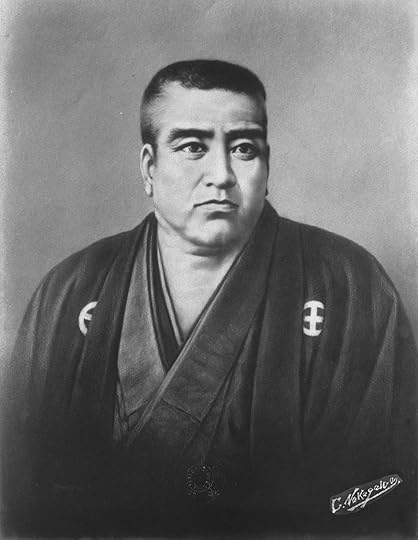
First off: This is a scholarly text and not a spinoff from the Hollywood movie. The choice of title (the book appeared in 2004, the movie in 2003) was clearly motivated by commercial concerns and not by historical considerations, but the extensive research that went into this text was begun many years before the movie was released and the book comes complete with all the standard academic apparatus. Moreover, most of the sources used by the author, a professor of Japanese history at Emory University, are Japanese, including primary literature and not just secondary literature.
Just in case you are interested, as enjoyable as it was, the movie bears little resemblance to the actual events, and Tom Cruise's character did not exist.
So, with that out of the way, what about the content of the book, which has provided an excellent supplement to my readings on the end of the Tokugawa Bakufu and the beginnings of the Meiji Restoration?
Saigo Takamori (1827 - 1877) was born the son of a minor samurai in the employ of the Shimazu daimyo, ruler of the domain of Satsuma on Kyushu, the southernmost main island of the Japanese archipelago. His life was a roller coaster ride of success and defeat, repeated again and again. But because he met both with the same kind of quiet and consistent integrity, and because he had an imposing presence (see above - the man was six feet tall in 19th century Japan!), he became a legendary figure. He became one of those heroes who are not really dead but are waiting to come back to save the country from the evil doers; so much so that the military government later had to rehabilitate him for their purposes. There are memorials to him all over Japan, including a statue in Ueno park in Tokyo:
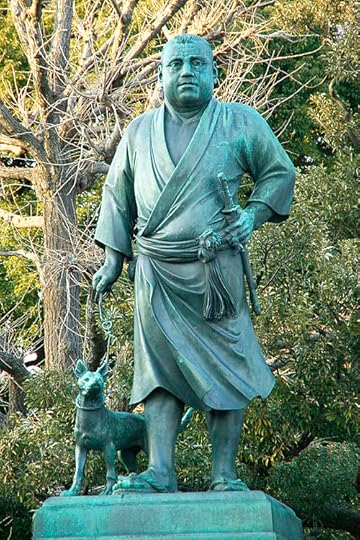
In the chapter on Saigo's childhood, Ravina has provided a fascinating look at the education of samurai boys in one of the some 300 domains Tokugawa Japan was divided into, indicating which aspects were fairly widespread through Japan and which were particular to Satsuma. I had previously not run across such detailed information, and it truly provides concrete insight into the indoctrination and formation of young samurai.
In 1854, for the first time, Saigo accompanied his daimyo on the latter's biannual pilgrimage to Edo as one of the lord's personal advisors. (All daimyo were required to spend every other year in Edo; their families were required to live there all of the time, essentially as hostages to assure the good behavior of the lords.) On the way he caught sight of Perry's "black fleet," which had just returned on their second visit expecting an answer to the ultimatum presented the year before and was undelicately placing the last straw on the Bakufu's back.
In Edo, Saigo became enthused with a current of thought known as "Mito learning." This mystical and xenophobic ideology tried to found the entire social structure of Tokugawa Japan on the basis of the divine emperor in order to bolster the increasingly spindly legged Bakufu. Concomitant was a hate of foreigners who were held to be a source of "spiritual contamination to Japan's purity." In a letter home Saigo wrote "I am such an ardent follower of Nariaki [the Mito daimyo] that if his lordship were to crack his whip and lead the way against the foreigners, I would rush in without hesitation."(*) He also was drawn to Wang Yangming's alternative to Zhi Xi's canonized neo-Confucianism
https://www.goodreads.com/review/show... ,
which emphasized instinct over reason and valued action above contemplation.
By 1856 Saigo had made the transition from being a vassal of a provincial daimyo to a fervent citizen of the "land of the gods" and was fully prepared to act. He became his lord's representative in Edo but had already modified his personal loyalties significantly. Fortunately, his wishes coincided temporarily with those of the daimyo, but his lord died suddenly in 1858, probably poisoned by relatives who had been outmaneuvered by him in order to become daimyo of Satsuma in the first place.
Almost immediately thereafter came the Ansei purge, when Bakufu conservatives cleaned up their opposition through murder, execution and banishment. The primary mover in this purge was Ii Naosuke, who also put an end to Yoshinobu's first attempt to become shogun. Now Saigo was a wanted man because he was one of Yoshinobu's loudest proponents. A failed double suicide of Saigo and the famous monk and poet Gessho (Gessho died, Saigo survived) gave the Satsuma domain opportunity to claim to the shogunal authorities that both men had died. Saigo went into hiding for three years on one of the small and extremely backward islands between Kyushu and Okinawa - islands which were nominally under Japan's rule but were culturally quite foreign. Ravina provides a glimpse into the culture and customs of the Amami islanders which was all completely new to me.
This was just the beginning of Saigo's henceforth stormy and eventful life and of Ravina's fascinating investigation of its context. Saigo was reprieved and then quickly condemned to hard time on an even smaller island, then reprieved again after 18 months to take over one of the domain's most important military commands. And so it went - up and down.
It was 1864 when Saigo took command of the important contingent of Satsuma samurai "protecting" the imperial court in Kyoto. The shogunate was significantly weakened, but the effete and ignorant officials of the court and the parochial daimyo were in no position to take up the slack - foreign and domestic policy were forgotten in favor of personal or ideological agendas. And the swords were coming out of their sheaths after two and a half centuries of pax Tokugawa.
The story gets quite complicated, and Saigo is in the middle of things, winning and losing, riding high and then scraping the bottom. It's quite a story.
The closing act was Saigo leading the Satsuma rebellion against the young Meiji government (with some 30,000 men under his command - not quite like the movie presented it; and they used rifles and cannon, but were soon out of ammunition and had no source of supply up in their hills), a government in which he had had an influential voice. Somewhat like the movie, when his army had been whittled down to a few hundred, he led a suicide charge, was disabled by a ball through the hip and requested a faithful friend to "act as a second" - to behead him. Saigo's head was whisked away so that the government could not display it.
(*) This stream of thought fed directly into the ideology of the militarists who guided Japan into Manchuria, China and ultimately the Second World War. Of further note is the fact that the last Tokugawa shogun, Yoshinobu, was the son of the Mito daimyo that Saigo so admired. Shiba Ryotaro makes the case in his The Last Shogun
https://www.goodreads.com/review/show...
that because Yoshinobu was so infused with Mito learning he could not bear to be known as an opponent of the emperor and thus, though he knew perfectly well that the young emperor was being manipulated by opportunists for their own ends, stepped aside quietly when the imperial rescript demanding the return of all political power to the emperor arrived.
Rating
http://leopard.booklikes.com/post/887...

January 14, 2019
The last samurai is dramatic rich emotional. This historical classic is a strong story,it's about the life of takamori a hero sets in the time of the Japanese emperor that surrounds the meiji restoration. Its a fabulous tale of history and divided struggles among different groups of loyalists and the sorrows of war,a legendary thriller of bravery loss and honour.

September 22, 2021
Like other reviewers have said, when Ravina focused on Saigo's life and actions proper, the book was good, flowed neatly, and was informative. But everything else was a mess, and the information on the actual final battle--which the Introduction made a big deal of--was summed up in less than two pages. The whole final rebellion earned less than five pages, and I was thoroughly lost in the ten pages that summarised the events leading up to the exact battle.
I don't think I've read a history book on Japan since middle school, so maybe Ravina's efforts are for people who are more familiar with this part of Japanese history. That being said, if your title is going to piggyback off the success of a historical-fiction film, be prepared for people who know nothing about the history side of a heavily fictionalised account.
I don't think I've read a history book on Japan since middle school, so maybe Ravina's efforts are for people who are more familiar with this part of Japanese history. That being said, if your title is going to piggyback off the success of a historical-fiction film, be prepared for people who know nothing about the history side of a heavily fictionalised account.
May 2, 2009
The few portions of this book that focus on Saigo Takamori’s life are interesting. The large portions of this book that focus on Japan’s political maneuvering during the 19th century are not. The central Japanese government had caused Samurai discontent by cutting their pay and banning them from owning swords. In 1877, Saigo led a revolt against the central government. Saigo’s forces were undersupplied and greatly outnumbered, and they were defeated. The government’s victory was the end of the traditional Samurai way of life. In Japan today, Saigo is revered as a martyr for Samurai honor.
April 4, 2026
my triumphant return. I read this book for class. Cool story but easy to get lost in unnecessary details at times

January 14, 2020
I'm disappointed. I was really excited to read this because I haven't read much Japanese history since high school. And even then, I did mostly American and European history.
The last 100 pages were very dry and condensed. I had a hard time keeping all the players straight, and then Ravina's conclusion of why Saigo rebelled felt very ... unbelievable. Even he can't believe that Saigo doesn't really have a good reason to rebel. Perhaps if Ravina built up his reasoning better.... It just seems like honor and Confucius ideals would be an excellent banner for Saigo to rally Satsuma around, and instead it feels like Saigo was just hanging, out meditating and then got bored of that so went on a suicide mission...? What?
As a reader I did not get a firm grasp on who Saigo was, but that might be because of how it ends. The last page rather clumsily links back to "Where is Saigo's head?" But rather than feeling complete about it, I feel rather cheated because the whole rebellion was portrayed as rather mundane.
This is going to sound silly, but I wish this book had more pictures. This is meant for a Western audience, and portraits of Saigo's confidants, places of where major battles were fought, art of the time, would have helped the text immensely. I am familiar with the majority of the references, but that is from my own personal experiences and not by way of credit to this book.
I do think the first half was extremely interesting. I was unfamiliar with Samurai lifestyle, especially in Satsuma, and Ravina did an excellent job researching and setting the scene of 1700-early 1800 Japan.
The last 100 pages were very dry and condensed. I had a hard time keeping all the players straight, and then Ravina's conclusion of why Saigo rebelled felt very ... unbelievable. Even he can't believe that Saigo doesn't really have a good reason to rebel. Perhaps if Ravina built up his reasoning better.... It just seems like honor and Confucius ideals would be an excellent banner for Saigo to rally Satsuma around, and instead it feels like Saigo was just hanging, out meditating and then got bored of that so went on a suicide mission...? What?
As a reader I did not get a firm grasp on who Saigo was, but that might be because of how it ends. The last page rather clumsily links back to "Where is Saigo's head?" But rather than feeling complete about it, I feel rather cheated because the whole rebellion was portrayed as rather mundane.
This is going to sound silly, but I wish this book had more pictures. This is meant for a Western audience, and portraits of Saigo's confidants, places of where major battles were fought, art of the time, would have helped the text immensely. I am familiar with the majority of the references, but that is from my own personal experiences and not by way of credit to this book.
I do think the first half was extremely interesting. I was unfamiliar with Samurai lifestyle, especially in Satsuma, and Ravina did an excellent job researching and setting the scene of 1700-early 1800 Japan.

May 4, 2012
Ravina writes an interesting account of Saigo Takamori's life but spends most of the book paralleling Saigo to the larger conflicts existing in Japan during his lifetime. Ravina adopts a slightly melodramatic tone throughout the book but leaves the reader revelling in awe of the Japanese hero. A good read overall and definitely a must for anyone interested in or studying the Meiji Restoration.

September 9, 2018
Interesting, but I thought it was pretty dry and not an easy read at all. Lack of maps of Japan didn't help.

November 11, 2024
While I enjoyed learning about the man behind the moniker, the back and forth, shifting currents and outright contradictions inside the Meiji Restoration were confusing, and left no clearer by the author. Takamori's character as a resilient, old-school samurai loyal to his emperor did indeed reflect the "movie of the same name," and Ravina towards the final chapters finally simplifies, to some degree, the events and Takamori's stance that led him to the final battlefield. So three stars instead of four.

January 29, 2023
Really easy to read and you gain an interesting perspective of Saigo's life. However, I had to read this for a class, and so I read it all in one sitting today. Let's see how much I retain of it for my paper :|
March 24, 2012
This is a pleasantly readable account of Saigo Takamori's life.
Saigo is an amazing figure, and so important in a critically transitional period in Japanese history. To have, in English, a readable account of his life is, in my opinion, of incalculable value.
This said, while there were parts of the book that I greatly enjoyed (the descriptions of Saigo's early years, and his early relationship with Okubo Toshimichi, who seems to have spent a great deal of energy extricating Saigo from scrapes into which Saigo's strict adherence to philosophical and Samurai codes of honor had flung him--how would Saigo ever possibly have remained relevant without Okubo's advocacy!?), two elements brought the book down for me.
The first was the author's choice to build a picture of the feudal domain of Satsuma (Saigo and Okubo's homeland) as the lone dominant force behind the Meiji Restoration (the key event in 19th century Japanese history when the Shogun was deposed and the 15 year old Emperor "reinstated" to "proper prominence" in Japanese politics). While I understand that an author has to choose a focus... a few paragraphs which more strongly acknowledged the Choshu contribution would have been appreciated (it was the alliance of Satsuma with Choshu that "tipped the balance" and made the Restoration possible.
The second was the author's failure to elaborate on the split between Saigo and Okubo. Saigo apparently went to his death cursing Okubo's lack of honor. After we have been treated to pages and pages of speculation regarding the ins and outs of Saigo's relationship with his Satsuma Lords, a touch more elaboration on his relationship with Okubo--historically of greater importance, I would hazard, to the history of Japan--would have been welcome.
I highly recommend this book to anyone interested in the topics it covers--but for a truly nuanced appreciation of the period and the enactors, you would want this book to be one of a number of titles on your shelves.
Saigo is an amazing figure, and so important in a critically transitional period in Japanese history. To have, in English, a readable account of his life is, in my opinion, of incalculable value.
This said, while there were parts of the book that I greatly enjoyed (the descriptions of Saigo's early years, and his early relationship with Okubo Toshimichi, who seems to have spent a great deal of energy extricating Saigo from scrapes into which Saigo's strict adherence to philosophical and Samurai codes of honor had flung him--how would Saigo ever possibly have remained relevant without Okubo's advocacy!?), two elements brought the book down for me.
The first was the author's choice to build a picture of the feudal domain of Satsuma (Saigo and Okubo's homeland) as the lone dominant force behind the Meiji Restoration (the key event in 19th century Japanese history when the Shogun was deposed and the 15 year old Emperor "reinstated" to "proper prominence" in Japanese politics). While I understand that an author has to choose a focus... a few paragraphs which more strongly acknowledged the Choshu contribution would have been appreciated (it was the alliance of Satsuma with Choshu that "tipped the balance" and made the Restoration possible.
The second was the author's failure to elaborate on the split between Saigo and Okubo. Saigo apparently went to his death cursing Okubo's lack of honor. After we have been treated to pages and pages of speculation regarding the ins and outs of Saigo's relationship with his Satsuma Lords, a touch more elaboration on his relationship with Okubo--historically of greater importance, I would hazard, to the history of Japan--would have been welcome.
I highly recommend this book to anyone interested in the topics it covers--but for a truly nuanced appreciation of the period and the enactors, you would want this book to be one of a number of titles on your shelves.

March 8, 2015
I love all things Meiji restoration, so I couldn't put this book down. Saigo Takamori was one of the main players in the restoration of the emperor in the late 1800s, then eventually realized he had created a monster and set out to stop what he had done, with tragic results. Mark Ravina does a fairly thorough job of combing through all of Saigo's correspondance and contemporary accounts to paint a portrait of one of Japan's important historical figures, one who might not be familiar to those outside of Japan. It's a pretty hefty tome of political intrigue and culture clash in late Edo period Japan, all compressed into a 200 page volume. For those not familiar with the feudal structure of Japan or the Meiji restoration, all the political scheming and especially the names of the different daimyo, samurai, and court nobles might get confusing. I had to pause and flip back every so often to make sure I was remembering the right person. I enjoyed seeing the inner workings of the bakufu and the scheming between different factions from Saigo's perspective. My only critique is that at times it seems the author is writing so deep from within Saigo's perspective that he does not spend enough time rounding out the characterization of some of Saigo's enemies, who historically were probably not as evil as the book suggests.

December 14, 2018
I've wanted to read this book for about 15 years, ever since seeing the film 'The Last Samurai'. In that film, there is a fictional samurai called Katsumoto, but he is loosely based on Saigo Takamori and this book explores Saigo's life and ideas. The author puts him in the historical context of a Japan that was starting to modernise, but riddled by repeated internal conflict.
As someone who doesn't know all that much about Japanese history, I found this book to be fairly accessible, understandable, with explanations included about, for example Japanese naming conventions and the previous lunar-based calendar. Equally, there are times when the text is marred by typos and what appear to be odd choices of words e.g. "memorial" used where "memorandum" or "memo" would fit better.
But it did give me a better understanding of Saigo and the turbulent era in which he lived and that's what the author set out to do.
As someone who doesn't know all that much about Japanese history, I found this book to be fairly accessible, understandable, with explanations included about, for example Japanese naming conventions and the previous lunar-based calendar. Equally, there are times when the text is marred by typos and what appear to be odd choices of words e.g. "memorial" used where "memorandum" or "memo" would fit better.
But it did give me a better understanding of Saigo and the turbulent era in which he lived and that's what the author set out to do.

March 29, 2023
While this book is really good, and I like a lot of stuff author brings up, one particularly big-ish problem arises. When talking of the Satsuma rebellion and the final days of Saigo, there's no detailed examination of his battles. I mean those at Kumamoto castle, Tabaruzaka, Enodakayama and Shiroyama. Particulary the last one makes this a sad event for I was hoping to learn something about the positions of the two armies, their logistics, weaponry, etc. There was a hint that Saigo had lost pretty much all fire power by September 1877 but nothing more. Maybe I overlooked something, but I am sure there was no discussion about Shiroyama. Not even a picture of the hill.
While the book also provides the life of the last samurai, I was more interested in his battles so that is the main reason why this is 3/5. The "life part" is here, but the battles are rather vague.
While the book also provides the life of the last samurai, I was more interested in his battles so that is the main reason why this is 3/5. The "life part" is here, but the battles are rather vague.

March 25, 2017
While this book is well written, I have come away with the feeling that I know very little about the man. The title is somewhat misleading. There is little to nothing written about any battles. I am not sure if it is because there is little documentation or what. The battles are given little to no attention. Most of the book follows his rise in importance and his activities in politics, but, there did not seem to be any real information on how he rose to prominence, or why he became so important. Sad really I had hoped for so much more.
Read
March 11, 2023sometimes felt chunkier than the length implies and i wished it held my hand more, especially during chapter 4, but that’s not it’s problem. quite interesting too. glad to have finished it after putting it down for so many years (due to chapter 4)

July 16, 2018
Really a 3.5. Readable yet a bit drab. Not very engaging yet informative and written well enough.
October 16, 2023
The Last Samurai is a relatively well constructed book but it has some fundamental issues that make the book disappointing. The book starts out great explaining Saigos childhood and what systems were in place for the young children growing up during this time period. Altho the farther you get into the book the less it seems to be about Saigo and more about other political problems. There are long periods of time where the book says nothing about Saigo or what he is doing during this time. Besides this the book has great writing and uses direct sources that have survived from that time period. It is clear that Mark Ravina spent a lot of time researching the subject and is very knowledgeable. I just wish for more explanations on Saigo.
I think the book deserves a 3.5/5 just because of the bad writing. This book is very clearly written for a western audience and definitely needs some explaining about the culture and politics. But when reading parts of the book it felt like a history class and I needed to take notes. The story of Saigo is an amazing story whose life should be looked at, the beliefs he had should be seen by everyone. We can all analyze how he handled tough situations and learn from his actions.
Saigo’s Most well known saying is “Revere heaven, Love Mankind” this quote is a perfect representation of Saigo and his beliefs. It's originally from a confucianism which Saigo was one of the most well versed people about ancient confucianism. This quote represents Saigos close relationship with confucianism and how it influenced his thoughts.
I think the book deserves a 3.5/5 just because of the bad writing. This book is very clearly written for a western audience and definitely needs some explaining about the culture and politics. But when reading parts of the book it felt like a history class and I needed to take notes. The story of Saigo is an amazing story whose life should be looked at, the beliefs he had should be seen by everyone. We can all analyze how he handled tough situations and learn from his actions.
Saigo’s Most well known saying is “Revere heaven, Love Mankind” this quote is a perfect representation of Saigo and his beliefs. It's originally from a confucianism which Saigo was one of the most well versed people about ancient confucianism. This quote represents Saigos close relationship with confucianism and how it influenced his thoughts.
This entire review has been hidden because of spoilers.
August 18, 2024
Saigo Takamori has a life worth reading about and this book was a good mix of short enough to read but fact filled enough to create a good picture. While he had a number of ups and downs and anyone familiar with the movie of the same name knows this doesn't have a happy ending he is a good example of a leader who stood on principle and was willing to give his life for a principle that he believed in. That brings up a number of questions - how important and influential are leaders that put principles first? Is there room for political leaders like that in the modern era or are their careers so short when they quit due to a disagreement that their influence is negligible? Is a pragmatic and compromising approach to politics better because it is more effective and longer lived? Do you need both the principled leader and the pragmatic, compromising leader to usher in dramatic changes (like Japan did during the Meiji restoration)? As Japan was so successful in transitioning from a feudal system to a centralized government in so short a time this is an interesting area of study.

January 20, 2019
Пусть романтичное название вас не обманывает: книга в основе своей документальная и к одноименному фильму отношения не имеет. Но хуже от этого она не становится: я бы обозначила эту книгу как "захватывающая документалистика". Много интересных фактов, бытовых деталей, на примере жизни одного человека и его ближайшего окружения точно переданы взгляды людей эпохи. Если вы интересуетесь Японией и не боитесь такого стиля и множественных фактических отсылок, имён, географических уточнений, то обязательно читайте.

October 24, 2020
This is not the story of the (good) movie of the same name. It is biography of the real life
Saigo, a lower status Samurai who rises to a place of importance and influence in Japanese the 1860 & 1870 politics. Saigo is an exceptional human being. It is a comprehensive description of a time of transition of a traditional to modern society. The narrative mentions lots of Japanese names of people who come and go, making it hard to keep track. Some of it is not that interesting but overall, it is worth reading.
Saigo, a lower status Samurai who rises to a place of importance and influence in Japanese the 1860 & 1870 politics. Saigo is an exceptional human being. It is a comprehensive description of a time of transition of a traditional to modern society. The narrative mentions lots of Japanese names of people who come and go, making it hard to keep track. Some of it is not that interesting but overall, it is worth reading.

October 9, 2023
I'm glad a book on his life exists and it is mostly a good read except for the completely made up parts.
There are three pages about Samurai as pedophilic homosexuals - all quoting a singular source that says, about itself, it is wholly conjecture by "reimagining vocabulary to deduce what might have been" and there are several passages throughout the book where Mr. Ravina (the author) claims the "Japanese fail to understand their culture/history/motivations" and proceeds to tell us how we ought to think things were while contradicting Saigo's letters and contemporary journals.
There are three pages about Samurai as pedophilic homosexuals - all quoting a singular source that says, about itself, it is wholly conjecture by "reimagining vocabulary to deduce what might have been" and there are several passages throughout the book where Mr. Ravina (the author) claims the "Japanese fail to understand their culture/history/motivations" and proceeds to tell us how we ought to think things were while contradicting Saigo's letters and contemporary journals.

May 15, 2024
The Last Samurai is one of my favorite movies. This is a biography of who Ken Watanabe's character is based on. The real story was just as fascinating and captivating as the performance. He started from humble beginnings and became one most influential Samurai in Japanese history and a legend. The book is short, focused, and relatively easy to follow if without a great grasp of Japanese history. I would recommend this to anyone who loves the movie or has a desire to learn more about Japanese history.
Read
May 17, 2026Although Saigō Takamori is best remembered for leading the Satsuma Rebellion, Ravina focuses almost entirely on his life prior to the uprising. The result is both narratively compelling and historically illuminating, leaving the reader with a deeper understanding of the conflicting emotions and ideas behind Japan’s rapid modernization.

June 10, 2018
A fascinating and detailed account into the conflicted world of the last true samurai. Although I found myself wishing the author delved into more detail around the legends of what took place on the hills of Shiroyama that fateful day.

November 4, 2021
Wonderful biography of Saigo Takamori, and with it the paradox at the heart of the Meiji Restoration. Supremely interesting individual and very well researched by Ravina, with broader implications for Imperial Japan and the consequences of modernization and expansion

May 18, 2020
Very good. More political then the movie though so do not confuse the two. This book definitely gives more insight into Japanese history. I found it very interesting

May 1, 2021
I read this for my HST 299 class at Salem State University.

Read
November 10, 2024I think a man does what he can until his destiny is revealed to him.
November 26, 2025
It's fascinating how much access we have to historical events. This book had more info than I needed or wanted, but I did enjoy the parts I read.
Displaying 1 - 30 of 59 reviews