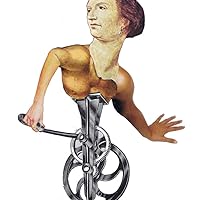
Photo-montage existed prior to the montages crafted by the one-time Dadaist Hannah Höch, but these sorts of efforts were mostly prosaic scrapbooks and family keepsakes, or "shrines" to silent era movie stars. Or they were idealized images of matriarchs, soldiers, strongmen and the like. Madame Höch, however, through her rigorous focus on selected contrasts between elements (as well as a keen sense of irony) managed to usher in a new art form that was at times shocking, other times humorous, but always thought-provoking. Her montages play with some figuratively very explosive material, violating taboos about race and sex, mixing the masculine and feminine forms, blending African totem fetish bodies and tribal mask heads with European women who are sleek, pale and presented in black & white, with their "New Woman" Bubikopf heads and lithe, nude dancer bodies.
Maud Levin's book on Hannah Höch's photo-montages includes many of the most memorable works created by the brilliant artist, but in her attempt to provide context, the author interjects herself a bit too much into the material. Her marshaling of so many theories by the likes of Lacan and Freud also is a bit wearing (sidenote: I wrote "Fraud" instead of "Freud" the first time while typing this review, an irony-rich Freudian slip if ever there was one). Hannah Höch had enough trouble overcoming the expectations and patronizing by her male contemporaries (even the well-meaning ones and even the ones with whom she was romantically linked) while she was trying to carve out her own place in the art world, and Maud Levin needlessly interjects all these stale voices with their discredited crackpot theories when, to be frank, all I wanted was Hannah Höch's images, and her own commentary where she saw fit to explain her work, or philosophy toward art specifically and life in general. Indeed, the autobiographical appendices at the end of the book, especially the first two, are only a couple of pages in length but seem to provide more context and enlightenment than Ms. Lavin summons in the preceding couple hundred pages or so.
The last vignette in the book was a very short story (if it can even be called that) by Frau Höch. "The Painter" is a Dadaist drollery that conflates the concepts of "chives" "God" and "woman" pell-mell, and while it was an interesting, enraged, and satirical look at male narcissism and egocentricity, it was also a bit of a head-scratcher and catches the artist at a probably low period. Her palpable frustration is understandable, but it's a bit of a sour coda to the book that touches upon male attempts to subvert Höch's autonomy rather than dwelling on it.
Lastly, the omission (aside from a cursory note in the "Chronology") of Hannah Höch's status during the Nazi years (and the perception of her work) seems a bit egregious. Her art was not rounded up in the notorious "Entartete Kunst" (Degenerate Art) display put on by the Nazis to show the perversity of cosmopolitanism, but there is no doubt that during these years of "Inner Immigration" when the artist remained in Germany (through the worst of the bombings) that the State had strong feelings about her art, and she had her own deeply held convictions about her art and those who wanted to suppress it, ignore it, or destroy it. There is no doubt an interesting story there, though it isn't presented in this book.
Needless to say, the images are the star of the show, and Höch does not disappoint even where Lavin falls short. There have to be better, more comprehensive offerings out there, though, I'm convinced, and better presented ones, too.