
What do you think?
Rate this book


71 pages, Paperback
First published January 1, 1486


„[Dumnezeu] a conceput omul ca pe o lucrare cu un aspect care nu îl diferenţiază [de celelalte fiinţe] şi, aşezîndu-l în centrul Universului, i-a vorbit astfel: ‘O, Adame, nu ţi-am dat nici un loc sigur, nici o înfăţişare proprie, nici vreo favoare deosebită, pentru ca acel loc, acea înfăţişare, acele îngăduinţe pe care însuţi le vei dori, tocmai pe acelea să le dobîndeşti şi să le stăpîneşti după voinţa şi hotărîrea ta. Natura configurată în celelalte fiinţe este silită să existe în limitele legilor prestabilite de mine. Tu, neîngrădit de nici un fel de oprelişti, îţi vei hotărî natura prin propria-ţi voinţă în a cărei putere te-am aşezat. Te-am pus în centrul lumii pentru ca de aici să priveşti mai lesne cele ce se află în lumea din jur. Nu te-am făcut nici ceresc, nici pămîntean, nici muritor, nici nemuritor, pentru ca singur să te înfăţişezi în forma pe care însuţi o preferi, ca şi cum prin voia ta ai fi propriu-ţi sculptor şi plăsmuitor de cinste. Vei putea să decazi la cele de jos, ce sînt lipsite de inteligenţă; vei putea, prin hotărîrea spiritului tău, să renaşti în cele de sus ce sînt divine’” (pp.122-123).
At last, the Supreme Maker decreed that this creature, to whom He could give nothing wholly his own, should have a share in the particular endowment of every other creature. Taking man, therefore, this creature of indeterminate image, He set him in the middle of the world and thus spoke to him:Alas, Pico never had the chance to defend his theses. The pope found thirteen of the 900 to be suspect, and when Pico clarified what he meant, he made things worse. The pope declared some of Pico’s ideas “capable of inflaming the impertinence of the Jews” and a number of others to “favor arts that are enemies to the Catholic faith and to the human race.”
“We have given you, O Adam, no visage proper to yourself, nor endowment properly your own, in order that whatever place, whatever form, whatever gifts you may, with premeditation, select, these same you may have and possess through your own judgement and decision. The nature of all other creatures is defined and restricted within laws which We have laid down; you, by contrast, impeded by no such restrictions, may, by your own free will, to whose custody We have assigned you, trace for yourself the lineaments of your own nature. I have placed you at the very center of the world, so that from that vantage point you may with greater ease glance round about you on all that the world contains. We have made you a creature neither of heaven nor of earth, neither mortal nor immortal, in order that you may, as the free and proud shaper of your own being, fashion yourself in the form you may prefer. It will be in your power to descend to the lower, brutish forms of life; you will be able, through your own decision, to rise again to the superior orders whose life is divine.”
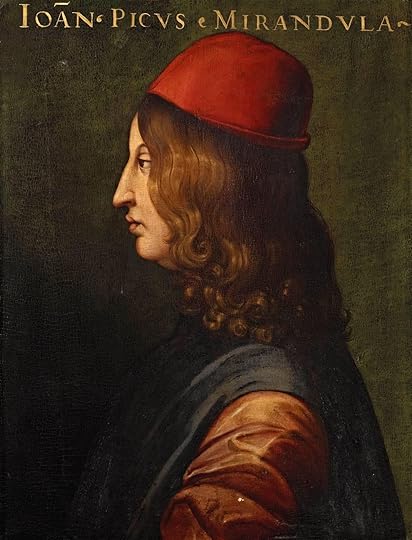
“We have given you, Oh Adam, no visage proper to yourself, nor any endowment properly your own, in order that whatever place, whatever form, whatever gifts you may, with premeditation, select, these same you may have and possess through your own judgment and decision. The nature of all other creatures is defined and restricted within laws which We have laid down; you, by contrast, impeded by no such restrictions, may, by your own free will, to whose custody We have assigned you, trace for yourself the lineaments of your own nature. I have placed you at the very center of the world so that from that vantage point you may with greater ease glance round about you on all that the world contains. We have made you a creature neither of heaven nor of earth, neither mortal nor immortal, in order that you may, as the free and proud shaper of your own being, fashion yourself in the form you may prefer. It will be in your power to descend to the lower, brutish forms of life; you will be able, through your own decision, to rise again to the superior orders whose life is divine.”
“But upon man, at the moment of his creation, God bestowed seeds pregnant with all possibilities, the germs of every form of life. Whichever of these a man shall cultivate, the same will mature and bear fruit in him. If vegetative, he will become a plant; if sensual, he will become brutish; if rational, he will reveal himself a heavenly being; if intellectual, he will be an angel and the son of God. And if, dissatisfied with the lot of all creatures, he should recollect himself into the center of his own unity, he will there, become one spirit with God, in the solitary darkness of the Father, Who is set above all things, himself transcend all creatures.”
Sometimes called the Renaissance Manifesto, Pico's work is short but difficult to access for modern readers. Its ornate language and obscure references (e.g., to the nine orders of angels) mask the relatively simple but profound underlying thoughts.
Pico intended to summarize the state of knowledge at his time but unfortunately was unable due to an early death, though this monumental task would have probably been beyond his powers in any case.
In essence, Oration addresses the nature of man and his relationship to God. Pico believes that man is uniquely positioned as a sentient being placed between the beasts (who do not possess sentience) and angels, who though sentient never sin (well, hardly ever-- see Paradise Lost). Placed in the "middle state" man alone has the power to make choices for good or evil and therefore has the potential, at least, to act as an agent for good and an admirer of truth and beauty. God, being the Creator, could not provide this perspective:
"... the Divine Artificer still longed for some creature which might comprehend the meaning of so vast an achievement, which might be moved with love at its beauty and smitten with awe at its grandeur."
Thus the source of man's intrinsic dignity and worth. Some religions teach that human worth comes only because of his relationship with God. God is certainly involved in Pico's formulation, but he believes humans have value because of who they are, not just because God created them. To be sure, Christianity teaches the man was created in God's image, which may be a metaphorical way of saying the same thing.


