Jump to ratings and reviews
Rate this book

Sightlines

Rate this book
The outer world flew open like a door, and I wondered what is it that we're just not seeing? In this greatly anticipated sequel to Findings, prize-winning poet and renowned nature writer Kathleen Jamie takes a fresh look at her native Scottish landscapes, before sailing north into iceberg-strewn seas. Her gaze swoops vertiginously too; from a countryside of cells beneath a hospital microscope, to killer whales rounding a headland, to the constellations of satellites that belie our sense of the remote. Written with her hallmark precision and delicacy, and marked by moments in her own life, Sightlines offers a rare invitation to pause and to pay heed to our surroundings.

242 pages, Paperback

First published April 1, 2012

152 people are currently reading
3803 people want to read

About the author

Kathleen Jamie

71 books322 followers
Kathleen Jamie is a poet, essayist and travel writer, one of a remarkable clutch of Scottish writers picked out in 1994 as the ‘new generation poets’ – it was a marketing ploy at the time but turns out to have been a very prescient selection. She became Professor of Creative Writing at the University of Stirling in 2011.

http://www.scottishpoetrylibrary.org....

Ratings & Reviews

What do you think?
Rate this book

Friends & Following

Create a free account to discover what your friends think of this book!

Community Reviews

5 stars
814 (45%)
4 stars
679 (38%)
3 stars
225 (12%)
2 stars
47 (2%)
1 star
10 (<1%)
Displaying 1 - 30 of 250 reviews
Profile Image for Bridget Weller.
77 reviews8 followers
May 21, 2012
This is a delicate and beautiful book. The cover calls it essays, but that suggests a kind of formality that would be out of place. The rigour here is of a much more reflective and questioning kind. Its creative non-fiction, to incisive for a namby-pamby word like "reflection", too poetic and beautifully written for "reportage", but a long way from short story territory. Whatever it is, its lovely.

The only problem with the above is that it probably means people are less likely to pick it up off the shelf: my discovery was a gift. Subject matter wise, if you are the type who kneels in wet grass for half an hour to watch the life and death dramas of an otherwise bug, or are thrilled by the image of a fin in the water or humbled by the gravitas of a whale bone, then this is for you.

Highly recommended.
Profile Image for Neil.
1,007 reviews757 followers
March 7, 2021
I love the way Kathleen Jamie writes. I imagine her shopping lists are something to behold (and I would probably read them if she published them). This book is described as a collection of essays, but that feels like a bit of a drab, grey term for what it actually is. There are fourteen chapters of varying length and each one captures an event in Jamie's life. It might be time she saw the aurora borealis or it might be time spent watching gannets only to be interrupted by a passing pod of orcas.

Two dominant themes (for me: others may pick up on different ones) are whales and remoteness. The chapters that talk about whales are, in some ways, very sombre (we have a dark history with these amazing creatures). The chapters that talk about time spent on the remote islands of St Kilda and Rona make me long for more time outside with nature (although my experiences tend to be somewhat tamer).

And maybe that's what it is that I like so much about reading Jamie's work. I have a (very small) photography business that functions as an outlet for my nature images and I enjoy nothing more than time spent outside watching nature do its thing. Jamie writes of experiences beyond my own - more remote and more intense - but she writes so delicately and engagingly that it just increases my desire to be out in nature.

So, 5 stars is really the only option.
Profile Image for Penny.
342 reviews90 followers
June 2, 2016
A beautiful writer. I honestly think Jamie could write about a visit to the dentist and make it sound lyrical. To call these chapters 'essays' seems wrong, they are more like meditations on a variety of subjects, mainly the natural world.
I love the way her mind works. She sees something and it triggers a response - and although she is in many ways a gentle writer she is also sharp and eagle eyed. How many people would even attempt to describe the aurora borealis?
She's never overly fanciful or flowery. I loved her description of the icebergs that floated past as she travels in the North -
"Some people say you can smell icebergs . . . I smell nothing but colossal, witless indifference."
Profile Image for Jason.
1,321 reviews139 followers
June 13, 2018
Wonderful writing, never have I been as jealous of an author as I am right now, the things Kathleen Jamie has done and the places she has been as part of the research for this book is stunning. Visiting remote abandoned islands in the Hebrides, St Kilda and Rona, to sitting inside a whale skeleton in a museum giving it a clean, that must have been an amazing experience. It wasn't all fun and games though, at times she suffers big time with seasickness that she must be wondering why she is putting herself through this, then she reaches her destination and it all suddenly makes sense. In this book she talks about her past, working on an archaeological site, you can see that's where her love of the outside started.

Beautifully written, she can make the mundane stand out so that you can become engrossed in it, really looking forward to what she gets up to in her next book.

Book review is here> https://felcherman.wordpress.com/2018...
Profile Image for Hugh.
1,293 reviews49 followers
June 7, 2016
A luminously reflective book, which brings together some fairly disparate subject matter into a unified whole. Jamie recounts a variety of experiences - an archaeological dig, various trips to remote Scottish islands such as St Kilda and Rona, a visit to a pathology department and an extraordinary section on the Hvalsalen (whale hall) of Bergen museum. She finds startlingly new and perceptive observations on all of these. A memorable and deeply rewarding read.
Profile Image for Lauren .
1,834 reviews2,550 followers
March 9, 2022
"You are placed in landscape, you are placed in time. But, within that, there’s a bit of room for manoeuvre. To some extent, you can be author of your own fate."

▪️SIGHTLINES by Kathleen Jamie, 2014.

#ReadtheWorld21📍Scotland

Such a nourishing and rich collection of essays from poet and nature writer, Kathleen Jamie!

The best essayists blend topics in the most seamless way, and Jamie does just this - sharing the history and nature of an archaeological excavation in the Shetlands, aurora borealis in Greenland to the work of osteology conservators in the in the Hvalsalen in Bergen, Norway, as well as relating memories, and weaving in personal side stories.

SIGHTLINES explores some outer edges/fringes of society and human settlement - the Outer Hebrides specifically the Archipelago of St Kilda, Greenland, the isle of Rona - but also the edges of life, as she muses on her mother's passing and what it means to "let nature take its course".

14 essays, all of them superb. This went on the favorite nonfictions list of 2021 that I made and shared last week. I am excited to read more by Kathleen Jamie.
Profile Image for Paul.
2,230 reviews
July 24, 2016


As with all books that are written by poets, this is a delight to read. The language is eloquent and lyrical, without being pretentious.

She takes us, through a series of essays, on a journey to places in the far north of the UK and Scandinavia. To islands and museums and more importantly to the part of the mind that communicates with nature.

Well worth reading. Shall be reading some of her other books
Profile Image for Anna.
2,117 reviews1,019 followers
June 19, 2020
I enjoyed 'Sightlines' more than Findings. The writing is equally beautiful and lyrical in both, but this collection is longer, feels more cohesive, and includes more archaeology. Somehow it connected for me on an emotional level more than the first collection, which is a reflection both on the content and my mood while reading each book, I suspect. The essays in 'Sightlines' discourse upon seabirds, remote Hebridean islands, orcas, and the excavation of an ancient burial site, among other topics. My favourite chapter concerned the Hvalsalen, a collection of whale skeletons in Bergen Natural History Museum. Jamie writes in beguiling detail of the whale bones in the process of cleaning and restoration. Whales are inherently fascinating creatures and she approaches them with wonder and measured consideration. Throughout the book, I appreciated how thoughtfully she reflects upon her fascination with nature, wildness, and the place of humans within it. I liked the balance between humans-as-animals and our tendency to anthropomorphise animals; Jamie sees no contradiction between the two, nor makes any judgement as to their correctness.

More prosaically, I enjoyed taking trips to vividly described and stunningly isolated islands without risk of seasickness. 'Sightlines' is an escapist read, as it transports you to new places, while also inviting reflection. The essay on a lunar eclipse reminded me of how profoundly I appreciated an eclipse, although it can't have been the same one, during my PhD. I stood out on my flat's balcony for at least an hour from about 3am watching the moon turn red. Somehow this calmed my mind, which was at the time buzzing relentlessly with the stress of writing my thesis. Jamie captures the same sense of perspective that I remember feeling, a profound reminder that we live on a ball of rock in space. Another essay on the wonder of excavating history reminded me of a childhood phase of wanting to be an archaeologist. I am definitely too much of an indoor person for archeology, but I can certainly understand the fascination of painstakingly uncovering the past. It was very pleasant to have these memories reawakened. The second essay, however, is quite different to the rest and not calming or escapist to read, as it concerns pathology. That one I could perhaps have done without at this time of profound health anxiety.
Profile Image for pennyg.
806 reviews7 followers
January 26, 2023
My second book by Kathleen Jamie and hopefully not my last. Quickly becoming my favorite naturalist. In this book we venture north to the iceberg laden fjords east of Greenland, on to contemplating the life of whales from their giant bones to a tiny Magpie Moth.

She dedicates this book to all the Island-goers. Her sense of wonder and enthusiasm for the natural world around her comes through on the page. Contemplating its vulnerability, combined with musing on her own life, beautifully written, reminding us of the joy of exploring nature.
Profile Image for Robyn.
827 reviews160 followers
March 14, 2015
3.5 stars rounding up to 4, because it's not Jamie's fault that I'm not her ideal audience. I think this has lovely bits in it - some gorgeous writing, and the two longest essays (one on whales and a collection of whale bones in a Norwegian museum, the other on St. Kilda) are stand-out. However, I usually look to essay collections like this to teach me new things, and her topics are fairly well-trod ones for me. I did enjoy the memories her essays provoked, especially of my own encounters with whales, and as Scotland is a favourite destination I'm looking forward to treading some of the same ground she does.
Profile Image for Preeti.
220 reviews195 followers
January 3, 2014
I’ll be honest. The first thing that attracted me to this book when I saw it on NetGalley was the cover. It’s a close up of a whale’s (not sure which kind) eye – it’s like it was made for me! Actually, it looks like Bryant Austin’s work, which is absolutely amazing and should be checked out. (Whoa, just researched and found that the cover image is, in fact, a photo by Austin!)

Sightlines is a book of essays about the natural world – at least, it bills itself as such. There were a few in there that I don’t know if I’d necessarily categorize that way, but overall, I think it meets the description. The book started out strong, with an essay about Jamie traveling in Iceland among the icebergs and catching the Aurora Borealis.
The next iceberg offers to the ship a ramp as smooth and angled as a ski jump. Just slide right up here, little ship, it seems to say, but the invitation is declined.

Another iceberg, and another. Some people say you can smell icebergs, that they smell like cucumbers. You can smell icebergs and hear your own nervous system. I don’t know. Although they pass slowly and very close, I smell nothing but colossal, witless indifference.
I really loved her description of watching the aurora, of the utter silence all around despite the “movement which ought to whoosh.” And the dearth of people despite the awe.
But: ‘Where is everyone else?’ I whisper. Aside from those few on the deck, the shapes of a few more people can be seen looking out from the windows of the bridge. The bridge, warm and reassuring with its competent officers and glowing green instruments. Where is everyone? My cabin mate clamps her arms to the sides of her goose-down jacket, stands rigid, and whispers in reply, ‘Perhaps they are asleep.’ She smiles as though she’d looked into the human condition some time ago, but has since moved on.
The next few essays were a little weird to me, not really my style. But her writing style kept me reading. Jamie is a Scottish author, and her essays are peppered with Scottish and English words – I was glad I was reading this on my Kindle because it was so easy to look up those unfamiliar words. Surprisingly, most if not all were in the dictionary as well!

The essays where she explored islands off the coast of Scotland, following birds, following whales, those were where my attention was piqued. And then the chapter on the Bergen Natural History Museum in which she visits the Hvalsalen – Whale Hall – to see the whale bones was my absolute favorite. I wish I could have been there with her, exploring the museum, climbing the skeletons, helping to clean them. I could almost smell the dust, the musty atmosphere, as I read. I usually try to get my favorite quotes, but I was so engrossed with that chapter that I didn’t stop to do that at all.

Overall I really enjoyed this book – it turned out different than I expected but that wasn’t a bad thing. If I had to describe it in one phrase, I’d call it natural history in a book.

A few more of my favorite quotes:
Once, I asked my friend John—half in jest—why we are so driven. By day John counsels drug addicts; by night he is a poet. He wrote back, half in jest: ‘You know, my job isn’t to provide answers, only more questions. Like: why are we not more driven? Consider: the atoms of you have been fizzing about for a bit less than five billion years, and for forty-odd of those years, they’ve been pretty well as self-aware as you. But soon enough they’ll go fizzing off again into the grasses and whatever, and they’ll never, ever know themselves as the sum of you again. That’s it. And you ask me why we’re driven? Why aren’t more folk driven? Whatever are they thinking about?’

We know we are a species obsessed with itself and its own past and origins. We know we are capable of removing from the sanctuary of the earth shards and fragments, and gently placing them in museums. Great museums in great cities—the hallmarks of civilisation.

The henge is gone, the director’s report is available to read, the photos are filed away, the Bronze Age woman’s bones—well, they’re in a cardboard box in a city store. The food vessel is reunited with its sister, and displayed in the National Museum, and has nothing to do with this place, this here.

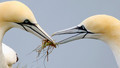
On gannets:
They held their long beaks at every angle, like—paintings again—those portraits of aristocratic dynastic families, where everyone is elegant and looks into the distance, looks anywhere except at each other.

It was probably nothing, so I said nothing, but kept looking. That’s what the keen-eyed naturalists say. Keep looking. Keep looking, even when there’s nothing much to see. That way your eye learns what’s common, so when the uncommon appears, your eye will tell you.

The things we deem worth keeping, that is, as we seem to be the arbiters of so many fates. There are only 4000 blue whales alive now. At the time of their deliverance, the moratorium of the 1960s, we had slaughtered our way through 350,000.

There was a time—until very recently in the scheme of things—when there were no wild animals, because every animal was wild; and humans were few. Animals, and animal presence over us and around us. Over every horizon, animals. Their skins clothing our skins, their fats in our lamps, their bladders to carry water, meat when we could get it.

Stuart often said there was no such thing as ‘natural harmony’. It was a dynamic. Populations expand, then crash. Mysterious things happen—catastrophic things sometimes, on the island, everywhere. Nothing stays the same.

Perhaps if you were some sort of purist, if you carried a torch for ‘the wild’ and believed in a pristine natural world over and beyond us, you might consider it an intrusion to catch a bird, and make it wear a ring or a tag. Perhaps you’d consider that their man-made burden violates them in a way. I admit there was something uncomfortable about the metal ring, soldiering on while the bird’s corpse withered. But when I got the chart out, traced the route, measured the distance, and understood that yes, of course, on a southwest bearing, you could swoop via certain channels from the North Sea through to the Atlantic, on small dark wings, it was because this one ringed bird had extended my imagination. The ring showed only that it was wedded to the sea and, if anything, the scale of its journeyings made it seem even wilder than before.
Note: I received a review copy of this book from NetGalley. Quotes may be subject to change in the final version.

To Explore:
Though this is not quite the Whale Hall of the book, AudioVision put together this amazing video called The Whale Warehouse. It takes you behind the scenes of the collection of whales and other large mammals at LA’s Natural History Museum. (Thankfully, we can't yet convey smells through video!)
Profile Image for Claire.
811 reviews366 followers
January 14, 2018
The second volume of essays by Kathleen Jamie that I've read, more encounters with birds on lonely, wind-windswept islands that have long been abandoned by humans, though traces remain of their earlier occupation.

In her trademark poetic style, she travels with experts from whom she gleans bits of information, fascinating trivia, or alarming statistics that tell of a significant drop in population of certain species, but mostly she continues her mission of acute observation, of trying to see in the simplest terms something of the lives and patterns of behaviour of these majestical winged creatures (The Gannetry), who make those long migrations each year and return to these islands to continue their heritage.

We learn more of her beginnings, of the archeological dig, where she developed a fascination for uncovering secrets hidden beneath (The Woman in the Field), we accompany her on a boat to the arctic(Aurora), to witness giant icebergs on the move, the green lights of the aurora overhead, a visit to a museum in Norway where ancient whalebones will be cleaned, restored, preserved, the sadness of their demise emitting an odour even after all these years of inhabiting a dusty dry interior (The Hvalsalen).

She muses on Pathologies in a science lab, a lunar eclipse, three attempts to visit St Kilda, Neolithic caves and the passage of time in her own life, marked by the growth of children into adolescence on the cusp of young adulthood.
Profile Image for Alasdair Pettinger.
Author 3 books9 followers
April 10, 2017
For those who worry about what kind of book this is, Bridget Weller's review nails it very well.

I'm happy to think of it as travel writing, which for me must always proceed from - and bear strong traces of - an experience lived at a particular place and time. And Jamie's attention is so focused that we get travel writing in almost its purest form, where narrative and abstract generalization are entirely subordinate to the work of engaging all the senses with its descriptions and recollections. Several weeks can be rendered through a handful of episodes so richly textured that we feel as if nothing can have been left out. A short piece about her attempt to rescue a magpie moth with a spoon - which I read almost without daring to take another breath till the end - seems to last exactly the same length of time as the events it recounts.

Icebergs are compared to cat-walk models. The Aurora is figured not as performance but a redrafting, perpetually dissatisfied with its own arrangements. Gannets 'interrogat[e] the sea like some old patrician poet frowning over his papers'. Bats hang from the roof of a cave 'like a scrunch of black pubic hair'. Jamie and her companions watch killer whales circling an archipelago as if they are spectators at a Grand Prix. These are just a handful of the many arresting images that made me not so much to want to visit the places she describes (though they did that too), but to renew my resolve to fine-tune the way I attend to my surroundings.

But if Sightlines is travel writing, it is also commonly assigned to that subdivision called 'nature writing'. And yet Jamie tends not to write about nature so much as interrogate the very category. Her subjects here include whales, seabirds, islands, the weather, but she makes no attempt to exclude the presence and influence of people and machines; nor does she inveigh against their interference by inviting us to share a bleak vision of the future or indulge in nostalgic fantasies of the past.

In a fine review of Robert Macfarlane's The Wild Places, she insisted that 'wild places' are anything but, and the point is made repeatedly in these essays. On St Kilda - often a byword for remoteness - she and her scientist companions map the long history of human settlement using GPS devices in the shadow of a radar base, punctuated by encounters with cruise ships and Japanese helicopter crews. 'I came to distrust any starry-eyed notions of "wild" or "remote",' she writes. 'Remote from what? London? But what was London?' After all, London is as remote from St Kilda as St Kilda is from London.

On her second visit to the island an approaching storm forces her party to leave almost as soon as they land: 'I've spent longer standing at bus stops.' And indeed bathos often forestalls any temptation to be sentimental or apocalyptic. Modernity pulses unapologetically through the book, whether it is in the image of investigators crawling on hands and knees 'like pilgrims or penitents' playing recordings of the call of Leach's petrels on a Sony Walkman waiting for the birds to reply, or in her - pleasantly unexpected - delight in taking off in a large passenger jet, 'truly the modern sublime.'

If 'nature' is the subject of these essays it is not so much the non-human world as the - sometimes shocking - confrontation with the corporeal; most uncomfortably perhaps in the hours she spends shadowing a pathologist at Ninewells Hospital in Dundee, examining with him a selection of internal organs. 'I couldn't have said whether it belonged to an aquarium, a puppet theatre or a bicycle repair shop', she remarks, on first seeing a cancerous colon in a bowl: a wonderfully-crafted rhythmic series that captures the exquisite balance of the serious and the comic that is one of the great joys of this book.

There is an excellent interview with the author in the Scottish Review of Books.


Profile Image for Pam.
708 reviews141 followers
June 7, 2021
Sightlines

Thinking about the title one could contemplate flight paths, satellite beams, connecting lines, lines to the distant horizon, expansiveness, navigational lines, narrowed field of vision and measures. All those concepts are pertinent to Kathleen Jamie’s book. Did I mention connectivity! The book is wonderfully written. In a narrow sense it is a travel and nature book, but is so much more. It’s a pity more good poets don’t write non-fiction.

Her pathologist friend in one of the chapters says, “you perceive what you expect…sometimes it needs a fresh eye, or a looser mind.” Jamie has those things.
Profile Image for Fiona.
982 reviews525 followers
April 14, 2013
Reading Kathleen Jamie is such a gentle, meditative, educational and joyful experience. Her writing has the same effect on me as listening to Dinah Washington does - take a deep breath, relax, and feel the worries of the day disappear.
Profile Image for Sophy H.
1,902 reviews110 followers
February 25, 2020
Very poetic and descriptive nature writing.

Kathleen Jamie is able to capture the wilderness with the right amount of awe, enthusiasm and pragmatism.

My only criticism is the amount of spelling/editing mistakes, they were a little distracting.
Profile Image for Andrew Cox.
188 reviews3 followers
January 31, 2016
Absolutely beautiful. I have now read both of Kathleen Jamie's books which were just a joy. I don't always find poetry easy but I think I better have a look at her poems. It's not easy to say why something is so good. Jamie invites the reader to look at the world afresh. Although there is absolutely nothing to suggest she is preachy somehow she reminds me of a deep spirituality, maybe Buddhist, although if it is Buddhist it is "natural" , understated but deeply significant. She looks at both the very normal & the more extreme side of nature and they are both beautiful. As a counsellor I am aware of "mindfulness" & agree with a lot of the ideas behind it but it has become popular & faddish & by doing so loses some of its value. I doubt Jamie necessarily thinks of mindfulness as such, she just looks at the world around her & conveys a picture whether it is of Killer Whales or the roof tops of Edinburgh. She conveys excitement, interest, the personal wonder of observation. It is grounded in the present which is intrinsically linked to all our pasts. There is a deep meaning to being present. We are part of this world. We may be insignificant amongst the grandeur of nature & this huge world but we are present & to admire the beauty on our doorsteps & on wild islands is to be alive & to be part of something greater than ourselves. She gives me optimism that maybe I can be connected, if not to people but to the world. Fantastic.
Profile Image for Bettie.
9,977 reviews5 followers
March 6, 2014
BOTW

Sightlines: http://www.bbc.co.uk/iplayer/episode/...

Read by: Maureen Beattie

BBC BLURB - "The outer world flew open like a door, and I wondered - what is it that we're just not seeing"?

Five years after Findings broke the mould of nature writing, award-winning Scottish poet Kathleen Jamie subtly shifts our focus on landscape and the living world, daring us to look again at the "natural", the remote and the human-made.

"Kathleen Jamie writes with unparalleled beauty, sharpness of observation, wit, delicacy, strength of vision and rare exactness of language" Daily Telegraph


Abridged by: Pete Nichols

Producer: Karen Rose A Sweet Talk Production for BBC Radio 4.

fradio
essays
zoology
spring 2012
pub 2012
non-fiction
R4
medical eew

1. Aurora: Mould-breaking nature writer Kathleen Jamie's unique odyssey through the natural world.

2. Pathologies

3. The Woman in the Field

4. The Gannetry

5. On Rona
This entire review has been hidden because of spoilers.
Profile Image for Marsali Taylor.
Author 39 books174 followers
April 17, 2012
I really enjoyed this one, but I felt it wasn't quite as good as the previous one, Findings, which held me spellbound through a long delay in Edinburgh airport. I took this one to keep me occupied during another long journey, and it did transport me just as 'Findings' did - I now want to see the Hvalsalen in Bergen, and feel as though I've seen Rona and St Kilda. However 'Findings' felt like more of a unity, like a long meditation - 'Sightlines' didn't give me that sense, and there were places where the writing jarred just a little with repetition, as if Jamie hadn't quite been given time to proof-read. Maybe the publishers were keen to follow up 'Findings' - and if 'Findings' hadn't been so wonderful I'd have expected less of 'Sightlines'.

However ... when I read 'Findings' I was travelling alone. Maybe I'd have been more engrossed into 'Sightlines' if I hadn't had a fidgety husband beside me ...
323 reviews3 followers
October 12, 2016
I made a mistake in this. I read it straight through. It's easy reading, and you slip into the beat of the writing. After a realisation a couple of essays in that they were only loosely linked on the nature/far north/human themes, they could be read in any order, and with long gaps between them. I particularly enjoyed the longer essays - St.Kilda and the whale jawbones were both interesting subject matter, and beautifully written. The oncology essay is also memorable and thought provoking (but sits at odds with the rest of the book by content, and tone - not a criticism though). But in some of the others, the sentences become more memorable than their essays. Good writing, but I'd suspect more impact to dip in and out of. I'll try that again in this book or another.
Profile Image for James Robertson.
Author 334 books269 followers
April 6, 2013
Kathleen Jamie is a fine poet and an excellent essayist. These essays record her close engagement with the environment and nature, and her constant questioning of the relationship human beings have with birds, whales, the sea, the land and the weather. They take her to remote, sparsely inhabited (or sometimes abandoned)islands and regions, where her questions come into the sharpest focus: because of course such places are inhabited, only not by humans. A book to make you think, quietly.
Profile Image for Nancy.
1,274 reviews53 followers
January 29, 2020
Finished: 03.11.201
Genre:
Rating: C -
Conclusion:
I agree with one other reviewer
...the first essay was stunning
but the rest of the book couldn't match up.

Lyrical written birds, bacteria, islands, whale bones
wind, caves and an archeological dig that seemed
endless.....and I longed only for more reflection.
Sightlines is a dialogue with nature and the
conversation flowed around a score of topics
..but I had difficulty staying awake and listening.
Profile Image for Jennifer.
1,900 reviews63 followers
March 26, 2017
Sometimes I read books that demand to be savoured, taken time over. And I rarely listen. But for Kathleen Jamie, I did. It was a real joy to spend time fossicking about various subjects with her. She doesn't weigh her writing down with an excess of research nor purple prose nor even passion, but her words are beautiful and interesting. I found her geographical sense of self an invaluable corrective - she is most certainly Scottish. She combines inspirational experiences with the prosaic (moon-watching with teenagers was especially good)
Profile Image for Ashley.
Author 1 book4 followers
May 21, 2020
Enchanted as I was by Scottish poet and natural world writer Kathleen Jamie's Findings, reading Sightlines was a no brainer. I love Jamie's wry, hyper-observant writing, her ability to capture themes as large as existence itself by pondering a whale bone or a bird. Highly recommended.
801 reviews56 followers
April 9, 2019
Gorgeous, gorgeous writing. In a series of what could be called essays, Kathleen Jamie describes remote islands in Scotland, its cliffs and birds and sea, whale sightings, a museum of whale bones in Bergen, a trip to the Arctic and the Aurora Borealis, a lunar eclipse and so on. Her acute observation, sense of wonder and sheer joy infuse each of these. Loved it!
Profile Image for Lana.
58 reviews
May 9, 2021
Bought this book on the Kindle a few years ago and forgot I had it! Glad to read it this year - vivid stories about her travels to remote places including the isle of Rona. I enjoyed being immersed in these windswept places, watching birds and whales, wandering around the remains of villages abandoned centuries ago. Poetic and beautiful writing.
Profile Image for Hanneleele.
Author 18 books83 followers
July 11, 2020
Osa lugusid siit on eestikeelsetes "Leidudes" olemas ent need, mida ma varem polnud lugenud (enamasti vaalaluudest), meeldisid samuti. Võib-olla isegi veel rohkem, sest kusagil tolmuses muuseumis vaalaluid puhastada tundub väga meeldiv. Ja vaaladest mõelda on kurb.
Profile Image for Stuart Malcolm.
544 reviews5 followers
January 17, 2023
Like most collections of essays/short stories, this is a little bit of a mixed bag; but on the whole it’s on the stronger side. There were a couple of 5 star reads that I particularly enjoyed and would’ve liked more of (the whaling museum was especially interesting).
Displaying 1 - 30 of 250 reviews

Join the discussion

Can't find what you're looking for?

Get help and learn more about the design.