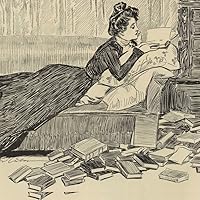
By the time Rachel Ferguson wrote 'Alas, Poor Lady' in 1937 it was possible to look back with horror and disbelief at what had happened to the daughters of extravagantly large Victorian families, victims of ‘parental incompetence’, who did not manage, through ineptitude or plainness or bad luck, to catch a husband.
This novel is in the Lytton Strachey tradition of furious anger with those who had gone before. There were thousands of women who had been condemned to become distressed gentlefolk, dependent for their livelihood (unless they had been fortunate enough to inherit wealth) to seek work as governesses and companions, often in families that did not treat them well. When they could not find work they were reduced to virtual penury. In the opening, 1936, chapter the question is asked: ‘But – how does it happen? How does it happen?’
The finger of blame in Alas, Poor Lady is cast less at the men (since the system favoured them in all respects why would they seek to change it?) but at the matriarch who is too lazy, too unthinking to want to change things for her numerous daughters. It is Mrs Scrimgeour in her large house in Kensington who is the real culprit, being selfish, evasive and lacking in any concern for her daughters beyond that of trying to make sure they fulfil society’s expectations of them. She fails to train them to be attractive to men or to find ways of occupying themselves; the most important thing, her daughters wearily accept, is that ‘a family of your own, one saw, saved your face’.
Rachel Ferguson was educated privately, before being sent to finishing school in Italy. She flaunted her traditional upbringing to become a vigorous campaigner for women's rights and member of the WSPU.
In 1911 Rachel Ferguson became a student at the Royal Academy of Dramatic Art. She enjoyed a brief though varied career on the stage, cut short by the First World War. After service in the Women's Volunteer Reserve she began writing in earnest.
Working as a journalist at the same time as writing fiction, Rachel Ferguson started out as 'Columbine', drama critic on the Sunday Chronicle. False Goddesses, her first novel, was published in 1923. A second novel The Bröntes Went to Woolworths did not appear until 1931, but its wide acclaim confirmed Rachel Ferguson's position in the public eye. Over the next two decades she wrote extensively and published nine more novels.
Rachel Ferguson lived in Kensington until her death in 1957.
A warning to start with. This book brought me to the point of tears.
It tells the story of Grace Scrimgeour, a middle-class Victorian woman who failed to marry, and for whom there was insufficient provision made to enable her to carry on the lfe to which she had been accustomed. She becomes a governess, and eventually, as more and more requirements are demanded of governesses, which her increasing age and own poor education makes her unable to provide, descends into little more than a nursery maid and lady's companion. Ultimately she becomes an annuitant of the "Distressed Gentlefolks' Protective Association", finally achieving through charity a measure of security.
The story of the Scrimgeour family runs from 1870 to 1936 the year before the book was published. The detail is suberb, we see the interactions in the family from the head of the household at the top to the servants at the bottom, and commentary on such Victorian activities as morning prayers and the annual holiday. The older daughters of the large family all marry while the younger four all face spinsterhood. Their father refuses to permit any of them to take up gainful employment, despite increasing problems with the finances, but it is only after he dies, leaving their financially-inexperienced mother at the family helm that things gradually take a turn for the worst. World events -such as the Great War, declining dividends from shares, and the introduction of income tax are all skilfully brought in by the author to help explain why the family struggles, it is not just the inexperience of a woman never trained to know about financial matters that explains their downfall. These issues affect the remaining members of the family who increasingly struggle also to maintain their status and help contribute financially to the remaining Scrimgeour daughters.
This is a novel about a rapidly changing society and its failure to make adequate provision for women failed by the previous generation. The unmarried woman was, of course, one of the "problems" of the late Victorian age whose domestic ideology did not include, and could not readily accept, such a thing. The writer is furious, eloquent and her story heart-rending. I highly recommend it.
This entire review has been hidden because of spoilers.
I felt it was very well written and held my interest throughout. However, it is unrelievedly sad with only a brief period of intense happiness in it. Because the author is so focused on the oppression of women, she skirts dangerously close to hectoring, but always manages to pull back. Still, she created some memorable characters and I am glad that I read it.
This novel follows the fate of Victorian-era gentlewomen sisters, the Scrimgeours, who, unable to snag husbands, are left to very sorry fates. After the death of their monied father, their spendthrift, flighty mother dispenses with the money that by rights should be preserved for them--giving large endowments to a grandson-in-law (who reminds her of her own indulged son, a casualty of World War I) and to various charities. One daughter, Aggie, though not Catholic, retreats to convent life; another, Grace, becomes an inept governess. The sisters who did marry resent making any support payments to Grace, and to the two other unmarried sisters: Mary and Queenie. In the end, Grace ends up relying on a charity for impoverished gentlefolk. Though an interesting and thought-provoking read, the book presents a number of challenges. First of all, much of the idiom is quite dated, and Ferguson writes fairly consistently convoluted, almost incomprehensible prose. This is not one of Persephone's easy middlebrow pleasure reads. It requires a certain amount of reading grit for one to persist. Additionally, the book might have benefited from a more narrow focus on one or two sisters. I was sorry, for example, not to have spent more time in the company of Mary, the blue-stocking sister, who struck me as the most interesting of all.
Okay, 60 pages in and not going to finish this one. I think I know what the author is getting at: women are oppressed. I don't really want to 400 more pages of it. I think it would be interesting, but I usually prefer happier books.
A surprisingly easy read about domestic life in early 20th century. The story focuses a lot on Grace, the youngest daughter, and charts her growth into adulthood and beyond. The rest of the characters are equally believable. This novel doesn't hold much pretenses, so while it features people from middle class families, their woes are very relatable and at the end of it all, I guess we all just want a safe home to live our last days in. :')
A good book, but a sad one. Also a book fuelled by anger or perhaps injustice.
It's about a large Victorian family and particularly about the four daughters who remain unmarried. Most of all, it is about Grace, the youngest daughter. She is passed over as a child since she is much younger than her sisters and the longed for brother is born soon after. The unmarried sisters spend much of their time bored, given the limited occupations available to them. They have servants for housework and cooking, and they are not allowed out without a chaperone. Going to university or seeking employment is 'not done' and each of them tries to stave off boredom.
The father fails to plan for the financial needs of all bar one of his unmarried daughters (and for Agatha/Aggie only because of specific circumstances). This is compounded by his indulgence of his son, beyond the family's means (and this is the father's fault not the son's). He then makes things worse by leaving all his (now somewhat depleted) to his wife who cannot and will not see herself as anything other than a wealthy widow and refuses to share financial information with her 'girls' even though they are now well into womanhood. They depend more and more on the kindness of their married sisters, nieces and nephews. Social and economic changes also reduce the value of little investments they have. The book charts how they cope.
Auf den ersten Blick wirkt dieser Roman etwas platt, scheint die Handlung doch nur aus aneinandergereihten Nebensächlichkeiten aus dem Leben der Protagonistin Grace zu bestehen, der es im "fortgeschrittenen" Alter von 18 noch nicht gelungen ist, zu heiraten. Wäre es nur das gewesen, hätte ich das Buch wohl nach dem ersten Teil zur Seite gelegt. Allerdings ist die Sprache des Romans so zart-träumerisch und gleichzeitig so niederschmetternd, dass es einem wirklich das Herz zerreißt, wenn Familie Scrimgeour von einem Unglück ins nächste rasselt. Alas, Poor Lady ist eine tolle Mischung aus Little Women und einer GUTEN Seifenoper, der ein bisschen mehr Tiefe nicht schlecht zu Gesicht gestanden hätte.
A delightful read, made for a lot of thinking and contemplation - especially about how the actions and choices made by parents will of course impact on their children for years to follow. I especially liked the construction of this book, with short, often very short chapters/sections. No flab on this book (my pet hate is waffle). If I could have asked for more it might have been in the latter part - I would have liked to have known more about Queenie's life in her cottage. Ferguson, however, is right enough to focus her reader on Grace's later life.
To fully appreciate the book, it’s worth noting that it was written in 1937, by Rachel Ferguson who was a suffragette. A sad and thought provoking tale about Grace, born in 1870. She is brought up in an era when it is expected that she will marry and be provided for. This fails to happen, and the book sets out her fate.
The language is quite old fashioned and some sentences had to be read several times to be made sense of, but I’m glad I persevered.
You know when you first start a book and you keep checking how many pages are left and you try to convince yourself to keep reading and then you don't? Looking at you Alas, Poor Lady.
I love many of the books in the Persephone collection and it is rare to find one that doesn't capture me. The writing in this particular title was fine and I was interested in the overarching tale but the devil is in the details and the execution of this novel did not work for me.
I felt like it dragged a bit in places. Maybe if it was streamlined a bit more. But an interesting and important look at women born in the victorian age, the society they were born into shifting and transforming and leaving them behind.
This is Persephone number 65 - and not the happiest of stories - but rather a fascinating one .
In this 1937 novel Rachel Ferguson examines the fate of Victorian gentlewomen who failed to marry, and whose families failed to leave them adequetly provided for. In the first chapter we are introduced to the GP (the Gentlefolks Protective Association) in1936, and the question posed by a shocked young actress at the opening of a bazaar raising money for the GP - "who does this happen?" is then examined in detain through the rest of this 460 + page novel.
Grace Scrimgeour is born in 1870, the eight child of a middle aged woman, whose eldest daughter at 23 is also having a child (her first) Grace is one seven daughters and one son (born two years after Grace) only three of these daughters marry. This places huge finacial stresses on the family in their later years. Grace eventually has to become a governess and later a companion. In between jobs, she lives in near penury - in terribly sad circumstances, or is forced to be put up by one of her elder sisters, or her neice, who don't always do so very graciously. For one short period during her governess years she finds real happiness.
This novel opens in London in 1937 at an event for a charity that benefits "distressed gentlewomen", and then traces the life of the elderly Grace Scrimgeour and her family of six sisters and one brother, to see how she ended up in a position of near starvation, needing the aid of this society. The Scrimgeours were a well-off middle-class family but their funds were badly invested (in the son and in shares) until the capital was all gone on keeping up appearances. Grace has a comfortable home until her middle years, then she is left almost penniless, shuttling between work she is unsuited for and an uncomfortable dependence on married sisters and nieces who have little time or money for her.
While obviously life was very tough for working class people before the welfare state, there was a particular kind of hardship in store for women who had been brought up expecting never to have to work, in a situation of complete dependence on parents who might then leave them nothing at all so that they were suddenly homeless and virtually unemployable in their forties or fifties.
It's a moving if uneventful story, and the characters of the mother and sisters are very well drawn. The men are vague, shadowy figures who seem to live in a different world.
I was so enraged when I read this book that I almost didn't finish it. I felt the boredom and claustrophobia and helplessness of Mary, of Grace, of them all. I had frequently to put the book down and rush out of the house, just to be OUTSIDE somewhere, so completely did the author comvey the smothering effect of these women's lives.
This entire review has been hidden because of spoilers.