

What do you think?

Fisher's Face
Admiral of the Fleet Lord 'Jacky' Fisher (1841-1920) was one of the greatest naval reformers in history. He was also a colossal figure to contemporaries, both loved and loathed, a man of exceptional charm, presence and charisma. Since the late 1940s, Jan Morris has been haunted by his face - with its startling combination of 'the suave, the sneering and the self-amused.' This evocation is both biography and a love letter, a perfect expression of her passionate interest in mavericks and outsiders, in travel, ships and the glorious pageantry of the British Empire in its prime.
Paperback
First published May 10, 1995
About the author
Jan Morris
163 books506 followersJan Morris was a British historian, author and travel writer. Morris was educated at Lancing College, West Sussex, and Christ Church, Oxford, but is Welsh by heritage and adoption. Before 1970 Morris published under her assigned birth name, "James ", and is known particularly for the Pax Britannica trilogy, a history of the British Empire, and for portraits of cities, notably Oxford, Venice, Trieste, Hong Kong, and New York City, and also wrote about Wales, Spanish history, and culture.
In 1949 Jan Morris married Elizabeth Tuckniss, the daughter of a tea planter. Morris and Tuckniss had five children together, including the poet and musician Twm Morys. One of their children died in infancy. As Morris documented in her memoir Conundrum, she began taking oestrogens to feminise her body in 1964. In 1972, she had sex reassignment surgery in Morocco. Sex reassignment surgeon Georges Burou did the surgery, since doctors in Britain refused to allow the procedure unless Morris and Tuckniss divorced, something Morris was not prepared to do at the time. They divorced later, but remained together and later got a civil union. On May, 14th, 2008, Morris and Tuckniss remarried each other. Morris lived mostly in Wales, where her parents were from.
In 1949 Jan Morris married Elizabeth Tuckniss, the daughter of a tea planter. Morris and Tuckniss had five children together, including the poet and musician Twm Morys. One of their children died in infancy. As Morris documented in her memoir Conundrum, she began taking oestrogens to feminise her body in 1964. In 1972, she had sex reassignment surgery in Morocco. Sex reassignment surgeon Georges Burou did the surgery, since doctors in Britain refused to allow the procedure unless Morris and Tuckniss divorced, something Morris was not prepared to do at the time. They divorced later, but remained together and later got a civil union. On May, 14th, 2008, Morris and Tuckniss remarried each other. Morris lived mostly in Wales, where her parents were from.
Ratings & Reviews
Friends & Following
Create a free account to discover what your friends think of this book!
Community Reviews
Displaying 1 - 15 of 15 reviews

August 26, 2023
I have always been fascinated by Admiral Lord John Fisher, the man who reformed the Royal Navy, served twice as First Sea Lord and was known to the public as "Jackey". I was surprised to find this book by an author (whose work I enjoy) who is more than fascinated with him.....she is almost obsessed with him and keeps his picture displayed in her home. Morris admits in the first chapter that the picture of Fisher (which is on the cover of this book) gave her the basis for this biographical study of what his face told her. This is not your usual biography but a study of the man's character and personality which was complex to say the least.
jackey Fisher was either reviled or revered.....he could be a a dear friend whose company everyone enjoyed, loved his ships and his Navy, was kind and generous to his crew, loved to dance, and never forgot old friends. On the other hand he could be a schemer, unforgiving to those who balked at his ideas, and ruined many a promising mans' career. He was married to the same woman all of his life but was not above dalliances and in his last years, he lived with another woman. Yet religion was a cornerstone of his life and he was a serious student of the Bible. His life was a dichotomy which has puzzled historians for years. The author admits that she is not qualified to analyze his strengths and weaknesses but is only giving her biased opinion of one of Britain's greatest naval figures. Knowing the author's mindset about Fisher, the reader is aware that this is a love letter to "Jackey". And I was totally engrossed in it.........a great read.
jackey Fisher was either reviled or revered.....he could be a a dear friend whose company everyone enjoyed, loved his ships and his Navy, was kind and generous to his crew, loved to dance, and never forgot old friends. On the other hand he could be a schemer, unforgiving to those who balked at his ideas, and ruined many a promising mans' career. He was married to the same woman all of his life but was not above dalliances and in his last years, he lived with another woman. Yet religion was a cornerstone of his life and he was a serious student of the Bible. His life was a dichotomy which has puzzled historians for years. The author admits that she is not qualified to analyze his strengths and weaknesses but is only giving her biased opinion of one of Britain's greatest naval figures. Knowing the author's mindset about Fisher, the reader is aware that this is a love letter to "Jackey". And I was totally engrossed in it.........a great read.

February 3, 2018
It is a remarkable face:
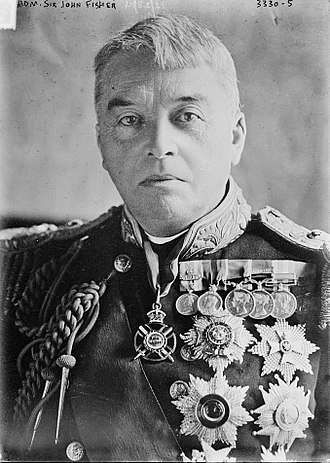
Although I don't see the "Oriental" qualities that contemporaries did.
Jan Morris saw Fisher's face in a picture and it is no understatement to say she fell in love. She spent forty years dwelling on it, accumulating testimony, before she wrote this. Part history, part memoir, part searching. This caprice, she called it.
Look at that face, she says:
Could there be any tenderness in such a man? Would you ever be sure of him? Is there cruelty to his charm, or is he the sort who would always need comforting? There's something disconcerting to those eyes, which sometimes gaze into utter blankness. On the other hand, he does seem stupendously sure of himself. How he flaunts his rank and authority. A lot of merriment is there, too--look at those laugh lines--and the smile is undeniably engaging, even kind. A man worth knowing better, you may decide. A man (though you hardly like to admit it even to yourself, with your own dear one beside you) it might well be fun to love.
The short wiki-version of Fisher is that, after a life in the British Navy, he became the First Sea Lord at the start of WWI, and although he was largely responsible for modernizing the Navy to that point, he was also largely responsible for the disaster at Gallipoli. He, uh, slunk off after that.
The events are here, of course, but so are stabs at character. Morris introduces us to Fisher's religious nature with the preamble: As a pagan myself . . . She reveals Fisher's many flirtations but, perhaps blinded by her crush, believes he went no further. Of his copious letters and other writings, Morris says: Fisher was a self-educated man, and it owed nothing to literary example.
Fisher could certainly turn a phrase. He said: I have never been good, so I admire it more in other people. Of social obligations, he said: Life would be endurable but for its pleasures. To a parliamentary question asking if one of his reforms had been a success and if so, why it had not been introduced earlier, he replied: The answer to the first part of the question is in the affirmative; as regards the second part, it might have been asked the Deity about the Creation.
As Sea Lord, one of his favorite expressions was: Find the exact damned ass who did it.
This is a quirky book, with a quirky title, and it is no criticism by me to say it is by a quirky author. I only discovered Jan Morris last year when I read, and loved, Hav. She's 90 now and still alive as far as I can tell. She wrote a lot. If I read two of her books a year and stay reasonably healthy, who knows?
But back to Jacky:
Fisher, it seemed, was a Great Englishman, a disgrace to his uniform, a manipulator, a hobgoblin, a damned socialist, a crook, a paragon of kindness, a parvenu, a cad, a genius, a fraud, a delight. Only one thing all are agreed upon: he had a marvelous face:
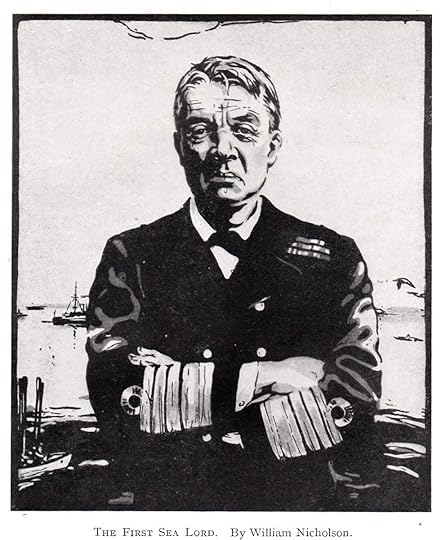
Although I don't see the "Oriental" qualities that contemporaries did.
Jan Morris saw Fisher's face in a picture and it is no understatement to say she fell in love. She spent forty years dwelling on it, accumulating testimony, before she wrote this. Part history, part memoir, part searching. This caprice, she called it.
Look at that face, she says:
Could there be any tenderness in such a man? Would you ever be sure of him? Is there cruelty to his charm, or is he the sort who would always need comforting? There's something disconcerting to those eyes, which sometimes gaze into utter blankness. On the other hand, he does seem stupendously sure of himself. How he flaunts his rank and authority. A lot of merriment is there, too--look at those laugh lines--and the smile is undeniably engaging, even kind. A man worth knowing better, you may decide. A man (though you hardly like to admit it even to yourself, with your own dear one beside you) it might well be fun to love.
The short wiki-version of Fisher is that, after a life in the British Navy, he became the First Sea Lord at the start of WWI, and although he was largely responsible for modernizing the Navy to that point, he was also largely responsible for the disaster at Gallipoli. He, uh, slunk off after that.
The events are here, of course, but so are stabs at character. Morris introduces us to Fisher's religious nature with the preamble: As a pagan myself . . . She reveals Fisher's many flirtations but, perhaps blinded by her crush, believes he went no further. Of his copious letters and other writings, Morris says: Fisher was a self-educated man, and it owed nothing to literary example.
Fisher could certainly turn a phrase. He said: I have never been good, so I admire it more in other people. Of social obligations, he said: Life would be endurable but for its pleasures. To a parliamentary question asking if one of his reforms had been a success and if so, why it had not been introduced earlier, he replied: The answer to the first part of the question is in the affirmative; as regards the second part, it might have been asked the Deity about the Creation.
As Sea Lord, one of his favorite expressions was: Find the exact damned ass who did it.
This is a quirky book, with a quirky title, and it is no criticism by me to say it is by a quirky author. I only discovered Jan Morris last year when I read, and loved, Hav. She's 90 now and still alive as far as I can tell. She wrote a lot. If I read two of her books a year and stay reasonably healthy, who knows?
But back to Jacky:
Fisher, it seemed, was a Great Englishman, a disgrace to his uniform, a manipulator, a hobgoblin, a damned socialist, a crook, a paragon of kindness, a parvenu, a cad, a genius, a fraud, a delight. Only one thing all are agreed upon: he had a marvelous face:

December 4, 2015
This book reads like a love letter to its subject, Jacky Fisher.
A reader who is looking for a biographical account of the life of Admiral Sir John ‘Jacky’ Fisher could potentially take umbrage over this book, ‘Where is the narrative, what about the facts?’ I, on the other hand, fell rather in love with the Jacky who appears in these pages and with Jan Morris for the care and affection she lavishes on him and for bringing him to life. She goes beyond the dry facts to imagine an emotional and personal life for him. At the same time she sets his life in context, as a naval officer serving in the British navy at the turn of the nineteenth and twentieth century. The book also chronicles an obsession. Jacky Fisher died on 10th July 1920, six years before Jan Morris was born and she discovered him in the 1940s via a glimpse of a photograph taken in 1881.
That photograph and his face with an inscrutable expression became the driving force behind this book. Morris began work on it in 1951.
“Material rained upon me. I heard from people who loved Kack Fisher, and people who detested him, women who were crazy about his memory, men who loathed his guts. I heard from people into whose lives he had briefly brought a glimpse of the unforgettable…” p9
That ‘unforgettable face’ kept her thinking about Jack for forty years before Fisher’s Face was published in 1995.
Jacky had a love of finery and display – never turned down an honour – but was in tune with the ordinary seamen (he was responsible for the abolition of flogging as a punishment). When in 1902 he left the Mediterranean at the end of his term as Commander-in-Chief he emerged from a farewell dinner to the deck of his flagship to be greeted by the entire ship’s company singing their version of Goodbye Dolly Gray as Goodbye Jacky, we must leave you. As Morris says ‘Can’t you hear their strong young voices still, and seethe mist in the Admiral’s eye.’ p62
So a lovely book and a fascinating man.
A reader who is looking for a biographical account of the life of Admiral Sir John ‘Jacky’ Fisher could potentially take umbrage over this book, ‘Where is the narrative, what about the facts?’ I, on the other hand, fell rather in love with the Jacky who appears in these pages and with Jan Morris for the care and affection she lavishes on him and for bringing him to life. She goes beyond the dry facts to imagine an emotional and personal life for him. At the same time she sets his life in context, as a naval officer serving in the British navy at the turn of the nineteenth and twentieth century. The book also chronicles an obsession. Jacky Fisher died on 10th July 1920, six years before Jan Morris was born and she discovered him in the 1940s via a glimpse of a photograph taken in 1881.
That photograph and his face with an inscrutable expression became the driving force behind this book. Morris began work on it in 1951.
“Material rained upon me. I heard from people who loved Kack Fisher, and people who detested him, women who were crazy about his memory, men who loathed his guts. I heard from people into whose lives he had briefly brought a glimpse of the unforgettable…” p9
That ‘unforgettable face’ kept her thinking about Jack for forty years before Fisher’s Face was published in 1995.
Jacky had a love of finery and display – never turned down an honour – but was in tune with the ordinary seamen (he was responsible for the abolition of flogging as a punishment). When in 1902 he left the Mediterranean at the end of his term as Commander-in-Chief he emerged from a farewell dinner to the deck of his flagship to be greeted by the entire ship’s company singing their version of Goodbye Dolly Gray as Goodbye Jacky, we must leave you. As Morris says ‘Can’t you hear their strong young voices still, and seethe mist in the Admiral’s eye.’ p62
So a lovely book and a fascinating man.

August 15, 2025
What a whirlwind of a character! And what a whirlwind of a writing style to take us upon this remarkable journey of quite literally peeking into the life of this outstanding and controversial personage.
This might be an unusual first read of Jan Morris, whom I’ve been waiting to read for a while, but this was the first book I could find in a small independently-owned book store in Wales, incidentally just a score miles away from where Jan lived, as the bookstore owner told me.
As a recent reader of (auto)biographies, it still fascinates me how much the life of a single person can shed light on the winds of the day, other people (surprisingly, Winston Churchill perhaps shown at the very lowest and darkest moment in his otherwise remarkably successful career), and events.
I could’ve down with fewer daydreams which described events that did not actually take place, but I still enjoyed such personal touches as they made me feel like I got better acquainted with the author, if not the hero of the book.
Lastly, I really do wish Jan had included the photos and/or letters that she so often alludes to as having “right in front of her”, as if teasing us with them. I did find a few of those on the Internet, but for many of them I simply didn’t want to get distracted from the book googling away.
Overall, I’d suggest reading this book to anyone either interested in Jan Morris’s writing or keen on learning a few things about the Royal Navy in the second half of 19th century.
This might be an unusual first read of Jan Morris, whom I’ve been waiting to read for a while, but this was the first book I could find in a small independently-owned book store in Wales, incidentally just a score miles away from where Jan lived, as the bookstore owner told me.
As a recent reader of (auto)biographies, it still fascinates me how much the life of a single person can shed light on the winds of the day, other people (surprisingly, Winston Churchill perhaps shown at the very lowest and darkest moment in his otherwise remarkably successful career), and events.
I could’ve down with fewer daydreams which described events that did not actually take place, but I still enjoyed such personal touches as they made me feel like I got better acquainted with the author, if not the hero of the book.
Lastly, I really do wish Jan had included the photos and/or letters that she so often alludes to as having “right in front of her”, as if teasing us with them. I did find a few of those on the Internet, but for many of them I simply didn’t want to get distracted from the book googling away.
Overall, I’d suggest reading this book to anyone either interested in Jan Morris’s writing or keen on learning a few things about the Royal Navy in the second half of 19th century.
May 4, 2024
What a brilliantly colourful and imaginative way to write a biography of someone.
I first read this sometime in 2011 and haven’t looked at it since, then, needing a small book for a holiday, I picked it off the shelf.
The way Jan devotes herself, honestly, to ‘Jacky’ is commendable and I doubt very much any author these days would have the courage to write so admiringly about a British figure from the turn of the century and during Britain’s height of power.
She writes devotedly about a man she never knew but from her decades long research knows intimately. The reader gets a real sense of who the man was, what he was thinking and what other’s perception of the man was.
Covering the fantastic, the tragic and the turmoil of his life, the decisions he made, the effects it had on others and the vices, as well as virtues are discussed.
It is in short fascinating to read, even re-read after nearly 13 years on the shelf.
I first read this sometime in 2011 and haven’t looked at it since, then, needing a small book for a holiday, I picked it off the shelf.
The way Jan devotes herself, honestly, to ‘Jacky’ is commendable and I doubt very much any author these days would have the courage to write so admiringly about a British figure from the turn of the century and during Britain’s height of power.
She writes devotedly about a man she never knew but from her decades long research knows intimately. The reader gets a real sense of who the man was, what he was thinking and what other’s perception of the man was.
Covering the fantastic, the tragic and the turmoil of his life, the decisions he made, the effects it had on others and the vices, as well as virtues are discussed.
It is in short fascinating to read, even re-read after nearly 13 years on the shelf.

October 15, 2019
If you like Jan Morris and/or naval history, you will enjoy this book. Jackie Fisher was a colorful & entertaining character & brought the Royal Navy out the 19th Century & into the 20th. Many of his ideas were so far ahead of his time that methods & materials did not yet exist to implement them.

July 3, 2019
Fascinating biography. Well written. (Not a well written review! But I enjoyed the book)

September 22, 2023
More a pen portrait than a biography and stronger on opinion than on fact, but an interesting read.

May 10, 2019
I had the exact same reaction as Jan when I first saw Jacky’s face, save for the attraction...
My reason for picking up this book was that I HAD to know what this man was like. Jan’s depictions are second-to-none and is written with such care I could hear Jan reading it back to me.
My reason for picking up this book was that I HAD to know what this man was like. Jan’s depictions are second-to-none and is written with such care I could hear Jan reading it back to me.
July 24, 2026
A commendable labor of love, but it's a pen portrait, not a biography. The author is clear that she is intensely biased toward her subject, and she makes a lot of excuses for him. The frequent self-inserts by the author do not aid the narrative. There are some racist, sexist, and xenophobic comments (from the author, not Fisher) which say much about the author and nothing about Fisher. The author also engages in some armchair Freudian psychology, which has not aged well.
I would point anyone interested in Fisher to first read his books Memories, by Admiral of the fleet, Lord Fisher and Records. They are shockingly progressive. While they may raise your blood pressure (all the CAPITAL LETTERS and exclamation!! marks!!!), they are one-of-a-kind, the essence of Jacky himself, and as good as we can get without traveling back in time and speaking to him in person.
I would point anyone interested in Fisher to first read his books Memories, by Admiral of the fleet, Lord Fisher and Records. They are shockingly progressive. While they may raise your blood pressure (all the CAPITAL LETTERS and exclamation!! marks!!!), they are one-of-a-kind, the essence of Jacky himself, and as good as we can get without traveling back in time and speaking to him in person.

July 24, 2021
Anyone who has read Morris's work on the British Empire or the memoirs will know of her fascination with John Fisher and that fascination reaches its apotheosis in this short, entertaining biography; a biography that includes a little of The Search for Corvo type memoir. Some readers may find there's a little too much of 'tally-ho' and 'I say, old boy' about the book, but nobody will find it boring or uninformative.

July 18, 2016
If my teachers at school had thought to liven up the Causes of the First World War by recounting the remarkable career of Jacky Fisher, founder of the modern Royal Navy, I might have paid more attention. Written in Morris' usual engaging style, this is an excellent introduction to one of British history's more interesting characters.

July 22, 2016
Wonderful and evocative account of Jacky Fisher, a fascinating figure in British naval history. Would have been nice if it. included some of the photos and illustrations the author wrote about so intriguingly.

April 13, 2023
Fantastic; it's like you know the fellow. Fisher's personality really shines through, with an afterglow of adoration from Morris. Those with any interest in the British Empire or just of a good underdog story would like this book.


April 4, 2016
I was disappointed in Morris's account of Fisher's life as it was mostly a character sketch rather than an account of a fascinating if not provocative man.
Displaying 1 - 15 of 15 reviews