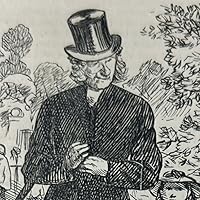
Richard Owen, F.R.S. (1804–92) was a controversial and influential palaeontologist and anatomist. Originally from Lancaster, he studied medicine at the University of Edinburgh and at London's St Bartholomew's Hospital. He grew interested in anatomical research and, after qualifying as a surgeon, became assistant conservator in the museum of the Royal College of Surgeons, and then superintendent of natural history in the British Museum. He became an authority on comparative anatomy and palaeontology, coining the term 'dinosaur' and founding the Natural History Museum. He was also a fierce critic of Darwin's theory of evolution by natural selection, and engaged in a long and bitter argument with Thomas Huxley, known as 'Darwin's bulldog' for his belligerent support of the theory. Published in 1894, this two-volume biography draws on Owen's diaries and a wealth of correspondence. Volume 2 includes an essay on Owen's contributions to anatomical science written, surprisingly, by Huxley.
Sir Richard Owen KCB was an English biologist, comparative anatomist and palaeontologist.
Owen is probably best remembered today for coining the word Dinosauria (meaning "Terrible Reptile" or "Fearfully Great Reptile") and for his outspoken opposition to Charles Darwin's theory of evolution by natural selection. He agreed with Darwin that evolution occurred, but thought it was more complex than outlined in Darwin's Origin. Owen's approach to evolution can be seen as having anticipated the issues that have gained greater attention with the recent emergence of evolutionary developmental biology. He was the driving force behind the establishment, in 1881, of the British Museum (Natural History) in London. Bill Bryson argues that, "by making the Natural History Museum an institution for everyone, Owen transformed our expectations of what museums are for".
Goodreads has this credited to Richard Owen when the book was written by his grandson (Richard S. Owen). This was an insightful and well compiled summary of Professor Owen's life, I think it having been written by someone who knew him added a perspective that would've been lost with an external biographer. That being said, some of the information is obviously sugarcoated and does not go into any description of the less savoury parts of Owen's life, such as his (Supposed) plagiarism of the belemnite paper for which he won the Copley(?) medal. Where the Darwinists erase his merits, this book erases his flaws. I do understand why that was done, as previously mentioned the Darwinists did overplay his flaws egregiously, so this is a good text to balance that out. Of course, all of the conflicts with the Darwinists would be in the second volume. There was a good mix of personal anecdotes and scientific information. Though the latter wasn't in much detail as this is more a life's account rather than an account of achievements.
I'd argue though that the star of the book is his wife, Caroline, as her diary extracts prove the most entertaining part of the book. It reads almost of exasperation as she describes how there was a rhinoceros carcass in the hallway AGAIN. I'm sure few people can claim to have that as an issue they've had multiple times in their life. Overall, massively enjoyed the read.