

What do you think?
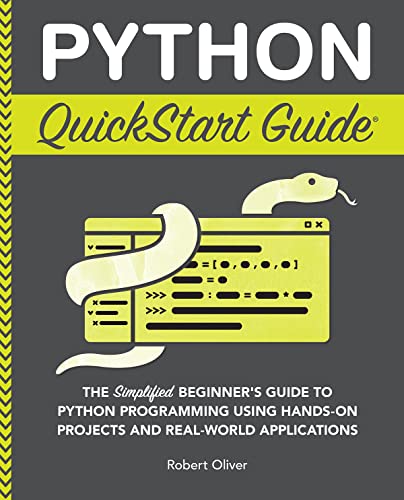
Python QuickStart Guide: The Simplified Beginner's Guide to Python Programming Using Hands-On Projects and Real-World Applications
The Ultimate Beginner's Guide to Learning Python in 2024!
**Includes FREE Digital Bonuses! Github Repository, Cheat Sheets, and More!**
Learn Why QuickStart Guides are Loved by Over 1 Million Readers Around the World
Learn Python fundamentals that can be used in any programming setting – use the guidance in this book to program your own game in a unique and practical Python learning experience.
From AI and machine learning to video game, app, and web development, Python is a critical behind-the-scenes component of everyday technology.
Python powers the services of household names like Google, Netflix, and Spotify along with tech pioneers like NASA, IBM, and Intel. Put simply, Python is the in-demand and easy-to-learn programming language that gets stuff done.
The Easiest Way to Learn Python in a Comprehensive, Step-by-Step Guide
In Python QuickStart Guide, senior developer and programmer Robert Oliver lays out the quickest and most accessible path yet to the mastery of Python fundamentals.
Written by a Programming Expert with Over 20 Years of Experience
Distilling his experience drawn from over two decades of working with Python and other programming languages, Robert’s clear voice and writing present a practical, hands-on approach that anyone, at any experience level, can use to become a Python programmer.
It doesn’t matter if you are a new or existing programmer, a job seeker looking for a career change or promotion, or just someone who wants to learn how to automate basic tasks with Python—Robert’s step-by-step approach, complete with a hands-on companion Python video game project, is the perfect starting point to master Python fundamentals!
Python QuickStart Guide is Perfect New or experienced programmers looking to enhance their career opportunities with an in-demand programming languageJob seekers who want to supercharge their resumes and increase their value in the job marketplaceStudents or recent college grads who have their sights set on a lucrative position in the tech industryFull stack developers or programmers who need to round out their programming skills to take on new projectsAnyone who wants to explore the world of programming, use Python to automate tedious tasks, or enhance their resume and future-proof their skills!
With Python QuickStart Guide, You'll Easily Understand These Crucial How to Use Python – Practical Examples, Code Snippets, Plus Follow Along to Code Your Own Game!Python Fundamentals – How to Use Python for Web Design and Interfacing with GitHub, SQL, and Other ApplicationsObject-Oriented Programming Principles – Managing Data, Scripts, Logic, Inputs, Outputs, and More!Programming Essentials – Debugging, Producing Clean Code, Best Practices, Time-Savers, and TipsPython Next Steps –Testing, Optimization, Speed Improvements, and More!
Go Beyond the Book with Exclusive QuickClips Videos
Look for Qui
**Includes FREE Digital Bonuses! Github Repository, Cheat Sheets, and More!**
Learn Why QuickStart Guides are Loved by Over 1 Million Readers Around the World
Learn Python fundamentals that can be used in any programming setting – use the guidance in this book to program your own game in a unique and practical Python learning experience.
From AI and machine learning to video game, app, and web development, Python is a critical behind-the-scenes component of everyday technology.
Python powers the services of household names like Google, Netflix, and Spotify along with tech pioneers like NASA, IBM, and Intel. Put simply, Python is the in-demand and easy-to-learn programming language that gets stuff done.
The Easiest Way to Learn Python in a Comprehensive, Step-by-Step Guide
In Python QuickStart Guide, senior developer and programmer Robert Oliver lays out the quickest and most accessible path yet to the mastery of Python fundamentals.
Written by a Programming Expert with Over 20 Years of Experience
Distilling his experience drawn from over two decades of working with Python and other programming languages, Robert’s clear voice and writing present a practical, hands-on approach that anyone, at any experience level, can use to become a Python programmer.
It doesn’t matter if you are a new or existing programmer, a job seeker looking for a career change or promotion, or just someone who wants to learn how to automate basic tasks with Python—Robert’s step-by-step approach, complete with a hands-on companion Python video game project, is the perfect starting point to master Python fundamentals!
Python QuickStart Guide is Perfect New or experienced programmers looking to enhance their career opportunities with an in-demand programming languageJob seekers who want to supercharge their resumes and increase their value in the job marketplaceStudents or recent college grads who have their sights set on a lucrative position in the tech industryFull stack developers or programmers who need to round out their programming skills to take on new projectsAnyone who wants to explore the world of programming, use Python to automate tedious tasks, or enhance their resume and future-proof their skills!
With Python QuickStart Guide, You'll Easily Understand These Crucial How to Use Python – Practical Examples, Code Snippets, Plus Follow Along to Code Your Own Game!Python Fundamentals – How to Use Python for Web Design and Interfacing with GitHub, SQL, and Other ApplicationsObject-Oriented Programming Principles – Managing Data, Scripts, Logic, Inputs, Outputs, and More!Programming Essentials – Debugging, Producing Clean Code, Best Practices, Time-Savers, and TipsPython Next Steps –Testing, Optimization, Speed Improvements, and More!
Go Beyond the Book with Exclusive QuickClips Videos
Look for Qui
568 pages, Kindle Edition
Published April 22, 2023
About the author
Robert Oliver
82 books2 followersLibrarian Note: There is more than one author in the Goodreads database with this name.
Ratings & Reviews
Friends & Following
Create a free account to discover what your friends think of this book!
Community Reviews
Displaying 1 - 2 of 2 reviews

July 15, 2023
With Python QuickStart Guide, veteran computer programmer and software developer Robert Oliver attempts to deliver something very ambitious. He has written a guidebook to the Python programming language that purports to take absolute beginners to the coding world through the fundamental principles and advanced topics necessary for them to achieve enough proficiency to produce their own sophisticated programs. Having spent several weeks reading every chapter—and, more importantly, working through every example and line of Python code in this lengthy volume—I can attest to the fact that the author very nearly succeeds in that audacious quest.
The book is organized into a series of short chapters that are collected into four sections, starting with basic Python operations (e.g., computer setup, data structure and storage, program flow techniques) before proceeding to more involved topics (e.g., functions and classes) and applications (e.g., math coding, internet access, file storage), and finally to advanced concepts (e.g., website development, Git, SQL). This is a logical progression and each concept in every chapter is illustrated with useful examples that give readers the opportunity to get plenty of hands-on experience with the code itself. (In fact, while all this code is listed in the print version of the book, the author has created a companion website from which the Python program files can be downloaded directly, which was quite helpful.) Connecting these concepts are the programs comprising a computer game—ClydeBank Coffee Shop—that is developed progressively throughout the entire volume.
There is so much to recommend for this project, but there are also aspects of the exposition that were less successfully executed. Fortunately, the good far outweighs the bad overall, which makes for a guidebook that should be welcomed addition on many bookshelves. Oliver has a very approachable manner in laying out the myriad topics and his explanations are always accessible and thoughtfully delivered. The examples he creates are generally nicely done and on point, but it would have been beneficial for there to be more end-of-chapter exercises for readers to work thorough on the own as a way of solidifying the understanding of the underlying concepts. (There are only about a half dozen such exercises scattered throughout the book.) Finally, the author’s obvious enthusiasm for coding and program development is apparent everywhere in the text and that passion certainly helped this reader stay motivated.
On the other hand, there are two significant issues that deserve mention as well. First, the concept of Python’s graphing and data plotting capabilities is not addressed anywhere in the guide. Given that data visualization is one of Python’s strengths as a programming language—and one of things that attracts a lot of users to begin with—not covering libraries such as Plotly, Matplotlib, and Seaborn seemed like a major omission for readers who are interested in writing more focused programs than they are in web development or game design. Second, despite my best (and repeated) efforts, I could not get all the code in the book to work properly. In particular, Visual Studio Code, the recommended code editor on which all examples were based, did not always work as described and some of the advanced topics (e.g, web development with Flask, contacting databases, SQLite interfacing) appeared to have missing elements and did not really run at all.
So, while Python QuickStart Guide is an easy book for me to recommend, that recommendation must be at least somewhat tempered for certain potential users. If your goal is to become a serious program developer, this volume provides a good overview of the capabilities of the Python language, the skills you will need to master, and the resources you will have available to you. However, for true beginners with more modest programming ambitions, there are other references that might better serve your coding needs.
The book is organized into a series of short chapters that are collected into four sections, starting with basic Python operations (e.g., computer setup, data structure and storage, program flow techniques) before proceeding to more involved topics (e.g., functions and classes) and applications (e.g., math coding, internet access, file storage), and finally to advanced concepts (e.g., website development, Git, SQL). This is a logical progression and each concept in every chapter is illustrated with useful examples that give readers the opportunity to get plenty of hands-on experience with the code itself. (In fact, while all this code is listed in the print version of the book, the author has created a companion website from which the Python program files can be downloaded directly, which was quite helpful.) Connecting these concepts are the programs comprising a computer game—ClydeBank Coffee Shop—that is developed progressively throughout the entire volume.
There is so much to recommend for this project, but there are also aspects of the exposition that were less successfully executed. Fortunately, the good far outweighs the bad overall, which makes for a guidebook that should be welcomed addition on many bookshelves. Oliver has a very approachable manner in laying out the myriad topics and his explanations are always accessible and thoughtfully delivered. The examples he creates are generally nicely done and on point, but it would have been beneficial for there to be more end-of-chapter exercises for readers to work thorough on the own as a way of solidifying the understanding of the underlying concepts. (There are only about a half dozen such exercises scattered throughout the book.) Finally, the author’s obvious enthusiasm for coding and program development is apparent everywhere in the text and that passion certainly helped this reader stay motivated.
On the other hand, there are two significant issues that deserve mention as well. First, the concept of Python’s graphing and data plotting capabilities is not addressed anywhere in the guide. Given that data visualization is one of Python’s strengths as a programming language—and one of things that attracts a lot of users to begin with—not covering libraries such as Plotly, Matplotlib, and Seaborn seemed like a major omission for readers who are interested in writing more focused programs than they are in web development or game design. Second, despite my best (and repeated) efforts, I could not get all the code in the book to work properly. In particular, Visual Studio Code, the recommended code editor on which all examples were based, did not always work as described and some of the advanced topics (e.g, web development with Flask, contacting databases, SQLite interfacing) appeared to have missing elements and did not really run at all.
So, while Python QuickStart Guide is an easy book for me to recommend, that recommendation must be at least somewhat tempered for certain potential users. If your goal is to become a serious program developer, this volume provides a good overview of the capabilities of the Python language, the skills you will need to master, and the resources you will have available to you. However, for true beginners with more modest programming ambitions, there are other references that might better serve your coding needs.
November 28, 2025
There are no shortage of great Python learning resources and this one is at the top of the heap. I love how the author takes the concept of Coffee Shop Simulator game as an example and walks you through each major concept as you’re coding along. Everything is explained succinctly and sufficiently, if not completely.
The flow of the lessons is logical, the layout is easy on the eyes, and the author doesn’t waste time debating subjective topics and opinions. The only glaring flaw is omission of Python’s virtual environment (virtualenv) usage and explanation.
If you’re looking to start learning coding in Python, this is an excellent resource that will get you well on your way.
The flow of the lessons is logical, the layout is easy on the eyes, and the author doesn’t waste time debating subjective topics and opinions. The only glaring flaw is omission of Python’s virtual environment (virtualenv) usage and explanation.
If you’re looking to start learning coding in Python, this is an excellent resource that will get you well on your way.
Displaying 1 - 2 of 2 reviews