Jump to ratings and reviews
Rate this book

The Golden Revolution: How to Prepare for the Coming Global Gold Standard

Rate this book
Why the gold standard is due for a comebackA reserve currency can only function as such if there is a general consensus that it provides a stable store of value. Without this trust, money, no matter what form it takes, will be abandoned--either suddenly in a crisis, or gradually over time--in favor of something else. "The Golden Revolution" looks at how the world is rapidly moving toward some form of global metallic standard, in which money, at least in official, international transactions, is linked directly to gold, silver, or both.

The practical reality of the transition to the coming global gold (or bimetallic) standard is going to be substantially different from the global fiat monetary and financial regime of today. It is not just money that is going to change. The nature and business of banking will also be affected, as will finance in general.Incisive and thoughtful, "The Golden Revolution" is a treatise on the broad effects of the current and future monetary structureLooks at why the world is headed inexorably back towards a metallic money standardExplores what the transition period might look like, including some historical examples of both orderly and disorderly transitionsExamines how the world of banking, finance, and investment, including asset valuation and portfolio management techniques, will work under a future gold standard and which industries, countries and markets are likely to benefit and which are likely to suffer

Full of advice on how investors can profit and protect themselves during this critical time of change, the book knows that those who are prepared will prosper, while those who won't stand to lose it all.

214 pages, Hardcover

First published January 1, 2012

2 people are currently reading
49 people want to read

About the author

John Butler

15 books1 follower

Ratings & Reviews

What do you think?
Rate this book

Friends & Following

Create a free account to discover what your friends think of this book!

Community Reviews

5 stars
5 (26%)
4 stars
9 (47%)
3 stars
5 (26%)
2 stars
0 (0%)
1 star
0 (0%)
Displaying 1 - 4 of 4 reviews
Profile Image for Paul.
Author 4 books136 followers
October 14, 2012
This sometimes academic-sounding book takes a levelheaded look at the implications of a global return to the gold standard--a return that the author regards as already under way.

From 2002 to 2011 the price of gold ran up from $300 an ounce to $1900 an ounce; its closing price yesterday was $1781.30. When I open National Geographic magazine I find ads selling gold coins; TV ads urge people to take advantage of high prices to sell their old scrap gold. Gold bugs have been saying "I told you so" for years, while mainstream financial gurus like Warren Buffett disparage gold as an unproductive, useless asset not worth the attention of the serious investor. For the average, interested person who has no special knowledge of economics or finance, what is the right attitude to take toward gold?

In this short book, John Butler, an experienced financial "strategist" now running his own investment firm in London, argues that we all should be aware of what's happening with gold, for the sake not only of our financial well-being, but also of the quality of society itself as it emerges from the transition to a world gold standard, which is now inevitable. It has been made inevitable by the explosion of debt in the world since the last link between gold and the U.S. dollar, the world's reserve currency, was severed by President Nixon in 1971. For 41 years the world has been operating on a so-called fiat-money system--one in which money is created from nothing by central banks--and, like all fiat-money systems that have existed previously, this one is collapsing in an orgy of public and private debt financed with ever-increasing amounts of newly created money. We're already in the end-game of this process. What's next?

Next is a global gold standard. According to Butler, there is no possibility whatever of avoiding this, nor should we want to avoid it, for a world on the gold standard will be more rational, more honest, and more just than a world running on fiat money. As the value of paper money evaporates through the promiscuous printing of it, people will seek a more stable store of value for their earnings and savings; they will seek gold and silver. When that happens, the value of any currency will depend on how credibly it is backed by gold. Whoever comes up first with a credible gold-backed currency will have the jump on other countries in the next phase of the world economy.

The United States, which has (supposedly) the world's largest reserves of gold, and whose dollar is still hanging on by its fingernails to world reserve-currency status, is, in Butler's opinion, in a good position to do this. He presents a number of scenarios by which it might be done. There is nothing to stop the government from implementing the orderly, well-planned return to gold set out by Henry Hazlitt in his 1960 book What You Should Know About Inflation (showing that there were sober thinkers even then who wanted to avoid the mess that we have got ourselves into since). It would not require 100% backing of all dollars by gold, but only a "credible" amount of backing. And what we find credible is up to each of us, but Butler observes that the longer this step is delayed, and the greater the disarray that we allow the world's finances to fall into, the higher this reserve requirement will be in order to seem credible.

But in any event, for this to occur, the dollar price of gold will have to be substantially higher than it is today. It could not conceivably be done at less than about $5,000 an ounce, and Butler presents a scenario for a reasonably credible gold-backed dollar, assuming a 40% reserve backing for today's M2 definition of the supply of money of $9 trillion, which implies a gold price of $13,200 an ounce.

That's right: a 640% increase from today's price. But in Butler's own words:
Some readers might express disbelief at the prospect of a gold price in excess of $10,000. I would advise these readers to express their disbelief rather at how the Federal Reserve has grown the money supply by such a colossal amount since President Nixon closed the gold window in 1971.
This assumes a timely, orderly, planned transition undertaken by the United States government, but there is no particular reason to expect that (unless those running the country suddenly become wise, prudent, and concerned exclusively with the public good). Just as likely, or more likely, are transitions to gold undertaken by other governments, either singly or acting together, to shake off the ill effects of the monetary inflation being exported at ever higher levels by the U.S. (it was this exportation of inflation that prompted first France, then other countries, in the 1960s to start redeeming their dollars for U.S. gold--the international "bank run" that prompted Nixon to shut the window).
Then there is the possibility of a disorderly transition not planned by anyone, one in which people simply flee to gold in a global melee. No one knows what financial system would emerge after the smoke clears, but it's certain that this scenario would lead to the highest prices for gold during the transition period.

Butler's book is laid out logically in three parts, examining why the days of the fiat dollar are numbered, then looking at various transition scenarios, and finally examining the likely implications of the new gold standard for banking, investing, and society generally. Butler's style is dispassionate and well-informed, but sometimes rather wonkish, as though he were writing for experts (there are even economics equations in a couple of spots). He is maybe too enthusiastic about certain niceties of economic theory for my taste, and his writing is marred by a few bad habits, like the persistent and incorrect use of the phrase "as such" to mean "thus" or "therefore" (an instance of what Bryan Garner calls "slipshod extension" of a phrase).

But I liked this book. Butler is optimistic and nonpolemical. Gold is a topic that usually provokes a lot of emotion, but Butler remains clear-eyed and practical in his treatment of it. He is not stridently trying to convince us that the gold standard is returning; he is simply informing us that a cool, objective analysis of facts shows this to be inevitable. And a person who is cool and objective will take the appropriate steps in good time.

The main takeaway is this: Get gold. Get it now, while you can still afford it.
Profile Image for Owlseyes .
1,805 reviews305 followers
Want to read
April 25, 2016
For some time now Gold has been the source of much speculation. Here in Portugal it’s not new reading an economist (see article in Portuguese *) in favor of selling the State gold reserves, and apply it for the State reform. That would make sense if already done, since a few weeks ago it was front-cover of a newspaper that Portugal was losing millions due to a gold devaluation.


-Is it truly a safe haven, when in times of trouble?


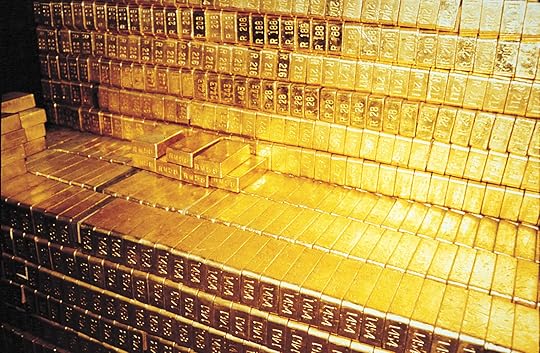
(gold bars at Fort Knox)

Butler gave an interview some time ago (October 2013) to Lars Schall, in Dusseldorf; he made interesting points that I refer next, regarding Gold-thinking trends.

It’s a well known fact that the USA left the gold standard in 1971. Until then the dollar had a corresponding value in terms of gold; but no more after Nixon’s administration decision, back in 1971; thereafter the dollar has been left “free” to float. It’s been for so many years a “dollar-centric” system, said Butler.

According to the author, “important trends “are intersecting to “break down” this dollar statusquo/equilibrium, as (world dominant) reserve currency, namely. Butler speculates about China and Russia using gold instead of dollars for trading. [Let's not forget petro-dollars,too].

The author agrees with the ideas advanced by James Rickards (Currency wars). But basically he suggests a back-to-the-gold mentality. He points out the fragility of the USA position: not having enough gold to back its currency; it would cover only “10 months of trade deficit”; and these current reserves haven’t been audited "for years”.

There are well-known investors (see Jim Rogers) who, for years, have been recommending: buy gold. Will it escalate in value**? What shall be the Governments position, when, and if, some currencies [yes: the dollar and the euro] collapse? Gold would have an important role to play, no doubt.
---
*http://expresso.sapo.pt/cadilhe-defen...

**According to Jim Sinclair of JSMineset.com, by 2016 , "Gold will be $3,200 to $3,500 an ounce." By 2020, Sinclair predicts, Emancipated gold will be $50,000 per ounce"

UPDATES

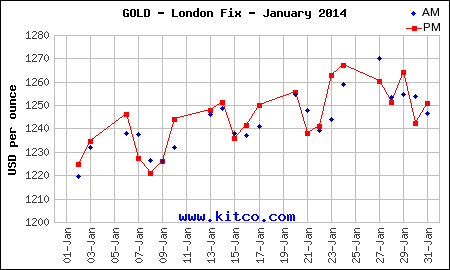
January 2014

...
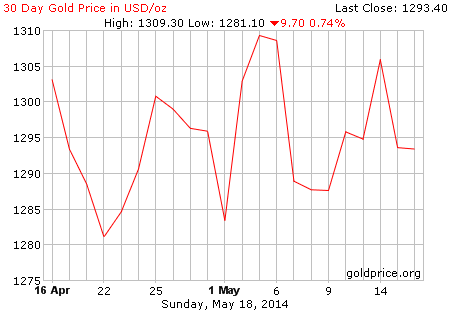
May 2014


January 2015
"Gold above $1,300 for first time in 5 months"
in RT
https://soundcloud.com/rttv/goldcore
Profile Image for Ryan Adams.
8 reviews1 follower
March 2, 2015
An interesting read full of statistics and charts. It starts off well enough but sort of drones on about the idea that fiat currency is terrible and unworkable. While I agree that fiat currency robs from the fiscally responsible to fund a government that is tending NOT to be fiscally responsible, I'm not certain his condemnation is fair. I would have appreciated a more rounded explanation of fiat currency's shortcomings.

Later, he bubbles over with the positive reasons for putting a gold standard in place. Simply by using a gold standard, governments and their peoples become more fiscally sound! Interest rates rise! Investments go up! It will be a magic era of prosperity as we are showered in gold fairy dust! Again, I think a more rounded explanation of the gold standard's good points may have been in order. It was well written, but the doomsayer chapters and the golden age chapters were just a bit too extreme. Which does not make them impossible or untrue- they just feel unlikely and as such, I feel I don't take away anything actionable from the book.
1,157 reviews11 followers
February 5, 2016
Great book! The man can write regarding very complicated ideas and subjects and make them understandable to the average man. That's great writing. The topic itself is fascinating, as well as practical, especially in light of today's economic and financial instability.
Displaying 1 - 4 of 4 reviews

Can't find what you're looking for?

Get help and learn more about the design.