This unusual but charming collection takes place in the mind of a 4th grader who falls asleep in science class. Students and teachers may recognize some ...
Jon Scieszka is an American children's writer, best known for picture books created with the illustrator Lane Smith. He is also a nationally recognized reading advocate, and the founder of Guys Read – a web-based literacy program for boys whose mission is "to help boys become self-motivated, lifelong readers."
A concept whose time has not come... Science Verse is fairly dumb. Lessons taught on the perimeter Of bad iambic pentameter Does not hearty reading make - It is simply hard to take. To seem nicer, it comes free with the book read on CD. (But it's a double-edged sword; Jon and Lane sound rather bored. Plus, their own rhymes they don't sing - A few kids give it a fling.) Such topics as evolution (Though Kansas demands ablution), Molecular states and chemics, Things like global epidemics, Human bodies, dinosaurs... Why not warts and canker sores? Seeing every rhyme unfold? The same punchline growing old. All the artwork, though? Terriffic (If not very scientific)! Rhyme each phrase and word and letter... Could it not be done much better? My two cents on Science Verse -- Truthfully? I'd do much worse.
This book teaches science while at the same time is full of fun, providing lots of laughs. Many of the rhymes are take-offs of common songs and poems kids may recognize, such as “Stopping By Woods on a Snowy Evening” by Robert Frost or “Jabberwocky” by Lewis Carroll. Some are short but still so clever, as this one on the dual form of light:
"Hey diddle diddle, what kind of riddle Is this nature of light? Sometimes it’s a wave, Other times particle . . . But which answer will be marked right?"
Similarly, the complexity of natural phenomena is elucidated in “What’s the Matter?” in which the authors begin by explaining:
"Miss Lucy had some matter. She didn’t know its state. She only had three choices, So tried to get it straight. . . ."
My favorite is this riff on “The Night Before Christmas”:
"'Twas the night before Any Thing, and all through deep space, Nothing existed -- time, matter, or place. No stockings, no chimneys. It was hotter than hot. Everything was compressed in one very dense dot.
When out of the nothing there appeared with a clatter A fat guy with reindeer and something the matter. His nose was all runny. He gave a sick hack. "Oh, Dasher! Oh, Dancer! I can't hold it back!"
He huffled and snuffled and sneezed one AH-CHOO! Then like ten jillion volcanoes, the universe blew. That dense dot exploded, spewing out stars, Earth, Venus, Jupiter, Uranus, and Mars,
Helium, hydrogen, the mountains and seas, The chicken, the egg, the birds and the bees, Yesterday's newspaper, tomorrow's burnt toast, Protons and neutrons, your grandma's pork roast.
The universe expanded. The guy said with a wheeze, 'Who will ever believe the world started by sneeze? So let's call it something much grander, all right? Merry BIG BANG to all! And to all -- Gesundheit!'”
Whimsical illustrations by Lane Smith complement each poem, and a CD of Scieszka (“rhymes with Fresca”) reciting the poems is also included.
Evaluation: This utterly delightful book of science rhymes will delight readers of all ages.
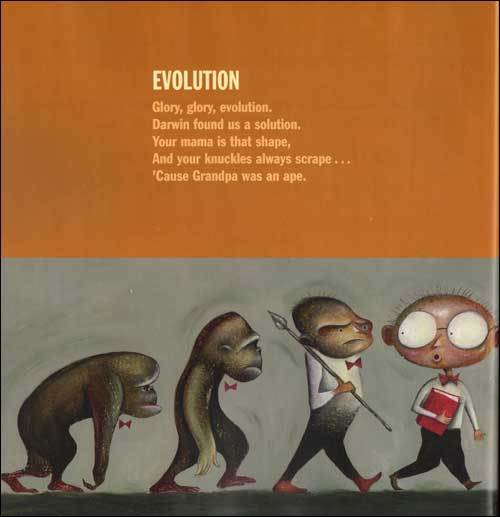
A Summary/Thoughtful Review: In his humorous scientific twists on age-old poems, nursery rhymes, and songs Jon Scieszka has written a collection of creative, witty poems about a broad range of science topics! Setting the scene in Mr. Newton's science class, a young boy has been "zapped" with a curse of the Science Verse, hearing everything as a science poem. In the pages that follow, readers enjoy the playful rhythms and rhymes of scientific topics such as: Evolution ("Glory, glory, evoluuution..."), Water Cycle (It's raining, it's pouring, for H2O is boring..."), You're It ("Eenie, meanie, mynie, mo. Catch a virus, watch it grow..."), and Changes ("I'm a little mealworm, short and wiggly. Here's my antenna, cute and jiggly..."), to name just a few. My personal favorite, Food Chain, describes this process to the tune of "I've Been Workin' on the Railroad." It goes like this: I've been working in the food chain, all the livelong day. In the middle of the food chain, I've got no time to play. Can't you see the green plants growing? That's energy, okay? Consumer eats up the producer, predator eats prey. Who's for lunch today? Who's for lunch today? Don't you just wonder, who's for lunch today? Predator or prey. Predator or prey. Eat or be eaten, that's the only way."
Together with the distinctly abstract illustrations by Lane Smith, Science Verse shares typically "dull" science topics with readers in a creative and attractive way! Although background knowledge of specific science topics may be necessary to comprehend some of the more complex concepts, teachers may use bits and pieces for a certain science unit, bringing "light" and humorous literature into the classroom (rather than just using the textbook). I definitely wish I had known about "Food Chain" last year when I taught this unit to my forth grade students! *This book came with an included CD of every poem read aloud! :)
Science Verse, by John Scieszka and Lane Smith, tells the story of a boy who is zapped with the curse of science verse when his science teacher suggests that if “you listens closely, the poetry of science can be heard in everything”. The unnamed by falls into a deep sleep or trance in which all of his science studies are transformed into poetic and sometimes creepy verse. This humor filled collection of science poems includes science themes from biology to astrology. Those readers familiar with classic poems such as “The Raven” by The Raven” by Edgar Allan Poe or “A Visit from St. Nicholas” more commonly known as “Twas the Night Before Christmas” by Clement Clarke Moore will quickly see the parallels between these poems. Students are more likely to recognize “Mary Had a Little Lamb” when they read “Mary had a little worm, she thought it was a chigger”. The humor filled drawings will help students understand the themes and make them giggle.
This collection would appeal to the comedians, scientists and poetry lovers of upper elementary classrooms. All but one of the poems is based off classic poems. The authors provided an “Observations and Conclusions” reference list at the end of the book. It would be really interesting to compare these versions to the original texts. The text is factual and incorporates science terms, which opens possibilities for students to use this to remember some key facts.
I listened to the audio version of this book, while also having a hard copy to follow along. Jon Scieszka and Lane Smith read most the poems, and they are absolutely wonderful! I will never read this book again without listening to them. I also enjoyed them SO much because they would add lib between the poems and again at the end of the book, they are so funny and entertaining. Listening to them read it was so very enjoyable for me and it sounded like they enjoyed it as well.
This book is a collection of poems on science related topics. The poems often inspired from other famous pieces of literature (i.e. The Raven by Edgar Allen Poe, Jabberwocky by Lewis Carroll, and more!) It starts off with a boy falling asleep during his science class and he begins to think and dream of everything in science poetry verses, and thus the poems begin.
This book would be perfect to use to infuse reading and science concepts. A great inspiration for students to create their own poems that involve, biology, the solar system, water cycle, the human body, etc. While I do think any age would enjoy this book, it would be more enjoyable for the reader to have some background knowledge on the science topics and the original texts in which they are parodying to fully appreciate Scieszka’s work. The illustrations are classic Lane Smith, and they truly compliment the text.
Summary - Elementary science topics including the states of matter and the solar system described in poetry. Curriculum Connection - Great book to use as a fun way to introduce a science topic. Could also be used as a language arts connection (under line all the verb, circle all the nouns, etc.) Could also be used to connect as a model for a science extension activity (write a poem about habitats similar to the poems we read in Science Verse). Personal Reaction - LOVED IT!! This has been my favorite picture book so far. I immediately decided to buy a copy to have for my future classroom because regardless of grade level students will find enjoyment in this book! The author covers a variety of topics that will work across different grade levels and the style and rhythm mimics poems many of us are already familiar with (the author playfully makes this point himself in the back of the book). Visual Appeal - The illustrations were done in dark but vivid colors that clue the reader into the dream state of the little boy from the start and end of the book. The little boy is placed in silly and strange scenes throughout the book. Intended Audience - Second to fifth grade, about seven to eleven years old.
The author's observations and conclusions noted at the end of this book were as interesting and funny as the book itself. Each poem has a science theme to which most students would be able to relate. Evolution, the water cycle, and the scientific method are a few examples of subjects put to familiar tunes such as "Casey at the Bat","It's raining, it's pouring..." and "Twinkle, Twinkle, Little Star." I didn't catch some of these connections until I read the author's notes, so it's worth an extra read or two. I especially loved "Dino-sore" in which the narrator laments the endless, grade to grade study of dinosaurs. His conclusion - dinosaurs weren't destroyed by meteors but by boring teachers. The illustrations by Lane Smith added to the humor of the poems with "sciency" pictures (periodic table) combined with subtle details (the boy wearing a bib when eating lobster as part of the food chain.) This would be a wonderful read-aloud for 3rd grade and up and a lesson on writing about what you know.
This is an award-winning poetry book. It has vividly colored pictures and catchy (and sometime disgusting) verse. It is memorable and covers many science topics. The verses are set to poetry we (and many children) know and love.
It can be used throughout the elementary curriculum and tied to science curriculum. Children and adults alike will laugh and remember the topics.
It is an excellent addition to any classroom library.
I am a big fan of Jon Scieszka (author) and Lane Smith (illustrator). This particular collaboration of theirs takes scientific facts and puts them to verse based on nursery rhymes or popular folk songs. The illustrations and graphic design of the book is brilliant. And if you aren't careful, you may learn a thing or two.
Science Verse is a compilation of poems related to a science class. It is a companion book to Jon Scieszka’s Math Curse. It begins with a student who says that his science teacher, cleverly named Mr. Newton said that if they listen closely, they can “hear the poetry of science in everything”. The next day, the student begins to hear the poems in everything Mr. Newton teaches about science. This is a fun book for children to read because of its playful words and lightheartedness. This is not a good source for completely factual information related to science topics, however, it is informative and offers readers a cheery perspective on the field of science. There is a section of the book titled: Why Scientists Don’t Write Nursery Rhymes. Included in this section is the following poem: Mary Had a…
Mary had a little worm. She thought it was a chigger. But everything that Mary ate, Only made it bigger.
It came with her to school one day, And gave the kids a fright, Especially when the teacher said, “Now that’s a parasite.”
As you can see, the poem does offer a brief explanation of parasites, but mostly gives the reader a laugh rather than a textbook answer. The collage artwork gives the reader a sense of the breadth of topics in science as each picture includes paintings, printed materials like newspaper, sketches and many colors. The text is easy to read and contrasts nicely with the plain colored background. I recommend this book to students in grades 4 and above because they are better able to understand some of the content and connect with the humor in the poems. Teachers can use this book to teach generally about the subject of science. I would not recommend using it as a tool to teach about a specific area of science, as it is not detailed enough to provide adequate information.
What an amazing book! This book has SO much to offer children; it has science, poetry, entertainment, and humor, all in one book. Being built off of the ending to “Math Curse,” the little boy in the story gets a science curse put on him that makes him look at everything in a scientific way, and he can only speak in verses to communicate what he sees.
Children really will love all the humor they get out of this book. The rhymes, poetry, and even songs are all entertaining ways for them to read and learn something. Also, the accompanying pictures provide even more enjoyment, as they are just as silly.
There is so much that children, and even adults, can learn from this book. It’s a wonderful resource for teaching poetry in a language arts lesson. The book even comes with a CD that has the book read by the authors, so that children can really hear what the poems were meant to sound like.
In addition to the poetry, there is a tremendous amount of scientific information to be taken away from the book. There are poems on the water cycle, black holes, the human body, dinosaurs, the food chain, and the list goes on and on!
This book would make a wonderful read as a whole, but can also easily be broken down into poem sections and have a child work with one poem a day. The possibilities are endless with this book, and it really is amazingly written.
When the teacher tells his class that they can hear the poetry of science in everything, a student is struck with a curse and begins hearing nothing but science verses that sound very much like some well-known poems. -Thanks to Goodreads
Literary Awards: Parent’s Choice Award Gold 2004 Non-Fiction ALA Notable Children’s Book Award 2005
Genre: Non-Fiction, Humor
Reading Level: 3rd-6th grade
Topic: Science, Poetry
Use: Guided Reading, Independent Reading
Social Issues: evolution, water cycle, anatomy, astronomy, black holes, dinosaurs, food chain, food additives, light, worms, parasites, fire, bedbugs, scientific method, electricity, virus, atoms, states of matter, senses, amoeba, metamorphosis, expanding universe and the solar system
Written By: Jon Scieszka and Illustrated by Lane Smith
Illustrations: His paintings are so unique and interesting. They really bring life into the topic of science. From the authors mouth, “I paint on board, building up several thin glazes of the oil, sealing them between coats with an acrylic spray varnish. This not only dries the oil instantly, but also causes a chemical reaction between the oil and the acrylic.”
Science Verse is a wonderful compilation of science themed poems! Jon Scieszka takes typical, boring science topics (such as amoebas, the food chain, and black holes, metamorphosis) and spices them up to become thrilling, interesting, humorous stories. At the beginning of the book a boy is stricken with a "curse of science verse" and transforms all of his science topics into poems (several of which paradoy the rhymes of famous poems). The artwork throughout the book acts as a wonderful companion to Scieszka's poetry. The multimedia artwork includes collage, drawings, printed materials, and paintings. After reading this picture book, I began to think of all the wonderful applications for this book! I can't imagine how children, who love songs and rhyme, would connect with this book! To be able to see these topics in a totally different way could transform dull science topics into exciting experiences for students. I would recommend this book for both elementary and middle school students. The book could be used for a variety of uses (besides the afore mentioned use to teach science topics) such as to teach poetry, use of humor in writing, and/or developing a creative writer's voice.
Science verse is a book that tells the story of a young boy drifting off to sleep during a science class and dreaming of science related concepts written in poem form. Many of these humorous poems are similar in structure, verse and phrasing as many famous past poems. For example, "Astronaut Stopping by a Planet on a Snowy evening" is similar to "Stopping by Woods on a Snowy Evening". All science poems and the originals they pair with are listed and discussed on the last page. While these poems are humorous and contain much scientific vocabulary, their ultimate goal is not accuracy. For example, the creation of the universe was not created by a man's sneeze as suggested in "'Twas the Night"!
I enjoyed these poems and I think they would work well as discussion starters or supplemental activities in a science class. Again, they would not be used to teach subject matter. I would also think an interesting activity may be to compare/contrast the famous original with the new versions of the poems in this book. Students could perhaps even be asked to write their own version.
This book was an interesting take on mixing poetry and science. The book opens with a boy who has been cursed with the science verse and he sees science through eyes of poems. There is a vast variety of poems written about various topics such as: evolution, the water cycle, body parts, dinosaurs, the food chain, chemistry, the scientific method, and much more more! This book would be a good literacy addition to opening up a science lesson and getting students to start thinking about what the poem may be telling about the concept that you are about to teach on. On the other end of the spectrum, you could read this book in literacy to integrate content across disciplines and bring up ideas that are being taught in science through a writing assignment in literacy. This book was a wow book for me because there was such variety in content and the illustrations and wording took a totally different twist than traditional convention embodies so it provided excitement and variety to the "normal" studies of poetry and science.
This is a very interesting book. It talks about a group of students in the class and they are learning science. Different pages were used to talk about different science theories. For example, there are theories on evolution, water cycle, dinosaur, food chain and scientific method at the bat, etc. For each one, a tiny little man is put there drawing a picture. These little people explain every science theory to readers. The picture is very vivid. The paragraph is simple and easy, very suitable to for the kids. In addition, there are simple and easy examples accompanied with vivid pictures. Each page has different themes. The whole book is very colorful and each theme uses different color backgrounds. The whole book is very significant. It uses the comic style to explain everything. When parents don’t know how to explain the science theory, then I highly recommend this book. It’s really helpful to explain the science theory to kids.
Science Verse is a book about, you guessed it, science poetry. What makes this book fun is a lot of the poems are set to well known nursery rhymes such as Mary Had a... (Little Parasite) instead of Mary Had a Little Lamb, poems such as 'Twas the night (before anything) which is set to the same meter as "Twas the Night Before Christmas, and stories such as The Senseless Lab of Professor Revere which is a take on the Ride of Paul Revere. The end of the book even features an Observations and Conclusions page which tells the reader with what other poem the poem in the book may be similar to. The illustrations are fantastically whimsical and what you come to expect from Lane Smith. This would be a fun book when talking about poetry with your students as it is silly and fun to read and also not only educates the reader about science, but shows how language arts can cross into other content areas.
How often do you get to read poems about science? Or maybe you do and this is a genre completely new to me! I knew that with Jon Scieska as the author and Lane Smith as the illustrator, these would be a blast! Such as the scientified "I've been working in the food chain, All the live long day" (as in "I've been working on the railroad") or "Mary had a little worm, She thought it was a chigger, But everything that Mary ate, only it made bigger" genre. You get the idea. Big shout out to longer poems "Gobblegooky" (Beware the Gobblegook, my son!--Beware the Jabberwok, my son! Anyone?) and "'Twas the night before Any Thing, and all through deep space, Nothing existed..."---Big Bang Theory and The Fat Guy with Reindeer mixed in". I'll end with the following poem.
Eeenie, meanie, mynie mo. Catch a virus, watch it grow. Once it's got you, it won't go. Eeenie, meanie, my-Oh No!
Yes... I believe you can hear them. Science facts set to some very familiar poems. When the teacher tells the class that science is poetry...the words take shape, the sounds become poetry, and the effect is quite amazing!
Science Verse is quite clever, but you knew that before you even started reading, of course. It's written by Jon Scieszka. Would you expect anything less? The illustrations are just as comical and fun. It'd be fun to get the original poem and compare side-by-side to realize just how clever these are.
Those verses that can be sung aloud definitely should which reminds me of my sophomore year in high school when I got in trouble for not singing the song that the animals sing in Orwell's Animal Farm with the rest of the class.
I shared this book with my 5th grade students and they really enjoyed it. Most of them seemed to think that it made science seem fun and funny. The illustrations kept them engaged also.
This is an immensely creative book which introduces science topics through rhyme, little poems that are very catchy and explain the topic a little bit.
Star rating: 5 Copyright: 2004 Genre: Poetry Theme(s): Science
I like how the book is able to breakdown complex science ideas in very simple and creative language. I think this book would be a great way to introduce students to science topics as it tells information in very fun way.
Quirky. Clever. Funny. Science-ifies classic poems. Love the illustrations by Lane Smith. Lots of tidbits in there - especially on the front and back covers. Super nerdy.
Make Science fun with Jon Scieszka's poetic picture book, Science Verse! I think, this would be an incredible way to introduce Science to your class at the beginning of the year. Helping students understand that science is everywhere and what exciting things you will be learning about: dinosaurs, stars, planets, food chain, human body, Big Bang Theory, and more! In addition, I would return to poems when you begin discussing the topic. There are many that will assist students with the new concept or remember important facts. I absolutely love each and every poem in this book; however, my favorites are Twas the Night (Big Bang Theory), Why Scientists Don't Write Nursery Rhymes (various topics), and What's the Matter? (Liquid, Solid, and Gas). Each poem is based on a science topic delivered in a familiar way; you may recognize nursery rhymes, classic songs, and famous poems. The inside book flap mentioned a real treat, there is another book written by Scieszka entitled, Math Curse. I have found a reading of this book on YouTube, Nana's Story Time. Anyway to integrate literature into ALL subjects to assist students in understanding new topics while creating another opportunity to fall in love with reading. I read this book as a part of my #BookaDay Reading Challenge, inspired by Donalyn Miller. My goal is to read at least one children's literature book everyday and share my thoughts here on my blog. Please feel free to subscribe or connect with me on social media to follow my journey through the books I read. Until next time ...
I really, really wanted to like this book...and really, really did not.
This is not a children's book. The vocabulary and concepts exclude that. However, I was reading it as an adult scientist (yes, I really am a scientist) looking for a bit of humour on scientific topics that I could enjoy and perhaps share with my colleagues. I will have to keep looking as I did not find it here.
My problems with the book?: -the rhymes were often quite awkward -there was an underlying negativity to the themes of many (most?) of the poems -there was an anti-teacher/anti-education bias -there were inaccuracies about science and the related concepts -it often just seemed like Scieszka was throwing words down on the page either not really understanding what they meant, or not really caring about the meanings of the words.
I really, really wanted to like this book. Unfortunately, I really, really did not.