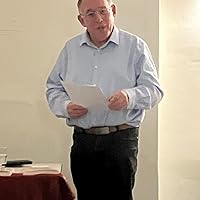
Dr. Richard “Rick” Spence received his PhD in History from the University of California Santa Barbara in 1981. He has taught at the University of Idaho since 1986 where currently he is a tenured full Professor of History. He specializes in Russian, intelligence and military history, and his course offerings include Modern Espionage, Anti-Semitism and the Holocaust, History of Secret Societies and the Occult in History.
Dr. Spence’s published works include Boris Savinkov: Renegade on the Left (East European Monographs/Columbia Univ. Press, 1991), Trust No One: The Secret World of Sidney Reilly (Feral House, 2002) and Secret Agent 666: Aleister Crowley, British Intelligence and the Occult (Feral House, 2008). He is also the author of numerous articles in Revolutionary Russia, Intelligence and National Security, International Journal of Intelligence and CounterIntelligence, The Historian, New Dawn and other publications. He has served as a commentator/consultant for the History Channel and the International Spy Museum and was a key consultant-interviewee for the Russian Cultural Foundation’s 2007 documentary film, “Leon Trotsky: The Secret of World Revolution,” and its subsequent “Trap for the Tsar.”
Writing a biography of a man as complex — and elusive — as Boris Savinkov is not an easy task. But Richard Spence has done an exemplary job of this. HIs 1991 book is comprehensive and authoritative — and it is also surprisingly readable.
The story of Savinkov is basically in three chapters. At first, and until around 1911, Savinkov was a leading member of the Battle Organisation of the Party of Socialist-Revolutionaries (PSR) in tsarist Russia. He was involved in organising successful assassinations of top tsarist government officials and members of the ruling Romanov family. But he had a fraught relationship with the PSR’s political leadership abroad which grew worse after Ievno Azef, Savinkov’s leader in the Battle Organisation, was exposed as a tsarist police spy.
The second chapter is considerably shorter. During the First World War, Savinkov was a defencist — he supported Russia fighting on the same side as the democracies — Britain, France and the United States. With the overthrow of the tsarist regime in March 1917, Savinkov returned to Russia where he became one of the ministers in Kerensky’s government. His links at this time to the PSR were tenuous.
The third and final chapter followed Savinkov’s struggle against the Bolsheviks. Savinkov played all sides here — he served for a time with various White generals, but could not stomache their reactionary politics. He fought for a time as a Green, leading peasants against both the Whites and Reds. By the early 1920s, he was largely a spent force, living in exile, unable to influence affairs back in Russia.
His “last throw”, as Spence put it, was his decision ot return to Soviet Russia where he announced that he had switched sides and now supported the Bolsheviks. A few months after his trial, where his death sentence was commuted and he seemed on his way to playing a role in the Soviet system, he fell (whether he was pushed or jumped is debated) from a window in Moscow’s notorious Lubyanka, headquarters of the Cheka.
A truly gripping tale, well told and highly recommended.