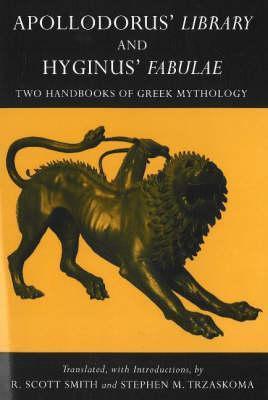
By offering, for the first time in a single edition, complete English translations of Apollodorus' Library and Hyginus' Fabulae --the two most important surviving "handbooks" of classical mythography--this volume enables readers to compare the two's versions of the most important Greek and Roman myths. A General Introduction sets the Library and Fabulae into the wider context of ancient mythography; introductions to each text discuss in greater detail issues of authorship, aim, and influence. A general index, an index of people and geographic locations, and an index of authors and works cited by the mythographers are also included.
The story of the Trojan horse isn't found in the Iliad, nor is the account of Achilles' death. Some of the main sources we have for Greek mythology, such as the preceding examples, come from the mythographers, i.e. Apollodorus and Hyginus. They fill in many gaps in our knowledge of Greek mythology. They recount the genealogy of the gods and tells of their amorous exploits and offspring. Not all of the tales are fabulous either. Some seem to be grounded in very possible history. Intrigues, wars, murders and many other subjects are recounted. One can conclude that many of the Greek playwrights were originally either inspired by handbooks such as these, or, possibly, from oral tradition. Chances are good when one reads more current mythogoraphical works like those of Robert Graves or Thomas Bulfinch, one will undoubtedly encounter these earlier mythographers as primary sources. What these works lack in poetic flair, they make up for in simply providing details.
As far as Greek mythology is concerned, Hyginus and Apollodorus are essential sources. They are later than Hesiod and Homer undoubtedly, but the traditions they recount are probably much older. The only other notable sources we have for Greek mythology comes from various odes, fragments, lyric poets and the tragedians and the comedians.
I have to say that I was put off by some of the phrasing chosen by the translators here. It is off putting when ancient thought is twisted into modern idiom. I suppose I prefer Romantic and Victorian phrasing and would probably opt for high (for lack of a better word) English than 21st century vernacular English.
It's a great handbook and I'm sure I'll keep it around for the index. Not a fun read though, since it's just a list of names with a few stories, and the translation isn't very elegant or interesting. I did discover some new gods I hadn't read about before, but most of the good stories in here have already been made epic for us by better writers.
A pleasure to read these fables and myths. Apollodorus' Bibliotheke is the more readable part of this handbook. Fabulae, while interesting to review, is more encyclopedic.
This book contains translations of two ancient compendiums of Greek mythology. Bibliotheca (Library) by Apollodorus, and Fabulae by Hyginus. This is a book that I was particularly looking forward to, and it did not disappoint. However, there is one caveat. Don't go into this expecting poetry or a flowing narrative. As it says on the cover, these should be looked at as handbooks or reference pieces. They can be quite dry, and it may be a slog to try and read through one (or both) all the way through as I did. So why the five star rating?
Well, Bibliotheca is a very important work, with it containing stories of which older versions are lost. For example, reading older Greek works, you will no doubt hear about the legendary Twelve Labors of Heracles. There were surely many depictions of these labors, but the majority of those are now lost to us. The oldest full account of the twelve labors that we have is within this work. The same can be said for several other stories, as well. Now, nothing in here is talked about in too much detail. It is basically an overview or a summary. But what it lacks in quality, it makes up for in quantity. It's quite comprehensive, and if you can think of a Greek myth, odds are that it is included here. Most stories are categorized by genealogy, which are then told in chronological order. The exception to this division is the final part of the work, which summarizes the events before, during, and after the Trojan War. Much of the final quarter is lost, included said Trojan War summary, so an "epitome" or later summary is used in its place. Overall, it's relatively simple and easy to follow.
The second work included, Fabulae, is very similar. It was written by a Roman, Hyginus, who may or may not be the same Hyginus who wrote about the constellations (as I mention in my review of Constellation Myths). But while that Hyginus seems quite learned and professional, this one feels much sloppier by comparison. There are several errors and mistakes, and his organization is a bit more haphazard, with some stories being skipped and instead touched upon later, after the Trojan War section. If this is indeed the same author, perhaps this was an earlier work, before he refined his craft? Regardless, this is still worth a look into. While the majority of the stories are shared between the two, several of them are interpreted differently, and it is interesting to see how the two authors differed in choosing a version of each myth. There is also the occasional story that only appears in one of the two. The famous tale of King Midas, for instance, is present in Fabulae but not Bibliotheca. All in all, Fabulae certainly feels more amateurish compared it's Greek counterpart, but it is still a very nice bonus.
While there are several translations of Bibliotheca out there, this is the one I'd recommend. It's nothing groundbreaking, but it does its job. And besides, the main reason to go for this one is the inclusion of Fabulae, which is much less known (and thus, far less translated).
Apollodorus is OK and written coherently, which is outstanding for such a topic; it's hard to make sense out of Hyginus. Most of the interesting stories are better told by Apollodorus, but it's good to complement with both versions
The classics can be hard to read sure to the misogyny, but are well worth it to understand the origins of so many concepts we use every day. Plus, monsters.