**Brutal and overwhelming, Confession wrestles with the legacy of Argentina’s past and the passions of one young girl. ** There are mysteries in the world of man, just as there are in the Kingdom of God, and that they too, albeit quite differently, are unfathomable. When Mirta López looks out the dining room window, she sees a slim, self-possessed older boy on his way back from school. It’s 1941 in provincial Argentina, and the sight of the Videla’s eldest son has awakened in her the first uncertain, unnerving vibrations of desire. Naturally, she confesses. But she cannot stop herself. Thirty years later, Videla is a general, leading the ruling military junta, and a cell of young revolutionaries plot an ingenious attack on him, and the regime. Writing from the present into the past, Martín Kohan maps the contours of Argentina’s 20th Century, but finds his center in one woman—devout, headstrong, lit up with ideas of right and wrong—not the grand historical figures of her lifetime’s omnipresent, brutalizing history. “There is an art to keeping lives constant, not allowing them to be altered by facts that are merely external.” And there is great beauty in Confession , its decades and landscapes, and the legacy of love and guilt playing out in one family and against the background of dictatorship’s traumas.
Martín Kohan es un escritor argentino y profesor de Teoría Literaria en la Universidad de Buenos Aires y en la Universidad de la Patagonia.
Sus obras se publican en editoriales como Einaudi (Italia), Serpent’s Tail (Reino Unido), Seuil (Francia) y Suhrkamp (Alemania). Ciencias morales (2007) es su novela más popular y ha sido llevada al cine con el nombre "La mirada invisible", bajo la dirección de Diego Lerman. En la película Kohan interpreta el breve papel de empleado de una tienda de discos. También con Ciencias morales ha ganado el Premio Herralde de Novela 2007.
En 2014 recibió el Premio Konex - Diploma al Mérito como uno de los 5 mejores novelistas del período 2008-2010 de la Argentina.
Me gusta el estilo. Me gustan las historias mínimas que se esconden dentro del global de la novela. Me gusta la historia que hay de fondo. Y sobre todo sobre todo lo que más me gusta es la combinación de todo ello.
El abandono de la niñez y la rebelión que el propio cuerpo nos marca de forma autónoma, o la relación tierna y entrañable con una persona mayor, son pequeñas historias y como digo la forma de contarlo, hacen que ensamble con el drama de fondo de forma magistral.
La primera parte es buena, la segunda parte más normalita y el capítulo final me ha parecido bárbaro: cualquier forma de arte siempre busca conmoverte y esa última parte como digo logró hacerme morir de risa y por momentos emocionarme, sin tregua, de una página a la siguiente. Lo tuve que terminar de una sentada (me recordó los cientos de partidas de naipes que jugaba yo con mi abuelo de niño). Para cualquier joven escritor le recomendaría esa última parte del libro, solo como espejo ya que debe ser ciertamente complejo escribir tan bien y con una técnica tan pulcra.
Sos ingresante y tu profe es Martin Kohan, terminas la clase y queres tomar los medios de producción pero te conformas con leer su último libro con una metralleta en la mano (y por alguna extraña razón te sentis atraida por Videla)
Me gustó. Es lo primero que leo de Kohan y lo que mas rescato es su forma de escribir. Simple y directa sin florituras, aunque en la primera historia sentí que se aferró a una idea y la desarrolló de más, pudiendo resumirse en un par de páginas. Es un libro que está bien.
Argentina. Such a place; sophisticated, layered, miserably so. Too beautiful - like that high school crush you’re secretly glad wouldn’t go out with you because you wouldn’t really know what to do if they’d said yes to you then, and now? Oh god - look - just look.
Now that I live a short ferry ride away, but in a different country from that big, ferocious yet weirdly impotent place, I find myself endlessly fascinated by its writers, its stories: Puig, Cortazar, Ocampo, Selva Almada and now Kohan.
Wait, you’re saying, she forgot Borges. No I didn’t, and Borges.
That country, rich with humor, culture, tenderness, insight, hindsight, loveliness, hubris - yet it seems so unable to shape these into anything actually Helpful.
This book. Skillfully told from the most innocent to the height of guile - what - I think? A grandmother talking openly about her adolescent sexuality? On what planet? But it all becomes tangible, believable, no more a confession than any other story that needed to be told. All coiled so gently.
Indeed this is a story that needed to be told. One of 30,000 or 40,000 - but who's counting?
The first chapters are divided by short riffs on the theme of the Rio de la Plata, a river that doesn’t appear to flow. It seems a river that defies Heraclitus; but it must be moving because it changes the color of the ocean at the point where it joins the Atlantic - near where I live - documenting its course by leaving a grayish brown patina which can be seen from above, or while shipboard.
When you’re in Buenos Aires there’s no perspective from which to see the horizon over the river. They’re both flat. A flat city looking at a flat river. But the city doesn’t bother to look at the dead river. It very pointedly looks away from it.
On a trip last month from Uruguay to Argentina, we were in the middle of the Rio de la Plata during a tormenta grande, a big storm, with hail the size of softballs and a blinding rain. I had a front row seat and it was glorious. Buenos Aires was temporarily flooded when we landed, the city forcibly paused for a few hours. Traffic tangled even more than usual.
Flooding, sudden underground changes in water make up another bit of the storyline in this fine book. The underground water systems we think are under control. A tiny detail of the Nature We Now Are in Charge of. Or imagine we are. But, really, how easily our way of life can be permanently put on pause by a little rain. How fragile it all is.
No one meant any harm, did they?
Best to find a steamy balcony in Villa Ortuzar, like we did, gather with friends around a piano and sing tango while the world burns. Maybe you’ll sing Volver. Maybe you can close your eyes and see Carlos Gardel.
Maybe then you can forget that secret you told. Or the one you should have told. And then it would have all been different.
I cannot recommend this perfectly constructed novel highly enough.
martín kohan es un maestro en alargar el tiempo y mantener la tensión NO PUEDE SER. me encantaron las tres partes de la novela, con la tercera todavía estoy recalculando porque es increíble cómo consigue atraparte de tal manera y dejarte al borde de la silla por páginas y páginas sin darte tiempo a nada. posta, la mejor persona viva y este libro debería ser lectura obligatoria en las escuelas para que los pendejos 1. sepan de historia argentina y 2. tengan que tener una clase de esi!!!!
What an excellent novel! It is original, thrilling, humane and very confidently written and translated. It is also full of symbolism and daring in form.
In just 160 pages we get 3 connected, but completely different parts that all center around the dictatorial Videla regime (1976-1981). The first part is set in the 40s and we see a young Videla growing up outside Buenos Aires. The second takes place at the height of his reign. And the third, my favourite, is set today looking back through the eyes of an old grandmother.
The three parts are also connected thematically. Confessions play an important role and so do rivers. The symbolism was evident and really contributed to the reading experience.
4,5 rounded up (and probably my favourite Charco of the year....together with Of Cattle and Men).
El manejo del ritmo no solo de la narracion sino de la propia lectura es gratamente alienante. De lo no dicho, todo dicho y verborrea catolica sin sentido; una historia no de amor de Dos, sino del Uno de la abuela, el fallo de la planificación y la negación de lo propio, quedan algunos cabos sin atar, algunas respuestas en el aire denso de los gobiernos de facto y el desparpajo de los adultos mayores cuando alcanzan la impunidad del geriatrico. Confesión me atrapó.
Ezequiel Martínez Estrada wrote that the pampa, crushed by the metropolis, denied by the city, was now emerging from the deep and conquering (reconquering) Buenos Aires. Normal life unfolds on the surface, mentally abolishing that sub-city of dark and latent galleries. No one thinks of that underground. No one pays it any attention. But just see what happens up above when what’s submerged re-emerges, when the clandestine city undermines the visible one, when the suppressed flow returns towards what suppresses.
Confession is Daniel Hahn's translation (apparently his 100th book!) of Martín Kohan's 2020 novel Confesión, and the latest from the wonderful Charco Press, tne 44th of their novels, all of which I've read and reviewed here.
This is a fascinating novel, a triptych of three pieces in different styles (one divided into two streams) which adds up to a fascinating portrait of the pressures of live in Argentina under military rule, centred around one woman, the narrator's grandmother.
The first section 'Mercedes' opens in the small city, in Buenos Aires province, of that name in 1941 (or rather looking back on 1941 from nearer the present day as the stories have been relayed to the narrator):
Father, I have sinned. I've sinned, or I think I have, said, and says, Mirta Lopez, my grandmother. Who wasn't my grandmother yet, of course: she was only twelve. Kneeling in the confessional at the church of San Patricio, over in Mercedes, aware of Father Stine, who was leaning forward, just like her, towards the porous wooden grille, in the comingled smell of incense and the damp of the floor and walls, in the thick gloom from the stained-glass windows that are too high up and probably dirty, as she awaited the double promise of understanding and punishment, of acceptance and rebuke, of indulgence and sanction, presenting tolerance with something maybe intolerable, approaching forgiveness with something perhaps unforgivable, Mirta Lopez, my grandmother, the girl who would much later be my grandmother, white blouse and blue skirt and an elastic headband, also blue, holding and ordering her hair, said this: I have sinned, and then: or I think I have.The verbs conjugated in that way, the present perfect, an appropriate form for confession and for all solemn pronouncements (for promises, the future: I won't do it again; for sins, the present perfect: I have lied). She said and says, in those exact words, and although when speaking today she raises her head, for a better evocation, at the time she lowered it, ashamed: chin touching her chest, her eyes lost on her own hands, a contained sob.
Mirta possible sin is her first feelings of sexual attraction to a boy, the elder son (or elder living son, his twin brothers have died at a young age) of the distiguished Videlas family, himself 4-5 years older. As this strand of the story continues over the year's Mirta's innocent feelings become more overtly sexual, and at the same time her initially naive confessions to her Priest more disingenuous. The section ends with Mirta's feeling unacknowledged, let alone consumated, and them each marrying different people in 1947-8.
A second stream (I use the term deliberately) in this first section is a series of shorter pieces on the Río de la Plata, on whose shores Buenos Aires stands, drawing on the work of various Argentian writers including Rodolfo Walsh, Borges, Juan José Saer, João Guimarães Rosa (of course Brazilian), Eduardo Mallea, Adolfo Prieto and Ezequiel Martínez Estrada. The latter is behind the comment that opens my review, and as this strand progresses the focus moves from the river itself, sometimes seen as an island sea, to the smaller underground streams in Buenos Aires itself.
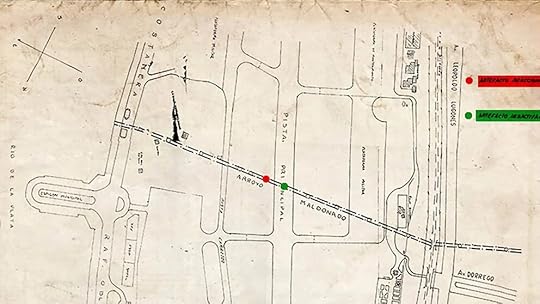
The second section, 'Airport', set in 1977, is told in a reportage style of brief statements and rather neatly shows how these two sections link. It tells of what seemed initially to this reader a rather unrealistic plan to assassinate the military dictator and his entourage by leftist guerrilas, using the underground sewers and streams of Buenos Aires to transport and plant a large bomb under an airport runway, timed to explode as a military plane takes off.
That leader is Jorge Rafael Videla, who the reader could have recognised as the elder son in the 'Mercedes' section from the family name and history. And the incident is actually a real, although unsuccessful one - see for example here for the details.
The map of the Maldonado Stream storm sewer used by the real-life bombers:
The third section, 'Truco' is set in the present day, with the narrator's grandmother, Mirta, now in a nursing home, her short-term memory unreliable, but her long-term memories still clear, and her present-day wits enough to give her grandson, the narrator, a strong match in a game of Truco (whose rules an appendix attempts to explain for the reader, not entirely successfully - interestingly Hahn says he translated the novel without understanding the rules). Again there are two streams, although this time interwoven in real-time, each with a link back to the confession theme, as the narrator and his grandmother play cards, the game involving a considerable amount of bluffing, deduction and stake-raising, but also as he confesses to him more about what happened the day his father, her son, was "disappeared" by the Junta's military police.
If there was a more direct connection of the characters in this part to those in 'Airport' I missed it, although the link to guerrila activity, and forced abduction of those suspected of being involved, is clear, and the narrator's grandmother provides a link, via her wished-for relationship with the regime's leader.
Overall, this is very well done, and, as always, Hahn's translation brings the English version to life. It is a novel where the English reader has to work harder to unlock references that would, I suspect, have been much more obvious to readers of the original, although that challenge, and the consequent knowledge gained, is part of the the beauty of translated literature.
Justo la semana del 24 de marzo leí este libro, no fue a propósito, sucedió. Es un libro interesante. El formato está bueno, la historia que se va armando por partes, donde todo lo no dicho va encontrando su lugar. Y cada relato se va volviendo más atrapante que el anterior, se va retorciendo y volviendo real.
Sinceramente el primer relato me perturbaba por momentos, la imagen de una niña enamorada de Videla es bastante chocante. El segundo relato me pareció muy bien logrado, te cuenta una historia verídica y simbólica. El tercero es tremendo, te pone al borde del abismo y uno no puede dejar de mirar para abajo.
En resumen, creo que este libro está bueno porque da una vuelta de rosca. Tiene un formato de escritura que va intercalando, entre los recuerdos de una niña-anciana y retratos del Rio de la Plata, entre rondas del Truco y confesiones heladas. Y es delicado, da lugar a la memoria, que tan importante es, incluso desde la ficción.
Tres historias bastante flojas. La primera es la que peor lo lleva y es que a pesar de que está muy bien escrita, cuenta muy poco. Creo que en una historia como esta no caben tantas florituras. 2.5 estrellas
Espectacular! Necesito procesarlo antes de escribir una reseña... Sólo voy a decir que es lo primero que leo del autor y ahora tengo ganas de leer el resto de sus obras ♥
No puedo decir que este haya aido, a mí parecer, de los libros más destacables de Kohan., pero seguramente se debe a que la vara que ha impuesto es altísima.
Tres relatos que solo podrían calificarse como subversivos, expresiones de una rebeldía religiosa, marxista o tibia.
El primero de ellos ocupa más de la mitad del libro, y es definitivamente el más flojo de todos. La historia de una adolescente en ebullición hormonal que sin saberlo se enamora de alguien vinculado a la dictadura no ha resonado enemigo en absoluto. Falta el drama y la tensión, se lo siente laxo.
Por el contrario, el segundo relato es puro stress, con la ansiedad vertiginosa de una heist movie del underground.
Pero el tercero es el más pulido, confirmando la tendencia del crescendo narrativo. Personaje entrañable, la confesión de una denuncia innecesaria y con consecuencias probablemente trágicas, un relato que se mueve al ritmo de una partida de truco dinámica y filosa de la que, al igual que la historia relatada por la abuela, el lector desconoce el final.
I really enjoyed this - set in Argentina the first section follows a young girl with severe religious anxiety around her crush on her neighbour. It then moves decades into the future where a group of political revolutionaries are plotting to attack him and his regime.
The structure of this was great and I loved both parts equally. It was freshly written and I particularly liked the first part. I’ve not read much modern male writing from Argentina but I would like to read more from Kohan after this as it was a good mix of political commentary, great writing and effective characters. There is a small coming of age feel to it and how when one grows up how much the world around you changes and the landscape and people who haunt it become completely different characters in your own life. Don’t know why I took so long to read this but it was great.
Este libro es espectacular. Kohan tiene algo en su forma de narrar que siempre me resulta perturbador, incómodo, y me parecen fascinante detectar cuando la literatura te pone en esa posición. Otra cosa que me encanta es la elegancia de su prosa, no hay palabra elegida al azar, todo parece pensado para lograr una armonía perfecta.
Amé muy intensamente la primera parte de la novela, de una calidad formal impecable. Es como un remolino que no avanza nunca, sino para adentro del propio remolino: siempre estamos ante un deseo que crece, ante un incendio en una iglesia apagado con las manos de una niña, por ese otro niño que será Videla. La cadencia que el ritmo que logra es magistral, una repetición se resignifica sobre la tercera parte de la novela por un escritor siempre atento a las voces de sus personajes. De la segunda parte me sentí bastante expulsada, tal vez por ese lenguaje tan descriptivo, tan lejos de la magia de la contemplación de la nuca de Videla y las intervenciones casi en tono ensayístico sobre el río y la ciudad, que son como joyas incrustadas en la primera parte de la novela. Las amé. Pero ese vértigo de la primera parte no pude volver a sentirlo después, y me quedé todo el tiempo con nostalgia y manija de esa cadencia primera, que vuelve a aparecer después solo en parte y por momentos. Sobre el final, me encantó el contrapunto de truco, tan argentinos -el contrapunto en la literatura, y el truco- en la búsqueda de una verdad guardada en la memoria de una abuela desmemoriada. Me pareció también un acierto abordar desde el fragmento y el espacio vacío la historia de nuestros desaparecidos, una historia que tiene todavía -y también - las venas, y el final, abiertos.
3.5 ⭐ ‘Confesión’ es un libro dividido en tres partes. En la primera, una niña le confiesa al cura de su pueblo que no puede dejar de mirar al joven que le gusta, un joven que será el mismísimo Videla. En la segunda parte, ya durante la dictadura, tres hombres planean un atentado para matarlo. Y en la tercera parte, la niña ya convertida en anciana, le confiesa a su nieto algo que hizo durante los años de dictadura militar. Me pareció muy bien escrito el libro por supuesto, pero creo que si el final hubiese sido más potente me habría encantado, creo que le faltó algo.
A young girl experiences her sexual awakening in watching a 16 year old boy walk down the street twice a week. This boy, known as “the Videlas’ eldest son”, would later go on to become the notorious dictator of Argentina. Told in three sections, we see how this man affects the lives of one family, before and during his reign.
Central to the stories in this novel is the idea of confession. Our central character, the young girl in the first section who becomes an elderly woman by the final section, is “lit up with ideas of right and wrong” and is propelled to make a series of confessions throughout her life, with increasingly greater consequences.
Confession is brilliantly translated and filled with the most rhythmic of sentences. Truly harmonious.
Este libro reúne todo lo que me interesa de la literatura: tensión y ritmo, escritura (estilo hermoso, dinámico, bellísimo), profundidad temática (y política). Todo esto a través de una trama vista en escorzo, muy en el estilo de Kohan, aludiendo a una estructura mayor e inabarcable (la dictadura, el deseo, la banalidad e introyección del mal) desde el gesto, el detalle y lo familiar. Impecable.
Nada más que toda una sorpresa de principio a fin. Aunque el autor ponga en juego nuestra paciencia (impacientes por conocer los desenlaces), teje con inteligencia una trama sorprendente.
I have to say that I read this book in March, and that it haunted me for days after turning the last page. In this book, the author's words speak volumes in a short space, which is for me a true measure of a person who is well in control of his or her craft. Confession is not a long novel, coming in at less than two hundred pages, but its short length disguises the complexity within. It also has a shocker of an ending that completely rattled me. Related in three interconnected parts, the author sets this novel timewise over three periods: before, during and after Argentina's military dictatorship that existed between 1976 and 1983.
I am drawn to books set during this period of Argentina's history and Confession left me absolutely stunned. Reflecting on it now brings back all of the feelings it produced the first time around, and it's likely I will never forget it. Each section of this novel focuses on some aspect of secrets that are held, thoughts or deeds that are left unspoken, things that are both known and unknown -- and what happens when those make their way to the surface. The author also explores the continuing impact of the past on the present, most especially in the ways in which ordinary lives are often randomly caught up in or bound to history. It is one of the best books I've read this year, and without hesitation I can definitely recommend it.
Una abuela le cuenta a su nieto que su primer amor fue Jorge Rafael Videla, un vecino del pueblo que décadas después se convertiría en el dictador.
El morbo que dispara la premisa de esta novela es una trampa con la que Martín Kohan enlaza tres historias: el despertar sexual de una preadolescente de la provincia por un joven que estudia en la academia militar de la capital; un atentado guerrillero contra el dictador que falló por casualidad; y una tragedia familiar que esconde un secreto que solo se puede confesar en el geriátrico.
La fascinación del personaje principal, Mirta López, por ese joven correctísimo y elegante, que visitaba a la familia todos los fines de semana y no se perdía la misa, sigue encendida incluso sabiendo de primera mano que ese hombre también fue el responsable de los mayores horrores de la historia argentina. Ahí está el horror en el que Kohan te envuelve sin nombrarlo y con el que hilvana las tres historias.
Videla fue un hijo de puta, no hay sorpresa. Pero Mirta López también lo puede ser, y esa revelación siniestra, ese horror escondido en una vida ordinaria, te hace pasar las páginas volando mientras escuchas a una abuela perderse entre sus confesiones infantiles, sus divagues de mujer mayor que está perdiendo sus capacidades cognitivas, y los trucos con las que intenta ganar a las cartas.
La premisa es una trampa porque no podría decir que Confesión es solo “un libro sobre la dictadura argentina” o “sobre la banalidad del mal”, que lo es. Pero también es un libro sobre el amor no correspondido, sobre la moralidad católica, sobre los muros de las clases sociales y la culpa de clase, sobre soñar y conformarse, sobre idealizar y morir en el intento, sobre las culpas innombrables y lo que se esconden padres e hijos. También es un libro sobre cómo fabrican la historia los Gobiernos autoritarios (googlear Operación Gaviota), y sobre Buenos Aires, esa ciudad incomprensible que le da la espalda a su río, entierra sus arroyos, y arroja sus vergüenzas en la costa.
Kohan es extraordinario. Parco, directo, fotográfico. Tiene lo que más me gusta de los escritores que me gustan: esconde tan a la vista lo que elige no narrar, que te hace sentir que lo descubriste solo. Pasé años sin leerlo y me acabo de fumar tres de sus novelas al hilo. Si pudiera comenzar de nuevo, lo haría por acá.
Un libro dividido en 3 partes que en el conjunto del libro conforman una misma historia.
En la primer parte una niña le confiesa a un cura sus pensamientos "impuros" cada vez que ve pasar por la vereda de su casa un jovencito Videla.
En la segunda parte se relata el atentado de un grupo de jóvenes revolucionarios contra la vida del dictador Jorge Rafael Videla en el Aeroparque de Buenos Aires en lo que fue la Operación Gaviota. En ese hecho un grupo de la organización ERP colocó dos cargas de TNT en el Aeroparque de Buenos Aires para hacer volar el avión de Videla cuando despegara.
En la tercer, sorprendente y última parte una anciana juego un partido de truco con su nieto, esa anciana es la niña de la primer parte. Entre jugada y jugada de esa partida de truco le cuenta qué fue lo que le sucedió a su hijo, el padre del chico, en la que se confesará, ahora, frente a su nieto.
Tremendo libro, súper recomendable.
《Los días en el país transcurrían tan oscuros y criminales, tan feroces y tenebrosos, tan de miedo y de masacre, que ellos no hicieron otra cosa que ratificar su convicción, aquella misma de la reunión de julio, de que era urgente dar un golpe al régimen: sacudir de una vez el tablero, el curso de la historia》.
《El Riachuelo y el Reconquista descargan sobre el Río de la Plata, que no tardó en verse, él mismo, envenenado. Aguas viciadas, aguas podridas, aguas sin vida, aguas apestadas, ya nadie más debía bañarse en ellas. La gente se replegó y aprendió a no tenerlas más en cuenta. Lo que fue balneario se convirtió en ruinas. Y Buenos Aires, en una ciudad seca. Las sustancias tóxicas arrojadas por las industrias mataron en esas aguas casi todo lo que había. La muerte impera de la manera más concluyente de todas: haciendo inviable la vida. Como para ratificar ese signo de muerte, o bien reconociéndolo, los criminales arrojarían al Río de la Plata los cuerpos indefensos de sus asesinados》.
1,5 estrellas realmente no me gustó para nada el estilo y el ritmo del relato del autor, tenia potencial de ser una historia super interesante y eligio la manera mas pedorra, repetitiva y vacía para mostrarla
Tengo sentimientos encontrados respecto de este libro. Hay varias de las cuestiones que aparecen en el libro que son un tópico común entre quienes estudiaron Letras en Puán -- la idea de que "la ciudad se construyó de espaldas al río", etc., y esos temas comunes le hacen perder un poco de magia porque se notan los recursos que utiliza (lo mismo con ciertos recursos estilísticos de la primera parte). Se entiende que toda esa disquisición sobre el río es necesaria para enganchar la narración de la Operación Gaviota, que a mi criterio no queda del todo bien integrada en el libro. Las historias alrededor de ese personaje entre inocente y siniestro que es la abuela tenía fortaleza narrativa suficiente. La parte de la Operación Gaviota está un poco mejor escrita que la entrada en Wikipedia pero más allá de eso no siento que aportara nada interesante a la narración.
Increíble. El argumento gira en torno a la idea de la confesión, una confesión que siempre cede ante la represión en sus distintas formas. Kohan, ya sabemos, narra como nadie. La historia no es demasiado compleja, una abuela es visitada por su nieto en el geriátrico y allí, mientras juegan al truco, entablan una conversación, entre idas y venidas de la mente de la propia abuela, en torno a esa idea de confesión. Parece simple, pero Kohan siempre encuentra una manera de contar, un modo de construir el relato que es fascinante, original. Y siempre, de fondo, allá expectante, la dictadura militar argentina. Tema fundamental de varios libros del autor. En el último capítulo ese contexto toma especial relevancia y explota el trágico final. In-cre-í-ble. Lean este libro
This entire review has been hidden because of spoilers.