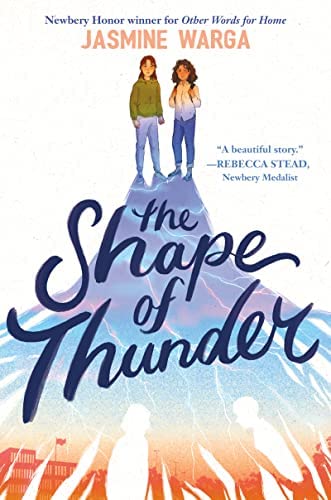
Rebecca Stead providing the blurb for the front cover is your first clue that The Shape of Thunder isn't just another middle-grade novel about personal loss. Weaving together themes of science, science fiction, and culture clash, Newbery Honoree Jasmine Warga delivers a story as unsettling as it is quiet, as deeply probing as it is confident in the moral tenets it espouses. It has been less than a year since Cora Hamed's older sister Mabel died, victim of a religious/racial hate crime. Losing her sister in one nightmarish morning of gun violence is a trauma that Cora has barely begun to process, but perhaps the most terrible part is that the shooter was Parker McCauley, the older brother of Cora's best friend Quinn. Cora severed her friendship with Quinn immediately after, and has gone out of her way not to speak to the girl, but this intentional distance is breached when Quinn sends Cora a package for her twelfth birthday. Grams wants Cora to open it, but even thinking about accepting the offering feels like a betrayal of Mabel. Cora will never forgive Quinn for what her brother did.
Quinn has lived in her own world of suffering these past months. Her brother killed himself following his shooting rampage, and her parents are constantly feuding. Is her father to blame because Parker used his guns to perpetrate the crime? Quinn wishes she could lean on her mother for support, but the woman is so absorbed in her own grief that Quinn can't broach the subject with her. As a promising young artist, Quinn finds some validation in Mrs. Euclid, the school art teacher, but is afraid to confide even in her about the day Parker turned murderer. Sending Cora the birthday box was a gesture that she wants to give their friendship another try, but is Quinn ready if Cora responds affirmatively?
To Cora's surprise, the contents of the box are a series of news and research articles speculating on time travel via wormhole. A minority of scientists believe our timeline has already seen visitors from the future, and Cora can't help wondering: if going back in time is possible, could she save Mabel? Cora is a crackerjack scientific mind and school Quiz Bowl competitor, not given to flights of fancy, but if there's a chance of restoring Mabel to her family, she has to investigate. She may even allow Quinn to assist.
Preadolescence is a daunting challenge under normal circumstances. Cora has brand-new feelings toward Owen Tanaka, a boy on her Quiz Bowl team whose intelligence, humor, and sense of style are attractive. Cora has become closer friends with Mia, a girl on the quiz team, since Mabel's death, but as Cora begins spending time with Quinn again, Mia doesn't handle the change well. Will she be relegated to second place again, if Cora lets Quinn back into her life? Quinn used to be a star soccer player on the school team, but this year she didn't try out. The pain of being on the outside looking in as her old teammates have fun competing together feels to Quinn like proper penance, who continues to obsess over what Parker did. Could she have stopped him if she paid better attention to the signs that his online community was radicalizing him? Could her father have prevented the tragedy if he got rid of his guns or more securely stored them? At least Cora has a therapist—the unflappable, graceful Dr. Randall—but Quinn has only her own thoughts for company on the subject, and they condemn her continually.
Cautious optimism rises when Cora signals she is willing to work with Quinn on the time travel hypothesis. The girls are wary around each other at first, neither of them ready to act like the close friends they were less than a year ago, but Cora has made up her mind: if they can go back and rescue Mabel, there's no need to hate Quinn. As their ongoing search yields no solid proof of a wormhole in their vicinity, however, Quinn knows they'll have to find something soon or Cora will lose faith. If they don't fix the timeline and resurrect Mabel, what hope is there for the future?
The Shape of Thunder is packed with emotional, illuminating moments. Cora finds a safe space in her sessions with Dr. Randall; he knows how to be supportive without coddling, when to push for progress or step back and let her breathe. He also responds well whenever Cora cries; as she observes, "Another thing I like about Dr. Randall: he doesn't react when I cry. Not in a mean way, but in a way that makes me feel like it's okay to cry. He doesn't make a big deal about it." We often go to such great lengths to insulate people we care about from having negative emotional reactions that we send the message that tears should be avoided at all cost. But sometimes, tears are appropriate. Letting a loved one's tears flow without direct comment assures them we aren't afraid of their most potent feelings, and they needn't be either. Crying is at times necessary for an emotionally healthy life.
One thing Quinn treasures about Cora is the trivia bits she used to sprinkle into their conversations. Even now, a knowledge nugget slips out of Cora now and then. My favorite is her explanation of why humans hear chirping birds more easily than most sounds. "And you know why that is?" Cora says. "You'd think it might be the roar of lions or the sound of some other predator, right? But no. We hear the chirps of birds because where there are birds, there usually is water. And where there is water, there's life. We're biologically programmed to favor life. Not fear. Isn't that so cool?" Cool, indeed. Whatever the danger looming against us, as individuals or a collective, we are hardwired to take risks and have adventure, even if finding our way to the watering hole increases the chances we'll lose our life to a predator. It's better to drink sweet water with friends than to shrink away from the public square and sip stagnant water from mud puddles, even if the latter may shield us from immediate harm. That is the fundamental truism of life, and one we mustn't forget.
Cora's father is as lost in grief over Mabel as she is, but has wise words that strike a chord with her. He proposes the concept of "imperfect theories", the scientific idea that theories we know aren't quite right can be used as stand-ins until we find evidence for a better model. He admits that none of his advice, or Grams's, will fix Cora's feelings of despair, but if she finds bits and pieces of it helpful to get her through the night, that's okay. "So maybe you can think of how you're handling missing Mabel—how you're coping with your grief—as an imperfect and evolving theory. It's always something you're going to have to puzzle over." Recognizing your own limitations is the hallmark of a sincere scientist, and Cora wants to be one. No magic bullet exists to kill the agony of missing Mabel, but surviving day to day is a noble goal.
Thoughts on handling grief are some of the most memorable parts of The Shape of Thunder. Like this, from Cora: "That's one of the things I hate the most about Mabel being gone. People want to remember her differently, perfectly. She was Mabel, my sister, my favorite person in the whole world, but she wasn't perfect. I want to remember her as she was. My memory of my sister is a triangle, made up of bold lines but also sharp angles, and everyone else wants to remember her as a boring and simple circle." Friends and family think they're doing the right thing when they ignore the crude or unpleasant sides of someone who has died, but in truth they are hastening that person's trip to the realm of the forgotten. We don't love epitaphs on a headstone, we love flesh and blood humans who do immoral things and have frustrating cycles of inappropriate behavior they fail to break free of all their lives, but I'd rather remember the real person than a sanitized replica who doesn't represent the complex, intense feelings I had for them. This relates to something Grams tells Cora, as Quinn writes at one point: "Grams says the dead belong to the living...she means that it's the people who are alive who create the memory of the dead person." It's our job as steward of a deceased love one's legacy to be sure people remember them authentically, and it's important to share our memories even if it hurts. Otherwise that person dies forever when we do, a fate we shouldn't want for someone we loved. Passing our precious memories on to others is much more fulfilling than if we hoard them to ourselves.
I have a pretty clear idea of Jasmine Warga's political bent, but overall she restrains herself admirably in these pages, not allowing The Shape of Thunder to devolve into a rant. When addressing sensitive topics like gun violence and extremist subcultures, she does so with a light touch for the most part, which tells me she's genuinely interested in presenting ideas in her books, not clubbing anyone over the head. The Shape of Thunder received a lot of Newbery buzz for 2022, and wouldn't have been a bad choice for at least an Honor. Thank you for a thoughtful read, Ms. Warga. You always seem to inspire.