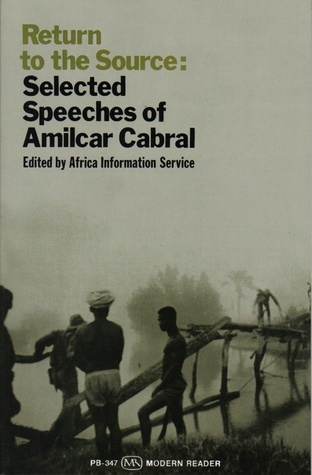
Amilcar Cabral, who was the Secretary-General of the African Party for the Independence of Guinea and the Cape Verde Islands (PAIGC), was assassinated by Portuguese agents on January 20, 1973. Under his leadership, the PAIGC liberated three-quarters of the countryside of Guinea in less than ten years of revolutionary struggle. Cabral distinguished himself among modern revolutionaries by the long and careful preparation, both theoretical and practical, which he undertook before launching the revolutionary struggle, and, in the course of the preparation, became one of the world's outstanding theoreticians of anti-imperialist struggle. This volume contains some of the principal speeches Cabral delivered in his last years during visits to the United States. The first is his speech to the fourth Commission of the United Nations General Assembly on October 16, 1972, on "Questions of Territories Under Portuguese Administration." His brilliant speeches on "National Liberation and Culture" (1970) and "Identity and Dignity in the Context of the National Liberation Struggle" (1972) follow.
Cabral was really a giant in the theory of decolonization, and this collection of speeches brings out the best of it. It helped a lot to hear him talk about the work the PAIGC was doing, because it was truly the ideal synthesis of theory and praxis. The middle section on national liberation & culture and identity & dignity was soooo good and really helped me parse out liberation movements as political and cultural forces and how they relate to the "return to the source." I also really enjoyed the Q&A he does with Black Americans where they discuss Pan-Africanism, internationalism, and connecting the struggles on the two continents. He was a true revolutionary that we lost too soon.
"The first duty of the revolutionary upon coming to power is to commit suicide".---Amilcar Cabral Amilcar Cabral did not face this problem, since his own comrades in the PARTY FOR THE LIBERATION OF GUINEA-BISSAU AND CAPE VERDE, which he founded, murdered him in 1973. (Yes, the official story that he was assassinated by the Portuguese secret police, the PIDE, has been debunked, by members of his own family). Cabral could have guessed this outcome. The colonialists in Africa posed the immediate danger to the workers and peasants but the anti-colonial insurgents, drawn from the European-educated and assimilated class were often just as hungry for power. How to overcome this deadly dilemma? RETURN TO THE SOURCE urges a cultural revolution DURING the independence struggle, a literacy campaign of reading, writing and political consciousness. Unique for his time, Cabral calls for the total education and liberation of women, including arming them. Books are just as important as guns, and after independence more so. Cabral is a voice crying in the wilderness. Who will play Jesus to his St. John the Baptist?
Return to the Source was part of the pioneering political theory materials during the African independence struggles.
Cabral excoriates the fascist Portuguese colonial government and calls for cultural dimensions to be taken more intentionally in any liberation struggle. This gap is yet to be filled in the current waves of abolitionist, BLM and decolonization movements.
Despite the fact that Return to the Source yokes itself on archaic ideals of Pan-Africanist identity, it still manages to delineate domination in varying degrees including the specific ways in which such movements curb women’s rights in addition to other class, gender issues.
Until fairly recently, although I had heard of Amilcar Cabral, I didn't know much about him. That changed with the publication of a new book by Pathfinder Press, Cuba and the Independence War in Guinea-Bissau and Cape Verde: The Fall of the Last Colonial Empire in Africa, by Cuban hero Víctor Dreke. This had been a work in progress for years. We told the first part of Dreke's story in From the Escambray to the Congo: In the Whirlwind of the Cuban Revolution, first published in 2002. Che Guevara's diary (The African Dream: The Diaries of the Revolutionary War in the Congo) of his time in the Congo had recently been published, and Guevara's conclusion was that it had been a disaster. Dreke disagreed with this conclusion, but he had the experience of years of participating in Cuban aid to national liberation movements in Africa behind him. To Dreke, however little they were able to achieve in Congo, it showed what the Cubans were capable of doing. He had not only seen independence for all the Portuguese colonies, he had seen Nelson Mandela released and become the president of South Africa.--How Far We Slaves Have Come!: South Africa and Cuba in Today's World, and Cuba and Angola: Fighting for Africa’s Freedom and Our Own.
We were even able to tour Víctor Dreke in the United States, speaking to students and workers.
The new Dreke book has numerous quotes from Amilcar Cabral, so I got this book of his speeches and writings.
The editor, Tsenay Serequeberhan, emphases Cabral as a Pan-Africanist, but I don't think it's Cabral's main focus. Cabral says: “Although we are in favor of unity from the Mediterranean to the Cape, we must recognize that there is not “one Africa.” Historically, economically, culturally, Africa is not one. The class situation in one country is very different from that in another. Moreover, it is not for me, at this stage of the struggle, to analyze the realities of classes in other countries.
“We are not fighting simply to hoist a flag and to have a national anthem.” We are fighting, he said, “so that our peoples may never more be exploited by imperialists, not only Europeans, not only people with white skins, because we do not confuse exploitation or exploiters with the color of men’s skins."
It reminded me of when Malcolm X, Black Liberation, and the Road to Workers Power was published, various Black nationalists wrote that if Malcolm X was a Marxist (something Jack Barnes never says--he simply says that was his trajectory, and explains why), that he was a Pan-Africanist Marxist. Malcolm X did more than anyone else to bring about contact with the freedom struggle in the US and countries in the Middle East and Africa, but still, when he came back, he told the 'Young Socialist' magazine that during his trip to African in the spring of 1964 he met a leader of the revolution against French colonial rule in Algeria, that country’s ambassador to Ghana, who “was a white man.” The Algerian revolutionary asked Malcolm, where does “Black nationalism” leave me? That experience, Malcolm said, “showed me where I was alienating people who were true revolutionaries dedicated to overturning the systems of exploitation that exists on this earth by any means necessary.” He added, “And if you notice, I haven’t been using the expression for several months.”
Cabral had progressed even further in the direction of becoming a Marxist than Malcolm X, but he didn't like labels and had good reason for this.
Cabral's speeches were free of demagogy and bluster, unlike the speeches of Eldridge Cleaver, who he had had the opportunity to meet. While the Black Panthers claimed to be Marxist, they understood absolutely nothing about Marxism, and while they claimed o have moved beyond Malcolm X, in reality, they had lapsed back into white-baiting, which Malcolm X had given up. In fact, they had little else to say. I was at a huge antiwar demonstration in 1967, at which both Martin Luther King and Stokely Carmichael had spoken. African-American participation was very large. But when the Black Panthers put themselves forward as "the vanguard," this participation ebbed because their only interest was in sending one "leader" to speak, and that was only to white-bait the audience.--See Out Now: A Participant's Account of the Movement in the United States Against the Vietnam War. The Woke politics of today are just a return to white-baiting and similar reactionary nonsense.
Cabral was hugely interested in the Cuban Revolution, meeting with both Fidel Castro and Ernesto Che Guevera. This was the first successful rebirth of Marxism since the Stalinization of the Comintern--See Dynamics of the Cuban Revolution: A Marxist Appreciation. Cabral said,
"Our hearts are also with our brothers in Cuba, who have shown that, even when surrounded by the sea, a people is capable of taking up arms and successfully defending its fundamental interests and of deciding its own destiny. We are with the Blacks of North America, we are with them in the streets of Los Angeles, and when they are deprived of all possibility of life, we suffer with them."
These speeches are brilliant works of propaganda coming from a leader who has endured battle alongside the masses of his country, and has a masterful understanding of dialects. It’s also very cool to read an African leader roast the United Nations the way he does in front of them! His analysis on culture and identity should be applied more in our current era of representational politics. The best parts of the book are where talks about the accomplishments of the PAIGC in the face of 10 years of consistent NATO bombing. It really gives you the feeling that we can win if we study hard and apply what we learn.
The First book of Cabral's writings that I read in my senior year of High School! It changed my life, and I know that it would change yours. Just read it! The information is still relevant to this day!
Perhaps the richest and most concise exposition of what "anti-colonial Marxism" looked like in the late twentieth century: i.e. an internationalist anti-colonial nationalism that appropriated and adopted Marxist concepts to unique contexts, with the by-product that the whole Marxist tradition was enriched. Cabral's sociological and cultural analyses are excellent, and his reflections on revolutionary strategy are compelling. I'm not always so sold on his political vision (the adoption of bourgeois political forms and occasional diminution of neocolonialism as an urgent threat). Even so, this is one of the great classics of anti-colonial thought.
Amilcar Cabral was a significant, respected political thinker on colonial issues from Guinea-Bissau. This is a small selection from his speeches. They made me ask questions. Portugal was the last European power to give up its African colonies and they took some persuading (cf armed struggle). Are Cabral's words still relevant now that the oppression of small nations is economic, not colonial? The WTO does not conform to international political protocols, it is not a nation and not subject to UN resolutions, it imposes sanctions not suffers them. Cabral was assassinated in 1973. What would he be writing now, if he had survived? I think he would be a supporter of fair trade, not free trade.
"History is a very strong chain. We have to accept the limits of history, but not the limits imposed by the societies where we are living." <3
Resounding insights into the role of indigenous and situated culture in decolonial struggles, as well as the paradoxically predominating role of the indigenous petty bourgeoisie and diaspora in "returning to the source" of identity as not in itself revolutionary but the first nationally-liberating act of a potential revolutionary process.
An ok compilation by MR/Africa Information Service of an absolutely brilliant thinker. There are a number of typographical/printing and spelling errors also, which is very unhelpful in reading somewhat dense theoretical texts.
Recommended reading mainly for helping understand not only Amílcar Cabral and the work of PAIGC, but to also look at the social and especially cultural conditions that made up the national liberation struggle in Guinea-Bissau and Cape Verde.
I think the strongest and most important speeches here are 'National Liberation and Culture,' which is especially recommended, but also the piece on the social conditions in Guinea-Bissau and the Q&A in the USA in 1972 with numerous Black and Pan-African organisations. Those and the other texts come together to really elaborate the cultural considerations that were vital to PAIGC.
What surprised me a little in reading this is how much Cabral emphasises that PAIGC and himself are not necessarily Marxist (despite thanking socialist countries for their support) and what he wants is to be free from exploitation and (colonial) domination above all else. I definitely see how this kind of stuff influenced Freire and critical pedagogy. The discussions on culture and national liberation felt so fresh and well worth reading if you're ever interesting in cultural studies, Cabral's approach is definitely under-appreciated. His discussions on the potentials of a certain kind of 'déclassés' stand out, except some of the almost immediate dismissal of 'lumpenproletariats.'
The main strengths are these theoretical discussions for sure, other texts are more like speeches and reports which show the progress PAIGC is making, but can feel very much in that place and in that time.
Cabral is definitely worth reading, especially National Liberation and Culture, that and other works around that would be what I suggest checking out.
Stark. Cabral beschreibt unter anderem die Entstehung der Befreiungsbewegung in Guinea, was schon sehr gut ist. Angefangen beim der Einsicht in die Notwendigkeit der konkreten Analyse für jede ernsthafte Bewegung haben sie systematisch die Zwischenglieder bis zum Erfolg gefunden und ergriffen.
Cabral gibt nicht bur Einblicke in diese konkrete revolutionäre Analyse und Praxis, sondern auch tiefe Einsichten in die Bedeutung der Kultur für die Befreiung vom Kolonialismus, die Bedeutung der Geschichte und wie sie den Kolonisierten genommen wird, den Weg zu einer wirklichen panafrikanischen Perspektive und mehr.
Ähnlich wie Mao hat Cabral einen instrumentellen, praktischen Zugang zum Marxismus. Er ist wichtig, weil er in der Befreiung hilft, nicht, wie das bei dogmatischen Begriffen der Fall ist, weil er an sich unbedingt zu verehren ist. Aber ungleich Mao ist Cabral durchaus aus eklektisch, was sich zeigt, wenn er beispielsweise die skandinavischen Länder als sozialistisch versteht.
Cabral kommt auch immer wieder auf das Problem des Neokolonialismus zu sprechen. Gerade hier wird aber die Notwendigkeit eines klaren Begriffs des Sozialismus deutlich. Ohne den, ohne dass den Massen klar wird, was hier auf dem Spiel steht, schwächt man die Abwehrkräfte gegen den Neokolonialismus. So ist trotz aller Bemühungen Guinea-Bissau heute ebenso neokolonial wie der Rest Afrikas. Die Frage, wie der Neokolonialismus zu überwinden ist, die Fanon schon vor Cabral zu schaffen gemacht hat, bleibt akut.
So kurz das Buch ist, so unbedingt lesenswert ist es.
I defer to Marie's review on the contextual power of Cabral's theory.
The most I can say is that this would not be a recommended first read for anyone who wants to know more about Cabral. They're perfectly adequate speeches with military diction and practical clarity, but without knowing the historical or theoretical context they're just that. Maybe try Amilcar Cabral: Revolutionary Leadership and People's War? That's what I can find, anyway.
The titular concept of the return to the source is probably the most important take away. Functionally the return to the source is a "frustration complex" experienced by that class Fanon called the "native intellectual" (the social elite of the colonized empowered by the colonizer). "Not and cannot in itself be an act of struggle," this return to the source is the moment the contradiction between being elite and being colonized reveals itself and which, "when expressed through groups and movements...is a prelude to the pre-independence movement or of the struggle for liberation from the foreign yoke."
Three stars for density and drawn-out theoretical musings. Five stars for the content and the editor for tying together a series of speeches that show the evolution of the independence movements of Guinea and Cape Verde. The changing attitudes of the party leadership towards the UN and towards the use of force, as well as to the Pan-Africa movement and the universality of the pursuit is particularly well conveyed. A reminder that so much emphasis and definition of identity comes from the external valuation of a situation - whether the Portuguese colonisers, the OAU or the UN, or the individuals aligned with revolutionary pursuits the world across.
The book is a simple collection of eight speeches Amilcar Cabral delivered to various local and international audiences over the 10+ year of armed struggle. The speeches were tools to share updates on the evolution of their struggles, clinical analysis of strategies used as well as arguments to convince audiences of the validity of their case. They from an instructive, if limited, guide to the history of Guinea Bissau, and into the mind of a fascinating individual who was much more that a guerilla leader. Read the full review: https://theworldincultures.com/367-re...
Particularly essential for “National Liberation and Culture” & “Identity and Dignity in the Context of the National Liberation Struggle.” Note particularly his analysis of the relation between native petit-bourgeois, the diaspora (almost synonymous here) and the culture of the peasant masses, the least compromised—-specifically that the culture that is being created/preserved *selectively* chooses values while skutting others.
“If a bandit comes in my house and I have a gun I can not shoot the shadow of this bandit. I have to shoot the bandit. Many people lose energy and effort, and make sacrifices combatting shadows. We have to combat the material reality that produces the shadow.”